Vein Pattern Recognition Using ROI Extraction
V. Muralikrishna1, Dr,B.Rama2, Dr. Arvind Kumar Sharma3
1 Research Scholar, Department of Computer science, OPJS University, Rajasthan. 2Professor, Computer Science Department, Kakatiya University, Warangal.
3Associate Professor, OPJS University, Rajasthan.
Abstract:
This paper presents a new approach to vein pattern recognition system. The various stages involved are Image acquisition, Region Of Interest Extraction. Our main focus is on Dynamic ROI Extraction and thinning. We got a database of hand images which are far infrared images of hand. For that images, we have done dynamic ROI extraction. The advantage of dynamic ROI extraction is that ROI extracted for different hand images varies in size as the size of the hand varies. As the size of ROI varies, we can extract more features from larger hand. We’ve proposed a new thinning algorithm which involves thinning the ROI to one pixel thick medial axis vein network and also removal of thinning artifacts. We used a sequential
thinning algorithm for thinning. We used a flag map in addition to image to decide which pixel to delete during thinning process. An artifact removal algorithm is used to remove any extra artifacts which ends the thinning process. After that key features are extracted which are bifurcations and end points which are stored separately as templates. Finally a matching algorithm is applied for identification. The matching algorithm is a coordinate matching where in we match the coordinate positions of key features of the live image which are stored in live template with the stored templates with certain fixed threshold. Our system is efficient as it got the lowest FAR which is necessary for security.
Keywords: hand vein, finger web, region of interest, binarisation, bifurcation, endpoint, morphology, template.
1.
Introduction
The prominence and acceptance of biometric technologies like process, identity verification, hand pure mathematics, and iris recognition might leave very little demand for alternative modalities. However, the rising vein-pattern recognition technology, with its own distinctive options and benefits,
to industrial readying. A biometric system is basically an automated pattern recognition system that either makes an identification[1].
Various types of biometric systems are being used for real-time applications. Some of the biometric systems generally used are ocular recognition, facial recognition, fingerprints, hand geometry and vein pattern recognition [5]. Hand vein identification has emerged as a promising component of biometrics study. The human vascular structure is individually distinct and appears to be time invariant. Human blood vessels are formed during the embryo stage with a variety of differentiating features, rendering each pattern unique, and their patterns remain relatively constant over one’s lifetime. A unique network of veins and arteries exists in every hand and finger of each human being. The subcutaneous vascular network appearing on the back of hand, referred to as the hand vein in this paper, is extremely difficult to forge and, therefore, offers promising biometric which also ensures liveness.VPR technology was developed in the 1990s, and the first commercialized system emerged in 2004.
2. Related work
lowpass filter and median filter are used to eliminate the speck noise and the horizontal strip scanning noise respectively. Yuhang Ding et al [17] presents the theoretical foundation and difficulties of hand vein recognition.
3. Proposed System
In this paper we develop a hand vein authentication system by extracting the key features of the hand which, for us is bifurcation and end points. In order to extract the key features, we have to go through several phases and they are dynamic ROI extraction [4,12]. The dynamic ROI extraction where we extract a region of interest based upon the size of the hand is explained in section 3.1.
3.1. Dynamic ROI Extraction
A database containing a total of 178 images which are far infrared images of the hand are obtained. Depending on the size of the hand, if the size of region of interest changes, we will get a larger ROI for larger hand. So, it is possible that we can extract more features from the larger hand which otherwise is not possible with fixed region of interest extraction. The process of dynamic ROI extraction from hand images is explained below. In order to extract the ROI, the first step is to make the image rotation invariant. For this we need to locate finger webs [18], which are key control points. Once the key control points are located, the image orientation is ascertained to extract reliable region of interest. The finger webs are located as follows.
First, the image is binarised using a global thresholding algorithm. Thresholding creates binary images from grey-level ones by turning all pixels below some threshold to zero and all pixels above that threshold to one [2].
If g (x, y ) is a thresholded version of f (x, y ) at some global threshold T ,
g(x,y)=
A global thresholding involves only one threshold value for the entire image in contrast to local thresholding which is also called adaptive thresholding for which the thresholding value changes in different regions of image. A global thresholding method called Otsu thresholding [13] is used to binarise the image.
1 if f(x,y) ≥ T
(a)
(b)
Fig 2. (a) Actual Image (b) Image after Otsu thresholding
After binarisation process, boundary extraction is done using morphological operations [2] on the binary image.The boundary of a set A, denoted as β(A), can be obtained by first eroding A by B and then performing the set difference between A and its erosion as follows.
β(A)=A (A B)
where B is a suitable structuring element.
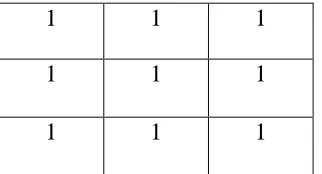
The structuring element used is a 3×3 matrix of ones as shown below.
1 1 1
1 1 1
1 1 1
Fig 3. Structuring element used in boundary extraction
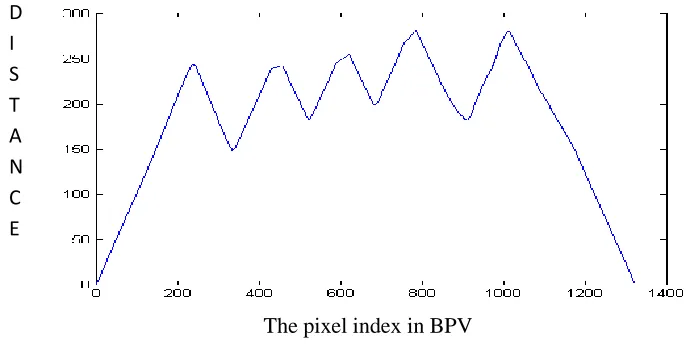
Now the boundary is traced [3] and the boundary pixel coordinates are stored in a matrix(Boundary Pixel Vector) starting from the lower left pixel and tracing towards right.After boundary tracing, the coordinates of the finger webs which are key control points are to be located. For this, euclidean distance is found between first pixel(P) coordinate in BPV(Boundary pixel vector and entire coordinates in the vector and the distances are stored in the distance vector(DE).
DE(i)=
A Distance distribution diagram[11] is constructed using the vector DE. The constructed diagram pattern is similar to geometric shape of the palm. In the diagram four local minima can be seen and five local maxima, which resemble the five finger tips (local maxima) and four finger webs (local minima) i.e., valley between fingers.
Fig 5. Distance Distribution Diagram
The local minimas which correspond to finger webs are located and the correspondind x-axis value is located which corresponds to the index to that pixel coordinates in BPV[27].
D I S T A N C E
Fig 6. Finger webs of an image
After obtaining finger webs the image is aligned to horizontal axis..The line joining fw1 and fw3 is made parallel to horizontal axis, thus making the image rotation invariant.
Fig 7. Image after rotation
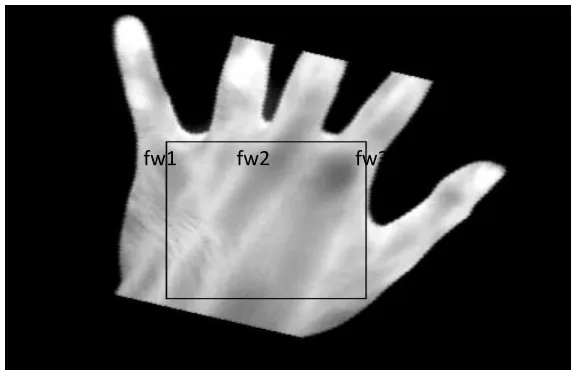
After alignment of the image, the finger webs are found again using the sameprocess discussed above. After finding finger webs, the ROI is extracted from the image. The ROI is the rectangle whose dimensions are as follows
Xdim=Distance between fw1 and fw3+(4*A) Ydim= Xdim+10-A;
Where A=half the distance between fw2 and the line connecting fw1 and fw3. The selected ROI from the image is shown below.
fw1
fw3 fw2
Fig 8. ROI Extraction from the image
5. Conclusion
Image process is done by some operations like image improvement, filtering and segmentation that are performed to make the image with higher quality and to extract the region of interest for feature extraction. This paper proposes a new dynamic ROI extraction method. Our dynamic ROI extraction made it possible to grab more features from the hand and our thinning algorithm gave a perfect one pixel thick medial axis which was very helpful in feature extraction. We got a FAR which is very low which is perfect for security applications.
References:
1. Chuck Wilson. “Vein Pattern Recognition : A Privacy-Enhancing Biometric”. Taylor & Francis Group, CRC Press, 1st edition, March 10, 2010.
2. Gonzalez, R.C. and Woods, R.E. “Digital Image Processing”. Prentice Hall, Upper Saddle River, NJ, Second edition, 2008.
3. Gonzalez, R.C., Woods, R.E. and Eddins, S.L. “Digital Image Processing using MATLAB”. Prentice Hall, Upper Saddle River, NJ, Second edition, 2010.
4. Kavati, I., Prasad, M.V. and Bhagvati, C., Vein pattern indexing using texture and hierarchical decomposition of Delaunay triangulation. In International Symposium on Security in Computing and Communication (pp. 213-222). Springer Berlin Heidelberg. 2013
5. A. K. Jain, P. Flynn and A. Ross. “Handbook of Biometrics”, NewYork: Springer, 2007.
6. D. Maltoni, D. Maio, A. K. Jain, and S. Prabhakar. “ Handbook of
Fingerprint Recognition”. New York: Springer, 2003.
7. Ajay Kumar and K. V. Prathyusha, “Personal authentication using hand vein triangulation and knuckle shape,” IEEE Trans. Image Processing, vol. 38, pp. 2127-2136, Sep. 2009.
8. S. Crisan, I. G. Tarnovan, and T. E. Crisan, “Radiation optimization and image processing algorithms in the identification of hand vein patterns,” Computer Standards and Interfaces, vol. 32, no. 3, pp. 130 -140, 2010. 9. C.L. Lin and K.C. Fan, “Biometric
verification using thermal images of palm-dorsa vein patterns,” IEEE Trans. Circuits Syst. Video Technol.,vol. 14, no. 2, pp. 199–213, Feb. 2004.
10. L. Wang and G. Leedham, “A thermal hand-vein pattern verification system,” in Pattern Recognition and Image Analysis, S. Singh, M.Singh, C.Apte, and P. Perner, Eds. New York: Springer, 2005, vol.3687, pp. 58-65.
11. L.Wang, G. Leedham, D. Siu Yeung Cho, “Minutiae feature analysis for infrared hand vein pattern biometrics” in Pattern Recognition 41/3/pp.920-929 (2008).
12. Prasad, M.V., Kavati, I. and Ravindra, K. Hand vein authentication system using dynamic ROI. In International Symposium on
Communication (pp. 203-212). Springer Berlin Heidelberg. 2013. 13.http://www.labbookpages.co.uk/soft
ware/imgProc/otsuThreshold.html. 14.Lin Yang, Xiangbin Liu, Zhicheng
Liu. “A Skeleton Extracting Algorithm for Dorsal Hand Vein Pattern”, International Conference on Computer Application and System Modeling (ICCASM 2010), Page:
V13-92 - V13-95.
15.T.Y.Zhang and C.Y.Suen, “A fast parallel algorithm for thinning digital patterns”, Communications of ACM 27, (3), pp. 236-239, 1984.
16.S. Zhao, Y. Wang, and Y. Wang, “Biometric verification by extracting hand vein patterns from low-quality images,” in Proc. 4th ICIG, Aug. 2007, pp. 667–671.
17.Y. Ding, D. Zhuang, and K. Wang, “A study of hand vein recognition method,” in Proc. IEEE Int. Conf. Mechatronics & Automation , Niagara Falls, Canada, Jul. 2005, pp. 2106–2110.
18.Chih-Lung Lin, Thomas C. Chuang, Kuo-Chin Fan, “ Palmprint Verification using hierarchical decomposition”, Pattern Recognition 38, No. 12, December 2005, pp. 2639-2652.