ISSN 2348 – 7968
A Survey on Intrusion Detection System with Data Mining
Techniques
Ms. Ruth D 1, Mrs. Lovelin Ponn Felciah M 2
1
M.Phil Scholar, Department of Computer Science, Bishop Heber College (Autonomous),
Trichirappalli, Tamilnadu, India
2Asst.Professor, Department of Computer Science, Bishop Heber College (Autonomous),
Trichirappalli, Tamilnadu, India
Abstract
In recent years to maintain the network security is a main problem in the world. The system or network is hacked by the unauthorized users. There are many methods to increase the security such as encryption, firewall. But these methods
are failed to detect the intrusions. For that a new technology
can be used is calledIntrusion detection system (IDS).The
intrusion detection is the process to monitor the network or
system and identify the intrusions. The IDS used data mining techniques for the network security, because to protect the network from various attacks and malicious traffic that originates from the internet. Data mining is used to extract the large amount of data from the database and also it is applied in many fields like Biological, Banking, Medical, Management, etc. This survey paper describes the Data mining approaches which are used to the detect
intrusion in a network.
Key words: Anomaly detection, Data mining, Intrusion detection system, Misuse detection.
1. Introduction
Data mining is the process of discovering interesting patterns (or knowledge) from large amounts of data. The data sources can include databases, data warehouses, the Web, any other information repositories or data that are streamed into the system [5].
2B
Data mining is also called KDD (Knowledge Discovery in Databases). The goal of data mining is process is used to extract information from the dataset and it is changed into an understandable structure.
Fig. 1 Typical locations for an intrusion detection system
ISSN 2348 – 7968
1B
The intrusion detection is software that automates the intrusion detection process [3]. The intrusion has many types namely viruses, worms, Trojan horse, etc. The normal
detection system like firewall, virtual private network are
failed to detect some critical intrusions from the network.
The IDS finding the threats give response to the network administrator or user of the system and also raises alarms or signals when the security violations are occurred. In figure 1
describes how the intrusion detection can be processed. The
information can be retrieved from the internet, then it is
checked by the firewall and finally it protected by the IDS
after that it send the information to the corresponding
network.
2. Methodology
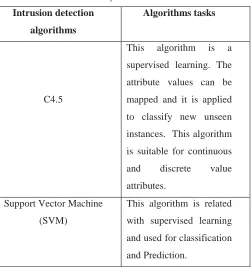
The Intrusion detection systems are protecting the
network from unknown attacks. The methods are used in
here are C4.5, support vector machine (SVM), genetic
algorithm, Apriori association rules algorithm, clustering
and classification.
Table. 1 Algorithms and data mining techniques used in intrusion detection
systems
Intrusion detection
algorithms
Algorithms tasks
C4.5
This algorithm is a
supervised learning. The
attribute values can be
mapped and it is applied
to classify new unseen
instances. This algorithm
is suitable for continuous
and discrete value
attributes.
Support Vector Machine
(SVM)
This algorithm is related
with supervised learning
and used for classification
and Prediction.
Genetic algorithm This algorithm set the
rules et randomly and
used for finding optimal
solutions to a specific
problem.
Apriori Association Rules
Algorithm
The association rule is
unsupervised learning.
Apriori algorithm is a
frequent item sets for
Boolean association rule.
It is a level wise search
Clustering This method is collecting
the data sets based on
similarity or distance
between them.
2.1. Detection Techniques
The components of intrusion detection system are: data source, analysis engine and response manager. The data source contains two categories namely host based and network based. The analysis engine gets the information from the data source and analyzes the attacks. The response manager detects the attacks and gives response to the corresponding users. The Intrusion detection has two categories for detecting attacks in the network or host. They
are:
a) Anomaly or Statistical detection
b) Misuse or Signature detection
Most of the researchers use these two techniques for detection
rate and false alarm rate.
Anomaly Detection
This detection technique is comparing user’s current behavior with usual behavior which is already stored in the database. It used to detect the unknown attacks. By using statistical techniques to find patterns of activity that appears to
ISSN 2348 – 7968
be abnormal [3]. It is failed in high detection rate. But the goal of anomaly detection system is to find the intrusion in the system timely.
Misuse Detection
This type of detection technique system use patterns of well-known attacks of the system to match and identify well-known intrusions [3].The misuse detection system is ability to detect only the known attacks which already stored in the database and generate the fewer false alarm rates. The disadvantage of this system is unable to detect the newly invented attacks.
Fig. 2 Components of Intrusion Detection System
3. A Review of Literature
This section discusses about various detection algorithms for network security.
[1] Network Intrusion Detection System based on Data Mining – S.A. Joshi, et. al.,
In this paper the author discuss about the data mining
algorithms and Intrusion detection system to detect the
unknown attacks from the dataset. There different kinds of
attacks but the authors of this paper discuss the few kinds of
attacks. They compares the four types of attacks are:
a) Probing attack
b) Denial of service
c) User to root
d) Remote to local
Then the author listed out the various data mining techniques
and intrusion detection techniques which is used for the
detecting the attacks like signature based detection, anomaly
based detection, network- based intrusion detection system,
host-based detection system. Comparing these types of attacks
and finding the high detection rates.
pattern capturing algorithm has high detection rate. Finally find out the percentage for detection rate and false alarm rate.
[2] Anomaly Detection in Network using Data mining Techniques – Sushil Kumar Chaturvedi, et. al.,
The main work of this compares the two types of algorithms
C4.5 and Support Vector Machine (SVM). First the given
dataset is pre-processing and then the data can be partition
into training and testing. The third stage the dataset is applied
in C4.5 and SVM algorithm. The author of this paper
compares these two algorithms and find out the detection rate
comparison and false alarm rate comparison. By using these
two data mining techniques they justify the C4.5 algorithm is
better than the SVM.
[3] Application of Genetic Algorithm in Intrusion Detection System – Omprakash Chandrakar, et. al.,
This paper describes about basic concepts of network intrusion detection system, components and types of attacks. The IDS contains the three types of components namely data source, analysis engine, response manager. This paper gives the overview of genetic algorithm. The genetic algorithm randomly selected the input (chromosome) and calculates the fitness value for each generated initial chromosome. The iteration has performed some specific operations namely sorting, selection, crossover, mutation and finally calculates the fitness value for chromosome.
IDS Components
Response
Analysis
Data Source
Misuse Detection System Host based
Anomaly Detection System Network based
ISSN 2348 – 7968
[4] Anomaly Detection System by Mining Frequent Pattern using Data Mining Algorithm from Network Flow – A.R.
Jakhale, et. al.,
This paper describes an anomaly detection system and its two phases namely training and testing. The sliding window and clustering is used to monitoring the network traffic by mining the frequent patterns using algorithms. The algorithms are so effective and used in real time monitoring. The frequent multi-pattern capturing algorithm has high detection rate. Finally find the percentage for detection rate and false alarm rate.
[5] A Survey on Intrusion Detection using Data Mining Techniques - R. Venkatesan, et al.,
This paper describes the overview of the intrusion detection
system and its each technique. The authors discuss pros and
cons of anomaly detection and misuse detection. By
combining these two categories and data mining
approaches, then include the Apriori association rule
algorithm for calculating the confidence levels. Apriori algorithm employs an iterative approach known as a level wise search, where k-item sets are used to explore (k + l)-item sets [5].
[6] A Review of Intrusion Detection System in Computer
Networks - Abhilasha A Sayar, et.al.,
In this paper the author discuss about the classification of Intrusion detection system, advantageous and disadvantageous and its types. In this the IDS uses the artificial intelligence, fuzzy logic and neural network. The techniques are used to detect the intrusions in the images. For example, in military the original information’s are changed into images and then send to another location. By using the artificial intelligence with IDS the user can easily identify the unknown attacks. This paper is useful for beginners to study the basic concepts of Intrusion detection system and also detect all kind of images.
4. Conclusion
This survey paper study on various techniques which are used to detect the attacks from unknown users. The intrusion detection system components are useful to know about the process of detection. The IDS is combined with the data mining techniques and algorithms detect the threats and give immediate response to the user, and also find the percentage of detection rate, false alarm rate, and confidence level.
References
[1] S.A.Joshi, Varsha S.Pimprale, “Network Intrusion Detection System (NIDS) based on Data Mining”, International Journal of Engineering Science and Innovative Technology, Vol. 2, No. 1, January 2013, ISSN. 2319-5967.
[2] Sushil Kumar Chaturvedi, Prof. Vineet Richariya. Prof. Nirupama Tiwari, “Anomaly Detection in Network using Data mining Techniques”, International Journal of Emerging Technology and Advanced Engineering, Vol. 2, No. 5, May 2012, ISSN. 2250-2459.
[3] Omprakash Chandrakar, Rekha Singh, Dr. Lal Bihari Barik, “Application of Genetic Algorithm in Intrusion Detection System”, International Institute for Science, Technology and Education, Vol. 4, No. 1, 2014,
ISSN. 2224-5774.
[4] A.R. Jakhale, G.A. Patil, “Anomaly Detection System by Mining Frequent Pattern using Data Mining Algorithm from Network Flow”, International Journal of Engineering Research and Technology, Vol. 3, No.1, January 2014,
ISSN. 2278-0181.
[5] R. Venkatesan, Dr. R. Ganesan, Dr. A. Arul Lawrence Selvakumar., “A Survey on Intrusion Detection using Data Mining Techniques”, International Journal of Computers and Distributed Systems, Vol. 2, No. 1, December 2012,
ISSN. 2278-5183.
[6] Abhilasha A Sayar, Sunil. N. Pawar, Vrushali Mane., “A Review of Intrusion Detection System in Computer Network”, International Journal of Computer Science and Mobile Computing, Vol. 3, No. 2, February 2014, pp. 700 - 703.
ISSN 2348 – 7968
Authors
First Author- Ruth D, Pursuing M.Phil (CS), Bishop Heber College (Autonomous), Trichirappalli, Tamilnadu, India.
Second Author- Lovelin Ponn Felciah M, Assistant Professor, Bishop Heber College (Autonomous), Trichirappalli, Tamilnadu, India.