International Journal of Research (IJR)
e-ISSN: 2348-6848, p- ISSN: 2348-795X Volume 3, Issue 01, January 2016Available at http://internationaljournalofresearch.org
Dynamic Stability Improvement of PMSG-Based Wind Turbine
Generators Fed to a Power System Using PID controller Based
STATCOM
B.NageswaraRao
1& K.Kranthi Pratap Singh
21
M.Tech Scholar, Dept. of EEE, ASR College of Engineering and Technology, JNTUK, A.P
2Assistant Professor, Dept. of EEE, ASR College of Engineering and Technology, JNTUK, A.P
Abstract: —
This paper presents the stability-improvement
results of four parallel-operated offshore wind
turbine generators (WTGs) connected to an
onshore power system using a static synchronous
compensator (STATCOM). In this project have
the fast advance of high-capacity
power-electronics technology, large commercial wind
turbine generators can be practically employed
to contribute high generated power to power
systems, where wind PMSGs with full back
to-back converters have proven to be good choices
for high-power WTGs. Basically, the grid side
converter of the PMSG-based WTG can be
operated as a STATCOM. Many manufacturers
also provide this option even for the case when
the WTG is not running. But in a real
PMSG-based OWF, It has several PMSG-PMSG-based WTGs
operating together, and it is difficult to control
reactive power of all WTGs at the same time to
supply adequate reactive power to the system.
Hence, to guarantee good power quality (PQ) of
the system, an additional VAR compensator is\
required. In this project, a STATCOM is
proposed as a VAR compensator. It can be
concluded from the simulation results that the
proposed STATCOM joined with the designed
damping controller can effectively improve the
stability of the studied SG-based onshore power
system under various disturbanceconditions .The
results
are
obtained
from
the
MATLAB/SIMULINK environment.
Keywords:
Dynamic
stability;
permanent-magnet synchronous generator (PMSG); static
synchronous compensator; MATLAB; wind
turbine generator (WTG)
I.
I
NTRODUCTIONThe renewable energy sources are one of the
biggest concerns of our times. High prices of oil
and global warming make the fossil fuels less
and less attractive solutions. Wind power is a
very important renewable energy source. It is
free and not polluter unlike the traditional fossil
energy sources. It obtains clean energy from the
kinetic energy of the wind by means of the wind
turbine. The wind turbine transforms the kinetic
wind energy into mechanical energy through the
drive train and then into electrical energy by
means of the generator. Although the principles
of wind turbines are simple, there are still big
challenges regarding the efficiency, control and
costs of production and maintenance.
Some academic researchers have devoted to
high-capacity offshore wind turbine generators
(WTGs) connected to onshore substations
through undersea cables .Currently, wind
doubly-fed induction generators (DFIGs) and wind
permanent
magnet
synchronous
generators
(PMSGs) have been widely used in high-capacity
offshore wind farms (OWFs) [1]. From the
historical point of view, a direct-coupled,
modular PMSG for variable-speed wind turbines
was proposed and multiple single-phase outputs
were separately rectified to obtain a smooth dc
link voltage. The dynamic model based on
small-signal stability of a wind turbine (WT) using a
direct-drive PMSG with its power converters and
controllers was proposed [2].
International Journal of Research (IJR)
e-ISSN: 2348-6848, p- ISSN: 2348-795X Volume 3, Issue 01, January 2016Available at http://internationaljournalofresearch.org
enhancement
of
power
systems
using
STATCOMs and the damping controller design
of STATCOMs were presented in [9]. A
variable-blade pitch of a WTG and design of an
output feedback linear quadratic controller for a
STATCOM to perform mechanical power
control and voltage control under different
operating conditions were studied in [10].
Controller design and system modeling for quick
load voltage regulation and suppression of
voltage flicker using a STATCOM were
explored in [11]. A novel D-STATCOM control
algorithm for enabling separate control of
positive- and negative-sequence currents was
proposed in [12]. Dynamic characteristics of a
power system with a STATCOM and a static
synchronous series compensator(SSSC) through
digital simulations were compared in [13]. The
application of a STATCOM to damp torsional
oscillation of a series-capacitor compensated ac
system were shown in [14]. The characteristics
of using PSS, static VAR compensator(SVC),
and
STATCOMfor
damping
undesirable
interarea oscillations of a power system were
compared in [15]. These days, with the fast
advance of high-capacity power electronics
technology, large commercial wind turbine
generators can be practically employed to
contribute high generated power to power
systems, where wind PMSGs with full
back-to-back converters have proven to be good choices
for high-power WTGs. Basically, the grid-side
converter of the PMSG-basedWTG can be
operated as a STATCOM. Many manufacturers
also provide this option even for the case when
the WTG is not running. But in a real
PMSG-based OWF, it has several PMSG-PMSG-based WTGs
operating together, and it is difficult to control
reactive power of all WTGs at the same time to
supply adequate reactive power to the system.
Hence, to guarantee good power quality (PQ) of
the system, an additional VAR compensator is
required. In this paper, a STATCOM is proposed
as a VAR compensator.
This paper focuses on modeling the
characteristics of four 5-MW PMSG-based
WTGs fed to an SG-based power system to
examine the effect of large power penetration to
the SG. For improving the damping of the SG of
the OMIB system, a STATCOM joined with the
designed PID controller connected to the
common ac bus of the studied system is
proposed.
II.
P
ROPOSEDT
OPOLOGY–
C
ONTROLS
TRATEGYA.
Basic diagram of the proposed system
:
International Journal of Research (IJR)
e-ISSN: 2348-6848, p- ISSN: 2348-795X Volume 3, Issue 01, January 2016Available at http://internationaljournalofresearch.org
Fig. 1 Configuration of the studied SG-based containing four parallel-operated PMSG-based WTGs with
STATCOM
B. Modelling of Wind Turbine:
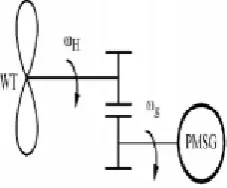
The blade pitch angle (degrees) are the constant coefficients. The wind speed is modeled as the algebraic sum of a base wind speed, a gust wind speed, a ramp wind , and a noise wind speed. The cut-in, rated, and cut-out wind speeds of the studied WT are 4, 14, and 25 m/s, respectively. When wind speed is lower than 14 m/s, When 14 m/s, the pitch-angle control system activates and increases accordingly. In fig.2 Each WT is directly coupled to the rotor shaft of a wind PMSG.
Fig2. Each WT coupled to the rotor shaft of a wind PMSG A. PMSG and Power Converter :
The power converter of each wind PMSG consists of a voltage source converter (VSC) and a voltage-source inverter (VSI) as shown in Fig. 3. The VSC or the VSI consists of six insulated gate bipolar properly decoupled by the dc- link capacitor. The common dc link with a large capacitor is connected between the VSC and the VSI. Theoperation of the VSC and the VSC is properly decoupled by the dc-link capacitor and, hence, the VSC and the VSI have independent controllers.
A. Modelling of STATCOM :
In order to temporarily avoid the high level of reactive compensation during recovery. In addition to the normal STATCOM control, allows for torque transient alleviation during the recovery process after a grid fault [4]. This is possible to achieve by reducing the voltage reference of the STATCOM control system and, by that, the reactive compensation when stability is ensured after fault clearing but before the grid voltage and the speed of the generator have returned to the prefault values [6]. In this way, the STATCOM can improve the torque capability of the PMSG when this is needed keep the system stable, and once stability is ensured, it can reduce the maximum torque during recovery. The strain on the drive train can thereby be reduced. This is particularly relevant where wind turbines cannot just disconnect from the grid to protect the installation from risk of mechanical damage that might be caused by the cumulative stress of repeated peak torque transients[5] This paper focuses on the recovery process after fault clearing and reactive power compensation .The other main issue related to this concept is that, since the decelerating torque of the generator is limited, the recovery process of the system will be longer than for the case of normal control of the STATCOM with a fixed voltage reference value[8].
III. MATLAB BASED SIMULATION &RESULTS
International Journal of Research (IJR)
e-ISSN: 2348-6848, p- ISSN: 2348-795X Volume 3, Issue 01, January 2016Available at http://internationaljournalofresearch.org
power, the active power provided by the DC capacitor is zero. Therefore, the capacitor does not change its voltage. With the provision of DC source or energy storage device on its DC side, there can be a little active power exchange between the STATCOM and the electric power system. When the phase angle of the AC power leads the inverter phase angle, the STATCOM absorbs real power from the AC system, if the phase angle of the AC power system lags the inverter phase angle, the STATCOM supplies real power to ACsystem. Without STATCOM is the system they will be a voltage drop. So that when STATCOM is used it will compensate the reactive power either by absorbing or generating in Fig.6&Fig.7 .When voltage is less it whenever fault occurs it can compensate the voltage drop.
Fig.3. MATLAB based simulation diagram of proposed system with masked diagrams
Fig.4.MATLAB based simulation diagram of proposed system with masked diagrams
Fig.5.MATLAB Based simulation Of Active power of proposed system
Fig.6.MATLAB Based simulation reactive power of proposed system
International Journal of Research (IJR)
e-ISSN: 2348-6848, p- ISSN: 2348-795X Volume 3, Issue 01, January 2016Available at http://internationaljournalofresearch.org
Fig.7.MATLAB Based simulation of Q sg
CONCLUSION
The concept of a new inverter with FACTS capability for small-to-mid-size wind installations is presented. Utilities are a major barrier to increasing the number of smaller distributed renewable installations. One of the ways that renewable can increase their penetration into these systems is by giving additional control to the utilities. This additional control is done with the help of FACTS devices and this will increase the cost of entire system. The proposed system demonstrates the application of a new inverter with FACTS capability in a single unit without any additional cost. Replacing the traditional renewable energy inverters with the proposed inverter will eliminate the need of any external STATCOM devices to regulate the PF of the grid. Clearly, depending on the size of the compensation, multiple inverters may be needed to reach the desired PF. This shows a new way in which distributed renewable sources can be used to provide control and support in distribution systems. The control strategy of system adjusts the reactivepower is controllable by the modulation index m. Usage of SHE method will eliminate lower level harmonics and improves the efficiency of the inverter.
REFERENCES
[1] F. Wu, X.-P. Zhang, and P. Ju, “Small signal stability analysis and control of the wind turbine with the direct-drive permanent magnet generator integrated to the grid,” Elect. Power Syst. Res., vol. 79, pp. 1661–1667, 2009.
[2] S. Nishikata and F. Tatsuta, “A new interconnecting method for wind turbine/generators
integrated system,” IEEE Trans. Ind. Electron.,vol.57, no.2, pp.468-475, Feb. 2010.
[3] L. Wang and C.-T. Hsiung, “Dynamic stability improvement of an integrated grid-connected offshore wind farm and marine-current farm using a STATCOM,” IEEE Trans. Power Syst., vol. 26, no. 2, pp. 690–698, May 2011.
[4] L. Wang and C.-N. Li, “Dynamic stability analysis of a tidal power generation system connected to an onshore distribution system,” IEEETrans. Energy Convers., vol. 26, no. 4, pp. 1191–1197, Dec. 2011.
[5] D. J. Trudnowski, A. Gentile, J. M. Khan, and E. M. Petritz, “Fixed speed wind-generator and wind-park modeling for transient stability studies,” IEEE Trans. Power Syst., vol. 19, no. 4, pp. 1911– 1917, Oct. 2004.
[6] N. Mithulananthan, C. A. Canizares, J. Reeve, and G. J. Rogers, “Comparison of PSS, SVC, and STATCOM controllers for damping power system oscillations,” IEEE Trans. Power Syst., vol. 18, no. 2, pp. 786–792, May 2003.
[7] D. J. Trudnowski, A. Gentile, J. M. Khan, and E. M. Petritz, “Fixed speed wind-generator and wind-park modeling for transient stability studies,” IEEE Trans. Power Syst., vol. 19, no. 4, pp. 1911– 1917, Oct. 2004.
[8] L. Wang and C.-N. Li, “Dynamic stability analysis of a tidal power generation system connected to an onshore distribution system,” IEEETrans. Energy Convers., vol. 26, no. 4, pp. 1191–1197, Dec. 2011.
[9] D Mary, Shinosh Mathew, Sreejith K “Modelling and Simulation of Grid Connected Wind Energy System,” International Journal of Soft Computing andEngineering (IJSCE) ISSN: 2231-2307, Volume-3,Issue-1, March 2013.
[10] Ankush Sharma“Review paper on applications of dstatcom in distribution system,”
International Journal of Research (IJR)
e-ISSN: 2348-6848, p- ISSN: 2348-795X Volume 3, Issue 01, January 2016Available at http://internationaljournalofresearch.org
engineering (ijisme) issn: 2319-6386, volume 2, issue-11, October 2014.
[11] U.S. Solar Market Insight, 2010 Year End Review Executive Summary, SEIA, Washington, DC, USA, 2011.
[12] AWEA U.S. Wind Industry Annual Market
Report Year Ending 2010, AWEA, Washington, DC, USA, 2011.
[13] S. A. Rahman, R. K. Varma, and W. H. Litzenberger, “Bibliography of FACTS applications for grid integration of wind and PV solar power systems: 1995–2010 IEEE working group report,” in Proc. IEEE PowerEnergy Soc. General Meeting, Jul. 2011, pp. 1–17.
[14] A. Beekmann, J. Marques, E. Quitmann, and S. Wachtel, “Wind energy converters with FACTS capabilities for optimized integration of wind power into transmission and distribution systems,” in Proc. CIGRE/IEEEPES Joint Symp. Integr. Wide, Scale Renew. Resour. Power Del. Syst., Jul. 2009, pp. 1–9.