PoReps: Proofs of Space on Useful Data
Ben Fisch
Stanford University, Protocol Labs
Abstract
A proof-of-replication (PoRep) is an interactive proof system in which a prover defends a publicly verifiable claim that it is dedicating unique resources to storing one or more retrievable replicas of a data file. In this sense a PoRep is both aproof of space (PoS) and a proof of retrievability (PoR). This paper establishes a foundation for PoReps, exploring both their capabilities and their limitations. While PoReps may unconditionally demonstrate possession of data, they fundamentally cannot guarantee that the data is stored redundantly. Furthermore, as PoReps are proofs of space, they must rely either on rational time/space tradeoffs or timing bounds on the online prover’s runtime. We introduce a rational security notion for PoReps called-rational replication based on the notion of an-Nash equilibrium, which captures the property that a server does not gain any significant advantage by storing its data in any other (non-redundant) format. We apply our definitions to formally analyze two recently proposed PoRep constructions based on verifiable delay functions and depth robust graphs. Lastly, we reflect on a notable application of PoReps—its unique suitability as a Nakamoto consensus mechanism that replaces proof-of-work with PoReps on real data, simultaneously incentivizing and subsidizing the cost of file storage.
1
Introduction
Consider as a thought exercise a simple composition of a PoR protocol and PoS protocol that would not succeed in achieving these goals. This simple protocol requires the prover to use a total of 2N space. The prover uses half of this space to produce a PoS (i.e. it runs a standard PoS protocol that requires it to fill this space with random data) and it uses the other half to actually store some useful data file of sizeN and produce PoRs of the file. This satisfies both a PoR and a PoS with only 2N storage and therefore shows both that the prover is using some minimum Ω(N) amount of storage and is able to retrieve the data of interest. However, it fails the “independent cost” criterion. Namely, it is more expensive for the prover to run this protocol on useful data (requiring 2N space to store both the useful data and the random data) than to just store the useless random data required for the PoS and provide a PoR for this random data (requiring onlyN space). Moreover, consider if the prover were asked to store kredundant copies of the same file Dand use this protocol to prove that it (a) is using at least kN space to store these copies and (b) is able to retrieve D. Following the protocol honestly requires 2kN space: kN space to store the k copies of D and kN space to store the random data required for the PoS. Unfortunately, the most rational strategy would be to store only the random data and a single copy ofDas this uses only (k+ 1)N space and still allows the prover to successfully pass the protocol.
While standard PoRs can provide proofs of data duplication in a private-verifier1 setting where the client preprocesses its own data before sending it to the server, their security relies on a non-colluding client to privately preprocess the data. One advantage of PoReps over standard PoRs for proofs of data duplication is that multiple clients could contribute data to a single database and would not need to trust any single client to preprocess the data. PoReps could also be used to provide proofs of storage for publicly available data. For example, a consensus server in a massively distributed and open state-replication system such as Bitcoin could provide a PoRep that it is storing a complete history of the state-machine transcript (i.e. in blockchain
systems like Bitcoin this is referred to as a “full node” storing the “chain”). Unlike PoRs, PoReps could be used to provide this proof without requiring all the verifiers to send the server their own preprocessed copy of the public transcript (incurring impractical communication).
PoReps provide a publicly verifiable proof of data duplication, secure against adversaries who will not deviate from an -rational honest strategy. The notion of an -equilibrium is used in game theory as a generalization of a Nash equilibrium where players gain at most anadvantage from deviating. This solution concept is appropriate for a malicious-but-lazy adversary, or in conjunction with the status-quo-bias assumption: you are on the couch and the TV remote is across the room, so you continue to watch the same channel. This may seem like a strangely weak security property to achieve in a cryptographic protocol. For a very simple reason it is actually the best possible security that PoReps can achieve, at least in the standard2 model of
computation for cryptographic analysis. In short, any prover storing kindependent replicas of the file could intentionally correlate these replicas in a way that it can still efficiently retrieve each in its original format. For example, it could encrypt them and store the key.
However, the primary use case of PoReps is probably not a proof of storage system that weakly discourages de-duplication. The properties achieved by PoReps make it uniquely suited
1
Verification of PoRs can also be outsourced. Proofs of retrievability where a client can outsource the work of verifying proofs were previously referred to as publicly verifiable PoRs or “public PoRs”, however the label outsourceableappropriately distinguishes their security property from the public verifiability of PoReps and proofs of space.
for a Nakamoto consensus mechanism (also known as blockchain consensus) that use PoReps as a useful proof of space in place of Bitcoin’s proof-of-work to achieve sybil-resistance. Briefly, Nakamoto consensus mechanisms and its variants are a special type of state-machine replication process managed by an unpermissioned, asynchronous, and distributed network of consensus participants, with the additional feature that the state-machine itself encodes fungible tokens of value. In particular, a defining characteristic of these consensus mechanisms is their ability to mint new tokens in the state machine in order to reward and incentivize consensus participants (termed miners), taking for granted that these tokens represent real-world assets.
Blockchain systems based on proof-of-space have been proposed [19, 42] and are in active de-velopment, pursuing goals including energy efficiency and more egalitarian distribution.3 PoReps target a different advantage entirely: they simultaneously incentivize useful peer-to-peer data storage. This is the basis of Filecoin [1]. The miners that manage the system’s distributed state-machine are required to produce PoReps in order to append transactions, or equivalently, be elected as temporary consensus leaders, and are rewarded with freshly minted coins in return. Accepting the hypothesis that the miners will be incentivized by these rewards alone to produce PoReps, just as Bitcoin miners produce wasteful proofs-of-work, the rewards–in effect–subsidize the auxiliaryuseful work accomplished by the PoRep: file storage.
The utility of -rational replication in this context is immediately transparent. It character-izes the cost required to nudge a data replication strategy from a weak equilibrium strategy into a strong one. In other words, it represents the cost that clients must pay (in a stylized model that ignores other market variables) to convince miners to encode their real data inside PoReps rather than “useless” generated data, and therefore the degree to which a system such as Filecoin subsidizes storage costs. PoReps thus sit at an exciting crossroads of economics and cryptography:
PoReps epitomize a cryptographic mechanism that is concerned not solely with the actions and capabilities of an adversary, nor penalties levied for misbehavior, but rather its broader effect on behaviors in an economy.
1.1 Related work
Proofs of storage Cryptographic proofs of storage have been proposed in a variety of flavors throughout the literature. Broadly speaking, proofs of storage are interactive protocols between a server (prover) and client (verifier) with different goals relating to statements about the server’s storage. Proofs-of-retrievability (PoR) [30] demonstrate that the prover can retrieve some spec-ified data known to the verifier. Apublic-key PoR is outsourceable, meaning that the client can provide a public authentication tag that any verifier can use to verify the server’s proofs. Unless the data itself is incompressible, a PoR does not necessarily prove anything to the verifier about how much space the prover is using in order to retrieve the file. In particular, in the public-key setting the third party verifier does not know whether the client is colluding with the server or not, and therefore a PoR is not a truly publicly verifiable claim of storage. In proofs-of-space (PoS) [24] a time-constrained prover demonstrates that it is storing some incompressible string of Ω(N) bits, and therefore using at least Ω(N) bits of space. This formulation of PoS is some-times referred to as a proof of persistent space as opposed to a proof of transient space [46]. Timing assumptions are inherently required in proofs of persistent space due to the efficiency
3
requirement that the communication between the prover and verifier is required to be compact, as otherwise the prover can store only the communication transcript and recompute the advice. Proofs-of-secure-erasure (PoSE) [44] are protocols similar to a PoS intended to demonstrate that a storage-bound prover has erased all of its storage. An important difference between PoSE and the standard PoS notion is that they involve a private-key verifier who preprocesses data, similar to a PoR proof. They were suggested as a protocol for a memory-bound embedded device to prove to a server that it has erased private data or all prior code before an update, e.g. to ensure that any malware has been erased.
Rationally secure storage protocols All of the above proof of storage protocols are uncon-ditionally secure, or at least characterize security in terms of strong time-space lower bounds. However, there are additionally a class of proof of storage protocols that are secure in a weaker
rational adversary model. The model considered in all of these works is an adversary that acts to minimize its storage costs. Storage enforcing commitments [28] were a precursor to PoR that require the prover to dedicate a minimum amount of storage in order to pass the protocol for a committed file F (preprocessed by a client with a secret key). Their constructions did not guarantee unconditionally that the prover was actually storing F, and were therefore only secure in an epsilon-rational sense. Hourglass schemes [51] were proposed as a generic method to prove that a server is storing data encoded in a specified format, in particular for the use cases of encryption-at-rest and file watermarking. Similarly, they leave open the possibility that the server is also storing a plaintext or non-watermarked version of the file. It only guarantees that such a server must use twice the storage resources to act maliciously.
Proof of data replication vs PoReps A proof of data replication/duplication, specifically in the sense of proving that data is stored in a redundant format, is a special case of hourglass schemes. Proofs of data replication/duplication have been explored primarily in the private-client setting similar to proofs of retrievability [7,47]. In this setting a private-client is somehow involved in preprocessing the data and either the client is the verifier or the client outsources its own verification work. The system Mirror [7] is one such example, which proposed a way for the server to replicate the client’s initially preprocessed file without requiring further communication from the client. The main technique in Mirror is a variant on RSA time-lock puzzles, and the security relies on timing assumptions similar to PoS. Several days ago another paper exploring this line of work was posted, which proposed a construction of proof of data replication in the private-client setting without timing assumptions [21].
(VDF) [14]. New constructions of PoReps using more traditional tools from proofs of space (i.e. hard-to-pebble graphs) were concurrently proposed in [26, 45].
Tight proofs of space As we develop in this work, there is a strong connection between tight proofs of space and PoReps. A tight proof of space is one where any adversarial prover implementing an attack uses only an fraction less space than the honest prover where can be made arbitrarily small. Intuitively, if a PoRep is not a tight proof of space (e.g. = 1/2) then there may be some adversary that would be rationally incentivized to deviate from honest behavior and therefore likely destroy the replication format. Pietrzak [45] constructed the first tight PoS, although the proof size isO(1/2) and depended on depth robust graphs with rather special properties [6]. Concretely, according to the analysis it requires graphs of degree 2,760 logN just to achieve 1/2 space gap. The PoRep based on verifiable delay encodings as a moderately hard function [14] is in fact an arbitrarily tight PoS, however it is exceedingly inefficient to generate on large data (scaling quadratically in the data size).
1.2 Contributions and Organization
This work is a foundational study of PoReps. Primarily, we motivate the goals of PoReps and explore what they are in contrast to other cryptographic primitives. Although many of the related primitives including proofs of retrievability, proofs of space, and proofs of data replication (private-client setting) were formally defined and studied in prior works, this is the first comprehensive formal study of PoReps. While a presentation at BPASE 2018 [26] provided the first basic definitions for PoReps and intuition about both the impossibility of ideal security and how to define -rational replication, we build upon this further and provide a comprehensive model and definitions. In particular, our framework also addresses issues of composable security noted in a recent paper by Fisch and Silas [27]—namely the issue that the prover may be incentivized to deviate from a rational replication strategy if deviating somehow benefits another simultaneous storage mechanism (e.g., perhaps it could use the PoRep data to compress auxiliary data that it is storing).
Contents
1 Introduction 1
1.1 Related work . . . 3
1.2 Contributions and Organization . . . 5
2 Proof-of-Replication 6 2.1 Replication Security Model . . . 10
2.1.1 Impossibility of ideal replication security . . . 13
2.1.2 Rational adversary model . . . 13
2.1.3 Security for decentralized storage networks . . . 20
3 Constructions 21 3.1 Basic PoRep from Verifiable Delay Encodings . . . 21
3.1.1 Basic-VDE-PoRep . . . 22
3.2 Block Chaining Encodings . . . 23
3.3 DRG PoRep . . . 25
3.3.1 DRG-PoRep . . . 26
4 Formal security analysis 30 4.1 Labeling games with VDEs . . . 31
4.2 Security claims . . . 32
A Preliminaries and Background 37 A.1 Compression and Erasure Codes . . . 37
A.2 Proofs of Retrievability . . . 38
A.3 Vector Commitments . . . 39
A.4 Proof of Retrievable Commitment . . . 40
A.4.1 PoRC Syntax and Definitions . . . 41
A.4.2 PoRC from Vector Commitments . . . 44
A.5 Verifiable Delay Encodings . . . 46
A.5.1 VDE security . . . 47
A.6 Depth Robust Graphs . . . 48
A.7 Proofs of Space . . . 50
A.8 Graph pebbling games . . . 51
2
Proof-of-Replication
1. PoRep.Setup(λ, T) → pp is a one-time setup that takes in a security parameter λ, time parameter T, and outputs public parameters pp. T determines the challenge-response period.4
2. PoRep.Preproc(sk, D)→D, τ˜ D is a preprocessing algorithm that may take a secret key sk
along with the data inputDand outputs preprocessed data ˜Dalong with its data tagτD,
which at least includes the sizeN =|D|of the data. The preprocessor operates inkeyless mode when sk=⊥.
3. PoRep.Replicate(id, τD,D)˜ →R,auxtakes a replica identifieridand the preprocessed data
˜
D along with its tag τD. It outputs a replica R and (compact) auxilliary information
auxwhich will be an input for the Prove and Verify procedures. (For example, auxcould contain a proof about the replication output or a commitment).
4. PoRep.Extract(pp, id, τD, R) → D˜ on input replica R and identifier id and data tag τD
outputs the data ˜D (and verifies its consistency withτD).
5. PoRep.Prove(R,aux, id, r)→π on input replicaR, auxilliary informationaux, replica iden-tifierid, and challenger, outputs a proof πid.
6. PoRep.Poll(aux) → r, s: This takes as input the auxiliary replica information aux and outputs a public challenge r along with any private randomness s used to produce this challenge. For public coin constructionss=⊥.
7. PoRep.Verify(id, τD, r, s,aux, π)→ {0,1} on input replica identifier id, data tagτD, public
challenge r, private randomness s (used to producer), auxilliary replication information aux, and proofπ it outputs a decision to accept (1) or reject (0) the proof.
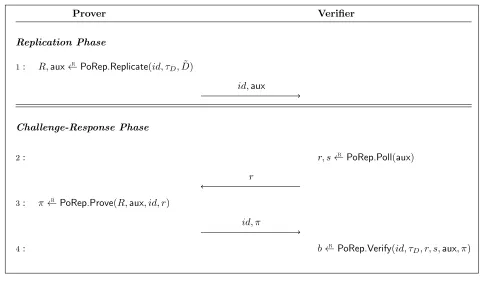
PoRep interactive protocol These algorithms are used in an interactive protocol as illus-trated in Figure 1. The setup (whether a deterministic, trusted, or transparent public setup, such as one involving a public random source) is run externally andppis given as an input to all parties. For each fileD, a preprocessor (a special party or the prover when operating in keyless mode, but not the verifier) runs ( ˜D, τD)←PoRep.Preproc(sk, D). The outputs ˜D, τD are inputs
to the prover and τD to the verifier.
Transparency, public coin, and public verifiability A PoRep scheme may involve a trusted one-time setup, in which casePoRep.Setup is run by a trusted party5 and the output pp is published for all parties to see. A transparent PoRep scheme is one in which the setup does not involve any private information. This trusted setup is an independent, one-time procedure, and the trusted party that runs the setup should have no further involvement in the interactive protocol. The data preprocessor on the other hand may use a secret-key, but it is not trusted. In
4
An alternative formulation may allow for a variable challenge-response periodT that might depend on the size of the data input. Our formulation does not allow this, implying that the online proverPoRep.Prove must run in parallel timeless than T (including transmission time of the its proof to the verifier) independent of the data size (up to O(poly(λ)) in length). Achieving a fixed polling periodT for all input data of any reasonable length (i.e.poly(λ)) is important in practice.
5
Prover Verifier
Replication Phase
1: R,aux←R PoRep.Replicate(id, τ
D,D)˜
id,aux
Challenge-Response Phase
2: r, s←R PoRep.Poll(aux)
r
3: π←R PoRep.Prove(R,aux, id, r)
id, π
4: b←R PoRep.Verify(id, τ
D, r, s,aux, π)
Figure 2.1: The diagram illustrates the interaction between a prover and verifier in a PoRep protocol. The setup and data preprocessing is run externally generating pp ← PoRep.Setup(λ, T) and ˜D, τD ← PoRep.Preproc(sk, D). The challenge-response protocol is timed, and the verifier rejects any response that is received more than T time steps after sending the challenge. This is formally captured by requiring PoRep.Prove to run in parallel time at most T. The propogation delay on the communication channel between Prover and Verifier is assumed to be nominal in comparison toT.
particular, the verifier is oblivious to whether the preprocessor colludes with the server or not. As we will discuss next the secret-key preprocessor only has implications for data retrievability, but not for the security of the publicly verifiable data replication (or proof of space). This is an important distinction from the notion of proof of data replication proposed in the system Mirror. A PoRep scheme may beprivate coin if the private input r toPoRep.Pollis non-empty, and it ispublic coin ifr=s. A public coin PoRep has the additional desirable property that the challenge output by PoRep.Pollcould be replaced by a challenge derived from an unpredictable public random beacon6.
Data preprocessing and data retrievability When the data input is preprocessed using a secret-key the resulting PoRep is a public-coin PoR (among satisfying other properties regarding replication and proof of space that we will discuss further in the following section on the PoRep security model). In this scenario we can imagine the preprocessor is a single client who wants to store (and replicate) data on a server, and generates the data tagτD to outsource this verification
6Proofs-of-space-time [2] is a proposed construction that non-interactively chains several PoReps by using the
Prover Verifier
τ r1
π1
r2
π2
t= 0
Replica Generation
Challenge-response
t=tinit
t=tinit+T
t=tinit+ 2T
Figure 2.2: Space-time diagram of the PoRep protocol. Following a phase of lengthtinitduring which the
prover generates a new replica, the verifier repeatedly challenges the prover to produce a PoRep within a challenge time period lengthT in order to verify that the prover is still storing the unique replica of the original data. For this proof system to be sound it is necessary thattinit>> T.
work. When the preprocessor runs in keyless mode the resulting PoRep is a PoRC (Section A.4) with respect to the output τD, which includes a commitment to the data D. Any (stateful)
verifier that is at one point given the opening of the commitment can thereafter use the tag to verify PoReps as standard PoRs. This is particularly useful for a setting in which multiple clients pool their files together and want to receive a single PoRep for the entire dataset, but they do not mutually trust one another to share a private-key. It is also appropriate for a dynamic setting where new clients are made aware of the data stored on the server and wish to verify retrievability without trusting the original client’s private-key preprocessing.
Treating data preprocessing in this way as a separate “layer of the stack” allows for a wider variety of constructions appropriate in different settings without impinging on the efficiency of the underlying PoRep protocol itself. In fact, a PoRep protocol that (without preprocessing) satisfies (δ,C)-PoRC (e.g. forC partitioning the data into constant size blocks) can immediately be compiled into either a public-key PoR or a PoRC using any number of previous techniques. We highlight the two scenarios:
1. A client has a data fileDand uses a randomly generated secret keyskto produce ˜D, τD ←
PoRep.Preproc(sk, D) which applies a rate-δ adversarial erasure code [15] to D (i.e. one that is resilient to arbitrary adversarial deletions of up to δ fraction of the blocks in
˜
D). The tag τD is a commitment to ˜D. The adversarial erasure code may involve a
secret transformation using sk and requires sk as well to recover from these errors. The private-key setting enables using more efficient erasure codes that only tolerate random deletions because they can be combined with a secret pseudorandom permutation of the data so that an adversary will only succeed in targeted deletions with up to negligible probability [15, 48]. The client then uses τD for verification in the PoRep protocol, which
we assume is already a (δ,C)-PoRC with respect to τD. Any verifierV can publicly verify
2. A keyless preprocessor transforms the data fileDinto a single code word of a deterministic rate-δ optimal erasure code (e.g., Reed-Solomon) with symbol size equal to the block size in C. It outputs τD as a deterministic commitment to ˜D, which is also a deterministic
commitment toD. Due to the resilience of the erasure code (Dcan be recovered from any δ fraction of the symbols in ˜D), the PoRep (δ,C)-PoRC of ˜Dbecomes a PoRC ofD.
Efficiency All algorithms must run in time O(poly(λ)) and with up to at most O(poly(λ)) parallelism. We don’t directly impose further efficiency requirements in the PoRep definition, but implicitly a PoRep scheme cannot be simultaneously correct and secure unless PoRep.Poll andPoRep.Provehave a lower parallel time complexity thanPoRep.ReplicateonO(poly(λ)) pro-cessors. Otherwise, for correctness to hold the challenge-response period will be long enough for an adversarial prover to rerun the replica generation from scratch. Furthermore, for prac-tical purposes it is highly desirable for PoRep.Prove and PoRep.Verify to run in constant or O(polylog(|D|)) time, where|D| is the length of the data file. Among other benefits, this en-ables batched proofs and verification of multiple replicas of the same (or distinct) files, which scales sublinearly in the number of replicas/files. Replica generation PoRep.Replicate runs in time greater thanmax(T,|D|), however it is desirable for this runtime to be sublinear inT· |D|
as the size of the file increases.
Correctness In a correct PoRep construction, a prover who runsPoRep.ReplicateandPoRep.Prove honestly must pass verification with probability 1. In order to pass verification the algorithm PoRep.Prove must run in parallel time at most T as otherwise the verifier will not receive the output within the challenge-response period. In addition, PoRep.Extractmust correctly extract the original data from a replica generated with PoRep.Replicate.
Definition 1(PoRep correctness). A PoRep construction is correct if for any security parameter
λ, anyid and data input D, there exists Tλ such that for all T ≥Tλ, pp← PoRep.Setup(λ, T), and (R, τ)←PoRep.Replicate(pp, id, D) it holds that:
P r "
PoRep.Verify(pp, id, r, s, τ, π) =Accept
(r, s)←PoRep.Poll(pp, τ) π ←PoRep.Prove(pp, R, id, r)
# = 1
and PoRep.Prove(pp, R, id, r) runs in parallel time at most Tλ.7 Additionally:
P r "
˜ D=D
R←PoRep.Replicate(pp, id, D) ˜
D←PoRep.Extract(pp, id, R) #
= 1
2.1 Replication Security Model
An ideal security goal for PoRep protocols, beyond satisfying the standard definition of a PoR, would be to guarantee the following properties, described informally:
7Mere existence ofTλmay seem like a weak requirement asTλcould be arbitrarily large, however it is soundness
Adverary Challenger
1: AprechoosesD~ =D1, ..., Dk;
~
id=id1, ..., idk; and computes
data tags~τ=τD1, ...., τDk
2: σ, ~aux← Apre(pp, z, ~id, ~τ , ~D)
z, ~id, ~aux=aux1, ...,auxk
3: ∀i ri←R PoRep.Poll(auxi)
~
r=r1, ..., rk
4: z, ~ˆ π← Aonl(pp, σ, ~aux, ~id, ~r)
~π=π1, ..., πk
5: bi ←PoRep.Verify(idi, τDi, ri,auxi, πi)
Output ˆz Output ˆb=^
i
bi
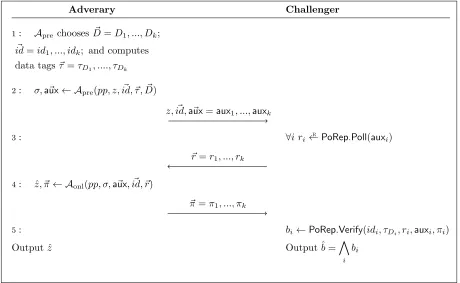
Figure 2.3: The diagram illustrates the PoRep security game between an adversary and a challenger. Several inputs come from the environment, which runs the setup pp← PoRep.Setup(λ, T) and chooses an auxiliary inputzfor the adversary. The adversary is split into two components: ApreandAonl. They
may share initial static state but cannot communicate during the game. In particular,Aonldoes not see
the inputz norD~ chosen byApre(z). It does obtain the inputspp, σ, ~aux. This restriction captures the
fact thatσmay encode a function of auxiliary informationz in addition to the replicas ofD. Moreover,~ Aonl runs in parallel time at mostTonl whereasApre is only restricted to run in total timeO(poly(λ)).
1. Any prover who simultaneously passes verification inkdistinct PoRep protocols (underk distinct identities) where the input toPoRep.Replicateis a fileDi in theith protocol must
be storingkindependent replicas, one for eachDi, even if several of the files are identical.
2. A prover who passes verification in a PoRep protocol where the input to PoRep.Replicate is a file ˜D = D◦ · · · ◦D (consisting of k copies of the same file D) must be storing k independent physical copies ofD.
We will capture these security goals more formally through a game between a PoRep prover (adversary) and a challenger (Figure 2.3). A high level overview of the game is as follows. The prover/adversary is split into two components: a replication adversary and an online adversary whose sequential running time (i.e. parallel time) is bounded by a parameterT. The replication adversary is allowed to select the data inputs and the number of replicas k. The replicas do not need to be of all the same files. Specifically, we represent this input as a vectorD= (D1, ..., Dk)
of data files Di each of size N, where some (or all) of the files are identical. The adversary
compute on the data (as in phase 1 of replication) to produce an advice string σ for the online adversary as well as the auxiliary output aux, which includes~ N (the claimed size of each data file component). The online adversary receives a vector ofk challenges from the challenger and must output k proofs. The challenger then runs the PoRep verifier on each and outputs the verifier’s accept/reject decision.
k-replication To capture “storing kindependent replicas” we say that σ is ak-replication of a file D if the string σ can be partitioned into k substrings σ1, ..., σk such that each allow full
recovery of the file D. Formally:
Definition 2. Let S be a data source on {0,1}n. A string σ is ak-replication of a data sample
D = (d1, ..., dk) ← Sk if and only if there is a lossless randomized encoding scheme (enc,dec) and a partition of σ into k substrings σ1, ..., σk such that enc(di) = σi and dec(σi) =di for all
i= 1, ..., k.
Intuitively, security goal (1) can be captured by requiring that any online adversary in the PoRep game who is not given ak-replication of the data by the preprocessor adversary will fail with overwhelming probability. This would imply that if several provers each provide distinct PoReps of the same file then they are each dedicating unique resources8 to storing the file. It would also imply that a prover who claims in a single proof to be storing multiple replicas of a file cannot physically deduplicate its storage. Unfortunately, this security property is impossible to achieve in a classical model of interactive computation (that does not include timing bounds on communication9), as we explain next. Instead, we will need to relax the security model to consider rational adversaries and bound the cost savings (measured in storage resources) of adversaries who do not store a k-replication of the data input. The security notion we call -rational replication could be informally interpreted as security against an “honest-but-opportunistic” adversary that will only employ a malicious strategy if they stand to save more than somecost doing so.
Data tag verification oracle In order to be as general as possible we don’t explicitly require τD to be a commitment toD. Instead, we assume the existence of an oracle Ocheck that imple-ments a verification procedure on a data/tag pair, perhaps provided additional advice aux, i.e. on input (D, τD,aux) it returns Ocheck(D, τD,aux) → b∈ {0,1}. A special case is where τD is
a commitment to D,aux is the opening hint, and Ocheck runs the commitment verification. In other scenarios Ocheck might verify signatures. As discussed previously, we allow for construc-tions that run in a private-key preprocessor mode and the data inputs/tags are provided by the preprocessor. For instance, they may be data authentication tags like in a more standard PoR scheme.
Definition 3. PoRep-Exp(A)(z, pp) = (ˆz,ˆb) is the PoRep game experiment (defined in Fig-ure 2.3) with adversary A= (Apre,Aonl) on inputsz, pp from the environment, represented as a
random variable where zˆis the output ofA andˆb is the challenger’s output. OutA(pp, z) = ˆz is
8The provers may be storing all the replicas on the same hard-drive, hence PoReps alone do not give a
meaningful guarantee of fault-tolerant data storage.
9
the random variable representing the first component of PoRep-Exp(A)(z, pp), and SuccA is the
probability that ˆb= 1.
Definition 4 (Admissible PoRep adversary). For any pp← PoRep.Setup(λ, T) a PoRep game adversary A = (Apre,Aonl) is admissible for the experiment PoRep-Exp(A)(z, pp) if Apre runs
in O(poly(λ)) and Aonl runs in parallel time at most T. The adversary A is µ-admissible if additionally Apre chooses data inputs D~ and tags~τ where for each ithere exists auxi such that
Ocheck(Di, τDi,auxi) = 1 and SuccA ≥µ.
2.1.1 Impossibility of ideal replication security
Suppose that the PoRep adversary stores the replicas in a string σ. The adversary can then “sabotage” the replication by using say the firstλbits ofσ as a key to encrypt the rest, and store the transformed string σ0 that includes the λ bit key and ciphertext. Since the adversary can efficiently decode σ fromσ0 it will still pass the protocol with the same success probability (i.e. it efficiently decodes σ0 and retrieves σ, and then follows whatever protocol behavior it would have initially on σ). Indeed, such “scrambling” attacks are impossible to prevent as there is always a trivially fast way to encode/decode one’s state in a way that destroys thek-replication format. We state this formally in the following proposition. Our proof is in the random oracle model for simplicity, although an analogous statement can be proven in the plain model from symmetric key encryption (i.e. PRPs) as long as |σ|> λ (this will always be true for A that succeeds on|D~|> λ, i.e. causes the challenger to output 1 with non-negligible probability).
Proposition 1. For any admissible adversary A = (Apre,Aonl) there exists an admissible
adversary A0 = (A0pre,A0onl) (with access to a random oracle H) such that for all pp, z and
~
D = (D1, ..., Dk) chosen by Apre for any k > 1 the distributions PoRep-Exp(A)(z, pp) and PoRep-Exp(A0)(z, pp) are identical and for σ, σ0 output by Aonl/A0onl respectively (in Figure 2.3,
line 3), at most one of σ, σ0 is ak-replication of D~ and yet |σ0|=|σ|.
Proof. A0 runs exactly asAwith the following modifications. A0preruns Apreuntil Line 2 of the
game, obtainingσ, ~aux. If |σ|= 1 then A0
pre outputsσ, ~aux and A0onl on a 1-bit σ runs exactly
like Aonl. By hypothesis k > 1, hence a 1-bit σ is not a k-replication by definition. In case
|σ|>1, then let σ0 denote the first bit of σ. A0pre computes H(σ0) =r, truncating the output
of H such that|r|=|σ| −1 (as Apre runs in time O(poly(λ)) we may assume w.l.o.g. that the output of H is longer than σ) and sets σ0 = σ⊕0||r. Note that only the first bit of σ0 (i.e. σ0) contains information about σ. All substrings of the remaining |σ| −1 bits are uniformly
distributed (they have zero mutual information with the remainder of σ). Therefore, assuming thatσ is a k-replication of D, then~ σ0 is not ak-replication fork >1. Finally, A0onl receives σ0, computes r =H(σ0) by reading the first bit ofσ0, and then recovers σ =σ0⊕0||r. Then A0onl
uses σ to runAonl. The output is identical toPoRep-Exp(A)(z, pp).
2.1.2 Rational adversary model
Given the impossibility of achieving PoRep security entirely based on cryptographic guarantees, we turn instead to a framework of modeling attacks based on incentives. Arational adversary
which is necessary in proofs of space that are not parallel sound [3, 46]. It was also invoked to model security in storage enforcing commitments, hourglass schemes, and private-client proof of data replication [7, 28, 51]. The threat model considered in all of these works is an adversary that acts to minimize its costs, measured in storage or work (and combinations of the two).
In our setting, independent from any client setup/preprocessing, any prover that passes k independent PoRep interactive protocols onk data file commitments should not save any costs by running a strategy that does not store a recoverable copy of the file in each protocol, even if this involves storing duplicate copies of the same file. The same holds if the prover passes a single PoRep interactive protocol on a single committed data file that contains redundant data. More precisely, for any successful strategy there is another “well-behaved” and efficiently computable strategy satisfying k-replication that uses no more than a factor 1/(1−) more storage, i.e the adversarial strategy saves at most an fraction of the storage by deviating from honest k-replication. Importantly, this “well-behaved” strategy should still retain all the information that the original adversary was storing, which we capture by saying that the new strategy simulates the output distribution of the original adversary in the security game. We call this security notion -rational replication.
Security under composition A challenge that arises in both defining and proving-rational replication for PoReps is showing that adversarial strategies do not save costs even in compo-sition with other protocols, in particular in the presence of auxiliary data on the server. While composition is always a security challenge often overlooked, it is especially salient here. One might think it would be sufficient to show that the adversary cannot compress its replicas by en-coding them in a different (malicious) format that no longer preserves replication. However, we must also consider that the adversary may be able to use the replica storage to help store other useful information on its hard drive. Suppose, for instance, that the (incompressible) replicas could be used as a seed to compress this auxiliary data, yet in a way that also entangles the seed together with the auxiliary data, destroying the replication format (i.e. a weak compression Definition 11). In this case, the adversary may actually save costs by deviating.
Fisch and Silas [27] showed that proving this is likely impossible without strong knowledge assumptions. Their analysis focussed on the “weak compression attack” described above, where the PoRep storage could be used as a seed to compress auxiliary data in a way that also destroys the replication format. One might hope to prove rational security by showing that any adversary who weakly compresses auxiliary data in this way can be converted to a better adversary that compresses its auxiliary storage just as well without destroying its replicas, i.e. coverts the weak compression to a strong compression (Definition 12) that would save the seed independently in its original format. However, they prove that any black-box reduction of strong compression to weak compression for a given class of sources would yield a universal compression scheme for that class in the random oracle model. In other words, proving this is as hard as constructing a universal compression scheme that works on any source in the class.
They also remark that some PoS constructions are proven secure by showing that the advice outputsdirectly encodes part of a random oracle’s function table, and in this case the minimal assumption suffices to show that any weak compression involving the PoS advice s as a seed can be converted to a strong compression. Unfortunately, this property is not true of PoReps because the underlying PoS advice actually encodes the committed data fileD.10 Therefore, we
require a stronger knowledge of compression assumption that applies to any incompressible seed s, even where the incompressibility applies only to strictly time bounded compression schemes.
Definition 5(Time bounded incompressibility). A sourceS is(T1, T2)-incompressible tok bits if there does not exist (for any constantδ) a δ-lossy strong compression scheme (enc,dec) where enc runs in parallel time T1 anddec runs in parallel time T2 that compressesS to k−log(1/δ) bits.
Assumption 1 (Knowledge of strong compression). Let S andX be any two samplable sources over {0,1}n such that S is (T
1, T2)-incompressible to (1−)n bits for some < 1. For any compression scheme (enc,dec) that compresses S × X to m bits where encruns in parallel time
T1 ordecruns in parallel timeT2, there exists a strong compression scheme(enc∗,dec∗)running in parallel time T1 and T2 respectively that compresses X to length m−(1−)n bits sampling seeds from S. Moreover, for any algorithm A that on inputs S and n outputs (enc,dec), there exists an efficient “extractor” which observes A’s internal state and outputs (enc∗,dec∗).
Definition of rational replication We will fix several notations regarding discrete probabil-ity distributions before presenting our formal definition of -rational replication. If X is a 0/1 random variable with probability mass function pX andY is a discrete random variable on the
same probability space thenpX|Y : Sup(Y)→R is the functionpX|Y(w) =P r[X = 1|Y =w].
If f, g are two real valued functions on a set Ω then f g if and only if f(w) ≥ g(w) for all w∈Ω, i.e. f is an upper bound on g.
Finally, for any two random variables X, Y let X(λ) ≈λ Y(λ) denote that the distributions of X and Y are computationally indistinguishable.11
Definition 6 (Rational replication). A PoRep construction is a µ-sound -rational replication if for any µ-admissible adversary A = (Apre,Aonl) there exists an admissible adversary A0 =
(A0pre,A0onl) such that for all pp, z sampled by the environment andD~ = (D1, ..., Dk) chosen by
Apre, and for σ, σ0 output by Aonl/A0
onl respectively (in Figure 2.3, line 2) then for all z from
the environment and pp←PoRep.Setup(λ, T) it holds that:
1. |σ| ≤(1−)|σ0|
2. σ0 is a k-replication of D~
3. OutA0(pp, z)
λ
≈OutA(pp, z) and SuccA0|OutA0(pp, z)SuccA|OutA(pp, z).12
10
The security might still be proven by showing how to encode a random oracle table using S together with D [45], but the remark in [27] no longer applies in this case. Moreover, the prover can even choose D to be correlated with the auxiliary dataz.
11The standard definition of computationally indistinguishable distributions with respect to a security parameter
λis that no poly(λ) time algorithms can distinguish samples from the two distributions except with probability negligible inλ.
12
This says that for any value of ˆz the probability A succeeds given that it outputs ˆz is bounded by the probability thatA0
Necessary and sufficient conditions for -rational replication PoReps satisfying -rational replication are implicitly proofs of space with an space gap. The converse is not necessarily true, i.e. -tight proofs of space are not immediately PoReps satisfying -rational replication. Furthermore, unlessτD isbinding toDrelative to Ocheck, meaning that for any τD
there does not exist (or it is computationally difficult to produce) D0 6= D and aux0,aux such thatOcheck(D, τD,aux) =Ocheck(D0, τD,aux0) = 1, then it is unclear how a scheme could satisfy
our definition (or any meaningful definition of replication security for that matter where the adversary is allowed to choose the data). If Ocheck is not binding then even rational replication security would likely fail because the adversary could find an alternative data input D0 6= D consistent with the same tag and run the rest of the protocol successfully onD0 as if it were the input. Formally, this would fail our security definition if any adversary that stores ak-replication of the original data inputDcould not output the same distribution (e.g. the adversary’s output ˆ
z is some function ofz and D0).
Implicit PoS protocol If a PoRep construction satisfies Definition 6 then PoRep.Setup, PoRep.Replicate,PoRep.Prove, andPoRep.Verify implicitly define a secure PoS as follows:
• Setup runsPoRep.Setup(λ, T)
• Initialization The prover runs R,aux←R
PoRep.Replicate(id, τD,D) and outputs˜ τD =aux and
S =R.
• Execution The verifier’s challenge is r ← PoRep.Poll(aux) and the prover responds with the proof π ←PoRep.Prove(R,aux, id, r). The verifier runs PoRep.Verify(id, τD, r,aux, π).
We say that a PoRep scheme is an (s, t, µ)-sound PoS if its implicit PoS protocol is an (s, t, µ)-sound PoS (see Section A.7, or Definition 23).
Lemma 1 (PoS is necessary). If a PoRep is a µ-sound -rational replication then it is an
((1−)kN, T, µ)-sound PoS.
Proof. Suppose not, i.e. there is some PoS adversary that succeeds in passing verification with probability greater thanµ using only (1−)kN storage.
LetD~ be a vector ofkidentical copies of an incompressible data inputD. By incompressible, we mean that for any randomized enc/dec scheme such that P r[enc(dec(D)) = D] = ξ then
|enc(D)| ≥N−log(1/ξ) where N =|D|. It follows that anyk-replication ofD must be at least kN bits long because by definition it can be partitioned into k substrings each of which are a deterministic encoding of D. Now take the PoS adversary AP oS who is able to pass Execution
within timeT with (1−)kN storage and construct AP oRep= (Apre,Aonl). Apre simulates the
Initialization phase for AP oS to obtain the outputs (Φ, S). It then sets aux = Φ and σ = S. Then for each challenge query, Aonl simulates the Execution phase for AP oS, passing it Φ and
Implicit PoRC protocol If the data tag τD is binding to the data input D and aux~ is a
binding commitment to the replicaRthen a PoRep may implicitly define a (δ,C)-PoRC protocol of (D, R) with respect to (τD,aux) (Section A.4). The coverC in this case is the set of pairs of
blocks (Ri, Di) such that R is defined to be the correct output of PoRep.Replicate(idi, τD, D),
Di is the ith block of D, and Ri is the ith block of R. The setup just runs the PoRep setup
and outputs parameterspp. ThePoRC.ProveandPoRC.Verifyprocedures simply run the PoRep prover and verify procedures.
• PoRC.Commit(pp, D): Run PoRep.Preproc(sk, D) to obtain the data tag τD along with ˜D.
Then run PoRep.Replicate(id, τD,D) to get (R,˜ aux). Save the hint Λ = (R, id). Output the
commitmentcom= (τD,aux).
• PoRC.Open(pp, com,Λ): Parse Λ = (R, id) and com = (τD,aux). Next run the extraction
procedure PoRep.Extract(pp, id, τD, R) to obtain D. Query b ← Ocheck(D, τD,aux). If b = 0
output ⊥otherwise output (D, R).
• PoRC.Prove(pp, com,Λ, c): Parse Λ = (R, id) andcom= (τD,aux). Generate the PoRep proof
π0 asPoRep.Prove(R,aux, id, r) output the PoRC proofπ= (π0, id).
• PoRC.Verify(pp, com, c, π): Parse com = (τD,aux) and π = (π0, id). Output the result b of
PoRep.Verify(id, τD, c,aux, π0).
We say that a PoRep scheme is aµ-soundδ-PoRC if its implicit (δ,C)-PoRC protocol as just described is µ-sound (see Definition 18).
The following powerful lemma establishes criteria that along with Assumption 1 are sufficient for -rational replication. This greatly simplifies the analysis for any PoRep construction that is also implicitly a secure public-coin PoRC protocol.
Lemma 2 (Sufficient conditions for rational replication). Given Assumption 1, if a PoRep construction with setup parameters T, λ satisfies the following conditions for some integerc:
(a) It is correct (see Definition 1)
(b) It is aµ-sound(1−δ)-PoRC, and the parallel runtime blowup of the extractor is less than a factor c, i.e. it is PRAM strongly µ-sound (see Definition 18).
(c) kindependent PoReps are a parallel((1−+δ)kN,(c+1)T, µ)-sound PoS (see Section A.7, or Definition 23).
then the PoRep construction is a µ-sound -rational-replication.
Proof. The outline for the proof is as follows. We consider any µ-admissible PoRep adversary
A=A= (Apre,Aonl) and construct the “well-behaved” adversaryA= (A0
pre,A0onl) that satisfies
the three conditions of Definition 6. Since A is µ-admissible for each i it chooses each Di, τDi and outputsauxi such thatOcheck(Di, τDi,auxi) = 1. A µ-admissible PoRep adversary is also a µ-admissible PoRC adversary in the implicit (1−δ,C)-PoRC protocol. Hypothesis (b), that the implicit (1−δ,C)-PoRC protocol isµ-sound, by definition means there exists a public extraction algorithm EA that A0onl could run withAonl to extract at least a (1−δ) fraction of the correct
blocks in each (Ri, Di), denoted by (R∗i, D
∗
i). Let R
∗ = (R∗
1, ..., Rk∗) and D
∗ = (D∗
runs in time at most c·tonl wheretonl< T is the runtime ofAonl (by the assumption thatAis
admissible).
We show (in Subclaim 1) that Apre, Aonl, and EA can be used to construct a lossless
com-pression scheme (enc,dec) that encodes EA’s output R∗ and A’s output ˆz = OutA(pp, z) in
PoRep-Exp(A(pp, z), where enc(R∗,z) = (σˆ ∗,aux) such that|σ∗| ≤ |σ|+negl(λ) anddec runs in total timecT. On the other hand, we show (in Subclaim 2) that Hypothesis (c) implies that R∗ is (poly(N),(c+1)T, µ)-incompressible to (1−)kN bits. Together with Assumption 1, Subclaim 1 and Subclaim 2 imply that A0
onl can compute a new strong compression scheme (enc∗,dec
∗)
that uses R∗ as a seed to encode compress ˆz to |σ∗| −(1−)kN ≤ |σ| −(1−)kN +negl(λ) bits. Finally,A0pre outputsσ0 =R||enc∗(R∗,z) and the sameˆ aux, and~ A0onl uses dec∗ to recover ˆ
z. Note that |σ0| ≤ |R|+|σ| −(1−)kN +negl(λ) =|σ|+kN+negl(λ). A0
onl finally runs the
honest PoRep.Proveso SuccA0 = 1 and OutA0 ≈OutA are identically distributed.
The existence of this A0 for any µ-admissible adversary A shows that the PoRep satisfies µ-sound -rational replication. It satisfies OutA0 ≈ OutA and SuccA0|OutA0 SuccA|OutA.
The the advice σ0 includes R and is thus a k-replication of D (Condition 2) with |σ0| ≤
kN+|σ|+negl(λ)≤
1−|σ|+|σ|+negl(λ)≤ |σ|/(1−) +negl(λ) (Condition 1).
Proof of Subclaim 1: LetRdenote the distribution of R∗ extracted byEA over the
random-ness ofEA,Apre, andAonl. Note that becauseAis µ-sound R∗ always contains a 1−δ fraction
of the blocks of R, where R is the correct output on the input D chosen by Apre except with at most probabilitynegl(λ) (that either the binding of Ocheck is broken or the extraction fails).
Let Z denote the distribution of ˆz given the fixed environment inputsz, pp. By simulating the game for A and running the extractor EA we can perfectly sample both of these distributions.
The sampled values R∗ and ˆz are given as input to enc along with aux and the randomness ρ used in the sampling. The randomnessρandauxwill be shared by bothencanddecso we treat this as a seed.
• enc uses ρto deterministically rerunApre to obtain σ and setsenc(ρ, R∗,z) =ˆ σ.
• dec runs EA with inputs σ and aux~ to extractR∗ from Aonl (in parallel time at most c·tonl)
and outputsR∗ while also usingρ to rerun Aonl on a given challenge vector to obtain ˆz. dec outputsR∗ and ˆz. Hence, (enc,dec) is a strong compression scheme on the sourceR × Z with loss negligible in λ, i.e. P r[dec(ρ,enc(ρ, R∗,z) =ˆ R∗,z]ˆ >1−negl(λ). Finally, by Fact 1, it can be converted to a lossless compression with a negl(λ) increase in output length.
Proof of Subclaim 2: AsRis the correct output ofPoRep.Replicate and the PoRep construc-tion is a ((1−+δ)kN,(c+ 1)T, µ)-sound PoS, R is (poly(N),(c+ 1)T, µ)-incompressible to (1−+δ)kN bits. Otherwise, for some µ0 > µ an adversary could compress R during the replication phase to (1−+δ)kN bits and store this µ0-lossy compression as its advice. It could then recover R in the challenge-response phase with probability µ0 and run the honest PoRep.Prove in total parallel time less than (c+ 1)T. This adversary would break the pre-sumed PoS soundness. Likewise, as R∗ consists of a 1−δ fraction of blocks from R, it is (poly(N),(c+ 1)T, µ)-incompressible to (1−)kN bits, because compressing R∗ to (1−)kN bits is equivalent to compressingR to (1−+δ)kN bits.
the proof that the PoRep is -rational-replication is entirely due to the environment auxiliary input z and the need to show that the adversary A0 can still output the same distribution (including the function ofz) as the adversaryA. (This necessitated constructingA0that extracts the replicaRfromA). If this requirement were dropped (or the auxiliary inputzis empty) then conditions (a) and (c) suffice without anyδ loss, i.e. if the PoRep is correct and a (1−)kN, T )-sound PoS then it is-rational secure. The reason is thatA0 could just run the honest replication strategy, whereσ0 =R and|R|=kN. Any adversary that causes the challenger to output ˆb= 1 must use σ of size at least (1−)kN by the PoS soundness.
What is missed by simply composing PoR and PoS? It is instructive to consider simply combining a proof of retrievability (PoR) with a proof of space (PoS) as a trivial candidate PoRep. For a fileD of size N, the honest prover would use N bits of storage to produce a PoS and separately store D. First, this results in at least a factor two space gap (the gap between the honest prover’s total space usage and the lower bound on an adversary’s space). The more criticial issue is that the adversary is clearly incentivized to only use N bits of storage for the PoS and drop the file entirely, provided that it can recover the file from another source. There is explicitly a factor two added cost for storing the file in addition to producing a proof of space. A prover is strongly incentivized to deduplicate its storage. In other words, this protocol fails -rational replication for any < 1, nor does it have data-independent costs. Thus we can see that at a minimum our definition requires that PoReps are simultaneously a PoS and PoR without costing the miner any extra space to store the entire file (or some encoding thereof that allows full recovery).
Space utilization There is still a silly way to combine PoS and PoR to achieve -rational replication without imposing another efficiency requirement on the construction that has to do withspace utilization. Suppose a P oS of N bits guarantees that the adversary is using at least δN bits (while the honest prover uses N bits). The trivial PoRep construction on a file D of size N would be a δ-PoS on m >> N bits (say m ≥ kN) combined with a PoR of D. The naive prover following this protocol uses at least (k+ 1)N bits, while an adversary must use at least δkN bits. The additional cost to this adversary of storing D is at most N bits, for a total storage of (δk+ 1)N, which is an = 1/(δk) overhead. This can be made arbitrarily small by increasing k. More generally, we can modify any PoRep scheme that is both a PoR and a δ-PoS to operate on padded dataD||0m form=k|D|so that there is ony an = 1/(δk) cost to additionally storing the file. However, at the same time, this generic construction utilizes only an fraction of the prover’s total space for useful storage. Ideally, we would like a construction that utilizes most of the space, independent of . Restricting to PoRep constructions that can be tuned to satisfy-rational replication usingO(N) space even as→0 excludes these wasteful constructions.
proof of space initialization, and the verification procedure involves a PoR of D along with r PoS verifications. Since in this setting the data file is chosen by the verifier/challenger and is assumed to be incompressible, the adversary must use as much space as the honest prover in order to pass verification.13
2.1.3 Security for decentralized storage networks
As we touched upon in the introduction, a primary intended use-case for PoReps is as a protocol that will help both incentivize and monitor file storage in a distributed network of nodes, which are compensated by the network in return for storing client data. Critically, these nodes are not directly compensated by the client. Rather, they are compensated for storing any data as long as the network verifiers (distinct from clients submitting data) can publicly verify they are storing the data. In fact, the network protocol may aggregate data pieces from several clients together and pass that to a storage node.
If clients were to pay storage nodes directly, say by putting a lump sum of money in escrow that the storage node receives in installments for continuing to store the file, then PoReps aren’t necessary. The role of network verifiers would be to verify that the storage node is still storing the client’s file using a standard proof of retrievability with outsourced verification, and then approve transfer of installment funds from the escrow account to the storage node. The storage node has nothing to gain from colluding with the client. It is only when we want the network itself to incentive storage participation from a source external to the client/node that PoReps actually become relevant.
The main thesis of the Filecoin [1] protocol is that by double using PoReps as a “proof-of-resource” (i.e in place of proof-of-work) and proof-of-storage both the network and the client simultaneously benefit.14 The network rewards the storage miners by printing inflationary re-wards (similar to mining rere-wards for Bitcoin proofs-of-work miners), thereby subsidizing the cost of file storage. Notice how this application of PoReps as a “useful” proof-of-storage to mine Filecoin and subsidize storage costs is extremely sensitive to the security property of PoReps. Consider a PoRep such as the naive combination of PoS and PoR, which does not satisfy -replication (for <1). A miner would actually double its profits in Filecoin mining rewards by deduplicating storage because it could now use the extra storage space to generate twice as many proofs of storage. Morever, miners could double their Filecoin rewards by producing PoReps for useless files that the prover generates from a small seed instead of storing real client data (called the “generation attack” in [2]. This means that Filecoin miners will charge even more to use their space to store user files, raising rather than subsidizing the cost of storage. More generally, if the PoReps do not have data-independent costs then the Filecoin mining rewards could have adverse effects on storage costs, driving miners to increase the cost of some files while lowering the cost of others.
13It satisfies Mirror’s definition ofδ-binding as long as the PoS has at most a 1−δ space gap. 14
.
3
Constructions
In all of the constructions we describe in this report we will skip the description ofPoRep.Preproc. The data is preprocessed in one of the modes described, and we start with the preprocessed data
˜
Dand data tagτD. We also assume there is an external verification procedure that the verifier
may query on any block di of the file ˜D, its positioni, andτD, which returns a result that we
denote byOcheck(di, i, τD)→b∈ {0,1}.
Building blocks All constructions use a VDE scheme {VDE.Setup,VDE.Enc,VDE.Dec}with identical input space and code space over {0,1}m for some m=O(λ) determined by the VDE
setup, as well as a hash functionH :{0,1}∗→ {0,1}mmodeled as a random oracle (i.e. mapping
strings of arbitrary length to strings of length m).
The construction DRG-PoRep uses DRG.Sample(n, d), which outputs an (αn, βn, d) depth robust graph with probability 1− negl(n) for d = O(logn). In the Section ?? we discuss instantiations ofDRG.Sampleand howdcan be chosen to target different values of the constants 0< β < α <1 (both analytically and empirically given our implementation of the best known attacks). In particular, inDRG-PoRep the value of αmust be very small, as this will determine the-rational security of the scheme (in fact=α).
The latter two constructions also use a vector commitment scheme with algorithmsVC.Setup, VC.Com,VC.Open, and VC.Verify.
Security parameters Each PoRep scheme will take two security parameters λ, κ as input. The parameter λdetermines the overall security level of the construction (e.g. 80-bit, 128-bit, 256-bit), whereas the parameters κ determines the soundness of the “online” proofs generated by PoReP.Prove. Since these are run repeatedly in a challenge-response protocol, we leave open the possibility that certain applications may target a non-negligible online soundness error such as 1/1,000, 1/100 or even 1/3. Each challenge-response proof will be subject to this soundness bound independently thus security is amplified against a prover that tries to cheat many times. We will discuss how concrete choices for each of the schemes impact security/efficiency.
3.1 Basic PoRep from Verifiable Delay Encodings
A very basic PoRep construction is simply to use the VDE scheme to derive a unique replica Rid as a slow encoding of the file F on a given id. This scheme was already sketched in [14],
which generalized a scheme originally proposed by Sergio Demian Lerner [33], although neither works provided a formal security analysis. During the challenge-response period, the verifier periodically checks that the server has been persistently storing the encodingRid by challenging
the server forRid itself. If the delay parameter of the VDE scheme is set appropriately relative
to the verifier’s polling period, then a prover that has deleted the replica Rid at any point
during the polling period will not be able to re-derive the encoding in time to respond to the verifier’s challenge. We also need to ensure that the replicas on two differentids are independent, and cannot be derived from one another more quickly than deriving each from scratch. The
relevant security property of a VDE scheme is that on any independent random challenge it is sequentially hard to compute, even given a polynomial number of prior encodings of other points. We can enforce the independence of inputs by using a random oracle15H applied to the replica id. Specifically, instead of encoding F directly, we encode F⊕H(id). Recovery of F is still possible as id is known to the decoder. Technically, as F may consist of multiple blocks of length m we will encode each ith block individually XORed with H(i||id). The verifier only needs to challenge for a randomly sampled constant number of the encoded blocks (and check them individually) in order to ensure that no more than anfraction have been deleted.
Lerner’s initial proposal of this protocol used a Pohlig-Hellman cipher as a weak instantiation of the VDE and also focussed on the special use-case of proving unique storage of a copy of a fixed file known to all the verifiers (it was proposed as a way to prove unique storage of a copy of a blockchain). In our case, we need to adapt the protocol to handle data files specified only by their commitment tagτD that may be initially unknown to the verifier. The PoRep needs to
still be a PoS in this case. Fundamentally, for this to be secure the slow replica encoding must depend on this tag. Otherwise, the prover can first set the PoRep replica to any arbitrary value and then run the data extraction algorithm on a particularid to find data consistent with this replica. This requires only a simple modification which is to use bothidand τD as input to the
random oracleH.
3.1.1 Basic-VDE-PoRep
PoRep.Setup(λ, T) → pp Set ∆ = 2T and run VDE.Setup(∆, λ) → ppvde. This specifies the block length m, and provides implicit input parameters to VDE.Encand VDE.Dec. Lastly the setup specifies an integer `=`(λ) of size O(λ).
PoRep.Replicate(id, τD,D)˜ →R, aux Parse ˜Das a file of N blocks d1, ..., dN each a string in
{0,1}m. For each i compute R
i = VDE.Enc(di⊕H(id||τD||i)). Output R = (R1, ..., RN) and
aux=N.
PoRep.Extract(id, τD, R)→D˜ ParseR= (R1, ..., RN) and for eachicomputedi =VDE.Dec(Ri)⊕
H(id||τD||i). Output ˜D= (d1, ..., dN).
PoRep.Poll(N)→r Fori= 1 to `randomly sample ri←R [N]. Outputr = (r1, ..., r`).
PoRep.Prove(R, N, id, r) → π Parse R = (R1, ..., RN) and r = (r1, ..., r`). Output the proof
π= (Rr1, ..., Rr`).
PoRep.Verify(id, τD, r, N, π)→0/1 Parse the proofπ= (π1, ..., π`) as`strings in{0,1}m. For
each i= 1 to `do:
1. Compute ˆdi =VDE.Dec(πi)⊕H(id||ri)
2. Querybi← Ocheck( ˆdi, ri, τD)
If bi= 1 for all ithen output 1 (accept), otherwise output 0 (reject).
15
VDE instantiation We can instantiate the basic PoRep construction with the Sloth [32] VDE. With a block size ofm= 4096 and time delay T of 10 minutes the Sloth decode takes ap-proximately 0.15 seconds. For the same target delay withm= 512 decoding takes approximately 3 seconds. These were measured on a 2.3 GHz Intel Core i7.
Replication time For a target polling period of 5 minutes, choosing the block size gives a tradeoff between proof size and initialization time. With a block size of m = 4096 and time delay T of 10 minutes, replication of files up to 50KB (N = 100) takes approximately 1 hour on 16 parallel cores. With block size m = 256 we can only support files up to 320 bytes for replication under 1 hour. If instead we fix the file size (e.g. up to 50KB) but decrease block size by a factor κ, then we both increase initialization time by a factor κand decrease proof size by a factorκ.
Proof size The proof size is a constant `m bits independent of the file size. To ensure (with soundness error δ) that no more than anfraction of the blocks have been deleted the number of queries `should be set to `= log(δ)/log(1−). For example to detect deletion of 1% of the data blocks with soundness error 1/3 we would require `≈100, in which case the proof might as well include the entire replica forN <100. To detect deletion of 5% with soundness 1/3 only requires `≈20. For 80% we can set `≈5.
Correctness and Security Correctness is immediate from the construction and correctness of the underlying primitives. The construction’s rational security is optimally tight, i.e. it satisfiesµ-sound -rational-replication for any arbitrary <1 andµ=negl(λ). We provide the formal analysis in Section 4 (Theorem 1). The construction is also therefore a tight16(Lemma 1).
Erasure code preprocessing In combination with an optimal rate 1−erasure code during preprocessing then it becomes perfectly rational for the prover to store a recoverable encoding of the file because even if it deletes anfraction of the blocks it will still be perfectly recoverable. Likewise, if the prover generateskindependent replicas of a fileDthen because it uses (1−)kN space overall it can store N blocks of each replica so that D is still recoverable from each. Increasing the tolerance of the erasure codes results in an increase in replica size, but may justify reducing the tightness of the PoS/rational-replication security (i.e. reduce ). For example, on N = 100 blocks, setting = 0.01 and using an erasure code that recovers from 1% deletion results in only a 1% increase in file size but reducing a proof that is equal in size to the original file. On the other hand if = 0.20 and D is preprocessed with an erasure code that tolerates 20% deletion, then we trade an increase in the replica size by 20% for a proof size of only 6% of the original file size.
3.2 Block Chaining Encodings
The Basic-VDE-PoRep is impractical for large file sizes. A 1 GB size file with block size of 512 bytes would take over 13 days to replica on a machine with limited parallelism. Increasing the block size to reduce replication time impacts proof size and is also limited by the message
16Although the VDE based PoRep is a concretely tight proof of space with practical proof sizes, unlike other
Data File Replica
˜
D1 VDE.Enc( ˜D1⊕H(id||i)) R1
˜
D2 VDE.Enc( ˜D2⊕H(id||i)) R1
..
. ... ...
˜
DN VDE.Enc( ˜DN ⊕H(id||N)) RN
Figure 3.1: Illustration ofPoRep.Replicatein the basic PoRep construction using a VDE.
Enc
D0
R0
H
id τD
Enc
D1
R1
H
id τD
Enc
D2
R2
H
id τD
· · · Enc
Dn
Rn
H
id τD
· · · Enc
Dn
Rn
H
id τD
Figure 3.2: Basic-VDE-PoRep in CBC-mode (insecure).
space of the VDE scheme. VDE schemes like Sloth operate on relatively small input spaces as larger input spaces are more susceptible to parallelization attacks. The fundamental issue in the Basic-VDE-PoRep construction is that the VDE is applied individually to each block of the file thus allowing a fully parallel attacker to derive the entire replica within timeT whereas it takes a non-parallel prover take time T N. In fact, the prover can re-derive the specific challenged blocks in total time`T (or parallel time T with only `parallelism).
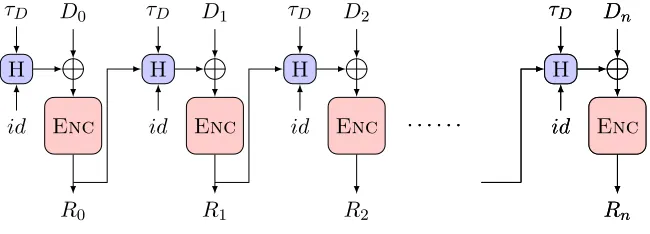
A natural way to reduce the overall replication time while maintaining the sequential hard-ness is to chain the encodings of each block, similar to encryption in block chaining cipher modes. A simple chaining would modify PoRep.Replicate in the Basic-VDE-PoRep by deriv-ing from each Ri (encoding of block di) a key ki = H(id||Ri) to be used in the encoding
Ri+1=VDE.Enc(di+1⊕ki) (of blockdi+1) as shown in Figure 3.2. EachRi can still be decoded
locally given onlyRi−1 asDi =VDE.Dec(Ri⊕ki) whereki =H(id||Ri−1). We would then
re-duce the time delayT for each call toVDE.Encsuch thatT·N is equal to the desired replication time.
c1
d1
c2
d2
c3
d3
c4
d4
c5
d4
c1 c2 c3 c4 c5
d1 d2 d3 d4 d5
Figure 3.3: Illustration of block dependency DAG configurations in cipher block chaining encodings. On the left is a simple chain (as in the chained Basic-VDE-PoRep) whereas the right depicts a mock depth robust chaining. For each chained encoding, theith encoding is derived asRi←Enc(ki, di) where
ki=H(id||parents(i)) andparents(i) denotes the set of encodings on nodesj with a directed edge toi.
respond to the verifier’s` random challenges in timekT with only `parallelism. As a result to ensure the server is storing at least 1/k fraction of blocks the replication time must be at least a factorN/k longer than the polling period.
Dependency graphs The issue with the simple cipher block chaining method is that the
dependency graph of the block encodings is not depth robust (see Section A.6). Let each block of the file represent a node in a graph where a directed edge is placed between theith node and thejth node if the encoding of thejth block of the file depends on the encoding of theith block. The resulting graph is a directed acyclic graph (DAG). By the properties ofHandVDE.Encthe dependencies are cryptographically enforced: if thejth block is dependent on theith block then the jth encoding cannot be computed unless the ith encoding is known except with negligible probability. If the dependency graph is (α, β) depth robust then deleting anyαN fraction of the encodings will contain a dependency path of length βN inside the deleted subgraph, meaning that it will require at least βN sequential calls toVDE.Encto re-derive the deleted blocks. On the other hand, the dependency graph of the cipher block chainedBasic-VDE-PoRepis a line, and as demonstrated by the time/space tradeoff attack described above it is at most (1−1/k, k/N) depth robust for any k < N (as storing only every kth node partitions the deleted set of nodes into lines of length k). More generally we can consider the parallel pebbling complexity of the dependency graph (Section A.8).
3.3 DRG PoRep