R E V I E W
Open Access
Secure-MQTT: an efficient fuzzy logic-based
approach to detect DoS attack in MQTT
protocol for internet of things
Haripriya A. P.
*and Kulothungan K.
Abstract
The advancements in the domain of Internet of Things (IoT) accelerated the development of new communication technologies. Machine to machine communication in IoT is accomplished with application protocols such as the Constrained Application Protocol and Message Queuing Telemetry Transport (MQTT). The openness of these protocols leads to various types of attacks including DoS Attack. MQTT is widely used in secure IoT applications like health monitoring. One of the prominent attacks in IoT is the denial of service (DoS) attack. This enforces the need for an efficient intrusion detection system method in MQTT-based application. In this paper, we address the vulnerabilities in MQTT, through which intruders can control the low-configuration devices in the network. This paper proposes a lightweight fuzzy logic-based intrusion detection scheme called Secure-MQTT, for detecting malicious activity during the communication between IoT devices. The proposed method uses a fuzzy logic-based system to detect the malicious behavior of the node with the help of a fuzzy rule interpolation mechanism. Secure-MQTT avoids the use of a dense rule base by exploiting the fuzzy rule interpolation that generates rules dynamically. The proposed method provides an effective mechanism to protect the low configuration devices from the DoS attack. The simulation results show that the proposed method detects the attacks more accurately when compared to the existing methods.
Keywords:Intrusion detection, Fuzzy interpolation, Fuzzy inference engine, Rule base, Publisher, Subscriber, Broker
1 Introduction
IoT is a promising future network paradigm that enables communication among heterogeneous smart devices. The number of connected devices is expected to be 50 billion
by 2020 [1]. The heterogeneous and huge number of
de-vices in the IoT leads to a difficulty in monitoring the data exchange between the devices, which in turn makes the in-trusion detection system (IDS) in IoT a potential research problem. Several protocols such as Message Queuing
Tel-emetry Transport (MQTT) [2], Constrained Application
Protocol (CoAP) [3], Extensible Messaging and Presence
Protocol (XMPP) [4], and Advanced Message Queuing
Protocol (AMQP) [5] are introduced to transfer the mes-sage in the IoT network. MQTT is the best candidate for M2M communication due to its lightweight characteristics and ability to work efficiently in low-power, limited
memory devices as compared to its counterpart, CoAP [6]. This paper focuses on IDS in the MQTT protocol.
The MQTT brokers are considered as the main com-ponent of any MQTT-based IoT application as it offers many services to the clients [7]. The main vulnerability of MQTT protocol is flooding the broker which leads to
a DoS attack [8]. The attacker compromises the broker
and sends false control or data packets during the DoS attack. Therefore, automatic recoverability from the DoS attack, the time taken for the recoverability, and the im-pact of broker failure in the IoT application are the sig-nificant security concerns in MQTT protocol.
One of the countermeasures for a DoS attack in MQTT is a certificate based on SSL/TLS authentication [9], which is not advisable for IoT devices since certificate manage-ment increases the computation and communication overhead. Also, session key generation and distribution in SSL/TLS reduces the performance of MQTT. Another se-curity measure to reduce the amplification of the DoS
© The Author(s). 2019Open AccessThis article is distributed under the terms of the Creative Commons Attribution 4.0 International License (http://creativecommons.org/licenses/by/4.0/), which permits unrestricted use, distribution, and reproduction in any medium, provided you give appropriate credit to the original author(s) and the source, provide a link to the Creative Commons license, and indicate if changes were made.
* Correspondence:[email protected]
IDS which will not produce effective results in all IoT net-work conditions. This is mainly because of the dynamic network features of IoT and low configuration IoT de-vices. This shows the demand for a lightweight IDS for MQTT to secure the communication among the con-strained devices in IoT.
In this paper, a novel lightweight IDS is proposed for MQTT-based IoT applications using fuzzy logic. The proposed system identifies the network anomal-ies with the help of fuzzy variables. The degree of anomalous behavior of the node is determined from this fuzziness. The fuzzy inference system executes IF-THEN-based fuzzy rules that are used to define the different network conditions to detect the at-tacks. The proposed fuzzy-based IDS in MQTT is the first IDS in its nature in the literature which prevents a DoS attack effectively in IoT applications. Our simulation analysis shows that Secure-MQTT is suitable for smart environments.
The major contributions of this paper are the following:
1. The proposed Secure-MQTT identifies the mali-cious behavior of the publish-subscribe nodes in the MQTT protocol in the IoT environment. We de-signed a novel efficient IDS using fuzzy logic which is applied to selected network traffic features. The proposed system employs efficient data pre-processing and a simple rule base for detecting a DoS attack.
2. Subsequently, a lightweight DoS attack detection scheme by employing fuzzy rule interpolation on the rule base is proposed. The fuzzy rule interpolation dynamically updates the rule base based on the past scenario. This enables the increase of the performance of the intrusion detection method.
3. Finally, the proposed IDS is validated and verified under varying network scenarios.
The rest of the paper is organized as follows.
Sec-tion 2 gives a brief idea about the methods used in
Secure-MQTT. Section 3 describes the existing
works in IDS detection in IoT networks. Section 4
publishers is monitored, and selected traffic features are trained over a period. The attacking scenario is simulated in the network where the number of the
malicious nodes is 10–50% of the total number of
nodes deployed in the network. The fuzzy
logic-based approach is applied to the selective traf-fic features. The malicious node is detected accord-ing to the fuzzy rules in the rule base. Then, the fuzzy inference engine decides whether the MQTT message has to be accepted or not. The complexity of the fuzzy model is reduced by dynamic fuzzy interpolation methods. It also helps to improve the efficiency of the revised rule base which in turn in-creases the overall performance of the IDS. The pro-posed work becomes lightweight in the absence of a dense rule base with dynamic interpolated rules that are derived from the most relevant network traffic
features in MQTT-based communication. The
Secure-MQTT is compared with existing MQTT-S, where the security is provided with SSL/TLS. The performance analysis shows that the Secure-MQTT outperforms MQTT-S.
3 Related works
This section discusses the relevant proposed works in IDS for IoT networks. In general, unauthorized access to the IoT network should be prevented in time by considering the constraint characteristics of the IoT devices. Traditional network IDS are not compatible with IoT due to the inadequate storage and computing of the devices. IDS can be broadly classified into two, namely anomaly-based IDS and signature-based IDS [12].
3.1 Signature-based IDS
In signature-based IDS, the behavior of the system is compared with the previously known attack patterns. The authors presented a signature-based lightweight
IDS, Snort, for low power networks [13]. The
pat-tern matching algorithm used in Snort is the
the attack pattern in the database should be updated over a period but is not illustrated in the paper. In
[14], an attack pattern matching engine, with
auxil-iary shifting and early decision, is incorporated for better performance of constrained devices in IoT. The auxiliary shifting method avoids the matching operations to increase the computation efficiency.
3.2 Anomaly-based IDS
Anomaly-based IDS monitors the network behavior and classifies the network activity as normal or anomalous. A botnet attack-detecting mechanism for
6LoWPAN gateways is proposed in [15], in which
the detection module analyzes the behavior of the network traffic. The botnet attack can be easily launched in the network via sending spam email, in-formation theft, and a DOS attack. An attacker con-trols the network by compromising the nodes in the network in a botnet attack. The authors have evalu-ated the detection rate but did not discuss the per-formance overhead of the detection scheme.
The authors in [16] suggested a sinkhole detection
scheme for secure routing on RPL for IoT networks. In this work, the detection scheme observes received and transmitted packets periodically and calculates
intru-sion ratio. Due to the high false-positive and
false-negative rates and more energy consumption, the solution for a sinkhole attack proposed fails for IoT application.
A game theory-based hybrid IDS for low con-strained devices is proposed in [17]. In this paper, au-thors have modeled a game for the normal user and attacker and Nash equilibrium value which deter-mines the anomaly behavior which is also calculated. In [18] is the proposed security information and event management-based IDS for M2M communication. In this work, the detection scheme observes the security events in the networks and applies the correlation method to identify the attack. The system can be im-proved by adding more libraries for improving detec-tion accuracy.
A hybrid intrusion detection scheme, based on
signa-ture and anomaly detection, is proposed in [19]. The
scheme has the benefit of storage efficiency of signature-based detection and computing efficiency of the anomaly-based detection. The placement strategy adopted here is centralized and distributed in which IDS scheme is implemented in both constrained de-vices and 6LOWPAN border router. The work can be extended to find more attacks in the IoT network.
The chance of false detection rate is more in signature-based schemes if the training set does not contain the observed behavior which is having normal characteristics [20]. The signature-based schemes fail
to address the continuous data streaming from many heterogeneous IoT devices whereas the abnormal be-havior of the network can be effectively detected using machine learning techniques. Therefore, this proposed work adapts anomaly-based detection to find malicious behavior in MQTT-based IoT networks. IDS in MQTT communication is not addressed effectively in literature; al-though, it is essential for secured IoT applications like mili-tary and smart environments. A variety of IDS schemes in IoT that are discussed above use different machine learning models such as artificial neural networks, genetic algorithm, and fuzzy logic which are applied for detecting the anomaly in the IoT network. In order to classify the uncertain and nonlinear data in MQTT, the proposed scheme adopts the fuzzy logic model, which helps to produce better accuracy.
The existing security mechanism in MQTT is
implemented through SSL/TLS. The certificate
generation and session key management in SSL/ TLS increase the computation complexity of the
constrained IoT devices. The proposed
Secure-MQTT uses a smaller comprehensive set of rules since the fuzzy interpolation method gener-ates rules dynamically. Therefore, the proposed method is light in terms of the computation steps involved.
4 Problem formulation 4.1 Background
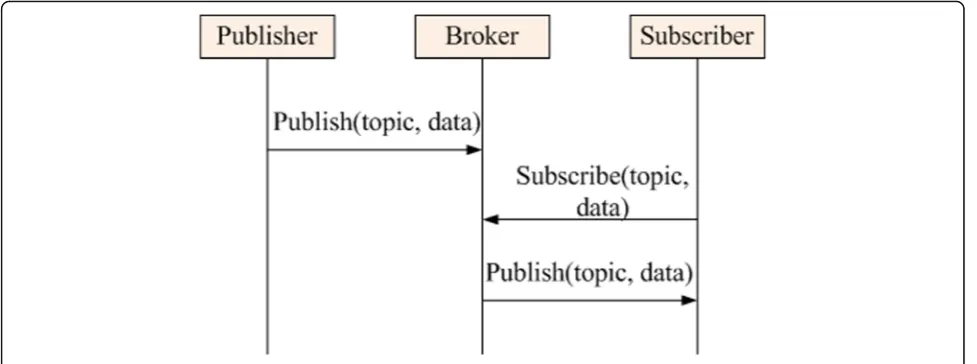
MQTT is a widely used application layer protocol to transmit data among the devices in IoT, because of its simplicity and scalability [21]. Figure1shows the gen-eral MQTT message model. In this model, publisher, subscriber, and the broker are the basic elements for accomplishing communication between the IoT de-vices [22].
MQTT follows a TCP-based connection establishment procedure. The device sends MQTT a request message,
CONNECT, to connect with the broker. Once the request is received, the broker will send the acknowledgment,
CONNACK, to the sending device. Later, the IoT device sends or publishes the message on a particular topic to the broker, and the receiving devices subscribe the messages from the broker. When a request arrives at the broker, the proposed Secure-MQTT analyzes the traffic and compares the stored fuzzy rules to check the presence of an intrusion.
4.1.1 Threat model
4.2 Attack scenario
The DoS attack scenario considered in this work is graphic-ally represented in Fig.2. The network traffic coming to the MQTT broker has to be analyzed.
An attacker can launch a DoS attack in the broker by
sending many connection requests continuously
thereby making the broker busy as in a flooding attack. If there are many connection requests that arrive at the same time, then the buffer will be drained and the bro-ker will not be in a position to handle new incoming requests. Moreover, the broker is not able to differenti-ate the normal CONNECT and the spoofed CON-NECT message packets. On receiving the flood request messages, the broker starts to acknowledge with CON-NACK message. There is an abrupt rate of increase in
the number of CONNECT and CONNACK packets during the DoS attack. This results in blocking the bro-ker service and prevents the functioning of the intended IoT network.
4.3 Design goals
Based on the above discussions, we formulate the pri-mary goals of the proposed as follows:
1. To develop a lightweight IDS to detect and prevent the DoS attack in MQTT for IoT devices
2. Design efficient methods to achieve early and timely detection of the flooding of publisher and subscriber messages which results in a DoS attack
Fig. 1MQTT Publish/Subscribe topic message model [22]
3. Design lightweight rule base to enable
computationally efficient decision making in fuzzy inference engine
5 Proposed IDS architecture
To achieve the design goals discussed above, a novel fuzzy logic-based IDS is proposed for the de-tection of an anomaly during the machine to ma-chine communication using the MQTT broker.
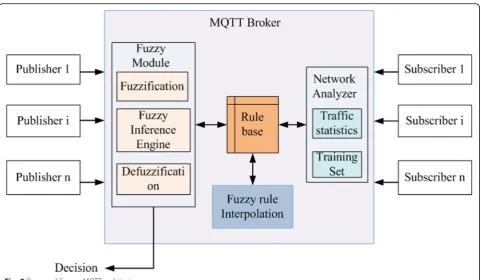
Figure 3 shows the proposed IDS architecture.
The major components of the proposed Secure-MQTT broker are a fuzzy module, rule base, fuzzy rule interpolation, and network analyzer which are explained as follows:
The fuzzy module consists of fuzzy computation and fuzzy verification sub-modules namely fuzzification, fuzzy inference engine, and defuzzification. Fuzzification estimates the fuzzi-ness of the MQTT message traffic analysis of the device based on Connection Message Ratio (CMR) and Connection Acknowledgment Message Ratio (CAMR). The fuzzy rule engine selects the appropriate rule and decides whether the request is a legitimate request or not. Defuzzification con-verts the fuzzified inputs into crisp output.
Rule base stores the fuzzy rules which are
formulated from the training network traffic dataset. Fuzzy rule interpolation [23] is applied to the rule
base to reduce the complexity in the fuzzy inference engine by deriving new appropriate rules in the rule base.
The network analyzer consists of traffic statistics and training dataset. The traffic statistics store the history of network traffic behavior for specified time frames. The training dataset stores network traffic features and it is used to train the fuzzy module.
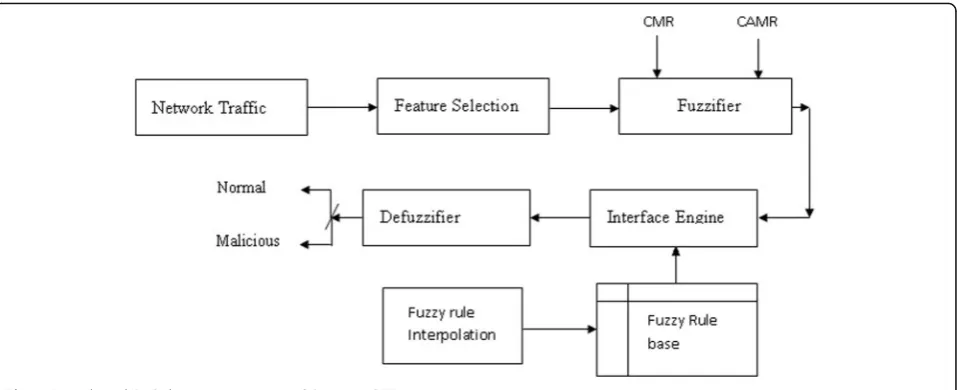
The fuzzy-based DoS detection in the proposed
Secure-MQTT is as shown in Fig.4.
Fig. 3Proposed Secure-MQTT architecture
Table 1Network Traffic Features
Feature name Description
Connect Connect command
ConnectAck Acknowledgment to Connect command
ConnectRate Percentage of Connect requests arrived at broker
ConnectAckRate Percentage of ConnectAckRate
PublishMessage Publish message from publishing client to broker
ConnAck Request for subscribing message
5.1 Feature selection
The features used in generating fuzzy rules are se-lected from the network trace dataset. During this feature selection process, devices collect the required features from the network traffic which is shown in Table 1.
The proposed work considers the features Connect and ConnectAck of CONNECT and CONNACK mes-sages, respectively, for training the proposed system. Then, the next step is to fuzzify the two important variables, CMR and CAMR. The fuzzy variable CMR indicates a fraction of connection requests from the publisher, which is formally given in Eq. 1.
CMR¼Nconnect
N ; ð1Þ
where Nconnect represents the count of the Connect
feature and N is the total number of MQTT
mes-sages. CAMR represent the fraction of subscriber re-quests received in the broker which is defined in Eq. 2.
CAMR¼NConnAck
N ð2Þ
whereNConnAckgives the number of connection
acknowledg-ment messages from MQTT broker. The CMR and CAMR are given as inputs to the fuzzy system. The algorithm for
IDS using Fuzzy logic is formally stated as follows:
The proposed intrusion detection works on the basis of Algorithm 1. The input variables CMR and CAMR are fuzzified using fuzzy membership function, then de-rive a fuzzy classifier to generate fuzzy rules which are in the form of an IF-THEN statement. The fuzzy infer-ence engine activates the selected rules in the rule base for a given instance. If no such rule is found in the rule base, then fuzzy rule interpolation that generates rule dynamically is applied. Defuzzify the output variable
anomaly to obtain a crisp value. The detailed workings of membership function and fuzzy inference engine, fuzzy rule interpolation, and defuzzification are given in the following sections.
5.2 Membership function
medium, high] of the training dataset. The output variable anomaly is also a fuzzy variable.
The membership values of the CMR and CAMR are de-rived from the observed values of each input parameters.
Fig.5illustrates the fuzzy set of CMR input variable. The linguistic variables for this fuzzy set are high, medium, and low.
The input variable CAMR is depicted in Fig. 6.
The linguistic variables low, medium, and high in CMR and CAMR are represented with a triangular membership function and the medium is represented using triangular membership function. The fuzzy in-ference engine computes the anomaly computation of each client.
The fuzzy set of output variableanomalyis given in Fig.7. Here, the used linguistic variables are normal, abnormal and attack. The triangular membership function represents the linguistic variables normal, abnormal, and attack.
The MQTT broker in the network monitors the traffic and examines and classifies the traffic based on fuzzy in-ference rules. The anomaly prediction is determined by fuzzy if-then rules which are previously defined. The
in-put variables Connect and ConnectAck determine the
fuzzy variable anomaly by applying the fuzzy rules.
5.3 Fuzzy inference system
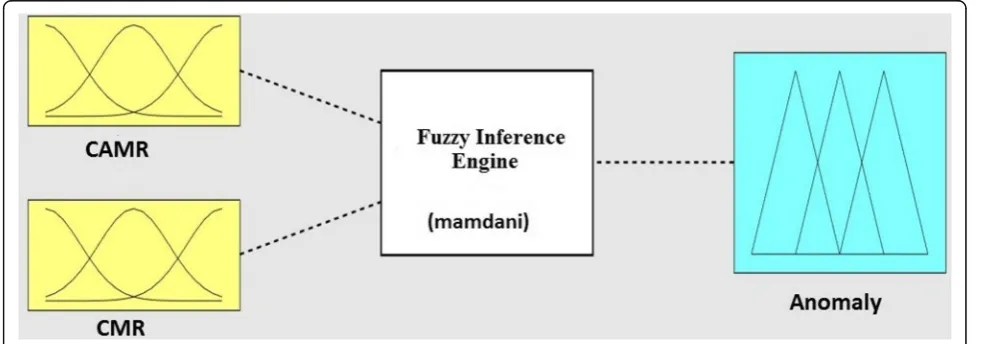
The fuzzy inference engine computes the anomaly compu-tation of each client using fuzzy rules. Figure8depicts the graphical representation of the proposed fuzzy inference engine. The CMR and CAMR are the input parameters of the proposed scheme, and the output variable anomaly is also a fuzzy variable.
If any anomaly is found, then the broker will discard the packets. Otherwise, the normal packets are sent to the subscriber. Based on the input variables CMR and CAMR, the fuzzy inference engine generates the fuzzy rules in the form of IF-THEN statement. An example of the rule is given as follows:
1. IF CMR = Low and CAMR = Low THEN anomaly = Normal
2. IF CMR = Low and CAMR = Medium THEN anomaly = Abnormal
3. IF CMR = High and CAMR = Medium THEN anomaly = Attack
Table 2 gives the fuzzy rules generated from heuristic fuzzy rule generation method. The proposed model con-sidered all possible permutations of the membership
values of CMR and CAMR. Each permutation is used as an antecedent for each rule. However, few permutations have shown poor performance as it was difficult to infer the consequent. Therefore, to improve the performance, Secure-MQTT adopted fuzzy rule interpolation.
5.4 Fuzzy rule interpolation
Fuzzy inference engine predicts the severity of anomaly by matching the rule found in rule base in the MQTT broker during the communication. It is a challenging task to form an exhaustive set of all the possible rules from the network trace set. A fuzzy inference engine fails to respond if a matching antecedent is not found in the rule base, which results in the poor performance of the fuzzy inference en-gine. Fuzzy rule interpolation, which executes if the fuzzy inference engine could not find any suitable match in the rule base, can be applied to improve the performance of the IDS. Fuzzy rule interpolation forms new rules based on past scenarios and modifies the rule base dynamically. This dynamic update of the rule base decreases the false-positive and false-negative rates and increases efficiency.
Secure-MQTT follows transformation-based fuzzy rule interpolation [24]. The original rule base R con-tains the ruleRiand the observationOsuch thatRi∈R.
Each rule Ri can be represented as Ri= IF (x1=Ai1)and
…(xj=Aij)…(xn=AiN) THENy=Bi where Aij is the
tri-angular membership functions,xjis thejthantecedent, 1≤
j≤N, Nis the total number of antecedents, andBiis the
consequent. The observation Ocan be represented as O
= {Ao1,Ao2,…,AoN} andAij= (l,n,r), wherelandrare left
and right points in the triangle andnis the normal point in the triangular and denotes the triangular membership func-tion of the antecedent xj. The representative value of
tri-angular function A can be defined as the mean of
x-coordinates which is computed as
REPð Þ ¼A ðlþrþnÞ
3 ð3Þ
The steps in transformation-based fuzzy rule
interpolation are given below: Fig. 7Membership function ofanomaly
Find the nearest rule for new observation:The aggregate distance of allxjdetermines the distance betweenRiand the observationOand it is calculated as follows:
where dist(Aij,Aoj) gives the distance betweenAijand Aoj, withRangexjforjthantecedent. Then,Prules, M≥2 with respect to observed valueAoj, are selected for interpolation operation to achieve the conclusionCo.
Design the transitional rules:The approximate value of the final consequent can be derived from the transitional rules using the new observations. This is achieved by applying linear interpolation to theP rules identified. The expected antecedents of the new rule are computed using the antecedents ofP rules as follows:
Also, the aggregated values of WBi and βB are
com-puted as follows:
Using this, the mapped consequent B″ can be
com-puted for the antecedentsAj″
Scaling and moving transformations: The REP values of antecedents of a transitory rule are
matches with those of observation. Also, we have to make sure that the fuzzy values in the transitory rule should be the same as the observation scale and move transformation.
The scaled value (l*,r*) is determined such thatr∗− l∗=δj(r''−l'')
sj¼r
−l
r0−l0 ð8Þ
Similarly, the consequent’s scaling factor is computed as follows:
The functionmoveis applied to the resulting fuzzy values if the mapped fuzzy set is the same as that of observation’s and is defined as follows:
movej¼
From the above equation, themovefunction of the consequent can be derived as follows:
moveB¼ XN
j¼1
movej
N
The scale and move mapping are applied toB″ usingδBand moveBin order to obtainBo.
5.5 Defuzzification
The crisp output is obtained by using a Mamdani fuzzy
inferencing engine [25], which aggregates the fuzzy
rules. It follows centroid approach in which the center of the area under the curve of a membership function gives the crisp output.
5.6 Proposed anomaly detection algorithm
The proposed anomaly detection algorithm is performed by MQTT broker and the procedures of the algorithm are formally stated in Algorithm 2. The proposed algorithm 2 takes input as the MQTT packet flowing through the net-work and returns the decision whether to accept or reject the packet as output.
Table 2Fuzzy rules for the proposed system
CMR Low Low Low Medium Medium Medium High High High
CAMR Low Medium High Low Medium High Low Medium High
The relevant features Connect and ConnAck are se-lected from the observed network traffic, and the fuzzy
variables CMR and CAMR are determined by Eqs. 1
and 2. Both CMR and CAMR are fuzzified and fuzzy
inference engine, which selects the appropriate rule, is applied. If such a rule is not found in the rule base, then fuzzy rule interpolation is executed. Then, defuz-zify the output variable anomaly and the decision is made. The decision is either packet accept or drop as per the anomaly.
6 Results and discussion
The Secure-MQTT is implemented in Contiki OS and the evaluation is done using the Contiki simulator COOJA. We run emulations on the sensor platform T1 EXP 5438 having a 16-bit processor MSP430F5438A with 256 KB flash, and 16 KB RAM MSP430F5438A has a 25-MHz clock frequency. The area of the IoT network is 500 × 500 m2in which 60 to 500 devices are deployed. The IoT net-work is modeled with legitimate nodes and the attacker nodes in the simulation environment. The attack is cre-ated in a distributive nature in which the number of at-tacker nodes varies from 10% to 50% of the total number of nodes present in the network. The attacking node sends the same request frequently at a higher rate compared to a legitimate node. We compare Secure-MQTT with
MQTT-S [26], and the comparison results demonstrate
that Secure-MQTT outperforms MQTT-S.
6.1 IDS evaluation metrics
The proposed scheme employs the significant IDS met-rics such as attack detection efficiency, attack detection
nodes whereas the malicious nodes show sharp variation from the normal flow of messages.
6.1.1 Attack detection efficiency (ADE)
ADE gives the efficiency of the proposed scheme in de-termining the malicious nodes based on the total num-ber of nodes deployed in the network. The following equation calculates the efficiency of detection.
ADE¼CM
N ð10Þ
where CM denotes the number of detected malicious
nodes andNrepresents the total number of nodes present
in the network. Figure3shows the ADE of Secure-MQTT.
Each deployment scenario (100, 150, 200, 300 nodes) is evaluated separately and the results are given in Fig.9. In all four cases, Secure- MQTT achieves better ADE compared to MQTT-S as the proposed algorithm cap-tures immediate variation in the message flow. The Secure-MQTT detects the presence of the malicious node by counting CONNECT and CONNACK messages from the device. Hence, Secure-MQTT performs the early detection of the malicious node which attacks a broker through flooding. Also, it is clear from Fig.9that the Secure-MQTT shows steady performance in detect-ing malicious nodes on an average of 80% and above compared to MQTT-S. MQTT-S follows traditional de-tection procedure using SSL/TLS security. This
ap-proach is not suitable for a dynamic network
environment like IoT network since the SSL/TLS con-siders general network traffic features.
6.1.2 Attack detection rate (ADR)
ADR is the number of true positives successfully de-tected out of the total number of detections and is deter-mined by the following:
ADR¼ NTP NTPþNFN
ð Þ ð11Þ
Figure10 shows the ADR of Secure-MQTT in
Fig. 9Attack detection efficiency ofa100,b150,c200, andd300 nodes
NTPþNTNþNFPþNFN
ð Þ
where NTP is the number of true positives, NTN is the
number of true negatives, NFP is the number of false
positive, andNFNis the number of false negatives.
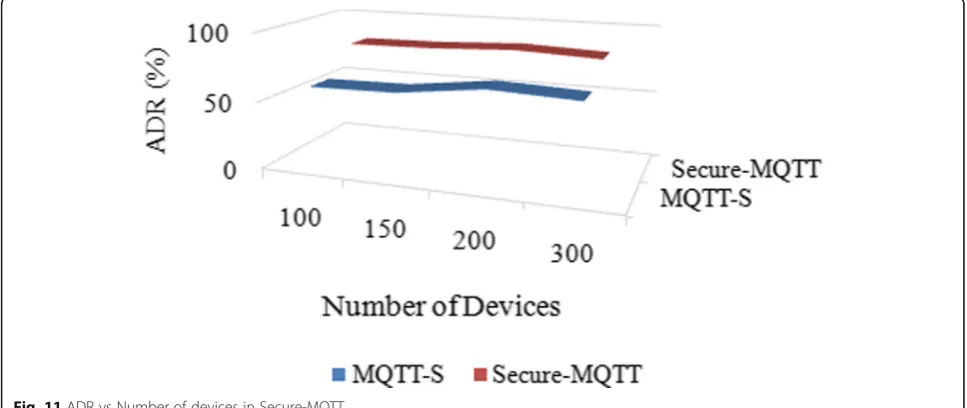
Figure 11 shows ADR vs number of devices in
Secure-MQTT. The proposed Secure-MQTT achieves high detection accuracy for different network scenarios as compared to MQTT-S. The Secure-MQTT considers only the relevant network traffic features (shown in
Table1) for the decision-making whereas MQTT-S does
not employ the feature selection method. This contrib-utes to the better detection accuracy of Secure-MQTT.
6.1.4 False-positive ratio (FPR)
False-positive ratio gives the rate of legitimate nodes that are identified as abnormal nodes and is defined as follows:
FPR¼ NFP
NFPþNTN ð
13Þ
Figure12shows the FPR of the proposed Secure-MQTT
and the MQTT-S over different timeslots by varying the number of request messages. Secure-MQTT obtains the least threshold FPR range [0.1–0.37] as compared to the
tional availability as a metric of the impact of security because the multiprocessing in a sensing device is limited. Thus, it is important to consider the impact of the attack on the maximum achievable communi-cation rate. The total available bandwidth that is as-sumed is 25,000 B/s for MQTT for the simulation.
Figure 13 describes the maximum communication
rate, with and without including IDS to the MQTT
protocol. It is observed from Fig. 13that the proposed
Secure-MQTT does not compromise to higher commu-nication rate though it reacts to attacks immediately. This shows that Secure-MQTT is efficient in detecting attacks without compromising network performance.
Precision
Precision gives the number of malicious nodes cor-rectly identified among the detected malicious nodes, which is defined as follows:
Precision¼ NTP
NTPþNFP ð
14Þ
We have measured the precision ratio of both the
schemes, proposed Secure-MQTT and MQTT-S. Figure14
shows that Secure-MQTT achieves better precision com-pared to that of MQTT-S.
Secure-MQTT achieves high precision due to the relevant feature selection and fuzzy base inference en-gine. In Secure-MQTT, the use of fuzzy interpolation enables the fuzzy inference engine to detect almost all possible attacks effectively and leads to a better true-positive rate than MQTT-S. There is no early tection in MQTT-S since it follows the traditional de-tection method SSL/TLS. The recall and F-score for the Secure-MQTT are calculated as given below:
Recall
Recall gives the percentage of malicious nodes cor-rectly identified among the total detected malicious nodes, which is defined as follows:
Recall¼ NTP
NTPþNFN ð
15Þ
F-score
Harmonic mean of precision and recall gives the F-score and is defined as follows:
F−score¼2: Precision:Recall
PrecisionþRecall ð16Þ
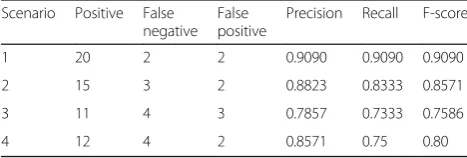
The overall performance analysis of the proposed
Secure-MQTT is given in Table 3. Here, we consider
precision, recall, and F-score for different scenarios in which the network is having 300 nodes with 10% mali-cious nodes.
Fig. 12FPR in different time slots
Secure-MQTT maintains better precision, recall, and F-score as the fuzzy rule interpolation detects the anom-aly by generating new rules in the absence of matching
rules in the rule base. Table 3 shows the performance
analysis of Secure-MQTT under various scenarios. The inference is that the proposed system maintains consist-ent performance under all possible scenarios. This indi-cates the significance of Secure-MQTT in real-time applications. Since the proposed Secure-MQTT is a dir-ect application of fuzzy logic, it needs only simple circuit
elements. Hence, the computation required for
Secure-MQTT is less when compared to existing MQTT-S. Moreover, the proposed Secure-MQTT shows high precision because of the use of fuzzy logic. Fuzzi-fied input and output parameter ensures that there will not be any performance degradation in Secure-MQTT.
7 Conclusions and future work
In this paper, we proposed a novel IDS, Secure-MQTT, for MQTT-based IoT environments. This method uses the correlation-based network feature selection, which selects only relevant features. A fuzzy logic-based infer-ence engine in Secure-MQTT determines the presinfer-ence of a malicious device accurately. Fuzzy rule interpolation
makes the Secure-MQTT lightweight. There is no need to store all the rules in the rule base. Fuzzy rule interpolation dynamically forms the rules, if the match-ing antecedent is not found in fuzzy inference engine. Hence, the storage of exhaustive sets of rules is avoided in Secure-MQTT and it is computationally inexpensive to have a match checking run for each instance. More-over, the fuzzy-based Secure-MQTT needs only simple circuit elements for system implementation. This also leads to the design of a lightweight Secure-MQTT by saving computation time and energy. The simulation of different attack scenarios shows the effectiveness of Secure-MQTT in detecting malicious in IoT. The ex-perimental analysis shows that Secure-MQTT achieves low FPR compared to existing work.
This work can be extended by considering other MQTT messages like SUBACK, PUBLISH, and PUBREC in order to strengthen the application layer security. Also, based on observed flexibility and scalability of the Secure-MQTT, this work is extensible to detect various attacks in other communication layers in IoT. As a future work, the proposed Secure-MQTT can be modified with the optimization of selected network traffic features.
Acknowledgements
Authors thanks in advance all the reviewers for their valuable suggestions and comments
Funding
Not Applicable
Authors’contributions
HAP proposed the idea, completed the simulation, and analyzed the performance of the proposed work. KK analyzed the factors that influence the algorithms and gave valuable suggestions to improve the manuscript. Both authors read and approved the final manuscript.
Fig. 14a–dPrecision in different time frames
Table 3Performance analysis of Secure-MQTT
Competing interests
The authors declare that they have no competing interests.
Publisher’s Note
Springer Nature remains neutral with regard to jurisdictional claims in published maps and institutional affiliations.
Received: 30 May 2018 Accepted: 17 March 2019
References
1. L. Atzori, A. Iera, G. Morabito, The Internet of Things: a survey. Comput. Netw.54(15), 2787–2805 (2010)
2. P. Sethi, S.R. Sarangi, Internet of Things: architectures, protocols, and applications. Can. J. Electr. Comput. Eng.2017(2017), 1–25 (2017) 3. C. Gomez, A. Arcia-Moret, J. Crowcroft, TCP in the Internet of Things: from
ostracism to prominence. IEEE Internet Comput.22(1), 29–41 (2018) 4. H. Lampesberger, Technologies for web and cloud service interaction: a
survey. SOCA10(2), 71–110 (2016)
5. S. Vinoski, Advanced message queuing protocol. IEEE Internet Comput.
10(6), 87–89 (2006)
6. M. Ammar, G. Russello, B. Crispo, Internet of Things: A survey on the security of IoT frameworks. J. Inf. Secur. Appl.38, 8–27 (2018)
7. R.A. Light, Mosquitto: server and client implementation of the MQTT protocol. J. Open Source Softw.2(13), 265 (2017)
8. S. Shadroo, A.M. Rahmani, Systematic survey of big data and data mining in internet of things. Comput. Netw.139, 19–47 (2018)
9. S. Jang, D. Lim, J. Kang, I. Joe, An efficient device authentication protocol without certification authority for Internet of Things. Wirel. Pers. Commun.
91(4), 1681–1695 (2016)
10. A. Oyler, H. Saiedian, Security in automotive telematics: a survey of threats and risk mitigation strategies to counter the existing and emerging attack vectors. Secur. Commun. Netw.9(17), 4330–4340 (2016)
11. S. Pang, D. Komosny, L. Zhu, R. Zhang, A. Sarrafzadeh, T. Ban, D. Inoue, Malicious events grouping via behavior based darknet traffic flow analysis. Wirel. Pers. Commun.96(4), 5335–5353 (2017)
12. B.B. Zarpelão, R.S. Miani, C.T. Kawakani, S.C. de Alvarenga, A survey of intrusion rjr. J. Netw. Comput. Appl.84, 25–37 (2017)
13. M. Roesch, Snort: Lightweight intrusion detection for networks. Lisa99(1), 229–238 (1999)
14. D. Oh, D. Kim, W.W. Ro, A malicious pattern detection engine for embedded security systems in the Internet of Things.
Sensors14(12), 24188–24211 (2014)
15. E. Cho, J. Kim, C. Hong,Attack model and detection scheme for botnet on 6LoWPAN Management Enabling the Future Internet for Changing Business and New Computing Services, Lecture Notes in Computer Science 5787 (Springer, Berlin, Heidelberg, 2009), pp. 515–518
16. R. Stephen, L. Arockiam, Intrusion detection system to detect sinkhole attack on RPL protocol in Internet of Things. Int. J. Electr. Electron. Comput. Sci.4(4), 16–20 (2017)
17. S. Shamshirband, A. Patel, N.B. Anuar, M.L.M. Kiah, A. Abraham, Cooperative game theoretic approach using fuzzy Q-learning for detecting and preventing intrusions in wireless sensor networks. Eng. Appl. Artif. Intell.32, 228–241 (2014)
18. D. Lavrova, A. Pechenkin, Applying correlation and regression analysis to detect security incidents in the internet of things.
Int. J. Commun. Netw. Inf. Secur.7(3), 131 (2015)
19. S. Raza, L. Wallgren, T. Voigt, SVELTE: Real-time intrusion detection in the Internet of Things. Ad Hoc Netw.11(8), 2661–2674 (2013)
20. L. Wallgren, S. Raza, T. Voigt, Routing attacks and countermeasures in the RPL-based internet of things. Int. J. Distrib. Sens. Netw.9(8), 794326 (2013) 21. M.A. Prada, P. Reguera, S. Alonso, A. Morán, J.J. Fuertes, M. Domínguez,
Communication with resource-constrained devices through MQTT for control education. IFAC-PapersOnLine49(6), 150–155 (2016)
22. A. Al-Fuqaha, M. Guizani, M. Mohammadi, M. Aledhari, M. Ayyash, Internet of Things: a survey on enabling technologies, protocols, and applications. IEEE Commun. Surv. Tutorials17(4), 2347–2376 (2015)
23. L. Yang, Q. Shen, Adaptive fuzzy interpolation. IEEE Trans. Fuzzy Syst.19(6), 1107–1126 (2011)
24. Z. Huang, Q. Shen, Fuzzy interpolative reasoning via scale and move transformations. IEEE Trans. Fuzzy Syst.14(2), 340–359 (2006)
25. E. Pourjavad, A. Shahin, The application of Mamdani fuzzy inference system in evaluating green supply chain management performance. Int. J. Fuzzy Syst.20(3), 901–912 (2018)
26. U. Hunkeler, H.L. Truong, A. Stanford-Clark, in3rd International Conference on IEEE Communication Systems Software and Middleware and Workshops, 2008. MQTT-S A publish/subscribe protocol for Wireless Sensor