Joint Performance Study of Channel Estimation
and Multiuser Detection for Uplink Long-Code
CDMA Systems
Ping Liu
Department of Electrical Engineering, University of California, Riverside, CA 92521, USA Email:[email protected]
Zhengyuan Xu
Department of Electrical Engineering, University of California, Riverside, CA 92521, USA Email:[email protected]
Received 1 November 2003; Revised 10 March 2004
Although numerous channel estimation and multiuser detection approaches have appeared for long-code uplink CDMA systems, joint performance study of channel estimators and symbol detectors remains largely open. In this paper, we construct three typical symbol-level linear receivers upon existing channel estimation method, known as zero-forcing (ZF), minimum mean-square-error (MMSE), and RAKE receivers, for symbol detection. Since the channel estimation error is rippled to the linear receivers, perfor-mance of all receivers is thus jointly analyzed with the channel estimator from a perturbation perspective. Extensive simulation examples involving different communication environments demonstrate high consistency between our analysis and experimental results.
Keywords and phrases:long codes, channel estimation, multiuser detection, perturbation analysis.
1. INTRODUCTION
Direct sequence (DS) code division multiple access (CDMA) technology has become an appealing solution to third-gen-eration wireless systems [1, 2]. It provides a communica-tion-system unique capabilities of simultaneous spectrum sharing, mitigation of jamming, interception, and multipath fading [3], and can easily support transmission of multirate information streams.
Multiuser interference (MUI) is a typical obstacle to be obviated in detection of input signals in a DS/CDMA sys-tem, which has attracted substantial efforts in recent years [4]. In DS/CDMA systems, the bandwidth of the input sig-nal is spread by a sequence with a much higher rate in order to effectively suppress the interference. There are two kinds of spreading codes: the periodic spreading sequence (short codes) which repeats from symbol to symbol, and the ape-riodic spreading sequence (long codes) which has a much longer period compared with the symbol duration. In recent years, many efforts have been focused on the CDMA system with short codes, resulting in simplified methods, and very importantly, tractable analysis of the system performance. However, long spreading codes feature the new CDMA-based
wireless standards [5]. Employment of long codes exhibits certain superiority to short codes in terms of increasing im-munity of the system to MUI and channel fading on the average [6], improving the spectrum efficiency through the uniform distribution of the signal bandwidth, and moreover ensuring a secure communication link in a hostile environ-ment, protecting users’ information against intentional in-terception.
2D RAKE receiver structure to maximize the output signal-to-interference-plus-noise ratio (SINR), both channel es-timation and minimum mean-square-error (MMSE)/zero-forcing (ZF) receivers are presented in [15,16]. Built upon the structure of convolutive channels, a Toeplitz displace-ment channel estimation method has been proposed [17]. A novel parallel factor analysis technique is applied to mul-tiuser detection [18]. Even in the presence of colored Gaus-sian noise in addition to unknown multipath fading and MUI, turbo multiuser detectors can be developed [19]. Based on LS fitting, a blind decorrelating RAKE receiver is re-cently proposed [20]. If all users’ spreading codes and prop-agation delays are known, a subspace technique can be ap-plied to estimate multipath parameters [21]. Performance of long-code CDMA systems and detection methods has also been studied under the assumption of perfect channel es-timate. A heuristic approximation of SINR for the decor-relator and simulation results for the MMSE receiver are provided [22]. Spectral efficiency of some linear receivers are explored [23, 24]. Near-far resistance of MMSE detec-tion is investigated [25] and trade-offs of long-versus-short spreading sequences are demonstrated [26,27]. Performance of ML detectors is studied for multirate CDMA systems [28].
In this paper, we study joint performance of the chan-nel estimator and multiuser receivers for long-code uplink CDMA systems. The channel estimator considered in our analysis is based on [21], which extends [10] to uplink com-munications with slight modification. It is also closely related to [20] where a low-complexity algorithm is further devel-oped. Based on the estimated channel, different linear detec-tion techniques such as ZF, MMSE, and RAKE are applied. Both ZF and MMSE receivers have complexity which is cu-bic in the processing gain. Due to the time-varying property of a long-code system, designing new low-complexity mul-tiuser detectors remains a challenging issue. Since in practice, the channel estimation is based on processing of finite data samples, it will deviate from its theoretical value, resulting in estimation errors. Perturbation in channel estimate will be further carried on to the receivers, causing receivers’ output SINRs and BERs all perturbed. To quantify the effect of sam-ple size, we apply perturbation theory to obtain the chan-nel mean-square error (MSE), detectors’ perturbed SINR, and finite-data-based bit-error rate (BER). Unlike previous work [22,23], which studied the effect of randomness of codes on the fluctuation of the SINR of receivers constructed from perfect signature vectors, our analysis considers the ef-fect of imperef-fect signature waveforms caused by finite data samples on the performance of receivers. Although joint per-formance has been studied for short-code DS/CDMA sys-tems [29] and long-code downlink CDMA systems [30], long-code uplink communications adopt completely differ-ent channel estimation and symbol detection schemes and the results in [29, 30] are not applicable. Therefore, new joint performance analysis for long-code uplink systems is necessary and important. Moreover, high consistency is ob-served between our experimental results and analytical re-sults.
This paper is organized as follows. A long-code CDMA uplink system model is described in Section 2. Subspace-based channel estimation method is reviewed, together with addition of noise-power estimation method and implemen-tation of three typical linear detectors are presented in Section 3. In Section 4, joint performance of channel esti-mator and detectors in terms of channel MSE, receivers’ SINR and BER is evaluated. Finally, various simulation ex-amples are provided inSection 5and conclusions are drawn inSection 6.
2. CDMA UPLINK WITH LONG CODES
Consider an uplink CDMA system [14], whereJmobile sta-tions are communicating with a base station. The jth user’s bit wj(n) is first spread by aperiodic codes cj,n(k) (k = 0,. . .,P−1), and then transmitted through a multipath chan-nelgj(m). All channels are assumed to have maximum order
q(qP). The signal from userjis assumed to arrive at the base station with delaydj. Then, after considering rectangle pulse shaping, the received chip-rate signal is a superposition of signals fromJusers corrupted by noise [13]
y(k)= J
j=1 q
m=0
gj(m)sj
k−m−dj
+v(k), (1)
where
sj(k)= ∞
n=−∞
wj(n)cj,n(k−nP), (2)
v(n) is zero-mean AWGN with variance σ2
v = E{|v(n)|2}. If we assume that the system is quasi-synchronous, where transmission delays from all users to the base station are within a small fraction of a chip duration, that is, 0≤dj
P. As a result, the intersymbol interference could be elimi-nated if we collect only L = P−µsamples in the nth bit interval into a vectory(n)=[y(nP+µ),. . .,y(nP+P−1)]T withµ=max{q+dj}. LetCj(n) be the truncated version of the following code filtering matrix of dimensions (P+q) by (q+ 1) for userj:
¯ Cj(n)=
cj,n(0) 0 ..
. . .. cj,n(0)
cj,n(P−1) ...
0 . .. cj,n(P−1)
, (3)
that is, Cj(n) = [ ¯Cj(n)]µ+1:P,1:q+1. Then according to (1), a simple matrix form follows:
y(n)= J
j=1
Cj(n)gjwj(n) +v(n)
whereC(n)(P−µ)×(J(q+1)),G(J(q+1))×J, andH(n)(P−µ)×J are de-fined as
C(n)=C1(n),. . .,CJ(n),
G=diagg1,. . .,gJ
,
H(n)=h1(n),. . .,hJ(n)
=C1(n)g1,. . .,CJ(n)gJ=C(n)G,
(5)
gj with (q + 1) elements is the channel vector of user j, w(n)J×1andv(n)(P−µ)×1are given by
w(n)=w1(n),. . .,wJ(n)
T ,
v(n)=v(nP+µ),. . .,v(nP+P−1)]T. (6)
Throughout this paper, we make the following assump-tions.
(AS1) All users’ information sequences are mutually inde-pendent and temporally i.i.d. with unit power. (AS2) Each user’s codes and delay are known.
(AS3) All users’ long codes are pseudorandom variables. (AS4) The number of active users in the system satisfiesJ <
(P−q)/(q+ 1).
The first assumption is adopted for most systems and conve-nient for analysis. However, the effect of different interfering power is studied in the simulation in the paper. For the sec-ond assumption, it is reasonable to assume that the base sta-tion knows all users’ spreading codes. On the other hand, all users’ delays are assumed to be estimated in advance by some delay estimator such as [16]. However, if they are not avail-able, we can over-parameterize the channel vector to absorb the delay ambiguity [20]. Long-code sequence can be catego-rized as deterministic or stochastic. To facilitate our analysis, the latter is adopted as (AS3). (AS4) is the condition required for channel estimation in [10,21] upon which our receivers are built.
3. CHANNEL ESTIMATION AND MULTIUSER DETECTION IN CDMA UPLINK
Before we start joint performance analysis, we first briefly present the channel estimation method, which extends [10] to CDMA uplink with some alterations. The tailored method, instead of using the whole code-decorrelated data vector, utilizes only a portion pertaining to the desired user to estimate channel in a reduced complexity. Whitening is per-formed before subspace method is applied, and noise power is estimated from the whitened data. Then, three most com-monly used symbol-level linear receivers, ZF, MMSE, and RAKE receivers, are constructed in order to detect the desired user’s symbols.
3.1. Subspace-based channel and noise-power estimation
According to (4), the original data vectory(n) contains non-stationary signal contribution and non-stationary noise contri-bution. Consequently, the conventional unconditional co-variance ofy(n), which is estimated from sample average of y(n)y(n)H, contains no noise subspace. The signal subspace in fact spans the whole operational space, as mentioned in [30]. Therefore, subspace approach cannot be applied to the unconditional covariance ofy(n).
As in [10], we first decorrelate the data vectory(n) in (4) using the pseudoinverse of code matrixC(n) at each symbol to obtain an approximately stationary sequence of J(q+ 1) elements as
u(n)=C(n)†y(n)
=Gw(n) +C(n)†v(n). (7)
It is observed that after code decorrelation,u(n) contains a stationary signal process and a nonstationary noise process. The unconditional covariance of the decorrelated sequence becomes
¯
R=GGH+σ2
vA, (8)
where
AJ(q+1)×J(q+1)E{C(n)†(C(n)†)H}
=E{[C(n)HC(n)]−1}. (9)
Noticing thatGcontainsJ users’ channel vector as its diag-onal block, we then partition both ¯RandAintoJ×J sub-matrices of dimensions (q+ 1)×(q+ 1). If we denote their (j,j)th submatrices as ¯RjandAj, respectively, then
¯
RjSTjRSj¯ =gjgHj +σv2Aj, wherej=1,. . .,J, (10)
andAjSTjASj, whereSjis a selection matrix of dimensions (q+ 1) byJ(q+ 1) and defined as
Sj=
0(j−1)(q+1)×(q+1);I(q+1)×(q+1);0(J−j)(q+1)×(q+1)
T
. (11)
The correlation matrix ¯Rj after decorrelation now contains the desired subspace spanned by the jth user’s channel vec-tor, but it is corrupted by a colored matrix Aj. Therefore, whitening is performed to yield
RjA−1j /2R¯jA−1j /2=A−1j /2gjgHj A−1j /2+σv2I. (12)
It is observed thatA−1j /2gjconstitutes the unique signal sub-space of Rj, andσ2
v is the least eigenvalue ofRj with mul-tiplicityq. For convenience, denote a new column vector of (q+ 1) elements asχjA−1j /2gj/A−1j /2gj, the subspace
the noise power
χj=arg maxβ=1β H
Rjβ,
gj= A 1/2 j χj
A1j/2χj, σ 2 v=
1
q
q+1 i=2
λi.
(13)
It can easily be verified from (12) that
σ2 v =
1
qtr
Unj
H RjUnj
, (14)
where “tr” is a trace operator.
It is necessary to mention that the above derivations use (AS3). However, without any assumption on codes, the averaged covariance of the decorrelated sequence u(n) can still be obtained as (8), if we define AJ(q+1)×J(q+1) (1/N)n[C(n)HC(n)]−1. Clearly, in this situation,Acan be calculated in advance given all sets of codes, and therefore modeled as a deterministic quantity. As a result, the above mentioned approach is still applicable.
3.2. Symbol detection
We now turn to symbol detection based on estimated chan-nel vectors. Without loss of generality, we focus on our de-sired user, user 1, and typical linear receivers to detect the desired user’s symbolsw1(n).
3.2.1. ZF receiver
Once all users’ channel vectors are estimated, the signature matrix can be constructed at each time instancenusing all users’ spreading codes as (5). Then, the ZF receiver at time instantnis defined as a column vector with (P−q) elements
fZF(n)=H(n)
H(n)HH(n)−1e, (15) whereeis a unitary vector with the first element as 1. Then
w1(n) is estimated by
ˆ
w1,ZF(n)=fZFH(n)y(n). (16)
3.2.2. MMSE receiver
The MMSE receiver, which is a column vector with (P−q) elements, can be defined as
fMMSE(n)=R(n)−1C1(n)g1, (17)
whereR(n) is the conditional correlation matrix ofy(n) at timen, which is conditioned on all users’ codes. Notice that
R(n) cannot be estimated by conventional sample average. However, it can be constructed by
R(n)=H(n)H(n)H+σ2
vI, (18)
onceH(n) is constructed as (5) from all estimated channel vectors and σ2
v is estimated according to (14). Correspond-ingly, the detected symbol is given by
ˆ
w1,MMSE(n)=fMMSEH (n)y(n). (19)
3.2.3. RAKE receiver
The RAKE receiver at timenis constructed as the following column vector with (P−q) elements [8]:
fRAKE(n)=h1(n)=C1(n)g1, (20)
and the desired user’s symbol is estimated as
ˆ
w1,RAKE(n)=fRAKEH (n)y(n). (21)
Linear receivers are coupled with estimated channel vec-tors. Their performance will be investigated jointly with channel estimators next.
4. PERFORMANCE ANALYSIS
In this section, we will apply perturbation theory to analyze the channel estimation MSE for each user. Performance of three linear receivers for the desired user is then evaluated in terms of SINR and BER. Before we proceed, we clarify some notations used in the following analysis. First, the perturba-tion is defined as the difference between the estimated quan-tity based on finite data samples and its asymptotic value based on infinite large data samples. For our subspace-based channel estimation, its perturbation is given by the difference between the estimated channel based onNdata samples and the true channel vector, after noticing that the true channel vector can be obtained when infinite data samples are ap-plied. For receivers, since they are constructed based on esti-mated channels, their perturbations thus depend on channel perturbations, which will be derived later. Moreover, as we can see later, all perturbations originate from the perturba-tion of data-covariance matrix, which is estimated from fi-nite data samples. Since the inputs and noise are all random, therefore, the perturbation of data covariance, and thus all other perturbations, can be modeled as random process. In the sequel, the perturbation is denoted by preceding the cor-responding quantity byδ, and the perturbed quantity with ˜. For example, δgj = ˜gj −gj,δRj = Rj˜ −Rj. Assume the number of data samplesNis sufficiently large such that per-turbation technique is applicable.
4.1. Channel mean-square error
When estimated from finite data samples, data-covariance matrix gets perturbed. Its perturbation will be carried over to channel estimate. In the sequel, we will study the statisti-cal performance of the jth user’s channel estimator under a large sample size assumption by applying perturbation tech-niques. It is observed from (13) that the jth user’s channel estimate depends onRjand therefore ¯R. When ¯Ris estimated fromNdecorrelated data samples as
˜¯ R= 1
N
N
n=1
u(n)u(n)H, (22)
Rjis perturbed as the following according to (10), (11), and (12):
˜
Using (22) and (23), and replacingu(n) with (7), we can fur-ther express ˜Rjas an estimate fromNdecorrelated data sam-ples as
Noticing that νj(n) is a Gaussian vector whose covariance
E{A−1j /2ST
jC(n)†v(n)v(n)H(C(n)†)HSjA−1j /2}can be approx-imated byσ2
vI, we can view ˜Rjto be estimated fromN sam-ples ofxj(n) corrupted by AWGNνj(n), and perturbation analysis can be readily conducted toRj. The Gaussian prop-erty on the noiseνj(n) is necessary for deriving some statis-tics later. According to [31], the first-order perturbation of the signal subspaceχjis given by
δχj=
χj, expanding the power term using Taylor series, and keep-ing only the first order terms, we obtain thejth user’s channel perturbation as
Since in-space error is much smaller than the orthogonal space error by [31], and noticinggj = (χH
jAjχj)−1/2A1 /2 j χj, we further simply (27) to the following by keeping only the orthogonal space error:
Then the covariance of channel estimation error is evaluated according to form matrix that is also required later:
Tj(D)=EδRjDδRj
, (31)
whereDcan be replaced by corresponding deterministic ma-trices of dimensions (q+ 1) by (q+ 1), respectively, later. Noticing (12) and (24), and using the results in [32], we have that if all quantities are real, and the noise is Gaussian, then
Tj(D)=γ
where represents elementwise multiplication, and κ4w is the fourth-order cumulant ofwj(n). For a complex system,
Tj(D)=γ
Therefore, for a given data model, statistical properties of the inputs and additive noise,Tj(D) can always be evaluated. Ap-plying (32) or (33) to (30), settingD=χjχHj, and noticing
It is further simplified if noise is small
EδgjδgHj be seen that the jth user’s channel MSE is proportional to noise power and inversely proportional to data lengthN. It also depends on its own channel condition and all users’ long codes.
4.2. SINRs of different receivers
SINR is an important performance indicator for receivers. The average SINR can be defined as
SINR= E
wheref(n) is any symbol-level receiver,
R1(n)=h1(n)h1(n)H,
Although fluctuation of SINR can be analyzed under perfect conditions, perturbation in channel estimation induced by finite data samples inevitably causes the receiver to be per-turbed as ˜f(n)=f(n) +δf(n), where the first-order pertur-bation δf(n) is assumed to have zero mean. This is a rea-sonable assumption. According to [32], it can be assumed thatE{δRj} =0 andE{δσv2} = 0, when they are estimated from finite data. Therefore one can verify thatE{δgj} = 0, and thenE{δH} =0. Consequently, from later analysis, we haveE{δf(n)} =0. Based on it, the perturbed SINR has the following form:
SINR= E
f(n)HR1(n)f(n)+Eδf(n)HR1(n)δf(n)
Ef(n)HR
int(n)f(n)
+Eδf(n)HR
int(n)δf(n)
.
(38) It depends on both unperturbed terms (signal power, interference-plus-noise power) and corresponding per-turbed terms. They follow particular forms of Φ(X) =
E{f(n)HXf(n)} for unperturbed terms and of Ψ(X) =
E{δf(n)HXδf(n)}for perturbed terms, whereXcan be re-placed byR1(n) orRint(n). Since different receivers take
dif-ferent forms, these quantities need to be evaluated for each receiver respectively. For shorter notations, all receiver sub-scripts are dropped later.
4.2.1. SINR of the ZF receiver
First, replacing the ZF receiver with (15), it can be shown that
ΦR1(n)=1 (39)
andΦ(Rint(n))=σ2
vf(n)2=σv2eHE{[H(n)HH(n)]−1}e. It is much involved to further simplifyΦ(Rint(n)). Therefore, time average over codes is performed for approximation:
ΦRint(n)
≈σ2 veH
1
N
N
n=1
H(n)HH(n)−1e. (40)
To evaluate the perturbation term, that is,Ψ(X), we first ob-tainδf(n) according to (15). Since perturbation in the signa-ture matrixH(n) is given by
δH(n)=C1(n)δg1,. . .,CJ(n)δgJ
, (41)
according to (5), noticing ˜H(n) = H(n) +δH(n), expand-ing [ ˜H(n)HH˜(n)]−1using Taylor series, and keeping only the first-order terms, we obtain
δf(n)≈Γ(n)δH(n)H(n)HH(n))−1e −H(n)†HδH(n)HH(n)†He,
(42)
where
Γ(n)=I−H(n)H(n)†,
H(n)†=(H(n)HH(n))−1H(n)H.
(43)
Then we obtain
Ψ(X)≈EeHH(n)HH(n)−1δH(n)HΓ(n)
×XΓ(n)δH(n)H(n)HH(n)−1e −EeHH(n)HH(n)−1δH(n)HΓ(n)
×XH(n)†HδH(n)HH(n)†He −EeHH(n)†δH(n)H(n)†XΓ(n)
×δH(n)H(n)HH(n)−1e +EeHH(n)†δH(n)H(n)†XH(n)†H
×δH(n)HH(n)†H e.
(44)
δgj could be regarded as independent of Cj(n) for j = 1,. . .,J, since the former depends onAjwhich can be viewed as independent ofCj(n) when the number of samples used to estimateAjis sufficiently large. As a result, the expectation in (44) will be performed in two steps: first with respect to
δgjwhile regarding eachCj(n) as a constant, and then with respect toCj(n) for the result obtained in the first step. Simi-larly, ensemble average can be replaced by sample average for largeN, resulting in the approximation of (44) by
Ψ(X)
≈ 1
N
N
n=1
eHH(n)HH(n)−1EδH(n)HΓ(n)XΓ(n)δH(n) ×H(n)HH(n)−1e−eHH(n)HH(n)−1 ×EδH(n)HΓ(n)XH(n)†H
δH(n)HH(n)†H e
−eHH(n)†EδH(n)H(n)†XΓ(n)δH(n) ×H(n)HH(n)−1e+eHH(n)†
×EδH(n)H(n)†XH(n)†HδH(n)H ×H(n)†He,
(45)
where each unperturbed quantity inside the expectation (un-derlined) terms is regarded as deterministic. Noticing that Γ(n) is orthogonal to R1(n) and H(n)†R1(n)(H(n)†)H = eeH, the perturbation of the desired power is then simplified as
ΨR1(n)=eHH(n)†EδH(n)eeHδH(n)HH(n)†H
e.
(46) Computation of the underlined term is given byAppendix A. If we apply results there, (46) becomes
ΨR1(n)
≈ 1
N
N
n=1
eHH(n)†C1(n)Eδg1δgH1
C1(n)HH(n)†He.
(47) Similarly, if we decomposeRint(n)=H(n)(I−eeH)H(n)H+
σ2
can be shown thatΓ(n)Rint(n)Γ(n)=σv2Γ(n), and
H(n)†Rint(n)H(n)†H=I−eeH+σ2 v
H(n)HH(n)−1.
(48) Applying the above results and usingAppendix A, we obtain
ΨRint(n)
≈ 1
N
N
n=1
σ2 veH
H(n)HH(n)−1EδH(n)HΓ(n)δH(n) ×H(n)HH(n)−1e+σv2eHH(n)†
×EδH(n)H(n)HH(n)−1δH(n)HH(n)†H e
+eHH(n)†J j=2
Cj(n)EδgjδgHj
×Cj(n)HH(n)†He.
(49)
Since the underlined terms computed byAppendix Aare at the order ofO(σ2
v/N), the first and second terms in (49) are at the order ofO(σ4
v/N) and can be omitted in the presence of very small noise power. Then (49) reduces to
ΨRint(n)
≈ 1
N
N
n=1
eHH(n)†
J
j=2
Cj(n)EδgjδgHj
Cj(n)H
H(n)†H e.
(50)
To summarize, the perturbed SINR can be predicted based
on (38), where unperturbed terms are computed by (39) and (40), and perturbed terms are computed by (47) and (50). According to (35), (47) and (50), bothΨ(R1(n)) and
Ψ(Rint(n)) are approximated at the order ofO(σ2
v/N), which is inversely proportional toNand proportional toσ2
v. More-over, it is observed that Ψ(R1(n)) is caused by the desired user’s channel perturbation, while Ψ(Rint(n)) is caused by all interfering users’ channel perturbations.
4.2.2. SINR of the MMSE receiver
Substituting (17) for the receiver, the unperturbed term can be shown to beΦ(X)=gH
1E{C1(n)HR(n)−1XR(n)−1C1(n)}g1, which is unobtainable in a closed form due to the inverse of R(n). Therefore, approximation of expectation by time average is applied here as for the ZF receiver,
ΦX)=g1H
1
N
N
n=1
C1(n)HR(n)−1XR(n)−1C1(n)
g1.
(51) To evaluate the perturbed term, perturbation of the receiver is necessary. ObtainingδR(n) from (18) and then using (17), one can verify the perturbation of the MMSE receiver by
δf(n)=R(n)−1δHe
−R(n)−1δH(n)H(n)H+H(n)δH(n)H+δσv2I
f(n).
(52)
Correspondingly,Ψ(X) can be approximated by two-step ex-pectations in the same way as for the ZF receiver as
Ψ(X)= 1
N
N
n=1
eHEδH(n)HR(n)−1XR(n)−1δH(n)e
+f(n)HH(n)EδH(n)HR(n)−1XR(n)−1δH(n)H(n)Hf(n) +f(n)HEδH(n)H(n)HR(n)−1XR(n)−1H(n)δH(n)Hf(n) +f(n)HR(n)−1XR(n)−1f(n)Eδσv2δσv2
+f(n)HEδH(n)H(n)HR(n)−1XR(n)−1δH(n)H(n)f(n)
a1
+a∗1
+f(n)HR(n)−1XR(n)−1EδH(n)δσ2 v
H(n)Hf(n)
a2
+a∗2
+f(n)HEδH(n)δσ2 v
H(n)HR(n)−1XR(n)−1f(n)
a3
a∗3
−eHEδH(n)HR(n)−1XR(n)−1δH(n)H(n)Hf(n)
a4
−a∗4
−eHEδH(n)HR(n)−1XR(n)−1H(n)δH(n)Hf(n)
a5
−a∗5
−eHEδH(n)Hδσ2 v
R(n)−1XR(n)−1f(n)
a6
−a∗6
,
where for shorter expression a1 up to a6 have been de-fined. All underlined terms follow general forms derived in Appendix AexceptE{δσ2
vδσv2}andE{δH(n)δσv2}which are derived inAppendix B. Since each expectation term is shown to be at the order ofO(σ2
v/N), the final perturbations for both the desired signal and interference plus noise are thus all at the order ofO(σ2
v/N). To summarize, the perturbed SINR for the MMSE receiver can be predicted based on (38), where unperturbed terms are computed by (51), and perturbed terms are computed by (53), withX replaced byR1(n) or
Rint(n) respectively.
4.2.3. SINR of the RAKE receiver
Closed-form SINR of the RAKE receiver will be derived here due to the simplicity of the receiver. We first rewrite the sig-nature matrix as the following:
H(n)=C1(n)g1,. . .,CJ(n)gJ subsequent analysis will be based on (54). First, the unper-turbed desired power is derived after replacing the RAKE re-ceiver with (20) andh1(n) withG1c1,n, and applying trace, vec, and kronecker product operations [33]. These steps are summarized by
The underlined term is given by [34] for real codes as
Ec∗1,n⊗c1,n
and for complex codes as
Ec∗1,n⊗c1,n
where κ4c is the fourth-order cumulant of the spreading codes,σ2
Similarly, the unperturbed interference-plus-noise power can be computed as the following after noticing thatc1,nis independent ofcj,n, andE{cj,ncHj,n} =σc2Iforj=1,. . .,J:
We now proceed to evaluate the perturbed termΨ(X) by first obtaining the perturbation of the RAKE receiver. According to (20) and (54), we haveδf(n) = δG1c1,n. Noticing (56),
Ωis a shifting matrix with all 1’s in the first subdiagonal, and Ω0 is defined as an identity matrix for convenience. Based on the above results, following the same steps for deriving (57), and noticing thatδG1is independent of codes, then the perturbed signal power is first obtained as
power is computed by
ΨRint(n)
= J
j=2
EcH
1,nδGH1Gjcj,ncHj,nGHj δG1c1,n
+Eσ2
vcH1,nδGH1δG1c1,n
=σ4 c J
j=2
trGjGH jE
δG1δGH1
+σc2σv2tr
EδG1δGH1
(65)
withE{δG1δGH1}given inAppendix C.
To summarize, the perturbed SINR for the RAKE receiver can be obtained analytically based on (38), where the unper-turbed signal power of the RAKE receiver, given by (57), de-pends on the desired user’s channel conditions as well as the second- and fourth-order statistics of its own code sequence, while the unperturbed interference plus noise power given by (61) depends on the second-order moment of the codes, and cross channel conditions between each interfering user and the desired user. Finally, perturbed signal power and in-terference are given by (64) and (65), respectively. From them andAppendix C, we can conclude that both the desired user’s power and interference-plus-noise power are perturbed at the order ofO(σ2
v/N).
4.3. BER performance of different receivers
For each receiver, once its output SINR is evaluated, BER can be obtained by assuming that the interference is Gaus-sian distributed. This may not necessarily be correct, but this approximation has been shown to be relatively good [8,35], especially when the number of interfering users is large. The BER for BPSK information symbol is
BER=Q
SINR
, (66)
whereQ(x)=(1/√2π)x∞e−t2/2 dt.
5. SIMULATION EXAMPLES
In this section, we verify our performance analysis by sim-ulation examples. The average channel MSE, and the aver-age SINR and BER of each receiver over 100 independent realizations are used as performance indicators. All analyt-ical results are obtained based on the results inSection 4. As theoretical limits, SINRs and BERs of all ideal linear receivers are also presented. Those ideal receivers are constructed from all users’ perfect channel vectors as well as noise power. In the simulation setup, we consider an uplink CDMA system, where each user transmit BPSK signals through a respective multipath channel, whose parameters are randomly gener-ated with equal power for each path according to Gaussian distribution. All users are assumed to have multipath delay spread asq=2. All users are assumed to have the same trans-mission power, if not stated otherwise. The spreading factor is set to be 32 for all simulations. To validate our analysis, we
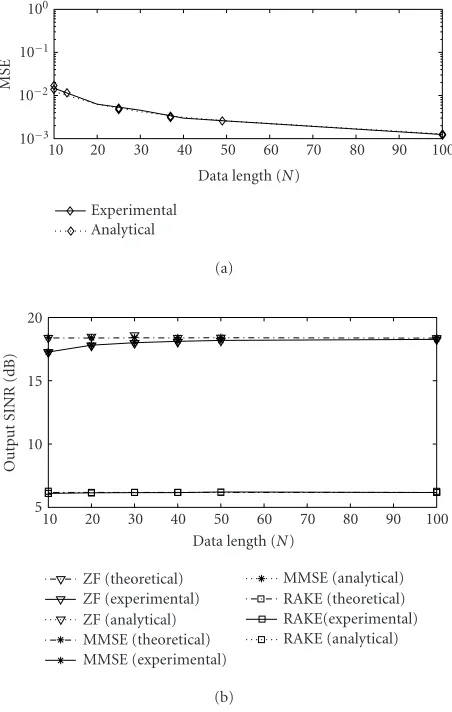
10 20 30 40 50 60 70 80 90 100
Data length (N) Experimental
Analytical 100
10−1 10−2 10−3
MSE
(a) 20
15
10
5
10 20 30 40 50 60 70 80 90 100
Data length (N) ZF (theoretical)
ZF (experimental) ZF (analytical) MMSE (theoretical) MMSE (experimental)
MMSE (analytical) RAKE (theoretical) RAKE(experimental) RAKE (analytical)
Output
SINR
(dB)
(b)
Figure1: Effect of data length. (a) MSE. (b) Output SINR.
study joint performance of the channel estimator and detec-tors under the effect of different system parameters, such as different data lengthN, various input signal-to-noise ratio SNR, varied number of usersJ, and signal to each interfering user’s power ratio (SIR).
Effect ofN,J=8, SNR=20dB, SIR=0dB
MSEs of channel estimation over differentNare plotted in Figure 1a. Experimental and analytical curves are highly con-sistent for all examinedN, and as expected, the MSE level de-creases whenNbecomes large. SINRs of all receivers are il-luminated inFigure 1b, where experimental, analytical, and theoretical SINRs start to overlap fromN = 50, indicating that the proposed receivers require very small data size to achieve their theoretical limit at 20 dB SNR environment. On the other hand, the ZF and MMSE receivers show much bet-ter performance than the RAKE receiver.
Effect of SNR,J=8,N=500, SIR=0dB
100 10−1 10−2 10−3
0 2 4 6 8 10 12
MSE
Input SNR (dB) Experimental
Analytical
(a)
12 10 8 6 4 2 0
−2
0 5 10
Output
SINR
(dB)
Input SNR (dB) (b) 100
10−1
10−2
10−3
0 5 10
BER
Input SNR (dB) (c)
Figure2: Effect of SNR. (a) MSE. (b) Output SINR. (c) BER. The legend of (b) and (c) is the same asFigure 1b.
seen that the experimental MSE converges to its analytical value at large SNR. Slight differences are caused by the first-order approximation error. Figures2band2cplot SINRs and BERs of each receiver. The MMSE receiver shows slightly
bet-ter performance than the ZF receiver. Both of them are signif-icantly superior to the RAKE receiver. The convergence be-tween the experimental and analytical values can also be ob-served for each receiver, indicating that our analytical SINR and BER can serve as good performance predictors. More-over, the experimental values are found to be very close to their theoretical ones, showing that each proposed receiver constructed from the proposed channel estimator and esti-mated noise behaves as well as its ideal counterpart.
Effect ofJ,N=500, SNR=10dB, SIR=0dB
The number of equally powered users in the system varies from 2 to 8. Figures3ato3cillustrate the MSE, SINR, and BER performance of the proposed methods, respectively. It can be observed that the MSE slightly degrades whenJ in-creases. Although an explicit relationship between the MSE andJis not obtained in (35),J’s effect can still be found to be
caused by the matrixA1j/2. Due to the same reason, the SINRs and BERs of the ZF and MMSE receivers also slightly de-grade for largeJ. The RAKE receiver’s performance degrades drastically, which can easily be explained from our analysis that the interference-plus-noise power in (61) significantly increases withJ. Again, for either MSE, SINR, or BER, exper-imental values are highly consistent with their corresponding analytical ones for largeJwhere Gaussian assumption for in-terference signals is well suitable. Each receiver’s experimen-tal SINRs and BERs are overlapped with their theoretical val-ues.
Near-far effect,N=500, SNR=10dB andJ=8
The power ratio of each interfering user over the desired user ranges from 0 dB to 10 dB at a step of 2 dB. Analytical and ex-perimental MSEs plotted inFigure 4aare found to be a con-stant, indicating that channel estimation MSE is not affected by interference power. This conclusion complies with (35), whereAj, as the only term containing interfering users’ ef-fect, is independent of interfering user’s power. The near-far resistance of the channel estimator can be accredited to the code correlation operation which significantly removes MUI in the partial data covariance matrix. Similar conclusion can be drawn to SINRs and BERs of both ZF and MMSE re-ceivers since they explicitly remove MUI. As expected, RAKE receiver’s performance degrades significantly when interfer-ence power increases.
6. CONCLUSION
100 10−1 10−2
10−4 10−3
2 3 4 5 6 7 8
MSE
Number of users (J) Experimental
Analytical
(a)
12 10 8 6 4 2 0
2 4 6 8
Output
SINR
(dB)
Number of users (J) (b)
100
10−1
10−2
10−3
2 4 6 8
BER
Number of users (J) (c)
Figure3: Effect of number of users. (a) MSE. (b) Output SINR. (c) BER. The legend of (b) and (c) is the same asFigure 1b.
100 10−1 10−2
10−4 10−3
0 1 2 3 4 5 6 7 8 9 10
MSE
σ2 j/σ12(dB) Experimental
Analytical
(a)
10
5
0
−5
0 2 4 6 8 10
Output
SINR
(dB)
σ2j/σ12(dB) (b)
100
10−1
10−2
10−3
0 2 4 6 8 10
BER
σ2 j/σ12(dB) (c)
APPENDICES
A. DERIVATION OF EXPECTATION QUANTITIES FOR THE ZF RECEIVER
A.1. Derivation ofE{δH(n)HZδH(n)}
In this case,Zis a deterministic matrix of dimensions (P−µ) by (P−µ). By (41), the (i,j)th element ofE{δH(n)HZδH(n)} is given byE{δgiHCi(n)HZCj(n)δgj}. The diagonal term (i.e.,
i = j) can readily be obtained as follows after replacing
E{δgjδgH
Replacingδgj by (29), the covariance between different channel perturbations is computed as
EδgjδgH
In this case,Zis a deterministic matrix of dimensionsJbyJ. According to (41), we immediately have
EδH(n)ZδH(n)H= previous analysis, the first term on the right-hand side of (A.4) involves the covariance of the perturbation between the same channel, which is at the order ofO(σ2
v/N), while the second term involves cross covariance between two diff er-ent channel perturbations, which is at the order ofO(σ4
v/N), therefore, (A.4) can be simplified to (A.5), after applying (35), as follows:
In this case, the matrixZshould have dimensions ofJ×(P−
µ), andZC(n) has dimensions ofJ×J(q+ 1). Partitioning each row ofZC(n) intoJsubvectors of equal length ofq+ 1 elements, and denoting the jth subvector at theith row as zHi j, we have
For a complex system, (A.7) clearly becomes a zero matrix. For a real system, as before, if we ignore the cross covariance between different channel perturbations, then (A.7) reduces to the following after using (35):
EδH(n)ZδH(n) can be readily obtained as the Hermitian of
E{δH(n)ZδH(n)}. It can also be observed that both
E{δH(n)ZδH(n)} and its Hermitian are at the order of
O(σ2
B. DERIVATION OF EXPECTATION QUANTITIES FOR THE MMSE RECEIVER
B.1. Derivation ofE{δσ2 vδσv2}
The perturbation of theqleast eigenvalues ofR1is given by
δσ2
v = (1/q) tr{(U1n)HδR1U1n}according to (14). Using vec and tr operations, it is straightforward to show
Eδσ2
θiis a unit vector with itsith element as 1. Correspondingly, the (i,j)th submatrix ofE{vec(δR1) vecH(δR1)}, which has size (q+ 1)×(q+ 1), becomesE{δR1θiθHjδR1} =T1(θiθHj) according to our definition (31). Applying those results, and noticing that
and for a complex system
Eδσ2 real or complex system.
B.2. Derivation ofE{δH(n)δσ2 v} Replacing δσ2
v with (1/q) tr{(U1n)HδR1U1n}, and expressing
E{δH(n)δσ2
v}in columns, we obtain
EδH(n)δσ2
It is observed that except the first column, all other ones involve cross-correlation betweenδgj andδR1. That cross-correlation depends on the cross-cross-correlation between δR1 andδRj for j = 1, and has been shown to be at the order ofO(σ4
v/N) by our previous analysis. Then we only focus on the first column next, and approximate all the other columns as0. Replacingδg1by (29) and applying trace property, the first column of (B.6) becomes
Eδh1(n)δσv2
C. DERIVATION OF EXPECTATION QUANTITIES FOR THE RAKE RECEIVER
C.1. Derivation ofE{vec(GH1δG1) vecH(GH1δG1)}
Rewriting vec(GH1δG1) as vec(GH1δG1I) and using vec operations, then the following holds:
EvecGH1δG1) vecH (C.1) is further computed as
EvecGH
whereBis defined as
B=BT0,. . .,BTP−1
T
. (C.3)
C.2. Derivation ofE{δG1δGH1}
Noticing (62), applying the result in (34), and ignoring
O(σ4
The authors would like to thank Professor L. Tong of Cornell University for his valuable suggestions. This work was sup-ported by the US National Science Foundation under Grant CCR 0207931.
REFERENCES
[1] Telecommunications Industry Association TIA, “Physical layer standard for cdma2000 standards for spread spectrum systems-TIA/EIA/IS-2000.2-A,” TIA/EIA Interim Standard, March 2000.
[2] 3rd Generation Partnership Project, “3GPP TS 25.2-series (physical layer),” technical specification. March 2001,http:// www.3gpp.org; http://www.3gpp2.org; http://www.itu.int/ imt.
[3] A. Viterbi, CDMA: Principles of Spread-Spectrum Communi-cation, Addison-Wesley, Calif, USA, 1995.
[4] S. Verdu, Multiuser Detection, Cambridge University Press, New York, NY, USA, 1998.
[5] E. H. Dinan and B. Jabbari, “Spreading codes for direct sequence CDMA and wideband CDMA cellular networks,” IEEE Communications Magazine, vol. 36, no. 9, pp. 48–54, 1998.
[6] S. Buzzi and H. V. Poor, “Channel estimation and multiuser detection in long-code DS/CDMA systems,” IEEE Journal on Selected Areas in Communications, vol. 19, no. 8, pp. 1476– 1487, 2001.
[7] A. Klein, G. Kaleh, and P. Baier, “Zero forcing and mini-mum mean-square-error equalization for multiuser detection in code-division multiple-access channels,”IEEE Trans. Vehic-ular Technology, vol. 45, no. 2, pp. 276–287, 1996.
[8] T. Krauss, W. Hillery, and M. Zoltowski, “Downlink specific linear equalization for frequency selective CDMA cellular sys-tems,” Journal of VLSI Signal Processing, vol. 30, no. 1-3, pp. 143–161, 2002.
[9] Y. Sung and L. Tong, “A projection-based semi-blind channel estimation for long-code WCDMA,” inProc. IEEE Int. Conf. Acoustics, Speech, Signal Processing (ICASSP ’02), vol. 3, pp. 2245–2248, Orlando, Fla, USA, May 2002.
[10] A. J. Weiss and B. Friedlander, “Channel estimation for DS-CDMA downlink with aperiodic spreading codes,” IEEE Trans. Communications, vol. 47, no. 10, pp. 1561–1569, 1999. [11] S. Bhashyam and B. Aazhang, “Multiuser channel estima-tion and tracking for long-code CDMA systems,”IEEE Trans. Communications, vol. 50, no. 7, pp. 1081–1090, 2002. [12] S. Buzzi and H. Poor, “On parameter estimation in long-code
DS/CDMA systems: Cramer-Rao bounds and least-squares algorithms,” IEEE Trans. Signal Processing, vol. 51, no. 2, pp. 545–559, 2003.
[13] Z. Xu and M. Tsatsanis, “Blind channel estimation for long code multiuser CDMA systems,” IEEE Trans. Signal Process-ing, vol. 48, no. 4, pp. 988–1001, 2000.
[14] Z. Xu, “Low-complexity multiuser channel estimation with aperiodic spreading codes,”IEEE Trans. Signal Processing, vol. 49, no. 11, pp. 2813–2822, 2001.
[15] H. Liu and M. Zoltowski, “Blind equalization in antenna array CDMA systems,”IEEE Trans. Signal Processing, vol. 45, no. 1, pp. 161–172, 1997.
[16] J. Ramos, M. Zoltowski, and H. Liu, “Low-complexity space-time processor for DS-CDMA communications,”IEEE Trans. Signal Processing, vol. 48, no. 1, pp. 39–52, 2000.
[17] C. J. Escudero, U. Mitra, and D. T. M. Slock, “A Toeplitz dis-placement method for blind multipath estimation for long code DS/CDMA signals,” IEEE Trans. Signal Processing, vol. 49, no. 3, pp. 654–665, 2001.
[18] N. D. Sidiropoulos, G. B. Giannakis, and R. Bro, “Blind PARAFAC receivers for DS-CDMA systems,”IEEE Trans. Sig-nal Processing, vol. 48, no. 3, pp. 810–823, 2000.
[19] Z. Yang and X. Wang, “Blind turbo multiuser detection for long-code multipath CDMA,” IEEE Trans. Communications, vol. 50, no. 1, pp. 112–125, 2002.
[20] L. Tong, A. van der Veen, P. Dewilde, and Y. Sung, “Blind decorrelating RAKE receivers for long-code WCDMA,”IEEE Trans. Signal Processing, vol. 51, no. 6, pp. 1642–1655, 2003. [21] P. Liu and Z. Xu, “Linear multiuser detection for uplink
long-code CDMA systems,” inProc. IEEE Int. Conf. Acous-tics, Speech, Signal Processing (ICASSP ’03), vol. 4, pp. 97–100, Hong Kong, April 2003.
[22] M. Honig and W. Veerakachen, “Performance variability of linear multiuser detection for DS-CDMA,” inProc. IEEE In-ternational Conference on Vehicular Technology, pp. 372–376, Atlanta, Ga, USA, May 1996.
[23] P. Schramm and R. R. Muller, “Spectral efficiency of CDMA systems with linear MMSE interference suppression,” IEEE Trans. Communications, vol. 47, no. 5, pp. 722–731, 1999. [24] S. Verdu and S. Shamai, “Spectral efficiency of CDMA with
[25] U. Madhow and M. L. Honig, “On the average near-far resis-tance for MMSE detection of direct sequence CDMA signals with random spreading,” IEEE Transactions on Information Theory, vol. 45, no. 6, pp. 2039–2045, 1999.
[26] S. Parkvall, “Variability of user performance in cellular DS-CDMA—long versus short spreading sequences,”IEEE Trans. Communications, vol. 48, no. 7, pp. 1178–1187, 2000. [27] K. Tang, P. H. Siegel, and L. B. Milstein, “A comparison of
long versus short spreading sequences in coded asynchronous DS-CDMA systems,” IEEE Journal on Selected Areas in Com-munications, vol. 19, no. 8, pp. 1614–1624, 2001.
[28] U. Mitra, “Comparison of maximum-likelihood-based de-tection for two multirate access schemes for CDMA signals,” IEEE Trans. Communications, vol. 47, no. 1, pp. 64–77, 1999. [29] Z. Xu, P. Liu, and X. Wang, “Blind multiuser detection: from
MOE to subspace methods,” IEEE Trans. Signal Processing, vol. 52, no. 2, pp. 510–524, 2004.
[30] Z. Xu, P. Liu, and M. D. Zoltowski, “Diversity-assisted channel estimation and multiuser detection for downlink CDMA with long spreading codes,” IEEE Trans. Signal Processing, vol. 52, no. 1, pp. 190–201, 2004.
[31] Z. Xu, “Perturbation analysis for subspace decomposition with applications in subspace-based algorithms,”IEEE Trans. Signal Processing, vol. 50, no. 11, pp. 2820–2830, 2002. [32] Z. Xu, “On the second-order statistics of the weighted sample
covariance matrix,”IEEE Trans. Signal Processing, vol. 51, no. 2, pp. 527–534, 2003.
[33] P. Lancaster and M. Tismenetsky,The Theory of Matrices, Aca-demic Press, San Diego, Calif, USA, 2nd edition, 1985. [34] Z. Xu, “Asymptotic performance of subspace methods for
synchronous multirate CDMA systems,” IEEE Trans. Signal Processing, vol. 50, no. 8, pp. 2015–2026, 2002.
[35] A. Host-Madsen and X. Wang, “Performance of blind and group-blind multiuser detectors,”IEEE Transactions on Infor-mation Theory, vol. 48, no. 7, pp. 1849–1872, 2002.
Ping Liureceived the B.S. and M.S. degrees in electronic engineering from Sichuan University, Chendu, China, in 1990 and 1993, respectively, the M.Eng. degree in electrical and electronic engineering from Nanyang Technological University, Singa-pore, in 1999, and the Ph.D. degree in elec-trical engineering from University of Cal-ifornia, Riverside, in 2004. From 1993 to 1997, she worked as a senior software
en-gineer with International Software Development Company, Shen-zhen, China. From April 1999 to August 1999, she worked as a search engineer with Kent Ridge Digital Labs, Singapore. Her re-search interests are in the area of blind channel estimation and equalization, wireless multiuser communications, and digital sig-nal processing.
Zhengyuan Xureceived both the B.S. and M.S. degrees in electronic engineering from Tsinghua University, Beijing, China, in 1989 and 1991, respectively, and the Ph.D. degree in electrical engineering from Stevens In-stitute of Technology, Hoboken, NJ, USA, in 1999. From 1991 to 1996, he worked as an engineer and Department Manager at the Tsinghua Unisplendour Group Corp. of Tsinghua University. Since 1999, he has
been with the Department of Electrical Engineering, University of