S T U D Y P R O T O C O L
Open Access
The systematic activation method as a nursing
intervention in depressed elderly: a protocol for a
multi
–
centre cluster randomized trial
Frans Clignet
1,2,3,4*, Berno van Meijel
1,4,5, Annemiek van Straten
1,2,6and Pim Cuijpers
1,2Abstract
Background:Depression in later life is a common mental disorder with a prevalence rate of between 3% and 35% for minor depression and approximately 2% for Major Depressive Disorder (MDD). The most common treatment modalities for MDD are antidepressant medication and psychological interventions. Recently, Behavioral Activation (BA) has gained renewed attention as an effective treatment modality in MDD. Although BA is considered an easy accessible intervention for both patients and health care workers (such as nurses), there is no research on the effectiveness of the intervention in inpatient depressed elderly.
The aim of study, described in the present proposal, is to examine the effects of BA when executed by nurses in an inpatient population of elderly persons with MDD.
Methods/design:The study is designed as a multi-center cluster randomized controlled trial. BA, described as The Systematic Activation Method (SAM) will be compared with Treatment as Usual (TAU). We aim to include ten mental health care units in the Netherlands that will each participate as a control unit or an experimental unit. The patients will meet the following criteria: (1) a primary diagnosis of Major Depressive Disorder (MDD) according to the DSM-IV criteria; (2) 60 years or older; (3) able to read and write in Dutch; (4) have consented to participate via the informed consent procedure. Based on an effect size d = 0.7, we intend to include 51 participants per condition (n = 102). The SAM will be implemented within the experimental units as an adjunctive therapy to Treatment As Usual (TAU). All patients will be assessed at baseline, after eight weeks, and after six months. The primary outcome will be the level of depression measured by means of the Beck Depression Inventory (Dutch version). Other assessments will be activity level, mastery, costs, anxiety and quality of life.
Discussion:To our knowledge this is the first study to test the effect of Behavioral Activation as a nursing intervention in an inpatient elderly population. This research has been approved by the medical research ethics committee for health-care settings in the Netherlands (No. NL26878.029.09) and is listed in the Dutch Trial Register (NTR No.1809).
Keywords:Major depressive disorder, Elderly, Inpatient, Behavioral activation, Nursing
* Correspondence:[email protected]
1
Department of Clinical Psychiatry, VU University, Van Der Boechorststraat 1, Amsterdam, the Netherlands
2
EMGO Institute, VU University Medical Center, Van der Boechorststraat 7, Amsterdam, BT 1081, the Netherlands
Full list of author information is available at the end of the article
Background
Depression in later life is a common mental disorder. Prevalence rates for depressive symptoms range between 3% and 35%, for minor depression approximately 10% [1], and for Major Depressive Disorder (MDD) 2% [2]. The prognosis of MDD in later life is poor: in three quarters of cases, the disorder becomes chronic [3]. MDD has serious consequences for everyday life (e.g. withdrawal from social activities, neglect of one’s self-care), with a risk of increased health care consumption [4,5]. MDD has one of the largest disease burdens, com-parable with other chronic diseases such as diabetes or COPD. About one third of patients with MDD will be referred to a mental health care facility (ambulatory or residential) [5]. The elderly are particularly at risk of developing persistent MDD because of their vulnerabil-ity to physical illnesses, which may contribute to the onset and persistence of MDD [6].
The most common treatment modalities for MDD are antidepressant medication and psychological interven-tions (or a combination thereof ) [7]. Antidepressants seem to be efficacious in treating late-life depression, al-though the treatment outcomes may be less positive for the subpopulation of older elderly [8]. There are several psychotherapeutic options in depression treatment. Among adults in general, these different options are comparable in their effectiveness [9]. Recently, Behav-ioral Activation (BA) has gained renewed attention as an effective treatment modality in MDD. In BA, patients learn techniques to monitor their mood and daily activ-ities and to gain insights into the connection between the two. The patients then learn how to develop a plan that increases the number of pleasant activities and posi-tive interactions with their environment. A meta-analysis has demonstrated large effect sizes for BA interventions (d = 0.89) when compared to a waiting list condition [10]. Furthermore, direct comparisons between Cogni-tive Therapy (CT) and BA have demonstrated that the effectiveness of the two interventions is comparable [11,12]. Since BA seems to be more accessible for many patients than CT, BA might be a preferred treatment op-tion. Another meta-analysis shows that, in general, psy-chotherapy seems to be as effective for older individuals as for younger adults [9]. However, this meta-analysis did not include studies focusing on severely depressed or hospitalized patients. In general, psychological treat-ments have been found to be less effective in outpatients with chronic depression [13], and possibly severe depres-sion [14], although the evidence is not conclusive [15].
Inpatient treatment remains an important treatment option for patients who cannot safely stay in their own environment [16]. Many of these patients suffer from se-vere and chronic forms of depression, and effective treat-ment options are needed to improve their recovery and
reduce their suffering. The number of studies on psycho-logical treatment for inpatients is limited. Recently, we summarized those studies in a meta-analysis and demonstrated small but robust effects [17]. However, there was a considerable variation in treatment setting, content of treatment, number of sessions, and inclusion and exclusion criteria applied. Furthermore, the quality of most of the studies was not optimal.
To our knowledge, there is only one study in which BA is tested in an inpatient population [18]. In this study, a total of 25 inpatient depressed adults were allo-cated either to BA (N = 10) or to Supportive Psychother-apy (SP) (N = 15). Despite the small sample, the study demonstrated the effectiveness of BA, with an effect size of 0.73. It is noteworthy that in this study, BA was exe-cuted by clinicians who had Master’s degrees, although BA is supposed to be an intervention which requires no complex skills.
The aim of study described in the present proposal is to examine the effects of BA when executed by nurses (RNs) in an inpatient population of elderly people with MDD. In this study, BA takes the form of a brief behav-ioral course of treatment lasting seven weeks, known as the Systematic Activation Method (SAM).
Methods/design Study design
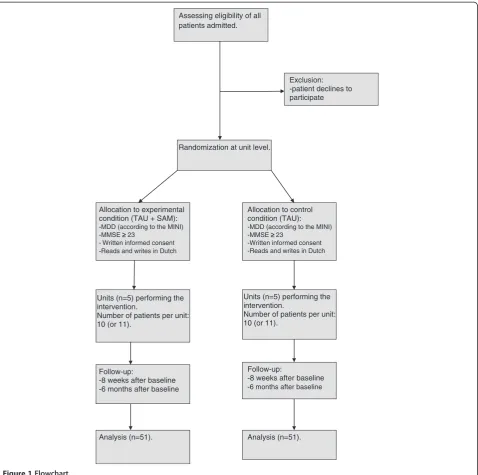
The study is designed as a multi-center cluster rando-mized controlled trial with the participation of ten men-tal health-care facilities in the Netherlands. The Systematic Activation Method (SAM) will be compared with Treatment As Usual (TAU) for inpatient depressed elderly. In Figure 1 the study design is summerized.
The study has been approved by the medical research ethics committee for health-care settings in the Nether-lands (No. NL26878.029.09) and is listed in the Dutch Trial Register (NTR No. 1809).
The units and randomization
The study will include ten mental health care units, which will be randomized to the experimental (SAM) or control (TAU) conditions. The following inclusion cri-teria will be used to select the units: (1) the units must specialize in the treatment of elderly patients with psy-chiatric disorders; (2) there must be at least three regis-tered nurses (RNs) available who are able and willing to execute the intervention. Units that specialize in a spe-cific disorder or treatment method (e.g. Electro Convul-sion Therapy) will be excluded from the study.
containing elements of the SAM, i.e. occupational ther-apy (because it focuses on activation), psychological treatment (because it focuses on influencing cognition).
For matching purposes, staff members at the partici-pating units will be asked to fill in a self-developed evaluation form providing information on the specific features of the unit. This form includes a number of general questions concerning characteristics of the pa-tient group, followed by more specific questions about the treatment program and level of restraint.
After matching the units into pairs, one unit will be allocated to the experimental condition and the other to
the control condition. Allocation will be performed by an independent researcher (AvS) who will not maintain contact with the participating units. A random allocation generator will be used.
Inclusion and exclusion criteria
The following patient inclusion criteria will be applied: (1) a primary diagnosis of Major Depressive Disorder (MDD) according to the DSM-IV criteria [19]. Patients with multiple diagnoses (e.g. comorbid personality dis-order) are eligible as long as the primary diagnosis is MDD; (2) 60 years or older; (3) able to read and write in
Units (n=5) performing the intervention.
Number of patients per unit: 10 (or 11).
Exclusion: -patient declines to participate
Allocation to experimental condition (TAU + SAM):
-MDD (according to the MINI) -MMSE ≥≥ 23
- Written informed consent -Reads and writes in Dutch
Randomization at unit level.
Allocation to control condition (TAU):
-MDD (according to the MINI) -MMSE ≥ 23
-Written informed consent -Reads and writes in Dutch
Assessing eligibility of all patients admitted.
Units (n=5) performing the intervention.
Number of patients per unit: 10 (or 11).
Follow-up:
-8 weeks after baseline -6 months after baseline Follow-up:
-8 weeks after baseline -6 months after baseline
[image:3.595.60.539.88.563.2]Analysis (n=51). Analysis (n=51).
Dutch; (4) the patient must have consented to participa-tion via the informed consent procedure.
Patients with severe cognitive problems (see below) will be excluded from this study because the interven-tion requires cognitive skills such as planning and evalu-ating activities and the structured monitoring of mood state.
Recruitment of the study sample
The participating units will keep a list of all newly ad-mitted patients and their primary diagnosis. All patients older than 60 with a primary diagnosis of MDD will be approached by a staff member and informed about the study. Once verbal consent is obtained and there are no cognitive problems according to the Minimal Mental State Examination (MMSE score≥23) [20], the patients will be approached by one of the researchers. Confirm-ation of the psychiatric diagnosis will be executed by means of a diagnostic interview using the MINI Plus, a standardized instrument to assess psychiatric disorders according to the DSM-IV criteria [21]. Patients who sat-isfy the inclusion criteria will then be included in the study. Due to the nature of the intervention, it will not be possible to perform the study as either a single-blind or double-blind trial.
Intervention
We developed the Systematic Activation Method (SAM) as a brief behavioral nursing intervention which focuses on increasing a positive mood change by increasing the number of positive activities. The SAM is based on Be-havioral Activation (BA), developed by Lewinsohn and colleagues [22-27] and Hopko et al. [18]. The underlying assumption is that positive reinforcement of a low re-sponse rate acts as an eliciting stimulus for depressive behaviors and serves as a sufficient explanation for in-activity in a depressed individual [27]. The SAM is pre-sented as a brief seven-week course. In order to make the SAM accessible for the elderly inpatient population, we have made some adjustments to the existing BA pro-tocols. First, the goals of each session are described in the course book. This differs from the existing protocols, in which the first session is used for mutual goal setting. It is difficult to describe the overall goals of treatment for inpatient elderly with MDD; that is why the goals have been described at the beginning of each session. Second, the course is presented as a nursing interven-tion instead of a psychological interveninterven-tion in order to increase its accessibility. Third, we simplified the activity logs to avoid overloading the patients. Fourth, the dur-ation of the intervention has been shortened to seven weeks, in contrast to the existing treatment protocols, which last between eight and 15 weeks.
The SAM consists of six sequential steps: 1) monitor-ing the patient’s mood; 2) having the patient execute pleasant activities, randomly selected from an existing list of 49 activities [25]; 3) having the patient develop a positive activity plan; 4) having the patient explore how to use external resources; 5) setting up an activity ex-periment; 6) evaluation and consolidation. There is a one-week time interval for each step except the third step (developing a positive activity plan), for which two one-week intervals are required. If necessary, the time interval between the sessions can be reduced or extend. Each session is highly structured and starts with a review of the patient’s homework. After that, the nurse and tient discuss the central theme of the session and the pa-tient is given his or her homework assignments for the coming week. The SAM is described in more detail by Clignet, Van Meijel, Van Straten, Lampe and Cuijpers [28].
The SAM requires the patient’s active involvement. This is often difficult due to the nature of MDD. The nurses participating in this study will therefore be given a brief training course of two four-hour sessions on guiding patients in executing the SAM. Training consists of two components. First, the nurses will be taught the structure and process of the SAM. Second, they will be trained in using motivational techniques. Many patients with MDD have difficulty engaging in structured activ-ities, this being one of the essential components of the SAM. The use of motivational techniques is therefore vital for the effective execution of the SAM.
During the study, the participating nurses will receive training on the job, with the researcher visiting the units for in biweekly supervision meetings. In addition, the re-searcher will maintain telephone and e-mail contact. During the supervision meetings, the nurses will be invited to reflect on their experiences during execution of the SAM intervention and–in the event of problem-atic implementation–adjustments and alternative strat-egies can be discussed. The biweekly meetings will therefore be used to establish treatment integrity, along with a random audit of the course books and a written evaluation by the patients in order to register the received components of the SAM intervention.
The participating patients will receive the SAM as an individual adjunctive therapy combined with their exist-ing primary treatment.
Control group
patients in their self-care activities, and encouraging them to participate in the unit’s daily activity program. Nurses also discuss the patient’s overall progress on a regular basis (weekly or biweekly). TAU is recorded at unit level. Before participating in the study, the units de-scribe their treatment program for MDD using a struc-tured form developed by the authors. This form is based on the NICE standard for MDD [7] and the Dutch guideline for MDD [29].
Assessment
All patients will be assessed at baseline, after eight weeks, and after six months. Each assessment will in-volve patients filling in a questionnaire. At baseline, we will collect demographic data (gender, social status, edu-cation, and ethnicity) and some information about the disease history (former episodes of MDD, frequency and nature of former treatments [outpatient treatments and/ or clinical admittance], and psychiatric co-morbidity).
Primary outcome
Our primary outcome is the level of depression. This is measured by means of the Beck Depression Inventory, second edition (BDI-II-NL) [30,31]. The BDI-II is a self-report scale which contains 21 items clustered in four response categories. The BDI-II is divided into two com-ponents, an affective component (e.g. mood) and a phys-ical component (e.g. loss of appetite). The cut off scores are: 0–13 for minimal depression, 14–19 for mild de-pression, 20 –28 for moderate depression, and 29–63 for severe depression. The Dutch version of the BDI-II has a high internal consistency (Chronbach’s α≥0.90) and a strong correlation with other depression instru-ments [32].
Secondary outcome
Secondary outcomes are: level of activity, anxiety, mas-tery, quality of life, costs and health care use.
An Activity Log (AL) will be used to measure the level of activity. This is a form in which the patient fills in his
or her activities over the past week. The AL contains a week schedule which is divided into morning, afternoon and evening activities. The patients will be asked to fill in the activities they have executed during the past week at baseline and after six months. The number of activ-ities and the type of activity will be used to calculate the activity level of each patient.
The seven anxiety items of the HADS (Hospital Anx-iety Depression Scale) [33] will be used to measure anx-iety. A four-point Likert scale is used to score the items (0 – 3) and the total score therefore ranges from 0 (no anxiety) to 21 (very anxious). The cut-off score is≥8, as an indication for an Anxiety Disorder.
Mastery will be measured by means of the Pearlin Mastery Scale [34]. This is a five-item self-report scale measuring internal locus of control. The items are pre-sented as statements to be scored on a five-point Likert scale. The scores on the Pearlin Mastery Scale range from 5 (minimum level of mastery) to 25 (maximum level of mastery).
Quality of life will be measured by means of the SF 36 (MOS Short Forms Health Survey) [35]. The scale con-tains 36 questions divided into eight subscales with three underlying dimensions: (1) Functional Status: physical functioning (10 questions), social functioning (2 ques-tions), role functioning – physical problems (4 ques-tions), role functioning – emotional problems (3 questions); (2) Welfare: mental health (5 questions), vitality (4 questions), pain (2 questions); (3) Evaluation of health care: general health perception (5 questions), change in health care (1 question). The response options vary from dichotomous to a six-point Likert scale. The SF-36 was translated into Dutch by Van der Zee & Sanderman [36].
[image:5.595.59.540.592.733.2]Costs will be measured by means of the TiC-P (Trim-bos/iMTA questionnaire for costs associated with Psy-chiatric Illness) [37]. This questionnaire consists of two parts: direct costs of care consumption and indirect costs of care consumption. The TiC-P is a broad ques-tionnaire which can be adjusted to the relevant
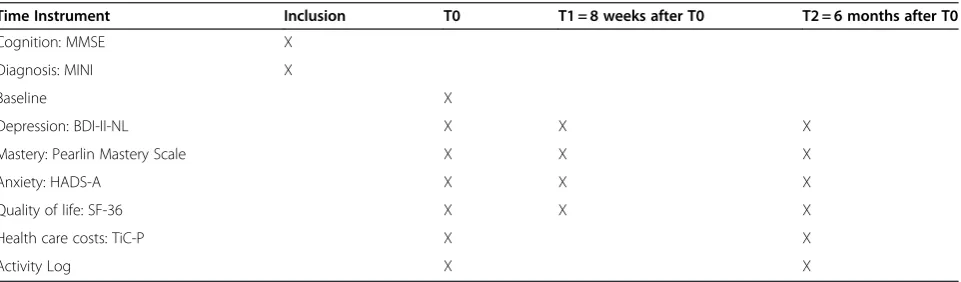
Table 1 Overview of instruments
Time Instrument Inclusion T0 T1 = 8 weeks after T0 T2 = 6 months after T0
Cognition: MMSE X
Diagnosis: MINI X
Baseline X
Depression: BDI-II-NL X X X
Mastery: Pearlin Mastery Scale X X X
Anxiety: HADS-A X X X
Quality of life: SF-36 X X X
Health care costs: TiC-P X X
population. This study will make use of the categories ‘care consumption’,‘informal care consumption’, and ‘use of medication’. All items have dichotomous ‘yes/no’ re-sponse options. The questionnaire will be completed by the patient as a self-report instrument.
Table 1 provides an overview of the instruments.
Statistical analyses
The primary outcome is level of depression as measured with the BDI-II-NL. This outcome will be used to test the effect of the SAM as a nursing intervention in in-patient depressed elderly compared with TAU. The SAM is considered effective if there is a significant decrease in the level of depression in the treatment group compared to the control group. Because the patients will be rando-mized at unit level, multi-level analyses will be used to test the effects of the SAM intervention. In order to in-vestigate differences in demographic and clinical vari-ables, ANOVAs and Chi-square tests will be executed. Differences between the two groups in baseline charac-teristics will be corrected where necessary. For patient-oriented outcomes, Clinical Significant Change will be used [38,39].
Data will be analyzed according to the ‘ intention-to-treat’principle as well as the‘completers only’principle.
In order to correct for missing values, Last Observa-tion Carried Forward and Multiple ImputaObserva-tion will be used as a sensitivity analysis.
Secondary outcome variables are quality of life (SF-36), costs (TiC-P), level of mastery (Pearlin Mastery Scale) and activities (Activity Log).
Anxiety is considered a co-variable because of its close association with MDD.
Sample size
Effect sizes (d) will be used to calculate the sample size. A meta-analysis by Cuijpers et al. [10] found an overall effect size of d = 0.87 in favor of Behavioral Activation (BA) compared to a waiting list condition. A study in an inpatient population found an effect size of d = 0.73 in favor of BA compared to supportive therapy [18].
Our study will be performed in an inpatient elderly population with severe MDD. Because of the large effect sizes in previous studies, an effect size of d = 0.7 is expected. With α= 0.05 and a power (1-β) of 0.8, 34 patients are needed per condition. In other studies [10,40], the dropout rate shows a large variability (2% – 50%). For this study, we assume an average drop-out rate of 25%. Another rule of the thumb is to increase the study population by 25% when patients are randomized at unit level. That means that 51 patients are required for each condition. In total, 102 patients will be included in this study. The sample size was calculated using the G*power 3.0 software program [41].
Discussion
This study will test Behavioral Activation (BA) as a nurs-ing intervention in an inpatient elderly population. The study is innovative in two aspects. First, in previous studies psychologists with Master’s degrees carried out this intervention [10,11,18]. In our study, BA has been adapted to make it a nursing intervention–the SAM – to be carried out by registered nurses [28]. This makes BA more accessible for a larger group of patients.
Second, to our knowledge, most of the research on BA has mainly been conducted in outpatient adult popula-tions. Only one other study [18] was executed in an in-patient adult population (N = 25) and, as far as we are aware, there are no studies in elderly inpatient popula-tions. Studies in the elderly population are relatively scarce and have focused on outpatients [42,43] or de-pression in combination with dementia [44,45]. To our knowledge, this is the first BA effect study in an elderly inpatient population worldwide.
In addition to the innovative nature of this study, there are some difficulties concerning the study design. First, the study is vulnerable to selection bias. The SAM will be implemented in five mental health care units, and decisions regarding patient inclusion will depend par-tially on the anticipated efforts of the staff nurses. In order to minimize selection bias, the researcher will make an initial selection of eligible patients. Despite this, however, selection bias cannot be ruled out entirely, be-cause it is ultimately the nurse who must motivate the patient to participate in the study, and this is expected to depend on the nurses’ belief that the SAM will be helpful for the patient. This may lead to selection bias in the experimental group, while the selection of patients in the control group will probably be free of bias. We will correct for any differences between the two groups in our statistical procedures.
This study will furthermore be vulnerable to informa-tion bias because a blind trial at interveninforma-tion level is not possible. In order to avoid information bias, only self-report scales will be used in this study.
Finally, the standardized execution of the intervention is a point of concern. The SAM will be implemented at five units for elderly persons with psychiatric disorders. Although the SAM is presented as a highly prescriptive intervention, we expect that– due to differences in pa-tient characteristics–individual variations in the execu-tion of the SAM may occur that will be difficult for the researchers to control. Coaching meetings will be orga-nized to promote treatment integrity.
Ethical considerations
benefit from the SAM while receiving treatment as usual. Although the study is intended for a broad cat-egory of patients, some patients will be excluded from the study, even though the nurses believe they could benefit from the SAM or parts thereof. These patients will also have an opportunity to engage in the SAM, but they will not be included in the study.
The SAM will be implemented in the control group units after all the patients have been included.
Trial status
The research is ongoing at the moment. We estimate that data-gathering will be completed in October 2012.
Competing interests
The authors declare that they have no competing interests.
Authors’contributions
FC was responsible for the initial draft of this manuscript and for organizing and implementing the study. BvM, AvS and PC contributed to development of the SAM and the study design. BvM, AvS and PC also revised earlier versions of the manuscript. All authors read and approved the final manuscript.
Acknowledgements
This study is partly funded by NutsOhra fund and Continuendo Musearte fund. The funders play no role in the study design, the collection, analysis and interpretation of data, or in the decision to submit the manuscript for publication.
Author details
1
Department of Clinical Psychiatry, VU University, Van Der Boechorststraat 1, Amsterdam, the Netherlands.2EMGO Institute, VU University Medical Center, Van der Boechorststraat 7, Amsterdam, BT 1081, the Netherlands.3Altrecht, Institute for Mental Health Care, Old Age Psychiatry, Dolderseweg 164, 3734 BN, Den Dolder, the Netherlands.4Inholland University of Applied Sciences, Research Group Mental Health Nursing, De Boelenlaan 1109, Amsterdam, HV 1081, the Netherlands.5Parnassia Bavo Groep, Institute for Mental Health Care, Monsterseweg 93, The Hague, RJ 2553, the Netherlands.6Mood Disorders Centre, Stocker road EX 4 4PY, Exeter, United Kingdom.
Received: 10 September 2012 Accepted: 10 September 2012 Published: 18 September 2012
References
1. Beekman AT, Copeland JR, Prince MJ:Review of community prevalence of depression in later life.Br J Psychiatry1999,174:307–311.
2. Beekman AT, Deeg DJ, van Tilburg T, Smit HJ, Hooijer C, van Tilburg W: Major and minor depression in later life: a study of prevalence and risk factors.J Affect Disord1995,36(1–2):65–75.
3. Beekman AT, Smit JH, Schoevers RS, de Beurs E, Braam AW, Penninx BW, van Tilburg W:The natural history of late-life depression: a 6-year prospective study in the community.Arch Gen Psychiatry2002, 59(7):605–611.
4. Bijl RV, Ravelli A:Psychiatrische morbiditeit, zorggebruik en zorgbehoefte. Resultaten van de Netherlands Mental Health Survey and Incidence Study(NEMESIS).Tijdschrift voor gezondheidswetenschappen1998,76(8):446– 457. Psychiatric morbidity, health care consumption & care needs. Results from the Dutch Mental Health Survey and Incidence study (NEMESIS). 5. Hilderink I, Vink M, van het Land H, Fotiadis L:Trendrapportage GGZ; Deel 3;
Kwaliteit En Effectiviteit, Basisanalyse. Utrecht: Trimbos Instituut; 2008 [Trend Report Mental Health Service, part 3; Quality and Effectiveness, basic analysis]. 6. Alexopoulos GS:Depression in the elderly.Lancet2005,365(4):1961–1970. 7. National Collaborating Centre for Mental Health (UK):Depression: The
Treatment and Management of Depression in Adults. Updated Editionth edition. Leicester (UK): British Psychological Society; 2010.
8. Tedeschini E, Levkovitz Y, Iovieno N, Ameral VE, Nelson JC, Papakostas GI: Efficacy of antidepressants for late-life depression: a meta-analysis and meta-regression of placebo-controlled randomized trials.Journal Clin Psychiatry2010,72(12):1660–1668.
9. Cuijpers P, van Straten A, Warmerdam L, Smits N:Characteristics of effective psychological treatments of depression: a meta regression analysis.Psychother Res2008,18(2):225–236.
10. Cuijpers P, van Straten A, Warmerdam L:Behavioral activation treatments of depression: a meta-analysis.Clin Psychol Rev2007,27(3):318–326. 11. Dimidjian S, Dobson KS, Kohlenberg RJ, Gallop R, Markley DK, Atkins DC,
Hollon SD, Schmaling KB, Addis ME, McGlinchey JB, Gollan JK, Dunner DL, Jacobson NS:Randomized trial of behavioral activation, cognitive therapy, and antidepressant medication in the acute treatment of adults with major depression.J Consult Clin Psychol2006,74(4):658–670. 12. Jacobson NS, Dobson KS, Truax PA, Addis ME, Koerner K, Gollan JK, Prince
SE:A component analysis of cognitive-behavioral treatment for depression.J Consult Clin Psychol1996,64(2):295–304. 13. Cuijpers P, van Straten A, Schuurmans J, van Oppen P, Hollon SD,
Andersson G:Psychotherapy for chronic major depression and dysthymia: a meta-analysis.Clin Psychol Rev2010,30:51–62. 14. Elkin I, Shea MT, Watkins JT, Imber SD, Sotsky SM, Collins JF, Glass DR,
Pilkonis PA, Leber WR, Docherty JP, Fiester SJ, Parloff MP:National Institute of Mental Health Treatment of Depression Collaborative Research Program. General effectiveness of treatments.Archives Gen Psychiatry
1989,46(11):971–982.
15. Driessen E, Cuijpers P, Hollon SD, Dekker JJM:Does pre-treatment severity moderate the efficacy of psychological treatment of adult outpatient depression? A meta-analysis.J Consult Clin Psychol2010,78(5):668–680. 16. Wolpert L:Stigma of depression–a personal view.British Medical Bulletin
2001,57:221–224.
17. Cuijpers P, Clignet F, van Meijel B, van Straten A, Li J, Andersson G: Psychological treatment of depression in inpatients: a systematic review and meta-analysis.Clin Psychol Rev2011,31(3):353–360.
18. Hopko DR, Lejuez CW, Lepage JP, Hopko SD, McNeil DW:A brief behavioral activation treatment for depression; a randomized pilot trial within an inpatient psychiatric hospital.Behav Modif2003,27:458–469. 19. American Psychiatric Association:Diagnostic and statistical manual of mental
disorders. 4th edition. Washington DC: American Psychiatric Association; 2000.
20. Folstein MF, Folstein SE, McHugh PR:Mini-mental state: a practical method for grading the cognitive state of patients for the clinician. J Psychiatr Res1975,12(3):189–198.
21. Van Vliet IM, Leroy H, Van Megen HJGM:Handleiding M.I.N.I. internationaal neuropsychiatrisch onderzoek. Leiden: Nederlandse Versie 5.0.0; 2002. Manual M.I.N.I. International Neuropsychiatric Interview, Dutch version.
22. Lewinsohn PM, Antonuccio DO:Steinmetz Breckenbridge J, Teri L: The Coping with Depression Course: A Psychoeducational Intervention for Unipolar Depression. Eugene OR: Castalia Publishing Company; 1984.
23. Lewinsohn PM:A behavioral approach to depression. InThe psychology of depression: Contemporary theory and research. Edited by Friedman RJ, Kats MM. New York: Wiley; 1974:157–185.
24. Lewinsohn PM, Biglan A, Zeiss AM:Behavioral treatment of depression. In
The behavioural management of anxiety, depression and pain. Edited by Davidson PO. New York: Brunner/Manzel; 1976:91–146.
25. Lewinsohn PM, Graf M:Pleasant activities and depression.J Consult Clin Psychol1973,41:261–268.
26. Lewinsohn P, Cuijpers P:In de put, uit de put: zelf depressiviteit overwinnen. Baarn: Uitgeverij Intro; 1996 [Coping with depression course].
27. MacPhillamy DJ, Lewinsohn PM:Depression as Function of Desired and Obtained Pleasure.J Abnorm Psychol1974,83(6):651–657.
28. Clignet F, van Meijel B, van Straten A, Lampe L, Cuijpers P:The Systematic Activation Method (SAM) in Depressed Elderly: A Case Report. Perspectives in Psychiatric Care2012,48(1):25–33.
29. Centraal Beleidsorgaan voor intercollegiale toetsing (CBO): In
Multidisciplinaire richtlijn depressie; richtlijn voor de diagnostiek en behandeling van volwassen cliënten met een depressie. Edited by Brandt-Dominicus JC. Utrecht: Trimbos Instituut; 2005. Multidisciplinary guideline for depression; guideline for the diagnosis and treatment of adults with a depressive disorder.
31. Van der Does AJW:Handleiding bij de Nederlandse versie van Beck Depression Inventory. 2nd edition. Amsterdam: Pearson: BDI-II-NL; 2002. Manual for the Dutch version of the Beck Inventory.
32. Evers A, van Vliet-Mulder JC, Groot CJ:Documentatie van tests en testresearch in Nederland, aanvulling 2005/01 (COTAN). Amsterdam: Boom test uitgevers; 2005 [documentation of tests and test research in the Netherlands, supplement 2005/01].
33. Zigmond AS, Snaith RP:The Hospital Anxiety and Depression Scale.Acta Psychiatrica Scandinavia1983,67:361–370.
34. Pearlin LI, Schooler C:The structure of coping.J Heal Soc Behav1978, 19(1):1–21.
35. Ware JE, Snow KK, Kosinski M, Gandek B:SF-36 Health Survey. Manual & Interpretation guide. Boston, MA: The Health Institute, New England Medical Centre; 1993.
36. Van der Zee K, Sanderman R:Het meten van de algemene
gezondheidstoestand met de RAND–36: een handleiding. RU Groningen: Groningen: Noordelijk Centrum voor Gezondheidsvraagstukken; 1993 [NCG reeks meetinstrumenten 3] [Measuring general health condition using the RAND-36; a manual].
37. Hakkaart-van Roijen L, van Straten A, Donker M, Tiemens B:Handleiding. Trimbos/iMTA questionnaire for costs associated with psychiatric illness (TiC-P). Erasmus Universiteit Rotterdam: Rotterdam: Instituut voor Medische Technology Assessment; 2002 [Guideline for the Trimbos/iMTA questionnaire for costs associated with psychiatric illness (TiC-P)]. 38. Jacobson N, Follette W, Revenstorf D:Psychotherapy Outcome research:
Methods for Reporting Variability and Evaluating Clinical Significance. Behavior therapy1984,15:336–352.
39. Jacobson NS, Truax P:Clinical significance: a statistical approach to defining meaningful change in psychotherapy research.J Consult Clin Psychol1991,59(1):12–19.
40. Persons JB, Burns DD, Perlof JM:Predictors of drop-out and outcome in cognitive therapy for depression in a private practice setting.Cogn Ther Res1988,12(6):557–575.
41. Faul F, Erdfelder E, Lang AG, Buchner:G*Power 3: a flexible statistical power analysis for the social, behavioral, and biomedical sciences. Behavior Research Methods2007,39(2):175–191.
42. Thompson LW, Gallagher D:Efficacy of psychotherapy in the treatment of late-life depression.Advances in Behavior Research Therapy1984,6:127–139. 43. Thompson LW, Gallagher D, Breckenridge JS:Comparative effectiveness of
psychotherapies for depressed elders.J Consult Clin Psychol1987, 55:385–390.
44. Teri L, Logsdon RG, Uomoto J, McCurry SM:Behavioral treatment of depression in dementia patients: A controlled clinical trial.J Gerontol
1997,52(4):P159–P166 [Series B, Psychological Sciences Social Sciences]. 45. Verkaik R, Francke AL, van Meijel B, Spreeuwenberg PM, Ribbe MW, Bensing
JM:The effects of a nursing guideline on depression in psychogeriatric nursing home residents with dementia.International Journal of Geriatric Psychiatry2010,26(7):723–732.
doi:10.1186/1471-244X-12-144
Cite this article as:Clignetet al.:The systematic activation method as a nursing intervention in depressed elderly: a protocol for a multi– centre cluster randomized trial.BMC Psychiatry201212:144.
Submit your next manuscript to BioMed Central and take full advantage of:
• Convenient online submission
• Thorough peer review
• No space constraints or color figure charges
• Immediate publication on acceptance
• Inclusion in PubMed, CAS, Scopus and Google Scholar
• Research which is freely available for redistribution