ISSN (Print) : 2320 – 3765 ISSN (Online): 2278 – 8875
I
nternational
J
ournal of
A
dvanced
R
esearch in
E
lectrical,
E
lectronics and
I
nstrumentation
E
ngineering
(An ISO 3297: 2007 Certified Organization)
Vol. 3, Issue 9, September 2014
Comparison of Image Compression
Techniques for Face Recognition Systems
1
Prof.Sheela Shankar, 2Dr.V.R Udupi
1
Department of Electronics & Communication Engg, KLE Dr. M. S. Sheshgiri CET, Udyambag ,Belgaum, India
2
Department of Electronics and Communication Engg, Gogte Institute of Technology, Belgaum, India
ABSTRACT: Face recognition is one of the challenging fields and rigorous research has been carried out in this regard. Though the technique is robust in recognizing faces for authentication, it often deals with storing quite a large number of face images of the same person with variations in pose, occlusions, expressions, etc. When many subjects are taken into account, the number of samples in the training database becomes considerably high and the storage becomes cumbersome. Hence memory management becomes a bigger issue and this is often a domain on which not much fuss is laid upon. The aim of this paper is to throw light on data compression and use a few of the techniques to compress face images. 507 face images from the AR face database were used and compressed with four different algorithms. The Compression Ratio (CR) and Bits Per Pixel (BPP) were calculated. It was found that these techniques were vital for building efficient face recognition systems.
KEYWORDS: Face recognition, Data compression, Face database, CR, BPP.
I.INTRODUCTION
Face recognition is a non-intrusive form of identifying a given face image and matching it against a set of faces in the database, in order to validate a person [1]. Today there are a number of face recognition algorithms available and it can be attributed to the rigorous research done in this regard. Even then, face recognition has been an active research domain in computer science. This is due to the fact that the inability or limited functionality of these systems in real time applications. The major reason being the variation in faces due to change in poses [2], age, goggles and other accessories, facial hair, illumination, etc [3].
Data compression is an art of representing data in a compact form, either for storage or for transmission purpose.Understanding the redundancy inherent in the data is crucial for designing effective data compression algorithms. There are basically two types of compression algorithms: Lossy and lossless compression. In lossy compression, some information is usually lost during the compression process. The system discards unimportant data, thereby providing higher compression rates. Whereas in lossless compression, no information is lost during the compression schemes [4-6]. The reconstructed data is identical to the original data in this case [7]. Lossless compression is basically applicable in critical systems like medical image applications, computer programs, etc.
The paper aims at effectively using a few of the data compression algorithms for compressing the face images thereby increasing the storage space of the training database. This helps in addition of more images, thereby adding to the efficiency of the face recognition system.
The rest of the paper is organized as follows. The related work is given in Section II. Section III deals with the implementation details along with the details of the face database used for the study. The results of the proposed implementation are given in Section IV. The paper concludes in Section V.
II.RELATED WORK
ISSN (Print) : 2320 – 3765 ISSN (Online): 2278 – 8875
I
nternational
J
ournal of
A
dvanced
R
esearch in
E
lectrical,
E
lectronics and
I
nstrumentation
E
ngineering
(An ISO 3297: 2007 Certified Organization)
Vol. 3, Issue 9, September 2014
10.15662/ijareeie.2014.0309019
The techniques used were JPEG, JPEG2000 and WSQ. In [10] an algorithm is devised which works directly with JPEG compressed images by using the DCT features rendered by the JPEG standard. This has also avoided the overhead of decompressing the image before recognition. Currently the shift from 2D images to 3D images to achieve better recognition results has been carried out. The storage of 3D face data requires lots of memory when compared to its 2D counterpart. A method to compress 3D face data and using it for the face recognition purpose has been proposed as in [12].
III.IMPLEMENTATION
Totally 507 face images from the AR face database were taken for the study. The images were arranged with proper labelling and were assessed using Matlab. The details of the face database used in the study are as given below:
A. AR Face Database
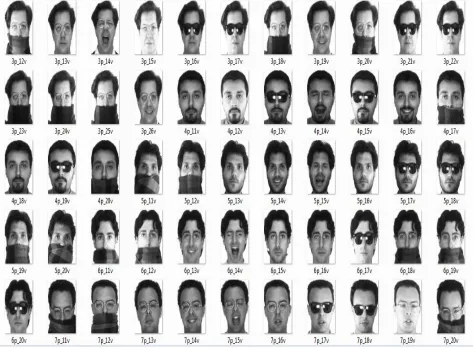
The database was created by Aleix Martinez and Robert Benavente in the Computer Vision Center (CVC) at the U.A.B. in the year 1988. It was the first database to include occlusions. The total number of subjects used here is 126 with 4000 total images. It provides provision for variation in illumination, frontal poses, expression, scarves, eye glasses, etc. [8]. The size of the RGB colour images is 768 × 576 pixels. In a 2-week interval, the subjects face images were captured twice by subjecting them to 13 different conditions. Fig. 1 shows samples taken from the AR Face Database.
ISSN (Print) : 2320 – 3765 ISSN (Online): 2278 – 8875
I
nternational
J
ournal of
A
dvanced
R
esearch in
E
lectrical,
E
lectronics and
I
nstrumentation
E
ngineering
(An ISO 3297: 2007 Certified Organization)
Vol. 3, Issue 9, September 2014
Each image was compressed using Progressive Coefficients Significance Methods (PCSM), Coefficients Thresholding Methods (CTM-1)and Coefficients Thresholding Methods (CTM-2). The tests used in these categories were:
1) Set Partitioning In Hierarchical Trees (SPIHT).
2) Subband thresholding of coefficients and Huffman encoding. 3) Global thresholding of coefficients and fixed encoding. 4) Global thresholding of coefficients and Huffman encoding.
In all the above cases, the Compression Ratio (CR) and Bits Per Pixel (BPP)were computed. The results are given in the results and discussion section.
IV.RESULTS AND DISCUSSIONS
ISSN (Print) : 2320 – 3765 ISSN (Online): 2278 – 8875
I
nternational
J
ournal of
A
dvanced
R
esearch in
E
lectrical,
E
lectronics and
I
nstrumentation
E
ngineering
(An ISO 3297: 2007 Certified Organization)
Vol. 3, Issue 9, September 2014
10.15662/ijareeie.2014.0309019
ISSN (Print) : 2320 – 3765 ISSN (Online): 2278 – 8875
I
nternational
J
ournal of
A
dvanced
R
esearch in
E
lectrical,
E
lectronics and
I
nstrumentation
E
ngineering
(An ISO 3297: 2007 Certified Organization)
Vol. 3, Issue 9, September 2014
The paper aims at comparing the efficiencies of different image compression algorithms for using them in face recognition systems. The importance of image compression is stressed so as to facilitate more storage space for newer class of face images in the training database.
ACKNOWLEDGEMENTS
The authors are immensely grateful to the valuable suggestions and help provided by the Department of Electronics and Communication Engineering, KLE Dr. M.S. Sheshagiri College of Engineering and Technology, Udyambag, Belgaum, Karnataka.
REFERENCES
1. Xiaozheng Zhang, Yongsheng Gao, “Face recognition across pose: A review”, Pattern Recognition 42 (2009) 2876 – 2896, Elsevier.
2. doi: 10.1016/j.patcog.2009.04.017
3. Rabia Jafri, Hamid R. Arabnia, “A Survey of Face Recognition Techniques”, Journal of Information Processing Systems, Vol.5, No.2, June
2009.
4. DOI : 10.3745/JIPS.2009.5.2.041
Sheela Shankar, Dr. V. R Udupi, “A Review on the Challenges Encountered in Biometric Based Authentication Techniques”, Volume 2, Issue 6, June 2014, International Journal of Advance Research in Computer Science and Management Studies (IJARCSMS). ISSN: 2321-7782 (Online).
5. R. Sankaralingam, R. Orugani, and N. Touba, “Static compaction techniques to control scan vector power dissipation,” in Proceedings of the
IEEE VLSI Test Symposium (VTS '00), pp. 35–40, Montreal, Canada, May 2000.
6. Manber, U.; Myers, G. Suffix arrays: A new method for on-line string searches. SIAM J. Comput.1993, 22, 935–948. 2. Larsson, N.J.;
Sadakane, K. Faster suffix sorting. Theoret. Comput. Sci. 2007, 317, 258–272.
7. CCSDS Secretariat, “Lossless Data Compression”, The Consultative Committee for Space Data Systems.
8. Manzini, G.; Ferragina, P. Engineering a lightweight suffix array construction algorithm.Algorithmca 2004, 40, 33–50.
9. Available at:http://www2.ece.ohio-state.edu/~aleix/ARdatabase.html
10. Delac, Kresimir, Mislav Grgic, and Sonja Grgic. "Image compression effects in face recognition systems." Face Recognition (2007): 75-92.
11. Eickeler, Stefan, Stefan Muller, and Gerhard Rigoll. "High quality face recognition in JPEG compressed images." In Image Processing, 1999.
ICIP 99. Proceedings. 1999 International Conference on, vol. 1, pp. 672-676. IEEE, 1999.
12. Delac, Kresimir, Sonja Grgic, and Mislav Grgic. "Image Compression in Face Recognition-a Literature Survey." Recent Advances in Face Recognition, edited by: Kresimir Delac, Mislav Grgic and Marian Stewart Bartlett (2008): 236.
ISSN (Print) : 2320 – 3765 ISSN (Online): 2278 – 8875
I
nternational
J
ournal of
A
dvanced
R
esearch in
E
lectrical,
E
lectronics and
I
nstrumentation
E
ngineering
(An ISO 3297: 2007 Certified Organization)
Vol. 3, Issue 9, September 2014
10.15662/ijareeie.2014.0309019
14. Funk, Wolfgang, Michael Arnold, Christoph Busch, and Axel Munde. "Evaluation of image compression algorithms for fingerprint and face
recognition systems." In Information Assurance Workshop, 2005. IAW'05. Proceedings from the Sixth Annual IEEE SMC, pp. 72-78. IEEE, 2005.
BIOGRAPHY
Prof.Sheela Shankar has completed her Bachelor of Engineering in Electronics and Communication from BIET, Davangere, Karnataka. She has pursued her Masters in Electronics and Control Engineering from Birla Institute of Technology and Science, Pilani. Currently she is working as an associate professor in the department of Electronics and Communication Engineering, KLE Dr.M.S.Sheshgiri College of Engineering and Technology, Belgaum, Karnataka, India. Her areas of research includes image processing, communication engineering and control engineering.