Congestion Control in Multi-Flow Environment
Using Multipath Routing Base in MANET
Neha Tiwari
Computer Science & Engineering
Nri Institute of Information Science and Technology Bhopal (M.P) 462021 India
Sini Shibu
Computer Science & Engineering
Nri Institute of Information Science and Technology Bhopal (M.P) 462021 India
Abstract— The multipath route establishment uses the method that discovers multiple multi hops communication between source and destination. Multi-path routing can balance the load better than the single path routing in ad hoc networks, thereby reducing the congestion by dividing the traffic in several paths. This research presents a new approach of Multipath Load Balancing with AOMDV routing protocol and Dynamic Queue based congestion control mechanism for avoiding congestion in network communication flows. In this scheme the store and forwarding capability of nodes are enhanced by varying the queue length according to incoming data. The AOMDV protocol performance is also enhanced to increment the link expiration time after failure the current connection establishment in network. The new connection is established according to the new link expiration time value, by that the possibility of link failure in AOMDV is also minimizes. It means the multipath routing performance in this technique has increases the link expiration time with vibrant queue length method. The multipath routing has no doubt better than the unipath routing and balance the load by proving the alternative path if the already established path are congested. But the performance of AOMDV is improves after adding the proposed scheme. The performance of normal AOMDV is measured on the basis of load handling capability of nodes in network and through performance matrices. The simulation of both the routing techniques is done in ns-2 simulator.
Index Terms—Congestion Multipath routing, Dynamic queue, Link expiration time, load balancing.
I.INTRODUCTION
Mobility and the lack of fixed infrastructure make Mobile Ad-hoc Networks (MANET) very gorgeous for new age applications. There are a lot of issues and challenges in designing a MANET network. At transport layer, end-systems can gather information about each used path: congestion state, capacity and latency. This information can then be used to react to congestion events in the network by moving the traffic away from congested paths [1].
Mobile Ad-hoc Networks (MANETs) are very gorgeous for latest applications. There are a lot of issues and challenges in designing a MANET network. Because active topology structure and node change every second on its position, one of the measure challenges is congestion, in MANET if sender node want to send data into the some specific receiver so very first broadcast routing packet onto
the network and get destination through the shortest path, if we apply AODV [2] or minimum intermediate hop, if we use DSR [3] after getting path sender sends actual data through uni-path link but at the same time more than one sender share common link so congestion occur onto the network that is measure issue for MANET. So various researcher works in that filed for minimization of congestion from network. In this synopsis we focus congestion minimization using multipath routing in ad-hoc network and transport layer base congestion control or rate analysis base congestion control in MANET.
In multipath technique sender sends data through more than one path to receiver node that increases the performance of the network are control the single share path congestion after that we also analyze data rate of sender if sender rate greater than the receiver node so we minimize the sending rate on the bases of transport layer technique..
II.MULTIPATH ROUTING
The process of discovering multiple routes among the distinct source and single destination at the time of single route discovery corresponds to multi-path routing [1]. In MANET, the prevailing issues such as scalability, security, network lifetime, etc can be handled by the multi-path routing protocols [4, 5]. This protocol enhances the end-to-end throughput and offers load balancing in MANET. Multipath routing has some disadvantages:-
A. Route Request Storm
A huge quantity of route request messages are created by the multipath reactive routing protocols. When the intermediate nodes requires to process the duplicate request messages, there is a chance of unnecessary overhead packets be set up in the networks.
B. Inefficient Route Discovery
III.RELATED WORK
Here we are presenting related work about existing work done in the field of MANET routing protocol, congestion control.
Makoto Ikeda, Elis Kulla et. al. [1] “Congestion Control for Multi-flow Traffic in Wireless Mobile Ad-hoc Networks” In this title, researcher deal with congestion control for multi-flow traffic in wireless mobile ad-hoc networks (MANET) using OLSR routing. This approach done through OLSR routing they also apply multi flow in AODV routing approach.
Kezhong Liu, Layuan Li et. al. [4] in his work titled “Research of QoS-Aware Routing Protocol with Load Balancing for Mobile Ad Hoc Networks” this title combines the multi-constraint QoS mechanism with the load balancing scheme to search the satisfying path between the source node and destination node. The researcher main objective is to develop a load balancing strategy that could monitor any changes to the load status of the neighborhoods and be able to choose the least loaded routes with the knowledge of the surrounding load status. The AQRL protocol makes an extension on the AODV and utilizes the node's resolvable bandwidth and load information to distribute the network loads, which can prevent network from getting into the sate of congestion, and avoid the power of congested node to be exhausted.
Yi, J., Adnane, A., David, S. and Parrein, B. [5] in his work titled “Multipath optimized link state routing for mobile ad hoc networks” The algorithm gains great flexibility and extensibility by employing different link metrics and cost functions. In addition, route recoveryandloop detectionare implemented in MP-OLSR in order to improve quality of service regarding OLSR.Multipath routing protocols for Mobile Ad hoc Network (MANET) address the problem of scalability, security (confidentiality and integrity), lifetime of networks, instability of wireless transmissions, and their adaptation to applications.
G.Vijaya Lakshmi Dr. C.Shoba Bindhu.[6] in his work titled “ Congestion Control Avoidance in Ad hoc network using queuing model”, they proposed the queuing mechanism hence improves the network metrics such as overall network throughput, reduces the route delay, overhead and traffic blockage probability. The approach is generated over a routing scheme in ad-hoc network.
S.Santhosh baboo and B.Narasimhan, [7] in his work titled “A Hop-by-Hop Congestion-Aware Routing Protocol for Heterogeneous Mobile Ad-hoc Networks”, In this title, they propose to develop a hop-by-hop congestion aware routing protocol which employs a combined weight value as a routing metric, based on the data rate, queuing delay, link quality and MAC overhead. Among the discovered routes, the route with minimum cost index is selected, which is based on the node weight of all the in-network nodes.
Tuan Anh Le [8] in his work titled “ecMTCP: An Energy-Aware Congestion Control Algorithm for Multipath TCP” they develop an energy-aware congestion control algorithm for multipath TCP, called ecMTCP. ecMTCP moves traffic from the most congested paths to the more
lightly loaded paths, as well as from higher energy cost paths to the lower ones, thus achieving load-balancing and energy-savings.
Jingyuan Wang, Jiangtao Wen et. al.[9] in his work titled “An Improved TCP Congestion Control Algorithm and its Performance “In this title, they propose a novel congestion control algorithm, named TCP-FIT, which could perform gracefully in both wireless and high BDP networks. The algorithm was inspired by parallel TCP, but with the important distinctions that only one TCP connection with one congestion window is established for each TCP session, and that no modifications to other layers (e.g. the application layer) of the end-to-end system need to be made. This work done only transport layer congestion control via TCP improvement method but congestion also occurs in routing time so that work enhance through routing base congestion control technique.
Kai Chen et al [10] proposed “an explicit rate-based flow control scheme (called EXACT) for the MANET network”. In EXACT, flow’s allowed rate is explicitly conveyed from intermediate routers to the end-hosts in each data packet’s special control header. As a result, EXACT reacts quickly and precisely to re-routing and bandwidth variation, which makes it especially suitable for a dynamic MANET network.
Kazi Chandrima Rahman et al [11] proposed “explicit rate based congestion control (XRCC) for multimedia streaming over mobile ad hoc networks”. XRCC addresses the problems that TCP faces when deployed over ad-hoc networks, and thus shows considerable performance improvement over TCP. Although XRCC minimizes packet drops caused by network congestion as compared to TCP congestion control mechanism, it still suffers from packet drops.
Hongqiang Zhai et al [12] proposed “a novel rate based end-to-end Congestion Control scheme (RBCC)”. Based on the novel use of channel busyness ratio, which is an accurate sign of the network utilization and congestion status, a new rate control scheme has been proposed to efficiently and reliably support the transport service in MANET. In RBCC, a sub layer consisting of a leaky bucket is added under TCP to control the sending rate based on the network layer feedback at the bottleneck node.
Emmanuel Lochin et al [13] proposed “a complete reliable rate-based protocol based on TCP-Friendly Rate Control (TFRC) and selective acknowledgement (SACK) mechanisms”. This design also introduces a flow control variable, which regulates the sender to avoid packet loss at the receiver due to a slow receiver. In this mechanism, there is no packet loss due to flow control, at the receiver, and applies a smoothness criterion to demonstrate that the introduction of the flow control inside TFRC does not alter the smoothness property of this mechanism.
information is proposed. In the link layer, each node uses a proportional controller to determine the ECN marking probability for the purpose of notifying incipient congestion. Then the rate based TCP sender adjusts its sending rate according to the feedbacks from the link layer.
Yuanyuan ZOU, Yang TAO at el [15] proposed a “A Method of Selecting Path Based on Neighbor Stability in Ad Hoc Network” in this title they studies about routing algorithm based on the stability in mobile Ad-Hoc network and presents a routing mechanism based on neighbor stability.
IV.PROBLEM FORMULATION
Mobile ad-hoc network are work under dynamic topology base and same time multiple sender share a common path that is not avoidable of congestion from network so that work to motivate in the new innovative idea of congestion control method and we solve the problem of congestion, here we use multipath routing an bandwidth estimation (rate base) scheme and control the congestion through the network.
V.PROPOSED CONGESTION CONTROL SCHEME The proposed algorithm is clearly explained the working of proposed load balancing scheme. In this dissertation the first sender has established the route to receiver on the basis of normal AOMDV protocol. It means more than one path is established in between sender and receiver and at time the data is delivers through one of the shortest selected path. Now the link expiration time (TTL) value and buffering capacity of nodes is fixed at that time. Now with in a particular time the sender has not deliver the data then the AOMDV is provides the alternative path that is equal or less than reliable than existing path. Then in that case the increment in TTL value is removes the possibility of link failure due to time limit. But if the possibility of load at any link or node is increases then in that the link expiration time always exceeds then to control the link expiration time limit the concept of queue length variation is added to control the possibility of congestion and link expiration time limit. The variable queue length scheme is raised the storing and forwarding capacity of or processing speed of nodes in network. The combination of these two different methods are improves the AOMDV routing performance and proper load balancing in network.
(1) Set M = Mobile Node’s (2) Set S = sender
(3) R = Receiver Node
(4) Routing Protocol = AOMDV (5) Broadcast Route Request (RREQ)
(6) Set TTL_START 5 //time to live 5 ms (7) TTL_THRESHOLD ; //Threshold Dynamic
Setting
(8) Define TTL_INCREMENT =2 // increment by 2 ms
{
If (Route in between S to R found) {
Check number of route;
If (route => 1) //means alternative route exist in network
{
If (next-hop !=R && Route Disjoint)
{
Continue tile all radio range nodes route packet receives
}
} Else
{
Receiver found;
Data_send();
}
}
Else {
Route error (RERR) }
Data send (S, R, data) // sending case drop minimization
{
Sender send’s data through computed path;
Check (Q size of Intermediate (I) node’s) //dynamic variation Q scheme at intermediate node
If (Q Size Limit == Full)
{Q= Q+1;
Store incoming data; }}
Receiver receives data from I node;
If (TTL==5)
{
Increment = THRESHOLD for next path establishment;
} Else {
Send ACK to sender S;
}} .
VI.SIMULATION ENVIRONMENT
Data collection and implementation we will use Network Simulator- 2 (NS-2) [16]. The description about simulation environment is as follows:
Network simulator 2 (NS2) is the result of an on-going effort of research and development that is administrated by researchers at Berkeley. It is a discrete event simulator targeted at networking research. It provides substantial support for simulation of TCP, routing, and multipath protocol.
trace file that can be used to do data processing (calculate delay, throughput etc)
A. The Simulation Parameter
We are taking the following parameters for case study shown in table1.
Table 1 Simulation parameter of case study
Number of nodes 40
Dimension of simulated area 800×800
Routing Protocol AOMDV
Simulation time (seconds) 100
Transmission Range 500m
Transport Layer Protocol TCP, UDP
Traffic type FTP, CBR
Packet size (bytes) 1000
Number of traffic connections 10
Maximum Speed (m/s) Random
B.Performance Matrices
There are following different performance metrics have showed the results on the basis of following:
Routing overhead: This metric describes how many routing packets for route discovery and route maintenance need to be sent so as to propagate the data packets.
Throughput: This metric represents the total number of bits forwarded to higher layers per second. It is measured in bps. It can also be defined as the total amount of data a receiver actually receives from sender divided by the time taken by the receiver to obtain the last packet.
Packet Delivery Ratio: The ratio between the amount of actually received data packets and incoming data packets.
VII.EXPECTED RESULTS
In this section the results are comparing in case of normal AOMDV routing and in case of proposed AOMDV routing. The proposed queue based scheme is showing the better performance and improves the routing capability of AOMDV protocol.
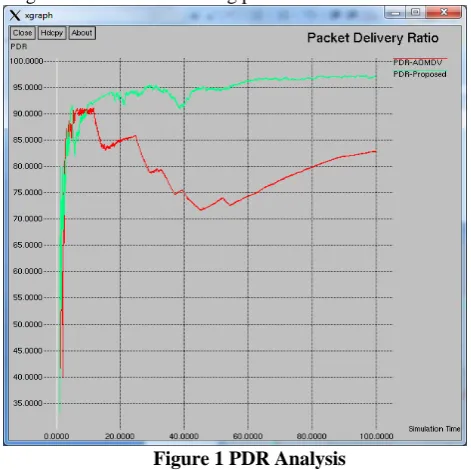
A. Packet Delivery Ratio Analysis
The percentage of packets are successfully received at destination are measured through packet delivery ratio. This graph is represents the performance of normal AOMDV routing and proposed link expiration time increment with dynamic queue length method. The normal AOMDV are no doubt provides the better results as compare to uni-path routing and capable of handling heavy load through multipath technique. In this graph the performance of AOMDV protocol and proposed load balancing scheme are almost equal at simulation time about 0 to 10 seconds but after that the PDF in case of proposed scheme is about 97 % up to end of simulation but the normal AOMDV are only provides the 83 % PDF at the end of simulation. At time about 40 to 60 seconds the PDF is about 72 and after that improves and reaches to 83%. The reason of low PDF
values is to switch next alternative path if the possibility of congestion is occur in existing path.
Figure 1 PDR Analysis
B.Throughput Analysis
The number of packets is received at destination in per unit of time are measured the through throughput parameter. The throughput is higher in network, if the transmission and receiving are running continually without any hindrance like congestion. This graph represents the throughput performance in case of normal AOMDV routing and load balancing with dynamic queue length scheme with dynamic link expiration time value for AOMDV routing. In case of proposed scheme the through put is about 875 packets / seconds but in case of normal AOMDV routing the throughput is only about 650 packets/ seconds. The performance of normal AOMDV is enhanced on the basis of link expiration time (TTL) and nodes packets storing capability. The proposed scheme is also removes the possibility of congestion and not only provides the alternative but also also improves the routing procedure.
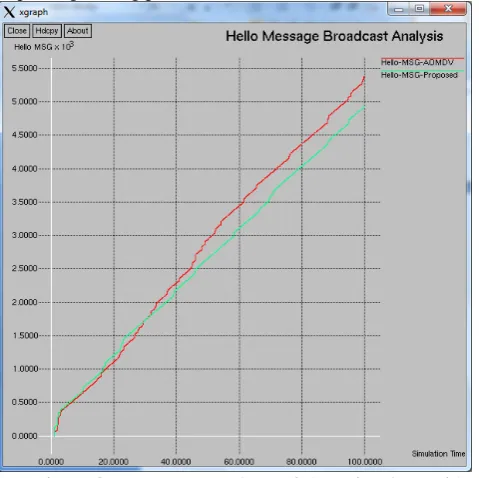
C.Hello Message Broadcast
The number of routing packets flooded in network for connection establishment and confirmation through sender and receiver in network are measured through routing load performance parameter. The less number of routing packets delivery in network are showing the better performance. In normal AOMDV routing and proposed load balancing scheme the routing load in network are nearly equal at time of about 30 seconds but after that the routing load in network of AOMDV are enhance and about 5300 packets are forwarded in to finding destination but in case of proposed scheme this is about 4800 packets in network. The larger numbers of routing packets are consumes the network bandwidth and time duration of data transmission is also affected. Now the proposed scheme are reduces the routing load through reduces the possibility of congestion through dynamic queue length and link expiration time value. If the link expiration time is enhanced during transmission then the obstacle of long route data transmission are also reduced in proposed scheme and improving routing performance.
Figure 3 Hello Message Analysis(Routing Analysis)
D.UDP Received Analysis
User Datagram Protocol (UDP) is the Transport layer protocol that works on connection less mechanism. This graph is shows the UDP packets received analysis of normal AOMDV protocol and proposed load balancing scheme with dynamic queue based with dynamic link expiration time value AOMDV routing. Here in case of normal AOMDV routing about 1750 packets are deliver in network but in case of proposed technique about 2400 packets are deliver in network. This performance shows the enhancement on link expiration time storing capability of nodes are improves the packets receiving.
Figure 5 UDP packets received analysis
E.UDP Lost Analysis
The main reason of packet loss in the UDP protocol is it s not reliable for data transmission due to continuous deliver of data packets without any confirmation with sender of successful data delivery. Here the packet loss in case of AOMDV is about 475 but the packet loss in proposed scheme with AOMDV routing is about only 60 packets. The difference of loss of packets is very high it means the proposed scheme are provides the better routing technique that minimizes the packet loss and properly balance the load in network.
Figure 6 UDP packets received analysis
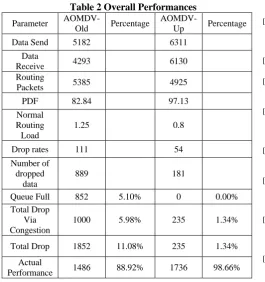
F.Overall Summery of Routing Schemes
Table 2 Overall Performances
Parameter
AOMDV-Old Percentage
AOMDV-Up Percentage
Data Send 5182 6311
Data
Receive 4293 6130
Routing
Packets 5385 4925
PDF 82.84 97.13
Normal Routing Load
1.25 0.8
Drop rates 111 54
Number of dropped
data
889 181
Queue Full 852 5.10% 0 0.00%
Total Drop Via Congestion
1000 5.98% 235 1.34%
Total Drop 1852 11.08% 235 1.34%
Actual
Performance 1486 88.92% 1736 98.66%
VIII.CONCLUSION
The demands for quality based multipath routing have resulted in considerable attention by researchers in the area of load balancing in MANET. There is a tendency in traditional Mobile ad hoc routing protocols to use intermediate nodes for large number of routes. This route selection is based on the routing protocol connection establishment procedure. The new routing approach we proposed with AOMDV routing protocol between a pair of source and destination nodes using intermediate nodes which are rich in resources like bandwidth, processing power etc. This scheme is based on the link expiration time and variable queue length method. This scheme are improves the routing capability of AOMDV multipath routing protocol by proving the ability to increment the link establishment time after current failure and by storing ability of packets. The proposed scheme ensures that the available bandwidth in the network is utilized efficiently by distributing traffic evenly which ensures better load balancing and congestion control. The simulation results are shows that the proposed scheme the nodes are efficiently handle the more load as compare to normal AOMDV. The proposed AOMDV routing scheme are provides the better results as compare to normal AOMDV routing on the matrices also like Routing load, throughput etc.
REFERENCES
[1] Makoto Ikeda, “Congestion Control for Multi-flow Traffic in Wireless Mobile Ad-hoc Networks” IEEE Sixth International Conference on Complex, Intelligent, and Software Intensive Systems , pp. 290 - 297, 2012.
[2] S. Das, C. Perkins and E. Royer, “Ad Hoc On Demand Distance Vector (AODV) Routing”, IETF RFC3561, July 2003.
[3] D. Johnson, "The Dynamic Source Routing Protocol for Mobile Ad Hoc Networks (DSR)", IETF Internet Draft, draft-ietf-manet-dsr-09.txt, April 2003.
[4] Chengyong Liu, Kezhong Liu, Layuan Li, “Research of QoS – aware Routing Protocol with Load Balancing for Mobile Ad-hoc Networks”, WiCom’ 08, 4th International Conference on Wireless communication, 2008.
[5] Yi, J., Adnane, A., David, S. and Parrein, B.,” Multipath optimized link state routing for mobile ad hoc networks”, Ad- Hoc Networks 9, pp-28-47, 2011.
[6] G.Vijaya Lakshmi Dr. C.Shoba Bindhu, “Congestion Control Avoidance in Ad hoc network using queuing model”, International Journal of Computer Technology and Applications, pp 750-760, vol 2, Issue 4, 2011.
[7] S.Santhosh baboo and B.Narasimhan, “ A Hop-by-Hop
Congestion-Aware Routing Protocol for Heterogeneous Mobile Ad-hoc Networks”, International Journal of Computer Science and Information Security (IJCSIS), Vol. 3, No. 1, 2009.
[8] Tuan Anh Le, Choong Seon Hong, Member, IEEE, Md. Abdur
Razzaque et. al. “An Energy-Aware Congestion Control Algorithm for Multipath TCP” IEEE Communications Letters, Vol. 16, No. 2, February 2012.
[9] Jingyuan Wang, Jiangtao Wen et. al. in his work titled “An Improved TCP Congestion Control Algorithm and its Performance” 2011 IEEE.
[10] K. Chen, K. Nahrstedt, N. Vaidya, "The Utility of Explicit Rate-Based Flow Control in Mobile Ad Hoc Networks", Proc. IEEE Wireless Communications and Networking Conference (WCNC 04), pp 1921-1926, 2004.
[11] [13] K. C. Rahman, S. F. Hasan, “ Explicit Rate-based Congestion Control for Multimedia Streaming over Mobile Ad hoc Networks”, International Journal of Electrical & Computer Sciences IJECS-IJENS, Vol 10, No 04, 2010.
[12] H. Zhai, X. Chen, Y. Fang, “Rate-Based Transport Control for Mobile Ad Hoc Networks”, IEEE Wireless Communications and Networking Conference, pp 2264 – 2269, Vol 4, 2005.
[13] E. Lochin, G. Jourjon, S. Ardon P. Senac, “Promoting the Use of Reliable Rate Based Transport Protocols: The Chameleon Protocol”, International Journal of Internet Protocol Technology, Vol 5, Issue 4, pp 175-189, March 2010.
[14] Y. Xu, Y. Wang, C.S. Lui, D-M. Chiu, “Balancing Throughput and Fairness for TCP Flows in Multihop Ad-Hoc Networks”, 5th International Symposium on Modeling and Optimization in Mobile Ad Hoc and Wireless Networks and Workshops (WiOpt), pp 1 – 10, 2007.
[15] Yuanyuan ZOU,Yang TAO “A Method of Selecting Path Based on Neighbor Stability in Ad Hoc Network” This work is supported by chongqing science and technology key research projects (No.2009AB2245) , 2012 IEEE.