A New Approach and Thermal Analysis of a LED Lamp Cooling by
using Optimization of Circular Fins
Md Azam Ali 1,G.Naresh Babu2, K. Anil Babu3 1
M.Tech Student, Dept. of Mechanical, Siddhartha institute of technology and sciences, Telangana, India
2
Assistant Professor, Dept. of Mechanical, Siddhartha institute of technology and sciences, Telangana, India
3
Assistant Professor, Dept. of Mechanical, Siddhartha institute of technology and sciences, Telangana, India
Abstract:The decision of distinct fin configuration in
LED Lamp for heat transfer application rely upon the burdenand manufacturing method consideration as good as the thermal characteristics it displays, circular Fins are oneof essentially the most well-known choice for enhancing the heat transfer rate to lower an junction temperature byminimizing the total thermal resistance of method. For actively cooled methods, this will essentially be completedthrough at the same time engineering the conduction by means of the heat sink and creating a good-designed flow sample ofheat over suitable convective floor area. Finite element method (FEM) was used to compute the maximumtemperature at junction of LED. A large study used to be implemented using ANSYS, a strong platform for heatflow through way of Led heat sink. Results accepted were presented in a series of temperature along the size of fins.
Keywords-ANSYS, Circular Fins, FEM, Junction
Temperature, Thermal Resistance.
I. INTRODUCTION
The latest solid-state lightening through light-emitting diodes(LED’s) has an inevitable trend to produce white lightillumination. Now-a-days LED’s are more popular for theirhigher luminous efficiency, energy serving and service life ascompared to conventional lights, but has a limitation of higherheat generation due to which life of LED becomes decreases([1], [2]). Hence it is necessary to modify or design anadvance cooling system which can serve effective cooling soas to get better luminous efficiency for longer period. For thatcomputational, analytical and experimental studies are carriedout mainly for the fins geometry, its number and pitches. Finsare generally used to increase the heat transfer rate from thesurface. According to Yunus A. Çengel [3] in analysis of finswe consider steady operation with no heat generation in thefin & assume thermal
conductivity of material is not changedi.e. constant. The heat transfer coefficient (h) is assumed to beconstant over the entire surface of the fin. The value ofconvective heat transfer coefficient (h) is much higher at thetip as compared to its base, since working fluid is majorlysurrounded by the solid surface near its base. Hence adding somany fins on a working surface decreases the overall heattransfer coefficient. Up till now, a serious consideration ofadvanced thermal management techniques for high powerLEDs has been already tried in many literatures. Toinvestigate package and system level temperature distributionof high power LED array, Christensen et al. [5] combined a 3-Dimensional Finite element model and thermal resistornetwork model to calculate the impact of a compact highpower LED array density, and active versus passive coolingmethods on device operation. It was suggested that activecooling such as, forced air convection, flat heat pipe andliquid cooling would be better to maintain high power LEDsunder the maximum temperature limit. But practically theabove methods are not possible to incorporate, it would
bebetter to innovate conventional fin
design.Muhammed NasirInan and Mehmet Arik [6] developed the figure of merits(FOM) which are important for the designers and researchersto find the
most optical solution for accounting for
importantfacts such as weight, size, cost and performance. They studiedthe thermal and optical experimental results of variouscommercial A-line LED lamps and investigated a variousFOMs based on size, weight and performance.
II. RELATED WORK
Simulation and experimental results show that the LEDmodule with a water-cooling tube exhibits better thermalperformances than the others. Dae-Whan Kim et al [3]demonstrated that the two-phase thermo fluid characteristicsof a dielectric liquid data obtained for single-phase wateryielded excellent agreement with
predictions for theconvective heat transfer
coefficients, dielectric fluids andtherefore the back surface of a full of life electronic part,supply a most promising approach for cooling high-poweredLEDs.
T.Cheng et al[4] were demonstrated Increasing pump rate offlow can build a pointy increase of the flow resistance. thefabric of device shell with high thermal physicalphenomenon will ameliorate the cooling performance,however the perform is restricted. In
line with preliminarytests and numerical
optimization, an optimized small jetcooling system is unreal and applied in thermal managementof a
light-emitting diode lamp. The temperature
checkdemonstrates the cooling system works well.
Ming-Tzer Lin et al [5] were explained water-coolingcontainer in the high power LED array gave more efficientconvection and the heat created by the LEDs was easilyremoved in the experiments. It was
shown that micro-tubewater-cooling systems
rendered an improvement in thermalmanagement that effectively decreases the thermalresistance and provides very good thermal dissipation.
III. THEORETICAL CALCULATION
LEDs produce light and heat by means of differentmechanisms as compared to the incandescent bulb. Bysupplying electrical energy, the electron energy will bepartly transformed into light and fairly into heat. Apparentlythe research into LED technology is paying attention onoptimizing the light emitting efficiency.
Although each module has a unique structure, generally theLED package consists of a LED chip
of the heat will be conducted to the heat sink. Themajor part of the heat is transferred to the surroundings byconvection from an optimized designed heat sink. On theother hand, radiation on the surface of the heat sink occursnaturally and it cannot be ignored as the average criticaltemperature of the LED module is high.
IV. METHODOLOGY
Fig.1 showed the schematic diagram of a conventional LED package structure. The LED die was packaged with silicon or epoxy encapsulant. Phosphors were added into encapsulant to convert wavelength range from blue to yellow in order to get white light. Since silicon or epoxy encapsulant has low thermal conductivity, the heat flow path can be ignored. The temperature of the LED junction (Tj)
can be expressed as Tj = Ta + (Rja×Pd)
Fig.1 Schematic diagram of a conventional LED package structure
Thermal management of LEDs is extremely critical and understanding it is essential when designing and developing LED systems. To prolong their lifetime and improve their performance, LEDs must be kept cool under all drive and operating conditions. The
fundamentals of heat transfer and a full
included resistances from convection and within the heat sink. Radiation is typically responsible for less than 5% of heat transfer in forced convection and was assumed negligible for this study. The resistances from thermal interfaces and within the LED constitute research fields beyond the scope of this work.
Fig. 2 Simplified thermal pathway of an array of down-lighting LEDs attached to a heat sink.
In the light of the above, the present work deals with
i) Developing a FEM methodology using ANSYS for the coupled-field analysis of circular fins by minimizing the total system’s thermal resistance.
ii) Studying the variation in junction temperature of the fin by varying number of nodes and carrying out a convergence study.
V. RESULTS AND DISCUSSIONS
•
The finite element analysis was based on the following common assumption:Steady-state heat flow,
• The material is homogeneous and isotropic, • There is no heat source,
• The convection heat transfer co-efficient is same all over the surface, the temperature of the surrounding fluid is uniform,
• The thermal conductivity of the material is constant
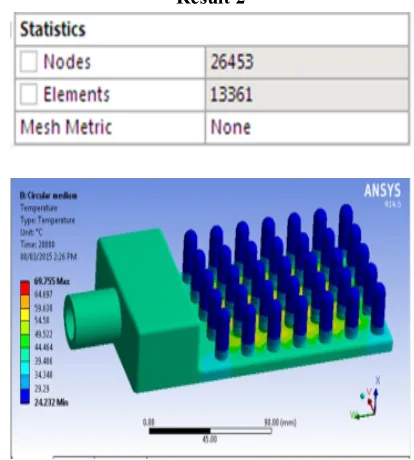
Fig.3 Circular Medium mesh
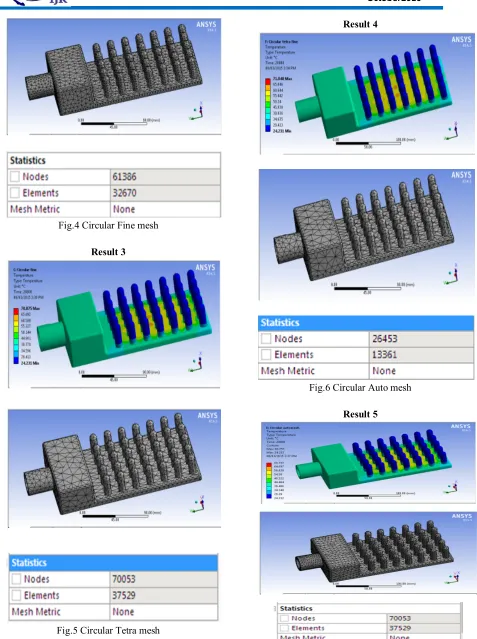
Fig.4 Circular Fine mesh
Result 3
Result 4
Fig.6 Circular Auto mesh
Result 6
VI. CONCLUSION
Thermal management of LED is tremendously critical and working out it is foremost when designing and constructing LED methods. To prolong their lifetime and strengthen their efficiency, LED have got to be stored cool below all pressure and working conditions. The fundamentals of heat sink and a full understanding of the heat development and thermal stack are required to effectively design an LED process. Thermal simulations and checking out should be used to optimize and measure the efficiency of every LED procedure. Technological trends within the area of high energy LED moderate sources have enabled their utilization in most cases illumination purposes. Along with this advancement
comes the necessity for innovative thermal
administration systems in an effort to make certain device efficiency and reliability. Minimizing an LED’s junction temperature is finished by way of minimizing the whole procedure’s thermal resistance. For actively cooled techniques, this may increasingly basically be carried out through concurrently engineering the conduction through the heat sink and making a well-designed flow sample over suitable convective floor discipline.
REFERENCES
[1] Zukauskas A, Shur MS, Gaska R (2002) Introductionto solid state lightening, Wiley, New York, pp21-29
[2] You JP, He Y et all (2007) Thermal Management
ofHigh Power Led; Preceeding of the
IMPACTConference, Taipei, Taiwan, pp239-242.,
[3] Yunus A. Cengel, 2007, ―Heat and Mass Transfer- APractical Approach,SI units 3rd Edition, TataMcGraw Hill Co.
[4] Incropera F.P., Dewitt D.P. 1996,Fundamentals Heatand Mass Transfer,4thedition, John Wiley & Sons.
[5] Christensen A, Ha M, Graham S (2007) Thermalmanagement methods for compact high
power LEDArrays. In: Proceedings of 7th
international conferenceon solid state lighting, San Diego, CA,
[6] Muhammed Nasir Inan and Mehmet Arik (2014) Amulti-functional design approach and proposed figureof merits for solid state lightening systems. Journal ofsolid state lightening. By Springer.
[7] Alvin C, Chu W, Cheng C, Teng J: Thermal Analysis of Extruded Aluminum Fin Heat Sink for LED Cooling Application.
[8] Chen KC, Su YK, Lin CL, Lu YH, Li WL, Chuang RW, Huang JQ, Chen SM (2008) Thermal management and novel package design of high power light-emitting diodes. In: Proceedings of 58th ECTC, Orlando, FL, pp 795–77.
[9] . Ma HK, Chen BR, Lan HW, Lin KT, Chao
CY(2009) Study of an LED device with
vibratingpiezoelectric fins. In: Proceedings of 25th annual IEEESemi-Therm, San Jose, CA, pp 267–272.
BIODATA
AUTHOR1
Md AzamAli has pursuing M.Tech (Thermal
Engineering) from Siddhartha Institute of
Technology and Sciences, Ghatkesar, Rangareddy, Telangana, India.
AUTHOR2
G.NareshBabu has presently working as Assistant Professor and HoD of Mechanical Department in Siddhartha Institute of Technology and Sciences, Ghatkesar, Rangareddy, Telangana, India.
AUTHOR3
K.Anil Babu has presently working as Assistant