Motion Detection and Tracking of a Leopard
in a Video
Nitesh Sanklecha
1, Dr. Sudarshan Patil Kulkarni
2PG Student [IE], Dept. of ECE, Sri Jayachamarajendra College of Engineering, Mysuru, Karnataka, India1
Professor, Dept. of ECE, Sri Jayachamarajendra College of Engineering, Mysuru, Karnataka, India2
ABSTRACT: Video object tracking has got wide application in vision, security, observational issues in natural science and in various other fields. In simple words, tracking may be defined as the estimation of the trajectory of a moving object in the image plane as it moves around the scene. Many research has been done in tracking a moving object. Most of the research is been carried out on tracking either Human Beings (like, Face Recognition, Waving hand etc.) or Vehicles. In this Paper, two scenarios are considered. First problem is tracking a Leopard when no other animal is present. Second problem is tracking a Leopard in the presence of other animal. Tracking of a Leopard is implemented in Simulink using Horn – Schunck and Lucas – Kanade method of Optical Flow, and also the Background Subtraction method. A comparative analysis is being done across both Optical Flow and Background Subtraction methods.
KEYWORDS:Optical Flow, Background Subtraction, Blob Analysis, Lucas –Kanade, Horn – Schunck.
I.INTRODUCTION
One of the primary objectives of tracking an object in a video is Security. In simple words, tracking may be defined as the estimation of the trajectory of a moving object in the image plane as it moves around the scene. Consistent labels are assigned to the tracked objects in each frame of a video. Further based on the tracking domain, a tracker can give useful information such as area, shape, and orientation of the object under interest.
In this paper, it proposes efficient algorithm for tracking a Leopard in a video either in absence of other animal or in presence of other animal using Optical flow methods and Background Subtraction Method. Optical flow is the pattern of apparent motion of objects in a visual scene caused by the relative motion between an observer and the scene. There are many methods to extract optical flow like Horn- Schunck algorithm and Lucas – Kanade algorithm. These two algorithm works on differential techniques.Background subtraction [4] is the one of the crucial step in detecting the moving object. It isparticularly a commonly used technique for motion segmentation in static images. It will detect moving regions by subtracting the current image pixel-by-pixel from a reference background image that is created by averaging images over time in an initialization period.
II
.
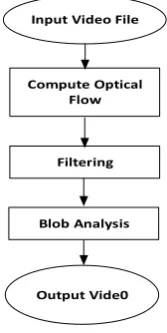
OPTICAL FLOW METHODOptical flow is the distribution of apparent velocities of movement of brightness patterns in animage. Optical flow can arise from relative motion of objects and the viewer. Consequently, Optical flow can give important information about the spatial arrangement of the objects viewed and the rate of change of this arrangement. Discontinuities in the optical flow can help in segmenting images into regions that correspond to different objects. Fig 1, shows the basic steps involved in tracking an object using Optical Flow method.
Horn – Schunck [2] algorithm is based on a differential technique computed by using a gradient constraint(brightness constancy) with a global smoothness to obtain an estimated velocity field. There are two main processes for the implementation of the HS algorithm. The first one is an estimation of partial derivatives, and the second one is a minimization of the sum of the errors by an iterative process to present the final motion vector.
in Lucas-Kanade algorithm by implementing the concept of Least Square method. Here we find the velocity that minimizes the constraint errors. The least-squares (LS) estimator minimizes the squared errors.
Fig1: Steps Involved in Object Detection and Tracking using Optical Flow Method
III.BACKGROUND SUBTRACTION METHOD
Background subtraction is the one of the crucial step in detecting the moving object. It isparticularly a commonly used technique for motion segmentation in static images. It will detect moving regions by subtracting the current image pixel-by-pixel from a reference background image that is created by averaging images over time in an initialization period. The basic idea of background subtraction method is to initialize a background firstly, and then by subtracting current frame in which the moving object present that current frame is subtracted with background frame to detect moving object. This method is simple and easy to realize, and accurately extracts the characteristics of target data, but it is sensitive to the change of external environment, so it is applicable to the condition that the background is known.Fig 2, shows the Generic Flow of Background Subtraction Algorithm.
Fig 2: Generic Flow of Background Subtraction Algorithm
IV.DESIGN AND IMPLEMENTATION
Implementation is the stage of the project where the theoretical design is turned into a workingmodel. Implementation is the key stage in achieving the new system because usually it involves a lot of upheaval in the user environment. It
Video Frames
Pre - processing
Background Modeling
Foreground Detection
Data Validation
Foreground Masks
Delay Input Video File
Compute Optical Flow
Filtering
Blob Analysis
A. SIMULINK MODEL FOR OPTICAL FLOW METHOD
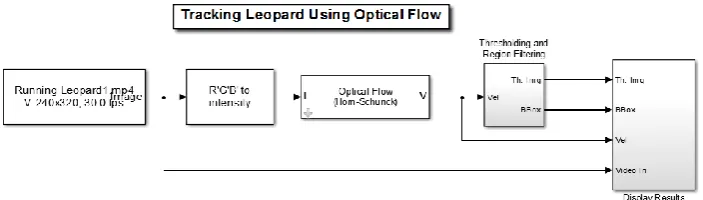
Fig 3:Simulink Based Block Diagram for Tracking Leopard using an Optical Flowmethod.
Fig 3, illustrates the Simulink model for tracking the Leopard using an optical flow method. Various blocks are used to detect and track a Leopard. For both the optical flow method the Simulink model remains the same. In optical flow block, user can select the method to be implemented. RGB to intensity block is used to convert the input RGB image into Intensity image.
Thresholding is a fundamental method to convert a gray scale image into a binary mask, so that the objects of interest are separated from the background. In the difference image, the gray levels of pixels belonging to the foreground object should be different from the pixels belonging to the background. Thus, finding an appropriate threshold will solve the localization of the moving object problem.
To extract feature from the object, the image has to be subdivided into constituent parts or objects. The process of sub dividing the images into its constituent parts or objects is called image segmentation.Region filtering is used to extracts moving object from video.
B. SIMULINK MODEL FOR BACKGROUND SUBTRACTION METHOD
Fig 4: Simulink Model for Tracking a Leopard using Background Subtraction Method
The model shown in fig 4, used the background subtraction technique that you specify in the Edit Parameters block to estimate the background. Three different techniques available are described as:
1. Estimating median over time - This algorithm updates the median value of the time series data based upon
constrained within Chebyshev's bounds, which are sqrt (3/5) of the standard deviation on either side of the mean of the data.
2. Computing median over time - This method computes the median of the values at each pixel location over
a time window of 30 frames.
3. Eliminating moving objects - This algorithm identifies the moving objects in the first few image frames
and labels the corresponding pixels as foreground pixels. Next, the algorithm identifies the incomplete background as the pixels that do not belong to the foreground pixels. As the foreground objects move, the algorithm estimates more and more of the background pixels.
Here, the algorithm used is estimating median over time which updates the median value of the time series data based upon the new data sample. Once the background estimation is completed by the program, the background is subtracted from each video frame to produce foreground images. This foreground image is converted to binary feature image. This is carried out by implementing Thresholding and performing certain morphological closing on each foreground image.
After the Background is estimated, the next step is to track the object of the interest in the video. The model locates the objects in each binary feature image using the Blob Analysis block [5]. Then the Draw Shapes block is used to draw a green rectangle around the objects that moves beneath the white line. A counter is used in the upper left corner of the Results window to track the number of objects in the region of interest.
V. RESULTS AND DISCUSSIONS
This chapter discuss about the Experimental results obtained for detection and tracking of an animal in a video. The proposed method is implemented using MATLAB/SIMULINK. The results of the three algorithms implemented for two different scenarios are shown.
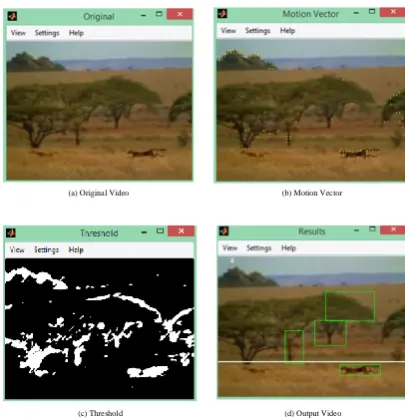
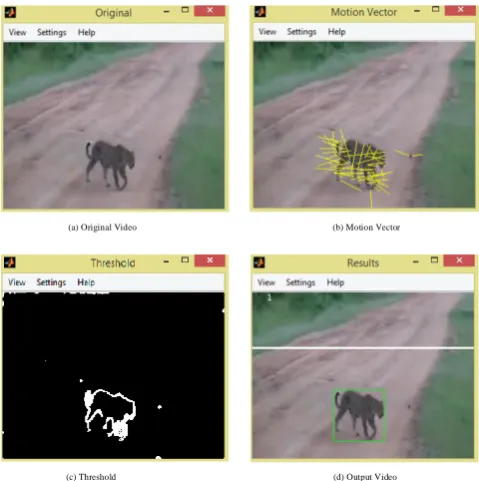
Fig 5 and fig 6, shows the results obtained using Horn – Schunck Algorithm of an Optical Flow Method.
Fig 5: Results of Optical Flow Method Using Horn – Schunck Algorithm for Running Leopard.mp4 (a) Original Video, (b) Motion Vector, (c) Threshold and (d) Output Video
In fig 5(d), the output video consists of some Noise and hence some additional objects are being detected along with Leopard using Horn - Schunck algorithm
(a) Original Video (b) Motion Vector
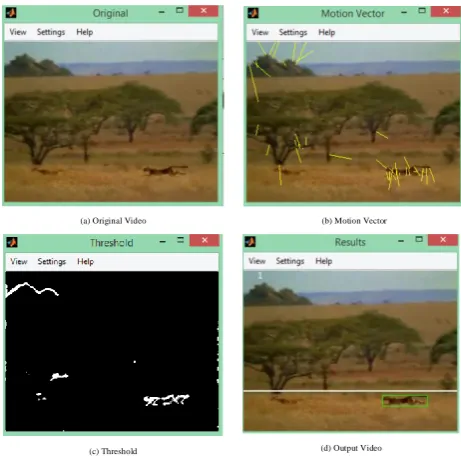
Figure 6: Results of Optical Flow Method Using Horn – Schunck Algorithm for Leopard.mp4 (a) Original Video, (b) Motion Vector, (c) Threshold and (d) Output Video
In fig 6(d), also the output video consists of some Noise and hence some additional objects are being detected along with Leopard using Horn - Schunck algorithm
Fig 7 and fig 8, shows the results obtained Lucas – Kanade algorithm of Optical Flow method
Fig 7: Results of Optical Flow Method Using Lucas – Kanade Algorithm for Running Leopard.mp4 (a) Original Video, (b) Motion Vector, (c) Threshold and (d) Output Video
Using Lucas – Kanade algorithm, the Leopard was tracked perfectly without any Noise as shown in fig 7 (d).
(a) Original Video
(c) Threshold (d) Output Video (b) Motion Vector
(a) Original Video (b) Motion Vector
Figure 8: Results of Optical Flow Method Using Lucas – Kanade Algorithm for Leopard.mp4 (a) Original Video, (b) Motion Vector, (c) Threshold and (d) Output Video
Using Lucas – Kanade algorithm, the Leopard was tracked perfectly without any Noise as shown in fig 8(d). This method gave better results compared to other two algorithms used.
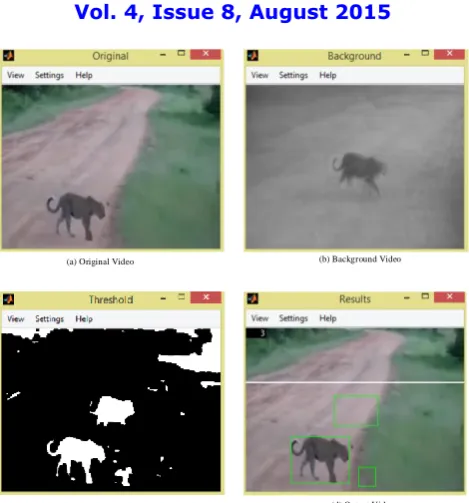
Fig 9 and fig 10 shows the results obtained using the Background Subtraction method.
Figure 9: Results of Background Subtraction Method for Running Leopard.mp4 (a) Original Video, (b) Background Video, (c) Threshold and (d) Output Video
Using this method, in fig 9(d) the Leopard was tracked with some background Noise. The results obtained were better than Horn – Schunck method of an optical flow.
(a) Original Video
(c) Threshold (d) Output Video (b) Motion Vector
(a) Original Video
Figure 10: Results of Background Subtraction Method for Leopard.mp4 (a) Original Video, (b) Background Video, (c) Threshold and (d) Output Video
Using this method, in Figure 10 (d) the Leopard was tracked with some background Noise. This method also could not eliminate the noise.
From the results of all the three algorithms used in this paper, Lucas - Kanade algorithm gave the better result compared to Background Subtraction method and Horn – Schunck algorithm. In Horn – Schunck algorithm and Background Subtraction Method, due to presence of Noise additional unwanted objects were being detected along with the Leopard.To summarize these algorithms, an analysis is been carried out which compares performance parameters recall and precision of the video.
Input Video Method Used
Total moving
object
Object Detected
Correct object
Missed object
False object
Recall (%)
Precision (%)
Leopard.mp4
Horn – Schunk (Optical
Flow) 1 2 1 0 1 100 50
Lucas – Kanade (Optical
Flow) 1 1 1 0 0 100 100
Background Subtraction 1 3 1 0 2 100 33
Running Leopard.mp4
Horn – Schunk (Optical
Flow) 2 4 1 0 3 100 25
Lucas – Kanade (Optical
Flow) 2 1 1 0 0 100 100
Background Subtraction 2 2 1 0 1 100 50
Table 1: Comparison of Performance Parameter Table for both the Input Video.
From Table 1, it is observed that Lucas – Kanade algorithm gave the best results compared to other two algorithms. Both the performance parameters gave 100% result since there were no object being missed nor were false objects being detected.
(a) Original Video
Input Video
Method Used Total
Number of Frames
(N)
Number of Frames in which Object was Detected
(D)
% Error (e) e =
𝐍−𝐃
𝐍 x100
Leopard.mp4
Horn – Schunk (Optical
Flow) 580 572 1.37
Lucas – Kanade (Optical
Flow) 580 578 0.34
Background Subtraction 580 565 2.5
Running Leopard.mp4
Horn – Schunk (Optical
Flow) 67 55 17.91
Lucas – Kanade (Optical
Flow) 67 62 7.46
Background Subtraction 67 59 11.94
Table 2: Performance Analysis of different Algorithmsfor both the Input Video.
From Table 2, it is seen that the % error was found to be minimum using Lucas – Kanade algorithm compared to Horn – Schunck method and Background Subtraction Method.
VI.CONCLUSION
The objective of this project to track the Leopard in a two different scenario of a video sequence was achieved. Using the Optical Flow method wherein the Horn-Schunck algorithm for motion estimation was put into effect which gave fair results. The disadvantage in using Horn – Schunck method is that it cannot eliminate the noise. Using Background Subtraction algorithm, satisfactory results were obtained. This method also could not eliminate the presence of noise.An attempt of using Lucas – Kanade algorithm gave the best results, were only the desired object was tracked and without any noise. Hence the performance parameters of this algorithm gave 100% result. The disadvantage of this
method is there are some discontinuities observed while determining the Optical Flow pattern
.
REFERENCES
[1]. Dhara Trambadia, Chintan Varnagar, Prajesh Khatiriya “Moving Object Detection and Tracking Using Hybrid Approach in Real Time to improve Accuracy”.International Journal of Innovative Research in Computer and Communication Engineering, Vol. 3, Issue 4, April 2015. [2]. Ekta Patel, Dolly Shukla, “Comparison of Optical Flow Algorithms for Speed Determination of Moving Objects”. International Journal of Computer Applications (0975-8887) Volume 63 –No. 5, February 2013.
[3]. Mayur Salve, Dinesh Repale, Sanket Shingate, Divya Shah, “SIMULINK based Moving Object Detection and Blob Counting Algorithm for Traffic Surveillance”. International Journal of Computer Applications (0975-8887) Volume 70 –No. 17, May 2013.
[4]. Dolley Shukla, Surabhi Biswas “Region Filtering and Optical Flow based Video Surveillance System”. International Journal of Computer Applications (0975-8887) Volume 63 –No. 6, February 2013.