Experience Delivery Platforms
by David Aponovich and Mark Grannan, November 26, 2013
ProfessionalsKey TaKeaways
a Diversity Of Digital experience software Is still The Norm In enterprises
Enterprises leverage numerous software tools in support of cross-channel digital
customer experiences. However, market fragmentation and integration challenges have
opened the door to integrated platforms.
emerging Digital experience Platforms Balance Convergence and
Integration
Software vendors have bought and/or built a range of foundational capabilities for
on-site digital experiences and have pushed integration with other tools, enabling
enterprises to establish flexible, heterogeneous platforms that address their requirements.
Identify Next-Generation Requirements To Better Prepare For Digital
experience Investments
Digital customer experience delivery platforms are emerging. No vendor currently offers
an end-to-end solution, and given existing investments, most enterprises can’t source
from a single vendor. Establish your requirements to set the stage for making a smart
decision at investment time.
why ReaD ThIs RePORT
Businesses need an array of software technology to support digital customer experiences, but they
struggle to understand and leverage the tools necessary to create and manage unified, multichannel digital
customer experiences across multiple touchpoints. Technology vendors are trying to help by bringing
more complete digital customer experience portfolios to the market, although hopes for a homogenous
environment are unrealistic at this point. In this report, we define the emerging digital customer
experience delivery platform, explore the vendors delivering these solutions, and provide insight into the
approaches these vendors are taking to integrate with the third-party technology in which their customers
have already invested.
table of contents
Firms struggle To Leverage Digital experience Technologies
welcome To The emerging Digital Customer experience Platform
Vendors have Different approaches To Digital experiences
recommenDAtions
Find The Right Balance Between Vendor Loyalty and Vendor Lock-In
notes & resources
Forrester interviewed 17 companies, including Acquia, Adobe, Bridgeline Digital, Demandware, Digital river, ektron, Hp Autonomy, Hubspot, hybris, iBm,
opentext, oracle, razorfish, salesforce.com, sapientnitro, sDl, and sitecore.
related research Documents
techradar™ For AD&D pros: Digital
customer experience technologies, Q3 2013 september 3, 2013
Digital experience Delivery maturity Assessment
may 16, 2013
choose Digital experience tools to engage With customers in A cross-channel World February 12, 2013
Drive Business transformation With Digital customer experiences
november 27, 2012
Platforms
A range of software vendors tackle the multichannel experience mandate
by David Aponovich and mark Grannanwith stephen powers, randy Heffner, Anjali yakkundi, and steven Kesler
2 5
20 8
FIRMs sTRuGGLe TO LeVeRaGe DIGITaL exPeRIeNCe TeChNOLOGIes
“An embarrassment of riches” is the phrase that may best describe the abundance of software tools
available to companies that need to create, manage, and measure cross-channel digital customer
experiences. Unfortunately, many firms have not been able to unify their software solutions to
extract maximum value from them and deliver comprehensive cross-channel experiences, because:
■
Discrete digital customer experience solutions are still the norm.
Many companies use
a jumble of point solutions, core business applications, content repositories, user interfaces,
and other elements that are not unified and often at best only loosely connected. Custom
integrations can provide some connective tissue between the various tools that support
cross-channel experiences. Enterprises typically build on foundational applications like
eCommerce or web content management (WCM) that often provide functionality like analytics,
personalization, optimization, and search. However, many firms have already bought
best-of-breed tools, such as web analytics and optimization, that complement their foundational
technologies.
■
Tech budgets often lack a center of gravity.
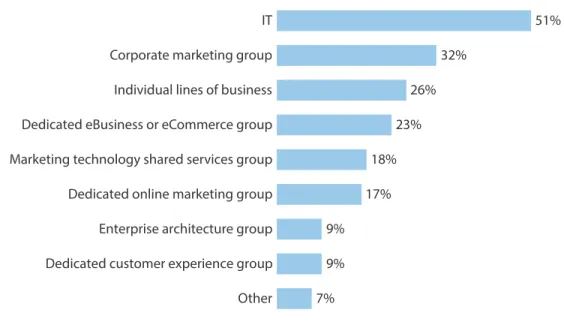
Technology budgets are fragmented, diminishing
overall spending effectiveness and limiting the potential synergies of unified planning and
technology purchasing. Forrester’s March 2013 Global Digital Experience Delivery Online
Survey of digital experience professionals showed that a range of different groups each controls
a portion of the budget for digital customer experience software (see Figure 1). IT remains
the leader in terms of budget control, but shares this power with corporate marketing, lines
of business, and others. These groups don’t always work in unison when purchasing related
technologies.
■
Siloed organizations create barriers.
Many businesses operate in silos, which extends to how
they operate their digital experience channels. Instead of creating coherent cross-channel digital
experiences that share data and processes and unify customer experiences, business segments
may act independently when serving different channels or needs, such as transactional versus
marketing websites (see Figure 2).
Figure 1
Digital Experience Technology Budgets Are Fragmented Between IT And The Business
Source: Forrester Research, Inc.
104302
“What organizations within your firm own the budget for purchasing applications that support digital customer experiences*?”
(Select up to three)
*Applications that support the management, delivery, and measurement of customer experiences, such as web content management, eCommerce platforms, web analytics, social analytics, site search, testing and optimization tools, and social networking platforms.
Source: March 2013 Global Digital Experience Delivery Online Survey
Base: 233 digital experience delivery professionals (multiple responses accepted)
IT 51%
Corporate marketing group 32%
Individual lines of business 26%
Marketing technology shared services group 18% Dedicated online marketing group 17% Dedicated eBusiness or eCommerce group 23%
Enterprise architecture group 9% Dedicated customer experience group 9%
Figure 2
Organizational Silos Are A Barrier To Unified Experiences
Fragmented Technologies Create Major Challenges
To date, organizations have only weakly addressed the fragmentation of digital customer experience
technologies, relying on integration and customization. Reliance on application integration has proven
costly, difficult, and in some cases impossible. One company told us that it aspires to improve its
multichannel digital customer experience execution but still struggles to integrate process-oriented
software, such as content management and editorial workflows, with other elements to support the
customer across digital touchpoints. Forward-thinking organizations define long-term strategic
and technical requirements for delivering cross-channel digital experiences with a focus on the
interrelationship between foundational platforms like WCM and the adjacent tools and technology
that support the requirement to manage, engage, and measure experiences across digital touchpoints.
1“We did an assessment of one of our clients; they were using 14 other tools in addition to our
platform’s capabilities. This says to me that organizations are leveraging many technologies
across the many parts of their business.” (Executive, eCommerce platform company)
“Our issue is getting departments to work together as we integrate eCommerce, social media,
analytics, advertising and other parts of the digital experience. Creating a ‘customer journey’
should be in reach for us, but it’s still a dream right now.” (Technology executive, media and
publishing organization)
Source: Forrester Research, Inc.
104302
“Which group is the final decision-maker for applications that support digital customer experiences?”
Source: March 2013 Global Digital Experience Delivery Online Survey
Base: 233 digital experience delivery professionals IT
20%
Enterprise architecture group 5%
Corporate marketing group 18% Dedicated online marketing group 7% Dedicated eBusiness or eCommerce group 14% Individual lines of business
12%
Dedicated customer experience group
4%
Marketing technology shared services group
9%
Other 11%
weLCOMe TO The eMeRGING DIGITaL CusTOMeR exPeRIeNCe PLaTFORM
This report focuses on technologies that support on-site digital channels or those owned and
controlled by the enterprise.
2Forrester puts 14 different technology capabilities under the umbrella
of on-site digital experience solutions, which we define as:
On-site experiences include an organization’s web and mobile experiences, such as traditional and
mobile websites, customer transactions, and mobile applications.
Digital experience technology encompasses many different areas that exist in parallel with
on-site technologies but which are often bought separately and owned by different budget holders
within the enterprise. Forrester categorizes the 14 technologies pertinent to on-site experiences
according to how they support evolving requirements to manage, engage, and measure in the digital
experience realm.
■
Manage.
Tools that support the “manage” phase in digital experience management include
WCM, digital asset management (DAM), product content management (PCM), commerce, and
email marketing.
■
Engage.
Tools that support the “engage” phase in digital customer experience are optimization,
personalization, video delivery, portal, recommendations, site search, and social depth.
■
Measure.
Tools that support the “measure” phase in digital customer experience are web
analytics, mobile analytics, and testing.
Until recently, no vendor could even begin to claim to possess a single digital experience platform
that addresses all digital experience-related requirements. But software vendors like Adobe, IBM,
and Oracle
have
focused on buying, building, and integrating best-of-breed components into
large-scale, integrated software offerings that manage multiple facets of digital experience. These vendors
don’t address every facet of an enterprise digital experience deployment, but they’re moving in that
direction.
Forrester recently interviewed 17 software vendors making a play in the digital customer experience
delivery market about their key capabilities. Despite many overlapping capabilities, there is still
no consistency around the breadth of offerings that vendors are including in emerging digital
experience “platforms.” For example, Adobe touts “marketing solutions” that enable experiences
across the Web, mobile sites and mobile apps, social engagement, targeting of content and
experiences to customers, DAM, multisite management, and optimization, all rolled up into an
“integrated solution” that’s part of the Adobe Marketing Cloud.
3IBM’s Customer Experience Suite
has 16 “components” that span a similar segment of software offerings but focus more heavily on
e-forms and templates.
4And most platforms offer a mix of on-premises and cloud technologies.
understanding Integration Requires a Critical eye, From Platform To solution To suite
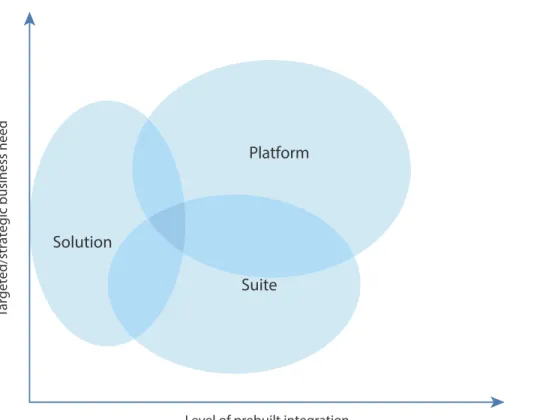
The range of digital experience functionality varies widely across vendors. However, the three levels
of integration are important when assessing how well any vendor’s set of products are integrated.
Forrester uses the following terms to indicate increasing levels of product-line value from a given
vendor (see Figure 3):
■
Solution.
A collection of products that, when integrated, addresses the problems being faced.
However, these products don’t all share common design tooling, runtime architecture, or
life-cycle management. Solutions are frequently comprised of products that were acquired rather
than built to work together.
■
Suite.
A set of products or tools that share an overall architecture, a common user experience,
and the ability to share common resources, but whose relationship to each other tends to be as
separate tools within a family — like Microsoft Office — rather than tools that work together to
fulfill a larger business need.
■
Platform.
A set of integrated products or tools that serve a variety of functions necessary to
achieving a larger business need. The separate products stand alone, but work together as part of
a bigger picture that maximizes value and impact by getting the larger job done.
Integration Is The Litmus Test Of The Digital experience Technology Platform
Integrating 14 disparate technologies to support on-site digital customer experiences is a mammoth
architectural and technical challenge. Without the right integration strategy and execution, your
digital business design aspirations will falter.
5Application development and delivery (AD&D)
professionals may need to educate stakeholders on the three levels of digital experience platform
integration:
■
Tooling integration.
An integrated tool set is easiest to achieve when the products share a
common architecture that’s typically updated on the same schedule and which allows native
control and user interface synchronization across the solutions that share the same tooling. For
example, a DAM solution owns an asset and can control versions across other solutions.
■
Runtime integration.
Runtime-level integration ensures that the various elements can be
managed and run as a coherent platform, often using a common set of management tools.
Connections between the elements enable information exchange with external solutions via
APIs, web services, and other connectors. An example of this is a commerce engine leveraging
a DAM asset and keeping the versions in each system synchronized as changes are made over
time.
■
Life-cycle integration.
Life-cycle integration enables coordinated control of assets even though
many different tools are used to create the experience, such as ensuring that video, text, and
application scripts all go into production in a coordinated way. This synchronizes the movement
of assets from a number of tools as you move from one business process phase to the next —
that is, through the planning, design, staging, and launch phases.
Figure 3
Solution Versus Suite Versus Platform
Source: Forrester Research, Inc.
104302
Ta
rgeted/strategic business need
Note: The size of the ovals reflects the typical range of variation in product lines that fit the category. Level of prebuilt integration
Platform
Solution
Digital experience Platforms enable Four Primary Digital Business Design Needs
Enterprises seeking solutions should keep in mind that a 21st-century view of integration doesn’t
focus on the technology, but rather on the business design needs.
6Digital customer experience
decision-makers should ask themselves how their current solution portfolio compares with a
potential digital experience platform when it comes to delivering the following digital business
design capabilities:
■
Business process flow.
Process-centric workflows help people get work done; they bridge
organizational silos and create internal organizational efficiencies.
■
Seamless user roles.
Platform-level user role definitions provide a basis for creating role-based
workspaces with a cohesive user experience that matches the way users work.
■
Role-centric information views.
The digital customer experience platform enables
business-oriented views of information that include both internal and external data and content via data
virtualization and other data architecture options.
■
Business control, insight, and flexibility.
The first three capabilities aggregate into business
control, insight, and flexibility, all of which enable ongoing business optimization.
These four capabilities are not exhaustive, especially regarding the connections to other platforms
across the enterprise. However, they address integration in the context of business value.
VeNDORs haVe DIFFeReNT aPPROaChes TO DIGITaL exPeRIeNCes
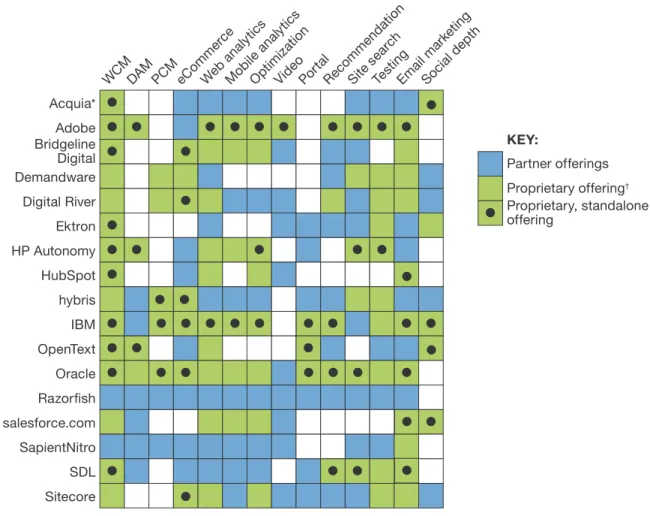
The market for digital experience platforms shows that most vendors provide one foundational
technology plus some adjacent capabilities that complement this core (see Figure 4).
Forward-thinking vendors also articulate a strategy to enable third-party integrations with their core
offerings. These range from formal, off-the-shelf integrations defined by vendor partnerships and
codevelopment efforts to API strategies that provide the interfaces so AD&D pros can connect
proprietary platforms to one or more third-party tools.
Figure 4
Digital Experience Platform Matrix
Source: Forrester Research, Inc.
104302 WCMDAMPCMeCom mer ce Web analy tics Mob ile a nalyt ics Optim izatio n Vide o Porta l Reco mm enda tion Site se arch Test ing Email mar ketin g Socia l dep th Acquia* Adobe Bridgeline Digital Demandware Digital River Ektron HP Autonomy HubSpot hybris IBM OpenText Oracle Razorfish salesforce.com SapientNitro SDL Sitecore KEY: Partner offerings Proprietary offering† Proprietary, standalone offering Forrester definitions:
*Acquia’s platform includes proprietary components (Acquia tools, modules, and services) and nonproprietary components (open source Drupal WCM and modules).
†Platforms that offer proprietary and third-party options for a specific capability are in the “proprietary” category.
• Proprietary offering: vendor-owned platform component.
• Partner offering: platform component sourced from a third party (regardless of completeness of integration).
• Standalone offering: platform component that is a standalone product and may also combine or integrate with other component(s) from the same vendor.
web Content Management-Centric Platforms Predominate
Many emerging digital experience platforms have built their offerings on a WCM foundation. They
provide core content management capabilities, including a repository for multiple content types
and many of the eBusiness and eMarketing features that support “manage, engage, and measure”
requirements. Vendors in this category include Acquia, Adobe, Bridgeline Digital, Ektron, HP
Autonomy, OpenText, SDL, and Sitecore (see Figure 5).
Figure 5
Web Content Management-Centric Platform Vendor Profiles
Source: Forrester Research, Inc.
104302
Adobe
Vendor description Provides creative tools, marketing tools, and Internet software development. Product name Adobe Marketing Cloud
Summary Includes WCM, DAM, analytics, testing and optimization, targeting, and email marketing. Adobe partners with hybris for eCommerce and offers email marketing via Adobe Campaign (acquired from Neolane in 2013).
Platform approach Adobe Experience Manager’s WCM foundation orchestrates content delivery. Integrations between Adobe Marketing Cloud and Adobe Creative Cloud provide the ability to measure, analyze, and optimize multichannel customer interactions with Adobe Analytics; execute tests, create audience segments, and target content with Adobe Target; access a holistic view of social activity and brand engagement with Adobe Social; optimize advertising efforts with Adobe Media Optimizer; power mobile app content with Adobe PhoneGap; and organize marketing efforts via Adobe Campaign.
Integration approach for
third-party products Adobe Experience Manager is based on Java and leverages the OSGi componentframework. The solution has external integrations with BrightEdge, Clay Tablet Technologies, ExactTarget, hybris, Silverpop, and Translations.com.
Revenue $4.4 billion Example clients Hyatt, Audi
Acquia
Commercial open source software company that provides products, services, and support for the Drupal platform.
Acquia Cloud
Offers Drupal-based WCM plus integrated digital experience capabilities including social depth. Includes access to Drupal-based modules and tools written by the open source community (Acquia Network, Acquia Cloud Site Factory, and Drupal Commons).
Based on the open source Drupal product, Acquia features an open architecture. Integration between Acquia tools is accomplished via web services, RESTful interfaces, and specific APIs.
Third-party products can be integrated via web services using Drupal’s open architecture, by creating a Drupal module, or in some cases via JavaScript. $45 million Georgia.gov Vendor description Product name Summary Platform approach Integration approach for third-party products Revenue Example clients
Figure 5
Web Content Management-Centric Platform Vendor Profiles (Cont.)
Source: Forrester Research, Inc.
104302
Bridgeline Digital
Vendor description Provides a range of applications to support content management, eCommerce, web analytics, and email campaigns.
Product name iAPPS Platform
Summary A family of separate .NET applications, including content management, eCommerce, and web analytics built by Bridgeline Digital to work together. Includes SaaS-based options.
Platform approach iAPPS Platform natively integrates digital experience functionality on a .NET-based framework that allows sharing of common information and components across each of these areas. Some controls extend across the platform; for example, iAPPS social allows eCommerce and CMS content to be pushed out to social channels from a single interface.
Integration approach for
third-party products iAPPS APIs are exposed to partners, customers, and developers by using JSONthrough RESTful calls. As a .NET framework, APIs can also be programmatically exposed through other means (e.g., SOAP/XML).
Revenue $26 million
Example clients The UPS Store, Triumph Motorcycles Ektron
Vendor description Provides WCM software and tools for digital customer experiences. Product name Ektron CMS
Summary Ektron offers core WCM capabilities plus a range of additional integrated tools to power integrated, multichannel experiences across web, mobile, and social channels.
Platform approach Ektron’s core solution for WCM and related digital experience management tools support a range of native capabilities and functionality from partners
that help organizations deliver relevant, personalized experiences. Integration approach for
third-party products Ektron Digital Experience Hub provides numerous prebuilt connectors for third-party digital experience applications such as analytics (Adobe, Google Analytics, Webtrends), marketing automation (Eloqua, Marketo), CRM (Microsoft Dynamics, salesforce.com), and HubSpot.
Revenue $49 million
Figure 5
Web Content Management-Centric Platform Vendor Profiles (Cont.)
Source: Forrester Research, Inc.
104302
OpenText
Vendor description Enterprise information management software vendor. Product name OpenText Customer Experience Management
Summary A set of solutions, some of which are integrated, aimed at helping enterprise clients deliver personalized, multichannel digital experiences.
Platform approach OpenText’s capabilities include WCM (formerly Vignette), DAM (formerly Artesia), analytics, portal, and social.
Integration approach for
third-party products A set of REST APIs and direct connectors allow access to the base capabilities ofthe user interface, workflow, and data between the business application and OpenText’s software stack. OpenText provides REST APIs and extensible connectors to third-party applications.
Revenue $1.2 billion
Example clients Behr, The District of Columbia HP Autonomy
Vendor description Provides information management software with a focus on search, WCM, rich media management, and testing and optimization.
Product name HP Autonomy Marketing Optimization
Summary A cloud-based platform for digital experience management with a range of associated capabilities for WCM, analytics, optimization, rich media management, and support for augmented reality-based marketing applications.
Platform approach Includes TeamSite for WCM, personalization, and publishing; HP Optimost for marketing optimization, testing, segmentation, and targeting; HP Explore (based on IDOL) for marketing analytics; HP MediaBin for rich media management and indexing; and Aurasma to support augmented-reality campaigns.
Integration approach for
third-party products External integrations are accomplished via REST APIs; they are presentationtier-agnostic for integration into third-party applications (web, custom, and mobile). For CRM, it features packaged integration with salesforce.com. Search integrations including Oracle Endeca and Solr/Lucene via open APIs. eCommerce reference architecture integration partners include Digital River and hybris. Revenue
Example clients
$120 billion Nikon, Jet Airways
Figure 5
Web Content Management-Centric Platform Vendor Profiles (Cont.)
Source: Forrester Research, Inc.
104302
Sitecore Vendor description
Product name
Provides WCM and digital marketing tools. Summary
Sitecore Customer Engagement Platform
Platform approach
A unified platform aimed at digital marketers that supports content management, campaign management, personalized experiences, and customer insights.
Integrations approach for third-party products
Sitecore’s all-in-one approach to delivering and managing digital customer experience includes the following capabilities: WCM, analytics, optimization, email marketing, and social tools.
Revenue
Sitecore’s strategy is to offer a native, integrated platform. But it also offers APIs to support integration with third-party digital experience tools and has a partnership with Insight Commerce.
Example clients
Forrester estimate: $90 million to $100 million P&G, Kraft Foods
SDL
Vendor description Provides global customer experience software and services. Product name SDL Global Customer Experience Management
Summary A set of solutions aimed at digital marketers with foundational components: SDL Tridion for WCM; SDL Fredhopper for recommendation, site search, and testing; and tools for running campaigns and email.
Platform approach SDL offers WCM, recommendation, site search, campaign management, and translation services.
Integrations approach for
third-party products SDL has partnerships for DAM (Adam Software), eCommerce (hybris, Intershop),web analytics (Webtrends), optimization (Maxymiser), and portal (IBM, Oracle, SAP). SDL offers data integration connectors and a visual ETL tool. It supports the exchange of community modules and extensions and common API and extensions for third-party integration at the UI, application, and data levels.
Revenue $366 million
Commerce-Based Platforms aim To expand On Transactional Foundations
Some vendors in the world of emerging digital experience platforms offer best-of-breed eCommerce
functionality, including core capabilities for delivering product-centric content and commerce
transactions. Over the past few years, some of them have begun building extended capabilities for
broader digital customer experience. Vendors in this category include Demandware, Digital River,
and hybris (see Figure 6).
enterprise Marketing Vendors Build On Marketing-Centric Capabilities
Vendors outside of traditional WCM and eCommerce are also creating offerings that support
aspects of multichannel digital customer experience management. This category includes customer
relationship management-centric provider salesforce.com and inbound marketing solution
vendor HubSpot. Each of these vendors puts tools in the hands of marketers to create and drive
personalized marketing and content experiences to engage customers and prospects with web, email,
social, and mobile experiences, often as a supplement to a client’s core WCM platform (see Figure 7).
Business-Centric Platforms Offer Front-Office and Back-Office Capabilities
Vendors in this category — IBM and Oracle are examples — may add significant eBusiness
capabilities to core WCM and/or eCommerce solutions (see Figure 8). These vendors often support
clients for whom digital customer experience includes, but is not limited to, large-scale,
digital-enabled business initiatives within overall digital experience strategies. In addition to digital content,
marketing, and commerce, these platforms offer back-end tools that support ongoing sales, service,
and account activities.
Figure 6
Commerce-Centric Platform Vendor Profiles
Source: Forrester Research, Inc.
104302
Digital River
Vendor description Provides an eCommerce solution with a range of capabilities to manage product-based content, transactional-product-based experience delivery, and analytics.
Product name Digital River Global Commerce
Summary A SaaS-based, eCommerce-centric platform with digital experience components (some native, some integrations) for WCM, PCM, analytics, portal, site search, and testing for B2C firms and companies that sell digital and physical products. Platform approach Digital River Global Commerce natively provides eCommerce capabilities plus
basic DAM, PCM, basic content management, site search (leveraging Solr), and analytics (DR site optimizer) for A/B testing for merchandisers.
Integration approach for
third-party products Digital River cites integration with partners in marketing, payments, commerce,and WCM including Adobe, Ektron, and Sitecore. Most marketing-related tools (e.g., Bazaarvoice, ExactTarget, and Responsys) are enabled with JavaScript or API connectors for data feeds. Integration partners span web and mobile analytics, optimization, personalization, video (Brightcove), recommendations, and testing. Revenue $386 million
Example clients Autodesk, GE Healthcare Demandware
Vendor description Provides a cloud-based digital commerce platform for omnichannel commerce experiences.
Product name Demandware commerce
Summary A cloud-based digital commerce platform to help businesses engage with customers and drive effective digital shopping experiences in an omnichannel world.
Platform approach Demandware cloud commerce’s all-in-one approach provides tools and capabilities like WCM, eCommerce tools, PCM, and email marketing to help businesses and brands support content creation, syndication, and publication of product information in an omnichannel environment.
Integration approach for
third-party products Demandware’s LINK Technology Partners network leverages a prebuilt APIframework to allow third-party web applications and software systems to interface with Demandware commerce’s shopping functionality to provide consistent experiences to consumers and allow clients to leverage existing investments in commerce-related capabilities.
Revenue $80 million Example clients Adidas, Lacoste
Figure 6
Commerce-Centric Platform Vendor Profiles (Cont.)
Source: Forrester Research, Inc.
104302
hybris
Vendor description Omnichannel eCommerce vendor, acquired in 2013 by SAP. Product name hybris Commerce Suite
Summary An eCommerce platform offering a range of omnichannel digital experience capabilities delivered via native and partner offerings.
Platform approach An open platform with native capabilities that include eCommerce, WCM, rich media management, PCM, search and navigation (Solr/Lucene as standard), and A/B testing.
Integration approach for
third-party products hybris allows third-party integrations at different levels: business logic, businesstools, and presentation layer. It also uses web services and a batch layer for data exchange between software solutions. Preferred partners include Adobe for WCM, celum for DAM, Maxymiser for optimization, Baynote for recommendations, SDL Fredhopper for search, Adobe Test&Target for testing, Responsys for email marketing, and Lithium for social depth. It also has basic integrations with various web analytics tools (Adobe, Google, Jirafe, and Webtrends).
Revenue Approximately $110 million Example clients Levi Strauss, Grainger
Figure 7
Enterprise Marketing-Centric Platform Vendor Profiles
Source: Forrester Research, Inc.
104302
Razorfish
Vendor description Publicis Groupe-owned global interactive agency. Product name Fluent
Summary Combines the capabilities of Adobe digital marketing cloud solutions and adds proprietary accelerators to deliver its a hosted platform that clients use to power digital customer experience and online marketing.
Platform approach The Fluent platform contains the following components: Adobe Experience Manager for WCM and rich media management; Adobe Target and
AudienceManager for segmentation models and content targeting; and Adobe Omniture for analytics and digital marketing tools. Razorfish offers software accelerators to use with these tools, such as vertical market tools (campaign plans, marketing tools), links to external customer data sources, attribution models and reporting capabilities, and dashboards to manage the platform. All of this helps digital experience and marketing pros serve targeted digital experiences and online campaigns. Razorfish offers open APIs and follows service-oriented architecture (SOA) principles to enable additional integrations.
Integration approach for
third-party products The Fluent platform is intended to be an all-in-one solution, delivered as ahosted, managed service, to support cross-channel experiences and campaigns. Razorfish leverages open APIs and follows SOA principles to enable additional integrations.
Revenue Forrester estimate: $420 million Example clients
HubSpot
Vendor description Inbound marketing software provider. Product name HubSpot
Summary A SaaS-based integrated marketing platform that includes marketing automation,social monitoring and publishing, search engine optimization (SEO), blogging, and analytics used by marketers to attract customers to sites and convert them to leads and then to customers. HubSpot targets small and medium-size businesses and has some clients among departments of larger enterprise.
Platform approach HubSpot features tools for managing landing pages and blogs, social media, SEO, and analytics. It also features support for email personalization, optimization, and digital analytics.
Integration approach for
third-party products HubSpot recommends using its open APIs for integration with third-party systemsand has formal partnerships and integrations with salesforce.com for CRM and Ektron for WCM.
Revenue $52 million
Example clients Hy-Line Cruises, NEC
Figure 7
Enterprise Marketing-Centric Platform Vendor Profiles (Cont.)
Source: Forrester Research, Inc.
104302
SapientNitro
Vendor description Global interactive marketing, creative design, and technology services agency. Product name EngagedNow
Summary EngagedNow leverages Adobe digital experience and marketing tools and adds frameworks and expertise to help brands and businesses support multichannel, optimized digital customer experiences and marketing. It supports marketing campaigns and microsites-as-a-service using Adobe Engagement Manager and analytics.
Platform approach EngagedNow uses commercial and proprietary components to integrate WCM, DAM, content and ad targeting, site search, email delivery and campaign management, customer intelligence tracking and analysis, and social profiles. SapientNitro also has a commerce platform that leverages IBM’s commerce offering.
Integration approach for
third-party products EngagedNow uses BridgeTrack (proprietary to SapientNitro) as its commoncustomer database; it pulls data from social channels, analytics partners, email campaigns, site behavior, and other sources. In addition to Adobe, EngagedNow leverages tools from Brightcove, Heiler, HP Autonomy, hybris, IBM, Limelight Networks, Oracle, SDL, Sitecore, Tridion, and Webtrends. EngagedNow utilizes Talend to support data integration.
Revenue $772 million Example clients Nascar, Visit Florida
salesforce.com
Vendor description Cloud CRM, digital marketing, and social software vendor that offers an integrated data-driven platform to support marketing, sales, and service and deliver digital customer experiences.
Product name Salesforce ExactTarget Marketing Cloud
Summary A solution that offers CRM, social tools, digital marketing, communities, and basic website management. Salesforce ExactTarget Marketing Cloud adds an email and digital marketing focus to gain credibility in digital experience, adding to the vendor’s tools for web, social, email, and mobile delivery.
Platform approach The Salesforce ExactTarget Marketing Cloud is a cloud platform combining CRM (salesforce.com) foundations with enterprise-scale email, mobile delivery, social depth tools, and basic website publishing.
Integration approach for
third-party products Salesforce ExactTarget Marketing Cloud’s (and salesforce.com’s) multitenantplatforms and integration frameworks enable customers to integrate data from external sources, including external packaged software to support digital experiences. Salesforce ExactTarget’s Fuel platform includes open APIs and developer tools that enable the development of third-party applications. Revenue $3 billion
Figure 8
Enterprise Business-Centric Platform Vendor Profiles
Source: Forrester Research, Inc.
104302
Oracle
Vendor description Multinational software vendor with a background in database management, supply chain management, customer relationship management (CRM), and enterprise resource planning.
Product name Oracle WebCenter
Summary A set of solutions aimed at supporting digital customer experience. Oracle WebCenter includes tools for WCM and portal. Other Oracle products include eCommerce, product catalog management, CRM, search, marketing automation, and analytics.
Platform approach Oracle has a number of acquired products in its portfolio, including portals, WCM (FatWire), enterprise content management (Stellent), eCommerce (ATG), search and navigation (Endeca), campaign automation (Eloqua), and predictive analytics (Real-Time Decisions).
Integration approach for
third-party products An Oracle-Brightcove integration supports video delivery (also supportingYouTube); integration with Google Analytics is an alternative or supplement to Oracle analytics.
Revenue $37 billion Example clients Textron, Pella
IBM
Vendor description Multinational technology and consulting services vendor. Product name IBM Customer Experience Suite
Summary A broad offering aimed at supporting rich, engaging, personalized experiences across multiple channels, comprised of formerly standalone offerings that IBM has integrated or is in the process of integrating.
Platform approach IBM’s offering includes WCM, portal, eCommerce, marketing automation, campaign management, and web analytics.
Integration approach for
third-party products IBM aims to support external integration via industry standards and APIs. Partnersinclude celum and Imagine for video and Perceptive Enterprise Search for search. Revenue $107 billion
r e c o m m e n d at i o n s
FIND The RIGhT BaLaNCe BeTweeN VeNDOR LOyaLTy aND VeNDOR LOCK-IN
We expect that digital experience delivery technologies will further converge and that the key
technology decision-makers will become less siloed — but this process will take years. In the
meantime, AD&D pros should examine vendors that offer multiple digital experience components.
At the same time, be wary of buying into vendors’ promises of an end-to-end solution and instead
give preference to vendors that invite customers’ legacy tool vendors to the party and offer them a
pathway to integration. Specifically, you should:
■
Understand which technologies are foundational to digital customer experiences.
To
be effective at digital customer experiences, you must understand which technology
components and capabilities — such as WCM and eCommerce — can serve as the
foundation upon which you can raise the timbers of a dozen or more supplementary digital
experience-centric tools and capabilities that will provide form and structure.
■
Consider your strategy and technical requirements for the next several years.
Rationalize
your current portfolio of digital experience tools in the context of your strategy and software
requirements for the next three to five years. Consider how potential vendors address the
digital experience “platform” requirements we spell out in this report. Determine whether,
based on your platform shortlist, it will be easy or hard to keep your preferred digital
experience components in service and integrate them easily into your future WCM or
eCommerce platform.
■
Use the digital experience issue to build bridges across your organization.
Consider the
growth of the digital experience delivery platform to be a chance to spur dialogue across
your organization. This is especially important if your company tends to operate in silos.
Use the discussion about next-generation digital experience platform to spur change in
the organization. Get teams to work together, define common requirements and standards,
rationalize what’s likely a diverse software portfolio, and determine what will best address
your digital experience needs going forward.
eNDNOTes
1 To deliver digital customer experiences that are consistent across channels, AD&D, marketing, and eBusiness pros need tools that allow them to easily administer, support, and optimize contextual cross-channel experiences in order to achieve their company’s strategic goals. To do this, they require tools that will allow them to manage the components of the experience; engage with customers in hyperfocused experiences; and measure customer experience to learn and fine-tune their efforts to improve results. Forrester refers to this paradigm as “manage, engage, and measure.” See the August 22, 2012, “Unify The Digital Experience Across Touchpoints” report.
2 Forrester defines digital experience within four categories: one pertaining to on-site experiences and three for off-site experiences. This report addresses on-site experiences. Off-site experiences take place outside of an organization’s proprietary domain and include tools like voice of the customer platforms and loyalty platforms for third-party customer engagement. Enterprise marketing technologies help marketers do their job better and focus on customer experience from a brand and campaign level. Customer service and support technologies help companies provide service to customers before, during, and after a purchase or interaction. See the September 3, 2013, “TechRadarTM For AD&D Pros: Digital Customer Experience Technologies, Q3 2013” report.
3 Source: “Adobe Experience Manager,” Adobe (http://wwwimages.adobe.com/www.adobe.com/content/ dam/Adobe/en/solutions/web-experience-management/pdfs/datasheet-aem-wcm-ue.pdf).
4 Source: “IBM Customer Experience Suite,” IBM (http://www-03.ibm.com/software/products/us/en/ ibmcustxpersuit/).
5 Forrester defines “digital business design” as: a business-centered approach to solution architecture, implementation, and integration that brings business and technology design together by placing design priority on user roles, business transactions, processes, canonical information, events, and other business aspects that embody a complete definition of a business. See the November 8, 2012, “Digital Business Design Is The New Integration” report.
6 To provide clients with a vision aimed at maximizing business agility, Forrester’s business capability architecture identifies six business design focal points as the future of solution architecture. Like digital business services, each of these focal points unifies application silos behind a business building block. See the November 8, 2012, “Digital Business Design Is The New Integration” report.
Forrester Research, Inc. (Nasdaq: FORR) is an independent research company that provides pragmatic and forward-thinking advice to
«
Forrester Focuses On
Application Development & Delivery Professionals
responsible for leading the development and delivery of applications
that support your company’s business strategies, you also choose
technology and architecture while managing people, skills, practices,
and organization to maximize value. Forrester’s subject-matter expertise
and deep understanding of your role will help you create forward-thinking
strategies; weigh opportunity against risk; justify decisions; and optimize
your individual, team, and corporate performance.
andrea davies, client persona representing Application Development & Delivery Professionals
informs better decisions, and helps the world’s top companies turn
the complexity of change into business advantage. our
research-based insight and objective advice enable it professionals to
lead more successfully within it and extend their impact beyond
the traditional it organization. tailored to your individual role, our
resources allow you to focus on important business issues —
margin, speed, growth — first, technology second.
for more information
To find out how Forrester Research can help you be successful every day, please
contact the office nearest you, or visit us at www.forrester.com. For a complete list
of worldwide locations, visit www.forrester.com/about.
client support
For information on hard-copy or electronic reprints, please contact Client Support
at +1 866.367.7378, +1 617.613.5730, or [email protected]. We offer