Explicit Web-Based Collocation Instruction on ESL Students’ Essay
Writing and Their Textual Cohesion and Coherence
Negin Shahryari1& DR. M. Balakumar2
1PhD Scholar, University of Mysore, Mysore, India
2Associate Professor, Central Institute of Indian Language, University of Mysore, Mysore, India
Abstract
A great number of scholars came to the point that by acquiring collocation students are able to learn English language very well. The objective of this study was to find out the impact of web- based collocation instruction on ESL students essay writing ability as well its influence on cohesion and coherence in writing. Seventy five freshmen female college students from 2 intact classes in JSS College for Women in Mysore in India participated in this survey. Students were divided into two groups: control and experimental group. Instructor taught vocabulary through traditional techniques to control group while experimental group received vocabulary through web-based collocation instruction. Statistical analysis on the basis of independent sample t-test revealed that web-based collocation instruction had positive effect on ESL students essay writing ability along with this instruction had suitable impact on cohesion and coherence of ESL students’ essay writing.
Keywords:
Web-based; Collocation; Cohesion & Coherence; ESL students; Essay writing.
1. Introduction
1.1. The notion of the study
“collectability” in linguistics is one that is usually troublesome for non-native speakers of English. In simple terms, a collocation can be defined as a pair or group of words that are often used together. The term collocation is used to indicate the repeated co-occurrence of lexical items. Different scholars (Nation, 2001; Durrant & Schmitt, 2010) opine that it is the learning of collocations that makes non- native speakers sound like native. Namvar (2012) “Collocations are two or more words, which have a strong tendency to co-occur in a language as a prefabricated combination of two or more words in a particular context.” A collocation incorporates two words that are joined simultaneously in the memory of native speakers repeatedly in both written and spoken conversation (Aghbar, 1990; Farghal & Al-Hamly, 2007). In later years scientists and instructors have raised the essentialness of collocations in language advancement and showing especially with non-native speakers (Ellis 1996). The importance of collocations in effective language learning was referred to as early as seventy years prior by Palmer (1933). After Palmer, Brown (1974) was one of the initial couple of pioneers to propose the incorporation of collocations in the EFL classroom. She underscored that learning collocations builds EFL learners' knowledge of collocation as well as enhances learners' oral fluency, listening perception, and reading speed. In late decades, progressed computer and data advances have unleashed the force of computers in language learning.
The remarkable development of the Internet and pervasiveness of computers has given chances to expand, or even supplant, face to face educating by producing learning
essays incorporate a wide assortment of mis-collocations. This is because of their absence of collocational competence on the grounds that they have gotten a direction that is "grammar focused" where there is no immediate direction of vocabulary. There are some important key factors in essay writing like: lexical resources, cohesion and coherence, considering punctuation and length of essay. Cohesion and coherence plays a significant role in writing good. With the utilization of linguistic devices cohesion and coherence in writing is achieved and connect ideas together in a text. In broad term, it is essential to study cohesion and coherence with each other due to the signal how the text is joined together and how it transform its message.
1.2. Related studies
Connor (1984) scrutinized a study of cohesion and coherence in English as a second language students’ writing. This survey compared cohesion and coherence in ESL students writing with native speaker writing. Based on Halliday and Hasan's (1976) cohesion theory 6 essays about argumentive tasks were evaluated. As well cohesion analyzed based on holistic rating and speech act. The outcomes demonstrated that overall cohesion was not a contrasting element between ESL students and native speakers writing. In addition native speaker was used cohesive devices more than ESL students in their writing. The writing of ESL student was lack of suitable linking for out coming statements.
The study of Chen (2011) included developing and evaluating a web-based collocation retrieval tool for EFL students
and teachers. The investigator proposed that concordancers have been one of the master key tools in the DDL (data-driven learning) approach. To find out if the new tool can accelerate the enquiring of collocations, this tool and the Hong Kong Polytechnic web concordancer were used by two groups of EFL students to discover suitable collocates in a translation task. The outcomes indicated that the students who used the Web Collocate tool found more proper English collocates. Additionally, a group of 35 pre-service English teachers were also requested to examine the effectiveness of this collocation tool. These EFL teachers disclosed that they could easily find appropriate English collocates with the help of Web Collocate.
Eidian, Gorjian& Aghvami (2013) worked on the impact of lexical collocation instruction on developing writing skill among Iranian EFL learners. The aim of scholars in this study was that to measure the impact of lexical collocation instruction on pre intermediate Iranian language learners writing proficiency. 50 male and female students contributed in this survey. After proficiency test students classified into two groups: experimental and control group. For control group conventional method was administered .While the principal of treatment in experimental group include:1) pre and post lexical collocation test 2) Writing one paragraph essay for five topics. When post test administered scholars realized that experimental group improved significantly after treatment than control group that received conventional method. 2. Purpose of the Study
web-based collocation instruction will result in better vocabulary learning than teaching vocabulary utilizing traditional methods such as definition, synonym and antonym. Moreover, this study will find that whether the effects of instruction on experimental group is significantly effective and cause any meaningful difference between the two groups ESL students’ cohesion and coherence in writing.
3. Research Questions
This survey aimed to discover answers to the following questions:
Research question1: Does Web- based collocation instruction significantly improves the ESL students’ essay writing ability?
Research question 2: Does Web-based collocation instruction significantly improve the cohesion and coherence of ESL students’ essay writing ability?
4. Methodology and Techniques Used 4.1. Setting
This study includes one control and one experimental group .The control group was taught traditionally and did not receive any treatment and just participated in pre and post test. While the experimental group contributed in the treatment. This study was administered at a JSS College for Women. The college is located in Mysore city in India. The students who study English participated in this research. The instruction of this study meets twice a week and each class lasts 60 minutes. The pedagogical approach adopted by the college is a combination of Web-based collocation instruction and communicative language instruction aiming to develop students’
linguistics accuracy and communicative language ability.
4.2. Case Study
Table 1: Number, age and gender of the students per group
Group Number of
Participants age Gender
Experimental 35 18-21 Female
Control 32 18-21 Female
4.3 .Materials and procedure
The study used two essays writing in two Indian freshmen classes which were randomly assigned to one experimental group and one control group or a comparison group. The control group only engaged in communicative task without provision of web-based collocation instruction and contributed in the pre and post-test. The experimental group contributed in the web-based collocation instruction treatment which lasted 3 months. 4.3.1. Essay writing
For the purpose of evaluating essay writing proficiency, the researcher assigned IELTS writing scoring. The writing scores ranged from 1 to 9. This approach to writing assessment has been advocated by several scholars in writing assessment. A researcher proposed three topics for writing an essay in pre-test and post-test. All topics were differing from each other. This task lasted 45 minutes to write an essay around 250 words. The researcher itself marked the papers and also the scholar used the
Oxford Dictionary of Collocations (2009) and Free Online Collocations Dictionary - Pro Writing Aid for determining suitable and correct collocation that students utilized in their essay writing. The final mark for each student was the average of the scores given by the two raters. To make sure inter- rater reliability, a practice session was held with regard to the IELTS scoring system; due to the two raters could completely comprehend the rating scale. But in order to make certain the consistency of the raters in scoring, they corrected the writings of 65 students and their inter-rater reliability was calculated. The inter-rater reliability of 0.82 was obtained which is quite high and statistically significant.
4.3.2. Treatment Procedure
For experimental group web-based collocation instruction was done. The new vocabulary was given to the students and instructor asked them to find out the suitable collocates of these vocabulary via Cambridge advanced learners dictionary, free online collocation Dictionary- Pro Writing Aid and web concordances. If students did not understand the meaning or they could not found suitable collocates for that words instructor thought for them. The unknown word was written in the center of the board and the instructor wrote some collocates around that word as well as helped students to learn which one collocates with that word. For instance:
Green Desk
When students learned these new collocation instructor asked student to write an essay and use these collocation. The sources for teaching collocations in this treatment are some books such as English Collocations in Use (McCarthy & O`Dell, 2005), Collocations Extra (Walter, E. 2010) and some dictionaries of collocations. Some examples of per session are such Topics: love story
New words: arranged- home –friend – sight – marriage – wedding –family- throw- divorce - custody – gained – messy
Target collocation: fairytale wedding- end in divorce – gain custody –love at first sight – propose marriage – arranged marriage and so on.
For control group the new vocabulary was presented through traditional techniques such as synonym, antonym, and definition.A post-test was given to the students in two sessions after the last treatment. Post-test included essay writing that were administered in the two classes and two groups. The whole process of web-based collocation instruction treatment along with pre-test and post- test lasted for three months.
5. Results and Dissection
5.1. The effect of Web-based collocation instruction on ESL students’ essay writing ability
As it was mentioned before, one of the main purpose which conduct this study was improving the ESL students essay writing ability that seems to be very important in students English language proficiency. The importance of collocation can be simply
understood while observing the writing and speaking of ESL learners that often are not successful to produce collocations in the correct order in their writing. Hence, the first hypothesis of this study is planned to realize the effect of Web-based collocation instruction on ESL students essay writing ability.
The mean and standard deviations of scores in the pre-test writing among two control and experimental groups are displayed in table 5.1. 1. As it is obvious from the table
Table 5.1.1 Descriptive statistics for pre and post-test writing on two groups
Groups N Mean Std. Deviation Std. Error Mean
Prewriting Control group 32 3.50 1.16 0.20
Experimental group 35 3.07 0.92 0.15
Post Writing Control group 32 5.09 0.81 0.14
Experimental group 35 7.20 0.89 0.15
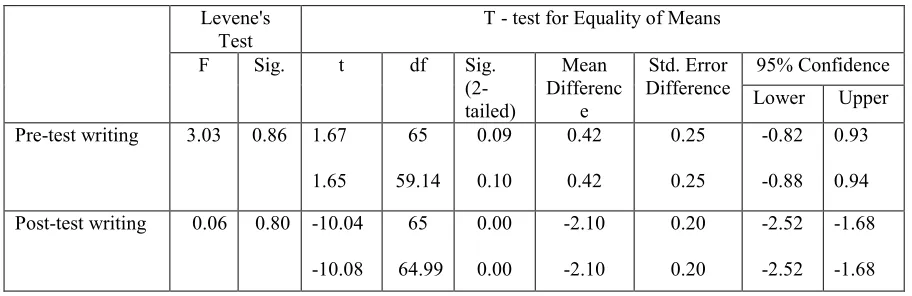
In order to find whether this difference between the mean scores for two groups is statistically significant, the pre-test and post-test scores were submitted to an Independent sample t-test. The results are shown in table 5.1.2. The difference in pre-test mean scores of control group (M=3.50, SD=1.16) and experimental group (M=3.07, SD=0.92) was not significant at the p<.05 level, while the
t-value is 1.67 and p=0.09 is higher than 0.05 level of significance with df=6. This result indicates that the students’ ability in two control and experimental groups were in a same level and there was not any significant difference between them. So, it was reasonable to do the instruction on experimental group and find the impact of it in comparison to control group with traditional instruction as there was not any significant difference between two groups.
Now, to realize the impact of web- based collocation instruction on experimental group, the result of post-test for both groups should be analyzed from the table 5.1.2. With the first glance, it can be seen that the mean score for experimental group is higher than control group. To find that if the different between means in two groups were statistically significant or not, the Independent t-test was applied. Table 5.1.2 shows that the difference of means between two control and experimental group are statistically significant at the p<0.05 level while the t-value = 10.04 and p = 0.00 with
df = 65. So, the result shows that the instruction on experimental group was effective and made a significant difference on experimental ESL students essay writing.
5.1.2. Independent sample t-test for post-test essay writing ability on two groups
Levene's
Test T - test for Equality of Means
F Sig. t df Sig.
(2-tailed)
Mean Differenc
e
Std. Error
Difference Lower 95% Confidence Upper
Pre-test writing 3.03 0.86 1.67
1.65
65
59.14
0.09
0.10
0.42
0.42
0.25
0.25
-0.82
-0.88 0.93
0.94
Post-test writing 0.06
0.80 -10.04 -10.08
65
64.99
0.00
0.00
-2.10
-2.10
0.20
0.20
-2.52
-2.52
-1.68
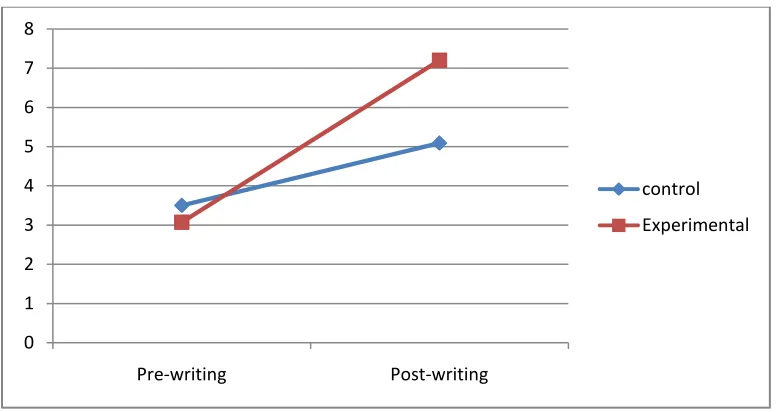
As it is shown in Figure 5.1, the enhancement in experimental group from pre-test to post-test in comparison to control group is highly considerable and indicates the effective impact of Web-based collocation instruction on ESL students writing. Moreover, the group means across
two testing times are presented graphically in Figure 5.1. It is evident that, overall, participants’ ability of essay writing has increased from pre-test to post-test and both groups are improved but, as it is clear from the figure, the improvement in experimental group is considerable and significant.
Figure 5.1.Groups’ mean scores on writing test across two testing times
5.2. The effects of Web-based collocation instruction on the cohesion and coherence of ESL students’ essay writing
Cohesion and coherence of the writing is one of the most essential components of an essay. It shows the unity and continuous of a text which pursue the essay’s title. To know whether web-based collocation instruction impacts on this trait, the ESL students’ essay writings of this study were analyzed and the scoring responds were submitted to independent sample t-test to compare the results of cohesion and coherence post-test between two control and experimental group. According to the pre-test result the mean score for control group is M= 3.00 with SD= 1.01 and for experimental group
M=2.81 with SD= 0.98. This result shows that the mean scores for both groups are so close together and there is not any considerable difference between the cohesion and coherence of both groups’ students in pre-test (table 5.2.1).
But with reference to the table 5.2.1 the descriptive analysis for post-test revealed that that there is more than one point different between the mean score of two groups as it is shown in table 5.2.1 the control group achieved Mean=5.00 and
0 1 2 3 4 5 6 7 8
Pre-writing Post-writing
control
SD= 0.80 while the experimental group Mean= 6.30 and SD= 0.72.
Table 5.2.1.Descriptive statistics for post-test cohesion and coherence on two groups
N Minimum Maximum Mean Std. Deviation
ContPreCohe 32 1.00 5.00 3.00 1.01
ContPostCohe 32 4.00 6.00 5.00 0.80
ExPreCohe 35 1.00 5.00 2.81 0.98
ExPostCohe 35 5.00 8.00 6.30 0.72
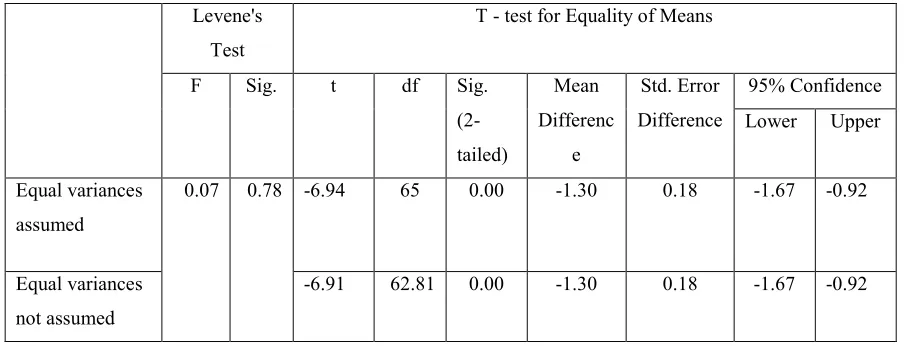
To realize whether this difference between two control and experimental groups are significantly different, the independent sample t-test was applied to find out this issue. Table 5.2.2 confirmed that there is statistically significant difference between the two control and experimental groups
while the result shows t-value = 6.94 and p = 0.00 is lower than 0.05 level of significance with df = 65. Therefore, the web-based collocation instruction significantly impacts on the cohesion and coherence of ESL students’ essay writing ability.
Table 5.2.2.Independent sample t-test for post-test cohesion and coherence on two groups
Levene's Test
T - test for Equality of Means
F Sig. t df Sig.
(2-tailed)
Mean Differenc
e
Std. Error Difference
95% Confidence Lower Upper
Equal variances assumed
0.07
0.78
-6.94 65 0.00 -1.30 0.18 -1.67 -0.92
Equal variances not assumed
-6.91 62.81 0.00 -1.30 0.18 -1.67 -0.92
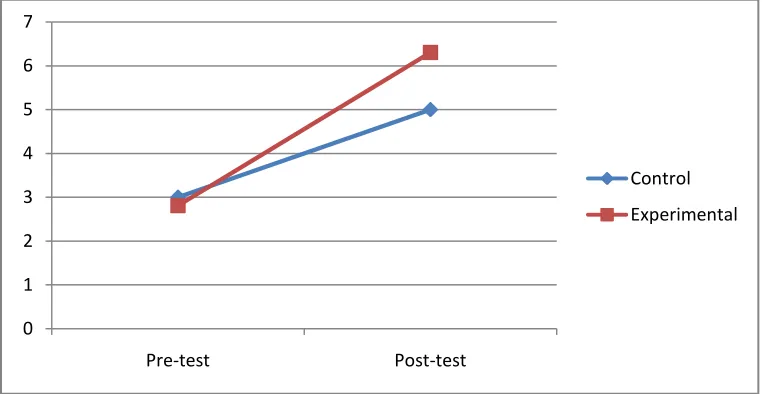
In addition by looking to the Figure 5.2, it can be clear that the ESL students’ cohesion and coherence in writing progressed across two testing times from pre-test to post-test in two control and experimental groups, but the noticeable point in here is that, the
ESL students’ essay writing ability in experimental group.
Figure 5.2.Groups’ mean scores on writing’s cohesion and coherence across two testing times
6. Conclusions and Recommendations
Analysis of data revealed that the experimental group that received web-based collocation instruction improved considerably from pre-tests to post-tests. Indeed web-based collocation instruction had positive effect on ESL students essay writing ability and increases their creativity and improved their writing scores. Moreover, cohesion and coherence in writing had significantly improved in experimental group and showed the effective impact of instruction. Cohesion and coherence demonstrates the unity and skillfully manages paragraphing which follow the essay’s topic. Students comprehended that collocations perform a crucial role in their essay writing, so they have become aware of the fact that utilizing collocations can ameliorate their writing and make it more natural and accurate. The
outcomes of the present study suggest that providing freshmen ESL students with web-based collocation instruction in the context of conducting communicative skills results in better performance in their writing and cohesion and coherence of their written text. In recent years it is so clear for every one that learning language had impressive changes. Computer assisted language learning (CALL) alluded to the use of computer in language learning and teaching program. Dhaif (1989 as cited in Gündüz, 2005) stated that “computers can never replace the live teacher, especially in language teaching, where the emphasis is on mutual communication between people”. “For the last three decades cohesion and coherence and their relationship have been a topic of intense debate in the international linguistic community (Hůlková, Jančaříková 2009)”.It is very obvious that cohesion and coherence in the writing is one of the key
0 1 2 3 4 5 6 7
Pre-test Post-test
Control
factors in the essay writing. Generally written language is an important key form of communication. Subsequently, acquiring to write good considered as paramount educational objective and one that needs the expansion of a complex diversity of skills. Be that as it may, for students to efficiently communicate their thought in writing they require to do more than write accurately; they should acquire to build coherent texts. In fact cohesion and coherence are not synonymous expressions. Coherence connect to the unity in meaning that transmited by a text, cohesion equals to the text level markers through which coherence is showed (Bereiter & Scardamalia, 1987; Graesser, McNamara, Louwerse, & Cai, 2004).
8. References:
Aghbar (1990).Fixed Expressions in Written Texts: Implications for Assessing Writing
Bereiter, C., & Scardamalia, M. (1987). The psychology of written composition. Hillsdale, NJ: Lawrence Erlbaum Associates.
Brown, D.F. (1974). Advanced vocabulary teaching: The problem of collocation.‖
RELC Journal, 5(2), 1–11.
Chen, H. J. H. (2011). Developing and evaluating a web-based collocation retrieval
tool for EFL students and
teachers. Computer Assisted Language Learning, 24(1), 59-76.
Dhaif, H. A.(1989).Can computers teach languages? English teaching forum. 27(3),pp. 17-19.
Durrant, P. & Schmitt, N. (2010). Adults learners’ retention of collocations from exposure. Second Language Research,
26(2), 163-188.
Eidian, F., Gorjian, B., & Aghvami, F.(2013). The Impact Of Lexical Collocation Instruction On Developing Writing Skill Among Iranian Efl Learners.
Ellis, N. C. (1996). Working memory in the acquisition of vocabulary and syntax: Putting language in good order. The Quarterly Journal of Experimental Psychology: Section A, 49(1), 234-250.
Farghal, M., & Al-Hamly, M. (2007). Lexical Collocations in EFL Writing. The Journal of Asia TEFL, 4(1), 269-294.
Fernández, R. F., Prahlad, S. R. R., Rubtsova, E., & Sabitov, O. (2009). Collocations in the vocabulary English teaching as a foreign
language. Acimed,19(6), 1-5.
Fowler ,W. S.& Norman Coe ( 1976).
Nelson English Language Tests: Nelson Graesser, A. C., McNamara, D. S., Louwerse, M. M., & Cai, Z. (2004). Coh-Metrix: Analysis of text on cohesion and language. Behavior Research Methods, 36 (2), 193–202.
Gündüz, N. (2005). Computer assisted language learning. Journal of Language and Linguistic Studies, 1(2).
English Discourse. Brno: Masaryk University.
Jonassen, D. H., Carr, C., & Yueh, H. P. (1998). Computers as mindtools for engaging learners in critical thinking. TechTrends, 43(2), 24-32.
Kaitakusha.
Kaufman, H. (1992.) Computers: A Resource for Teaching Literacy in the AMEP. Adult Migrant Education Services.
Lai, C. C., & Kritsonis, W. A. (2006). The Advantages and Disadvantages of Computer Technology in Second Language Acquisition. Online Submission,3(1).
Levy, M. (1997). Computer-Assisted Language Learning: Context and Conceptualization. Clarendon paper backs.
McCarthy, M. (1990). Vocabulary. Oxford University Press.
McCarthy, M. O” Dell, F.(2005). English collocations in use.
Miller, H. (1964). Henry Miller on writing (No. 151). New Directions Publishing
Namvar, F. (2012). The relationship between language proficiency and use of collocation by Iranian EFL students. 3L: The Southeast Asian Journal of English
Language Studies, 18(3), 41-Nation, I. S. P. (2001). Learning vocabulary in another language. Cambridge: Cambridge University Press.
Nguyen, T.T.H., & Khuat, T.T.N. (2003). The effectiveness of learning vocabulary
through games. Asian EFL Journal Quarterly, 5(4). Retrieved on January 15, 2010 from
http://www.asian-efl-journal.com/dec_03_vn.pdf
Oliver, M. & Bradley, C. (1999). Examples of Best Practice in the use of multimedia in Higher Education, EXE report no. 2, London: University of North London .
Palmer, H.E. (1933). Second interim report on English Collocations. Tokyo:
Rubin, J. & Thompson, I. (1994). How to be a successful language learner. Boston, Massachusetts: Heinle & Heinle.
Salaberry, M. R. (2001). The use of technology for second language learning and teaching: A retrospective. The Modern Language Journal, 85(1), 39-56.
Sophistication. Paper presented at the meeting of the English Association of Pennsylvania
State System Universities.
Sun, Y. C., & Wang, L. Y. (2003). Concordancers in the EFL classroom: Cognitive approaches and collocation difficulty. Computer Assisted Language Learning, 16(1), 83-94.
Walter, E. (2010). Collocations Extra Book with CD-ROM: Multi-level Activities for Natural English. Cambridge University Press.