VLSI
�
Design and Implem
b
ntation of Arthimetic Circuit for
Video Encoding Using
VLSI
�
Technology
Sk.�Mujafar Ahmed1, Shaik Yasmin 2 & Boggarapu Kantha Rao3
1Associate Professor, Medha Institute of Science& Technology for Women, Khammam,
2M-Tech, Medha Institute of Science& Technology for Women, Khammam,
3HOD & Assoc Prof, Medha Institute of Science & Technology for Women, Khammam,
E-mail:- [email protected]
ABSTRACT
The field of estimated registering has gotten
significant consideration from the
examination group in the previous couple of
years, particularly with regards to sundry
flag preparing applications. Picture and
video pressure calculations, for example,
JPEG, MPEG, et cetera, are solidly
appealing possibility for rough processing,
since they are tolerant of figuring
imprecision because of human
indistinctness, which can be misused to
acknowledge exceptionally control
proficient usage of these calculations. In any
case, subsisting inexact models commonly
fix the gauge of equipment estimation
statically and are not versatile to include
information. For instance, if a fixed rough
equipment configuration is used for a
MPEG encoder (i.e., a fixed level of
estimation), the yield quality fluctuates
enormously for various information
recordings. This paper addresses this issue
by proposing a reconfigurable surmised
design for MPEG encoders that improves
control utilization with the objective of
keeping up a specific Peak Signal-to-Noise
Ratio (PSNR) limit for any video. Toward
this end, we outline re-configurable
snake/subtracted pieces (RABs), which have
the competency to balance their level of
guess, and hence incorporate these squares
in the kineticism estimation and discrete
cosine change modules of the MPEG
encoder. We propose two heuristics for
naturally tuning the estimate level of the
RABs in these two modules amid runtime
predicated on the qualities of every
individual video. Exploratory outcomes
demonstrate that our approach of
powerfully altering the level of equipment
estimation predicated on the info video
worships the given quality bound (PSNR
corruption of 1%–10%) crosswise over
puissance saving up to 38% over a
customary non approximated MPEG
encoder design. Note that yet the proposed
re-configurable estimated design is
exhibited for the septic instance of a MPEG
encoder, it can be effortlessly stretched to
other DSP applications.
Key words: - Surmised circuits, rough figuring, low power plan, quality configurable.
.INTRODUCTION
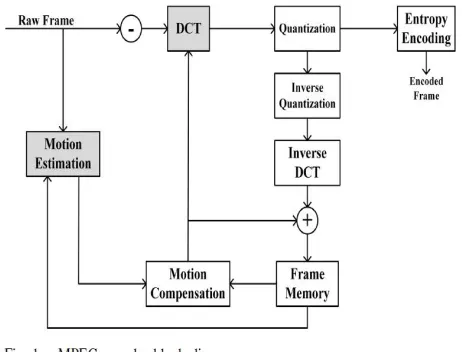
Presenting a surrounded measure of registering imprecision in picture and video handling calculations frequently brings about an insignificant measure of recognizable visual transmutation in the yield, which makes these calculations as perfect possibility for the usage of surmised processing structures. [1] Approximate figuring models misuse the way that a moment unwinding in yield rightness can bring about significantly less complex and lower control executions. [4] However, most inexact equipment structures proposed so far experience the ill effects of the imperative that, for generally changing information parameters, it turns out to be difficult to give a quality bound on the yield, and at times, the yield quality might be thoroughly
outline of reconfigurable viper/subtraction pieces (RABs) for four ordinarily utilized snake designs, viz., swell convey viper (RCA), convey look forward snake (CLA), convey sidestep snake (CBA), and convey separate snake (CSA), and in this manner coordinate them into the MPEG encoder to empower quality configureable execution. 3) We propose an outline philosophy to habituate the DA powerfully predicated on the video attributes with the objective of discovering that yield quality is inside a specified bound. 4) We have actualized the proposed design for a MPEG encoder on an Alter DE2 field-programmable entryway exhibit (FPGA) board and assessed it using eight benchmark recordings. [8] Our trial comes about demonstrate that the proposed design brings about power funds indistinguishably commensurate to a gauge approach that uses fixed surmised equipment while adoring quality imperatives crosswise over various recordings. [6] The leftover of this paper is sorted out as takes after. Area II gives a record of related work in the space of estimated registering. Segment III gives a succinct rundown of the MPEG pressure standard and in addition a concise portrayal of the measurements used for video quality assessment. [10] A contextual analysis that
suits as the inspiration for our work and the proposed reconfigurable surmised design for MPEG encoding are portrayed in Sections IV and V, separately. Segment VI reports the outcomes acquired through equipment usage for our plan on a FPGA, and Section VII finishes up this paper.
2. RELEGATED WORK
2.1Existing System
strategies in present imprecision by superseding adders with their surmised partners. The estimated adders are acquired by cleverly destroying a portion of the transistors in a mirror snake. A foremost point to note is that these surmised circuits are hardwired and can't be changed without re integrating the whole circuit. There withal subsist cases of approximations presented in a MPEG encoder. A large portion of them abuse the intrinsic blunder strength of the kineticism estimation (ME) calculation, which brings about minor quality debasement. For instance, Moshnyaga et al. use barely width pressure system to decrease control utilization of video outline memory. He and Liou and He et al. use bit truncation to present approximations in the ME square of a MPEG encoder. A versatile piece veiling strategy is proposed in ,where the creators propose to truncate the pixels of the present and foremost edges required for ME relying on the quantization step. Nonetheless, such a coarse-grained input truncation is relevant just to the clear cut instance of ME and gives unsuitable outcomes for different pieces, for example, discrete cosine change (DCT), which requires a better direction over mistake. As in and this paper also points in
predicated RAB, we propose double mode convey look forward and spread cause obstructs as its constituent fundamental building squares. Determinately, we give a near investigation of the power utilization of the diverse RABs and withal exhibit how the DA is consequently directed crosswise over various casings amid run-time.
2.2Proposed System
This area portrays the diverse strides followed in developing our proposed reconfigurable engineering and how it was inserted inside the MPEG encoder. A. Reconfigurable Adder/Subtractor Blocks Dynamic variety of the DA should be possible when each of the snake/subtractor pieces is furnished with at least one of its rough duplicates and it can switch between them according to imperative. This reconfigurable engineering can incorporate any surmised variant of the adders/subtractions. As a kind of perspective, Gupta et al. proposed six various types of inexact circuits for adders. Notwithstanding, it furthermore should be learned that the supplemental territory overheads required for developing the reconfigurable rough circuits are negligible with sufficiently cosmically massive power funds. As cases, we have winnowed the two
Compiler and the comparing comes about are depicted in Our examinations have demonstrated an insignificant distinction in the strength utilization of DMFA when worked in both of the two estimation modes. Consequently, with no loss of all inclusive statement, guess 5 was winnowed for its higher likelihood of giving the right yield result than truncation, which constantly yields 0 independent of the info. demonstrates the rationale square outline of the DMFA cell, which supersedes the constituent FA cells of a 8-bit RCA, as appeared in additament, it withal comprises of the estimate controller for inducing the appropriate separate signs for the multiplexers. A multimode FA cell would give even a superior other option to the DMFA from the purpose of controlling the estimate greatness. Be that as it may, it withal builds the multifaceted design of the decoder square used for stating the correct winnow signs to the multiplexers and also the rationale overhead for the multiplexers themselves. This undermines the essential target as the vast majority of the intensity reserve funds that we get from approximating the bits are perplexed. Rather, the two-mode decoder and the 2:1 multiplexers have immaterial overhead and
withal give sufficient summon over the estimate degree.
3. IMPLEMENTATION
3. 1 Effect of Hardware Approximation
On Video Quality
supreme PSNR and gives the rate debasement in PSNR (contrasted and an exact rendition of the MPEG encoder) for the five randomly winnowed video benchmarks (Akiyo, Garden, Bowing, Coastguard, and Container) when the quantity of bits to be approximated (withal named the DA) is changed. For this situation, we have approximated the slightest significant bits (LSBs) of the adders. There are different methods for setting the hard edge for the yield PSNR, which decides if the nature of a video is worthy or not. For straightforwardness, it is induced that either the total PSNR or the rate transmutation in PSNR obliges as a reliable measuring stick for assessing the nature of recordings yielded by the approximated MPEG encoder. In such manner, we characterize two measurements: 1) total mistake limit (AET) and 2) relative blunder edge (REM) to divide between the satisfactory and unsatisfactory recordings.
Fig 1 8-bit reconfigurable RCA block.
Fig 2 8-bit reconfigurable CLA block.
3. 2 Reconfigurable Adder/Subtracted
Blocks
reconfigurable design can incorporate any estimated form of the adders/sub tractors. proposed six various types of estimated circuits for adders. Be that as it may, it withal should be determined that the supplemental zone over heads required for developing the reconfigurable surmised circuits are insignificant with satisfactorily cosmically tremendous power funds. As cases, we have winnowed the two most verdant strategies exhibited in to be specific, truncation and guess 5, for approximating the viper/subtracted pieces. The last one can withal be conceptualized as an improved adaptation of truncation as it just transfers the two 1-bit inputs, one as Sum and alternate as Carry Out (Cull 2). On the off chance that A, B, and C in are the 1-bit contributions to the full adder(FA), at that point the out puts are Sum= B and C out = A. The proposed conspire supersedes every FA cell of the adders/subtractions with a double mode FA (DMFA) cell in which every FA cell can work either in plenarily exact or in some guess mode relying upon the condition of the control flag APP. A rationale high estimation of the APP flag signifies that the DMFA is working in the rough mode. We term these adders/subtractors as RABs. It is significant
target as the vast majority of the puissance reserve funds that we get from approximating the bits are muddled. Rather, the two-mode decoder and the 2:1 multiplexers have irrelevant overhead and withal give sufficient summon over the estimation degree. 1) DMFA Overhead: The puissance gating transistor and the multiplexers of the DMFA are intended to acquire the minimum conceivable overhead. Our investigations demonstrate that exchanging energy of the CMOS transistors contributes toward the vast majority of the aggregate power utilization of the FA and DMFA pieces. Table I shows the intensity utilization of FA and DMFA for various modes gotten by thorough recreation in Synopsys Nano Sim. It demonstrates that the puissance increments by 0.21 μW when we work DMFA in exact mode as contrasted and the perfect FA piece.
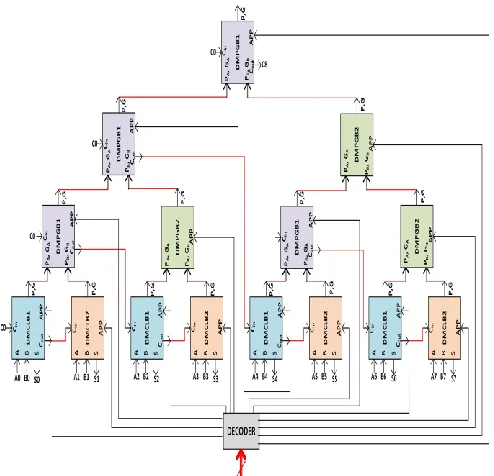
Fig 3 Architecture Diagram
4. EXPERIMENTAL RESULTS
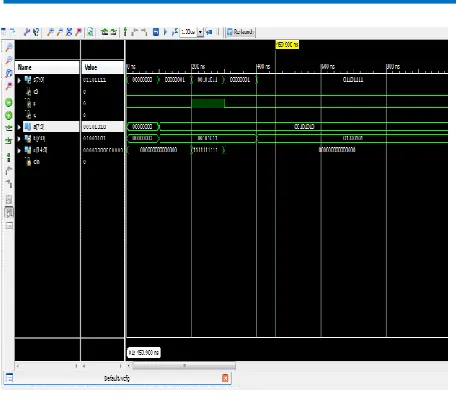
Fig 5 Simulation output
5. CONCLUSION
This paper proposed a reconfigurable estimated engineering for the MPEG encoders that streamline control utilization while keeping up yield quality crosswise over various information recordings. The proposed engineering is predicated on the idea of powerfully reconfiguring the bore of guess in the equipment predicated on the info attributes. It requires the utilizer to assign just the general least quality for recordings in lieu of deciding the bore of equipment estimate. Our exploratory outcomes demonstrate that the proposed engineering brings about power investment funds indistinguishably equivalent to a standard approach that uses adjusted rough equipment while worshiping quality limitations crosswise over various
recordings. Future work incorporates the consolidation of other estimate strategies and lengthening the approximations to other number-crunching and utilitarian squares.
6. REFERENCE
[1] M. Elgamel, A. M. Shams, and M. A. Bayoumi, “A comparative analysis for low power motion estimation VLSI architectures,” in Proc. IEEE Workshop Signal Process. Syst. (SiPS), Oct. 2000, pp. 149–158.
[2] F. Dufaux and F. Moscheni, “Motion estimation techniques for digital TV: A review and a new contribution,” Proc. IEEE, vol. 83, no. 6, pp. 858–876, Jun. 1995. [3] I. S. Chong and A. Ortega, “Dynamic voltage scaling algorithms for power constrained motion estimation,” in Proc. IEEE Int. Conf. Acoust., Speech, Signal Process. (ICASSP), vol. 2. Apr. 2007, pp. II-101–II-104.
[4] I. S. Chong and A. Ortega, “Power efficient motion estimation using multiple imprecise metric computations,” in Proc. IEEE Int. Conf. Multimedia Expo, Jul. 2007, pp. 2046–2049.
ACM/IEEE Int. Symp. Low Power Electron. Design (ISLPED), 2009, pp. 195–200. [6] J. George, B. Marr, B. E. S. Akgul, and K. V. Palem, “Probabilistic arithmetic and energy efficient embedded signal processing,” in Proc. Int. Conf. Compil., Archit., Synth. Embedded Syst. (CASES), 2006, pp. 158–168.
[7] D. Shin and S. K. Gupta, “A re-design technique for datapath modules in error tolerant applications,” in Proc. 17th Asian Test Symp. (ATS), 2008, pp. 431–437. [8] S. Venkataramani, A. Sabne, V. Kozhikkottu, K. Roy, and A. Raghunathan, “SALSA: Systematic logic synthesis of approximate circuits,” in Proc. 49th Annu. Design Autom. Conf. (DAC), Jun. 2012, pp. 796–801.
[9] V. Gupta, D. Mohapatra, S. P. Park, A. Raghunathan, and K. Roy, “IMPACT: IMPrecise adders for low-power approximate computing,” in Proc. 17th IEEE/ACM Int. Symp. Low-Power Electron. Design (ISLPED), Aug. 2011, pp. 409–414.
[10] V. Gupta, D. Mohapatra, A. Raghunathan, and K. Roy, “Lowpower digital signal processing using approximate adders,” IEEE Trans. Comput.-Aided
Design Integr. Circuits Syst., vol. 32, no. 1, pp. 124–137, Jan. 2013
AUTHOR-1
SHAIK YASMIN PGScholar bearing Roll no 156C1D6817 with specailisation of VLSI & Embedded Systems Branch in Medha Institute Of Science And Technology For Women . my area of interest subjects are IC Designing and Embedded systems. Mail id [email protected]
AUTHOR 3:
Boggarapu Kantha Rao, HOD & Assoc Prof, Medha Institute Of Science & Technology For Women,Khammam, B.KANTHA RAO received his B.Tech degree in Electronics And Communication Engineering from Adams Engineering College,Paloncha,JNTUH in 2006 and M.Tech in EMBEDDED SYSTEMS from Anurag Engineering College,kodad, JNTUH in 2011,is a faculty member in the Department of Electronics And Communication Engineering, Medha Institute Of Science& Technology For Women, Khammam and presently working as Associate Professor. His research interests include Embedded Systems, VLSI Design.E-mail:[email protected].