Optimization of Cutting Forces, Tool Wear and Surface Finish
in Machining of AISI 304 Stainless Steel Material Using
Taguchi’s Method
Nithyanandhan.T[1], Manickaraj.K[2] and Kannakumar.R[3]
[1] , [2], [3] –CMS College of Engineering and Technology, Coimbatore. [email protected]
ABSTRACT
In order to produce any product with desired quality by machining, proper selection of process parameters is essential. This can be accomplished by
Taguchi’s approach. The aim of the present work is to investigate the effects of process parameters on surface finish and material removal rate (MRR) to obtain the optimal setting of these process parameters. And the analysis of Variance (ANOVA) is also used to analyze the influence of cutting parameters during machining. In this work, AISI 304 stainless steel work pieces are turned on
conventional lathe by using tungsten carbide tool. The results revealed that the feed and nose radius is the most significant process parameters on work piece surface roughness. However, the depth of cut and feed are the significant factors on MRR.
Tool wear is serious, which leads to lower machining efficiency and it is thus of great importance to choose reasonable cutting parameters to decrease tool wear and increase machining efficiency. In this work, coated carbide tools were used to cut the materials. In light of the tool wear mechanism, tool flank wear model was established. The optimal cutting temperature was obtained using the established wear model. Further cutting parameter optimization was conducted according to the optimal cutting temperature. The optimized Cutting parameters can be considered to increase tool life and machining efficiency.
In the present study, an attempt has been made to investigate the effect of cutting parameters on cutting forces and tool wear in hard turning of
AISI 304 steel using coated carbide tools. The machining experiments were performed in accordance to Taguchi’s method obtained results reveal that, cutting speed and depth of cut have significant effect on feed force whereas feed rate and depth of cut are factors that significantly influences on thrust force. The depth of cut and cutting speed has predominant effect on tool wear. Feed rate have
less significant effect on tool wear. But, in case of cutting force modeling, all the three parameters have significant effect. Key parameters and their effects on tool wear and cutting forces have also been presented in graphical contours which may help for choosing operating parameter preciously. Optimized model indicates desirability level for economy in machining process.
1. INTRODUCTION
In machining process, Surface finish is one of the most significant technical requirements of the customer. A reasonably good surface finish is desired to improve the tribological properties, fatigue strength, corrosion resistance and aesthetic appeal of the product
The aim of this experimental investigation is to evaluate the effects of the process parameters on AISI 304 stainless steel work piece to surface roughness, tool wear, and cutting forces by employing Taguchi’s orthogonal array design and Analysis of Variance (ANOVA) using tungsten carbide tool on conventional lathe under dry environment. The AISI 304 stainless steel is the most widely used grade steel. It is used for aerospace components and chemical processing equipment, for food, dairy, and beverage industries, for heat exchangers, and for the milder chemicals.
2. TAGUCHI’S APPROACH
small set from all possibilities which helps to determine least no. of experiments, which will further help to conduct experiments to determine the optimum level for each process parameters and establish the relative importance of individual process parameters. This ratio considers both the mean and the variability. In ANOVA is used to indicate the influence of process parameters on performance measures. Taguchi proposed three categories of performance characteristics in the analysis of the S/N ratio, that is, the smaller the better, the higher the better, and the nominal the better.
3. GLIMPSES ON RELATED LITERATURE
G.Sutter, this paper deals with cutting temperature and heat generated at the tool-chip interface during high speed machining operations have been recognized as major factors that influence tool performance and work piece geometry or properties.N.A.Abukhshim, it described that the determination of the maximum temperature and temperature distribution along the rake face of the cutting tool is of particular importance. Because, of its controlling influence on tool life, as well as, the quality of the machined part.Robert W.Ivester,it described that infrared based measurements and analysis of cutting tool temperatures for orthogonal machining of alloyed titanium. Abele.E . Have described about high speed machining of titanium alloys. Titanium alloys are on account of their unrivalled qualities wide spread in certain industriesL.B.Abhang . Have presented about chip-tool interface temperature prediction model for turning process. This paper deals the tool-chip interface temperature measurement during turning. Tool-work thermocouple is used to measure the temperatureJ.J.MASON. Described about an effect of tool parameters on temperature fields in high speed machining. This study focuses on experimental modeling of dry high speed machining of aluminum alloyZhao-Peng Hao, Yong Lu, Dong Gao, Yi-Hang Fan & Yan-Li Chang Cutting Parameter Optimization Based on Optimal Cutting Temperature in Machining .R. Suresh, S. Basavarajappa, G.L. Samuel . Predictive Modeling of Cutting Forces and Tool Wear in Hard Turning using Response Surface Methodology. B. Fnides, M.A. Yallese, H. Aouici .
Hard turning of hot works steel AISI H11: Evaluation of cutting pressures, resulting force and temperature.
Mechanika,Li Qian, Mohammad Robiul Hossan.
Effect on cutting force in turning hardened tool steels with cubic boron nitride inserts. Journal of Materials Processing Technology, G. Madhavelu, B. Ahemd.
Hot machining process for improved metal removal rates in turning operations. D.C. Montgomery.
Design and analysis of Experiments. Wiley, New
York. E. Daniel Kirby, Zhe Zhang, Joseph C. Chen, Jacob Chen. Optimizing surface roughness in a turning operation using the Taguchi parameter design method.
4. DYNAMOMETERS
There are various types of dynamometers that are used to measure machining forces. The most popular dynamometers are strain gauge dynamometers, octagonal dynamometers, parallel beam dynamometers, piezoelectric dynamometers and split tool dynamometers. Piezoelectric dynamometers will be the main consideration in this project work.
The dynamometer is made by Kistler Instrument corporation ltd. The instrument shown in Figure 3.2 is a quartz three-component dynamometer and can be used to measure the three component forces. The dynamometer is said to have a great rigidity and consequently a high natural frequency. The instrument has a very high resolution which enables it to measure the smallest variation in large forces.
Fig 4.1 Kistler three components Dynamometer fitted with tool holder
5. CHARGE AMPLIFIERS
The Kistler quarts three-component dynamometer is connected to three Kistler multichannel charge amplifiers which is shown in Figure 3.3 and it is using a highly insulated connection cable. The amplifiers amplify the electrical charges delivered from the dynamometer into proportional voltages that can be displayed as proportional forces.
Fig 5.1 Multi Channel Charge Amplifier 6. SURFACE FINISH MEASUREMENT
directly, a surface roughness tester shown in Figure 3.4 is placed over the finished product. It has stylus probe to read the surface finish with in the specified distance. The distance to be moved by the probe can be set by the operator. Three types of λ values can be given and the lambda represents distance to be moved.
Fig 6.1 Surface Roughness Tester
7. PLAN OF EXPERIMENTS
A well planned set of experiments in which all parameters of interest are varied over a specified range is a better approach to obtain systematic data. Mathematically speaking such a set of experiments is complete and ought to give desired results. The effect of many different parameters on the performance characteristic in a condensed set of experiments can be examined by using the 33 orthogonal arrays (OA) Design of Experiments.
8.0 PARAMETERS Input parameters
Cutting speed Feed rate Depth of cut Output parameters
Cutting forces Tool wear
Surface roughness
9.0 FACTORS AND LIMITS
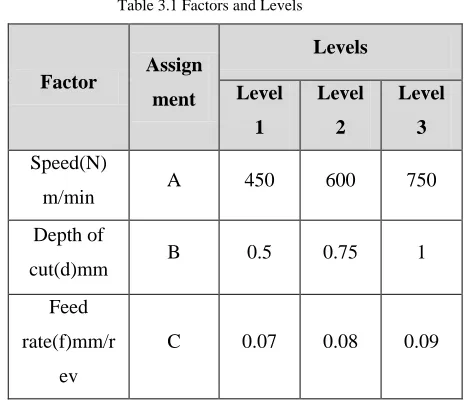
Determining what levels of a variable to test requires an in-depth understanding of the process, including the minimum, maximum, and current value of the parameter. For example, if the cutting speeds in turning can be varied between 400m/min and 800m/min. Three levels might be chosen at 450,600, and 750m/min. Also, the economic cost of conducting experiments plays a significant role in minimizing production costs and must be considered when determining the number of levels of a parameter to include in the experimental design. Typically, the number of levels for all parameters in the experimental design is chosen to be the same to aid in the selection of the proper orthogonal array. Knowing the number of parameters and the number
of levels, the proper 33 orthogonal array based Design of Experiment can be selected.
Table 3.1 Factors and Levels
Factor Assign ment
Levels
Level
1
Level
2
Level
3
Speed(N)
m/min A 450 600 750
Depth of
cut(d)mm B 0.5 0.75 1
Feed rate(f)mm/r
ev
C 0.07 0.08 0.09
10.0 CHEMICAL COMPOSITION
Table12.1: Chemical Composition of the Work piece Material.
Element C Mn Si P S Cr Ni Fe Weight
(%)
0.08 2.0 1.0 0.05 0.03 19 9 68.84
11.0 PHASES IN EXPERIMENTATION
The experimentation process for determining the surface roughness by optimizing machining parameters has been divided into the following phases as described below:
1. Phase 1-Plan of experiments 2. Phase 2-Tool and material selection 3. Phase 3-Collection of data
4. Phase 4-Analysis of data
12.0 PLAN OF EXPERIMENTS
13.0 TAGUCHI’S ORTHOGONAL ARRAY
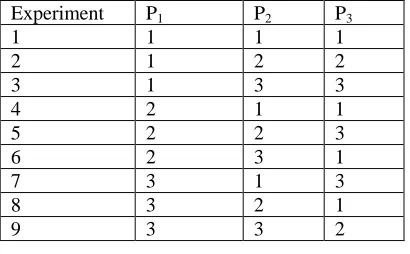
Table 13.1: Orthogonal array based design of experiment
Experiment P1 P2 P3
1 1 1 1
2 1 2 2
3 1 3 3
4 2 1 1
5 2 2 3
6 2 3 1
7 3 1 3
8 3 2 1
9 3 3 2
14.0 EXPERIMENTAL PROCEDURE
Turning is a popularly used machining process in which a single point cutting tool removes unwanted material from the surface of a rotating cylindrical work piece. The conventional lathe machines play a major role in modern machining industry to enhance product quality as well as productivity.
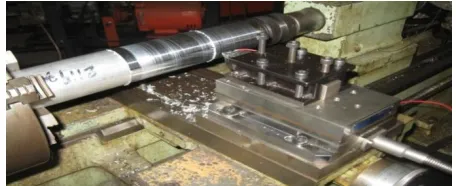
The machining tests are carried out on the material in cylindrical form, 350 mm long and 50 mm diameter is turned by tungsten carbide tool using conventional lathe. The variable speed of up to 1000 rpm and a power rating of 7.5kW. A center hole was drilled on the face of the work piece to allow supporting at the tailstock .These work pieces cleaned prior to the experiments by removing 0.3 mm thickness of the top surface from each work piece in order to eliminate any surface defects and wobbling. The surface roughness of machined surfaces has been measured by a Talysurf (Taylor Hobson, Surtronic 3+, UK) surface roughness tester. The experiment was conducted based on a three level orthogonal array using a central lathe machine. The photograph of the machine setup is shown in Figure.3.4 For carrying out this experiment on the centre lathe machine tungsten carbide cutting tool was used. The final experimental setup consists of the following components for the turning process:
Kirloskar Turnmaster-35. All geared lathe. Work piece material AISI 304 stainless steel Machining tool insert THN SNMG 08 Kistler three-component dynamometer Type k thermocouple.
Multichannel charged amplifier type 5070 TR 100 Surface Roughness Testers.
Fig14.1 Experimental set-up
15.0MACHINABILITY OF AISI 304 STAINLESS
STEEL:
Mach inability is reported to be the ease or the difficulty with which a material can be machined under a given set of operating conditions including, cutting speed, feed rate and depth of cut, resulting in acceptable tool life and at the same time providing good surface finish and acceptable functional characteristics of the components. The Mach inability of a material is mainly assessed by measuring the cutting forces, tool life, surface finish generated and component forces during a machining operation. The principle problems associated with machining AISI 304 stainless steel are related to high cutting temperatures, high cutting pressures, chatter, and the high chemical reactivity.
16.0 DESIGN OF EXPERIMENTS
Table 16.1: 33 orthogonal array based design of experiment by
levels
Runs Speed(m/min) Feed rate(mm/rev)
Depth of cut (mm)
1 450 0.07 0.5
2 450 0.08 0.75
3 450 0.09 1
4 600 0.07 0.75
5 600 0.08 1
6 600 0.09 0.5
7 750 0.07 1
8 750 0.08 0.5
17.0 PROCESS PARAMETERS READING
Table 17.1: Process parameters values for design of experiment levels design of experiment levels
CONCLUSION
For AISI 304 stainless steel various parameters like cutting forces in x, y & z direction, surface finish and tool wear are experimentally found out. For lathe speed to 450 rpm,600rpm,750 rpm and feed rate of 0.07mm/min,0.08mm/min and 0.09mm/min.
All this experiments was carried out in conventional lathe using Kistler Dynamometer, Perthometer and Profile Projector.
The tool used for turning was tungsten carbide and depth of cuts were 0.5, 0.75 and1mm The experiment has been concluded by taking experimental parameters for AISI 304 stainless steel.
In the future, the above parameters will be analyzed and optimized using design of expert software and parameters will be compared with experimental values.
REFERENCES
[1] Akasawa,T., Sakurai,H., Nakamura,M. , Tanaka, T., Takano, K. Effects of
free-cutting additives on the machinability of austenitic stainless steels. Journal of Materials Processing Technology, 2003; 143-144: 66–7
[2] Al-Ahmari, A.M.A. Predictive
machinability models for a selected hard material in turning operations. Journal of
Material Processing Technology, 2007; 190:305-311.
[3] Aman Aggarwal and Hari singh. Optimization of machining techniques – A retrospective and Literature ReviewSadhana , 2005; 30: 699–711.
[4] Aman Aggarwal, Hari singh, Pradeep kuma, Manmohan sing. Optimizing power consumption for CNC turneparts using response surface methodology and Taguchi’s Technique-A comparative analysis, Journal of Material .Processing Tech., 2008; 200: 373-384.
[5] Anirban Bhattacharya, Santanu Das, Majumdar,P., and Ajay Batish. Estimation of the effect of cutting parameters on surface finish and power consumption during high speed machining of AISI 1045 steel using Taguchi design and ANOVA, Production Engineering and Research Development, 2009; 3:31-40. [6] Anthony xavior, and Adithan, M.
Determining the influence of cutting fluids on tool wear and surface roughness during turning of AISI 304 austenitic stainless steel, Journal of Material processing
Technolog209; 2009: 900-909.
[7] Barua, P.B., Kumar, P., and Gaindhar, J.L. Optimal setting of process parameters for multi-characteristic products using Taguchi design and utility concept-an approach, Proc ICAMIE, University of Roorkee, India,1997 : 839-842. Runs Speed
(m/min)
Feed rate(mm/r
ev)
Depth of cut (mm)
Cutting forces (N)
Surface finish (microns)
Tool wear (mm)
F(x) F(y) F(z) Ra Ra/Z
1 450 0.07 0.5 59.84 142.78 108.4 1.65 11.03 0.01
2 450 0.08 0.75 100.19 149.51 156.25 1.30 11.3 0.02
3 450 0.09 1 127.53 263.72 285.52 1.13 9.76 0.03
4 600 0.07 0.75 114.5 186.08 150.73 2.34 14.3 0.04
5 600 0.08 1 137.15 236.62 214.51 1.27 9.50 0.03
6 600 0.09 0.5 67.44 122.27 114.11 1.09 6.73 0.02
7 750 0.07 1 125.06 173.25 183.32 1.36 9.2 0.04
8 750 0.08 0.5 71.96 360.12 289.55 2.39 21.66 0.04
[8] Bhattacharya, A., Faria-Gonzalez, R. and Ham. Regression analysis for predicting surface finish and its application in the determination of optimum machining conditions, ASME Journal of Engineering for Industry, 1970; 4: 711-714.
[9] Cebeli ozek et al. Turning of AISI304 austenitic stainless steel, Journal of Engineering and Natural sciences, 2006; 2: 117-121.
[10] Chou,Y.K., and Song, H. Tool nose radius effects on finish hard turning, Journal of Materials ProcessingTechnology, 2004; 148(2): 259-268.
[11] D. O’Sullivan, M. Cotterell. Machinability of austenitic stainless steel SS 303, Journal of Materials Processing Technology, 2002; 124: 153–159.
[12] D.K. Pal, S.K. Basu. 1971. Hot machining of austenitic manganese steel by shaping. International Journal of Machine Tool Design. 11: 45-61.
[13] N.N.S Chen, K.C. Lo. 1974. Factors affecting tool life in hot machining of alloy steels. International Journal of Machine Tool Design. 14: 161-173.
[14] V. Raguram, M.K. Muju. 1981. Improving tool life by magnetization in hot turning machining. International Journal of Machine Tool and Manufacture. 20: 87-96.
[15] B.K. Hinds, S.M. DE Almedia. 1981. Plasma arc heating for hot machining. International Journal of Machine Tool Design. 21: 143-152.
[16] T. Kitagaea, K. Maekawa. 1990. Plasma hot machining for new engineering materials. Wear. 139: 251-267.
[17] N. Tosum, L. Ozler. 2004. Optimisation for hot turning operations with multiple performance characteristics. International Journal of Advanced Manufacturing Technology. 23: 777-782.
Author’s profile T.Nithyanandhan received the
B.E., degree in Mechanical Engineering from the PTR college of Engineering, Madurai, Anna University, Chennai, India, in 2011.Also received M.E., in Mechanical Engineering (Engg.Design) in SBM college of Engineering, Dindigual, Anna University, Chennai, India, in 2013.
K.Manickaraj received the B.E.,
degree in Mechanical Engineering from the Thagarajar college of Engineering, Madurai, Anna University, Chennai, India, in 2010.Also received M.E., in Mechanical Engineering (Engg.Design) in Anna University, Regional centre, Coimbatore, India, in 2013.
R.Kannakumar received the