ISSN (Print) : 2320 – 3765 ISSN (Online): 2278 – 8875
I
nternational
J
ournal of
A
dvanced
R
esearch in
E
lectrical,
E
lectronics and
I
nstrumentation
E
ngineering
(An UGC Approved Journal)
Website: www.ijareeie.com
Vol. 6, Issue 8, August 2017
Experimental Verification of the Speed
Performance of PMSM Using DS1104
dSPACE with Load Disturbance
Mamatha G*, Rekha PS
SJB Institute of Technology, Bengaluru, India
ABSTRACT: A novel design implementation of Extended Kalman Filter (EKF) combined with state observer for a Permanent Magnet Synchr onous Motor (PMSM) is proposed. The precise speed estimation is achieved using kalman algorithm and the Linear Quadratic Regulator (LQR) technique is used to tune the PID controller parameters. The disturbance rejection is achieved using observer based PID controller and its error is retained and will act as immune to disturbance rejection. The proposed methodology combines the best features ofEKF estimator and that of the observer based PID controller and greatly enhances the PMSM speed control performance compared to the case when an EKF andobserver acting alone. The PMSM speed controller is implemented using MATLAB/SIMULINK and DS1104 dSPACE board. The experimental results for the speed response variations when the PMSM is subjected to the load disturbance are presented. The experimental results verify the effectiveness of the proposedmethod.
KEYWORDS: Permanent magnet synchronous motor; Extended kalman filter; Observer; PID; Vector control
I. INTRODUCTION
Permanent Magnet synchronous Motors (PMSM) are popular because they are efficient, compact and highly reliable, exhibits high torque/inertia ratio. Therefore it has becomethechoiceofexcellenceinthefieldofvariablespeed electric drive applications. The PMSM drives with the vector controltheorydemonstratethehighperformanceandcontrols the flux and torque independently, similar to the DC motor. Although the vector control is a complex control technique, the progresses in the development of fast semiconductors switches and cost efficiency micro-controller has made the vector control feasible.
To measure the shaft position of the PMSM the optimal encoder is used. Speed signal is obtained through thediscrete differentiation of the encoder position; this signal is very noisy and has an inherent delay. In order to avoid adverse effect on the performance of the system, the speed can be estimated through the Extented kalman filter (EKF) algorithm. The Extended Kalman Filter produces the optimal estimation of the states based on the least square method. Though the design of the observer is simple, it does not calculatetheoptimalestimationofthestatesunlikeinKalman Filter. Since, the fast dynamics demands for a highestimatorgain which in turn causes noisy states. Hence, the Kalman Filter gives a better approach to state estimation because it is easier to tune the filter in terms of process and measurement noise variances than in terms of eigenvalues of the error- model.
ISSN (Print) : 2320 – 3765 ISSN (Online): 2278 – 8875
I
nternational
J
ournal of
A
dvanced
R
esearch in
E
lectrical,
E
lectronics and
I
nstrumentation
E
ngineering
(An UGC Approved Journal)
Website: www.ijareeie.com
Vol. 6, Issue 8, August 2017
based PID and Extended Kalman Filter are combined to achieve better speed controller and to react quickly for the load disturbances.
To realize the better performance, the vector control theoryrequirestheknowledgeoftherotorpositionandspeed of the motor. The first goal of the proposed method is to find theoptimalmethodtoestimatetheangularspeedofthemotor. Since the rotor position is estimates through using sensors, it isessentialtoestimatethespeedaccuratelyundernoisynature to attain the speed tracking performance. It is effectively handledbydesigningtheExtendedKalmanFilter(EKF).The EKF is precisely estimate the angular speed by considering the noise in the measurement. The basic idea is to realize simple tracking algorithm and it is achieved in the proposed method. The second goal is to design a PID controller,which is quickly react to the variation of the reference input and to develop an observer to achieve disturbance rejection. Finally in this paper, implementation of a drive system by observer based PID controller combined with the EKF is achieved. In theproposedimplementation,thespeedandq-axiscurrentare estimated accurately by introducing combined observer and EKF algorithmtheory.
The proposed method yields a smooth and quick speed tracking. In addition, the noises in the signals are mitigated substantially. The actual disturbance applied to the system is reducesignificantly,andprovidesbettercontrolofthecontrol signal variation. The overall system performance during use is greatly enhanced. The experimental results justify the effectiveness of the proposedcontroller.
II. DESCRIPTION OF MOTORMODEL
ThevectorcontroltheoryisutilizedinPMSMdrivesinwhichthe resulting state-feedback LQR for the augmented system is: 3-ф stationary frame transforms into 2-ф synchronously rotating rotor reference frame to control the flux and torque
independently.
The stator voltage equations in the rotor references frame are [17,18]:
sq s m sd s sd s
sd i Li
dt d L i R
v , (1)
)
( ssd fd
m sq s sq s
sq i Li
dt d L i R
v (2)
The stator flux linkages equations are:
fd sd s sd Li
, (3)
sq s sq Li
Rs and Ls are the stator winding resistance and inductance. The electromagnetic torque generated and the acceleration is given by:
sq fd
em i
p
T
2
, (4)
mech L em mech J B J T T dt d
ISSN (Print) : 2320 – 3765 ISSN (Online): 2278 – 8875
I
nternational
J
ournal of
A
dvanced
R
esearch in
E
lectrical,
E
lectronics and
I
nstrumentation
E
ngineering
(An UGC Approved Journal)
Website: www.ijareeie.com
Vol. 6, Issue 8, August 2017
III. PID CONTROLLER WITH EXTENDED KALMAN FILTER DESIGN AND STATE SPACE
OBSERVER
The state space model of the simplified PMSM with referenceto the q-axis is:
) ( ) ( )
( 1 1 1 1
1 t Ax t Bu t
x , (6)
) ( )
( 1 1
1 t C x t
y (7)
The state space model of the speed controller can be written as:
) t ( u B ) t ( x A ) t (
x2 2 2 2 2 ,(8)
) t ( u ) t ( x C ) t (
y2 2 2 1 ,(9)
) t ( r E ) t ( y ) t (
u2 c (10)
The entire system output with the motor output plus the load disturbance is:
) ( ) ( )
(t y1 t d t
y (11)
The resulting state-feedback LQR for the augmented system is:
) t ( x K ) t ( x K ) t ( x K ) t (
u1 e e 1 1 2 2 (12)
The quadratic cost function J for the system is given as:
dt )] t ( u R ) t ( u ) t ( x Q ) t ( x [ J 1 T 1 e 0 T e
(13)where Q0 is the state variation and R0 is the control energy consumption.
The optimal state-feedback control gain which minimizes the performance index is given by:
P B R K T e 1 e (14)
The total control law is equivalent to a PID controller with {K1x1(t)} acting as proportional and derivative controller and {K2} acting as integral controller.
The design of an observer, whose dynamic function is the same as that of the motor, is
)] ( ) ( ˆ [ ) ( ) ( ˆ ) (
ˆ1 t A1x1 t B1u1 t J C1x1 t yt
x o (15)
Where,xˆ1(t) is an observed state andx1(t)is the real state.
The state space model of the simplified PMSM is:
k 1 k k (I AT)x BTu
x , (16)
k
k cx
ISSN (Print) : 2320 – 3765 ISSN (Online): 2278 – 8875
I
nternational
J
ournal of
A
dvanced
R
esearch in
E
lectrical,
E
lectronics and
I
nstrumentation
E
ngineering
(An UGC Approved Journal)
Website: www.ijareeie.com
Vol. 6, Issue 8, August 2017
) 0 , u , x ( f
xk k1 k (18)
) 0 , x ( h
yk k (19)
mech sq fd sq s mech s fd sq s s k k ) J TB 1 ( i ) J 2 p T ( v L T ) 2 p L T ( i ) L TR 1 ( ) u , x (f andh(xk,0)Hxk. (20)
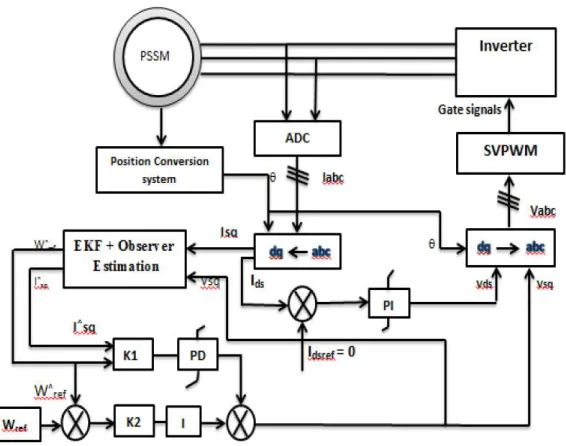
The PMSM states x can be estimated by using EKF algorithm during each sampling time interval as shown in the Figure1. The estimated current acts as an input to the state observer, while the estimated speed is compared with the reference speed.
Figure 1: The Kalman filter algorithm.
ISSN (Print) : 2320 – 3765 ISSN (Online): 2278 – 8875
I
nternational
J
ournal of
A
dvanced
R
esearch in
E
lectrical,
E
lectronics and
I
nstrumentation
E
ngineering
(An UGC Approved Journal)
Website: www.ijareeie.com
Vol. 6, Issue 8, August 2017
Figure 2: The block diagram of speed controller using the EKFcombined with the state observer.
IV. EXPERIMENTAL RESULTS
point DSP. The model implementation is achieved in the real time (RTI) in dSPACE board where the Simulink code is converted directly into DSP code in the expansion box. The control-desk which acts as user interface is used to regulate the output of the system. The CP1104I/O board is an input-output interface board between the power electronic The experiments are conducted in order to verify and validate the results [19,20]. The PMSM speed controller is implemented using DS1104 dSPACE board. The DS1104 dSPACE controller board is built around the TI TMS320F240 floating drive board and dSPACE controller board. The block diagram used in the implementation is as
shown in the Figure 3.
ISSN (Print) : 2320 – 3765 ISSN (Online): 2278 – 8875
I
nternational
J
ournal of
A
dvanced
R
esearch in
E
lectrical,
E
lectronics and
I
nstrumentation
E
ngineering
(An UGC Approved Journal)
Website: www.ijareeie.com
Vol. 6, Issue 8, August 2017
Based on optimal control theory, the desired control gain K1 and K2 are determined and the Kalman filter gain is obtained using EKF algorithm. The output drive current and speed are estimated through the EKF algorithm as previously discussed. The inputs are taken directly from the machine terminals. At the output, the motor response is checked and the speed control is observed.
The experimental results are recorded with the Non-observer under no load condition with the reference speed of 100rad/s.
It is observed from the Figures4a and 4b that the measured speed signal and current signals are too noisy and there is an over shoot in the current signal.
Figure4a: Speed response of the PMSM without the controller under no load.
Figure4b:Current response of the PMSM without the controller under no load.
ISSN (Print) : 2320 – 3765 ISSN (Online): 2278 – 8875
I
nternational
J
ournal of
A
dvanced
R
esearch in
E
lectrical,
E
lectronics and
I
nstrumentation
E
ngineering
(An UGC Approved Journal)
Website: www.ijareeie.com
Vol. 6, Issue 8, August 2017
Figure5a: Speed response of the PMSM with the proposed controller under no load
.
Figure5b: Current response of the PMSM with the proposed controllerunder no load.
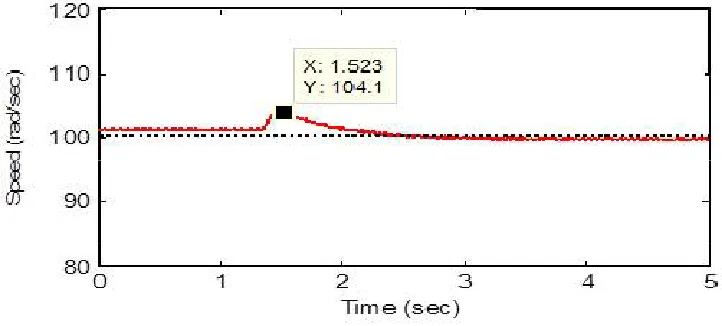
To verify for the speed estimation performance of the proposed method for a step change in steady state operation of PMSM; the load is varied from -0.2Nm to 0.2Nm. The experimental results are shown in the following figures for the increasing load. The estimated speed and current are compared with the actual values and are validated. Figures6a and 6b shows the actual and estimated speed responses and the Figures7a and 7b shows the actual and estimated current
responses respectively.
ISSN (Print) : 2320 – 3765 ISSN (Online): 2278 – 8875
I
nternational
J
ournal of
A
dvanced
R
esearch in
E
lectrical,
E
lectronics and
I
nstrumentation
E
ngineering
(An UGC Approved Journal)
Website: www.ijareeie.com
Vol. 6, Issue 8, August 2017
Figure6b:Speed response of the PMSM with the proposed controller under increasing load.
Figure 7a: Current response of the PMSM with the proposed controller under increasing load.
Figure7b: Current response of the PMSM with the proposed controller under increasing load.
ISSN (Print) : 2320 – 3765 ISSN (Online): 2278 – 8875
I
nternational
J
ournal of
A
dvanced
R
esearch in
E
lectrical,
E
lectronics and
I
nstrumentation
E
ngineering
(An UGC Approved Journal)
Website: www.ijareeie.com
Vol. 6, Issue 8, August 2017
Figure 8a: Speed response of the PMSM without the controller under decreasing load.
Figure 8b:Speed response of the PMSM with the proposed controller under decreasing load.
ISSN (Print) : 2320 – 3765 ISSN (Online): 2278 – 8875
I
nternational
J
ournal of
A
dvanced
R
esearch in
E
lectrical,
E
lectronics and
I
nstrumentation
E
ngineering
(An UGC Approved Journal)
Website: www.ijareeie.com
Vol. 6, Issue 8, August 2017
Figure 9a: Current response of the PMSM without the controller under decreasing load.
Figure9b: Current response of the PMSM with the proposed controller under decreasing load.
From the experimental results it is observed that the speed deviation is around 5rad/sec and the speed recovers quickly after the load disturbance with less transient time of around 0.8secs. The measured speed signal is smooth and contains less noise compared to the conventional methods. The significant reduction in the transient input signal variation is noticed, which intern help to reduces the risk of potential input signal saturation, and prevents the deterioration of the system performance.
V. CONCLUSION
ISSN (Print) : 2320 – 3765 ISSN (Online): 2278 – 8875
I
nternational
J
ournal of
A
dvanced
R
esearch in
E
lectrical,
E
lectronics and
I
nstrumentation
E
ngineering
(An UGC Approved Journal)
Website: www.ijareeie.com
Vol. 6, Issue 8, August 2017
REFERENCES
1. Dhaouadi R, Mohan N, et al. Design and implementation of an extended Kalman filter for the state estimation of a permanent magnet synchronous motor. IEEE Transactions on Power Electronics 1991; 6: 491–497.
2. Seok JK,Lee JK, et al. Sensorless speed control of nonsalient permanent-magnet synchronous motor using rotor-position-tracking PI controller. IEEE Transactions on Industrial Electronics 2006; 53: 399-405.
3. Chen H, “PMSM Servo Drive System for Electric Power Steering Based on Two-Degree-of-Freedom Torque Control”, Proceedings of International Conference of Industrial Technology, pp 2901 – 2906
4. Mamatha G,Ali W, et al. Design and Digital Implementation of Controller for PMSM Using Extended Kalman Filter, International Journal of Circuits and Systems 2013; 4: 489-497.
5. Zedong Z, Yongdong L, et al. A Rotor Speed and Load Torque Observer for PMSM Based on Extended Kalman Filter.Proceedings of the IEEE international conference on Industrial Technology 2006; 233-238.
6Ali WH, Mamatha G, et al. Design of a Speed Controller Using Extended Kalman Filter for PMSM. IEEE 57th International Midwest Symposium on Circuits and System 2014.
7. Zhang Y, Akujuobi C et al. Load disturbance resistance speed controller design for PMSM. IEEE Transaction on Industrial Electronics 2006; 53: 1198-1208.
8. ShedbalkarK, DhamangaonkarAP, et al. Speed estimation using extended Kalman filter for PMSM. International Conference on Emerging Trends in Electrical Engineering and Energy Management 2012; 433-435.
9. Jun Y , Huixian L, et al. Nonlinear disturbance observer based robust tracking control for a PMSM drive subject to mismatched uncertainties,” Proceedings of 31st Chinese Control Conference 2012; 830-835.
10. Du L, Zhang K, et al. Linear auto disturbance rejection controller for vector-controlled PMSM drive system.Proceedings of International Conference on Transportation, Mechanical, and Electrical Engineering 2012; 879–882.
11. Mohamed YA,Design and Implementation of a Robust Current-Control Scheme for a PMSM Vector Drive With a Simple Adaptive Disturbance Observer,” IEEE Transactions on Industrial Electronics2007; 54: 1981–1988.
12. Kalman ER, A new approach to linear filtering and prediction problems, Transactions of the ASME–Journal of Basic Engineering 1960; 82: 35– 45.
13. Welch G, Bishop G,An introduction to the Kalman filter, Technical Report 95-041, Univ. of North Carolina at Chapel Hill, Department of Computer Science1995.
14. GermaniA,ManesC, The Polynomial Extended Kalman Filter as an exponential observer for nonlinear discrete-time systems. 47th IEEE Conference on Decision and Control 2008; 5122-5127.
15. Song Y, GrizzleJW,The Extended Kalman Filter as a Local Asymptotic Observer for Nonlinear Discrete-Time Systems,American Control Conference 1992; 3365 – 3369.
16. Silverio B, Tubiana L,Extended Kalman filter tuning in sensorless PMSM drives. IEEE Trans Industry Applications2003; 39: 276-281. 17. MohanN, Electric Drives, an Integrative Approach, MNPERE, Minneapolis, 2000.
18. Pillay P, Krishnan L, Application Characteristics of Permanent Magnet Synchronous and Brushless DC Motors for Servo Drives. IEEE Trans Ind Appl 1991; 27: 986-996.