ISSN 2286-4822
www.euacademic.org DRJI Value: 5.9 (B+)
Effectiveness of Cognitive (active and inactive) and
Training on Recalling of Children with Special
Mental Needs
BAHARAK HAMEDI MA Educational Psychology Islamic Azad University, Tehran Central Branch Iran ARINA POUR KAMALI MA educational Psychology Islamic Azad University, Tehran Central Branch Iran MAHNAZ NIKAKHLAGH MA educational Technology Islamic Azad University, Tehran South Branch Iran
Abstract:
Special Mental Needs
Key words: cognitive strategies, Recalling, Special Mental Needs
Introduction
Children with mild mental retardation, as children with mental disabilities who are educated are more backward than other groups who have training in the forehead were noted. Children with special needs, mental or words of mentally retarded children have difficulties in thinking and problem solving is identified (Van der Molen et al, 2007). The main difficulties for children when scientific activities as well as reading and writing (Halahan et al, 2005).
Studies have proven that the level of deep thinking and retention problems of children with special needs in mind his peers will be higher than the normal children (Halahan et al, 2009). The most consistent findings in comparison to non-disabled individual learning abilities and mental disabilities when takes special people with mental wish list of words, sounds or images that a group of a few seconds before they are presented to recall, weaker than non-disabled persons acting(Yousefi,2009). One of the main reasons that children with intellectual disabilities about the things to have trouble remembering complex, is that they do not know effective learning methods such as mediation which used. When individuals are given list of words to memorize it, they often try to practice it aloud and then maintain. However, such methods do not use students in general retardation (2002). Accordingly, many studies showed retarded children have difficulty in using cognitive strategies (Yousefi, 2009). Therefore, research should be directed to go to the children's cognitive aspects of learning strategies able to use (Martin, Craft & Sheng, 2001).
research revealed that the cognitive training on academic performance and retention in memory is affected(Halahan et al, 2005).
For this reason, many researchers’ findings indicate retention failure and subsequent reminder that enabled by the use of cognitive strategies, i.e. strategies in which children are taught methods to directly and continuously encourages children to the experimental strategy used in practice to improve (Yousefi, 1999). However, research has shown that children with special needs did not mind using cognitive strategies to keep their minds off the drug retention (Beckman, 2002). In other words when the Examiner strategies did not directly teach children the educational opportunity to learn using Ta Recommend syllabus, retention of material to memorize, they could not recall the content.
Accordingly, it can be concluded that students with disabilities are active learners, especially mentally, because they could not automatically cognitive strategies) to review, develop and organize) use. Thus, it can be stated that these students probably do not use self-regulatory strategies (Ruthanne & VonThaden, 2010) and not In other words of cognitive awareness (Henry & MacLean, 2010).
In addition to demographic characteristics on learning, children with mental disabilities have special motor and sensory feature that can affect their learning. If we accept the claim that many children in the sense of one or more specific problems, and these problems can be solved with special training (Chan, 2007); so it might be a different approach that involves the senses improve retention difficulties, memory and learning can help them (Cantrell, Chambers, Carter & Margaret, 2011).
Special Mental Needs
purpose of this study was to investigate the effectiveness of cognitive training enable, disable reminders on children with special needs is subjective. According to this study, question whether active cognitive learning disabled children with special needs, mental effect on reminders?
Method
This is quasi experimental with pre-test – post-test and control group.
Sampling
The population is all children with special and mental needs in third grade boys in Tehran City that enrolled in 2011-2012. Community through use of random sampling multi-stage cluster of four schools from different districts of Tehran selection of these four schools, 60 children, mentally retarded boy, grade III sampling randomly selected 60 children who were selected to randomly into three groups (Control group, Inactive Cognitive group, Active cognitive group) and control group of 15 subjects were assigned to each group. Children placed in different groups were done randomly.
Measure
Recalling method to measure term is used with series of images. Adopted in this study to measure recall tests, post-test were used in each of 12 cards.
The theme of card is fruits, animals and the equipment. And 4 of each card were presented.
It was a way of grading cards for every correct answer a score considered was otherwise a score of subjects was not. Sum of individual scores is for each test score as he was reminded.
were included after training; children were evaluated to determine effectiveness of training.
Instructions pre-test and post-test are as follows: The child is going to do play together. I'll show you some photos and called one by one to tell them. Good look at the photos and try to remember the names of them. When I show you all the photos I have seen the photos say what?
Thus, the shape of the card is card was shown to the child was 5 seconds, giving him the opportunity to see card and next card was offered after 2 seconds. The results in table for each test were recorded.
Procedure
After placing groups of subjects considered for each training group received 12 sessions in weeks. Active cognitive training group, experimenter was involved during learning techniques and strategies taught to children. And child continued to be encouraged to use these strategies in experimental tasks. These groups every three types of active cognitive training (over-elaboration and organization) received. In every part of learning strategy training to child, he would also repeat their strategy to increase awareness.
Special Mental Needs
Results
Table 1. Descriptive data related to the pre-test and post-test, research subjects
The highest score The lowest score Standard deviation Mean Number Descriptive Statistics 9,00 6.00 1,29 7,40 15 Control group pre-test 9,00 6.00 1,06 7,46 15 Inactive Cognitive group 10,00 6.00 1,09 7,93 15 Active cognitive group 9,00 7.00 0,74 7,86 15 Control group post-test 12,00 8.00 0,97 10,33 15 Inactive Cognitive group 12,00 9.00 0,91 11,13 15 Active cognitive group
For effects of other variables are not affected by independent variable, with variance analysis when attempting to evaluate the homogeneity of age, mental age, IQ score, subjects were reminded. As Table 2 makes clear, F values for these variables in the control groups, cognitively disabled, cognitively disabled, subjects at the 0.05 is not meaningful. The subjects of same age and in a similar condition when, mental age, IQ scores were noted in pre-test to test.
Table 2. Results of analysis of variance to assess the homogeneity of the age, mental age, IQ, and scores on the recall test groups
Significance level F test Mean square df
sum of Square Source of
Special Mental Needs 0.291 56 16.268 Error 59 18.020 Total 1000 0.000 0.000 3 0.000 Between-group IQ 0.000 56 0.000 Error 59 0.000 Total 0.572 0.673 0.861 3 2.583 Between-group Pretest Significance level F test 1.279 56 71.600 Error 0.074 2.438 59 74.183 Total
Table 3. Results of the analysis of variance on the mean of remembering: control, cognitive passive, active cognitive, active cognitive
Significance level F
Mean square df
sum of
Square Source of change
0.0010 65.669 42.372 3 127.117 Between-group 0.645 56 36.133 Error 59 163.250 The total
According to Table 3, values of F obtained is equal to 65.669 and significance level equal to 0.001 indicates that average 4 significant difference exists, therefore, to compare paired groups follow up Tukey test was used for results as shown in table 4.
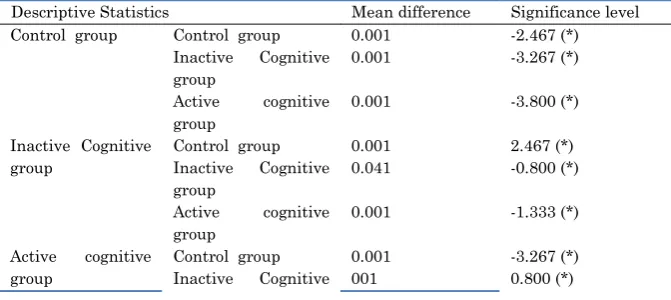
Table 4. Results of Tukey's follow-up to evaluate the mean difference between the control groups, cognitive, passive, active cognitive recall
Significance level Mean difference
Descriptive Statistics
-2.467 (*) 0.001
Control group Control group
-3.267 (*) 0.001
Inactive Cognitive group
-3.800 (*) 0.001
Active cognitive group
2.467 (*) 0.001
Control group Inactive Cognitive
group Inactive Cognitive 0.041 -0.800 (*)
group
-1.333 (*) 0.001
Active cognitive group
-3.267 (*) 0.001
Control group Active cognitive
group
-0.533 0.276
Active cognitive group
Results of follow up Tukey test (Table 4) shows that there is significant difference cognitive and control group (2.467), cognitive activation (3.267) in 0.001, according to Table 1, mean score of group cognitive reminded disabled, cognitively active than control group. This finding suggests that training at all - test was effective in improving children's recall.
The difference between the average active Cognitive Turn (0.800) in the 0.05 p<is significant.
Discussion and Conclusion
Cognitive problems of children with special needs, mental difficulties, increasing use of cognitive strategies and along with weakness, sensory problems in sense that it has major role in the learning of children with special needs and mental problems have doubled (Sharifi, 2006). Trying to use other senses as well as strategies that less attention has been paid to them could be a step in advancing the education of these children. The results of this study show that cognitive strategies enable, disable approach in all groups compared to the control group, children with special needs and mental recall is improved(Torgesen, 2008).
Special Mental Needs
consolidate basis. These findings, the vast majority of the research have been achieved. Therefore, in line with results from other studies (Chan, 2007;Riggs,2008), children with special needs and mentally able to employ these strategies. So that children with special needs, mental although later than normal children, but the ability to use strategies to achieve, and can after training, utilize strategies into practice is reasonable and acceptable. These findings are an important part of well-known cognitive strategies are learnable.
It seems that children's inability to remember material, more it is caused by inability of children to learn use of
Recommend Syllables and implementation of
strategy(Broadley,2003). This result indicates that children with disabilities can use strategy due to deployment strategies. The results in all experimental groups similar to what is seen as good practice and experiment with educational content as well as tester and test content similar to content of training strategies of learning strategies and reminder undeniably. Seems to apply training exercises for children with mental disabilities must be trained before they completely overlap and the more of them become less overlap. This strategy can be extended in the future to help.
Based on findings of this study can be concluded that active cognitive training - takes recall of children with special cognitive training better mentally disabled. In other words, these two methods of training, they were superior. Although the descriptive data, difference between two groups, but difference in means indicates statistical significance is not reached. Descriptive Analysis of data shows that resulting averages roughly mean recall scores are close to maximum. Therefore it well reflects strength of both methods, lack of significant other is not due to weakness caused by one of two methods, but reminder of females.
movement data as well as interfering with proper Recommend Syllables iconic image of card and use content of at least four to teach to the single card also by creating an incentive, promote and facilitate children learn to utilize to disabled. During training exercises, as well as strategies to try and test content strategy is similar enough training exercises.
REFERENCES
Beckman, P. 2002. “Strategy instruction. ERIC digests (Digest number E638).” Arlington, VA: ERIC Clearinghouse on Disabilities and Gifted Education. Council for
Exceptional Children. (ERIC Document Reproduction
Service. ED474302).
Broadley, I. M. J. 2003. “Teaching short term memory skills to children with Down's syndrome.” Down Syndrome
Research & Practice 1(2):56-62.
Cantrell, S. Chambers, A.J.E., Carter, J.C., Margaret, M.A. 2011. “The impact of strategy-based intervention on the comprehension and struggling readers.” J of
Educational Psychology 102(2):257-280.
Chan, L., Kle, P. 2007. Methods and strategies in the education
of Retarded children. Translated by Maher, F. Tehran:
Jeihoon Press, 60-88.
Halahan, D.P., Kaufman, J. 2005. Exceptional Children.
Translated by M. Javadian. Mashhad: Astan Quds Razavi Press.
Halahan, D. P. and Kaufman J. 2009. Exceptional Children. Translated by F. Maher. Tehran: Roshd Press.
Henry, L. A. & MacLean, M. 2010. “Working memory performance in children with and without intellectual disabilities.” American Journal on Mental Retardation
Special Mental Needs
Martin, D. S., Craft, A. & Sheng, Z. N. 2001. “The impact of cognitive strategy instruction on deaf learners: An international comparative study.” American Annals of
the Deaf 146(4):366–378.
Riggs, F.R. 2008. Multi – sensory approaches to spelling and reading, in saturation for students with learning
disabilities. M.A. Dissertation. Washington: Ohio
University, Faculty of the College of Education. 44-51 Ruthanne, H. J. & Von Thaden, K. 2010.“The effect of cognitive
education on the performance of students with neurological developmental disabilities.” J of N
Rehabilitation. 17(3): 201-209.
Sharifi, D. P. 2006. Mentally Retarded Children. Tehran: Oroj Press, 66-93.
Torgesen, L. 2008 “The learning disabled child as an inactive learner: educational implications.” Topics in Learning
and Learning Disabilities 2(1):45-52.
Van der Molen, J. E. H. Van Luit, M. J. Jongmans, & M.W. Van der Molen. 2007. “Verbal working memory in children with mild intellectual disabilities.” J of
Intellectual Disability Research 5(1):162–169.