
ISSN 2348 – 7968
Modeling, Simulation and Control Solutions For Mechatronics
Design of Solar Light Tower
Mohammed M. K.1,2 ,Farhan A. Salem 1,3
1Dept. of Mechanical Engineering, College of Engineering, Taif University, 888, Taif, Saudi Arabia.
2El-Minia University, Faculty of Engineering, Production Eng. & Design Dept.,
3 Alpha center for Engineering Studies and Technology Researches, Amman, Jordan.
Abstract
As an option to conventional light tower (LT) that uses
ICE as electricity generator source, an integration of LT design and PhotoVoltaic (PV) panels resulting in Solar
light tower (SLT),this paper proposes a new generalized
and refined model for Mechatronics design of pure standalone SLT and some considerations regarding design,
modeling and control solutions. The selection, design and
integration of main subsystems including mechanical structure, electric DC machines and controls are proposed. The SLT system is designed to operate in two modes manual and automatic. The proposed SLT system model consists of seven main subsystems, each subsystem, is mathematically described and corresponding Simulink sub-model is developed, then an integrated generalized model of all subsystems is developed, and is developed to allow designer to have the maximum output data (numerical and graphical) to select, test and evaluation the overall SLT system and each subsystem outputs characteristics and performance, for desired overall and/or either subsystem's specific outputs, under various PV subsystem input operating conditions, to meet particular SLT system requirements and performance. The obtained results show the simplicity, accuracy and applicability of the presented designs and models to help in Mechatronics design of SLT systems .
Keywords: Mechatronics, Photovoltaic (PV) system, Solar Light Tower (SLT), Modeling, simulation.
1. Introduction
In last years an increasing attention and more importance are dedicated to researches in the fields of alternative machines using internal combustion engines as electricity generator source, and corresponding fuel consumption economy and reduction of related emissions. As an option to conventional light tower (LT) using ICE as electricity generator source, an integration of LT design and PhotoVoltaic (PV) panels resulting in Solar light tower
(SLT). it uses the PV panel as electricity generator to
convert the irradiance from sunlight into electricity, to generate its own power for lightening and for storing in batteries, all the power needs are supplied 100% by the PV
panel subsystem, it generates electricity and provides light
without noise, any fuel consumption and any related emissions, the SLT system is designed to replace used
diesel powered light tower, and can be applied at locations where fuel availability and mains powered electricity is not available or is too expensive to implement
Considering that theessential characteristicandthe keyto
success in Mechatronics system design is a balance
between two sets of skills modeling/analysis and
experimentation/hardware implementation skills, where Modeling, simulation, analysis and evaluation processes in Mechatronics design consists of two levels, sub-systems models and whole system model with various sub-system models interacting similar to real situation[1], this paper proposes a new generalized and refined model for Mechatronics design of pure Standalone SLT and some considerations regarding design, modeling and control
solutions, that can be applied to help in facing the two top
challenges in developing Mechatronics Standalone SLT systems; early identifying system level problems and ensuring that all design requirements are met.
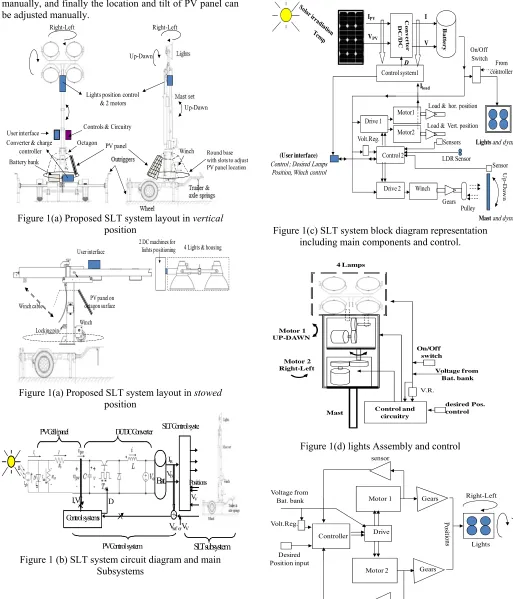
The proposed whole SLT system model consists of seven main subsystems, each subsystem, is to be mathematically described and corresponding Simulink sub-model is developed, then an integrated generalized model of all subsystems is developed, finally the subsystems models and the whole SLT system model, are to be tested and analyzed for desired system requirements and performance, under various PV subsystem input operating conditions. The proposed SLT system and each subsystem design and integration, layout, circuit and block diagram representations are shown in Figure 1.
Features and specifications of proposed SLT design:The proposed design is to result in the following: Better light distribution and area coverage. Towed-portable on it own two wheels SLT. Mast is easily cranks up, stowed and extends, using either manual or controlled winch. The lamps may be adjusted in the desired direction up, down, left or right; manually and automatically, less weight, cost
efficient, aerodynamically efficient design.Set-up; simple,
easy and fast: easy set-up by one person in less minimum
time counted in minutes; tow the SLT unit to the desired site location, park the unit, deploy the jack stands, adjust solar panel to face sun, aim the lights at the desired target for illumination, deploy the lighting mast, and turn the
lighting system on. Operating Modes; the proposed design
can operate with two modes; automatically On/Off using a programmable lighting system that uses photocell and
Manual operating mode for light when it is required.Zero
ISSN 2348 – 7968
For achieving these features, the below specifications are selected; Maximum height of SLT tower 8 m, Maximum height SLT unit with mast stowed 2 m, Overall length with mast stowed 6 m, Overall trailer frame width with fenders 3 m, 4 X 1000w Metal Halide Floodlight, mounted on light cross member in cuboid housing.
2. Selection, design and integration of each subsystem and whole SLT system
The proposed SLT system and corresponding model consists of seven main subsystems, in particular; PV panel, DC/DC converter, battery bank, three separate DC actuating machine, control units and mechanical structure with its dynamics sub-model, each subsystem,
2.1 Subsystems selection, design and integration.
Light subsystem; For better light distribution and area
coverage, a (4 X 1000 Watt) Metal halide floodlight lamps are selected, it produce an intense white light, has high luminous efficacy of around 75 - 100 lumens per watt, with 6000 to 15000 working hours. [1-2] these to be supported with quick disconnect fixtures and plug in ballasts. For a 4x1000w tower light, can illuminate areas greater than 4500m² at an average 20 lux [3]. As shown in Figure 1(d), each lamp is proposed to be located in gasket with high reflectivity surface with polishing and oxidation treatment. a pair of lamps are mounted on light cross member from both sides (see Figure 1) and fixed using handle bolts, and both pairs of lamps to be located in a cuboid housing, that in turn mounted on motor shaft with gears, finally, all this assembly are mounted on other, second, motor shaft with gears, the first motor allows light subsystem to rotate vertically up and dawn with limits from zero to 45 deg ,whereas the second motor allows the whole first assembly ( with first motor) to rotate horizontally right and left with limits from zero to 90 deg in either direction. The whole lights sub-system assembly to be adjusted to rotate up, down, left or right, both manually and automatically: manually, where each of the four lights can be adjusted manually to desired direction, by loosening the handle bolts on the lamp fixtures and aiming them in the desired direction, and automatically through user interface,(Joystick or Keypad) applying simple PI-controller with corresponding control components, as shown in Figure 1(d)
Actuator subsystem; 24 V DC machines as prime
movers are a suitable, available, and simple to interface choice.
Sensors subsystem; for position control, limit switches
and/or potentiometers are suitable, available, and simple to interface choice.
PV subsystem; consists of PV panel, DC/DC
Converter/charge controller, with MPPT algorithm, to
charge the 24Volt battery bank, for 12-hour nightly run time, the PV subsystem layout, circuit and diagram representation are shown in Figure 1(b) Figure 1(c). The PV panel is to be designed to provide the required power, with manually adjustable-tilt and location around the mast base, to face the sun rise and sunset, the assembly is mounted on a round base with slots for adjusting PV panel location. To reduce the effects of wind speed and corresponding aerodynamic and lift forces, an 3D octagon (see Figure 1(a)) with base greater than upper surface with slope of 45 degrees, can be used as base (chassis) to support the PV panel and move it to any of it's eight surfaces, facing the sun also as shown in Figure 1, the 3D octagon, can be used as housing cover for the SLT base with battery bank, DC/DC converter charge controller, control and circuitry.
Trailer subsystem; the Mast with lamps (tower) are
mounted on trailer, that includes axle springs for smooth towing on highways and jobsites, a standard steel fenders are to be used. To provide support for wind speed (wind stability), the design include a four telescopic outriggers and jack, these are shown in Figure 1(b).
Mast subsystem; is designed to easily raised up and
extends to the vertical position to 8 m in height, by dual easily hand-operated or controlled electric winch, with
corresponding, cables and pulleys.Safety considerations;
To ensure the safety, the mast is to be supported with-locking pin at the base of the pivot post that lock automatically and user will hear it “snap” into place[5].Also a sensing device (limit switch or potentiometer) for ensuring maximum motions limits of 90 degrees and height to be used.
Control unit subsystem; Microcontroller type (PIC
18FXX) , with corresponding drive and voltage regulator is a suitable, available, inexpensive, easy to program choice, suitable for controlling the motions of motors, the control system layout is shown in Figure 1(c)
User interface subsystem; can be located above the top
surface of the octagon; it can be selected to be a joystick, keypad, pushbutton or display for data inputting and displaying.
2.2 Pure manual SLT system design
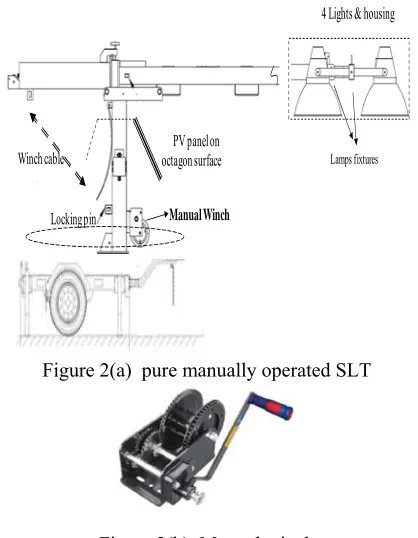
The proposed design of SLT can further be simplified and reduced in cost, to have the construction shown in Figure 2(a), by removing control systems and corresponding components, resulting in pure manually operated SLT. In this design, the mast is rise manually, by hand-operated winch shown in Figure 2, also, each of the 4 lights can be adjusted manually to desired direction, by loosening the handle bolts on the lamp fixtures and aiming
them in the desired direction, also the assembly with 4
ISSN 2348 – 7968
manually, and finally the location and tilt of PV panel can be adjusted manually.
Up-Dawn Up-Dawn
Right-Left
Round base with slots to adjust PV panel location Octagon
User interface
Right-Left
Battery bank
Lights position control & 2 motors
Controls & Circuitry
Converter & charge
controller PV panel Winch
Figure 1(a) Proposed SLT system layout in vertical
position 2 DC machines for
lights positioning 4 Lights & housing
Winch Locking pin Winch cable
User interface
PV panel on octagon surface
Figure 1(a) Proposed SLT system layout in stowed
position
Control systems
Bat.
IB
VB
+-Vref or VV
D I,V
PV Cell/panel DC/DC Converter
PV Control system
SLT Control system
SLT subsystem
VV Positions
Figure 1 (b) SLT system circuit diagram and main Subsystems
IPV
VPV
Control system1
I
B
a
tt
ery
V
Iload
Drive 1
Control 2 Motor1
Volt.Reg. Sensors
Load & hor. position
(User interface)
Control ; Desired Lamps Position, Winch control
Load & Vert. position Motor2
Lightsand dynamics On/Off
Switch
Drive 2 Winch Gears
Pulley
Mastand dynamics
Up
-Da
w
n
Sensor
D
LDR Sensor
From controller
Figure 1(c) SLT system block diagram representation including main components and control.
4 Lamps
Control and circuitry Motor 1
UP-DAWN
Motor 2 Right-Left
desired Pos. control On/Off
switch
Voltage from Bat. bank V.R.
Mast
Figure 1(d) lights Assembly and control
Drive
Motor 1 Gears
Controller
sensor
Motor 2 Gears
sensor
Lights Desired
Position input Voltage from Bat. bank
Volt.Reg.
Right-Left
Up
-D
awn
ISSN 2348 – 7968
Figure 1 (a)(b)(c)(d) Proposed SLT system design, layout, circuit and block diagram representations of main overall
system and subsystems, including; PV panel, DC/DC converter, battery bank, DC actuators and controls.
4 Lights & housing
Manual Winch Locking pin
Winch cable octagon surfacePV panel on Lamps fixtures
Figure 2(a) pure manually operated SLT
Figure 2(b) Manual winch
3. Modeling of SLT system
The proposed SLT system and corresponding model consists of seven main subsystems, each subsystem, is to be mathematically described and corresponding Simulink sub-model is to be developed, then an integrated generalized model of all subsystems is to be developed.
3.1 Mathematical bases of lamps
Lumens are converted to watts, as described next; The
power P in watts is given by Eq.(1) and the luminance Ev
in lux (lx) is given by Eq.(2)
/ V
P
(1)
)
2
( 10.76391 /
v lx V
E A
(2)
Where: ΦV the luminous flux in lumens, (lm) and η :the
luminous efficacy in (lm/W), A: the surface area A in
square m, for Metal halide lamp η= 75-100 lm/W and ΦV
=75*103-105 lm.
For a spherical light source, the area A is given by Eq.(3)
A 4· ·r2 (3)
The energy consumption (kWh) = System Input Wattage (kW) x Hours of Operation/Year
Hours of Operation/Year = Operating Hours/Day x Operating Days/Week x Operating Weeks/Year
3.2 Modeling and simulation of the PV cell, module, panel and array
PV system is a whole assembly of solar cells, connections, protective parts, supports etc. The basic
device of a PV system is the single PV cell. Cells are
hermetically sealed under toughened, high transmission glass to produce highly reliable, weather resistant modules that may be warranted for up to 25 years. PV system naturally exhibits a nonlinear I-V and P-V characteristics
which vary with the radiant intensity β and cell
temperature T.In the dark, the I-V output characteristic of
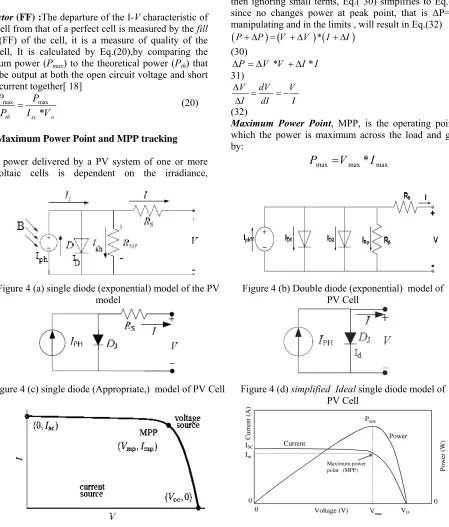
a solar cell has an exponential characteristic similar to that of a diode [6-7], therefore, the simplest equivalent circuit of a PV solar cell consists of a diode, a photo-current, a parallel resistor expressing a leakage current, and a series resistor describing an internal resistance to the current flow, this all is shown in Figure 1(b) and Figure 4(a), this
equivalent circuit is called a single diode model, a more
accurate model is called double diode model and shown in
Figure 4(b) . The diode determines the I-V characteristics of the cell (Figure 4(e,f)) [11]. A general mathematical description of I-V output characteristics for a PV cell has been studied for over the pass four decades and can be found in different resources including [7-28].
The output net current of PV cell I, and the V-I
characteristic equation of a PV cell, is found by applying
the Kirchoff’s current law (KCL) on the equivalent
simplified single diode circuit shown in Figure 4(d). The net output current is the difference of two currents; the
light-generated photocurrent Iph and diode current Id
[7-28]., and is given by Eq.(4)
ph d
II I (4) The light-generated photocurrent Iph is generated by the
incident light and directly proportional to the sun
irradiation β and operating temperature, Iph isgiven by
Eq.(5).
1000ph sc i ref
I I K T T (5) The cell’s short-circuit current ISC,is the current through
the solar cell when the voltage across the solar cell is zero
(see figure 3(e)(f)), ISC is calculated when the voltage
equals to zero I (at V=0) = Isc, at T= 25°C and the solar
insolation β=1kW/m2 , given in datasheet specifications of
PV panel.
The diode current Id is given by Eq.(6).
( )
I I 1
S q V IR
NKT d s e
ISSN 2348 – 7968
Based on this, the basic equation for output net current of
PV cellI, of the PV cell represented as single diode with series resistance RS and without shunt resistance RSH,
shown in Figure 3(c), is obtained by substituting Eqs.(5) and Eq. (6) in Eq.(4) , this gives Eq.(7):
( )
I I I S 1
q V IR NKT ph s e
(7) The basic equation given by Eq. (7) does not represent the
actual I-V characteristics of practical and real operation of PV cell, because in the real operation of the solar cell some losses exist, to get a more real behavior and to pick
up these losses in real PV cell, a third current based on Rs
and Rsh, called shunt current IRsh and given by Eq.(8), is
added, with these additions the corresponding equivalent circuit diagram is as shown in Figure 3(a) [25], and the net current of the cell will be given by Eq.(7), this equation shows that the output current generated depends on the PV
cell voltage V, solar irradiance β on PV cell, and ambient
temperature T. Eq.(9) describes the single-diode model
presented in Figure 4(e), this model offers a good compromise between simplicity and accuracy and for simplicity is used and modeled in this paper. Characteristic I-V curve of a practical photovoltaic device and the three remarkable points, is shown in Figure 4(e).
S RSH sh
V
R
I
I
R
(8)
( )
( )
I
I I I 1
I I 1
1000
S
S
d RSH q V IR
S NKT
ph s
sh q V IR ph
S NKT
sc i ref s
sh
I
V R I
e
R
V R I
I I
I K T T e
R (9)
The diode reverse saturation current IS, is constant under
the constant temperature T, and found by setting the
open-circuit condition, using Eq. (7), let I = 0 (no output
current) and solve for IS, gives Eq.(10). The diode reverse
saturation current Is, varies as a function of the
temperature T, as given by Eq.(11).
mod
1 SOC 1
Sc sc
s
qV qV
NKT N KAT
S I I le I u I
e e
(10) 3 1
3 1 1
( ) ( ) g ref g ref qE T T NKT S S ref qE T T NKT
S S
ref
T
I T I e
T
T
I T I e
T (11)
The power produced by a single PV cell is not enough for general use, where, each solar cell generates around 0.5V, therefore the PV cells are connected in series-parallel configuration on modules, where series connections for high voltage requirement and in parallel connections , or PV panels consisting of one or more PV modules, to produce desired power output. Panels can be grouped to
form large photovoltaic arrays. The term array is usually
employed to describe a complete power-generating unit,
consisting of any number of PV modules and panels. PV
module mathematical model ; The current output of given PV module, considering the number of parallel and series
connections of cells NP , NS, is given by Eq.(12).
( )
I I I 1
S S P IR V P q S N N S NKT
P ph P s
sh
N V R I
N
N N e
R (12) The maximum PV voltage; Since the PV cell efficiency is
insensitive to variation in shunt resistance RSH , the effect
of parallel resistance RSH can be neglected (Figure 4(c) in
Eq. (9), the maximum PV voltage can be represented by
Eq. (13).
ln ph s
s s
I I I
NKT V IR q I (13) Open circuit voltage Vo; Corresponds to the voltage drop
across the diode (p-n junction), when it is traversed by the
photocurrent Iph when the generator current is I = 0. It
reflects the voltage of the cell in the night, and given by
Eq. (14):
ln ph 0
o
s
I NKT
V for I
q I (14) The power delivered by a PV system of one or more
photovoltaic cells is dependent on the irradiance, temperature, and the current drawn from the cells. The power output of a PV system is given by Eq.(16):
*
P V I
(16) Maximum Power Point, MPP, is the operating point at which the power is maximum across the load and given by Eq.(17):max max* max
P V I (17) Efficiency (Maximum) of solar cell is the ratio between
the maximum power Pmax and the incident light power, and
given by Eq.(18), where Pinis taken as the product of the
solar irradiation of the incident light (G=β/1000),
measured in W/m2, with the surface area (A) of the solar
ISSN 2348 – 7968 max
out in in
P P
P P
(18)
* 1000 in
A
P (19) Fill factor (FF) :The departure of the I-V characteristic of
a real cell from that of a perfect cell is measured by the fill
factor (FF) of the cell, it is a measure of quality of the solar cell, It is calculated by Eq.(20),by comparing the
maximum power (Pmax) to the theoretical power (Pth) that
would be output at both the open circuit voltage and short circuit current together[ 18]
max max
*
th sc o
P P
FF
P I V
(20)
3.2.1. Maximum Power Point and MPP tracking
The power delivered by a PV system of one or more photovoltaic cells is dependent on the irradiance,
temperature, and the current drawn from the cells. The power output of a PV system is given by:
*
P V I
With incremental change in current ΔI ,and voltage ΔV,
the modified power is given by Eq.(30), by solving and then ignoring small terms, Eq.( 30) simplifies to Eq.(31),
since no changes power at peak point, that is ΔP=0,by
manipulating and in the limits , will result in Eq.(32)
P P
V V
* I I
(30)* *
P V V I I
( 31)
V dV V
I dI I
(32) Maximum Power Point, MPP, is the operating point at which the power is maximum across the load and given by:
max max
*
maxP
V
I
Figure 4 (a) single diode (exponential) model of the PV
model Figure 4 (b) Double diode (exponential) model of PV Cell
Figure 4 (c) single diode (Appropriate,) model of PV Cell Figure 4 (d) simplified Ideal single diode model of
ISSN 2348 – 7968
Figure 4(e) Characteristic I-V curve of a practical
photovoltaic device and the three remarkable points: short
circuit (0, Isc), maximum power point (Vmp, Imp) and
open-circuit(Vo, 0)[17]
Figure 4(f) Typical characteristic I-V and P-V curve of a practical photovoltaic device and the
three remarkable points [18]
3.3 Modeling and simulation of PV cell ; module, panel and array
Based on Eq.(12), PV cell Simulink model Simulink model is shown as sub-model of the generalized SLT system model and shown in Figure 7(b) the mask model is shown in Figure 7(c)
For PV subsystem sub-model model shown in Figure 7(b), by defining parameters including number of series and
parallel PV cells (NS,NP,), the corresponding PV module
can be tested and evaluated, this model can be used to develop required PV module, panel or array. Running this
model for defined parameters listed in Table-2 at standard
operating conditions; will result in P-V and I-V
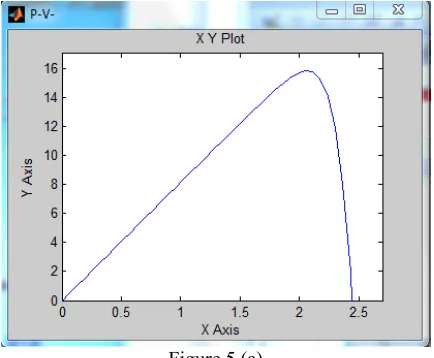
characteristics shown in Figure 5, these curves show, this
is 3.926 Watt PV cell, ISC = 8.13 A , Vo= 0.6120V , Imax
=7.852 A , Vmax =0.5 V, (MPP = Imax * Vmax =7.852
*0.5=3.926).
Figure 5 (a)
Figure 5 (b)
Figure 5(a)(b) P-V and I-V characteristics of PV module consisting of four series PV cells
3.4 Modeling and simulation of the buck converter
In this paper, Buck converter is a suitable DC/DC
converter to be used with PV system and tested to result in
constant desired output voltage of 24 V to be fed to DC
actuators. Buck converter is used for voltage step-down; it
is power converter which DC input voltage is greater than DC output voltage. A simplified buck converter circuit diagram is shown in Figure 1(b) as subsystem of whole SLT circuit diagram . The exact control of output voltage is accomplished by using a Pulse-Width-Modulation
(PWM) signal to drive the buck converter MOSFET-switch
ON or OFF, by controlling the switch-duty cycle D, based on this, if the principle of conservation of energy is applied then the ratio of output voltage to input voltage is given by Eq.(33):
*
out in on
out in
in out on off
V I T
D V D V D
V I T T (33)
Where: Iout and Iin, : the output and input currents. D : the
duty ratio (cycle) and defined as the ratio of the ON time of the switch to the total switching period. The PWM generator is assumed as ideal gain system, In this paper, for transfer function block diagram representation, the duty
cycle of the PWM output will be multiplied with gain Kv=
KD, This equation shows that the output voltage is lower
than the input voltage; hence, the duty cycle is always less than 1. The mathematical model of buck converter in its
two switch positions (ON , OFF), can be derived applying
Kirchoff's voltage and current laws. The simplified
ISSN 2348 – 7968
differential equations given by Eq.(34), The dynamics when the ideal switch is ON are given by Eq.(35). The buck converter subsystem Simulink model and mask, shown as sub-model of the generalized SLT system model are shown in Figure 7(d), the mask model is shown in Figure 7(c)
1
( R R )
, 0 , :
( R R L )
L
in o on L L L
o L
o on L L L
di
V V i i
dt L t dT Q ON
dV di
v i i
dt dt (34) 1 ( )
, 0 , :
1 ( ) * L in o o L o di V v
dt L t dT Q ON
dv
i v
dt C R
(35)
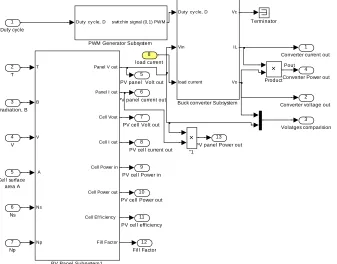
3.5 Photovoltaic panel-Converter (PVPC) system model
The developed both Simulink models of PV panel and buck converter are integrated to result in single Simulink model and mask shown as sub-model of the generalized SLT system model in Figure 7(e)
3.6 Actuators subsystem modeling
The proposed design of SLT is developed with three actuating systems; two separate DC motors are used to adjust light-assembly direction to rotate up, dawn, right and left to result in better area coverage, also, and a controlled electric winch with corresponding, cables and pulleys is used to raise ( crank up) the mast to vertical location. In both cases a suitable position sensor is to be used to detect and limit actuator's motion.
3.6.1 Modeling the light-assembly DC motors and sensor subsystems
The actuating machines most used in Mechatronics motion control applications are DC machines (motors). PMDC motor a suitable, available and easy to control actuator for light-assembly. In [29-33] introduced tested and verified a detailed derivation of refined mathematical model and corresponding Simulink model of DC machine and sensor, based on these, the open-loop transfer function of the PMDC is given by Eq.(36), In the following
calculation the disturbance torque, T, is all torques
including coulomb friction, and given by
(T=Tload+Tf).Dynamics of potentiometer can be
represented using Eq.(37),
2
( ) ( ) ( ) / ( ) ( ) Lights open in t open
a a equiv equiv a a b t
s
G s
V s
K n
G s
s L s R J s b s L s R T K K
(36)
__ (Voltage change) (Degree cha gn e) pot out pot
pot out tpot
V t K t
V t K t (37)
The geometry of the mechanical part determines the moment of inertia, the light-assembly can be considered to be of the cuboid shape with dimensions; width, b= 0.3 m , depth, L= 0.5 m and height h=0.5 m , whereas, the Mast
can be considered to be a rod with length L=6 m and mass
M. For light assembly, the total equivalent inertia, Jequivand
total equivalent damping, bequivat the armature of the motor
with gears attached is calculated as given by Eq.(38).Considering the light-assembly of rectangle m rotating a round a perpendicular axis through it's center ,the inertia is calculated by Eq.( 38). these values are to be
substitute in Eq.(31) to replace motor's J and b, to result in
open loop transfer function of DC motor with light load attached 2 2 2 1 2 2 1 2 , ,
(b h )
12
load
equiv m gear Load
equiv m Load
M J
N
J J J J
N
N
b b b
N (38)
Each DC machine must generate torque required to overcome all load torques, these load torques are to be mathematically modeled and simulated, then integrated with the DC machine Simulink model. An acceleration is required to move the light-assembly to desired position, this added torque is calculated based on that the sum of torques acting at pivot lifting joint is equal to mast moment
of inertia, Jlight multiplied by the angular acceleration, as
given by Eq.(39),
2 2
* (
*
b h )
12 light J M T T
(39)Considering aerodynamic Drag force opposing the motion
of the light-assembly due to air drag, the aerodynamic drag
force is function of light-assembly linear velocity, ν and
given by Eq.(40):
2
aerod d
F 0.5 * * A*C *
vehicl (40)ISSN 2348 – 7968 2
aerod d
1
T * * A*C * *
2 vehicle rr
(41)
Where: Cd : Aerodynamic drag coefficient characterizing
the shape of the mast and can be calculated using the expression given by Eq.(42),where S: frontal area of light-assembly , square shape with length, 0.5 m and width of 0.5 m
aerod 2
F 0.5 D
C
S
(42)
Considering the aerodynamics lift force, Flift; that iscaused
by pressure difference between the light-assembly front and back side, and is given by Eq.(43), Where: B : SLT
reference area. CL: The coefficient of lift, and can be
calculated using the expression given by Eq.(44):
0.5* * * * 2
lift L
F C B (43)
2 0.5 L
L C
A
(44)
Where: L: lift,the air density (kg/m3) at STP, ρ =1.25, A:
light-assembly frontal area (length* width= 0.25 M). V: light-assembly velocity.
The DC machine subsystem Simulink model with sensors and load dynamics, are shown in Figure 7(f)(g) , also is shown as mask sub-model of the generalized SLT system model in Figure 7(a)
To determine the electric battery capacity, and correspondingly design the of Photovoltaic panel with series and parallel connected cells, it is required to estimated energy required by each DC machine, the required power in kW that each DC machine must develop at stabilized operation can be determined by multiplying the total force with the velocity of the light-assembly, and given by Eq.(45):
(
) *
*
Total Total
P
F
F
(45)Electrical power (in watts) in a DC circuit can be calculated by multiplying current in Amps and V is voltage, and given by Eq.(46):
P= I x V (46)
3.6.2 Winch subsystem modeling
Electrically powered winch is used to raise the mast from stowed position to vertical position, an electric DC motor is selected as actuator to generate desired power, the mathematical and Simulink model of DC motor are given
by Eq.(36). The total equivalent inertia, Jequivand total
equivalent damping, bequivat the armature of the DC motor
with gears attached is calculated as given by Eq.(38). Since, the geometry of the mechanical part determines the moment of inertia, the Mast can be considered to be rod of
length L= 6 and mass m =1500 kg, The moment of inertia
can be found by computing the integral, given by Eq.(47)
2
/2 3 3
/2 2
/2 /2
/ 8 1 2
3 3 12
l
l
Mast l
l
x m l
J x sdx s s ml
sl
(47)An acceleration is required to move the mast from a level position, this added torque is calculated based on that the sum of torques acting at pivot lifting joint is equal to mast
moment of inertia, JMast multiplied by the angular
acceleration, as given by Eq.(48),
2
* 1
12 *
Mast
T J
T ml
(48)
Also, referring to Figure 6, for winch lifting a mast, the torque required is given byEq.(49). Considering aerodynamic Drag force opposing the motion of the mast due to air drag, given Eq.(40), The aerodynamics torque is
given by Eq.(41), where: Cd : characterizing the shape of
the mast and can be calculated using the expression given by Eq.(42),where S: frontal area of mast , assumed to be
cylindrical , with length, 6 m and width of 0.3 m.
Considering the aerodynamics lift force, Flift; that iscaused
by pressure difference between the mast front and back side, and is given by by Eq.(43), where: B : reference
area. CL: A: frontal area (length* width= 1.8 M). Referring
to figure 7, for the worst case, the torque required at lifting
joint to raise the mast vertically, and to hold Mast at a
given distance from lifting joint can be found by Eq.(50) . Performing, torque balance about lifting joint, given by Eq.(51), Substituting T from Eq.(50) in Eq.(51), gives Eq.(52):
T= r.M.g.cos(θ) (49)
T= F*L= M*g*L (50)
0
T F L T
(51)T
M g L
(52) The DC machine subsystem Simulink model and maskwith sensor of winch system, are shown as sub-model of the generalized SLT system model in Figure 7(f) the mask model is shown in Figure 7(a)
Mast mass
Gears
Motor
Mast mass
F= M*g F= M*g* cosθ
T
Figure 6 Torque calculations
ISSN 2348 – 7968
3.7 Control system modeling
Different control algorithms, including PI, PID , can be proposed to control the overall SLT system output performance in terms of output angular position, as well as, controlling output characteristics and performance of PVPC subsystem to meet desired output voltage or current under input working operating conditions.
PI controller: because of its simplicity and ease of
design, PI, PD and PID controllers is widely used in
variable speed applications and current regulation. In this
paper PI controller will be applied for achieving desired outputs characteristics of PVPC subsystem and meeting desired output speed of overall SLT system , where separate PI controllers configurations are to be applied to control the PVPC subsystem and overall SLT system to achieve desired outputs of position, voltage and load currents, it is important to notice that, in the proposed SLT model, PI controller can be replace with any other suitable control algorithm.
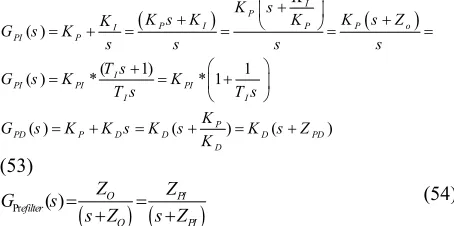
The PI and PD controllers transfer function in different
forms are given by Eq.(53). The controller's pole , zero
will affect the response, mainly the PI zero given by; Zo
=-KI/KP, will inversely affect the response and should be
cancelled by prefilter, while maintaining the proportional
gain (KP), the prefilter transfer function is given by Eq.(54)
, the placement of prefilter is shown on generalized model[34].
( )
( 1) 1
( ) * * 1
( ) ( ) ( )
I P
P I P P o
I
PI P
I
PI PI PI
I I
P
PD P D D D PD
D
K
K s
K s K K K s Z
K
G s K
s s s s
T s
G s K K
T s T s
K
G s K K s K s K s Z
K
(53)
Prefilter( ) O PI
O PI
Z Z
G s
s Z s Z
(54) The Suggested control system to control the actuators of
SLT system are shown as sub-model in SLT model in Figure 7 (h)
PVPC subsystem controllers :The power delivered by a
PV system is dependent on the irradiance β, temperature T,
and the current drawn from the cells V. To maximize a PV
system's output power, it is necessary continuously tracking the maximum power point (MPP) in the I-V characteristic of the PV system (see Figures 4(e,f)) , a switch-mode power converter, can be used to maintain the PV’s operating point at the Maximum Power Point MPP, The Maximum Power Point tracker MPPT, does this by controlling the PV array’s voltage or current independently of those of the load.
Perturb and observe algorithm; A detailed Simulink
model of perturb and observe algorithm is shown in Figure
7(i).The VPV and IPV are taken as the inputs to MPPT unit,
duty cycle D is obtained as output. In this perturb and observe algorithm a slight perturbation is introduced to the system. Due to this perturbation the power of the module changes. If the power increases due to the perturbation then the perturbation is continued in that direction, after the peak power is reached the power at the next instant decreases and hence after that the perturbation reverses. When the steady state is reached the algorithm oscillates around the peak point [35]
Also, A PI controllers, also can be used to control PV panel characteristics, where two separate PI controllers are used, first PI current controller shown in Figure 7(g), is used to match motor-current with required Load-torque (Variations) current to overcome, where both currents are compared and the difference is fed to PI controller to generate converter's output current in accordance with Duty cycle to match and generate required load current. A second PI voltage controller shown in Figure 7(g), used to control the converter's output voltage to match desired output voltage, by comparing desired converter output voltage (24 V) and actual converter's voltage, the difference is fed to PI controller to control the buck converter MOSFET switch according calculated duty cycle to result in desired voltage[35-36].
4. Smart day night control and simulation
LDR can be used as day-night sensing device, to switch lights of SLT system ON and off, LDR is interfaced to corresponding microcontroller (e.g.PIC 10FXXX) input pin, that will control the drive circuit, that in turn switch lights ON and OFF, algorithm flow chart is shown Figure 7(a), circuit simulation in Proteus is shown in Figure 7(b)(c) .
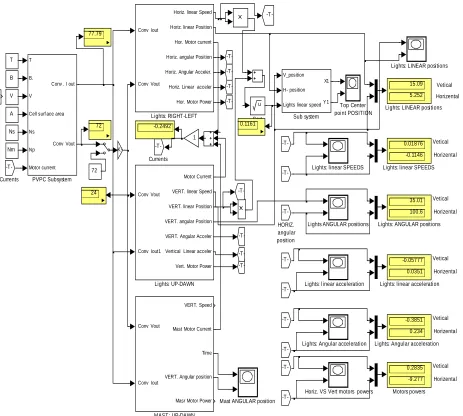
5. Proposed generalized whole SLT system Simulink model
The proposed generalized SLT system model is developed by integrating all subsystems sub-models, is shown in Figure 8(a)
6. Testing, analysis and evaluation
ISSN 2348 – 7968
acceleration all versus time, and in Figure 9(b) are shown response curves of consumed current, load current , motor generated torque and load torque all versus time. Correspondingly response curves of actuator responsible for Horizontal right-left motions are shown in Figure 9(c)(d) and for actuator responsible for mast motions, are shown in Figure 9(e)(f).
In Figure 9 is shown the plots relating the vertical and horizontal motions, in particular, positions, speeds, and accelerations of SLT mast and of lambs assembly versus , where in Figure 10(a) is shown the relation between angular positions of both vertical and horizontal motions,
in Figure 10(b) is shown the relation between linear positions of both vertical and horizontal motions, in Figure 10(c) is shown the relation between linear speeds of both vertical and horizontal motions, , in Figure 10(d) is
shown the plot between angular accelerations of both
vertical and horizontal motions, in Figure 10(e) is shown
the plot of linear acceleration positions of both vertical
and horizontal motions, in Figure 10(f) is shown mast angular position versus time, finally in Figure 10(g) is shown lights assembly center point motion versus time. The simulation output numerical values, of each subsystem and whole SLT system are listed in Table1
Vetical
Horizental
Vetical
Horizental
Currents
Currents
HORIZ. angular position
Vetical
Horizental
Vetical
Horizental
Vetical
Horizental
Vetical
Horizental Top Center
point POSITION V_position
H- position
Lights linear speed X1
Y1
Sub system u
Sqrt T
B.
V
Cell surf ace area
Ns
Np
Motor current Conv . I out
Conv Vout
PVPC Subsystem
0.2835
-9.277
Motors powers Mast ANGULAR position
Conv Vout
Conv Iout
VERT. Speed
Mast Motor Current
Time
VERT. Angular position
Masr Motor Power
MAST: UP-DAWN
0.01876
-0.1146
Lights: linear SPEEDS
Conv Vout
Conv Iout1
Motor Current
VERT. linear Speed
VERT. linear Position
VERT. angular Position
VERT. Angular Acceler
Vertical Linear acceler
Vert. Motor Power
Lights: UP-DAWN Conv Iout
Conv Vout
Horiz. linear Speed
Horiz. linear Position
Hor. Motor current
Horiz. angular Position
Horiz. Angular Acceler.
Horiz. Linear acceler
Hor. Motor Power
Lights: RIGHT-LEFT
35.01
100.6
Lights: ANGULAR positions Lights ANGULAR positions
-T-
-K-1
0.1161
-T-,1
-T-,
Lights: linear acceleration Lights: linear SPEEDS
Lights: Angular acceleration
Horiz. VS Vert motors powers
-0.3851
0.234
Lights: Angular acceleration Lights: LINEAR positions
15.09
5.252
Lights: LINEAR positions
-0.05777
0.0351
Lights: linear acceleration -0.2492
72 77.79
24 Nm
Ns A V B
72 T
ISSN 2348 – 7968
Illumination reading (LDR1 and LDR2) Light sensor
Converting LDR readings Comparator or
PIC corresponing pins
Set RB? to 1
end LDR >= 47
Yes No
Set RB? to 0
Figure 7(a) Flowchart of microcontroller programming (algorithm)
Figure 7(b)(c) day-night sensor circuit simulation in Proteus[38]
cell current P
I V
V
P V
I
Ish
Id Iph Is
8 Fill Factor
7 Cell Efficiency
6 Cell Power out
5 Cell Power in
4 Cell I out 3
Cell Vout
2 Panel I out 1
Panel V out
V1
I12.mat
To File2 P.mat
To File1 V.mat
To File
75
PV module output voltage
0.5
PV cell voltage Module V
[P] Goto [P]
From
Cell P-V
Cell I-V B
B0
1000
1
100 .9
.8
.7
.6 .5
.4 .3
.2
.11 .10
.1
K
.'
PV.mat
.
,.
eu
,
eu
,
''4
''3
''2 ''1
'' N
'
205.7
1 Vo
.
Rs
Ki
Rsh
Tref
1
1
Isc
q
2.938 6 Np 5
Ns
4 A 3 V
2 B 1
T
ISSN 2348 – 7968
Figure 8(b) PV cell/panel Simulink model shown as sub-model of the generalized SLT system model
Pout
13 PV panel Power out
12 Fill Factor
11 PV cell efficiency
10
PV cell Power out 9 PV cell Power in
8 PV cell current out
7 PV cell Volt out
6 PV panel current out
5 PV panel Volt out
4 Converter Power out
3 Volatges comparision
2 Converter voltage out
1 Converter current out Terminator
Product
Duty cy cle, D switchin signal (0,1) PWM
PWM Generator Subsystem
T
B
V
A
Ns
Np
Panel V out
Panel I out
Cell Vout
Cell I out
Cell Power in
Cell Power out
Cell Ef f iciency
Fill Factor
PV Panel Subsystem1
Duty cy cle, D
Vin
load current
Vc
IL
Vo
Buck converter Subsystem
''1 8
load current
7 Np
6 Ns 5 Cell surface
area A 4 V 3 Irradiation, B
2 T 1 Duty cycle
Figure 8(c) The PV-Converter subsystem, including three mask models of three subsystems: PV subsystem, converter subsystem and PWM generator
3 Vo 2 IL
1 Vc Product
Duty cy cle, D switchin signal (0,1) PWM
PWM Generator Subsystem
R/(L*(R+Rc)) 1/(C*(R+Rc)) 1/L
12.02
R/(R+Rc)
1
s
((RL+Ron)+((R*Rc)/(R+Rc)))/L
(R*Rc)/(R+Rc)
R/(C*(R+Rc))
1 s 2
Vin 1 Duty cycle, D
ISSN 2348 – 7968
Currents
T
B.
V
Cell surf ace area
Ns
Np
Motor current Conv . I out
Conv Vout
PVPC Subsystem T
-72 77.79
24 Nm
Ns A V B
72 T
Figure 8(e) PV Panel-Buck converter mask subsystem of three subsystems PV, Converter and PWM.
Current Torque
EMF constant Kb
angular speed Current
Voltage desired from Voltage controller
Kt
torque constant
-K-rad2mps V=W*r
linear speed 1/n
gear ratio 1
La.s+Ra
Transfer function 1/(Ls+R)
1
Jequiv.s+bequiv
Transfer function 1/(Js+b)
DC_Machinet.mat
Kb
-K-Load Dyn. & Kf
1 s Input V
Anular angle
-K-position sensor
-K-Current sensor
-K-Current required
ISSN 2348 – 7968
Angle angul ar
speed aerodynamics l ift torque
r*m/2 r*m/2 Coloum Fri cti on aerodaynami c torque,
Load torque
PI Control ler
10 Horiz. Li near acceleration
9 Out1 8 Out2 7 Load orque 6 Motor orque 5 DC machine Current, I
4 Angular HORIZONTAL Posi tion 3
Angul ar HORIZONTAL accel eration
2 Linear HORIZONTAL Position 1
Linear HORIZONTAL speed. 1 -K-rads2mps= R_wheel*(2*pi)/(2*pi). -K-rad2degree n gears -K-angle feedback Kpot
-K-1 La.s+Ra Transfer 1/(Ls+R)3 1 den(s) Transfer 1/(Js + b)3 Saturati on1
rou Rou: The invi ronment ( air) densi ty (kg/m3) 1
-T-Mass_l ights
Manual Switch
-C-M : The mass light-assembly
-K-Kt 1 s 1 s Integrator. -C-H_inertia1=(b^2+h^2) [motor_current] -T-[r1] -T-Kb EMF constant Divi de7 Di vide6 Divi de18 Divide17 Divi de16 Di vide15 Divide14 Divi de,1 du/dt du/dt Deri vati ve 12
Constant
Cd1 Cd : Aerodynamic
drag coeffici ent
CL1 CL: The coeffici ent of l ift
-C-B : underside area
Angular acceleration
Angle- theta
Angl e- degrees
-T-Ang. accel
Add3
A1 A:Cross-secti onal area , where it i s the wi dest, (m2)2
2 1 1. 1 -K-. s+Zo s ,1 r1 Lights radi us
bm 1 Kp 3 Prefilter 2 Controll er 1 Input Vol t,(0 :12)
Figure 8(g) Simulink model of the PMDC machine subsystem used in SLT ( Vertical horizontal and mast actuating DC machines) with load dynamics .
PI Control l er
(Joysti ck )
0:180
6 Hori z. Li near accel er 5
Hori z. Angul ar Accel er.
4 Hori z. angul ar Posi ti on
3 M otor current
2 Hori z. l i near Posi ti on
1 Hori z. l i near Speed
l oad torque Vi n (0:24)
Vert. l i n posi ti on
Vert. Angl . posi ti on VERT . Accel
T orque
SLT _UP7.m at
SLT _UP6.m at SLT _UP4.m at
SLT _UP61.m at SLT _UP2.m at
SLT _UP1.m at SLT _UP99.m at
Zo s+Zo Prefi l ter.
1 1 Prefi l ter PID(s)
PID Control l er1
PI(s) PI Control l er
PD(s) PD Control l er1
Motor current M otor current
Input Volt,(0 :12)
Controller
Pref ilter
Linear HORIZONTAL speed.
Linear HORIZONTAL Position
Angular HORIZONTAL acceleration
Angular HORIZONTAL Position
DC machine Current, I
Motor orque
Load orque
Out2
Out1
Horiz. Linear acceleration
Li ghts sybsystem : RIGHT -LEFT s+Zo s ,1 -K-Kp 1 Conv Vout
ISSN 2348 – 7968
Figure 8(i)Perturb and Observe Algorithm simulation [35]
PV panel V out PV panel I out
Converter V out Converter I out
2 Conv Vout
1 Conv. I ou
[Conv_current]
Duty cy cle
T
Irradiation, B
V
Cell surf ace area A
Ns
Np
Load current
PV panel current out
PV panel Volt out
Conv erter I out
Conv erter V out
PVPC Subsystem
PI(s)
PI Controller
[panel_Iout]
[Conv_Vout] [panel_Vout]
[Conv_current]
PV_con13.mat [D]
[control]
75 2.161e+004
72 77.79
54.18 7
Motor current 6
Np 5 Ns 4 Cell surface area
3 V 2 B. 1 T
Figure 8(g) Twp separate PI controllers (right and below)for controlling PV output characteristics
0 2 4 6 8
-2 0 2 4
Me
te
r
Vert. LINEAR Speed
0 2 4 6 8
0 2 4 6 8
Me
te
r
Vert. LINEAR Position
0 2 4 6 8
-20 0 20 40
Time(s)
Vert. ANGULAR Acceler.
0 2 4 6 8
0 20 40 60
Time(s)
Vert. ANGULAR Position
Figure 9(a) vertical up-dawn motion response curves; linear position, angular position, linear speed and angular acceleration all versus time
[Conv_Vout]
[panel_Vout]
V_out_desired
Vout desired
PI(s)
PI Controller1
1.001
0.96
D desired 0.96
D calculated
PV_con11.mat
4 [D]
ISSN 2348 – 7968
0 2 4 6 8
-10 0 10 20 30
Am
p
e
re
Vert. MOTOR current
0 2 4 6 8
-100 0 100 200 300
Am
p
e
re
Vert. LOAD Current
0 2 4 6 8
-10 0 10 20 30
Time(s)
N/
m
2
Vert. MOTOR Torque
0 2 4 6 8
-5 0 5 10 15
Time(s)
N/
m
2
Horiz. LOAD Torque
Figure 9(b) vertical up-dawn response curves of consumed current, load current , motor generated torque and load torque all versus time
0 2 4 6 8
0 5 10 15
Me
te
r
Horiz. LINEAR Speed
0 2 4 6 8
0 5 10 15
Me
te
r
Horiz. LINEAR Position
0 2 4 6 8
-100 0 100 200
Time(s)
Horiz. ANGULAR Acceler.
0 2 4 6 8
0 50 100
Time(s)
Horiz. ANGULAR Position
ISSN 2348 – 7968
0 2 4 6 8
0 50 100
A
m
p
er
e
Horiz. MOTOR current
0 2 4 6 8
0 50 100
Am
p
e
re
Horiz. LOAD Current
0 2 4 6 8
0 50 100
Time(s)
N/
m
2
Horiz. MOTOR Torque
0 2 4 6 8
-50 0 50
Time(s)
N/
m
2
Horiz. LOAD Torque
Figure 9(d) Horizontal right-left motion response curves of consumed current, load current , motor generated torque and load torque all versus time
0 2 4 6 8
-100 0 100 200 300
M
e
ter
Mast LINEAR Speed
0 2 4 6 8
0 200 400 600
cm
Mast LINEAR Position
0 2 4 6 8
-50 0 50 100
Time(s)
Mast ANGULAR Acceler.
0 2 4 6 8
0 20 40 60 80 100
Time(s)
Mast ANGULAR Position
ISSN 2348 – 7968
0 2 4 6 8
-20 0 20 40 60
A
m
pere
Mast MOTOR current
0 2 4 6 8
-100 0 100 200 300
A
m
pere
Mast LOAD Current
0 2 4 6 8
-50 0 50 100
Time(s)
N/
m
2
Mast MOTOR Torque
0 2 4 6 8
-1 0 1
2x 10
7
Time(s)
N/
m
2
Mast LOAD Torque
Figure 9(f) Mast response curves of consumed current, load current, motor generated torque and load torque all versus time
1 1.1 1.2 1.3 1.4 1.5 1.6 1.7 1.8 1.9 2 70
71 72 73 74 75 76 77 78 79 80
Time (secnd)
M
a
gni
tude
PV Panel-converter outputs
Converter I out Converter V out PV panell V out
0 0.01 0.02 0.03 0.04 0.05 0.06 0.0 0
20 40 60 80 100 120 140 160 180 200
Time (secnd)
M
a
gni
tu
de
PV Panel-converter outputs
Converter I out Converter V out PV panell V out
ISSN 2348 – 7968
0 0.05 0.1 0.15 0.2 0.25 0.3 0.35 0.4
0 0.2 0.4 0.6 0.8 1
Time (secnd)
M
agn
itu
d
e
Time Series Plot:
PI 'Voltage' controller signal
Figure 9(h) PI control signal
Figure 10(a) the plot of relating angular positions of both
vertical and horizontal linear speeds Figure 10(b) the plot of relating vertical and horizontal motions linear positions of both
ISSN 2348 – 7968
Figure 10(d) the plot of relating angular accelerations of
both vertical and horizontal motions Figure 10(e) the plot of relating positions of both vertical and horizontal motions linear acceleration
Figure 10(f) mast angular position versus time Figure 10(g) lights assembly center point motion versus
time
Table 1(a) Simulation results of each subsystem and whole SEDDMRP system for straight line motion
PVPC system inputs
PV cell outputs PV Panel outputs Converter outputs DC machinee outputs
β 300 Voltage 0.5 V Voltage 75 V Voltage 72 Input voltage 24 V
T 75 Current 1.37 A Current 46.01 Current 77.79 Right-left
output Ang. position.
90
D 0.5 Fill factor 0.1374 P-out 5594.4 Up-dawn
output Ang. position
45
A 0.0025 Power out 0.6835 Mast Ang.
position
90
Ns 150 Power in 0.5
ISSN 2348 – 7968
Conclusions
A new generalized and refined model for Mechatronics design of pure standalone solar light tower and some considerations regarding design, modeling and control solutions are proposed. The proposed SLT system model consists of eight main subsystems, each subsystem, is mathematically described and corresponding Simulink sub-model is developed, then an generalized whole SLT system model is developed by integrating all sub-models, the generalized model is developed to allow designer to have the maximum output data (numerical and graphical) to select, model, simulate, analyze and evaluation the overall SLT system and each subsystem outputs characteristics and performance, for desired overall and/or either subsystem's specific outputs, under various PV subsystem input operating conditions, to meet particular SLT system requirements and performance. The obtained results show the simplicity, accuracy and applicability of the presented designs and models to help in Mechatronics design of SEV system .
Table 2 Nomenclature and nominal characteristic of SLT subsystems
Lights DC machine parameters
Vin=24 V Input voltage to DC machine
Kt=1.188 Nm/A Motor torque constant
Ra = 0. 1557Ω Motor armature Resistance
La=0.82 MH Motor armature Inductance,
Jm=0.271 kg.m2 Geared-Motor Inertia
bm=0.271 N.m.s Viscous damping
Kb=1.185 rad/s/V Back EMF constant,
n=1 Gear ratio
Jequiv kg.m2 The total equivalent inertia,
bequiv N.m.s The total equivalent damping,
Kpot =0.2667 Tachometer constant, for
right-left motion
Kpot1=0.0.5333 Tachometer constant, for
up-dawn motion
ω=speed/r, rad/s Shaft angular speed rad/sec
Tshaft The torque produced by motor
η The transmission efficiency
Tshaft The torque, produced by the
driving motor
Mast DC machine parameters
M,m, Kg The mass of the mast
Vin=24 V Input voltage to DC machine
Kt=3.1882Nm/A Motor torque constant
Ra = 1 Ω Motor armature Resistance
La=1 MH Motor armature Inductance,
Jm=1 kg.m2 Geared-Motor Inertia
bm=1 N.m.s Viscous damping
Kb=3.1882rad/s/V Back EMF constant,
Vin=24 V Input voltage to DC machine
Cd =0.80 Aerodynamic drag coefficient
CL The coefficient of lift, with
values
Cr=0.5 The rolling resistance
coefficient
ρ , kg/m3 The air density at STP, ρ =1.25
a, m/s2 linear Acceleration
G, m/s2 The gravity acceleration
ν, m/s The linear speed.
B Mast reference area
L lift,
Af Mast frontal area
KP Proportional gain
KI Integral gain
Z0 PI controller zero
Pm The power available in the
wheels of the vehicle.
TTotal The total resistive torque, the
torque of all acting forces.
Solar cell parameters
Isc=8.13 A , 2.55 A ,
3.8 The short-circuit current, at reference temp 25◦C
I A The output net current of PV
cell (the PV module current)
Iph A The light-generated
photocurrent at the nominal
condition (25◦C and 1000
W/m2),
Eg : =1.1 The band gap energy of the
semiconductor
/
t
V KT q The thermo voltage of cell. For
array :(Vt N KT qs / )
Is ,A The reverse saturation current
of the diode or leakage current of the diode
Rs=0.001 Ohm The series resistors of the PV cell, it they may be neglected to simplify the analysis.
ISSN 2348 – 7968
V The voltage across the diode,
output
q=1.6e-19 C The electron charge Bo=1000 W/m2 The Sun irradiation
β =B=200 W/m2 The irradiation on the device
surface
Ki=0.0017 A/◦C The cell's short circuit current temperature coefficient Vo= 30.6/50 V Open circuit voltage
Ns= 48 , 36 Series connections of cells in the given photovoltaic module Nm= 1 , 30 Parallel connections of cells in
the given photovoltaic module K=1.38e-23 J/oK; The Boltzmann's constant
N=1.2 The diode ideality factor, takes
the value between 1 and 2 T= 50 Kelvin Working temperature of the p-n
junction
Tref=273 Kelvin The nominal reference
temperature
Buck converter parameters
C=300e-6; 40e-6 F Capacitance L=225e-6 ; .64e-6 H Inductance
Rl=RL=7e-3 Inductor series DC resistance rc= RC=100e-3 Capacitor equivalent series
resistance, ESR of C ,
Vin= 24 V Input voltage
R=8.33; 5 Ohm; Resistance
Ron=1e-3; Transistor ON resistance
KD=D= 0.5, 0.2, Duty cycle
Tt=0.1 , 0.005 Low pass Prefilter time constant
VL Voltage across inductor
IC Current across Capacitor
REFERENCES
[1]
Farhan A. Salem, Ahmad A. Mahfouz, AProposed Approach to Mechatronics Design and Implementation Education-Oriented, Innovative Systems Design and Engineering , Vol.4, No.10, pp 12-39,2013.
[2]
Hordeski, Michael F. Dictionary of energyefficiency technologies. USA: CRC Press. pp. 175–176. ISBN 0-8247-4810-7, 2004.
[3]
Grondzik, Walter T.; Alison G. Kwok,Benjamin Stein, John S. Reynolds Mechanical and Electrical Equipment for Buildings, 11th Ed.. USA: John Wiley & Sons. pp. 555–556. ISBN 0-470-57778-9, 2009.
[4]
Light Tower, operator's manual, PI 7.6 LPTL / PI 9.5 LP TL / PI 9.9 P TL / PI 14.3 P TL, PI (precise industries), www.pi-dubai.com
[5]
TEREX light Construction, operationalmanual, series AL4000D1 light tower operation, service and parts manual After Serial Number: FKF-13923, REVISION B SEPTEMBER 2006.
[6]
G. Walker, "Evaluating MPPT convertertopologies using a MATLAB PV model," Journal of Electrical & Electronics Engineering, Australia, IEAust, vol.21, No. 1, 2001, pp.49-56.
[7]
Francisco M. González-Longatt, Model ofPhotovoltaic Module in Matlab , 2DO Congreso Iberoamericano de estudiantes de ingeneria electrica, electronica y Computacion (II CIBELEC 2005).
[8]
Huan-Liang Tsai, Ci-Siang Tu, and Yi-JieSu, Development of Generalized Photovoltaic Model Using Matlab/Simulink, Proceedings of the World Congress on Engineering and Computer Science, October 22 - 24, 2008, San Francisco, USA 2008.
[9]
J. Surya Kumari, Ch. Sai Babu, MathematicalModeling and Simulation of Photovoltaic Cell using Matlab-Simulink Environment, International Journal of Electrical and Computer Engineering (IJECE) Vol. 2, No. 1, pp. 26~34 February 2012.
[10]
Sergio Daher, Jurgen Schmid and FernandoL.M Antunes, “Multilevel Inverter Topologies
for Stand- Alone PV Systems” IEEE
Transactions on Industrial Electronics.Vol.55, No.7, July 2008.
[11]
Soeren Baekhoeg Kjaer, John K.PedersenFrede Blaabjerg “A Review of Single –Phase Grid-Connected Inverters for Photovoltaic
Modules” IEEE Transactions on Industry
Appications, Vol.No.5, September/October 2005..
[12]
J.M.A. Myrzik and M.Calais “Sting andModule Intigratrd Inverters for Single –Phase Grid-Connected Photovoltaic Systems –
Review” IEEE Bologna Power Tech

![Figure 7(b)(c) day-night sensor circuit simulation in Proteus[38]](https://thumb-us.123doks.com/thumbv2/123dok_us/7819203.1295582/12.612.97.520.388.703/figure-b-day-night-sensor-circuit-simulation-proteus.webp)
![Figure 8(f) Simulink model of the open loop PMDC machine system used in SLT (Vertical horizontal and mast actuating DC machines) and proposed current and position controls components [34]](https://thumb-us.123doks.com/thumbv2/123dok_us/7819203.1295582/14.612.218.389.77.260/simulink-vertical-horizontal-actuating-proposed-position-controls-components.webp)
