Comment on the paper entitled "Geochemistry of Polyphase Gneisses from Schirmacher Oasis, East Antarctica" by S.M. Hussain and V. Divakara Rao, JGS!, v.47(3), pp.303-312.
I would like to point out what I consider as some erroneous observations and untenable interpretations in the above paper. Certain suggestions on the tectonometamof-phic history of Schimlacher Oasis (SO) are also given:
1. Mention is made of the SO being included in the East Antarctic craton and consisting of Precambrian rocks (p.303, line 19). As defined presently, the East Antarctic craton is an early Proterozoic craton (Jacobs and Thomas, 1994, Rogers, 1996) while the Dronning Maud Land is part
bf
the Mid-Proterozoic mobile belt/orogen formed due to convergent tectonics during the Grenville orogeny.2. As the rocks from SO range in age from Proterozoic to Mesozoic. the description presented by the authors (p.305, line 10) for the rock type exposed in SO using such simplistic grouping as acid and basic rocks is misleading.
3. As no deformation -metamorphic framework is given by the authors, it is not clear which "extensive post metamorphic granite/migmatite formation event" (p.305, line 32) compl lcating the original lithology is being referred to. As it stands, M3-D3 event (sequence of Sengupta, 1993) resulted in retrogression of original granulite facies rocks and syntec-tonic emplacement of granitic bodies. No major metamorphic reconstitution of these rocks post dating the M3-D3 event is observed.
4. The geological map is modified after Sengupta (1988) rather than simplified, and is misrepresented by the authors. Pelitic granulites (khondalites) have been grouped with the garnet- biotite gneiss (GBG). Infact, the field evidence shows a sharp contact between the well bedded khondalite and amphibolite facies retrogressed GBO. Further, the calc gneiss (CG) as shown on the map by the authors consists of a very low proportion of calc gneiss, but essentially of khondalite and minor charnockite ~hich are injected by leucocratic quartzo-feldspathic veins (Sengupta, 1988).
5. The petrography i.e. mineral phases and textures ofrocks chemically analysed are not given; accessory phases are not given while discussing REE geochemistry.
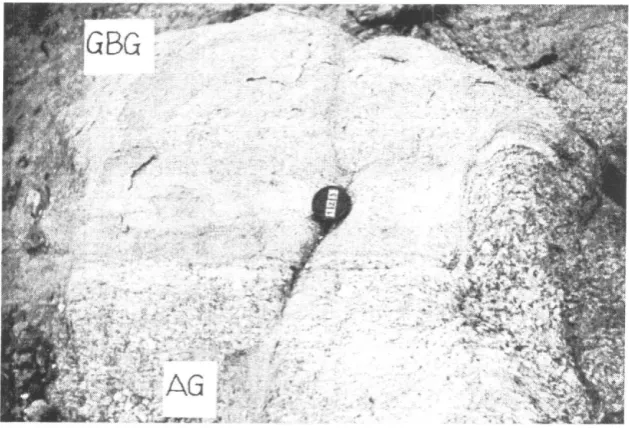
6. Contrary to the authors contention (p.305, line 40), field evidence in central SO clearly shows augen gneiss (AG) to intrude the GBG and hence is younger than the latter (Fig. 1 ).
7. Reference and locations of the GBG composition from Wohlthat are not given (in their Table I). Two single analyses of these rocks are unlikely to be representative of lithounits from such a large exposed mobile belt (-250 km x 130 km) for comparison with those of SO (p.31l, line 2).
8. One of the major oxide parameters for assessing the major oxide composition which includes alkalies, alumina and calcium is mol~r AlCNK, which has been calculated
and listed in Table I for each rock type to assess authors claim of the GBG and AG being cogenetic.
Fig.I. Augen gneiss (AG) showing sharp contact Gamet-biotite gneiss (GBG. retrogressed opx-bearing quartzofeldspathic gneiss)
Table I. AJCNK values for a) Gamet-Biotite Gneiss b) Augen Gneiss and c) QuartzofeJdspathic gneiss.
a)
b)
c)
Sample No.
ALCNK value
Sample No. AJCNK value
Sample No.
NCNK value
84
J 05
14 095
42
I 007 103 1 JO
109
I 007
96 1 045
A perusal of the table indicates:
110 106
20 097
39 I 18
35 1034
87 095
116
I 58 ·119
243
91
091
12
I 35
24 109
a) Wide variability in NCNK ofGBG indicating grouping together of more than one
rock type. It is suggested from field observation and I iterature (Sengupta, 1988) that high
NCN~ of GBG corresponds only to metapelites (khondalites)
b) NCNK values of AG fall in a narrow range and depict a metaluminous character (different from GBG and, therefore, difficult to be considered as cogenetic, p.31 0, line 12).
c) The AlCNK values of QFG (quartzofeldspathic gneiss) are lower than that of GBG. IfQFG was a partial melt derivative ofGBG (contended by the authors on p.310, line 13), then higher AlCNK values would be expected for QFG.
Furthermore, the P, T conditions of the amphibolite facies event indicate maximum of 5.1 kb at 600 C from metapelite (Ravindra Kumar, 1986), which is inadequate to cause partial melting of the GBG to generate the metaluminous QFG (alaskitic/leucogneiss veins).
9. AG shows greater LREE enrichment with respect to HREE than the GBG shows.
*
The GBG shows moderate Eu anomaly (EulEu
=
0.55) as compared to low to no Eu anomaly (Eu/Eu * = 0.74) of AO indicating the source rocks for GBG and AG to be disti nctl y different.10. Authors in their discussion start with the contention that "the field, mineralogical and chemical characteristics of garnet- biotite gneiss and augen gneiss suggest that these two phases are cogenetic while the quartzofeldspathic gneiss appears to be a partial melt of the GBO". But earlier (p. 305, line 40) the field relations is purported to be unclear. The mineralogical description of GBO and AG has not been shown to be related and, therefore, a conclusion of their being cogenetic is overambitious.
II. Mineralogy of GBG does not reflect granulite assemblage and, therefore, the process visualised on page 310, line 25 is far fetched.
12. "Similarity ofREE distribution pattern between GBG andAG suggest derivation from a pelitic source" (p. 310, line 32) cannot be taken to infer.the source of protolith.
13. From the structural data of Sengupta (1993) indicating an earlier tec-tonometamorphic event recorded in granulites from SO, apparently absent in the Wohlthatlcentral Dronning Maud Land (cDML) and the sapphirine-bearing high pressure assembl age from SO reported by Grew (1983) suggests that the Schirmacher Hills probably represents part of a different mobile belt or parts of the basal units of cDML? This would run counter to the authors contention that the SO could be younger than WohlthaUcDML (p.311, line 6).
cDML is not part of the Eastern Ghats Granulite Belts (EGGB) or the Kerala Khondaltie Belt (KKB) with any direct strike continuity (eg. Yoshida et at. 1992, Brandon and Meen, 1995, Kriegsman, 1995). Hence the comparison of the chemical composition of polyphase gneisses of SO with those of EGGB and KKB (page 311, last paragraph) are irrelevant as they are from different mobile belts having different ages.
The lithological ensemble in the eastern part of SO, mostly unretrogressed, is dominated by charnockite-enderbite interlayered with pyroxene granulite with sapphirine bearing high pressure assemblages preserved in minor metapelitic (?) pods. cDMLexposes dominantly metapelitic sequence metamorphosed to intermediate pressure granulite facies (Pant. 1991, Pant and Verma, 1992) with the well developed pyroxene granul i te unit of SO being absent in cDML, suggesting different metamorphic regimes for the SO and cDML. Further, the presence of earlier tectonometamorphic events, preserved in boudins from SO (Sengupta, 1993) have not been reported from cDML, indicating temporal differences in their development. The tectonic development and kinematic significance of Grenvillian
and pre Gren villian (?) structures would aid in understanding the development of metamor-phic regime from Schirmacher Hills, which appears to be different from that exposed in cDML. Later,
it
appears that both the regions underwent similar Pan African tectonothermal events.Antarctica Division
. Geological Survey of India
Faridabad -
121001
V. RAVIKANT
References
BRANDON, A.D. and MEEN, J.K. (1995). Nd isotopic evidence for the position of southernmost Indian terranes within East Gondwana. Precamb. Research, v.70, pp.269-280.
GREW, E.S. (1983). Sapphirine-Garnet and associated parageneses in Antarctica. ]n:Oliver, RL., P.R James and J.B. Jago (Eds.). Antarctic Earth Science, Cambridge University Press, Cambridge. pp.40-43.
JACOBS, J. and THOMAS, R.J. (1994). Oblique collision at about 1.1 Ga along the southern margin ofthe KaapvaaJ continent, south-east Africa. Oeol. Rundsch. v.83, pp.322-333.
KRIEGSMAN, L.M. (1995). The Pan African event in East Antarctica: a view from Sri Lanka and the Mozambique Belt. Precamb. Res. v.75, pp.263-277.
PANT. N.C. (1991). Metamorphic evolution of Humboldt Mountains, Dronning Maud Land, East Antarctica. Ph.D. Thesis, Mohanlal Sukhadia Univ., Udaipur, India, 98 pp.
PANT, N.C. and VERMA, P.K. (1992). Granulite facies metamorphism in the Humboldt Mountains, Queen Maud Land, East Antarctica. Abst. 24 IGC, Kyoto, Japan, v.2-3, 587 pp.
RAVINDRA KUMAR, G.R (1986). Note on the P-T conditions of metamorphism of Schirmacher Range, East Antarctica. Dept. of Ocean Dev. Tech. Publ. No.3, pp.22S.230.
ROGERS, J.J.w. (]996). A history of continents in the past three billion years. lGeol. v.104, pp.91-107. SENGUPTA, S. (1988). History of successive deformations in relation to metamorphism-migmatitic events in the
Schirmncher Hills, Queen Maud Land, East Antarctica. JGSJ, v.32, pp.295-319.
SENGUPTA. S. (1993). Tectonothermal history recorded in mafic dykes and enclaves of gneissic basement in the Schirmacher Hills, East Antarctica. Precamb. Res. v.63, pp. 273-29].
YOSHIDA, M. FuNAKI, M. and VJTANAGE. P.w. (1992). Proterozoic to Mesozoic East Gondwana: the juxtaposition of India-Sri Lanka-Antarctica. Tectonics, v.II, pp.381-391.
Reply
We are thankful to Ravikant (RK) for his thorough reading of our paper and hence the discussion. However, he appears to have missed many salient points in our paper. Further in his own comments there are some contradictions. It appears as though Mr. RK wants to express his ideas on Schirmacher Oasis through this discussion.
1. The paper he has referred in item No.1 Jacobs and Thomas (1994), Rogers (1994), post-dates out publication (see the date of submission of our papers). Hence the question of referring to them does not arise. However, the gneisses in question have been already dated and the Rb-Sr isotopic age of Gamet Biotite Gneiss (GBG) and Quartzo-feldspathic Gneiss (QFG) from the Schirmacher Oasis are GBG = 853
±
51 m.y. and QFG = 779±
26 m.y. (Madoom Hussain etat.
1991) and are not included in the text as per referee's advice.The ages clearly show their neo-Proterozoic age. We think that, neo-Proterozoic is certainly Precambrian.
2. In view of reply at comment (1'), (2) is irrelevant. We have reported the occurrence of acid and basic rocks which need not have time relation.
3. The paper deals mostly with the geochemistry of the polyphase gneisses and hence the structural aspects which post date the rock formations are irrelevant for the approach taken by the authors. In isochemical metamorphism the post-formational t~ctonic
distur-bances does not alter much the bulk chemistry.
4. The geological map presented is not modified, but rather simplified as the GBG and Banded gneiss (BG) are similar in mineralogy, the latter also contains garnet and biotite and hence grouped together.
5. Petrological description ?f the polyphase gneisses is already given in the paper which has been reviewed and accepted.
6. We have described the lithology in the order (oldest first) i.e., GBO, Augen gneiss (AG) and QFO. We have also mentioned that QFG is the youngest phase. Naturally AG is younger than GBG though we have not given a field photo.
7. The GBO compositions referred from the Wohlthats in the paper have been given to show the similarity and presence ofGBG also in Wohlthat. The paper is not on WohIthat, but on Schirnlacher Oasi£.
8. The AlCNK ratio does not refer to time. Two different rock formations may form at the same time but may have different AlCNK values. Also, same rock type formed in different depositional basins like the Eastern Ghats metapelites (Murthy, 1996) may have different AlCNK values. Even depending on the compositional heterogeneity in the source rock the values may vary substantially. Hence this comment is not acceptable. Also in the same comment (c) higher P-T conditions for the same formations (750-800C at 5-8 kb) have been reported by Grew (1983) for this area which clearly supports high P-T and anatectic origin of the feldspathic gneiss (Le Breton and Thompson, 1988; Patino-douce and 10hnston, 1989).
9. The LREE, HREE variations and their fractionation is controlled mostly by garnet and ilmenite, the concentration of which varies from place to place and hence source need not be different but can be heterogenous (Harris and Inger, 1992; Barbey et ai. 1989).
10. The field relation is not very clear at every place between GBG and AG. We have specifically recorded that the relation between GBG and AG is not clear. However, the chemical composition of these gneisses clearly indicate the relation between GBG and AG (some of the chemical variation diagrams were not included on the ad v ice of the references). The order of the evolution suggested is GBG, AG and QFG (see Tables and description).
L 1. Even after reading the whole paper so thoroughly it is surprising that RK missed the mineralogical description of the GBG given on p.305 which clearly demonstrates a granulite assemblage of high P-T.
12. We feel that RK is not completely aware of the importance ofREE in identifying the protolith characters. There are many recent publications on this topic which may please be referred (e.g. Condie et al. 1992).
13. The structural deformation which has no time control (which is not dated) cannot be taken for regional comparative studies. Also the structural deformation depends on so many factors and hence cannot be compared from different areas. On p.311 line 6 we have said that the GBG from Schirmacher Oasis and Wohlthats show overall similarity in their compositions, suggesting Wohlthat as the probable provenance for the pelitic sediments of Schirmacher Oasis or both Wohlthat and Schirmacher Oasis had a common provenance. We have not mentioned that the Schirmacher Oasis could be younger than Wohlthats.
There is lot of recent literature regarding the Queen Maud Land (QML), Eastern Ghat Mobile Belt (EGMB) and Kerala Khondalite Belt (KKB) (Rao et al. 1995; Stackerbrandt, 1988; Cherty, 1995; Dash et at. 1987; Chacko et ai. 1992) which shows that the continuity of the DML and EG is still debatable. On the basis of data (both chemical and structural) available with us on the EGMB and KKB, we support pre-Gondwanic continuation ofthese two belts.
In the last para RK clearly says that the Schirmacher Oasis contains charnockite, enderbite and pyroxene granulites with sapphirine bearing high pressure assemblages. A contradiction of his earlier comments (e.g. No.II).
Finally we would like to say that modelling the evolution of a polymetamorphic scantily known terrain' cannot be equivocal. It would have been better if Ravikant could have submitted a separate paper on this aspect.
National Geophysical Research Institute Hyderabad - 500 007
References
S.M. HUSSAIN
V. DIVAKARA RAO
BAR8EY, P., BERTRAND, 1.M., AKNGOUA. S. and DAUTEL, D. (1989). Petrology and u/Pb geochronology of the Telohat migmatites, Aleksod, Central Hoggar. Algeria. Contr. Miner. Petrol., v.1O 1. pp.207 -219.
CHACKO. T.. RAVINDRA KUMAR, G.R., MEEN, J.K. and ROGERS. U.W. (1992). Geochemistry of high-grade supracrustal rocks from the Kerala Khondalite Belt and adjacent massif chamockites, South India. Precamb. Res .. v.55, pp.469-489.
CaNDlE, K.c., BaRYTA. D.M., JINZHONG LIU and XIANGLIN QIAN (1992). The origin ofkhondalites: geochemical evidence from the Archaean to Early Proterozoic granulite belt in the North China craton. Precamb. Res., v.59, pp.207-223.
CHETTY, T.R. K. (1995). A correlation of Proterozoic shear zones between Eastern Ghats India and Enderby Land, East Antarctica based on LANDSAT imagery. Geol. Soc. Ind., Memoir 34, p.205-220.
DASH, B., SAHU. K.N. and BOWES. D.R. (1987). Geochemistry and original nature of Precambrian khondalites in the Eastern Ghats, Orissa, India. Trans. Roy. Soc. Edinburgh, v.78, pp.115-127.
GREW, E.S. (1983). Sapphirine-Gamet and associated paragneisses in Antarctica. In: Olive, R.L., P.R. lames and J,B. Jago (Eds,) Antarctic Earth Science, Cambridge University Press, Cambridge, ppAO-43.
HARRIS. N.B.W. and INGER, S. (1992). Trace element modelling of pelite-derived granites. Contr. Min. Petrol., v.l] O. pp.46-56.
LE BRETON, N. and THOMPSON, A.B. (1988). F1nid <l:bsent (dehydration) melting of biotite in metapelites in the early stages of crustal anatexis. Contr. Mineral. Petrol. v.99, pp.226·237.
MADOOM HUSSAIN, S., SUBBA RAO, D.V .. POORNACHANDRA RAO, G.V.S., RAMANA RAo, A.V. and RAMA RAO, P. (1991). Geoscientific investigations in Antarctica. National Geophysical Research Institute, Hyderabad, Annual Report 1991-92, pp.35·36.
MURTHY, N.N. (1996). Geochemistry and origin ofkhondalites from the Eastern Ghats granulite belt. India. Ph.D. Thesis. Osmania University, 128 pp.
PATlNO·DouCE, A.E. and JOHNSTON, A.D. (1989). Melt productivity from aluminous metasediments as a function of temperature, pressure and bulk composition of the source. EOS, v.70(43), 1395 pp.
RAO, A.T., DIVAKARA RAO. V.. YOSHIDA, M. and ARIMA, M. (1995). Geochemistry of charnockites from the Eastern Ghats Granulite Belt - Evidence for possible linkage between India and Antarctica. OeD!. Soc.-Ind., Memoir 34, pp.273-292.
STACKERBRANDT, W., KAMPF. H. and WETZEL, H. U. (1988), The geological setti ng of the Schirmacher Oasi s, Queen Maud Land, East Antarctica. Z.Geol. Wiss. Berlin, v.16(7), pp.66 1-665.
***
SHORT COMMUNICATIONS
It has been decided to encourage submission of "Short Communications"
to the Journal, intended to convey important and significant results of ongoing
investigations and research work. It will be our endeavour to bring out these
without too much of time lag.
However, Short Communications should not exceed 1500 typewritten words and should be accompanied by an infonnative summary not exceeding three to five typed sentences. They may also include essential illustrations which
would stand 2/3 reduction in the block making without loss of clarity, particularly
the lettering employed. A short list of only the most important references may be appended at the end.
Authors are therefore requested to send in "Short Communications" to
achieve the objectives stated. - Ed.