ISSN 2286-4822
www.euacademic.org DRJI Value: 5.9 (B+)
Effect of Integrated Weed Management on the
Performance of Short Duration Transplanted
Aman
Rice Varieties
SHAKINUR ISLAM
Department of Agronomy Bangladesh Agricultural University Mymensingh, Bangladesh
MD. ABDUS SALAM
Department of Agronomy Bangladesh Agricultural University Mymensingh, Bangladesh
MAHFUZA BEGUM
Department of Agronomy Bangladesh Agricultural University Mymensingh, Bangladesh
KAWSAR HOSSEN1
Department of Agriculture Noakhali Science and Technology University
Noakhali, Bangladesh
MD. SHAFIQUL ISLAM
Department of Agronomy Bangladesh Agricultural University Mymensingh, Bangladesh
Abstract:
An experiment was carried out at the Agronomy Field Laboratory, Bangladesh Agricultural University, Mymensingh during the period from July to October 2015 to study the effect of variety and integrated weed management practices on the yield performance of T. aman rice varieties. The experimental treatments comprised three varieties viz. BRRI dhan56, BRRI dhan62 and Binadhan-7; and six
weeding treatments viz., W0 (no weeding), W1 (two hand weeding at 15 and 35 DAT), W2 (application of Pyrazosulfuron ethyl), W3 (application of Pyrazosulfuron ethyl + one hand weeding at 35 DAT), W4 (stale
seedbed) and W5 (stale seedbed + application of Pyrazosulfuron ethyl).
The experiment was laid out in a split plot design with three replications. The results showed that fifteen weed species belonging to ten families infested the experimental plots. Weed density was significantly affected by rice varieties. The maximum weed growth was noticed in variety BRRI dhan62 and minimum was in variety Binadhan-7. Stale seedbed and application of early post emergence herbicide (W5) produced the lowest weed density. BRRI dhan62 produced the highest grain yield due to highest number of grains panicle-1. The highest number of each of total tillers hill-1, effective tillers hill-1, grain yield and 1000-seed weight was observed in stale seedbed treatment. From the interaction effects it is observed that numerically the highest grain yield was obtained from BRRI dhan62 × application of early post-emergence herbicide Pyrazosulfuron ethyl + one hand weeding at 35 DAT. From the results of the study it may be concluded that application of early post-emergence herbicide and one hand weeding at 35 DAT might be the best option for controlling weed as well as obtaining higher grain yield in transplanted aman rice.
Key words:Weed management, variety, yield and T. aman rice.
INTRODUCTION
Rice (Oryza sativa L.) is the most extensively cultivated crop in
About 220 hectares agricultural lands are decreased per year due to urbanization, industrialization, housing and road construction purposes. Among different groups of rice
Transplant aman rice covers about 48.67% of total rice area.
Geographic and agronomic condition of Bangladesh is favorable
for rice cultivation. In Bangladesh T. aman rice is grown during
July-August to November to December. There are two major
methods of aman rice crop establishment, namely,
transplanting and direct sowing. Transplanting occupies the field for lesser time compared to the direct seeded crop and it facilitates the control of weeds. Rice cultivar has tremendous impact on the growth and infestation of weed in the rice field. Usually short stature cultivars face more weed infestation than the taller ones. So, to avoid the weed competition and to get maximum yield from rice, appropriate cultivar should be
selected. In Bangladesh, transplant aman rice is most
important that contributes a lot in total rice production. So,
emphasis should be given to increase the aman rice yield
through the adoption of proper management especially weed control and other management practices. Weeds grow in each of the crop field throughout the world. So it is often said that „crop production‟ is a fight against weeds‟ (Mukhopadhay and Ghosh, 1981). Among the pests, weeds are considered an important biotic constraint to food production. Their competition with crops reduces agricultural output (quantity and quality), and increases external costs by spreading them across farm boundaries. It is also a major constraint to increased farmers‟ productivity, particularly in developing countries. Infestation of weed is one of the most important causes for low yield of rice. In Bangladesh, weed infestation reduces the grain yield by 30-40%
for transplanted aman rice (Mamun, 1990; BRRI, 2008). The
time due to various reasons (Ahmed et al., 2005). In developed countries, integrated weed management is extensively used to control weed but in Bangladesh, few studies have attempted to establish the most suitable and economic integrated weed
management system in T. aman rice. Herbicides are effective in
controlling weeds alone or in combination with hand weeding. The best weeding regime need to be found out with a view to reducing losses due to weed infestation and thus getting maximum yield. A few works on the productivity of transplant
aman rice and weed growth due to cultivar and weeding
regimes in rice have been done in our country. The present study was, therefore, undertaken with the following objectives: to see the effect of variety on weed growth and their performance, to find out the effect of integrated weed
management on the performance of transplant aman rice and
to find out the effect of interaction between variety and integrated weed management practices on the yield
performance of T. aman rice.
MATERIALS AND METHODS
Description of the Experimental Site
The experimental site is located at 240 75Nꞌ latitude and 900
50ꞌ E longitude at an elevation of 18 m above the mean sea
level. The experimental area is characterized by non-calcareous dark grey floodplain soil belonging to the Sonatola soil series under the old brahmaputra floodplain, agro-ecological zone 9. The soil of the experimental field was more or less neutral in reaction with pH value 6.8, low in organic matter and fertility level. The land type was medium high with silt loam in texture. The climate of the locality is tropical in nature and is characterized by high temperature and heavy rainfall during
Experimental treatment
The treatment consisted of three cultivars of transplant aman
rice and six weeding treatments as follows: Factor A: Variety (3): BRRI dhan56, BRRI dhan62 and Binadhan-7. Factor B:
Weed management practices (6): W0 = No weeding, W1 = Hand
weeding at 15 and 35 DAT, W2 = Application of early post
emergence herbicide (Pyrazosulfuron ethyl), W3 = Application of
early post emergence herbicide + one hand weeding at 35 DAT,
W4 = Stale seedbed and W5 = Stale seedbed + application of
early post emergence herbicide.
Experimental design and layout
The experiment was laid out in a split plot design assigning variety in the main plot and integrated weed management in the sub plot. Each treatment was replicated 3 times. Treatment combinations were assigned at random to a block. Total numbers of unit plots were 3×6× 3 = 54. Each plot size was 4.0 m× 2.5 m. The distance maintained between the main plot and the replications were 0.5m and 1.0 m, respectively. Layout of the experiment was done on 12 July 2015.
Crop Husbandry
BRRI dhan62 and Binadhan-7 were fertilized with 80-60-40-10 kg ha-1, 165-50-70-45 kg ha-1 and 120-15-60-10 kg ha-1urea, triple superphosphate, muriate of potash and gypsum respectively. The entire amounts of triple superphosphate, muriate of potash and gypsum were applied at the time of final land preparation. Urea was applied in three installments at 15, 30 and 45 days after transplanting (DAT). Maturity of crops was determined when 90% of the grains became golden yellow in color. Then the harvested crops of each plot except 5 hills plot-1 was bundled separately, properly tagged and brought to threshing floor. The crops were then threshed and the fresh weights of grain and straw were recorded plot-wise. The grains were cleaned and finally the weight was adjusted to a moisture content of 14%. The straw was sun dried and the yields of grain and straw plot-1 were recorded and converted to t ha-1.
Data collection
Weed parameters: Weed density 2) and Weed dry weight (m-2).Crop characters at harvest: Plant height (cm), Number of total tillers hill-1, Number of effective tillers hill-1, Number of non-effective tillers hill-1, Number of grains panicle-1, Number of sterile spikelets panicle-1, Weight of 1000 grains (g), Grain yield (t ha-1), Straw yield (t ha-1) and Harvest index (%)
Statistical analysis
RESULTS AND DISCUSSION
Weed parameters
The experimental plots were infested with 15 weed species
belonging to nine families (Table 1). Generally conditions
favourable for growing transplanted aman rice also favourable
for the exuberant growth of a number of weed species that
compete with crop plants. Weeds found in transplanted aman
rice field are aquatic, semi aquatic, broad leaved, grasses and a few sedges which could withstand water logging usually enough to depress crop yield very significantly if not timely controlled (Mian and Gaffer, 1960).
Table 1: Infesting species of weed in the experimental field of
transplanted aman rice
Serial No.
Local Name
Scientific Name Family Morphological Type 1. Angta Paspalum scrobiculatum L. Poaceae Grass 2. Shama Echinochloa crusgalli (L.) P. Beauv. Poaceae Grass 3. Arial Leersia hexandra Swartz Poaceae Grass 4. Durba Cynodon dactylon L. Poaceae Grass 5. Sabuj nakful Cyperus difformis L. Cyperaceae Sedge 6. Mutha Cyperus rotundus L. Cyperaceae Sedge 7. Pani chaise Eleocharis atropurpurea (Retz.) J. Presl & C.
Pres
Cyperaceae Sedge
8. Joina Fimbristylis miliacea L. Cyperaceae Sedge 9. Pani marich Polygonum orientale L. Polygonaceae Broad leaved 10.Keshuti Eclipta alba L. Compositae Broad leaved 11.Pani kachu Monochoria vaginalis (Burm. F.) C. Presl Pontederiaceae Broad leaved 12.Malancha Alternanthera philoxeroides (Mart.) Amaranthaceae Broad leaved 13.Shusni sak Marsilea crenata C. Presl Marsileaceae Broad leaved 14.Pani long Ludwigia hyssopifolia (G. Don) Exell Onagraceae Broad leaved 15.Pani shapla Nymphaea nouchali L. Nymphaeaceae Broad leaved
Effect of variety on weed density and weed dry weight
found in BRRI dhan56. At 60 DAT numerically the highest weed density was (42.83 m-2) found in BRRI dhan62 and the lowest one (39.22 m-2) was found in Binadhan-7. There was no significant effect on total weed dry weight. At 20 DAT, the highest total weed dry weight was observed (5.71 g m-2) in Binadhan-7 and the lowest total weed dry weight was observed (5.11 g m-2) in BRRI dhan56 which did not significantly differ from the variety BRRI dhan62 (5.49 g m-2). At 40 DAT, the highest total weed dry weight was observed (42.94 g m-2) in BRRI dhan62 and the lowest one (39.79 g m-2) in BRRI dhan56. At 60 DAT, the highest total weed dry weight was observed (52.99 g m-2) in BRRI dhan62. It was evident that the highest weed dry weight was observed in BRRI dhan62 and the lowest dry weight was observed in the BRRI dhan56.
Table 2: Effect of variety on weed density and dry weight at 20, 40, and 60 DATs (Days after transplanting)
Variety Weed density (no. m-2 ) Weed dry weight ( g m-2)
20 DAT 40 DAT 60 DAT 20 DAT 40 DAT 60 DAT BRRI dhan56 57.94b 61.61 39.78 5.11 39.79 45.15 BRRI dhan62 72.83a 71.11 42.83 5.49 42.94 52.99 BINA dhan7 71.78a 68.89 39.22 5.71 41.43 48.59 CV (%) 52.20 31.37 20.31 23.65 16.19 34.08 Level of
significance
** NS NS NS NS NS
* In a column figures with same letters or without letters do not differ significantly whereas figures with dissimilar letter differ significantly as per DMRT.
** = Significant at 1% level of probability NS = Not-significant
Effect of weed management on weed density and weed dry weight
Weed density was significantly influenced by weeding regimes at 20 and 60 DATs (Table 3). At 20 DAT, the highest weed
density (167.1 m-2) was found in W0 (no weeding) and the
lowest one (16.44 m-2) was found in W5 (stale seed and
the highest weed density (186.8 m-2) was found in W0 (no
weeding) and the lowest one (16.56 m-2) was found in W5 (stale
seed and application of early post emergence herbicide) treatment. At 60 DAT, the highest weed density (42.83 m-2)
was also found in W0 (no weeding) andthe lowest (17.78 m-2)
was found in W5 (stale seed and application of early post
emergence herbicide) treatment. Rekha et al. (2002) reported
that weed density was lower in all weeding practices compared to the unweeded control plot. There was significant effect of weeding regime treatment on total weed dry weight (g m-2) at 20, 40 and 60 DAT. At 20 DAT, the highest weed dry weight
(14.25 gm-2) was observed in W0 (no weeding) treatment. The
lowest dry weight (1.81 g m-2) was observed in W5 (stale seed
and application of early post emergence herbicide) treatment. At 40 DAT, the highest weed dry weight (75.06 g m-2) was
observed in W0 (no weeding) and the lowest weed dry weight
(8.27 gm-2) was observed in W5 (stale seed and application of
early post emergence herbicide) treatment. At 60 DAT, the
highest weed dry weight (82.82 g m-2) was observed in W0 (no
weeding) and the lowest dry weight (15.50 g m-2) was observed
in W5 (stale seed and application of early post emergence
herbicide) treatment.
Table 3: Effect of weed management on weed density and dry weight at 20, 40, and 60 DATs (Days after transplanting)
Variety Weed density (no. m-2 ) Weed dry weight ( g m-2)
20 DAT 40 DAT 60 DAT 20 DAT 40 DAT 60 DAT W0 67.1a 186.8a 86.78a 14.25a 75.06a 82.82a W1 114.8b 91.67b 50.33b 6.93b 58.05b 66.98b W2 50.22c 54.33c 36.67c 4.23c 42.49c 50.27c W3 33.78d 28.89d 28.67cd 3.13cd 36.98d 43.54d W4 22.78de 25.00d 23.44d 2.24de 27.47e 34.34d W5 16.44e 16.56d 17.78d 1.81e 8.27f 15.50e CV (%) 20.62 19.54 27.11 21.80 11.80 21.09 Level of significance ** ** ** ** ** **
* In a column figures with same letters or without letters do not differ significantly whereas figures with dissimilar letter differ significantly as per DMRT.
Interaction effect of varieties and weed management on weed density and weed dry weight
The interaction between varieties and weeding regime was found to be insignificant at 20, 40 and 60 DATs (Table 2). At 20
DAT, the highest weed density (177.3 m-2) was found in V3W0
(Binadhan-7× no weeding) and the lowest one (13.00 m-2) was
found in V1W5 (BRRI dhan56× stale seed and application of
early post emergence herbicide) treatment. At 40 DAT, the
highest weed density (201.3 m-2) was found in V2W0 (BRRI
dhan62 × no weeding) and the lowest one (13.6 m-2) was in
V1W5 ((BRRI dhan56× stale seed and application of early post
emergence herbicide) treatments. At 60 DAT, the highest weed
density (92.33 m-2) was found in V2W0 (BRRI dhan62 × no
weeding) and the lowest one (17.33m-2) in V1W5 (BRRI
dhan56× stale seed and application of early post emergence herbicide) treatment. As no significant variation observed on weed dry weight at 20, 40 and 60 DAT due to interaction effect of variety and weed management. At 20 DAT, numerically the
highest weed dry weight (14.59 g m-2) was observed in V3W0
(Binadhan-7 × no weeding) treatment and the lowest weed dry
(1.66 g m-2) was observed in V1W5 (BRRI dhan56× stale seed
and application of early post emergence herbicide) treatment. At 40 DAT, the highest weed dry weight (77.95 g m-2) was
found in V2W0 (BRRI dhan62 × no weeding) and the lowest dry
weight was observed in V1W5 (BRRI dhan56× stale seedbed and
application of early post emergence herbicide) treatment. At 60
DAT, the highest weed dry weight was found in V2W0 (BRRI
dhan62 × no weeding) and the lowest weed dry weight was
observed in V2W5 (BRRI dhan62 × stale seedbed and
Table 4: Interaction effect of varieties and weed management on weed density and dry weight at 20, 40, and 60 DATs (Days after transplanting)
Interaction (variety and weed
management)
weed density (no. m-2 ) dry weight ( g m-2)
20 DAT 40 DAT 60 DAT 20 DAT 40 DAT 60 DAT
V1 W0 150.7 177.7 82.00 13.88 72.49 78.45 V1 W1 98.67 75.33 49.67 6.29 55.74 55.23 V1 W2 43.00 44.00 37.00 4.14 40.39 44.85 V1 W3 24.33 31.00 29.33 2.83 35.82 41.08 V1 W4 18.00 28.00 23.33 1.89 27.09 33.16 V1 W5 13.00 13.6 17.33 1.66 7.19 18.11 V2 W0 173.3 201.3 92.33 14.29 77.95 89.82 V2 W1 123.3 92.67 52.67 7.05 61.14 81.04 V2 W2 54.33 57.00 39.00 4.27 43.93 53.02 V2 W3 36.33 30.33 30.00 3.19 37.93 44.97 V2 W4 28.67 27.33 25.00 2.28 28.01 35.24 V2 W5 21.00 18.00 18.00 1.84 8.71 13.83 V3 W0 177.3 181.3 86.00 14.59 74.74 80.20 V3 W1 122.3 107.0 48.67 7.49 57.27 64.67 V3 W2 53.33 62.00 34.00 4.30 43.16 52.93 V3 W3 40.67 25.33 26.67 3.39 37.19 44.56 V3 W4 21.67 19.67 22.00 2.58 27.30 34.61 V3 W5 15.33 18.00 18.00 1.96 8.90 14.56 CV (%) 20.62 19.54 27.11 21.80 11.80 21.09 Level of
significance
NS NS NS NS NS NS
In a column figures with same letters or without letters do not differ significantly whereas figures with dissimilar letter differ significantly as per DMRT.
NS = Not-significant
V1= BRRI dhan56, V2= BRRI dhan62 and V3= Binadhan-7 W0=No weeding
W1= Hand weeding at 15 and 35 DAT (Days after transplanting),
W2=Application of early post emergence herbicide,
W3= Application of early post emergence herbicide and one hand weeding at
35 DAT,
W4=Stale seedbed, W5=Stale seedbed and application of early post emergence
herbicide
Effect of variety on crop characters
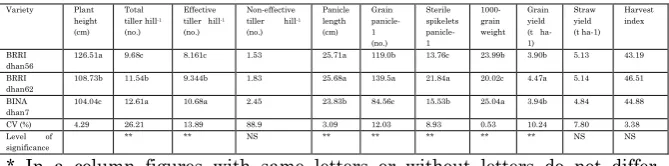
Variety exerted significant effect on plant height (Table 5).
Results showed that V1 (BRRI dhan56) produced the tallest
plants (126.51 cm) while V3 (Binadhan-7) produced the shortest plants (104.04 cm). The variation was probably due to the
genetic makeup of the varieties (Table 5). Total tillers hill-1 was
significantly affected by variety. The variety Binadhan-7
the variety BRRI dhan56 produced the lowest number of total
tillers hill-1 (9.68). The highest number of effective tillers hill-1
(10.68) was found in Binadhan-7. The lowest number of
effective tillers hill-1 (8.16) was obtained in BRRI dhan56.
Number of non-effective tillers hill-1 was not significantly influenced by variety. Panicle length was significantly influenced by variety. The longest panicle (25.71 cm) was recorded in BRRI dhan56 which was statistically similar with BRRI dhan62 and the shortest one (23.83 cm) was recorded in
Binadhan-7. Number of grains panicle-1 was significantly
influenced by different variety. The highest number of grains panicle-1 (139.50) was observed in BRRI dhan62 and the lowest one was found (84.56) in Binadhan-7. Number of sterile spikelets panicle-1 was significantly influenced by different
varieties. The variety V2 (BRRI dhan62) produced the highest
number of sterile spikelets panicle-1 (21.84) while the lowest
one (13.76) was attained by the variety V1 (BRRI dhan56).
1000-grain weight was significantly influenced by different
varieties of transplanted aman rice. The heaviest 1000-grain
weight (25.04) was found in variety Binadhan-7 and the lowest 1000-grain weight was found (20.02) in variety BRRI dhan62. These variations might be due to the genetic makeup of the varieties. As the varieties differed significantly in respect of grain yield. The highest grain yield (4.47 t ha-1) was obtained in BRRI dhan62. The highest grain yield obtained from BRRI dhan62 was mainly due to the favorable effect of highest number of grains panicle-1 (139.5) and other yield attributes. The lowest grain yield (3.90 t ha-1) was obtained in BRRI dhan56. This difference was observed due to different cultivar characteristics of rice plant. Differences in number of grain
yield due to varieties were also reported by Siddeque et al.
(2002). Straw yield was not significantly influenced by the
variety. Numerically, the highest straw yield (5.14 t ha-1) was
was found in BINA dhan7. Harvest index was not significantly affected by variety. Numerically, the highest harvest index (46.51%) was found in BRRI dhan62 and the lowest one (43.19%) was found in BRRI dhan56.
Effect of weed management on crop characters
Plant height was not significantly influenced by different weed management practices (Table 6). The tallest plant (116.5 cm)
was found in W2 (application of early post emergence herbicide)
treatment which was statistically identical with W1 (hand weeding at 15 and 35 DATs), and W3 (post-emergence herbicide and hand weeding at 35 DAT), W4 (stale seedbed) and W5 (stale seed and application of early post emergence herbicide) treatments. The shortest plant (105.7 cm) was found in W0 (no
weeding) treatment. Number of total tillers hill-1 was not
significantly influenced by different weed management treatment. However, numerically the highest number of total
tiller hill-1 (12.09) was observed from W4 (stale seedbed)
treatment. The lowest number of total tillers hill-1 (10.80) was
obtained from W0 (no weeding) treatment. The result reveals
that effective weed management enhanced effective tillers production. Number of effective tillers hill-1 was significantly influenced by variety. The highest number of effective tillers hill-1 (10.68) was found in Binadhan-7. The lowest number of
effective tillers hill-1 (8.16) was obtained in BRRI dhan56.
Number of non-effective tillers hill-1 was not significantly influenced by different weed management practices. Panicle length was significantly affected by different weed management. The longest panicle (25.78 cm) was observed in W5 (stale seed and application of early post emergence
herbicide) which was statistically similar with W2 (application
(no weeding) treatment. Number of grains panicle-1 was significantly influenced by different weed management practices. The highest number of grains panicle-1 (129.50) was produced by W3 (post-emergence herbicide and hand weeding at 35 DAT) treatment and the lowest number of grains panicle-1 (95.36) was produced by W0 (no weeding) treatment. Number of grains panicle-1 was significantly influenced by different weed management practices. The highest number of grains panicle-1 (129.50) was produced by W3 (post-emergence herbicide and hand weeding at 35 DAT) treatment and the lowest number of grains panicle-1 (95.36) was produced by W0 (no weeding) treatment. Number of sterile spikelets panicle-1 was significantly influenced by different weed management practices. The highest number of sterile spikelets panicle-1 (17.78) was produced by W0 (No weeding) treatment, while the lowest one (16.43) was produced by W4 (stale seedbed) treatment. 1000-grain weight was not significantly affected by weed management practices. Numerically the heaviest
1000-grain weight (23.03 g) was observed in W2 (Application of early
post emergence herbicide), W3 (post-emergence herbicide and hand weeding at 35 DAT), W4 (stale seedbed) and W5 (stale seed and application of early post emergence herbicide) treatments and the lowest 1000-grain weight was (22.93 g) observed in W0 (no weeding) treatment. Grain yield was significantly influenced by different weed management practices. The highest grain yield (4.56 t ha-1) was produced by W4 (stale seedbed) treatment which was statistically identical with W3 (post- emergence herbicide and hand weeding at 35 DAT) treatment, while the lowest grain yield (3.05 t ha-1) was
produced by W0 (no weeding) treatment. Treatment W1 (hand
weeding at 15 and 35 DAT) and W5 (stale seed and application of early post emergence herbicide) treatment were statistically identical. Control treatment (no weeding) produced the lowest
had significant effect on straw yield. The highest straw yield
(5.43 t ha-1) was observed in W0 (no weeding) treatment and the
lowest straw yield (4.61 t ha-1) was observed in W5 (stale seed
and application of early post emergence herbicide) treatment. Harvest index was significantly influenced by different weed management. The highest harvest index (47.94%) was observed
in W3 (application of early post emergence herbicide and one
hand weeding at 35 DAT) treatment. The lowest harvest index
(35.96%) was observed in W0 (no weeding) treatment.
Interaction effect of variety and weed management
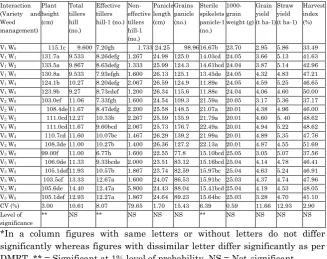
Plant height was significantly affected by interaction between varieties and weed management (Table 7). The tallest plant
height (133.5 cm) was obtained from the variety V1 (BRRI
dhan56) with W2 (early post-emergence herbicide) treatment
and the shortest one from the variety V3 (Binadhan-7) with W0
(no weeding) treatment. There was no significant variation in
total tillers hill-1 due to interaction between variety and
weeding treatment. Significant variation was found in number of effective tillers hill-1 due to interaction between variety and weed management. The highest number of effective tillers hill-1 (12.67) was produced by Binadhan-7 in W3 (post- emergence herbicide and hand weeding at 35 DAT) treatment which was statistically identical with Binadhan-7 × stale seedbed + application of early post emergence herbicide Pyrazosulfuron ethyl. The lowest number of effective tillers hill-1 (6.77) was produced by Binadhan-7 variety in W0 (No weeding) treatment.
Number of non-effective tillers hill-1 was not significantly
Number of grains panicle-1 was not significantly influenced by different varieties and weed management. Numerically, the highest number of grains panicle-1 (176.7) was produced by BRRI dhan62 with W3 (post-emergence herbicide and hand weeding at 35 DAT) treatment and the lowest one (77.80) was produced by Binadhan-7 with W0 (no weeding) treatment. The interaction between variety and weed management had significant effect on number of sterile spikelet‟s panicle-1. The highest number (22.49) of sterile spikelets panicle-1 was obtained from BRRI dhan62 with W3 (post- emergence herbicide and hand weeding at 35 DAT) treatment and the lowest number (11.88) of sterile spikelet‟s panicle-1 was found from BRRI dhan56 with W5 (stale seed and application of early post emergence herbicide) treatment which was statistically
identical with V1W4 (BRRI dhan56 × stale seedbed). V3W0,
V3W1, V3W2, V3W3, V3W4 and V3W5 were statistically identical
with each other. 1000-grain weight was not significantly affected by varieties and weed management. Grain yield was
not significantly influenced by different varieties and weed
management. Numerically, the highest grain yield (4.94 t ha-1)
was produced by V2W3 (BRRI dhan62 × post-emergence herbicide and hand weeding at 35 DAT) treatment. Similar
results were also observed by Ferdous et al. (2016). The lowest
grain yield (2.95) was obtained in BRRI dhan56 × no weeding practice might be due to the poor performance of yield
contributing characters like number of tillers hill-1 and grains
panicle-1 because severe weed infestation occurred in the plots due to competition for moisture, nutrients between weed and
rice plants. Similar results were also observed by Gogoi et al.
(2000). Straw yield was not significantly influenced by variety and weed management. Harvest index was significantly influenced by different weed management. The highest harvest
index (47.94%) was observed in W3 (application of early post
treatment. The lowest harvest index (35.96%) was observed in
W0 (no weeding) treatment.
Table 5: Effect of variety on the performance of transplanted aman
rice
Variety Plant height (cm)
Total tiller hill-1
(no.)
Effective tiller hill-1
(no.)
Non-effective tiller hill-1
(no.) Panicle length (cm) Grain panicle-1 (no.) Sterile spikelets panicle-1 1000-grain weight Grain yield (t ha-1) Straw yield (t ha-1) Harvest index BRRI dhan56
126.51a 9.68c 8.161c 1.53 25.71a 119.0b 13.76c 23.99b 3.90b 5.13 43.19 BRRI
dhan62
108.73b 11.54b 9.344b 1.83 25.68a 139.5a 21.84a 20.02c 4.47a 5.14 46.51 BINA
dhan7
104.04c 12.61a 10.68a 2.45 23.83b 84.56c 15.53b 25.04a 3.94b 4.84 44.88 CV (%) 4.29 26.21 13.89 88.9 3.09 12.03 8.93 0.53 10.24 7.80 3.38 Level of
significance
** ** NS ** ** ** ** ** NS NS
* In a column figures with same letters or without letters do not differ significantly whereas figures with dissimilar letter differ significantly as per DMRT.
** = Significant at 1% level of probability NS = Not-significant
Table 6: Effect of integrated weed management practices on the
performance of transplanted aman rice
Weed management practices Plant height (cm) Total tiller hill -1 (no.)
Effective tiller hill-1
(no.)
Non-effective tiller hill-1
(no.) Panicle length (cm) Grain panicle-1 (no.) Sterile spikelets panicle-1 1000-grain weight Grain yield (t ha-1) Straw yield (t ha-1) Harvest index
W0 105.7c 10.80 7.100c* 1.644 23.78d 95.36b 17.78a 22.93 3.05b 5.43a 35.96a
W1 115.4ab 10.84 8.689b 1.822 24.69c 118.9a 16.75ab 23.00 4.06a 4.96ab 45.01a
W2 116.5a 11.36 9.844a 1.822 25.11b 114.3a 17.46ab 23.03 4.37a 5.26ab 45.38a
W3 115.1ab 11.51 10.07a 1.756 25.31b 129.5a 17.28ab 23.03 4.54a 4.93ab 47.94a
W4 113.4ab 12.09 10.42a 3.111 25.77a 117.4a 16.43b 23.03 4.56a 5.04ab 46.87a
W5 112.4b 11.07 10.24a 1.489 25.78a 110.7ab 16.55b 23.03 4.07a 4.61b 46.89b
CV (%) 3.00 10.61 8.07 79.65 1.70 15.43 6.39 0.59 11.66 12.93 2.90 Level of
significance
NS NS ** NS ** ** ** NS ** ** **
* In a column figures with same letters or without letters do not differ significantly whereas figures with dissimilar letter differ significantly as per DMRT.
** = Significant at 1% level of probability, NS = Not-significant W0=No
weeding
W1= Hand weeding at 15 and 35 DAT (Days after taransplanting),
W2= Application of early post emergence herbicide
W3= Application of early post emergence herbicide and one hand weeding at
35 DAT
W4=Stale seed bed and
Table 7: Interaction effect of variety and weed management on the
performance transplanted aman rice
Interaction (Variety and Weed management) Plant height (cm) Total tillers hill (no.) Effective tillers hill-1 (no.) Non- effective tillers hill-1 (no.) Panicle length (cm) Grains panicle (no.) Sterile spikelets panicle-1 (no.) 1000-grain weight (g) Grain yield (t ha-1) Straw yield (t ha-1) Harvest index (%)
V1 W0 115.1c 9.600 7.20gh 1.733 24.25 98.96 16.67b 23.70 2.95 5.86 33.49 V1 W1 131.7a 9.533 8.26defg 1.267 24.98 125.0 14.03cd 24.05 3.66 5.13 41.63 V1 W2 133.5a 9.867 8.63defg 1.333 25.99 124.3 14.61bcd 24.04 3.87 5.14 42.96 V1 W3 130.8a 9.533 7.93efgh 1.600 26.13 125.1 13.45de 24.05 4.32 4.83 47.21 V1 W4 124.1b 10.27 8.20defg 2.067 26.59 124.9 11.89e 24.05 4.59 5.25 46.65 V1 W5 123.9b 9.27 8.73cdef 1.200 26.34 115.6 11.88e 24.04 4.06 4.60 50.00 V2 W0 103.0ef 11.06 7.33fgh 1.600 24.54 109.3 21.59a 20.05 3.17 5.36 37.17 V2 W1 108.4de 11.67 8.47defg 2.200 25.58 148.5 21.07a 20.01 4.38 4.96 46.00 V2 W2 111.0cd 12.27 10.33b 2.267 25.59 135.9 21.79a 20.01 4.60 5. 40 48.62 V2 W3 111.0cd 11.67 9.60bcd 2.067 25.73 176.7 22.49a 20.01 4.94 5.22 48.62 V2 W4 110.7cd 11.60 10.07bc 1.467 26.29 139.2 21.99a 20.01 4.89 5.35 47.76 V2 W5 108.3de 11.00 10.27b 1.400 26.36 127.2 22.13a 20.01 4.87 4.55 51.69 V3 W0 99.00f 11.00 6.77h 1.600 22.55 77.8 15.10bcd 25.05 3.05 5.07 37.56 V3 W1 106.0de 11.33 9.33bcde 2.000 23.51 83.12 15.16bcd 25.04 4.14 4.78 46.41 V3 W2 105.1def 11.93 10.57b 1.867 23.74 82.59 15.97bc 25.04 4.63 5.24 46.91 V3 W3 103.5ef 13.33 12.67a 1.600 24.07 86.53 15.91bc 25.03 4.37 4.74 47.96 V3 W4 105.6de 14.40 12.47a 5.800 24.43 88.04 15.41bcd 25.04 4.19 4.53 48.05 V3 W5 105.1def 12.93 12.27a 1.867 24.64 89.23 15.64bc 25.03 3.28 4.70 41.10 CV (%) 3.00 10.61 8.07 79.65 1.70 15.43 6.39 0.59 11.66 12.93 2.90 Level of
significance
** NS ** NS NS NS ** NS NS NS NS
*In a column figures with same letters or without letters do not differ significantly whereas figures with dissimilar letter differ significantly as per DMRT. ** = Significant at 1% level of probability, NS = Not-significant V1= BRRI dhan56, V2= BRRI dhan62 and V3= Binadhan-7; W0=No weeding,
W1= Hand weeding at 15 and 35 DAT (Days after transplanting), W2=
Application of early post emergence herbicide, W3= Application of early post
emergence herbicide and one hand weeding at 35 DAT, W4=Stale seedbed and
W5=Stale seedbed and application of early post emergence herbicide.
CONCLUSIONS
From the result of the study, it could be concluded that, for the control of weeds in effective manner and in order to get
considerable amount of grain yield in transplant aman rice,
CONFLICT OF INTEREST
The authors declare that there is no conflict of interests regarding the publication of this paper
REFERENCES
16.Ahmed, G. J. U., Bhuiyan, M. K. A., Riches, C. R.,
Mortimer, M. and Jhonson, D. (2005). “Farmer‟s participatory studies of integrated weed management system for intensified low land”. Proceeding of the 8th Biennial Agronomy Convention, Bangladesh Agron. J. 17(3): 31-32.
17.BBS (Bangladesh Bureau of Statistics). (2012). Yearbook
of Agricultural Statistics of Bangladesh. Bangladesh Bur. Stat. stat. Divn. , Ministry of Plan. Govt. People's Repub. Bangladesh, Dhaka. p. 45.
18.BRRI (Bangladesh Rice Research Institute). (2008).
Annual Report for 2007.Bangladesh Rice Res. Inst. Joydevpur, Bangladesh. pp. 28-35.
19.Ferdous, J., Islam, N., Salam, M. A. and Hossain, M. S.
(2016). “Effect of weed management practices on the
performance of transplanted aman rice varieties”.
Journal of Bangladesh Agricultural University, 14(2): 17-22.
20.Gogoi, A. K., Rajkhowa, D. J. and Kandali, R. (2000).
“Effect of varieties and weed control practices on rice
productivity and weed growth”. Indian J. Agron. 45(3):
580-585.
21.Gomez, K. A. and Gomez, A. A. (1984). “Statistical
22.IRRI (International Rice Research Institute). (2006). “Rice yield by country and geographical region”. World rice statistics. Intl. Rice Res. Inst. Los Banos. Laguna Philippines. pp. 1-8.
23.Mamun, A. A. (1990). “Weeds and their control: A review
of weed research in Bangladesh”. Agricultural and Rural Development in Bangladesh. Japan Intl. Co- operation Agency, Dhaka, Bangladesh. JSARD. 19: 45-72.
24.Mian, A. L. and Gaffer, M. A. (1960). “Torkgranular as a
weedicide in transplant aman rice in East Pakistan”. J. Sci. Res. 20(2): 119-124.
25.Mukhopadhay, S. K. and Ghosh, D. C. (1981). “Weed
problem in oil seed crops and its control”. Pesticide Information. 7: 44.
26.Rekha K. B, Razu M. S, Reddy M. D (2002). “Effect of
herbicides in transplant rice”. Indian J. Weed Sci. 34(1-2): 123-125.
27.Siddeque, S., Hossain, G., Ahmed, S. Q. and Farhad, A.