Available online: https://edupediapublications.org/journals/index.php/IJR/ P a g e | 1372
Robust Path Deduction And Load Balancing In Dynamic Wireless Sensor
Network Using Rtr Algorithm
Keesari Priyanka 1, Merigala Kishore Babu 2
1PG Scholar, Dept of CSE,Universal College Of Engineering &Technology, Guntur,AP
2 Asst.professor, Dept of CSE Universal College Of Engineering &Technology, Guntur, AP.
Abstract:In large-scale multi-hop wireless sensor networks (WSNs) for data collection the ability of monitoring per-packet routing paths at the sink is essential in better understanding network dynamics, and improving routing protocols, topology control, energy conservation, anomaly detection, and load balance in WSN deployments. We first devise a basic Routing Topology Recovery (RTR) algorithm with the measurement metric of modular summation, and illustrate how basic RTR algorithm works The path determining process from source to destination for data transmission is generally known as routing. In most WSNs routing of incoming data can be determined by the network layer. The SNs at the source cannot reach the sink node directly in multi-hop networks, hence intermediate SNs need to relay their respective packets. Mainly the routing path of every packet is helpful in understanding the network performance.We present SANA secure Ad hoc Network Architecture. Its goal lies in managing adaptively preventive, reactive and tolerant security mechanisms to provide essential services even under attacks, intrusions or failures. The results reveal that our approach significantly outperforms other state-of-the-art methods including MNT, Pathfinder, and CSPR. Furthermore we validate our method intensively with a real-world outdoor WSN deployment running collection tree protocol for environmental data collection.
Index Terms: Wireless sensor networks, routing dynamics, path reconstruction, performance analysis, Mesh Network, Security management, wireless ad hoc networks, , routing. Security model,
1. INTRODUCTION
Many current and envisaged applications for wireless sensor networks (WSNs)
involve data collection in remote,
inaccessible or hostile environments, such as deserts, mountains, ocean floors, and battlefields [1]. A multitude of sensors might be deployed within a certain area and their activity is usually monitored and managed by a powerful trusted entity. Security in WSNs presents several well-known challenges stemming from all kinds of resource constraints of individual sensors [2]. The security measurement taken in this project is to save the energy in each node. The main use of the energy saving is based
Available online: https://edupediapublications.org/journals/index.php/IJR/ P a g e | 1373
Figure: 1 Wireless Sensor Network
The assurance is proven in the formula while the ratio of message delivery can be
used for average case performance
evaluation [5]. Some of the applications require the perfect delivery in the specified time or else the message will be considered as the useless or after the time limit the information content will be decreased. Thus, some routing protocols mainly perform for delay time control of the network [6,7]. The average performance these type of protocols is evaluated by measuring the message delivery accordingly with time factors. Some routing protocols have adopted their main objectives for network lifetime.
2. RELATED WORK
Much work has been done to provide security primitives for wireless sensor
networks, including practical key
management broadcast authentication and data authentication as well as secure in-network processing [8]. The work of this paper is complementary to the above techniques, and can be combined to achieve high information assurance for sensor network applications [9].This mechanism is to resolve the public auditing problem. The method is to execute the OLSR. Packet loss
transmission will be described her. HLA based OLSR protocol is compared with existing AODV and other protocol [10]. WSN is a limited storage capacity. The nodes are spread in manner and autonomous devices. The senor node can interconnect the data directly or indirectly. The routing path and the network topology change frequently [11]. Zhu et al [12] have provided the study on the average energy consumption in LSWSNs of sensor node distribution in hexagon manner. Monte Carlo method is being used to verify and simulated the distance distribution function and average energy consumption function. Samara sing he and Leone [13] have presented the scalable routing in LSWSNs and is known as Greedy routing. The routing zone divides the network into zones of geographical coordinates. The study outcomes the ability to adopt in a tree-based protocol to attain improved performance and scalability
3. SYSTEM ARCHITECTURE
Available online: https://edupediapublications.org/journals/index.php/IJR/ P a g e | 1374
existing WSN delay and loss tomography approaches [15].
Figure 2 System Model
4. PROPOSED MODEL
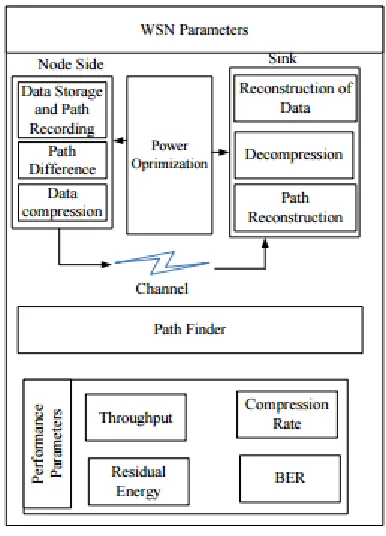
The prime purpose of the proposed system is to perform power optimization in very large WSN and also path reconstruction of the system. Pathfinder comprises of two primary segments for way recreation as appeared in above figure [16]. At the PC side, the way reproduction segment deduces parcel ways from the compacted data and utilizes astute way theory to recreate the bundle ways with high remaking proportion. At the node side, path difference of each packet is recorded in three data structures, bit vector, container and XOR-byte which are updated hop-by-hop [17].
Fig.3 Proposed system architecture
We proposed a robust path reconstruction technique using in very large wireless sensor network. It optimizes the power in the entire
network. Here we are using data
compression method to compress the data in the node. The recent advancement in the
technology has made feasible for
manufacturing the small and low-cost sensors. The sensing devices measure the environmental conditions and transfer them into the electrical signal
5. RECOVERY ALGORITHM
We first devise a basic Routing Topology
Recovery (RTR) algorithm with the
Available online: https://edupediapublications.org/journals/index.php/IJR/ P a g e | 1375
a brute force approach would be O((n−1)!) which is prohibitive. Every measurement packet originated from a sensor node i contains the original node’s unique ID id, and its path measurement yi. This sink receives these packets in sequence from which two vectors are formed: a sequence vector S = {id1, id2, · · · ,idM} where the subscripts indicate the arriving order, and the corresponding measurement vector Y = {yi1 , yi2 , · · · , yiM }. We present our RTR algorithm based on these two vectors. For convenience, we also use “recovering node i” to refer “recovering the path originated from node i” as for convenience. These two terms are exchangeable in this paper. The basic idea of the RTR algorithm is for each incoming path measurement y originated from a new node child, the sink and all the previously recovered nodes could be its parent candidates.According to the currently recovered topology TP whose module sum aggregation matches the received y. Update the topology TP by adding the edge between node child and node parent and the new shortcut if there is one. Notice, because of any tie situations, it is possible that there are multiple topology updates for the same new incoming node child and the same recovered topology TP. To ensure not to miss any true solution, record all recovered updates in a set newSet and every topology in newSet will be checked for the next new node [19].
A. RTR algorithm
Notation
GetSize(s): return the size of the set s;
s1 ∪ s2: join the two sets s1 and s2; group(s):
Group the same topologies in the set s;
FindTP: return the set of all matched topologies.
Function RTR(S, Y, r)
1: TP ← {}; Set ← {T P}; /*initial T P and Set*/
2: for (i ← 1;i ≤ getSize(S);i + +)
3: child ← S[i]; y ← Y [i]; newSet ← {}
4: for all topologies TP ∈ Set do
5: Candidates ← {r} ∪S[1, · · · , i − 1];
6: for all candidates parent ∈ Candidates do
7: TPSet ← f indTP(child, parent, y, T P);
8: if (TPSet 6= {})/*exist matched topologies*/
9: then newSet ← newSet∪ T P Set;
10: end for
11: end for
12: Set ← group(newSet);
13: end for
B. Fast RTR Algorithm
RTR algorithm with multiple measurement metrics helps reduce the potential size of the
solution set significantly. While the
Available online: https://edupediapublications.org/journals/index.php/IJR/ P a g e | 1376
algorithm may waste resources trying to search either non-existent or duplicated solution candidates in its effort to obtain the
complete set of potential solution
candidates. The main changes introduced into the FRTR compared to the RTR algorithm are given below [20]:
• Node child will stop testing other parent candidates Candidates as long as it finds one in the for loop (line 6-10) of Function RTR(S, Y, r) in Figure 3;
• Function f indT P will return the first match topology and stop searching the rest potential ones. These changes enable us to improve the FRTR algorithm’s performance by sorting the parent candidates Candidates and the corresponding path candidates in Function
C. ADOV
TRANSMITTINGPROTOCOL
The AODV transmitting protocol is the important concept of which it should be transmitted in the simple consequent concept. The most useful concept of the proposed work is based upon the simple and efficient usage of the model through which it can be determined. Here AODV is the Ad Hoc On demand transmitting used for the information monitoring concept. Adhoc On-Demand Distance Vector (AODV) is a transmitting protocol for portable ad hoc networks (MANETs) and additional wireless ad hoc networks [21]. The most powerful usage of the AODV is the upcoming usage of the system that should be used for the information passing. The main usage of the
routing protocol is simplified and
maintained in the system through which it should be processed for the system usage and performance of the function.
6. PERFORMANCE EVALUATION
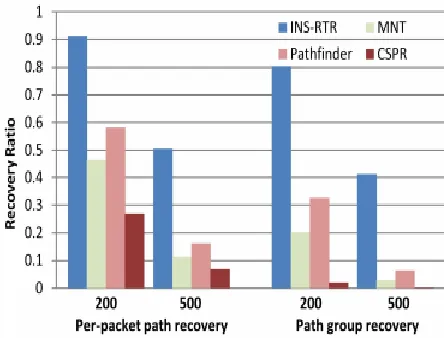
We focus not only on per-packet path reconstruction but also on path group reconstruction. For CSPR, a path group, and hence all the packets in the path group,
cannot be recovered if it contains
insufficient number of packets even after data collections for many cycles. In fact, due to the dynamic nature of the simulated WSNs, it is observed that 92.11% of the path groups in 200-node simulation and 98.95% of the path groups in 500-node simulation contain less than 5 packets. MNT has recovered 46.50%, Pathfinder has recovered 58.32%, and CSPR has recovered 26.98%. Increasing the network size has degraded the performance of all the algorithms. For 500-node simulation study, CSPR has recovered the paths of only 6.90% packets, whereas MNT has recovered 11.37%, and Pathfinder recovered 16.28%. In contrast, INSRTR has achieved the path
reconstruction ratio of 50.65%, still
performing much better than the other approaches/algorithms
Available online: https://edupediapublications.org/journals/index.php/IJR/ P a g e | 1377
7. CONCLUSIONS
We present a novel approach to WSN tomography for dynamic routing topology from piggy-back measurements. Formulated as a novel and interesting optimization problem, our approach is general and systematic, particularly suited for WSN deployments at harsh environments with severe resource constraints at sensor nodes. The concept was proposed perfectly based upon the simulation working model..Our proposed WSN dynamic routing topology inference with incomplete path measurement set in a collection cycle due to packet loss in real-world environments. We plan to further investigate our WSN dynamic routing topology inference approach for large-scale of WSNs consisting of thousands of nodes. We also plan to implement the proposed approach and test it thoroughly in a real-world WSN test bed. In real time the supported format can be maintained in the simplest form of the hardware through which it should be designed. The supporting hardware the ardino tools were implemented
to simultaneously support the real
processing
8. REFERENCES
[1] M. Ceriotti et al., “Monitoring heritage buildings with wireless sensor networks: The Torre Aquila deployment,” in Proc. IPSN, 2009, pp. 277–288.
[2] Roberto Di Petro, Gabriele Logier, Claudio Oriented, and Gene Tsudik, “United We Stand: Intrusion Resilience in Mobile Unattended WSNs”, IEEE Transactions on Mobile Computing, Vol. 12, NO. 7, July 2013
[3] M. Kavitha “A Novel Routing Scheme to Avoid Link Error and Packet Dropping in
Wireless Sensor Networks” International
Journal of Computer Networks and
Applications(IJCNA),
DOI:10.22247/ijcna/2016/v3/i4/48569 Volume 3, Issue 4, July – August (2016).
[4] Merlyn, A. Anuba, and A. Anuja Merlyn. "Energy Efficient Routing (EER) For Reducing Congestion and Time Delay in Wireless Sensor Network." International
Journal of Computer Networks and
Applications 1.1 (2014): 1-10.
[5] Labrador, Miguel A., and Pedro M. Wightman. Topology Control in Wireless Sensor Networks: with a companion simulation tool for teaching and research. Springer Science & Business Media, 2009.
[6] Acs, Gergely, and LeventeButtyán. "A taxonomy of routing protocols for wireless
sensor networks." BUTE
Telecommunication department (2007)
[7] Li, Xiangfang. Multi-layer Optimization in Wireless Ad Hoc Networks.ProQuest, 2007.
[8] G. Werner-Allen, J. Johnson, M. Ruiz, J. Lees and M. Welsh, "Monitoring Volcanic Eruptions with a Wireless Sensor Network", in Second European Workshop on Wireless Sensor Networks (EWSN05), Istanbul, Turkey, 2005.
[9] D. Culler, D. Estrin and M.Srivastava, "Overview of Sensor Networks", IEEE Computer Journal, vol. 37, pp. 41-49, 2004.
[10] M. Kavitha “A Novel Routing Scheme to Avoid Link Error and Packet Dropping in Wireless Sensor Networks” International
Journal of Computer Networks and
Available online: https://edupediapublications.org/journals/index.php/IJR/ P a g e | 1378
DOI:10.22247/ijcna/2016/v3/i4/48569 Volume 3, Issue 4, July – August (2016).
[11] Merlyn, A. Anuba, and A. Anuja Merlyn. "Energy Efficient Routing (EER) For Reducing Congestion and Time Delay in Wireless Sensor Network." International
Journal of Computer Networks and
Applications 1.1 (2014): 1-10
[12]Haofu Zhu; Jianlin Mao; Le Wang; Lixia Fu; NingGuo, "The study on point average energy consumption by Monte
Carlo in large-scale wireless sensor
networks," in Information and Automation, 2015 IEEE International Conference on, vol., no., pp.1700-1703, 8- 10 Aug. 2015.
[13]Samarasinghe, K.; Leone, P., "Greedy Zone Routing: Scalable routing in large scale wireless ad-hoc networks," in Sensing, Communication, and Networking (SECON), 2015 12th Annual IEEE International Conference on, vol., no., pp.172-174, 22- 25 June 2015.
[14] Merlyn, A. Anuba, and A. Anuja Merlyn. "Energy Efficient Routing (EER) For Reducing Congestion and Time Delay in Wireless Sensor Network." International
Journal of Computer Networks and
Applications 1.1 (2014): 1-10.
[15] Zafar, Saima, Hina Tariq, and KanzaManzoor. "Throughput and Delay Analysis of AODV, DSDV and DSR Routing Protocols in Mobile Ad Hoc Networks." International Journal of
Computer Networks and Applications
(IJCNA) 3.2 (2016): 1-7.
[16] Kaur, Sukhkirandeep, and RoohieNaaz Mir. "Energy Efficiency Optimization in Wireless Sensor Network Using Proposed Load Balancing Approach." International
Journal of Computer Networks and
Applications (IJCNA) 3.5 (2016): 108-117.DOI: 10.22247/ ijcna /2016/48861.
[17] L. Mo et al., “Canopy closure
estimates with GreenOrbs:
Sustainablesensing in the forest,” in Proc. SenSys, 2009, pp. 99–112.
[18] Y. Yang, Y. Xu, and X. Li. Topology tomography in wireless sensor networks based on data aggregation. In Proc. Int. Conf. on Communications and Mobile Computing, pages 37–41, 2009.
[19] E. Candes and T. Tao.Decoding by linear programming. IEEE Trans. Info. Theory, 51(12):4203–4215, 2005
[20] E. Candes, J. Romberg, and T. Tao. Robust uncertainty principles: exact signal reconstruction from highly incomplete frequency information. IEEE Trans. Info. Theory, 52(2):489–509, 2006.
[21] D. S. J. D. Couto, D. Aguayo, J. Bicket, and R. Morris, “A high throughput path metric for multi-hop wireless routing,” in Proc. Mobi Com, 2003, pp. 134–146
Student :
Keesari Priyanka
Studying M.tech in Universal College
Of Engineering
Available online: https://edupediapublications.org/journals/index.php/IJR/ P a g e | 1379