OPF Based CRM Using Supply Side and
Demand Side Management
J. Sreenivasulu1, P.Srinivasa Varma2, V. Sankar3
Assistant Professor, Department of EEE, JNTUACE, Pulivendula, India1
Lecturer, Department of EEE, JNTUACE, Ananthapuramu, India2
Professor, Department of EEE, JNTUACE, Ananthapuramu, India3
ABSTRACT: Congestion Relief Management (CRM) plays a significant role in Power Systems Operation under deregulated environment. In the literature, only real Power constrains are considered, whereas in this reactive power as well as complex power constraints are also considered. In the proposed method, Optimal Power Flow (OPF) solution is also considered to obtain Congestion Relief Charge (CRC) in terms of Supply Side Management and Demand Side Management. Expressions are derived, algorithm is developed and software has been developed. The results are compared with a sample test system, with real, reactive, and complex powers.
KEYWORDS: Congestion Relief Charge, Demand Side Management, Supply Side Management, Congestion Relief Management, Ancillary Market (AM).
I. INTRODUCTION
Congestion Relief Management is the process to avoid or relieve the congestion in the transmission system which includes the computation of Congestion Relief Charge (CRC) and Total Contract Violation (TCV) [1]. But in the deregulation, congestion has become a term in conjunction with power systems and competition [3]. The amount of electric power that can be transmitted between two locations through a transmission network is limited by security constraints. Power flows should not be allowed to increase a limit at which the network to collapse due to angular instability, voltage instability or cascaded outages. The system is said to be congested when such a limit is reached [2]. Various congestion management schemes suitable for different electricity market structure have been reported in the literature [4].
When the congestion happens, Independent System Operator (ISO) will be fully responsible for the operation of Ancillary Service Market (ASM) to manage supply and demand sides [6]. Congestion Relief Charge functions, Total Contract Violations etc. have been derived and to get back profit in the system. Independent System Operator can allocate the payments to the participants in proportion to the usage of the system [7].
However, from the literature, all the above analysis has been carried out with real power constraints only, with no changes in reactive powers. In this paper, reactive power constraint with no change in real power is considered. Further, the combination of the real and reactive power changes keeping the other unchanged are simultaneously considered and used as a constraint for complex power to obtain Minimum CRC, Minimum Total Contract Violation (TCV), and Minimum Compromised Objective Function (COF). Further, three cases are also considered Viz., Supply Side Management (SSM), Supply Side and Interruptible Load Management (SS&ILM), Supply Side and Demand Side Management (SS & DSM).
II. MATHEMATICAL MODELS FOR PROPOSED METHOD
The procedure for congestion relief management considering both reactive and complex power constraints is presented in this section.
A. Congestion Relief with Reactive Power Constraints
The reactive power constraints can be included in the objective function for Congestion Relief Charge:
L N L O L L L N g g o g G g
G
Q
C
Q
Q
C
Q
C
Q
Q
C
CRC
L G
1 1
))
(
)
(
(
))
(
)
(
(
(1)Subjected to: L L o i l G g o i g m i i Loss N L L N g g ij g k k ij ij ij
N
L
Q
Q
Q
N
g
Q
Q
Q
Q
Q
Q
S
Q
SP
Q
P
L G,....,
2
,
1
,...,
2
,
1
0
)
(
)
)
(
max min max min 1 1 1 2 max 2 2
Where, GN
Number of supply side to participate in congestion reliefL
N
Number of demand side to participate in congestion relief maxij
S
MVA flow limit of a congested line between bus-i and bus-ji Loss
Q
Reactive power loss in branch-iij
Q
Original reactive power flow in between bus-i and bus-jij
P
Original real power flow in between bus-i and bus-jg
Q
Offers of supply side in MVARL
Q
Offers of demand side in MVARo i
Q
Contracted reactive power in market m Number of branches in system)
(
g GQ
C
Incremental or Decremental price bids submitted by supply side in AM.)
(
L LQ
C
Incremental or Decremental price bids submitted by demand side in AM.
n i o i iv
Q
Q
Q
1 (2) Subjected to: L L o i l G g o i g m i i Loss N L L N g g ij g k k ij ij ijN
L
Q
Q
Q
N
g
Q
Q
Q
Q
Q
Q
S
Q
SQ
Q
P
L G,....,
2
,
1
,...,
2
,
1
0
)
(
)
)
(
max min max min 1 1 1 2 max 2 2
By combining above two Eqns. (1) and (2), the Compromised Objective Function (COF) is formulated, to satisfy the objectives of the ISO, i.e, minimize Total Contract Violation (TCV) as well as total payment paid as CRC [2, 7]. 2 * 2 *
)
(
)
(
]
[
CRC
CRC
Q
Q
O
v vQ (3)
Where,
*
v
Q
Minimum value of Total Contract Violation(CRC)* Minimum value of payment
Congestion Relief Charge Functions, which are submitted by Supply and Demand Side, are defined as follows:
MCP
Q
C
G(
g)
(
1
i)
where,
0
0
,...,
1
i i GN
i
Dec
Q
Inc
Q
g g:
:
(4)MCP
Q
C
L(
L)
(
1
i)
0
0
,...,
1
i i LN
i
Inc
Q
Dec
Q
L L:
:
Inc Increase in Supply/Demand
Dec Decrease in Supply/Demand
To relieve the congestion in the system, huge amount of money is needed. The total expenses for relieving the congestion on the system are to be paid by the system participants. To get back this cost including profit, the ISO can allocate the payments to the participants in proportion of the participant's usage of system and is treated as Market Clearing Price (MCP) [7]. This is formulated with reactive power constraints as:
N l L i LCRC
Q
Q
MCP
1 max ,)
(
(5)N Number of congested line
Li
Q
Power flow in MVAR on line L allocated to participant imax
L
Q
Max power flow in MVAR on line L.Algorithm:
1. Read the input data i.e., branch data, bus data.
2. Run the AC optimal power flow and compute the values of
and
. 3. Compute MCP using Eqn. (5).4. Consider the cases of supply side management, supply side & interruptible load management and supply side & demand side management for congestion relief.
5. Compute CRC, TCV and COF using Eqns. (1), (2) and (3) for the above cases. 6. Stop.
B.
Congestion Relief with Complex Power Constraints
The Complex power constraints can be included in the objective function for Congestion Relief Charge:
L N L O L L L N g g o g G g
G
S
C
S
S
C
S
C
S
S
C
CRC
L G
1 1
))
(
)
(
(
))
(
)
(
(
(6) Subjected to:0
1 1 1
m i i Loss N L L N gg
S
S
S
L G max min g o ig
S
S
S
Where, max
ij
S
MVA flow limit of a congested line between bus-i and bus-ji Loss
S
Reactive power loss in branch-ig
S
Offers of supply side in MVAL
S
Offers of demand side in MVAo i
S
Contracted complex power in market m Number of branches in system)
(
g GS
C
Incremental or Decremental price bids submitted by supply side in AM.)
(
L LS
C
Incremental or Decremental price bids submitted by demand side in AM.Minimization of Total Contract Violations is the other objective formulated as:
n i o i iv
S
S
S
1 (7) Subjected to: L L o i l G g o i g m i i Loss N L L N g gN
L
S
S
S
N
g
S
S
S
S
S
S
L G,....,
2
,
1
,...,
2
,
1
0
max min max min 1 1 1
To satisfy the objectives of ISO, the COF is formulated by combining equations (6) and (7) as
2 * 2 *
)
(
)
(
]
[
CRC
CRC
S
S
O
v vS (8)
Where,
*
v
S
Minimum value of Total Contract Violation(CRC)* Minimum value of payment
Congestion Relief Charge Functions, which are submitted by Supply and Demand Side, are defined as follows:
MCP
Q
C
G(
g)
(
1
i)
0
0
,...,
1
i i L
N
i
Inc
S
Dec
S
L L
:
:
As in the case of reactive power, ISO can allocate the payment to the participants in proportion of the participant’s usage of the system. Similarly, with respect to complex power, the payment allocation by ISO is formulated as:
Nl L i L
CRC
S
S
MCP
1 max
,
)
(
(9)Where,
N Number of congested line
Li
S
Power flow in MVA on line L allocated to participant imax
L
S
Max power flow in MVA on line L.III. CASE STUDY
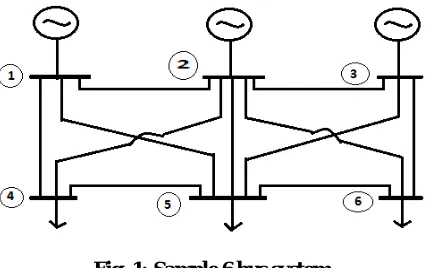
In this paper, a sample 6 bus system [5] shown in Fig. 1 is used as a case study to illustrate the CRM methodology with respect to reactive and apparent powers.
Fig. 1: Sample 6 bus system
To analyse the CRM using 6 bus system, three different cases [3] have been used in this paper and are known as:
1. Supply Side Management (SSM)
2. Supply Side and Interruptible Load Management (SS&ILM) 3. Supply Side and Demand Side Management (SS & DSM)
With the above three cases, in the paper [3] only real power congestion management is used, where as in this paper, reactive power and complex power congestion managements are also obtained and results are compared.
IV. SIMULATION RESULTS
The simulation results of CRM for three cases with respect to real power are presented in Table I.
TABLE I
CRM RESULTS WITH RESPECT TO REAL POWER
The simulation results of CRM for three cases with respect to reactive power are presented in Table II.
TABLE II
CRM RESULTS WITH RESPECT TO REACTIVE POWER
The simulation results of CRM for three cases with respect to complex power are presented in Table III.
TABLE III
CRM RESULTS WITH RESPECT TO COMPLEX POWER
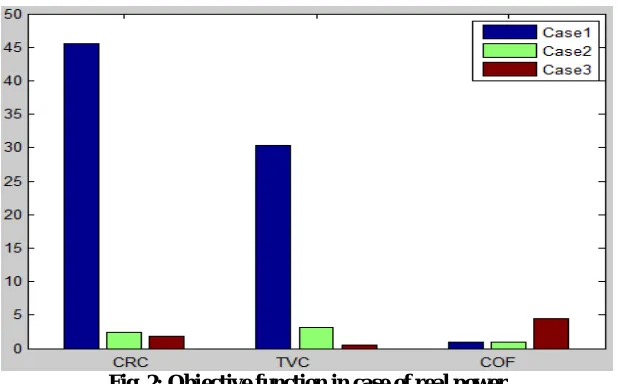
The graphical representation of the objective function in case of real power is shown in the below Fig. 2.
Fig. 2: Objective function in case of real power
objectives Case1 SSM
Case2 SSM & ILM
Case3 SSM & DSM
Min CRC (Rs.) 45.60 2.40 1.80
Min TCV (MW) 30.40 3.11 0.54
Min COF 1.0 1.01 4.47
Objectives
Case1 SSM
Case2 SSM & ILM
Case3 SSM & DSM
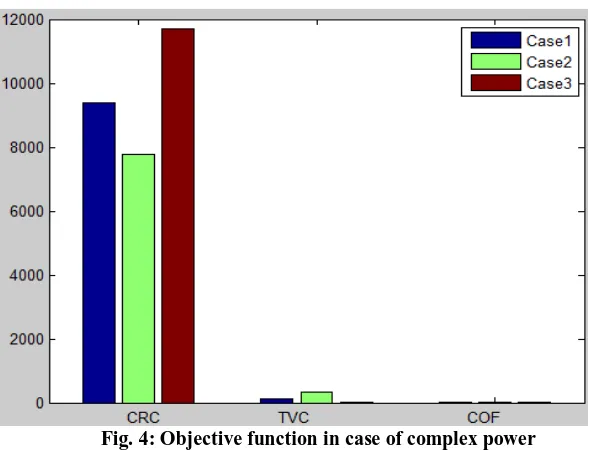
Min CRC (Rs.) 9374.40 7773.60 011694.60
Min TCV (MVA) 158.75 341.90 339.08
Min COF 1.41 0.51 0.54
Objectives Case1 SSM
Case2 SSM & ILM
Case3 SSM & DSM Min CRC (Rs.) 4198.80 3709.20 4416.00
Min TCV (MVAR) 35.39 175.67 175.67
The graphical representation of the objective function in case of reactive power is shown in the below Fig. 3.
Fig. 3: Objective function in case of reactive power
The graphical representation of the objective function in case of complex power is shown in the below Fig. 4.
Fig. 4: Objective function in case of complex power
From the above results, it can be seen that the minimum cost and minimum power violation required for the CRM to maintain the line 5 limit within the max limit i.e., 100%. From Table I, it is observed that, the value of CRC is less in the case 3 i.e., Rs. 1.80. Similarly, the value of TCV is also less in case 3. Hence, it is concluded that, case 3 provides the optimum and minimum cost for CRM and minimum power violations with respect to real power among all the cases.
V. CONCLUSIONS
The CRM analysis using different cases is investigated in this paper. The CRM methodology is illustrated using 6 bus system and a MATLAB program has been developed.
From the results it is concluded that, the system can relieve the congestion at minimum cost and minimum power violation with respect to real power by including Supply Side Management and Demand Side Management.
The Supply Side and Interruptible Load Management system provides the minimum cost and power violation with respect to reactive and complex powers.
REFERENCES
[1] Smt.Usha Surendra & S.S.Parathasarthy, “Congestion management in deregulated power sector using fuzzy based optimal location technique for series flexible alternative current transmission system (FACTS) device”, Journal of Electrical and Electronics Engineering Research Vol. 4, No. 1, pp. 12-20, August 2012.
[2] Deependra Singh and K. S. Verma, “GA-based Congestion Management in Deregulated Power System using FACTS Devices”, IEEE, 2012.
[3] Mohamad H. Moradi, Somayeh Dehghan and Hamid R. Faridi, “Improving Zonal Congestion Relif Management Using Economical and
Technical Factors of the Demand side”, second IEEE International Conference on Power and Energy, pp. 1027-1032, Dec. 2008.
[4] A. Kumar, S. C. Srivastava, and S. N. Singh, “A Zonal Congestion Management Approach Using Real and Reactive Power Rescheduling”, IEEE Trans. on Power Systems, Vol. 19, No. 1, February 2004 , pp. 554-561.
[5] Allen J. Wood and Bruce F. Wollenberg, “Power Generation Operation and Control”, 2nd edition, John Wiley & Sons, 2004.
[6] Le Anh Tuan and Kankar Bhttacharya, “Interruptable Load Services for Transmission Congestion Relief”, 14th PSCC, Sevilla, June 2002. [7] Baran Mesut.E, Banunarayanan Venkat, E. Garren Kenneth, “Equitable Allocation of Congestion Relief Cost to transactions, IEEE Trans. on Power Systems”, Vol. 15, No. 2, pp. 579-585, MAY 2000.
BIOGRAPHY
J. Sreenivasulu received his M. Tech. from JNT University, Anantapur, A. P., India, in 2009. Currently, he is working as Asst. Prof. in EEE Dept., JNTA College of Engineering, Pulivendula, A. P., India. His research interest is Electrical Power Systems.
P. Srinivasa Varma received his M. Tech. from JNT University, Hyderabad, A. P., India, in 2008. Currently, he is a research scholar of JNT University, Anantapur, A. P., India. His research interest is Power System Deregulation.