ISSN (Print) : 2320 – 3765 ISSN (Online): 2278 – 8875
I
nternational
J
ournal of
A
dvanced
R
esearch in
E
lectrical,
E
lectronics and
I
nstrumentation
E
ngineering
(An ISO 3297: 2007 Certified Organization)
Vol. 4, Issue 6, June 2015
Artificial Neural Network: A tool for Rapid
Quantitative Elemental Analysis Using
Neutron Activation Analysis
M.E. Medhat1
Department of Experimental Nuclear Physics, Nuclear Research Center, Cairo, Egypt
ABSTRACT: An artificial neural network (ANN) has been trained with real-sample NAA (neutron activation analysis) spectra of irradiated materials. Following the training stage ANN was applied to a subset of similar samples thus obtaining the elemental concentrations by NAA method. Results obtained with the ANN method are in good agreement with results obtained from NAA techniques, showing the high potentiality of ANN in NAA quantitative analyses.
KEYWORDS: Artificial Neural Network, Neutron.
I.INTRODUCTION
Developments from artificial intelligence like artificialneural networks, ANN, can be regarded as an engineeringprocedure emulating the human brain activity. It can bedefined as a set of non-linear and non-stationary interconnectionof elemental processes able to carry out at least oneof the following functions: training, remembrance and generalization,or, abstraction of substantial properties. Thefundamentals of the ANN technique have been described elsewhere[1- 2] and several commercial and free codes area accessible nowadays.Applications of ANN to atomic and nuclear physics hasincreased during the last two decades [3–13], mainly inproblems related to nuclear reactors. The most used paradigms in artificial intelligence applications to nuclear scienceand particle physics are the expert system, general algorithms, fuzzy system, neural networks and hybrid system.Some applications to α, β, and
spectra have beenreported in the last decade. Further application ofANN in other cases where strong non-lineal effects arepresent like in the spectral analyses generated in analyticaltechniques like PIXE and XRF (X-ray fluorescence)are scarce and in BIXE spectra (beta induced X-rayemission) remain unexplored [14,21].
Application of ANN is found in several issues where similar patterns have been represented by many spectra with specific differences. A typical case is presented in the elemental analysis of samples of unknown composition by neutron activation analysis (NAA) technique. The corresponding spectra represent the peaks containing known energy with variable intensities holding necessary information for the evaluation of the primary concentrations present in each sample. NAAis a nuclear technique based on the detection of -rays emitted by radionuclides neutrons [2–5]. Activation analysis differs from the other methods such as chemical analysis; it depends on the properties of the nucleus and not on the behavior of electrons in the outer shells of the atom. In general, NAA has many advantages over many conventional methods such as simultaneous analysis of multi-component samples and high degree of sensitivity for the majority of elements, many elements can be determined at levels of parts per billion.The basic essentials required to carry out analysis of samples by NAA are; source of neutrons, suitable instrumentation for detecting gamma rays, and a detailed knowledge of the reactions that occur when neutrons interact with target nuclei.One of the factors that define the quality of theanalysis is the ability to determinethe position of peaks in the spectrum, calculate the energy of the gamma ray each peak represents and estimate the areas of the peaks in the spectrum.Usually this is accomplished by theuse of some reliable computer code, like Genie 2000software (Canberra Industries, Meriden, USA).Additional inputs of the proper physical parametersinvolved in the irradiation like beam flux, detector efficiency, reaction cross section geometrical parameters, etc., permit the determination of the elemental concentrations.
ISSN (Print) : 2320 – 3765 ISSN (Online): 2278 – 8875
I
nternational
J
ournal of
A
dvanced
R
esearch in
E
lectrical,
E
lectronics and
I
nstrumentation
E
ngineering
(An ISO 3297: 2007 Certified Organization)
Vol. 4, Issue 6, June 2015
elemental concentrations as part of a study ofdeterminingtrace elements responsible of long livedisotopes in cement used reactor shielding. Several gamma spectrawere obtained from cement samples which apart of the samples set was analyzed by thestandard method of NAA and later used to train the ANN for further calculations. The proposed ANN method was applied for quantitativeanalysis of irradiated cement samples.
II.ANALYSIS Principle of NAA
There are three known methodsfor determining elemental concentrations by NAA namely: absolute,relative, and comparator methods [22]. We use inthis work the absolute method because it offers several advantageson the basis of speed, cheapness, versatility and ease of automation.It also offers the possibility of multi-element analysis in one singleirradiation. Consider a sample of mass W, subjected to irradiation in a neutron fluxfor a time period (ti). At the
end of the irradiationthe sample is allowed to decay for a time td and counted for a time tc. If the mass of an element in
the sample ism, then, the measured, c can be obtained from the basic absolute neutron:
C
m
/
w
(1)w
[
N
0/
M
]
SDCt
cwhere P is the net peak area under the gamma peak of interest, Mis the atomic mass of the target nuclide, NA is Avogadro‟s number,Ω is the natural abundance of the target isotope, is the effectivecross section for (n,) reaction,
is the gamma-ray emission probability ε is the photo peak efficiency, S is the saturation factor,
S = (1 − e−ti ), D is the decay factor, D = e−td and C is the countingfactorC = (1 − e−tc ) whereis the decay constant for the (n,)product radionuclide.
Principle of ANN
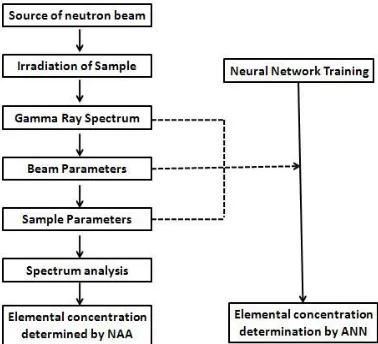
As mentioned above,the net peak area under the gamma peak of interest is currently used todetermine the elemental concentration. Here, a slightly differentapproach has been used based on the fact that ANNapplication disregards additive constants. Then consideringthe observation that the background contribution at thepeak is rather constant for equal irradiation times, theuse of the maximum value at the peak channel as an inputin ANN calculations, simplifies data handling and providesequivalent results as those obtained when the full area isused. These values and the already known concentrationswere given as an input and output data respectively inthe ANN training phase. fig. 1 shows the diagram followedin each phase.
ISSN (Print) : 2320 – 3765 ISSN (Online): 2278 – 8875
I
nternational
J
ournal of
A
dvanced
R
esearch in
E
lectrical,
E
lectronics and
I
nstrumentation
E
ngineering
(An ISO 3297: 2007 Certified Organization)
Vol. 4, Issue 6, June 2015
securedfromreal time analysis. The network was trained with the well-established back-propagation algorithm in order to learn first and then reproduce the process in order to obtain the concentration of certain elements in some cement samples. The neural network feeds with input parameters like: the neutron beam flux impinging the sample, mass of the sample, spectral information of the detected -ray.
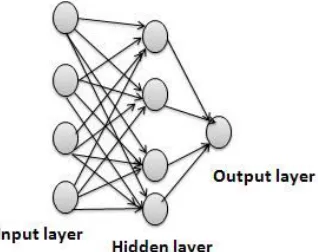
For each element, an ANN with three layers (fig. 2), (input, hidden, output) was used to generate the mapping of the p-input parameters (in this work p = 4 to the q-output parameters, here represented by the concentration of the element in the sample (q = 1). The mapping wasconducted considering the weights of the respective neuron connections which werecalculatedduring the supervised training procedure.
Figure 2: Schematic representation of a three-layer feed-forward neural network.
For training, the method for least square error back propagation, the most often used supervised learning algorithm, was used. Supervised learning refers to the known input and expected output for every example in consideration;therefore, training the ANN considers the fact that the calculated outputs should be in vicinity to the expected outputs strictly for every considered data points. Apparently, a neural network considering with p-inputs, single hidden layer and with L-neurons (here considering L = 4) and a single output node, The resultant error rateEk for
the input or output training scheme (xk,yk) is represented by
E = 1
(3)
2 yk −ok 2
where ok is the resultant calculated output producedwhile the k-thinput vector (x1k…xpk) is been made obtainable to
the networkandsigmoid function is used for the transformation and where ykrepresents the expected output value in relation to input xk. The altogether computation of the error is done by
E = Ek (4)
The protocol for altering weights considering their presentation of input or output pair k is performed by the gradient descent method, suggesting the minimization of the quadratic error function in an iterated manner. Once the training was successfully completed, effective testing for verifying the efficiency was performed.To train theANN, first the initial weights are fixed in a random way.Then each sample (the 4 input values) is introduced inthe ANN, which compute the output (Ok in the aboveequations), it is say, the actual concentration value. Thisvalue is compared with
expected concentration value andaccording to the error, the weights are modified so thatboth values (computed concentration and expected concentration)become the closest possible.
ISSN (Print) : 2320 – 3765 ISSN (Online): 2278 – 8875
I
nternational
J
ournal of
A
dvanced
R
esearch in
E
lectrical,
E
lectronics and
I
nstrumentation
E
ngineering
(An ISO 3297: 2007 Certified Organization)
Vol. 4, Issue 6, June 2015
Training of the ANN considering each of the elements and similar topology was done in an independent manner where sigmoid activation function was implementedforthe hidden and output layers.Error value, momentum, learning rate, etc., parameters and the topology were obtained through laborious experimentation.
III.RESULTS AND DISCUSSION
Without missing generality in this ANN applicationonly the major elementsobserved in the spectra were considered. Trace elements,although important for other studies, were not statisticallyuseful for the present purpose. Elemental concentrationswere calculated by standard NAA methodology in theway described above. These results were considered as„„expected concentrations‟‟. As for NAA uncertainties,overall values ranged between 3% and 12%. A
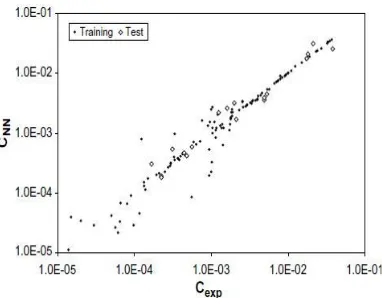
feed-forward neural network, with definitetopology was independently trained in parallel with thebackward error propagator to determine the elementalconcentrations of interest in the samples of thisstudy. Spectrawere randomly selected and used in training the network and three wereused in testing it. All training cases were learned correctlyby each of the six neural networks.The agreement isillustrated in Fig. 3, where concentrations are shown foreach element in samples.To assess the goodness of the ANN method in providingconcentrations values, a comparison with NAA results wasdone and is shown in fig. 4. A linear regression calculationfor results from all elements, in the test and training sets,was performed. Correlations factor, r2, of 0.86 and 0.99were obtained for the test and training sets, respectively.
Figure 3: Elemental concentration obtained from the three samples of the test set using ANN (CNN) and NAA (Cexp),
are shown for three cement samples respectively for each element.
Figure 4: The predicted concentrations from ANN (CNN) as compared with
ISSN (Print) : 2320 – 3765 ISSN (Online): 2278 – 8875
I
nternational
J
ournal of
A
dvanced
R
esearch in
E
lectrical,
E
lectronics and
I
nstrumentation
E
ngineering
(An ISO 3297: 2007 Certified Organization)
Vol. 4, Issue 6, June 2015
IV.CONCLUSIONS
The main purpose of this work was to explore the applicationof ANN for a fast analysis of NAA in astudy of elemental concentration of some cement samples. It has been provedthat this methodology provides results as good as thoseobtained by one of the already accepted methods. Eventhough the number of cases was rather limited, the decisionto use independent neuronal topologies for each elementworking in parallel provided reliable results. Surely, theexperimental results would be improved with a greaternumber of cases to use as training and test sets. So,the use of ANN as a reasonable alternative for the elementalconcentration determination in NAAprocedurehasbeen established. In addition, this ANN application provedto be fast enough as to predict that the analysis of a greatnumber of samples can be accomplished in few minutes,avoiding the direct participation of the analyst in eachone. Once the ANN has been trained, its use become fast,thus, permitting the automation of NAA spectra analysisand reducing costs and time.
REFERENCES
[1].E M Azoff, “Neural Network Time Series Forecasting of Financial Markets”, John Wiley &Sons, England,pp. 50-51, 1994.
[2].R Latorre, et al, “Signature neural networks: definition and application to multidimensional sorting problems,” IEEE Trans. Neural Networks, vol 22, pp. 8–23, 2011.
[3].A C A Mol, et al, “Radiation dose rate map interpolation in nuclear plants using neural networks and virtual reality techniques”.Ann. Nucl. Energy, vol. 38, pp. 705–712, 2011.
[4].R J A H Eendebak, P J Lucassen, C P Fitzsimons, “Nuclear receptors and microRNAs: Who regulates the regulators in neural stem cells?”.FEBS Letters, vol. 585, pp. 717– 22, 2011.
[5].T V Santhosh, et al, “A diagnostic system for identifying accident conditions in a nuclear reactor”.Nucl. Engin. and Design, vol. 241, pp. 177– 184, 2011.
[6].N Castin, L Malerba, R Chaouadi, “Prediction of radiation induced hardening of reactor pressure vessel steels using artificial neural networks”. J. Nuclear Materials,vol. 408, pp. 30–39, 2011.
[7].K Hadad, M Pourahmadi, H Majidi-Maraghi, “Fault diagnosis and classification based onwavelet transform and neural network”. Prog. Nucl. Energy,vol. 53, pp. 41–47, 2011.
[8].R Coban, “Computational intelligence-based trajectory scheduling for control of nuclear research reactors”.Prog. Nucl. Energy, vol. 52, pp. 415– 424, 2010.
[9].E Zio, F Di Maio, M Stasi, “A data-driven approach for predicting failure scenarios in nuclear systems”.Ann. Nucl. Energy, vol. 37, pp. 482– 491, 2010.
[10]. T Tambouratzis, I. Pàzsit, “A general regression artificial neural network for two-phase flow regime identification”.Ann. Nucl. Energy,vol. 37, pp.672–680, 2010.
[11]. E Zio, M Broggi, N Pedroni, “Nuclear reactor dynamics on-line estimation by Locally Recurrent Neural Networks”.Prog. Nucl. Energy,vol. 51, pp. 573–581, 2009.
[12]. M Boroushaki, “Numerical solution of the neutron transport equation using cellular neural networks”.Ann. Nucl. Energy,vol. 36, pp.15–27, 2009.
[13]. E Ayaz, “Component-wide and plant-wide monitoring by neural networks for Borssele nuclear power plant”.Energy Conversion and Management,vol. 49, pp. 3721–3728, 2008.
[14]. T U O Xianguo, B Cheng, K Mu, Z Li, “Neural network-based matrix effect correction in EDXRF analysis”.Nuclear Science and Techniques,vol. 19, pp. 278–281, 2008.
[15]. E A Hernández-Caraballo, L M Marcó-Parra, “Direct analysis of blood serum by total reflection X-ray fluorescence spectrometry and application of an artificial neural network
approach for cancer diagnosis”.SpectrochimicaActa Part B: Atomic Spectroscopy,vol. 58,pp. 2205–2213, 2003. [16]. N P Barradas, A Vieira, R Patrício, “RBS without humans”.Nucl. Instr. Meth. Phys. Res. B,vol. 190, pp. 231–236, 2002.
[17]. A Vieira, N P Barradas, “Neural network analysis of Rutherford backscattering data”.Nucl. Instr. Meth. Phys. Res. B, vol. 170, pp. 235–238, 2000.
[18]. E Yoshida, K Shizuma, S Endo, T Oka, “Application of neural networks for the analysis of gamma-ray spectra measured with a Ge spectrometer”.Nucl. Instr. Meth. Phys. Res. A, vol. 484, pp. 557–563, 2002.
[19]. ME Medhat, “Artificial intelligence methods applied for quantitative analysis of natural radioactive sources”.Ann. Nucl. Energy,vol. 45, pp.73–79, 2012.
[20]. S Dragović, et al, “Artificial neural network modeling of uncertainty in gamma-ray spectrometry”.Nucl. Instr. Meth. Phys. Res. A,vol. 540, pp.455–463, 2005.
[21]. A Negarestani, et al,” Estimation of the radonconcentration in soil related to the environmental parameters by a modified Adaline neuralnetwork”.App. Radi. andIsot,vol. 58, pp. 269–273, 2003.