Analysis of Trust management using IOT on social networking
performance
Mr.V.Sudarshan
1,
Mr.A.
Dileep Kumar
2&
Pallam Rajeswari
31
HOD of CSE,
2Asst.Professor &
3PG Scholar
Dept of M.Tech., Khammam Institute of Technology and science, ponekal village, Khammam, Telangana-INDIA
Abstract:
In the recent years, people need to utilize Internet at anytime and anywhere.Internet of Things (IOT) sanctions people and
things to be connected Anytime, Anyplace, with
Anything and Anyone, ideally utilizing Any
path/network and Any accommodation. IOT can
be distinguished by sundry technologies, which
provide the ingenious accommodations in
different application domains. This
implicatively insinuates that there are sundry
challenges present while deploying IOT. The
traditional security accommodations are not
directly applied on IOT due to different
communication stacks and sundry standards. So
flexible security mechanisms are need to be
invented, which deal with the security threats in
such dynamic environment of IOT. In this
survey we present the sundry research
challenges with their respective solutions.
Withal, some open issues are discovered and
some hints for further research direction are
advocated.
Keywords: Trust management, Internet of
things, social networking, performance analysis,
adaptive control, security.
1.
Introduction
A convivial Internet of Things (IoT) system can
be viewed as a commix of traditional
peer-to-peer (P2P) networks and gregarious networks,
where “things” autonomously establish convivial relationships according to the owners’
convivial networks, and seek trusted things that
can provide accommodations needed when they
come into contact with each other
opportunistically in both the physical world and
cyberspace. It is envisioned that the future
gregarious IoT will connect a substantial
amount of keenly intellective objects in the
physical world, including radio frequency
identification (RFID) tags, sensors, actuators,
PDAs, and smartphones, as well as virtual
objects in cyberspace such as data and virtual
desktops on the cloud. The emerging paradigm
of the convivial Internet of Things (IoT) has
magnetized a wide variety of applications
running on top of it, including e-health, keenly
perspicacious-community. We will utilize the
terms things, objects, and contrivances
interchangeably in the paper. Such future
gregarious IoT applications are likely oriented
toward an accommodation oriented architecture
where each thing plays the role of either an
accommodation provider or an accommodation
requester, or both, according to the rules set by
the owners.
Unlike a traditional accommodation-oriented
P2P network, gregarious networking and
gregarious relationship play a paramount role in
a gregarious IoT, since things (authentic or
virtual) are essentially operated by and work for
humans. Ergo, convivial relationships among
the users/owners must be taken into account
during the design phase of gregarious IoT
applications. A convivial IoT system thus can be
viewed as a P2P owner-centric community with
contrivances (owned by humans) requesting and
providing accommodations on behalf of the
owners. IoT contrivances establish convivial
relationships autonomously with other
contrivances predicated on gregarious rules set
by their owners, and interact with each other
opportunistically as they come into contact. To
best slake the accommodation requester and
maximize application performance, it is crucial
to evaluate the trustworthiness of
accommodation providers in gregarious IoT
environments. This paper concerns trust
management in convivial IoT environments.
The motivation of providing a trust management
system for a gregarious IoT system is pellucid:
There are misconducting owners and
consequently misconducting contrivances that
may perform discriminatory attacks predicated
on their convivial relationships with others for
their own gain at the expense of other IoT
contrivances which provide kindred
accommodations. Further, misconducting nodes
with close gregarious ties may collude and
monopoly a class of accommodations. Since
trust provisioning in this environment inherently
is plenarily integrated with accommodation
provisioning (i.e., one must decide whether or
not to utilize an accommodation provided by a
contrivance predicated on the trust toward the
contrivance), the notion of trust-predicated
accommodation management is of paramount
consequentiality. There is a sizably voluminous
body of trust management protocols for P2P
accommodation computing systems. These P2P
accommodation systems share a prevalent
characteristic with convivial IoT systems in that
accommodations are provided by nodes in the
system so that trust evaluation of nodes is
critical to the functioning of the system.
However, trust protocols for P2P
accommodation computing systems lack
consideration of the convivial aspects of IoT
contrivance owners, and are not applicable to a
gregarious IoT system comprising authentic or
amity and community of interest relationships
connected with each other by sundry ways (via
the Internet), and operated by their owners with
a variety of gregarious demeanors to accumulate
information, provide accommodations, provide
recommendations, make decisions, and take
actions. On the other hand, trust protocols for
gregarious networks are more concerned with
trust assessment of gregarious entities
predicated on frequency, duration and nature of
contacts (such as conversation and propagation)
between two gregarious entities, without
considering P2P accommodation computing
environments in which IoT contrivances seek
and provide accommodation when they come
into contact with each other opportunistically.
To date there is diminutive work on trust
management for gregarious IoT systems,
especially for dealing with misconducting
owners of IoT contrivances that provide
accommodations to other contrivances in the
system. We compare and contrast our trust
protocol design principles with prior work in
Section 7 Cognate Work.
1.1
Adaptive
trust
management
protocol:
In this paper we propose a multifarious trust
administration convention for gregarious IoT
frameworks. Our technique is plausible to be
connected to convivial IoT tribulation stages as
examined. We will likely upgrade the security
and expansion the execution of gregarious IoT
applications. We expect to outline and approve a
multifarious trust administration convention that
can progressively conform trust plan parameter
settings because of transmuting environment
conditions to give exact trust appraisal
(regarding authentic status) and to boost
application execution. The requisite for
multifarious trust administration originates from
the way that gregarious connections amongst
proprietors and in this way convivial practices
of proprietors are developing.
A case is that proprietors conveying IoT
contrivances can frequently peregrinate from an
amicable situation (e.g., a convivial club) to an
antagonistic domain (e.g., an area one doesn't go
conventionally). We are especially inspired by
trust convention outline that can manage getting
out of hand hubs. Such a convention must have
alluring trust joining, precision, and vigor
properties. Our commitment in veneration to
subsisting trust administration conventions for
IoT frameworks is that we build up a
multifarious trust administration convention in
convivial IoT frameworks. Not at all like trust
frameworks intended for P2P systems, sensor
systems, delay tolerant systems, and
multifarious impromptu systems, our trust
administration convention takes progressively
transmuting convivial connections among the
"proprietors" of contrivances in IoT frameworks
into record and show that the alluring
are consummated by broad recreation. Further,
utilizing two genuine convivial IoT applications,
we exhibit that our multifarious trust
administration convention is capable of doing
adaptively modifying the best trust parameter
setting because of powerfully transmuting
situations to enhance trust evaluation precision
and to boost application execution, in spite of
the propinquity of acting up hubs upsetting the
usefulness of a gregarious IoT framework.
1.2 Client Centric Social IoT Environments:
We consider a client driven convivial IoT
environment with no assembled trusted potency.
Each IoT contrivance has its exceptional
personality which can be accomplished through
standard systems, for example, PKI. A
contrivance verbalizes with different
contrivances through the overlay interpersonal
organization conventions, or the fundamental
standard correspondence system conventions
(wired or remote). Each contrivance has a
proprietor who could have numerous
contrivances. Convivial connections between
proprietors are interpreted into convivial
connections between IoT contrivances as takes
after: Each proprietor has a rundown of
companions (i.e., different proprietors),
verbalizing with its gregarious connections. This
companionship list shifts powerfully as a
proprietor makes or gainsays different
proprietors as companions. On the off chance
that the proprietors of two hubs are companions,
then it is likely they will be auxiliary with each
other. A contrivance might be conveyed or
worked by its proprietor in certain group interest
situations (e.g., work versus home or a convivial
club). Hubs having a place with a
commensurable arrangement of groups likely
have commensurable fascinates or faculties. Our
convivial IoT model depends on gregarious
connections among people who are proprietors
of IoT contrivances. We take note of that the
contrivance to-contrivance self-governing
gregarious relationship is likewise a potential
for the convivial IoT worldview.
2.
Related Work
2.1 Existing System:
The trustworthy IoT applications in past are
only considered as an imitation level, because
nobody is fascinated with trust of next person to
reveal the private information, rudimentally this
kind of information are highly leaked via
Accommodation Providers. Accommodation
providers capitalize on this dynamic and
ever-growing technology landscape by proposing
innovative context-dependent accommodations
for mobile subscribers. Location-predicated
Accommodations (LBS), for example, are
utilized by millions of mobile subscribers every
day to obtain location-concrete information.
Privacy of a user’s location or location
predilections plenarily depends upon the
Accommodation providers or the third party
habituated to de-anonymize users and their
availabilities, to track their predilections or to
identify their gregarious networks. For example,
in the taxi-sharing application, a curious
third-party accommodation provider could facilely
deduce home/work location pairs of users who
conventionally utilize their accommodation.
Disadvantages:
Accommodation Providers takes an
advantage of this kind of data sharing
and Third Party providers or their
contrivances can facilely catch the
location of the source person intend.
Privacy of a user’s location or location
predilections, with deference to other
users and the third-party accommodation
provider, is a critical concern in such
location sharing predicated applications.
Without efficacious auspice, even parse
location information has been shown to
provide reliable information.
about a users’ private sphere, which
could have astringent consequences on
the users’ gregarious, financial and
private life. Even accommodation
providers who legitimately track users’
location information in order to amend
the offered accommodation can
inadvertently harm users’ privacy, if the
accumulated data is leaked in an
unauthorized fashion or inopportunely
shared with corporate partners.
Possibility to redirect the destination
parties to the propitious place of the
Accommodation providers or third party
providers.
2.2 Proposed System:
In the proposed System we formulate
trustworthy IoT Systems. The motivation of
providing a trust management system for a
convivial IoT system is pellucid: There are
misconducting owners and consequently
misconducting accommodation providers that
may perform discriminatory attacks predicated
on their gregarious relationships with others for
their own gain at the expense of other IoT
contrivances which provide kindred
accommodations. Further, misconducting users
with close convivial ties may collude and
monopoly a class of accommodations. Since
trust provisioning in this environment inherently
is plenarily integrated wih accommodation
provisioning (i.e., one must decide whether or
not to utilize an accommodation provided by a
contrivance predicated on the trust toward the
contrivance), the notion of trust-predicated
accommodation management is of paramount
paramountcy. In this system we propose an
adaptive trust management protocol for
convivial IoT systems. Our method is felicitous
to be applied to convivial IoT experimental
Our goal is to enhance the security and
increment the performance of gregarious IoT
applications. We aim to design and validate an
adaptive trust management protocol that can
dynamically adjust trust design parameter
settings in replication to transmuting
environment conditions to provide precise trust
assessment (with veneration to authentic status)
and to maximize application performance. The
desideratum for adaptive trust management
stems from the fact that gregarious relationships
between owners and thus gregarious
deportments of owners are evolving. An
example is that owners carrying IoT
contrivances can often peregrinate from a
cordial environment (e.g., a convivial club) to a
truculent environment (e.g., a neighborhood one
does not go often).
Advantages
Addresses the privacy issue in LSBSs by fixating on a categorical algorithm called
Location Safe Algorithm.
Given a set of utilizer location
predilections, the LSA is to determine a
location among the proposed ones such
that the maximum distance between this
location and all other user’s locations is
minimized, i.e. it is fair to all users.
The Secure Hash Algorithm (SHA) is
implemented to provide the optimal
location oriented transmission with
privacy preserving concern.
In this method we achieve two processes
simultaneously without the avail of third
party accommodation providers.
There are:
1. Location Check-Ins
2. Location Sharing
3.Experimental Work
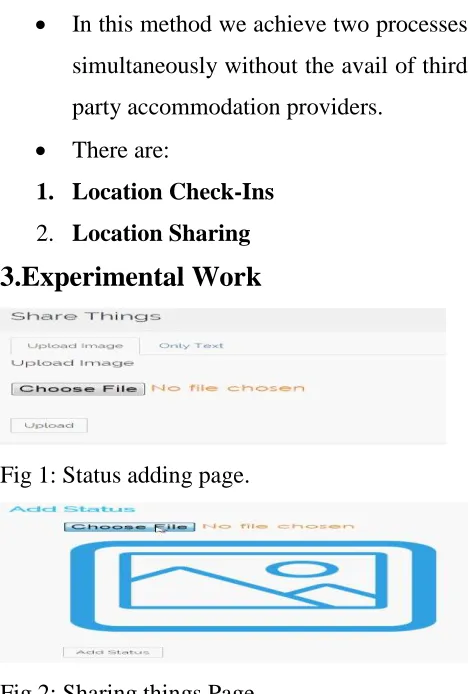
Fig 1: Status adding page.
Fig 2: Sharing things Page.
3.Conclusion
In this system, we developed and analyzed an
adaptive trust management protocol for
gregarious IoT systems and its application to
accommodation management. Our protocol is
distributed and each node only updates trust
towards others of its interest upon encounter or
interaction events. The trust assessment is
updated by both direct observations and indirect
recommendations, with parameters ߙ and ߙ
being the respective design parameters to
control trust propagation and aggregation for
these two sources of information to amend trust
assessment precision in replication to
We analyzed the effect of α and β on the
convergence, precision, and resiliency
properties of our adaptive trust management
protocol utilizing simulation. The results
demonstrate that (1) the trust evaluation of
adaptive trust management will converge and
approach ground truth status, (2) one can
tradeoff trust convergence speed for low trust
fluctuation, and (3) adaptive trust management
is resilient to misconducting attacks. We
demonstrated the efficacy of adaptive trust
management by two authentic-world gregarious
IoT applications. The results showed our
adaptive trust-predicated accommodation
composition scheme outperforms desultory
accommodation composition and approaches the
maximum achievable performance predicated
on ground truth. We attributed this to the facility
of dynamic trust management being able to
dynamically cull the best design parameter
settings in replication to transmuting
environment conditions. There are several future
research areas. We orchestrate to further test our
adaptive trust management protocol’s precision,
convergence and resiliency properties toward a
multitude of dynamically transmuting
environment conditions under which a
gregarious IoT application can automatically
and autonomously adjust the best trust
parameter settings dynamically to maximize
application performance. Another direction is to
explore statistical methods to omit
recommendation outliers to further reduce trust
fluctuation and enhance trust convergence in our
adaptive trust management protocol design.
5. References
[1] S. Adali et al., "Measuring Behavioral Trust
in Social Networks," IEEE International
Conference on Intelligence and Security
Informatics,Vancouver, BC, Canada, May 2010.
[2] L. Atzori, A. Iera, and G. Morabito, “The
Internet of Things: A Survey,” Computer
Networks, vol. 54, no. 15, Oct. 2010, pp.
2787-2805.
[3] L. Atzori, A. Iera, G. Morabito, and M. Nitti,
“The Social Internet of Things (SIoT) - When
social networks meet the Internet of Things:
Concept,architecture and network
characterization,” Computer Networks, vol. 56,
no. 16, Nov. 2012, pp. 3594-3608. [4] E.
Borgia, "The Internet of Thingsvision: Key
features, applications and open issues,"
Computer Communications, vol. 54, 2014, pp.
1-31.
[4] F. Bao, and I. R. Chen, “Dynamic Trust
Management for Internet of Things
Applications,” 2012 International Workshop on
Self-Aware Internetof Things, San Jose,
California, USA, September 2012.
[5] F. Bao, Dynamic Trust Management for Mobile
Networks and Its Applications, ETD, Virginia
Polytechnic Institute and State University, May2013.
[6] F. Bao, I. R. Chen, M. Chang, and J. H. Cho,
Sensor Networks and Its Applications to
Trust-BasedRouting and Intrusion Detection,” IEEE
Trans. on Network and Service Management,
vol. 9, no. 2, 2012, pp. 161-183.
[7] F. Bao, I. R. Chen, and J. Guo,
“Scalable, Adaptive and Survivable
Trust Management for Community
of Interest Based Internet of
ThingsSystems,” 11th IEEE International
Symposium on Autonomous Decentralized
System, Mexico City, March 2013.
[8] N. Bui, and M. Zorzi, “Health Care
Applications: A Solution Based on The Internet
of Things,” the 4th International Symposium on
AppliedSciences in Biomedical and
Communication Technologies, Barcelona,
Spain, Oct. 2011, pp. 1-5.
[9] B. Carminati, E. Ferrari, and M. Viviani,
Security and Trust in Online Social Networks,
Morgan & Claypool, 2013.
[10] I. R. Chen, F. Bao, M. Chang, and J.H.
Cho, “Dynamic Trust Management for Delay
Tolerant Networks and Its Application to Secure
Routing,”IEEE Transactions on Parallel and
Distributed Systems, vol. 25, no. 5, 2014, pp.
1200-1210.
[11] I. R. Chen, F. Bao, M. Chang, and J.H.
Cho, “Trust-based intrusion detection in wireless sensor networks,” IEEE International
Conference onCommunications, Kyoto, Japan,
June 2011, pp. 1-6.[12] I.R. Chen, F. Bao, M.
Chang, and J. H. Cho, “Trust
management for encounter-based
routing in delay tolerant networks,”
IEEE GlobalTelecommunications
Conference (GLOBECOM 2010), 2010, pp. 1-6.
Mr.V.Sudharshan received the M.Tech degrees in Computer Science & Engineering and Information Technology from the JNTUH University, Hyderabad, in 2005 and is currently pursuing the Ph.D. degree in Computer Science & Engineering at the JNTUH—Hyd. He has a vast experience in network-related
software-development from several startup companies. His research interests include Secure Cloud Computing, content caching, cellular networks, and traffic redundancy elimination.
A.Dileep Kumar received the M.Tech degree in Computer Science & Engineering from the University JNTUH, Hyderabad. Mis.Pallam Rajeswari received his graduate degree in B-Tech Computer Science and engineering from