Disambiguating explicit discourse connectives without oracles
Anders Johannsen Anders Søgaard
University of Copenhagen
{ajohannsen,soegaard}@hum.ku.dk
Abstract
Deciding whether a word serves a dis-course function in context is a prerequi-site for discourse processing, and the per-formance of this subtask bounds
perfor-mance on subsequent tasks. Pitler and
Nenkova (2009) report 96.29% accuracy (F194.19%) relying on features extracted
from gold-standard parse trees. This fig-ure is an average over several connectives, some of which are extremely hard to clas-sify. More importantly, performance drops considerably in the absence of an ora-cle providing gold-standard features. We show that a very simple model using only lexical and predicted part-of-speech fea-tures actually performs slightly better than Pitler and Nenkova (2009) and not sig-nificantly different from a state-of-the-art model, which combines lexical, part-of-speech, and parse features.
1 Introduction
Discourse relations structure text by linking seg-ments together in functional relationships. For in-stance, someone might say ”Saber-toothed tigers are harmlessbecausethey’re extinct”, making the second part of the sentence serve as an explana-tion for the first part. In the example the discourse
connective because functions as a lexical anchor
for the discourse relation. Whenever an anchor is present we say that the discourse connective is ex-plicit.
Complicating the matter, phrases used as dis-course connectives sometimes appear in a non-discourse function. For instance, ”and” may be either a simple conjunction, as in ”sugar and salt”, or a discourse relation suggesting a temporal re-lationship between events, for instance ”he struck the match and went away”. The Penn Discourse
0 20 40 60 80 100
No. of markers 0.1
0.2 0.3 0.4 0.5 0.6 0.7 0.8 0.9 1.0
Cumulative occurences
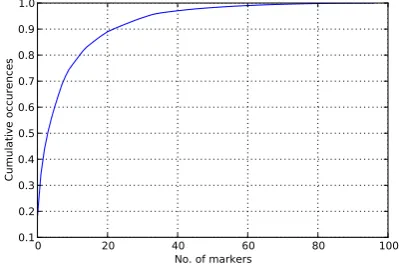
Figure 1: A picture of the problem. 10% of con-nectives account for roughly 75% of occurrences
Treebank (PDTB) (Prasad et al., 2008) distinguish 100 types of explicit connectives—a subset of these are listed in Table 2. The type of relation-ship is selected from a hierachial structure where the four top-level categories are Comparison, Con-tingency, Temporal, and Expansion.
Discourse relations are important for many ap-plications and, since the PDTB was released, much effort has gone into developing tools for recreating the annotations of the resource automat-ically. Recently two ambitious end-to-end parsers have appeared which transform plain text to full PDTB-style annotations (Lin et al., 2010; Ghosh, 2012). Both systems share a pipelined architecture in which the output of one component becomes the input to the next. A crucial first step in their pro-cessing is correctly identifying explicit discourse connectives; when unsuccessful subsequent steps fail.
An accuracy in the high ninetees seems to sug-gest that the problem is almost solved. For the task of discourse connective disambiguation this unfor-tunately does not hold true, because, as we argue here, the task benefits from being seen and eval-uated as a number of smaller tasks, one for each
connective type. Figure 1 shows why: the distribu-tion of connectives follows a power law such that the majority of occurrences comes from relatively few but highly frequent connective types. If we do not take into account the uneven sizes of the categories, our performance figure ends up saying very little about how well we are doing on most of the connectives, because it is being dominated by the performance on a few high-frequency items.
In this paper we look in more detail on the eval-uation of the discourse connective disambigeval-uation task, in particular how two commonly used feature models perform on individual discourse connec-tives. The models are Pitler and Nenkova (2009) (P&N), and its extension by Lin et al. (2010) (Lin). Motivated by our findings we advocate the use of macro-averaging as a necessary supplement to micro-averaging. Additionally, we perform our experiments in a more realistic setting where acc-cess to oracle gold-standard annotations is not as-sumed. The observed performance drop from or-acle to predicted parses leads us to propose a new model, which approximates the syntactical infor-mation of the parse trees with part-of-speech tags. Although these features are less powerful in the-ory, the model has comparable macro-average per-formance in realistic evaluation.
The rest of the paper is structured as follows. In the next section we give reasons why low-frequency connectives should not be overlooked. Section 3 describes our experiments, and Section 4 reports on the results. The discussion is in Section 5, followed by a review of related work in Section 6. Section 7 concludes the paper.
2 The importance of the long tail
Are there any compelling reasons to pay attention to the lower-frequency connectives when high-frequency connectives overwhelmingly dominate? As noted in the caption to Figure 1, the top 10 ac-count for above 75% of the occurrences and top 20 for above 90%. So why should we care?
It turns out that the low-frequency connectives are quite evenly distributed among texts. In the Wall Street Journal part of the Penn Treebank, 70% of articles that contain explicit markers con-tain at least one marker not in the top 10. Not counting very short texts (having only two or fewer explicit connectives of any type), the num-ber rises to 87%. While low performance on less frequent connectives does not hurt a token-level
macro-average much, it still means that you are likely to introduce errors in something like 70% of all WSJ articles. These errors percolate leading to erroneous text-level discourse processing.
In Webber and Joshi (2012) the prime example of a discourse application is automatic text simpli-fication. Here, ignoring the long tail of discourse connectives would be out of the question, because it is precisely those less familiar expressions — which people encounter rarely and have weaker intuitions about — that would benefit the most from a rewrite. Two other examples, also cited in Webber and Joshi (2012), are automatic assess-ment of student essays (Burstein and Chodorow, 2010), and summarization (Thione et al., 2004). In student essays we encourage clear argumenta-tive structure and rich vocabulary; failing to recog-nize that in an automatic system would not qual-ify as fair evaluation. And summarization is of-ten performed over news wire, which, as shown in the PDTB, has a high per-article incidence of con-nectives not in top 10. Additionally, some low-frequency connectives like ”ultimately” and ”in particular” are strong cues for text selection.
Another reason to suspect that low-frequency connectives are important comes from an obser-vation about the distribution of connectives in biomedical text. Ramesh and Yu (2010) report an overlap of only 44% between the connectives found in the The Biomedical Discourse Relation Bank (Prasad et al., 2011), a 24 article subset of the GENIA corpus (Kim et al., 2003), and the PDTB. The intersection contains high-frequency connectives, such as ”and”, ”however,” ”also,” and ”so”. Connectives specific to the biomedi-cal domain include ”followed by,” ”due to,” and ”in order to”, and the authors speculate that the unique connectives encode important domain spe-cific knowledge.
3 Experiments
Our experiments are designed to shed light on three aspects of discourse connective disambigua-tion: 1) error distribution wrt. connective type; uneven performance builds a strong case for aver-aging over connective types instead of averaver-aging over data points; 2) performance loss in the ab-sence of an oracle; and 3) performance of simple model based on cheaper and more reliable annota-tions.
all of which model syntactical aspects of the dis-course connective.
The P&N and Lin feature sets are chosen to rep-resent state-of-the-art. The high accuracy of P&N at 96.29% is frequently cited as an encouraging re-sult, see Huang and Chen (2011; Alsaif and Mark-ert (2011; Tonelli and Cabrio (2012; Zhou et al. (2010). Besides discourse parsing P&N has been used for tasks as diverse as measuring text co-herence (Lin et al., 2011) and improving machine translation (Meyer and Popescu-Belis, 2012). The POS+LEX feature set is proposed as an alternative model. The baseline always predicts the majority class.
P&N This feature set derives from parse trees and replicates the features of Pitler and Nenkova (2009). Starting from the potential discourse con-nective, the features include the highest category in the tree subsuming only the connective called the self-category, the parent of that category, the left sibling of the self-category, and the right sib-ling of the self-category. A feature fires when the right sibling contains a VP, and another if there is a trace node below the right sibling. Note that the trace feature will never fire outside of the gold parse setting since state-of-the-art parsers do not predict trace nodes.
Importantly, there is a feature for the identity of the connective and interaction features between the connective and the syntactical features in ef-fect allowing the model to fit parameters specific to each connective. Furthermore, combinations of the syntactical features are allowed, but they can-not be connective-specific.
Lin The feature set augments P&N with part-of-speech and string features for the tokens adjacent to the connective, as well as the part-of-speech of the connective itself. The part-of-speech features for the adjacent tokens interact with the part-of-speech of the connective, and the string features interact with the indicator feature for the connec-tive. It also adds a syntax feature: the path to the root of the parse tree.
POS+LEX The simple feature set builds on
part-of-speech tags and tokens. Part-of-speech
tags are captured using a window of two tokens around the marker, and the lexical features are the same as Lin. Like P&N there is a feature for the identity of the connective as well as interaction
Model Micro Macro
Oracle Pred. Oracle Pred.
Baseline 72.7 72.7 53.9 53.9
P&N 93.0 90.7 85.3 80.7
Lin 95.2 92.9 86.7 83.6
POS+LEX 89.7 89.7 82.5 83.5
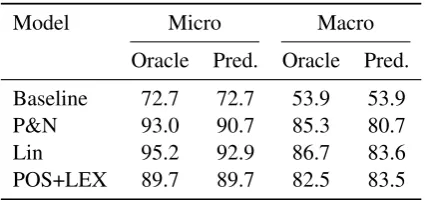
Table 1: ComparingF1 score on oracle and
pre-dicted features using macro and micro averag-ing. A Wilcoxon signed rank test shows that the macro-averaged difference between POS+LEX and Lin10 using predicted features is not signfi-cant atp <0.01.
features between the identity feature and other fea-tures.
In keeping with Pitler and Nenkova (2009) our learner is a maximum entropy classifier trained on sections 2-22 of the WSJ using ten-fold cross-validation.
3.1 Parsing Wall Street Journal
To obtain a version of the WSJ corpus containing fully predicted parses we use the Stanford Parser1 training a separate model for each section. To parse a specific section we train on everything but that section (e.g. for parsing section 5 the train-ing set is section 0-4 and 6-24). AverageF1on all
sections is 85.87%. Although the very best state-of-the-art parsers2 report F1 of above 90%, our
parsing score greatly exceeds typical performance on real-life data, which is almost always out-of-domain with respect to 1980s WSJ. Thus this set-ting still compares favourably to performance in the wild.
4 Results
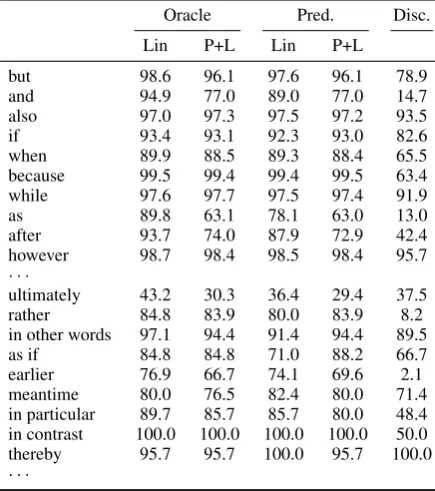
A summary of the results is found in Table 1. For a subset of frequent and less frequent connectives, Table 2 lists individual F1 scores. In all of the
feature sets we see a marked drop moving from micro-average (average over instances) to macro-average (macro-average over connective types)—P&N, for instance, goes from 93.0% to 85.3%. This shows that the scores of less frequent connectives are somewhat lower than frequent ones. When
1
http://nlp.stanford.edu/software/ lex-parser.shtml, 2012-11-12 release with the ’goodPCFG’ standard settings
Oracle Pred. Disc.
Lin P+L Lin P+L
but 98.6 96.1 97.6 96.1 78.9
and 94.9 77.0 89.0 77.0 14.7
also 97.0 97.3 97.5 97.2 93.5
if 93.4 93.1 92.3 93.0 82.6
when 89.9 88.5 89.3 88.4 65.5
because 99.5 99.4 99.4 99.5 63.4
while 97.6 97.7 97.5 97.4 91.9
as 89.8 63.1 78.1 63.0 13.0
after 93.7 74.0 87.9 72.9 42.4
however 98.7 98.4 98.5 98.4 95.7
· · ·
ultimately 43.2 30.3 36.4 29.4 37.5
rather 84.8 83.9 80.0 83.9 8.2
in other words 97.1 94.4 91.4 94.4 89.5
as if 84.8 84.8 71.0 88.2 66.7
earlier 76.9 66.7 74.1 69.6 2.1
meantime 80.0 76.5 82.4 80.0 71.4
in particular 89.7 85.7 85.7 80.0 48.4 in contrast 100.0 100.0 100.0 100.0 50.0
thereby 95.7 95.7 100.0 95.7 100.0
· · ·
Table 2: F1 score per connective. The table is
sorted by the number of actual discourse connec-tives in the PDTB. After the break the table con-tinues from position 50. The last column gives the percentage of discourse connectives.
features are derived from predicted parses perfor-mance also fall, from 93.0% to 90.7% with micro-average, and even more dramatically with macro-average, where it goes from 85.3% to 80.8%. Given that we are interested in real life perfor-mance this last figure is the most interesting.
5 Discussion
In NLP applications we cannot assume the exis-tence of oracles providing us with gold-standard
features. Often switching to predicted features
introduces greater uncertainty. If the parser of-ten confuses two non-terminals that are important for connective disambiguation we loose predictive power. Thus, on the P&N model, the average con-ditional entropy per feature given the class (how surprising the feature is when we know the an-swer) increases by 8.8% when the oracle is un-available. In contrast there is almost no difference between the conditional entropy of the POS model with oracle features and without, indicating that the errors made by the tagger are not confusing in the disambiguation task.
Predicted parse features are associated with un-certainty even when used in combination with words and part of speech. Comparing the number
of times the Lin model changes an incorrect pre-diction of POS+LEX to a correct one and the num-ber of times it introduces a new error by changing a correct prediction to an incorrect one, we ob-serve that corrections almost always come with a substantial number of new errors. In fact, 58 con-nectives have at least as many new errors as cor-rections.
Predicted parse features also contribute to fea-ture sparsity, because of the greater variability of automatic parses. On the other hand, they are more expressive than part of speech, and in the example below, where only Lin correctly identifies ’and’ as a discourse connective, part of speech simply does not contain enough information.
“A whole day goes by andno one even knows
they’re alive.
6 Related work
Atterer and Sch¨utze (2007) present similar exper-iments for prepositional phrase attachment show-ing that approaches assumshow-ing gold-standard fea-tures suffer a great deal when they are evaluated on predicted features. Spitkovsky et al. (2011) also caution against the use of gold-standard features, arguing that for unsupervised dependency parsing using induced parts of speech is superior to relying on gold-standard part-of-speech tags.
This work also relates to Manning (2011) who point out that even though part-of-speech tagging accuracy is above 97% the remaining errors are not randomly distributed but in fact occur in just the cases we care most about.
7 Conclusion
Discourse connective disambiguation is an impor-tant subtask of discourse parsing. We show that when realistic evaluation is adopted — averag-ing over connective types and not relyaverag-ing on ora-cle features — performance drops markedly. This suggests that more work on the task is needed. Moreover, we show that in realistic evaluation a simple feature model using part-of-speech tags and words performs just as well as a much more complex state-of-the-art model.
Acknowledgements
References
Amal Alsaif and Katja Markert. 2011. Modelling discourse relations for Arabic. InProceedings of the Conference on Empirical Methods in Natural Language Processing, EMNLP ’11, pages 736–747, Stroudsburg, PA, USA. As-sociation for Computational Linguistics.
Michaela Atterer and Hinrich Sch¨utze. 2007. Prepositional phrase attachment without oracles. Computational Lin-guistics, 33(4):469–476.
Jill Burstein and Martin Chodorow. 2010. Progress and New Directions in Technology for Automated Essay Eval-uation. In R. Kaplan, editor,The Oxford Handbook of Applied Linguistics, 2nd Edition, pages 487–497. Oxford University Press.
Sucheta Ghosh. 2012. End-to-End Discourse Parse using Cascaded Structured Prediction. Phd thesis, University of Trento.
Hen-Hsen Huang and Hsin-Hsi Chen. 2011. Chinese dis-course relation recognition. InProceedings of 5th Interna-tional Joint Conference on Natural Language Processing (IJCNLP 2011), pages 1442–1446.
J.-D. Kim, T. Ohta, Y. Tateisi, and J. Tsujii. 2003. GE-NIA corpus–a semantically annotated corpus for bio-textmining.Bioinformatics, 19(Suppl 1):i180–i182, July. Ziheng Lin, Hwee Tou Ng, and Min-yen Kan. 2010. A
PDTB-Styled End-to-End Discourse Parser. Technical Report 2004, School of Computing, National University of Singapore, Singapore.
Ziheng Lin, Hwee Tou Ng, and Min-Yen Kan. 2011. Auto-matically evaluating text coherence using discourse rela-tions. pages 997–1006, June.
Christopher D. Manning. 2011. Part-of-Speech Tagging from 97% to 100%: Is It Time for Some Linguistics? In AlexanderF. Gelbukh, editor,Computational Linguis-tics and Intelligent Text Processing SE - 14, volume 6608 ofLecture Notes in Computer Science, pages 171–189. Springer Berlin Heidelberg.
Thomas Meyer and Andrei Popescu-Belis. 2012. Using Sense-labeled Discourse Connectives for Statistical Ma-chine Translation. In Proceedings of the Joint Work-shop on Exploiting Synergies Between Information Re-trieval and Machine Translation (ESIRMT) and Hybrid Approaches to Machine Translation (HyTra), EACL 2012, pages 129–138, Stroudsburg, PA, USA. Association for Computational Linguistics.
Emily Pitler and Ani Nenkova. 2009. Using syntax to disam-biguate explicit discourse connectives in text. In Proceed-ings of the ACL-IJCNLP 2009 Conference Short Papers, ACLShort ’09, pages 13–16, Stroudsburg, PA, USA. As-sociation for Computational Linguistics.
Rashmi Prasad, Nikhil Dinesh, Alan Lee, Eleni Miltsakaki, Livio Robaldo, Aravind Joshi, and Bonnie Webber. 2008. The Penn Discourse TreeBank 2.0. In Proceedings of LREC.
Rashmi Prasad, Susan McRoy, Nadya Frid, Aravind Joshi, and Hong Yu. 2011. The biomedical discourse relation bank.BMC Bioinformatics, 12(1):188.
Balaji Polepalli Ramesh and Hong Yu. 2010. Identifying dis-course connectives in biomedical text. InAMIA Annual Symposium Proceedings, volume 2010, page 657. Ameri-can Medical Informatics Association.
Valentin I Spitkovsky, Hiyan Alshawi, Angel X Chang, and Daniel Jurafsky. 2011. Unsupervised dependency parsing without gold part-of-speech tags. InProceedings of the Conference on Empirical Methods in Natural Language Processing, pages 1281–1290. Association for Computa-tional Linguistics.
Gian Lorenzo Thione, Martin Van Den Berg, Livia Polanyi, and Chris Culy. 2004. Hybrid text summarization: Com-bining external relevance measures with structural analy-sis. InProceedings ACL Workshop Text Summarization Branches Out. Barcelona.
Sara Tonelli and Elena Cabrio. 2012. Hunting for Entail-ing Pairs in the Penn Discourse Treebank. InProceedings of COLING 2012, pages 2653–2668, Mumbai, India, De-cember. The COLING 2012 Organizing Committee. Bonnie Webber and Aravind Joshi. 2012. Discourse
Struc-ture and Computation: Past, Present and FuStruc-ture. In Asso-ciation for Computational Linguistics, page 42.