Latent Topic Embedding
Di JiangBaidu, Inc., China
[email protected] Rongzhong Lian Baidu, Inc., China
Lei Shi Baidu, Inc., China
[email protected] Hua Wu
Baidu, Inc., China
Abstract
Topic modeling and word embedding are two important techniques for deriving latent semantics from data. General-purpose topic models typically work in coarse granularity by capturing word co-occurrence at the document/sentence level. In contrast, word embedding models usually work in fine granularity by modeling word co-occurrence within small sliding windows. With the aim of deriving latent semantics by capturing word co-occurrence information at different levels of granularity, we propose a novel model namedLatent Topic Embedding(LTE), which seamlessly integrates topic generation and embedding learning in one unified framework. We further propose an efficient Monte Carlo EM algorithm to estimate the parameters of interest. By retaining the individual advantages of topic modeling and word embedding, LTE results in better latent topics and word embedding. Experimental results verify the superiority of LTE over the state-of-the-arts in real-life applications.
1 Introduction
Topic modeling and word embedding are gaining significant momentum in the field of text mining. General-purpose topic models such as Latent Dirichlet Allocation (LDA) (Blei et al., 2003) and Sentence LDA (Jo and Oh, 2011) usually utilize word co-occurrences at the document/sentence level to compose the ”topics”, which capture the latent semantics between words. These models are plagued by the sim-plistic bag-of-words assumption, which ignores the valuable sub-sequence information between words. Some recent endeavors introduced n-gram information into topic models (Wallach, 2006), however, the size of vocabulary is significantly enlarged and these techniques are hardly feasible for real-life applica-tions. Therefore, the technique of topic modeling needs a remedy for solving the word sequence problem with fairly low cost. Word embedding models such as Word2Vec (Mikolov et al., 2013a) map words into distributed representations. Word embedding models primarily focus on the word co-occurrences within small sliding windows, which enable word embedding to capture (at least partially) the information of word sequences. One key problem of the existing word embedding models is that they are typically short-sighted and are not aware of the themes of the document.
With their differences, the core of topic modeling and word embedding is based upon the assumption that the words co-occurring frequently should have semantic commonality. In light of their individual advantages and drawbacks, we see that the two techniques are essentially complimentary and can be inte-grated to enhance each other. In this paper, we propose theLatent Topic Embedding(LTE) to seamlessly integrate topic modeling and word embedding in one framework. In the generative process of LTE, we assume that the observed words in document can be generated through two channels: one is through the Multinomial distribution and the other is based upon topic embeddings as well as word embeddings. In this way, the embedding information influences the result of topic modeling while the topic information affects the training of word embeddings in return. LTE enables topic modeling to utilize word sequence information and it equips word embeddings with the document-level vision. We propose a Monte Carlo
This work is licensed under a Creative Commons Attribution 4.0 International Licence. Licence details: http:// creativecommons.org/licenses/by/4.0/
EM algorithm to efficiently infer the parameters of interest in LTE. Extensive experiments on real-life applications verify the superiority of LTE over several strong baselines.
The rest of this paper is organized as follows. In Section 2, we review the related work. In Section 3, we discuss the technical details of LTE. In Section 4, we illustrate how to conduct parameter inference for LTE. In Section 5, we present the experimental results. Finally, we conclude this paper in Section 6. 2 Related Work
The present work is related to previous research on topic modeling and word embedding. Latent Dirichlet allocation (LDA) is a generative probabilistic model for collections of discrete data such as text corpora (Blei et al., 2003)(Griffiths and Steyvers, 2004). LDA and its variants has been widely employed in many texting mining scenarios (Wang and McCallum, 2006)(Krestel et al., 2009)(Xu et al., 2009)(Jiang et al., 2013) and demonstrated promising performance. It is worth mentioning that some work such as the bigram topic model (Wallach, 2006) aims to alleviate the negative effect of bag-of-words assumption in LDA. However, considerable computational cost is involved since the bigram model creates a multi-nomial distribution for each pair of the topics and the words, the amount of which is usually voluminous. While topic modeling received intensive research in the field of Bayesian network research, word em-bedding received much attention in the field of neural network. Word emem-bedding (Bengio et al., 2003) is proposed to fight the curse of dimensionality by learning a distributed representation for words which allows each training sentence to inform the model about an exponential number of semantically neigh-boring sentences. Mikolov presented several extensions of Skip-gram that improve both the quality of the vectors and the training speed (Mikolov et al., 2013b) (Mikolov et al., 2013a). Paragraph vector that is an unsupervised algorithm that learns fixed-length feature representations from variable-length pieces of texts was proposed in (Le and Mikolov, 2014). Word embedding is adapted for incorporating contex-tual information in learning vector-space representations of situated language (Bamman et al., 2014). A more relevant work is (Liu et al., 2015), which inputs the result of topic modeling into word embedding models to learn the topical word embedding. The major difference between this work and ours is that they did not aim to integrate topic modeling and word embedding and yet only utilizes the result of topic modeling as the input of word embedding models. Recently, (Nguyen et al., 2015) extended two Dirich-let multinomial topic models by incorporating word embeddings to improve the word-topic mapping. (Li et al., 2016) proposed a generative model that replaces the Multinomial word generation assumption of LDA with embedding based assumption.
Although topic modeling and word embedding receive intensive attention in recent years, to the best of our knowledge, there is no previous endeavor on integrating them together as a joint learning task to enhance each other. LTE paves the way for collectively modeling of word co-occurrence information at different granularity levels while retaining the topic modeling result as well as the word embedding result.
3 Generative Process of Latent Topic Embedding
Latent Topic Embedding (LTE) views each document as a bag of sentences and each sentence is com-posed of words. The generative process of LTE is formally depicted in Algorithm 1. For each topick, the corresponding multinomial topic-word distributionφkis drawn fromDirichlet(β). When generating a document, a multinomial document-topic distributionθdis drawn fromDirichlet(α). For each sentence
sin the document, we draw a latent topiczds based on the document-topic distribution. For each token in the document, we drawn an indicatorifrom Bernoulli(τ). Ifiis 0, the wordwis generated according to topic-word distributionφzds. Ifiis 1, the wordwis generated according to topic-word distribution P(w|zds, Cw, M), which is defined as follows:
P(w|zds, Cw, M) =P(vw|xw) = e xw·vw
P
w0exw·vw0. (1)
In Eq. (1),Cwstands for the sliding window forw. Specifically,Cwcontains several words that precedes
Algorithm 1:Generative Process foreach sentencesinddo
draw a topiczds ∼Multinomial (θd) foreach token insdo
draw an indicatori∼Bernoulli(τ) ifi= 0then
of element-wise addition of the word embeddings ofCw and the topic embedding indexed byzds (i.e., xw =vcw ⊕vzds) andvwis the embedding ofw. The parameters of interest areφ,θandM.
4 Training LTE
In Section 4.1, we describe how to sample the latent topics for sentences. In Section 4.2, we discuss how to optimize the vectors via stochastic gradient descent. The parameter inference algorithm is formally presented in Section 4.3.
4.1 Sampling Latent Variables
By translating the generative process of LTE into joint distribution, we aim to maximize the likelihood of the observed words w: P(w|α, β, τ, M). Ideally, we would compute optimal M by maximizing
P(w|α, β, τ, M)directly. However, evaluating this likelihood is intractable and what can be computed is the complete likelihoodp(w,i,z|α, β, τ, M):
wheremdz is the number of sentences that are assigned to topiczin documentd. nzvis the number of times thatvis assigned to topiczthrough Multinominal distribution andΓ(·)indicates Gamma function,
Ais the number of 0 that are generated by the Bernoulli distribution andB is the number of 1 that are generated by the Bernoulli distribution. By applying Bayes rule, the full conditional of assigning topick
tozds is obtained as follows:
The possible combinations ofidsis exponential in the length of the sentences. Similar to (Nguyen et al., 2015), we conduct approximation of the above equation and integrate outids,
P(zds=k|w,z−ds,i−ds, α, β, τ, M)≈PK mdk+αk
Exactly calculatingP(vw|xw)is computational infeasible, since the normalization term involves all the words in the vocabulary. Thus, we utilize noise contrastive estimation (NCE) to approximate it. The advantage of NCE is that it allows us to fit models that are not explicitly normalized making the training time effectively independent of the vocabulary size. Thus, we will be able to drop the normalization factor from the above equation, and simply useexw·vw in place ofP(xw|vw). Similar to the method
described in (Mnih and Teh, 2012)(Dyer, 2014), we fixing the normalized constants inP(xw|vw) to 1, then we obtain the following approximation:
P(zds=k|w,z−ds,i−ds, α, β, τ, M)∝(mdk+αk)Y
For each wordwin sentences, its latent indicatoriwis sampled as follows:
P(iw= 0|zds=k)∝(1−τ)PWnkw+βw
w=1(nkw+βw)
(6)
P(iw= 1|zds=k)∝τexw·vw (7)
The above sampling process repeats for a predefined number of iterations. It is worth mentioning that there are works about scaling up Gibbs sampling or make it more efficient. Since the topic of designing better Gibbs sampling algorithms is beyond the scope of this paper, interested readers may refer to (Newman et al., 2009) and (Wang et al., 2009) for more detailed information.
4.2 Embedding Optimization
Now we convert the joint likelihood in Eq. (2) to its logarithm form, which is defined as follows:
L(w,i,z;α, β, τ, M) =DlogΓ(
Eq. (8) is a separable function. Each hyperparameter can be independently maximized. The hyperpa-rametersα,βandτ can be straightforwardly optimized by Newton-Raphson algorithm like (Blei et al., 2003). As we usually utilize fixedαandβ, the focus now is to illustrate how to optimize the vectors in
M through maximizingPdPs∈dPw∈s&iw=1logP(vw|xw)whose corresponding NCE log-likelihood
whereσ(·)to denote the sigmoid function,|NEG|is the number of negative samples for each word and
whereNEG(w)stands for the negative samples ofw. The update formula for the topic embeddingvz
Based on the above discussion, we now formally present the parameter inference of LTE in Algorithm 2. After applying this algorithm, we obtain the quantities of interest such as Θ,Φ the topic embeddings and the word embeddings. Note that LTE covers both the outputs of topic model and the output of word embedding. Theoretically, it can be applied in any scenario where topic modeling or word embedding is previously utilized. In the experiments, we will show that retaining both the outputs of topic model and word embedding is critical for comprehensively capturing different kinds of latent semantics in text.
Algorithm 2:Monte Carlo EM repeat
run Gibbs sampling according to Eq. (5)(6)(7) ;
optimize the corresponding parameters according to Eq. (10) and (11); untila predefined number of iterations;
5 Experiments
In this section, we evaluate the performance of LTE. Unless otherwise stated, the experimental results are obtained when the size of the embedding is set to 20 and the size of the sliding window is 5. Similar insights are obtained when varying the two parameters and we skip them due to space limitation. In Section 5.1, we present some topic examples. In Section 5.2, we show the result of perplexity evaluation. In Section 5.3, we evaluate the the performance LTE through a task of topical word extraction.
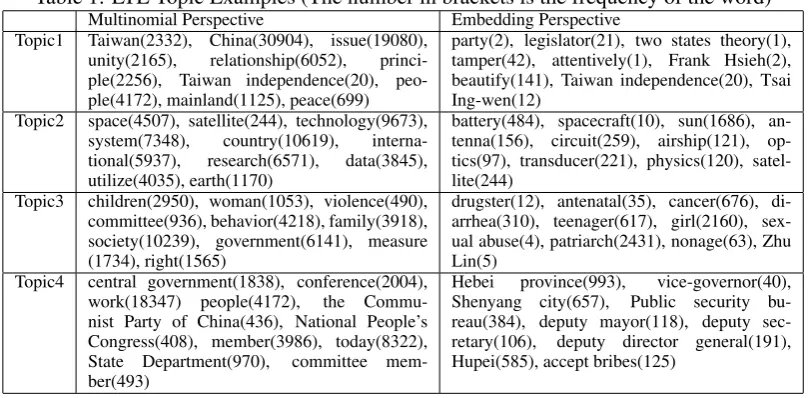
Table 1: LTE Topic Examples (The number in brackets is the frequency of the word) Multinomial Perspective Embedding Perspective nist Party of China(436), National People’s Congress(408), member(3986), today(8322),
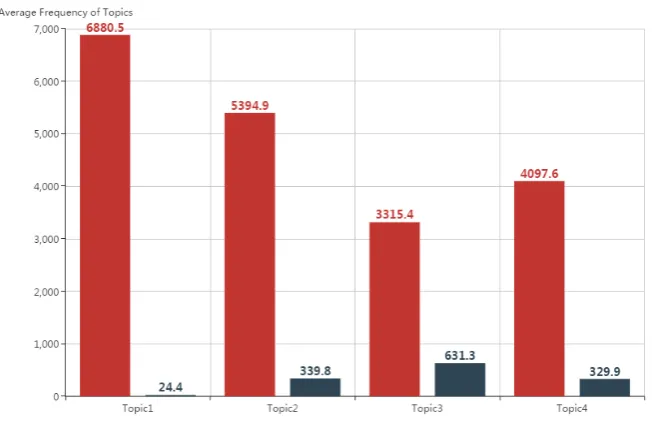
Figure 1: Average Word Frequency of the Two Perspectives
words whose embeddings have the highest cosine similarity with the topic embedding can be considered as the content of this topic. We utilize Web page dataset for the experiment. Some topic examples are presented in Table 11. We observe that the words are semantically coherent in both of the two
perspec-tives. For example, Topic 1 is about political issues between mainland China and Taiwan, Topic 2 is related to space technology, Topic 3 discusses the well-being of women and children and Topic 4 con-tains words about the political system of China. For each topic, the words from the two perspectives are semantically relevant and complimentary to each other.
An important insight is obtained from analyzing the frequencies of words in topics. The average word frequencies of the two perspectives are presented in Figure 1. We can see that word frequency of the second perspective is significantly smaller than that of the first perspective. For example, in Topic 1, the average word frequency of the first perspective is 6880.5 while that of the second perspective is only 24.4. This phenomenon shed light on an big advantage of LTE in text mining: bridging the semantic relevance between words with different frequencies. LTE overcomes the inherent problem of topic models that the topics are usually dominated by words of high frequency. By using the topic and word embeddings, we can effectively discover the semantics of words of relatively low frequency.
5.2 Perplexity Evaluation
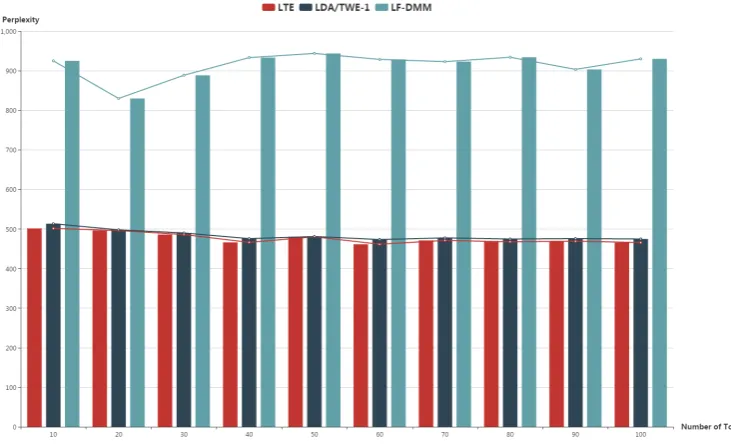
We proceed to quantitatively compare LTE with LDA and the state-of-the-arts (i.e., Topical Word Embed-ding (TWE-1) (Liu et al., 2015) and Latent Feature-Dirichlet Multinomial Mixture (LFDMM) (Nguyen et al., 2015) ) in terms of perplexity, which is a standard measure of evaluating the generalization perfor-mance of a probabilistic model (Rosen-Zvi et al., 2004). A lower perplexity indicates better generaliza-tion performance. A holdout dataset containing about ten thousand Web pages are utilized for perplexity evaluation. The result of perplexity comparison is presented in Figure 2. Since TWE-1 reuses the result of LDA, they have exactly the same performance in terms of perplexity. When varying the number of topics from 10 to 100, LTE always achieves the lowest perplexity, showing that generative process of LTE is a reasonable assumption for the data. An important observation is that LTE significantly outper-forms LFDMM, showing that adding the sentence assumption and jointly utilizing word embedding and topic embedding to generate words result in better fit for the latent data structure of natural language documents. Perplexity is an indicator of the quality of the Multinomial topics. We observe that jointly
Figure 2: Perplexity on Holdout Data
training of multinomial topics and embeddings does not harm the quality of the Multinomial topics. Rather, the joint training paradigm of LTE slightly improves the quality of the Multinomial topics. This observation verifies our assumption that the collectively utilizing co-occurrence information of different granularity has the potential of improving the performance of topic models.
5.3 Topical Word Extraction
We now evaluate the performance of LTE in the scenario of topical word extraction, which is critical for natural language understanding in modern search engines. Given a document, the goal of topical word extraction is to find some words that are highly relevant to the document theme. Conventionally, LDA plays an important role in topical word extraction (Zhao et al., 2011)(Pasquier, 2010). The existing methods based LDA are usually plagued by the weakness of capturing the semantics of words with low frequency. In this section, we study whether the embeddings generated by LTE are able to alleviate this problem. Ten thousands Web pages are utilized for this evaluation and the ground truth (i.e., the words that are highly relevant to the document theme) is manually prepared by human experts.
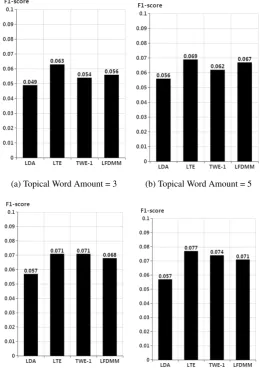
To derive the topical words for a documentd, we first calculate the score of each wordwindand the score reflect the relevance betweenwand the themes ofd. Then we sort all the words according to their scores and select the top-k words as the topical words ofd. For TWE-1, LFDMM and LTE, the score of a wordwis calculated based on embeddings byscore(w) = PzP(z|d) cos(vw, vz), where cosis the cosine similarity between two embeddings. As for LDA, we rely on the multinomial topics and calculate the score byscore(w) =PzP(z|d)P(w|z). We compare the performance of these models in terms of
F1score, which is the harmonic mean of precision and recall.
(a) Topical Word Amount = 3 (b) Topical Word Amount = 5
(c) Topical Word Amount = 7 (d) Topical Word Amount = 10
Figure 3: Topical Word Extraction
6 Conclusion
In this paper, we propose LTE to seamlessly integrate topic model and word embedding into one joint learning framework. We discuss a Monte Carlo EM algorithm for learning the parameter of LTE. LTE does not only output topic-related distributions but also generates distributed representation for words and latent topics. By applying LTE, we obtain coherent latent topics and the embedding generated by LTE are effective for identifying topical words of documents. Extensive experiments verify our assumption that topic modeling and word embedding are potentially complimentary for each other. While LTE is a specific model for off-the-shelf usage, the technique discussed in this paper can be easily transfer to many other scenarios where integrating other topic modeling and word embedding techniques are needed.
Acknowledgements
We would like to thank the anonymous reviewers for their insightful comments and suggestions. This work is supported by National Basic Research Program of China (973 program No. 2014CB340505) .
References
Yoshua Bengio, R´ejean Ducharme, Pascal Vincent, and Christian Janvin. 2003. A neural probabilistic language model. The Journal of Machine Learning Research, 3:1137–1155.
David M Blei, Andrew Y Ng, and Michael I Jordan. 2003. Latent dirichlet allocation. the Journal of machine
Learning research, 3:993–1022.
Gabriel Doyle and Charles Elkan. 2009. Accounting for burstiness in topic models. InProceedings of the 26th
Annual International Conference on Machine Learning, pages 281–288. ACM.
Chris Dyer. 2014. Notes on noise contrastive estimation and negative sampling.arXiv preprint arXiv:1410.8251. Thomas L Griffiths and Mark Steyvers. 2004. Finding scientific topics. Proceedings of the National academy of
Sciences of the United States of America, 101(Suppl 1):5228–5235.
Di Jiang, Kenneth Wai-Ting Leung, Wilfred Ng, and Hao Li. 2013. Beyond click graph: Topic modeling for search engine query log analysis. InInternational Conference on Database Systems for Advanced Applications, pages 209–223. Springer.
Yohan Jo and Alice H Oh. 2011. Aspect and sentiment unification model for online review analysis. In
Proceed-ings of the fourth ACM international conference on Web search and data mining, pages 815–824. ACM.
Ralf Krestel, Peter Fankhauser, and Wolfgang Nejdl. 2009. Latent dirichlet allocation for tag recommendation. In
Proceedings of the third ACM conference on Recommender systems, pages 61–68. ACM.
Quoc V Le and Tomas Mikolov. 2014. Distributed representations of sentences and documents.ICML.
Shaohua Li, Tat-Seng Chua, Jun Zhu, and Chunyan Miao. 2016. Generative topic embedding: a continuous representation of documents. InProceedings of The 54th Annual Meeting of the Association for Computational Linguistics (ACL).
Yang Liu, Zhiyuan Liu, Tat-Seng Chua, and Maosong Sun. 2015. Topical word embeddings.
Tomas Mikolov, Kai Chen, Greg Corrado, and Jeffrey Dean. 2013a. Efficient estimation of word representations in vector space. arXiv preprint arXiv:1301.3781.
Tomas Mikolov, Ilya Sutskever, Kai Chen, Greg S Corrado, and Jeff Dean. 2013b. Distributed representations of words and phrases and their compositionality. InAdvances in Neural Information Processing Systems, pages 3111–3119.
Andriy Mnih and Yee Whye Teh. 2012. A fast and simple algorithm for training neural probabilistic language models. arXiv preprint arXiv:1206.6426.
David Newman, Arthur Asuncion, Padhraic Smyth, and Max Welling. 2009. Distributed algorithms for topic models. The Journal of Machine Learning Research, 10:1801–1828.
Dat Quoc Nguyen, Richard Billingsley, Lan Du, and Mark Johnson. 2015. Improving topic models with latent feature word representations.Transactions of the Association for Computational Linguistics, 3:299–313. Claude Pasquier. 2010. Task 5: Single document keyphrase extraction using sentence clustering and latent
dirich-let allocation. InProceedings of the 5th international workshop on semantic evaluation, pages 154–157. Asso-ciation for Computational Linguistics.
Michal Rosen-Zvi, Thomas Griffiths, Mark Steyvers, and Padhraic Smyth. 2004. The author-topic model for authors and documents. InProceedings of the 20th conference on Uncertainty in artificial intelligence, pages 487–494. AUAI Press.
Hanna M Wallach. 2006. Topic modeling: beyond bag-of-words. In Proceedings of the 23rd international
conference on Machine learning, pages 977–984. ACM.
Xuerui Wang and Andrew McCallum. 2006. Topics over time: a non-markov continuous-time model of topical trends. InProceedings of the 12th ACM SIGKDD international conference on Knowledge discovery and data
mining, pages 424–433. ACM.
Gu Xu, Shuang-Hong Yang, and Hang Li. 2009. Named entity mining from click-through data using weakly supervised latent dirichlet allocation. InProceedings of the 15th ACM SIGKDD international conference on
Knowledge discovery and data mining, pages 1365–1374. ACM.
Wayne Xin Zhao, Jing Jiang, Jing He, Yang Song, Palakorn Achananuparp, Ee-Peng Lim, and Xiaoming Li. 2011. Topical keyphrase extraction from twitter. InProceedings of the 49th Annual Meeting of the Association for
Computational Linguistics: Human Language Technologies-Volume 1, pages 379–388. Association for