Identifying idiomatic expressions using automatic word-alignment
Bego ˜na Villada Moir´on and J¨org Tiedemann
Alfa Informatica, University of Groningen Oude Kijk in ’t Jatstraat 26
9712 EK Groningen, The Netherlands
{M.B.Villada.Moiron,J.Tiedemann}@rug.nl
Abstract
For NLP applications that require some
sort of semantic interpretation it would be helpful to know what expressions exhibit an idiomatic meaning and what expres-sions exhibit a literal meaning. We invest-igate whether automatic word-alignment in existing parallel corpora facilitates the classification of candidate expressions along a continuum ranging from literal and transparent expressions to idiomatic and opaque expressions. Our method relies on two criteria: (i) meaning predictability that is measured as semantic entropy and (ii), the overlap between the meaning of an ex-pression and the meaning of its compon-ent words. We approximate the mcompon-entioned overlap as the proportion of default align-ments. We obtain a significant improve-ment over the baseline with both meas-ures.
1 Introduction
Knowing whether an expression receives a lit-eral meaning or an idiomatic meaning is import-ant for natural language processing applications that require some sort of semantic interpretation. Some applications that would benefit from know-ing this distinction are machine translation (Im-amura et al., 2003), finding paraphrases (Bannard and Callison-Burch, 2005), (multilingual) inform-ation retrieval (Melamed, 1997a), etc.
The purpose of this paper is to explore to what extent word-alignment in parallel corpora can be used to distinguish idiomatic multiword sions from more transparent multiword expres-sions and fully productive expresexpres-sions.
In the remainder of this section, we present our characterization of idiomatic expressions, the mo-tivation to use parallel corpora and related work. Section 2 describes the materials required to ap-ply our method. Section 3 portraits the routine to extract a list of candidate expressions from auto-matically annotated data. Experiments with differ-ent word alignmdiffer-ent types and metrics are shown in section 4. Our results are discussed in section 5. Finally, we draw some conclusions in section 6.
1.1 What are idiomatic expressions?
Idiomatic expressions constitute a subset of mul-tiword expressions (Sag et al., 2001). We assume that literal expressions can be distinguished from idiomatic expressions provided we know how their
meaning is derived.1 The meaning of linguistic
expressions can be described within a scale that ranges from fully transparent to opaque (in figur-ative expressions).
(1) Wat what
moeten must
lidstaten member states
ondernemen do
om to aan
at haar her
eisen demands
te to
voldoen? meet?
‘What mustEU member states do to meet her
demands?’
(2) Deze this
situatie situation
brengt
brings de the
bestaande existing
politieke political barri`eres
barriers zeer very
duidelijk clearly
aan
in
het
the
licht.
light
‘This situation brings the existing political limitations to light very clearly.’
(3) Wij we
mogen may
ons us
hier here
niet not
bij by
neerleggen, agree, maar
but
moeten must
de the
situatie situation
publiekelijk publicly
aan
op
de
the
kaak
cheek
stellen.
state
‘We cannot agree but must denounce the situ-ation openly.’
Literal and transparent meaning is associated with high meaning predictability. The meaning of an expression is fully predictable if it results from combining the meaning of its individual words
when they occur in isolation (see (1)). When
the expression undergoes a process of metaphor-ical interpretation its meaning is less predictable. Moon (1998) considers a continuum of transpar-ent, semi-transparent and opaque metaphors. The more transparent metaphors have a rather predict-able meaning (2); the more opaque have an un-predictable meaning (3). In general, an unpredict-able meaning results from the fact that the mean-ing of the expression has been fossilized and con-ventionalized. In an uninformative context, idio-matic expressions have an unpredictable meaning (3). Put differently, the meaning of an idiomatic expression cannot be derived from the cumulative meaning of its constituent parts when they appear in isolation.
1.2 Why checking translations?
This paper addresses the task of distinguishing lit-eral (transparent) expressions from idiomatic pressions. Deciding what sort of meaning an ex-pression shows can be done in two ways:
• measuring how predictable the meaning of
the expression is and
• assessing the link between (a) the meaning of
the expression as a whole and (b) the cumu-lative literal meanings of the components.
Fernando and Flavell (1981) observe that no connection between (a) and (b) suggests the ex-istence of opaque idioms and, a clear link between (a) and (b) is observed in clearly perceived meta-phors and literal expressions.
We believe we can approximate the meaning of an expression by looking up the expressions’ translation in a foreign language. Thus, we are interested in exploring to what extent parallel
cor-pora can help us to find out the type of meaning an expression has.
For our approach we make the following as-sumptions:
• regular words are translated (more or less)
consistently, i.e. there will be one or only a few highly frequent translations whereas translation alternatives will be infrequent;
• an expression has a (almost) literal meaning
if its translation(s) into a foreign language is the result of combining each word’s transla-tion(s) when they occur in isolation into a for-eign language;
• an expression has a non-compositional
mean-ing if its translation(s) into a foreign language does not result from a combination of the reg-ular translations of its component words.
We also assume that an automatic word aligner will get into trouble when trying to align non-decomposable idiomatic expressions word by word. We expect the aligner to produce a large variety of links for each component word in such expressions and that these links are different from the default alignments found in the corpus other-wise.
Bearing these assumptions in mind, our
ap-proach attempts to locate the translation of aMWE
in a target language. On the basis of all
recon-structed translations of a (potential)MWE, it is
de-cided whether the original expression (in source language) is idiomatic or a more transparent one.
1.3 Related work
Melamed (1997b) measures the semantic entropy of words using bitexts. Melamed computes the
translational distributionTof a wordsin a source
language and uses it to measure the translational
entropy of the wordH(T|s); this entropy
approx-imates the semantic entropy of the word that can be interpreted either as (a) the semantic ambigu-ity or (b) the inverse of reliabilambigu-ity. Thus, a word with high semantic entropy is potentially very am-biguous and therefore, its translations are less
re-liable (or highly context-dependent). We also
are those sequences of 2 or more words (adja-cent or separate) that show a conventionalized meaning. From English-French parallel corpora, Melamed’s method induces and compares pairs of translation models. Models that take into account non-compositional compounds are highly accurate in the identification task.
2 Data and resources
We base our investigations on the Europarl corpus consisting of several years of proceedings from the European Parliament (Koehn, 2003). We focus on Dutch expressions and their translations into
Eng-lish, Spanish and German.2 Thus, we used the
en-tire sections of Europarl in these three languages. The corpus has been tokenized and aligned at the sentence level (Tiedemann and Nygaard, 2004). The Dutch part contains about 29 million tokens in about 1.2 million sentences. The English, Span-ish and German counterparts are of similar size between 28 and 30 million words in roughly the same number of sentences.
Automatic word alignment has been done us-ing GIZA++ (Och, 2003). We used standard set-tings of the system to produce Viterbi alignments of IBM model 4. Alignments have been produced for both translation directions (source to target and
target to source) on tokenized plain text.3 We also
used a well-known heuristics for combining the two directional alignments, the so-called refined alignment (Och et al., 1999). Word-to-word align-ments have been merged such that words are con-nected with each other if they are linked to the same target. In this way we obtained three differ-ent word alignmdiffer-ent files: source to target (src2trg) with possible multi-word units in the source lan-guage, target to source (trg2src) with possible multi-word units in the target language, and
re-fined with possible multi-word units in both
lan-guages. We also created bilingual word type links from the different word-aligned corpora. These lists include alignment frequencies that we will use later on for extracting default alignments for individual words. Henceforth, we will call them
link lexica.
2This is only a restriction for our investigation but not for the approach itself.
3
Manual corrections and evaluations of the tokenization, sentence and word alignment have not been done. We rely entirely on the results of automatic processes.
3 Extracting candidates from corpora
The Dutch section from the Europarl corpus was automatically parsed with Alpino, a Dutch
wide-coverage parser.4 1.25% of the sentences could
not be parsed by Alpino, given the fact that many sentences are rather lengthy. We selected those sentences in the Dutch Europarl section that con-tain at least one of a group of verbs that can function as main or support verbs. Support verbs are prone to lexicalization or idiomatization along with their complementation (Butt, 2003). The se-lected verbs are: doen, gaan, geven, hebben,
ko-men, maken, neko-men, brengen, houden, krijgen, stellen and zitten.5
A fully parsed sentence is represented by the list of its dependency triples. From the dependency triples, each main verb is tallied with every
de-pendent prepositional phrase (PP). In this way, we
collected all theVERB PPtuples found in the
selec-ted documents. To avoid data sparseness, theNP
inside thePPis reduced to the head noun’s lemma
and verbs are lemmatized, too. Other potential arguments under a verb phrase node are ignored. A sample of more than 191,000 candidates types (413,000 tokens) was collected. To ensure statist-ical significance, the types that occur less than 50 times were ignored.
For each candidate triple, the log-likelihood (Dunning, 1993) and salience (Kilgarriff and Tug-well, 2001) scores were calculated. These scores have been shown to perform reasonably well in identifying collocations and other lexicalized ex-pressions (Villada Moir´on, 2005). In addition, the
head dependence between each PP in the
candid-ates dataset and its selecting verbs was measured. Merlo and Leybold (2001) used the head depend-ence as a diagnostic to determine the argument
(or adjunct) status of aPP. The head dependence
is measured as the amount of entropy observed
among the co-occurring verbs for a given PP as
suggested in (Merlo and Leybold, 2001; Bald-win, 2005). Using the two association measures and the head dependence heuristic, three different rankings of the candidate triples were produced. The three different ranks assigned to each triple were uniformly combined to form the final rank-ing. From this list, we selected the top 200 triples
4Available at http://www.let.rug.nl/ ˜vannoord/alp/Alpino.
5
which we considered a manageable size to test our method.
4 Methodology
We examine how expressions in the source guage (Dutch) are conceptualized in a target lan-guage. The translations in the target language en-code the meaning of the expression in the source
language. Using the translation links in
paral-lel corpora, we attempt to establish what type of meaning the expression in the source language has. To accomplish this we make use of the three word-aligned parallel corpora from Europarl as described in section 2.
Once the translation links of each expression in the source language have been collected, the en-tropy observed among the translation links is com-puted per expression. We also take into account how often the translation of an expression is made out of the default alignment for each triple com-ponent. The default ’translation’ is extracted from the corresponding bilingual link lexicon.
4.1 Collecting alignments
For each triple in the source language (Dutch) we collect its corresponding (hypothetical) trans-lations in a target language. Thus, we have a list
of 200VERB PPtriples representing 200 potential
MWEs in Dutch. We selected all occurrences of
each triple in the source language and all aligned sentences containing their corresponding transla-tions into English, German and Spanish. We re-stricted ourselves to instances found in 1:1 sen-tence alignments. Other units contain many er-rors in word and sentence alignment and, there-fore, we discarded them. Relying on automated word-alignment, we collect all translation links for each verb, preposition and noun occurrence within the triple context in the three target languages.
To capture the meaning of a source expression
(triple)S, we collect all the translation links of its
component wordssin each target language. Thus,
for each triple, we gather three lists of
transla-tion linksTs. Let us see the exampleAAN LICHT
BRENG representing the MWE iets aan het licht brengen ’reveal’. Table 1 shows some of the links
found for the tripleAAN LICHT BRENG. If a word
in the source language has no link in the target lan-guage (which is usually due to alignments to the
empty word),NO LINKis assigned.
Note that Dutch word order is more flexible than
Triple Links in English
aan NO LINK, to, of, in, for, from, on, into, at licht NO LINK, light, revealed, exposed, highlight,
shown, shed light, clarify
breng NO LINK, brought, bring, highlighted, has, is, makes
Table 1: Excerpt of the English links found for the
tripleAAN LICHT BRENG‘bring to light’.
English word order and that, thePPargument in a
candidate expression may be separate from its se-lecting verb by any number of constituents. This introduces much noise during retrieving transla-tion links. In additransla-tion, it is known that concepts may be lexicalized very differently in different languages. Because of this, words in the source language may translate to nothing in a target lan-guage. This introduces many mappings of a word toNO LINK.
4.2 Measuring translational entropy
According to our intuition it is harder to align words in idiomatic expressions than other words. Thus, we expect a larger variety of links (includ-ing erroneous alignments) for words in such ex-pressions than for words taken from exex-pressions with a more literal meaning. For the latter, we expect fewer alignment candidates, possibly with only one dominant default translation. Entropy is a good measure for the unpredictability of an event. We like to use this measure for comparing the alignment of our candidates and expect a high average entropy for idiomatic expressions. In this way we approximate a measure for meaning pre-dictability.
For each word in a triple, we compute the en-tropy of the aligned target words as shown in equa-tion (1).
H(Ts|s) =−
X
t∈Ts
P(t|s)logP(t|s) (1)
This measure is equivalent to translational
en-tropy (Melamed, 1997b). P(t|s) is estimated as
the proportion of alignment t among all
align-ments of word s found in the corpus in the
con-text of the given triple.6 Finally, the translational
entropy of a triple is the average translational
en-tropy of its components. It is unclear how to
6Note that we also consider cases where
treat NO LINKS. Thus, we experiment with three
variants of entropy: (1) leaving out NO LINKS,
(2) counting NO LINKS as multiple types and (3)
counting allNO LINKSas one unique type.
4.3 Proportion of default alignments (pda)
If an expression has a literal meaning, we expect the default alignments to be accurate literal trans-lations. If an expression has idiomatic meaning, the default alignments will be very different from the links observed in the translations.
For each triple S, we count how often each of
its components s is linked to one of the default
alignments Ds. For the latter, we used the four
most frequent alignment types extracted from the corresponding link lexicon as described in section
2. A large proportion of default alignments7
sug-gests that the expression is very likely to have lit-eral meaning; a low percentage is suggestive of non-transparent meaning. Formally, pda is calcu-lated in the following way:
pda(S) =
P
s∈S
P
d∈Dsalign f req(s, d)
P
s∈S
P
t∈Tsalign f req(s, t)
(2)
where align f req(s, t) is the alignment
fre-quency of wordsto wordt in the context of the
tripleS.
5 Discussion of experiments and results
We experimented with the three word-alignment types (src2trg, trg2src and refined) and the two
scoring methods (entropy andpda). The 200
can-didate MWEs have been assessed and classified
into idiomatic or literal expressions by a human expert. For assessing performance, standard pre-cision and recall are not applicable in our case be-cause we do not want to define an artificial cut-off for our ranked list but evaluate the ranking it-self. Instead, we measured the performance of each alignment type and scoring method by ob-taining another evaluation metric employed in in-formation retrieval, uninterpolated average
preci-sion (uap), that aggregates precipreci-sion points into
one evaluation figure. At each pointcwhere a true
positive Sc in the retrieved list is found, the
pre-cision P(S1..Sc) is computed and, all precision
points are then averaged (Manning and Sch¨utze, 1999).
7Note that we take
NO LINKSinto account when comput-ing the proportions.
uap=
P
ScP(S1..Sc)
|Sc|
(3)
We used the initial ranking of our candidates
as baseline. Our list of potential MWEs shows an
overall precision of 0.64 and an uap of 0.755.
5.1 Comparing word alignment types
Table 2 summarizes the results of using the
en-tropy measure (leaving out NO LINKS) with the
three alignment types for the NL-EN language
pair.8
Alignment uap src2trg 0.864 trg2src 0.785 refined 0.765 baseline 0.755
Table 2:uapvalues of various alignments.
Using word alignments improves the ranking
of candidates in all three cases. Among them,
src2trg shows the best performance. This is surprising because the quality of word-alignment
from English-to-Dutch (trg2src) in general is
higher due to differences in compounding in the two languages. However, this is mainly an issue for noun phrases which make up only one com-ponent in the triples.
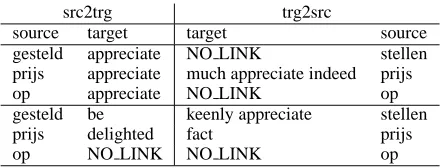
We assume that src2trg works better in our case because in this alignment model we explicitly link each word in the source language to exactly one target word (or the empty word) whereas in the trg2src model we often get multiple words (in the target language) aligned to individual words in the triple. Many errors are introduced in such align-ment units. Table 3 illustrates this with an example with links for the Dutch triple op prijs stel corres-ponding to the expression iets op prijs stellen ’to appreciate sth.’
src2trg trg2src
source target target source
gesteld appreciate NO LINK stellen prijs appreciate much appreciate indeed prijs
op appreciate NO LINK op
gesteld be keenly appreciate stellen prijs delighted fact prijs
[image:5.595.307.527.613.697.2]op NO LINK NO LINK op
Table 3: Example src2trg and trg2src alignments
for the tripleOP PRIJS STEL.
src2trg alignment proposes appreciate as a link to all three triple components. This type of align-ment is not possible in trg2src. Instead, trg2src
in-cludes twoNO LINKSin the first example in table
3. Furthermore, we get several multiword-units in the target language linked to the triple compon-ents also because of alignment errors. This way,
we end up with manyNO LINKSand many
align-ment alternatives in trg2src that influence our en-tropy scores. This can be observed for idiomatic expressions as well as for literal expressions which makes translational entropy less reliable in trg2src alignments for contrasting these two types of ex-pressions.
The refined alignment model starts with the in-tersection of the two directional models and adds iteratively links if they meet some adjacency
con-straints. This results in manyNO LINKS and also
alignments with multiple words on both sides. This seems to have the same negative effect as in the trg2src model.
5.2 Comparing scoring metrics
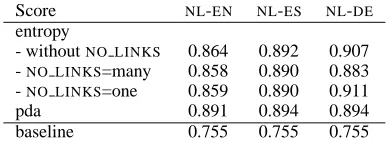
Table 4 offers a comparison of applying transla-tional entropy and the pda across the three
lan-guage pairs. To produce these results, src2trg
alignment was used given that it reaches the best performance (refer to Table 2).
Score NL-EN NL-ES NL-DE
entropy
- withoutNO LINKS 0.864 0.892 0.907
-NO LINKS=many 0.858 0.890 0.883
-NO LINKS=one 0.859 0.890 0.911
pda 0.891 0.894 0.894
baseline 0.755 0.755 0.755
Table 4: Translational entropy and the pda across
three language pairs. Alignment issrc2trg.
All scores produce better rankings than the baseline. In general, pda achieves a slightly better
accuracy than entropy except for the NL-DE
lan-guage pair. Nevertheless, the difference between the metrics is hardly significant.
5.3 Further improvements
One problem in our data is that we deal with word-form alignments and not with lemmatized ver-sions. For Dutch, we know the lemma of each word instance from our candidate set. However, for the target languages, we only have access to surface forms from the corpus. Naturally, inflec-tional variations influence entropy scores (because
of the larger variety of alignment types) and also the pda scores (where the exact wordforms have to be matched with the default alignments instead of lemmas). In order to test the effect of
lemmatiz-ation on different language pairs, we usedCELEX
[image:6.595.317.515.239.397.2](Baayen et al., 1993) for English and German to reduce wordforms in the alignments and in the link lexicon to corresponding lemmas. We assigned the most frequent lemma to ambiguous wordforms. Table 5 shows the scores obtained from applying
lemmatization for the src2trgalignment using
entropy (withoutNO LINKS) and pda.
Setting NL-EN NL-ES NL-DE
using entropy scores
with prepositions
wordforms 0.864 0.892 0.907
lemmas 0.873 – 0.906
without prepositions
wordforms 0.906 0.923 0.932
lemmas 0.910 – 0.931
using pda scores
with prepositions
wordforms 0.891 0.894 0.894
lemmas 0.888 – 0.903
without prepositions
wordforms 0.897 0.917 0.905
lemmas 0.900 – 0.910
[image:6.595.84.279.453.524.2]baseline 0.755 0.755 0.755
Table 5: Translational entropy and pda from
src2trgalignments across languages pairs with different settings.
Surprisingly, lemmatization adds little or even decreases the accuracy of the pda and entropy
scores. It is also surprising that lemmatization
does not affect the scores for morphologically richer languages such as German (compared to
English). One possible reason for this is that
lemmatization discards morphological informa-tion that is crucial to identify idiomatic expres-sions. In fact, nouns in idiomatic expressions are more fixed than nouns in literal expressions. By contrast, verbs in idiomatic expressions often al-low tense inflection. By clustering wordforms into lemmas we lose this information. In future work, we might lemmatize only the verb.
Another issue is the reliability of the word
align-ment that we base our investigation upon. We
preposi-tions might blur the contrast between idiomatic ex-pressions and literal translations when measured
on the alignment of individual words. Table 5
includes scores for ranking our candidate expres-sions with and without prepositions. We observe that there is a large improvement when leaving out the alignments of prepositions. This is consistent for all language pairs and the scores we used for ranking.
rank pda entropy MWE triple
1 9.80 8.3585 ok breng tot stand ’create’ 2 9.24 8.0923 ok breng naar voren ’bring up’ 3 16.40 7.8741 ok kom in aanmerking ’qualify’ 4 15.33 7.8426 ok kom tot stand ’come about’ 5 8.70 7.4973 ok stel aan orde ’bring under discussion’ 6 5.65 7.4661 ok ga te werk ’act unfairly’ 7 17.46 7.4057 ok kom aan bod ’get a chance’ 8 9.38 7.1762 ok ga van start ’proceed’ 9 14.15 7.1009 ok stel aan kaak ’expose’ 10 18.75 7.0321 ok breng op gang ’get going’ 11 13.00 6.9304 ok kom ten goede ’benefit’ 12 1.78 6.8715 ok neem voor rekening ’pay costs’ 13 20.99 6.7411 ok kom tot uiting ’manifest’ 14 1.41 6.7360 ok houd in stand ’preserve’ 15 0.81 6.6426 ok breng in kaart ’chart’
16 16.71 6.5194 ok breng onder aandacht ’bring to attention’ 17 10.25 6.4893 ok neem onder loep ’scrutinize’ 18 7.83 6.4666 ok breng aan licht ’reveal’ 19 5.99 6.4049 ok roep in leven ’set up’ 20 15.89 6.3729 ok neem in aanmerking ’consider’
...
100 1.72 4.6940 ok leg aan band ’control’ 101 14.91 4.6884 ok houd voor gek ’pull s.o.’s leg’ 102 23.56 4.6865 ok kom te weten ’find out’ 103 15.38 4.6713 ok neem in ontvangst ’receive’ 104 31.57 4.6556 * ga om waar ’go about where’ 105 35.95 4.6380 * houd met daar ’keep with there’ 106 34.86 4.6215 * ga om zaak ’go about issue’
107 28.33 4.5846 ok kom tot overeenstemming ’come to terms’ 108 6.06 4.5715 ok breng in handel ’launch’
109 35.62 4.5370 * ga om bedrag ’go about amount’ 110 22.58 4.5089 * blijk uit feit ’seems from fact’ 111 51.12 4.4063 ok ben van belang ’matter’ 112 49.69 4.3921 * ga om kwestie ’go about issue’ 113 23.61 4.3902 * voorzie in behoefte ’fill gap’ 114 16.18 4.3568 ok geef aan oproep ’make appeal’ 115 50.00 4.3254 * houd met aspect ’keep with aspect’ 116 40.91 4.3006 * houd aan regel ’adhere to rule’
117 20.12 4.3002 * stel vast met voldoening ’settle with satisfaction’ 118 36.90 4.2931 ok kom tot akkoord ’reach agreement’ 119 36.49 4.2906 ok breng in stemming ’get in mood’ 120 14.06 4.2873 ok sta op schroeven ’be unsettled’
...
180 70.53 2.7395 * voldoe aan criterium ’satisfy criterion’ 181 52.33 2.7351 * beschik over informatie ’decide over information’ 182 74.71 2.6896 * stem voor amendement ’vote for amending’ 183 76.56 2.5883 * neem deel aan stemming ’participate in voting’ 184 30.26 2.4484 ok kan op aan ’be able to trust’
185 68.89 2.3199 * zeg tegen heer ’tell a gentleman’
186 45.00 2.1113 * verwijs terug naar commissie ’refer to comission’ 187 80.39 2.0992 * stem tegen amendement ’vote againsta amending’ 188 78.04 2.0924 * onthoud van stemming ’withhold one’s vote’ 189 77.63 1.9997 * feliciteer met werk ’congratulate with work’ 190 82.21 1.9020 * stem voor verslag ’vote for report’
191 77.78 1.9016 * schep van werkgelegenheid ’set up of employment’ 192 86.36 1.8775 * stem voor resolutie ’vote for resolution’ 193 73.33 1.8687 * bedank voor feit ’thank for fact’ 194 39.13 1.8497 * was wit van geld ’wash money’ 195 82.20 1.7944 * stem tegen verslag ’vote against report’ 196 80.49 1.6443 * schep van baan ’set up of job’ 197 86.17 1.4260 * stem tegen resolutie ’vote against resolution’ 198 85.56 1.1779 * dank voor antwoord ’thank for reply’
[image:7.595.77.287.210.727.2]199 90.55 1.0398 * ontvang overeenkomstig artikel ’receive similar article’ 200 87.88 1.0258 * recht van vrouw ’right of woman’
Table 6: Rank (using entropy), entropy score, and
pda score of 60 candidateMWEs.
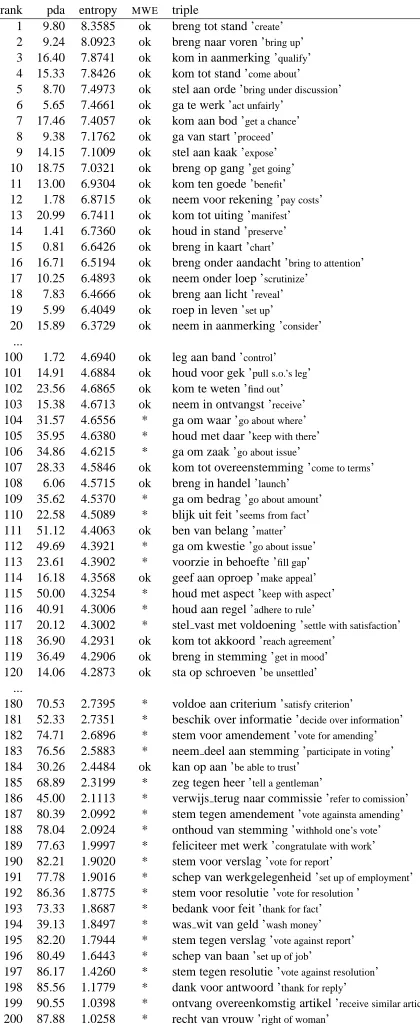
Table 6 provides an excerpt from the ranked
list of candidate triples. The ranking has been
done using src2trg alignments from Dutch to Ger-man with the best setting (see table 5). The score assigned by the pda metric is also shown. The
column labeled MWE states whether the
expres-sion is idiomatic (’ok’) or literal (’*’). One issue that emerges is whether we can find a threshold value that splits candidate expressions into idio-matic and transparent ones. One should choose such a threshold empirically however, it will de-pend on what level of precision is desirable and also on the final application of the list.
6 Conclusion and future work
In this paper we have shown that assessing auto-matic word alignment can help to identify idio-matic multi-word expressions. We ranked candid-ates according to their link variability using trans-lational entropy and their link consistency with
regards to default alignments. For our
experi-ments we used a set of 200 Dutch MWE
candid-ates and word-aligned parallel corpora from Dutch
to English, Spanish and German. The MWE
can-didates have been extracted using standard associ-ation measures and a head dependence heuristic. The word alignment has been done using standard models derived from statistical machine transla-tion. Two measures were tested to re-rank the can-didates. Translational entropy measures the pre-dictability of the translation of an expression by looking at the links of its components to a target
language. Ranking our 200 MWE candidates
us-ing entropy on Dutch to German word alignments improved the baseline of 75.5% to 93.2% uninter-polated average precision (uap). The proportion of
default alignments among the links found forMWE
components is another score we explored for
rank-ing our MWE candidates. Here, the accuracy is
rather similar giving us 91.7% while using the res-ults of a directional alignment model from Dutch to Spanish. In general, we obtain slightly better results when using word alignment from Dutch to German and Spanish, compared to alignment from Dutch to English.
There emerge several extensions of this work that we wish to address in the future. Alignment types and scoring metrics need to be tested in
lar-ger lists of randomly selected MWEcandidates to
num-ber of NO LINKS per expression. Our
assump-tion is that an expression with manyNO LINKSis
harder to translate compositionally, and probably
an idiomatic or ambiguous expression.
Altern-atively, an expression with no NO LINKS is very
predictable, thus a literal expression. Finally, an-other possible improvement is combining several language pairs. There might be cases where idio-matic expressions are conceptualized in a similar way in two languages. For example, a Dutch idio-matic expression with a cognate expression in Ger-man might be conceptualized in a different way in Spanish. By combining the entropy or pda scores
forNL-EN, NL-DE and NL-ES the accuracy might
improve.
Acknowledgments
This research was carried out as part of the
re-search programs for IMIX, financed by NWO and
the IRME STEVIN project. We would also like to thank the three anonymous reviewers for their comments on an earlier version of this paper.
References
R.H. Baayen, R. Piepenbrock, and H. van Rijn.
1993. The CELEX lexical database
(CD-ROM). Linguistic Data Consortium, University of Pennsylvania,Philadelphia.
Timothy Baldwin. 2005. Looking for prepositional verbs in corpus data. In Proc. of the 2nd
ACL-SIGSEM Workshop on the Linguistic Dimensions of Prepositions and their use in computational linguist-ics formalisms and applications, Colchester, UK.
Colin Bannard and Chris Callison-Burch. 2005. Para-phrasing with bilingual parallel corpora. In
Pro-ceedings of the 43th Annual Meeting of the ACL,
pages 597–604, Ann Arbor. University of Michigan.
Miriam Butt. 2003. The light verb jungle.
http://ling.uni-konstanz.de/pages/ home/butt/harvard-work.pdf.
Ted Dunning. 1993. Accurate methods for the stat-istics of surprise and coincidence. Computational
linguistics, 19(1):61—74.
Chitra Fernando and Roger Flavell. 1981. On idiom.
Critical views and perspectives, volume 5 of Exeter Linguistic Studies. University of Exeter.
Bart Hollebrandse. 1993. Dutch light verb construc-tions. Master’s thesis, Tilburg University, the Neth-erlands.
K Imamura, E. Sumita, and Y. Matsumoto. 2003. Automatic construction of machine translation
knowledge using translation literalness. In
Proceed-ings of the 10th EACL, pages 155–162, Budapest,
Hungary.
Adam Kilgarriff and David Tugwell. 2001. Word sketch: Extraction & display of significant colloc-ations for lexicography. In Proceedings of the 39th
ACL & 10th EACL -workshop ‘Collocation: Com-putational Extraction, Analysis and Explotation’,
pages 32–38, Toulouse.
Philipp Koehn. 2003. Europarl: A
multilin-gual corpus for evaluation of machine trans-lation. unpublished draft, available from
http://people.csail.mit.edu/koehn/publications/europarl/.
Christopher D. Manning and Hinrich Sch¨utze. 1999.
Foundations of Statistical Natural Language Pro-cessing. The MIT Press, Cambridge, Massachu-setts.
I. Dan Melamed. 1997a. Automatic discovery of non-compositional compounds in parallel data. In 2nd
Conference on Empirical Methods in Natural Lan-guage Processing (EMNLP’97), Providence, RI.
I. Dan Melamed. 1997b. Measuring semantic entropy. In ACL-SIGLEX Workshop Tagging Text with
Lex-ical Semantics: Why, What and How, pages 41–46,
Washington.
Paola Merlo and Matthias Leybold. 2001. Automatic distinction of arguments and modifiers: the case of prepositional phrases. In Procs of the Fifth
Com-putational Natural Language Learning Workshop (CoNLL–2001), pages 121–128, Toulouse. France.
Rosamund Moon. 1998. Fixed expressions and Idioms
in English. A corpus-based approach. Clarendom
Press, Oxford.
Franz Josef Och, Christoph Tillmann, and Hermann Ney. 1999. Improved alignment models for statist-ical machine translation. In Proceedings of the Joint
SIGDAT Conference on Empirical Methods in Nat-ural Language Processing and Very Large Corpora (EMNLP/VLC), pages 20–28, University of
Mary-land, MD, USA.
Franz Josef Och. 2003. GIZA++: Training of
statistical translation models. Available from
http://www.isi.edu/˜och/GIZA++.html.
Ivan Sag, T. Baldwin, F. Bond, A. Copestake, and D. Flickinger. 2001. Multiword expressions: a pain in the neck for NLP. LinGO Working Paper No. 2001-03.
J¨org Tiedemann and Lars Nygaard. 2004. The OPUS corpus - parallel & free. In Proceedings of the
Fourth International Conference on Language Re-sources and Evaluation (LREC’04), Lisbon,
Por-tugal.
Bego˜na Villada Moir´on. 2005. Data-driven
Identi-fication of fixed expressions and their modifiability.