W
ord
E
mbeddings
E
valuation and
C
ombination
Sahar Ghannay
1, Benoit Favre
2, Yannick Est`eve
1and Nathalie Camelin
1 1LIUM - University of Le Mans, 72000, Le Mans, France2Aix-Marseille Universit´e, CNRS, LIF UMR 7279, 13000, Marseille, France
Abstract
Word embeddings have been successfully used in several natural language processing tasks (NLP) and speech processing. Different approaches have been introduced to calculate word embeddings through neural networks. In the literature, many studies focused on word embedding evaluation, but for our knowledge, there are still some gaps. This paper presents a study focusing on a rigorous comparison of the performances of different kinds of word embeddings. These performances are evaluated on different NLP and linguistic tasks, while all the word embeddings are estimated on the same training data using the same vocabulary, the same number of dimensions, and other similar characteristics. The evaluation results reported in this paper match those in the literature, since they point out that the improvements achieved by a word embedding in one task are not consistently observed across all tasks. For that reason, this paper investigates and evaluates approaches to combine word embeddings in order to take advantage of their complementarity, and to look for the effective word embeddings that can achieve good performances on all tasks. As a conclusion, this paper provides new perceptions of intrinsic qualities of the famous word embedding families, which can be different from the ones provided by works previously published in the scientific literature.
Keywords:Word embeddings, benchmarking, speech processing, natural language processing
1.
Introduction
Word embeddings are projections in a continuous space of words supposed to preserve the semantic and syntac-tic similarities between them. They have been shown to be a great asset for several Natural Language Processing (NLP) tasks, like part-of-speech tagging, chunking, named entity recognition, semantic role labeling, syntactic pars-ing (Bansal et al., 2014a; Turian et al., 2010; Collobert et al., 2011), and also for speech processing: for instance, word embeddings were recently involved in spoken lan-guage understanding (Mesnil et al., 2015), in detection of errors in automatic transcriptions, and in calibration of con-fidence measures provided by an automatic speech recog-nition system (Ghannay et al., 2015).
These word representations were introduced through the construction of neural language models (Bengio et al., 2003; Schwenk, 2013). Different approaches have been proposed to compute them from large corpora. They in-clude neural networks (Collobert et al., 2011; Mikolov et al., 2013a; Pennington et al., 2014), dimensionality reduc-tion on the word co-occurrence matrix (Lebret and Col-lobert, 2013), and explicit representation in terms of the context in which words appear (Levy and Goldberg, 2014). One particular hypothesis behind word embeddings is that they are generic representations that shall suit most appli-cations.
Many studies have focused on the evaluation of word em-beddings intrinsic quality, as well as their impact when they are used as input of systems. Turianet al.(Turian et al., 2010) evaluate different types of word representations and their concatenation on the chunking and named entity recognition tasks.
This work was partially funded by the European Commission through the EUMSSI project, under the contract number 611057, in the framework of the FP7-ICT-2013-10 call, by the French Na-tional Research Agency (ANR) through the VERA project, under the contract number ANR-12-BS02-006-01, and by the R´egion Pays de la Loire.
The evaluation can be performed as well on the word sim-ilarity and analogical reasoning tasks, like in (Levy and Goldberg, 2014; Ji et al., 2015; Gao et al., 2014; Levy et al., 2015). Recently, the study proposed by (Levy et al., 2015), focuses on the evaluation of neural-network-inspired word embedding models (Skip-gram and GloVe) and traditional counted-based distributional models - pointwise mutual in-formation (PMI) and Singular Value Decomposition (SVD) models-. This study reveals that the hyperparameter opti-mizations and certain system design choices have a con-siderable impact on the performance of word embeddings, rather than the embedding algorithms themselves. More-over, it shows that, by adapting and transferring the hyper-parameters into the traditional distributional models, they achieve similar gains as the neural-network word embed-dings.
In this paper, we present a rigorous comparison of the performances of different kinds of word embed-dings coming from different available implementations: word2vec (Mikolov et al., 2013a), GloVe (Pennington et al., 2014), CSLM (Schwenk, 2007; Schwenk, 2013) and word2vecf on dependency trees (Levy and Goldberg, 2014). Some of them were never compared; for instance, word2vec embeddings (Mikolov et al., 2013a) have been never compared to the CSLM toolkit, which is able to build deep feedforward neural network language models on large datasets because of an efficient code optimized for GPUs. Moreover, dependency-based word embeddings (Levy and Goldberg, 2014) have been never compared to CSLM, GloVe or Skip-gram (Mikolov et al., 2013a) embeddings. In order to measure the supposed semantic and syntactic in-formation captured by word embeddings, we evaluate their performance for different NLP tasks as well as on linguistic tasks.
embeddings are estimated on the same training data, using the same vocabulary, the same dimensionality, and the same window size.
In addition to these word embeddings evaluation, we are in-terested on their combination through concatenation, Prin-cipal Component Analysis and ordinary autoencoder in or-der to look for an effective embedding that can achieve good performance on all tasks.
The paper is organized along the following lines: section 2. presents the different types of word embeddings evaluated in this study. Section 3. describes the benchmark tasks. The experimental setup and results are described in section 4., and the conclusion in Section 5..
2.
Word embeddings
Different approaches have been proposed to create word embeddings through neural networks. These approaches differ in the type of the architecture and the data used to train the model. In this study, we distinguish three cate-gories of word embeddings: the ones estimated on unla-beled data based on simple or deep architectures, and oth-ers estimated from labeled data. These representations are detailed respectively in the next subsections.
2.1.
Fast and simple estimation of word
embeddings
This section presents three types of word embeddings com-ing from two available implementations:
• CBOW: This architecture, proposed by (Mikolov et al., 2013a), is similar to a feedforward Neural Net-work Language Model (NNLM) where the non-linear hidden layer is removed, and the contextual words are projected on the same position. It consists in predict-ing a word given its past and future context, by aver-aging the contextual word vectors and then running a log-linear classifier on the averaged vector to get the resultant word.
• Skip-gram: This second architecture from (Mikolov et al., 2013a) is similar to CBOW, trained using the negative-sampling procedure. It consists in predicting the contextual words given the current word. Also, the context is not limited to the immediate context, and training instances can be created by skipping a constant number of words in its context, for instance,
wi−3,wi−4,wi+3,wi+4, hence the nameskip-gram.
• GloVe: This approach is introduced by (Penning-ton et al., 2014), and relies on constructing a global co-occurrence matrix of words in the corpus. The embedding vectors are based on the analysis of co-occurrences of words in a window.
2.2.
CSLM word embeddings
CSLM word embeddings are computed from unlabeled data by the CSLM toolkit (Schwenk, 2013), which esti-mates a feedforward neural language model. This approach projects then−1word indexes onto a continuous space and, from these word embeddings representations, computes the
n-gram probabilities of each word in a short-list of the most
frequent words as outputs of a the neural network. This ar-chitecture is more complex and more time-consuming to train than the three approaches presented above, but the computation time is reasonable due to the ability of the GPU implementations.
2.3.
Dependency-based word embeddings
(Levy and Goldberg, 2014) proposed an extension of word2vec, called word2vecf and denoted w2vf-deps, which allows to replace linear bag-of-words contexts with arbitrary features. This model is a generalization of the skip-gram model with negative sampling introduced by (Mikolov et al., 2013a), and it needs labeled data for train-ing. As in (Levy and Goldberg, 2014), we derive contexts from dependency trees: a word is used to predict its gov-ernor and dependents, jointly with their dependency labels. This effectively allows for variable-size.
3.
Benchmark tasks
3.1.
NLP tasks
In this sub-section, we briefly introduce the NLP tasks on which we evaluate the performance of the different word embeddings: part-of-speech tagging (POS), syntac-tic chunking (CHK), named entity recognition (NER), and mention detection (MENT).
For each of these tasks, a label has to be predicted for each word in context. Therefore we model the problem as feed-ing a neural network with the concatenation of the five word embeddings of a 5-gram as input. This 5-gram is centered on the word for which the prediction has to be made by the neural network. If an embedding does not exist for one of the words, it is replaced with 0. Words outside sentence boundaries are replaced with 0.
We test word embeddings in the context of the following tasks:
• Part-Of-Speech Tagging (POS): categorizing words among 48 morpho-syntactic labels (noun, verb, adjec-tive, etc.). The system is evaluated on the standard Penn Treebank benchmark train/dev/test split (Marcus et al., 1993).
• Chunking (CHK): segmenting sentences in proto-syntactic constituents. There are 22 begin-inside-outside encoded word-level labels. The system is evaluated on the CoNLL 2000 benchmark (Tjong Kim Sang and Buchholz, 2000).
• Named Entity Recognition (NER): recognizing named entities in the text, such as persons, locations and or-ganizations. There are 21 begin-inside-outside en-coded word-level labels. The system is evaluated on the CoNLL 2003 benchmark (Tjong Kim Sang and De Meulder, 2003).
• Mention detection (MENT): recognizing mentions of entities for coreference resolution. There are 3 labels (begin, inside, outside). The task is performed on the Ontonotes corpus (Hovy et al., 2006) with the CoNLL 2012 split.
Task Benchmark Train Dev Test
POS Penn Treebank 958K 34K 58K
CHK CoNLL 2000 191K 21K 47K
NER CoNLL 2003 205K 52K 47K
MENT Ontonotes 736K 102K 105K
Table 1: Data split for each benchmark.
3.2.
Linguistic tasks
In this study, we are interested as well on the analogical reasoning task for the purpose of testing the space sub-structures of the word embeddings. The tool provided by word2vec1and the Google analogy dataset (Mikolov et al., 2013a) are used for this task. The evaluation set is com-posed of five types of semantic questions such as capital cities (Athens:Greece → Tehran:?) and family (boy:girl
→ brother:?), and nine types of syntactic questions such as adjective-to-adverb (amazing:amazingly→calm:?) and comparative (bad:worse→big:?). Overall, there are 8,869 semantic and 10,675 syntactic questions. A question is cor-rectly answered if the proposed word is exactly the same as the correct one. The question is answered using Mikolov (Mikolov et al., 2013a) approach named 3CosAdd (addition and subtruction) in the literature.
Finally, we want to evaluate the different word embed-dings on a variety of word similarity tasks, based on cor-pora WordSim353 (Finkelstein et al., 2001), rare words (RW) (Luong et al., 2013) and, MEN (Bruni et al., 2012). These datasets contain word pairs with human similarity ratings. The evaluation of the word representations is per-formed by ranking the pairs according to their cosine simi-larities and measuring the Spearman’s rank correlation co-efficient with the human judgment.
4.
Experiments
4.1.
Experimental setup
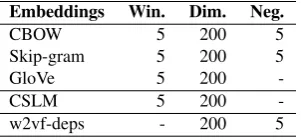
The word embeddings described in section 2. are estimated on the annotated Gigaword corpus, which is composed of over 4 billion words. It contains dependency parses used for training w2vf-deps embeddings, and the unlabeled ver-sion is used to train the other embeddings. Note that words occurring less than 100 times have been discarded, result-ing in a vocabulary size of 239K words. The parameter settings used in our experiments are summarized in Table2, their values have been selected based on previous studies (Levy and Goldberg, 2014; Ji et al., 2015; Gao et al., 2014; Levy et al., 2015).
Embeddings Win. Dim. Neg.
CBOW 5 200 5
Skip-gram 5 200 5
GloVe 5 200
-CSLM 5 200
-w2vf-deps - 200 5
Table 2: Parameters used for extracting the word embed-dings (window size, dimension, negative sampling)
1
https://code.google.com/p/word2vec/
The 5-gram NNLM used to compute the CSLM word em-beddings is composed of a projection layer of 800 units, corresponding to 200-dimensional word embeddings, two hidden layers of 1024 units each, and an output layer pro-viding probabilities for a short-list composed of the 16,384 most frequent words. The CSLM training process needed 16 hours and 30 minutes on a computer equipped with a NVIDIA Tesla K40 GPU card, while 8h was necessary for GloVe embeddings, 7h for Skip-gram, and about 3 hours and 30 minutes for CBOW.
4.2.
Experimental results of individual word
embeddings
4.2.1. NLP tasks
In this section, we report the performance of the different word embeddings on the four NLP tasks. A neural net-work classifier based on a multi-stream strategy is used to train the models. This architecture depicted in figure 1, was introduced by (Ghannay et al., 2015) for the ASR error detection task.
output
H2
H1-left H1-current H1-right
Wi-2 Wi-1 Wi Wi+1 Wi+2
Figure 1: Architecture of the NN used for experiment on NLP tasks
The first hidden layer has 300, 100 and 300 units for H1-left, H1-current and H1-right respectively. The second hid-den layer has 300 units. Activation functions are rectified linear units (relu) for the first layer andtanhfor the second one. The hyper-parameters, learning rate and batch size, are tuned over the validation set available for each task. The CHK, NER and MENT tasks are evaluated by com-puting F1 scores over segments produced by our models. The POS task is evaluated by computing per-word accu-racy. Theconllevalscript is used for evaluation (Mesnil, 2015). Last, the significance of our results is measured us-ing the 95% confidence interval.
Task POS CHK NER MENT Embeddings Acc. F1 F1 F1
CBOW 96.01 90.48 78.32 55.49
Skip-gram 96.43 89.64 77.65 57.80
GloVe 95.79 86.90 76.45 54.49
CSLM 96.24 90.11 76.20 57.34
w2vf-deps 96.66 92.02 79.37 58.06
Table 3: Performance of word embeddings on the NLP tasks.
data, which can be difficult to provide for resource-scarce languages which do not have dependency parsers.
Considering the simple embeddings, we observe that Skip-grams performs significantly better than CBOW and GloVe on POS and MENT tasks. However, for the other tasks CBOW achieves the best results. Lastly, these embeddings outperforms CSLM for all tasks.
4.2.2. Linguistic task 1: Analogical reasoning tasks
Subtask
CBO
W
Skip-gram
GloV
e
CSLM
w2vf-deps
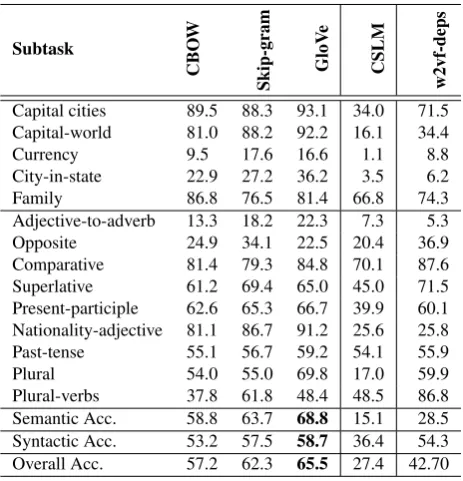
Capital cities 89.5 88.3 93.1 34.0 71.5
Capital-world 81.0 88.2 92.2 16.1 34.4
Currency 9.5 17.6 16.6 1.1 8.8
City-in-state 22.9 27.2 36.2 3.5 6.2
Family 86.8 76.5 81.4 66.8 74.3
Adjective-to-adverb 13.3 18.2 22.3 7.3 5.3
Opposite 24.9 34.1 22.5 20.4 36.9
Comparative 81.4 79.3 84.8 70.1 87.6
Superlative 61.2 69.4 65.0 45.0 71.5
Present-participle 62.6 65.3 66.7 39.9 60.1
Nationality-adjective 81.1 86.7 91.2 25.6 25.8
Past-tense 55.1 56.7 59.2 54.1 55.9
Plural 54.0 55.0 69.8 17.0 59.9
Plural-verbs 37.8 61.8 48.4 48.5 86.8
Semantic Acc. 58.8 63.7 68.8 15.1 28.5
Syntactic Acc. 53.2 57.5 58.7 36.4 54.3
Overall Acc. 57.2 62.3 65.5 27.4 42.70
Table 4: % Accuracy of various word embeddings on the evaluation set of analogical reasoning tasks.
We observe in table 4 that the different word embeddings yield a large range of accuracy on this task. The word em-beddings ranking obtained in the previous evaluation task is not preserved. Globally, GloVe achieves the best ac-curacy, followed by Skip-gram and CBOW embeddings. They achieve 65.5%, 62.3% and 57.2% of accuracy respec-tively. Thus, this result match those presented by (Penning-ton et al., 2014; Levy et al., 2015). While w2vf-deps and CSLM have respectively 43.1% and 27.4% of accuracy.
4.2.3. Linguistic task 2: Similarity task
Task WS353 RW MEN
CBOW 59.0 46.5 60.9
Skip-gram 55.8 50.2 66.2
GloVe 53.3 41.0 66.0
CSLM 47.8 43.4 48.2
w2vf-deps 52.3 43.5 55.7
Table 5: Performance of word embeddings on word simi-larity tasks.
Table 5 summarizes the performance of word embeddings on similarity tasks. As we can see, the results are in fa-vor of Skip-grams. In fact, it reaches the best results in two tasks, and based on confidence interval evaluation, it achieves nearly the same results as CBOW in WS353 task.
4.3.
Performance of combined word embeddings
The evaluation of the different word embeddings reported in section 4.2., shows that the best embbedings are w2vf-deps, Skip-gram and GloVe. Each of them is efficient on one task. However, building an effective word embedding remains an ultimate goal, which can be achieved by the combination of embeddings.
Based on state of-the-art studies, the combination of dif-ferent word embeddings takes advantage of their comple-mentarity and yields an improvement on different tasks: chunking, and named entity recognition as in (Turian et al., 2010). For instance, as shown above , the simple con-catenation of Brown clusters and word embeddings resulted in an improvement on chunking and named entity recog-nition. Moreover, in (Ghannay et al., 2015), we have in-vestigated the use of different approaches to combine 100-dimensional word embeddings: concatenation (Concat), PCA and auto-encoders (AutoE). In that work, we have shown that the combination with auto-encoders yields sig-nificant improvement on the ASR error detection task. Here, we propose to combine the simple word embeddings (CBOW, Skip-gram and GloVe) and the ones achieving the best results reported in section 4.2. (w2vf-deps, Skip-gram and GloVe), using the same approaches as in (Ghannay et al., 2015). The two combination sets are calledSimpleand Bestrespectively in the remainder of the paper.
The combination approaches are briefly detailed as follow:
Concat: For the first approach, we simply use the concate-nation of the three word embeddings types from each combination set. As a consequence, each word is rep-resented by a 600-dimensional vector.
PCA: For the second approach, the PCA technique is ap-plied to Concat embeddings. According to these em-beddings, the matrix composed of all words is first mean centering using Z-scores. The new coordinate system is then obtained computing PCA using the cor-relation method. The data is then projected onto the new basis considering only the first 200 components.
AutoE: Lastly, we investigate the use of ordinary auto-encoder (Vincent et al., 2008). This auto-auto-encoder is composed of one hidden layer with 200 hidden units each. It takes as input the Concat embeddings and as output a vector of 600 nodes. For each word, the vec-tor of numerical values produced by the hidden layer will be used as the combined word embedding.
The performance of the combined word embeddings are compared to the individual embeddings that it contains. Furthermore, the autoencoder is tuned on the dev corpus of NER task. In the following sections, the improvements are indicated in bold, whereas, based on confidence interval evaluation the significant ones are underlined.
4.3.1. NLP tasks
are nearly the same as the best individual ones. Moreover, they achieve the best results on most NLP tasks.
Task POS CHK NER MENT
Dim. Embeddings Acc. F1 F1 F1
Simple: Cbow-deps-Skip-GloVe
600 Simple-Concat 96.24 91.24 79.43 57.86
200 Simple-PCA 96.39 90.20 78.99 57.72
Simple-AutoE 95.99 89.59 78.44 57.76
Best: w2vf-deps-Skip-GloVe
600 Best-Concat 96.67 91.88 81.06 58.20
200 Best-PCA 96.45 90.13 79.66 60.22
Best-AutoE 96.64 91.35 80.43 60.39
Table 6: Performance of combined word embeddings on the NLP tasks.
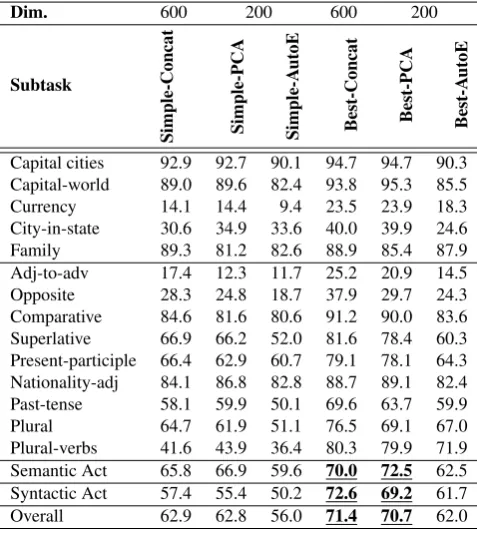
4.3.2. Linguistic task 1: Analogical reasoning task As shown in table 7, the significant improvements for this task are achieved by the combination of the best dings, through the concatenation and PCA. These embed-dings achieve respectively 71.4% and 70.7% of overall ac-curacy.
However, this is not the case for the Autoencoder combined word embeddings, which, achieve the lowest accuracy.
Dim. 600 200 600 200
Subtask
Simple-Concat Simple-PCA Simple-A
utoE
Best-Concat Best-PCA Best-A
utoE
Capital cities 92.9 92.7 90.1 94.7 94.7 90.3
Capital-world 89.0 89.6 82.4 93.8 95.3 85.5
Currency 14.1 14.4 9.4 23.5 23.9 18.3
City-in-state 30.6 34.9 33.6 40.0 39.9 24.6
Family 89.3 81.2 82.6 88.9 85.4 87.9
Adj-to-adv 17.4 12.3 11.7 25.2 20.9 14.5
Opposite 28.3 24.8 18.7 37.9 29.7 24.3
Comparative 84.6 81.6 80.6 91.2 90.0 83.6
Superlative 66.9 66.2 52.0 81.6 78.4 60.3
Present-participle 66.4 62.9 60.7 79.1 78.1 64.3
Nationality-adj 84.1 86.8 82.8 88.7 89.1 82.4
Past-tense 58.1 59.9 50.1 69.6 63.7 59.9
Plural 64.7 61.9 51.1 76.5 69.1 67.0
Plural-verbs 41.6 43.9 36.4 80.3 79.9 71.9
Semantic Act 65.8 66.9 59.6 70.0 72.5 62.5
Syntactic Act 57.4 55.4 50.2 72.6 69.2 61.7
Overall 62.9 62.8 56.0 71.4 70.7 62.0
Table 7: % Accuracy of various combined word embed-dings on the evaluation set of analogical reasoning tasks.
4.3.3. Linguistic task 2: Similarity task
Results on this task, as shown in table 8, are again in favor of the combination of the best embeddings. The concatena-tion and PCA combined embeddings yield results as good as the individual embeddings they contain on both WS353 and MEN tasks. However, among the combinations of the simple ones, the concatenation and PCA combined
embed-dings achieve an improvement respectively on WS353 and MEN tasks.
As in the analogical reasoning task, autoencoders result in lower performance. We have yet to find a definitive ex-planation to this behavior, but one conjecture is that the combination through autoencoders do not preserve the lin-ear structure of the embeddings which allow translations to represent linguistic and semantic properties.
Dim. Task WS353 RW MEN
Simple: Cbow-Skip-GloVe
600 Simple-Concat 60.2 48.0 65.0
200 Simple-PCA 57.4 49.6 66.9
Simple-AutoE 55.3 46.0 63.9
Best: w2vf-deps-Skip-GloVe
600 Best-Concat 57.0 48.6 69.4
200 Best-PCA 57.9 49.5 71.3
Best-AutoE 55.8 44.6 64.9
Table 8: Performance of combined word embeddings on word similarity tasks.
5.
Conclusions
In this paper, we perform a systematic comparison of major word embeddings impact on typical NLP tasks, as well as semantic and syntactic similarity tasks.
The evaluation results reported in this paper match those in the literature, since improvements achieved by one word embedding in a specific task are not observed in other tasks. We have confirmed that embeddings trained given depen-dency parses give the best performance on the NLP tasks. Thus, it is interesting to evaluate the performance of such embedding on the ASR error detection task. For the linguis-tic tasks, the results are in favor of the basic embeddings especially Skip-gram and GloVe. More, the basic embed-dings outperform CSLM on all tasks.
Furthermore, we have proven, that the combination of the embeddings yields significant improvement. This result corroborates a previous observation made in recent work on embeddings combination for ASR error detection (Ghan-nay et al., 2015).
In addition, results obtained by Best-PCA show that build-ing an effective word embeddbuild-ing that achieve good perfor-mance in almost all tasks, can be reached by the combina-tion of the efficient embeddings in each task through PCA. Finally, such combination performs poorly on intrinsic ana-logical reasoning tasks. This peculiar aspect, which seems to indicate that NLP systems do not make use of seman-tic regularities presented in embeddings, remains to be ex-plored in future work.
6.
References
Mohit Bansal, Kevin Gimpel, and Karen Livescu. 2014b. Tailoring continuous word representations for depen-dency parsing. InACL (2), pages 809–815.
Yoshua Bengio, R´ejean Ducharme, Pascal Vincent, and Christian Janvin. 2003. A neural probabilistic language model. volume 3, pages 1137–1155. JMLR.org, March. Elia Bruni, Gemma Boleda, Marco Baroni, and
Nam Khanh Tran. 2012. Distributional semantics in technicolor. InProceedings of the 50th Annual Meet-ing of the Association for Computational LMeet-inguistics (Volume 1: Long Papers), pages 136–145, Jeju Island, Korea, July. Association for Computational Linguistics. Ronan Collobert, Jason Weston, L´eon Bottou, Michael
Karlen, Koray Kavukcuoglu, and Pavel Kuksa. 2011. Natural Language Processing (Almost) from Scratch. volume 12, pages 2493–2537. JMLR.org.
Lev Finkelstein, Evgeniy Gabrilovich, Yossi Matias, Ehud Rivlin, Zach Solan, Gadi Wolfman, and Eytan Ruppin. 2001. Placing search in context: The concept revisited. In Proceedings of the 10th international conference on World Wide Web, pages 406–414. ACM.
Bin Gao, Jiang Bian, and Tie-Yan Liu. 2014. Wordrep: A benchmark for research on learning word representa-tions.CoRR, abs/1407.1640.
Sahar Ghannay, Yannick Est`eve, Nathalie Camelin, Camille Dutrey, Fabian Santiago, and Martine Adda-Decker. 2015. Combining continous word representa-tion and prosodic features for asr error predicrepresenta-tion. In3rd International Conference on Statistical Language and Speech Processing (SLSP 2015), Budapest (Hungary), November 24-26.
Eduard Hovy, Mitchell Marcus, Martha Palmer, Lance Ramshaw, and Ralph Weischedel. 2006. Ontonotes: the 90% solution. In Proceedings of the human language technology conference of the NAACL, Companion Vol-ume: Short Papers, pages 57–60. Association for Com-putational Linguistics.
Shihao Ji, Hyokun Yun, Pinar Yanardag, Shin Mat-sushima, and S. V. N. Vishwanathan. 2015. Wordrank: Learning word embeddings via robust ranking. CoRR, abs/1506.02761.
R´emi Lebret and Ronan Collobert. 2013. Word emdeddings through hellinger pca. arXiv preprint arXiv:1312.5542.
Omer Levy and Yoav Goldberg. 2014. Dependencybased word embeddings. In Proceedings of the 52nd Annual Meeting of the Association for Computational Linguis-tics, volume 2, pages 302–308.
Omer Levy, Yoav Goldberg, and Ido Dagan. 2015. Im-proving distributional similarity with lessons learned from word embeddings. Transactions of the Association for Computational Linguistics, 3:211–225.
Minh-Thang Luong, Richard Socher, and Christopher D Manning. 2013. Better word representations with recur-sive neural networks for morphology. CoNLL-2013, 104. Mitchell P Marcus, Mary Ann Marcinkiewicz, and Beatrice Santorini. 1993. Building a large annotated corpus of english: The penn treebank. Computational linguistics, 19(2):313–330.
Gr´egoire Mesnil, Yann Dauphin, Kaisheng Yao, Yoshua Bengio, Li Deng, Dilek Hakkani-Tur, Xiaodong He, Larry Heck, Gokhan Tur, Dong Yu, et al. 2015. Us-ing Recurrent Neural Networks for Slot FillUs-ing in Spoken Language Understanding. Audio, Speech, and Language Processing, IEEE/ACM Transactions on, 23(3):530–539. Gr´egoire Mesnil. 2015. Recurrent Neural Networks with Word Embeddings DeepLearning 0.1 documentation. http://www.deeplearning.net/tutorial/rnnslu.html#rnnslu. Tomas Mikolov, Kai Chen, Greg Corrado, and Jeffrey Dean. 2013a. Efficient estimation of word representa-tions in vector space. In Proceedings of Workshop at ICLR.
Tomas Mikolov, Ilya Sutskever, Kai Chen, Greg S Cor-rado, and Jeff Dean. 2013b. Distributed representations of words and phrases and their compositionality. In Ad-vances in neural information processing systems, pages 3111–3119.
Jeffrey Pennington, Richard Socher, and Christopher D Manning. 2014. Glove: Global vectors for word rep-resentation. In Proceedings of the Empiricial Methods in Natural Language Processing (EMNLP 2014), vol-ume 12.
Holger Schwenk. 2007. Continuous space language mod-els. Computer Speech & Language, 21(3):492–518. Holger Schwenk. 2013. CSLM-a modular open-source
continuous space language modeling toolkit. In INTER-SPEECH, pages 1198–1202.
Erik F Tjong Kim Sang and Sabine Buchholz. 2000. In-troduction to the conll-2000 shared task: Chunking. In Proceedings of the 2nd workshop on Learning language in logic and the 4th conference on Computational natu-ral language learning-Volume 7, pages 127–132. Asso-ciation for Computational Linguistics.
Erik F Tjong Kim Sang and Fien De Meulder. 2003. In-troduction to the conll-2003 shared task: Language-independent named entity recognition. In Proceedings of the seventh conference on Natural language learning at HLT-NAACL 2003-Volume 4, pages 142–147. Associ-ation for ComputAssoci-ational Linguistics.
Joseph Turian, Lev Ratinov, and Yoshua Bengio. 2010. Word representations: a simple and general method for semi-supervised learning. InProceedings of the 48th an-nual meeting of the association for computational lin-guistics, pages 384–394. Association for Computational Linguistics.