Coreference Resolution in FreeLing 4.0
Montserrat Marimon
∗, Llu´ıs Padr´o
†, Jordi Turmo
† ∗Universitat Pompeu Fabra. Barcelona, Spain.†TALP Research Center.
Universitat Polit`ecnica de Catalunya. Barcelona, Spain. {padro,turmo}@cs.upc.edu
Abstract
This paper presents the integration of RelaxCor into FreeLing. RelaxCor is a coreference resolution system based on constraint satisfaction that ranked second in the CoNLL-2011 shared task. FreeLing is an open-source library for NLP with more than fifteen years of existence and a widespread user community. We present the difficulties found in porting RelaxCor from a shared task scenario to a production enviroment, as well as the solutions devised. We present two strategies for this integration and a rough evaluation of the obtained results.
Keywords:FreeLing, Coreference Resolution, CoNLL-2011, relaxation labeling
1.
Introduction
FreeLing1is an open-source multilingual language
process-ing library providprocess-ing a wide range of analysis functionali-ties for several languages.
The project is conceived as a library that can be called from a user application in need of analysis services. The software is open-source, distributed under an GNU Affero General Public License2, and dual-licensed to companies that
em-bed it in their commercial products or online services. The open-source approach has been very fruitful during the fifteen years of life of the project (the first version was re-leased on 2003). The amount of accumulated downloads during this time is over 200,000. Contributions from the user community combined with the increasing availability of open source language resources has made it possible to extend the number of supported languages from three (En-glish, Spanish and Catalan) to fourteen (adding German, French, Italian, Portuguese, Russian, Norwegian, Asturian, Welsh, Galician, Croatian and Slovene).
FreeLing offers a wide variety of language processing mod-ules, though not all modules are available for all languages. Most relevant modules are: Language identification, tok-enization and sentence splitting, lemmatization, date/time detection, numbers detection, multiword expressions detec-tion, physical magnitudes detecdetec-tion, named entity recogni-tion and classificarecogni-tion, PoS tagging, SAMPA phonetic en-coding, word sense disambiguation, shallow parsing, con-stituency parsing, dependency parsing, semantic role la-belling, coreference resolution, semantic graph extraction, and document summarization.
More details about the FreeLing project can be found in (Padr´o and Stanilovsky, 2012) and in the online documen-tation in the project website.
One remarkable extension in version 4.0 was the inclu-sion of a Coreference Resolution module, based on Relax-Cor, the second-ranked system in CoNLL-2011 shared task
1http://nlp.lsi.upc.edu/freeling 2
http://www.gnu.org/copyleft/agpl.html
(Sapena et al., 2011).
However, academic shared tasks have a very specific sce-nario, which does not necessarily match the real-world set-tings in which a system like FreeLing is required to operate. Thus, considerable efforts must be devoted to the integra-tion of a module successful in the laboratory, such as Re-laxCor, in a production pipeline.
In this paper we describe how this coreference resolution module was integrated in FreeLing (for English and Span-ish), as well as the encountered obstacles and solutions de-vised. We also present an alternative configuration for Re-laxCor using hand-written constraints instead of the auto-matically learnt constraints used in CoNLL shared task. The next section briefly summarizes related work. Sec-tion 3. overviews the basic idea behind RelaxCor and the main difficulties presented by its integration in FreeLing. Sections 4. and 5. describe an alternative set of hand-written constraints and compare its performance with the machine-learned model. Finally, Section 6. concludes.
2.
Related Work
There are several open-source suites other than FreeL-ing that offer state-of-the-art level NLP functionalities. The most remarkable, for being open-source, widely used and offering a set of functionalities comparable to FreeL-ing are: Stanford CoreNLP (Manning et al., 2014), Apache OpenNLP3, NLTK (Bird et al., 2009) and IXA
Pipes (Agerri et al., 2014).
There are also other systems of NLP-related software, such as GATE or UIMA, which are not language analy-sis pipelines themselves, but architectures or frameworks to integrate existing components.
The above mentioned suites largely differ with respect to the used programming language, offered APIs, processing speed, supported languages, customization or retraining ca-pabilities, whether they are more developer-oriented or
user oriented, etc. Thus, a detailed comparison is out of the scope of this paper.
Regarding coreference resolution, Stanford CoreNLP in-cludes an updated version of the first-ranked system in CoNLL 2011 shared tasks, supporting English and Chinese. Apache OpenNLP offers a basic support for English. IXA Pipes do not ship a coreference resolution module out-of-the-box, but third-party provided modules are available for Spanish and English. Finally, the latest FreeLing version offers coreferences for Spanish and English.
The first attempt to establish a common evaluation frame-work for coreference systems was carried out in SemEval 2010 (Recasens et al., 2009), which offered data sets for 6 languages (including English and Spanish). Later, CoNLL-2011 and CoNLL-2012 shared tasks (Pradhan et al., CoNLL-2011; Pradhan et al., 2012) proposed similar tasks that have been a reference framework since then. The 2011 edition in-cluded only English, and was won by Stanford rule-based system (Lee et al., 2013). The 2012 edition included En-glish, Arabic, and Chinese, and was won by a neural net-work based system (Fernandes et al., 2012), which has been the main trend in the state of the art since then.
3.
Integration of RelaxCor into FreeLing
3.1.
RelaxCor
RelaxCor is a coreference resolution system based on con-straint satisfaction. The coreference resolution problem is represented as a graph with mentions in the vertices which are connected to each other by edges. Edges are assigned a weight that indicates the confidence whether the mention pair corefers or not. More specifically, an edge weight is the sum of the weights of the constraints that apply to that mention pair.
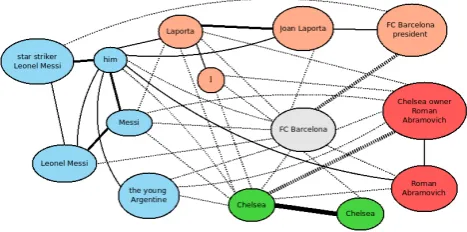
The knowledge used by the system is encoded in con-straints, each of which has a confidence score. The larger the score absolute value, the more reliable the constraint is and the stronger effect when applied. The sign of the con-straint confidence score indicates whether a pair or a group of mentions may corefer (positive) or not (negative). Only constraints over pairs of mentions are used in the current version of RelaxCor, though the model can handle higher-order constraints. Constraints and their confidence scores can be obtained from any source, including manual encod-ing or automatic acquisition from a trainencod-ing corpus. Figure 3.1. shows (a simplified version of) the graph corre-sponding to the text:
FC Barcelona president Joan Laporta has warned Chelsea off star striker Leonel Messi. Aware of Chelsea owner Roman Abramovich’s interest in the young Argentine, Laporta said last night: ”I will answer as always, Messi is not for sale and we do not want to let him go.”
Constraints are applied to every pair of mentions in the text, and a compatibility score for that pair is computed (repre-sented by edges in the graph). Many pairs remain uncon-nected if constraints find no evidence neither for nor against joining them. The algorithm will partition the graph, keep-ing together pairs with high compatibility and settkeep-ing apart nodes with negative scores.
Figure 1: Graf produced from example text. Dotted lines represent negative compatibility scores. Solid lines repre-sent positive scores. Line thickness is proportional to score absolute value. Colors represent the final groups created.
For instance, constraints assign large negative value to nodes corresponding to named entities of different classes (person and organization entities in this example), and large positive values to nodes of the same kind with similar names (e.g. Both mentions ofChelsea, orMessiandLeonel Messi). There are also nodes such ashimthat are compat-ible with many mentions, and the final decision depends both on the strength of their connections, and the conec-tions among their neighbors (e.g.himnot only has stronger connections withMessiandstar striker Leonel Messi, but they both also share a strong connection withLeonel Messi, which reinforces all of them gluing together).
RelaxCor uses relaxation labeling for the resolution pro-cess. Relaxation labeling is an iterative algorithm that per-forms function optimization based on local information. It has been widely used to solve a variety of NLP problems. A vector of probability values is maintained for each ver-tex/mention. Each vector element corresponds to the prob-ability that the mention belongs to a specific entity among the potential entities in the document. During the resolu-tion process, the probability values are updated according to the edge weights and probability vectors of the neigh-boring vertices. The larger the edge weight, the stronger the influence exerted by the neighboring distributions. The process stops when there are no more changes in the prob-ability vectors.
The relaxation labeling approach combines mention pair classification and linking in one step. Thus, decisions are taken considering the entire set of mentions, which ensures consistency and avoids local classification decisions. Mentions are modeled as feature sets, and contain a variety of information (gender, number, person, PoS, sense, etc). Constraints use these features to establish a compatibility value among pairs of mentions (e.g. Two mentions with different gender will have a negative compatibility. Men-tions that are pronouns and have the same person, gender, and number will have a positive compatibility, etc.). Note that semantic and syntactic information can also be used in the constraints.
RelaxCor works can be found in (Sapena et al., 2013). We selected RelaxCor as the coreference resolution module to be integrated in FreeLing for the following reasons
• It was developed in UPC, so FreeLing team has a deep understanding of the algorithm and the code, which eases the portability. Also, the underlying algorithm is Relaxation Labelling which was already part of FreeL-ing, since it is used by one of the PoS taggers. • RelaxCor uses a very general approach: The problem
is modeled in terms of graph vertices encoded as fea-ture sets and constraints among them, which makes it easy to adapt the code for new languages or even for new tasks.
• The constraint-based approach allows the addition of new languages with a relatively low cost: If no training data is available to use machine learning techniques, constraint can be hand-encoded as presented in this paper.
3.2.
Integration Issues
Coreference Resolution is a complex NLP tasks, since it requires a lot of information from previous analysis steps: Tagging and parsing are required to identify candidate men-tions and to discover syntactic relamen-tions among them that are relevant to the task (e.g. appositions, relative clauses, etc.). Named Entity detection and classification is also cru-cial to establish whether two names may refer to the same entity. Word sense disambiguation and Semantic Role La-belling also provide relevant information in some cases. This large amount of dependences largely increases the dif-ficulty of integrating a module developed in one specific scenario into a production pipeline, each with its own set-tings and dependences.
Some relevant issues that we had to take into account are:
• The input data in CoNLL-2011 shared task follows tokenization conventions that not necessarily match those used by FreeLing.
• The input data in CoNLL-2011 shared task uses a PoS tagset that has some differences with that used by FreeLing.
• The input data in CoNLL-2011 shared task contains a gold constituency parse which can be used to de-tect mentions. The module integrated in FreeLing will have to resort to the output of its own parser, which not only will contain errors, but also uses different labels and syntactic structures.
• The constituency parser in FreeLing is rule based and uses a simple strategy. Thus, it does not perform at the same accuracy level as a statistical parser.
• The input data in CoNLL-2011 shared task contains speaker information in some dialog documents, but FreeLing has no dialog or speaker detection module.
To tackle with these issues, we took the following integra-tion decisions:
• To build two mention detectors:
– Another one based on dependency trees, that would use the output of FreeLing statistical de-pendency parser, which offers more robust and accurate results. This detector follows FreeLing linguistic team criteria to establish what a can-didate mention is, which are not necessarily the same followed in CoNLL shared tasks.4
• To adapt the mention feature extraction, as well as the syntactic checks required by some constraints, to FreeLing PoS tagset and syntactic labels and struc-tures. Note that this had to be done twice: for con-stituency trees and for dependency trees.
• To taylor the train/development/test corpus to match FreeLing tokenization criteria. We ported the corefer-ence annotations to the corpus retokenized according to FreeLing criteria, and we excluded from the cor-pus those documents where unsolvable retokenization clashes prevented the safe mapping of the gold anno-tations.
• To exclude dialog documents with speaker informa-tion from the corpus.
4.
Coreference Resolution in FreeLing
As mentioned in section 3.2. we integrated in FreeLing two versions of RelaxCor: One using constituency parsing to detect mentions and to extract syntactic information and the other using dependency parsing.
4.1.
Constituency parsing version
The constituency parsing based module consists of a straightforward translation of the original RelaxCor from Perl to C++, adapting PoS tagset, constituent labels and syntactic structures. The goal was to have a FreeLing module that could use machine learning models learned on the CoNLL shared task, to avoid costly re-training and parameter-tuning procedures. Given differences between the criteria used in the training corpus and the output of FreeLing preprocessing stages, we expect this module to perform worse once integrated in FreeLing than it did in the shared task, so we will consider it as a baseline.
4.2.
Dependency parsing version
The dependency parsing based module uses more accurate parsing trees, raising the quality of mention detector and syntactic information used in constraints. Since constituent information is not available here, originally trained mod-els can not be used. One option would be retraining the module using a corpus adapted to the new criteria, which would require a costly re-annotation effort. Thus, we opted by developing a set of hand written constraints, inspired on the approach proposed in (Lee et al., 2013), the winner sys-tem in CoNLL-2011, that defines ten sieves of decreasing precision rules, applied in a cascaded schema.
4
In our case, relaxation labeling applies all constraints si-multaneously, thus we need to emulate the cascading us-ing compatibility scores of different ranges (e.g. more re-leable rules have scores around 50, while less precise con-straints have scores about 5–10), so that higher-precision rules overweight any contradicting lower-precision rule. In addition, our model does not follow an entity-mention ap-proach but a mention-pair apap-proach, thus some sieves can be only approximated. Finally, we need to add some de-fault rules that favor the creation of singletons in absence of strong enough coreference evidence, to avoid ending in trivial solutions where all mentions belong to the same group.
Next, we overview the sieves proposed by Stanford and present a few samples of the rules we encoded in each of them:
• Sieve 1: Mentions with the same speaker in dialog documents or when direct speech is used. We only deal with the later, since no speaker identification is available in FreeLing.
Sample rules:
+50 if both mentions are personal pronoun “I” and both are inside the object of the same reporting verb (say,tell,ask, etc.) or inside the same quo-tation.
-25 if one mention is a personal pronoun and the other is not the same pronoun and both are inside the object of the same reporting verb, or inside the same quotation.
• Sieves 2–3: Mentions containing the same text (either the whole mention or up to the head word).
Sample rules:
+50 if both mentions are of the same type (named en-tity, pronoun, noun phrase), not nested in one an-other and their texts match completely.
+25 if both mentions are of the same type and their texts match up to the head word.
• Sieve 4: Mentions appearing in specific constructions (e.g. relative clauses, appositions and predicative con-structions).
Sample rules:
+50 if both mentions are in apposition.
+50 if both mentions are in a predicative structure. +50 if one mention is a relative pronoun and has the
other as syntactic antecedent.
• Sieves 5–7: Mentions that have the same head, or the head of one matches some word in the other.
Sample rules:
+25 if one mention is a named entity or noun phrase, the other is not a pronoun, they have the same head and their modifiers are compatible.
• Sieves 8–9: Mentions headed by the same proper name.
Sample rules:
+50 if both mentions are named entities and they have the same head and the same semantic class.
• Sieve 10: Pronominal coreference.
Sample rules:
+15 if one mention is a 3rd-person, non-relative pro-noun, the other is a named entity or noun phrase, they have morphological agreement and they belong to compatible semantic classes (person, man, woman, non-person, organization, loca-tion).
Since the used features and rules are very general, we also evaluated their performance on Spanish, using the anno-tated corpus provided by SemEval-2010 Task 1 (Recasens et al., 2009). After adapting the lexicon and syntactic cri-teria used by the features and rules, we obtained a corefer-ence resolution system with a performance comparable to our version for English.
5.
Experiments and Results
In this section we present the experimental setting we used to roughly evaluate the results of the integration.
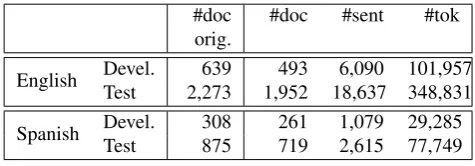
We evaluated two systems: (1) the original RelaxCor ported to C++, using the output of FreeLing constituency parser and the original model trained on CoNLL-2011 data, and (2) the alternative version, using the output of FreeLing de-pendency parser and hand-written rules. Both systems were also applied to Spanish (after adapting configuration files with relevant lexica, PoS tags, syntactic labels, etc). The used data was a subset of CoNLL-2012, excluding documents containing dialogs or severe tokenization mis-matches (accounting for about 16-17% of the documents). The original CoNLL-2012 test and development sections were used as development corpus for the hand-written rules, and the train section of CoNLL-2012 was used as test. See Table 1 for a summary of corpus sizes.
#doc orig.
#doc #sent #tok
English Devel. 639 493 6,090 101,957 Test 2,273 1,952 18,637 348,831
Spanish Devel. 308 261 1,079 29,285 Test 875 719 2,615 77,749
Table 1: Sizes of the used development and test corpus. Column#doc origshows the number of documents in the original CoNLL corpus. The other columns show the sizes of the corpus after filtering dialog documents and tokeniza-ton mismatches.
Table 2 shows the results for both developed versions com-puted using the latest version (v8.01) of official CoNLL-2012 scorer. Rows markedMDpresent mention detection scores. Other rows present different performance metrics, including CoNLL-2011 and 2012 official metrics (average of MUC,B3, and CEAF-e).
Several issues must be taken into account when interpreting the results:
Constituency parsing, ML constraints Dependency parsing, hand-written constraints
English Spanish English Spanish
Corpus Metric R P F1 R P F1 R P F1 R P F1
MD 65.80 62.87 64.30 28.55 55.90 37.80 66.66 64.97 65.80 55.85 62.05 58.79
MUC 54.76 49.37 51.93 19.80 41.91 26.89 52.48 54.30 53.38 36.98 43.89 40.14 B3 41.12 28.06 33.36 15.60 42.53 22.83 36.88 45.58 40.77 34.81 44.72 39.15 Devel. CEAF-m 39.18 37.45 38.29 24.12 47.22 31.93 46.60 45.42 46.00 45.07 50.07 47.44 CEAF-e 28.54 33.89 30.98 22.80 38.58 28.66 43.42 35.62 39.13 46.73 45.81 46.27 BLANC 42.69 28.20 32.01 10.34 31.65 15.59 40.44 48.36 42.63 27.40 36.30 31.06
CoNLL 41.47 37.10 38.75 19.40 41.00 26.12 44.26 45.16 44.42 39.50 44.80 41.85
MD 57.57 54.25 55.86 28.07 52.73 36.64 59.81 57.35 58.56 59.08 60.64 59.85
MUC 43.46 38.48 40.82 19.46 39.89 26.16 45.67 46.64 46.15 38.99 42.57 40.70 B3 35.04 27.92 31.08 15.40 39.76 22.20 36.16 42.31 39.00 35.76 42.68 38.91 Test CEAF-m 38.60 36.40 37.47 24.02 45.14 31.36 46.22 44.32 45.25 46.25 47.47 46.86 CEAF-e 29.23 32.95 30.98 22.46 35.65 27.56 42.97 35.74 39.02 48.03 43.55 45.68 BLANC 35.48 23.26 27.50 10.41 31.04 15.59 33.74 39.37 35.30 29.21 34.01 31.21
CoNLL 35.91 33.11 34.29 19.10 38.43 25.30 41.60 41.56 41.39 40.92 42.93 41.76
Table 2: Results of both RelaxCor integration strategies for English and Spanish.
• The machine-learning version was trained on CoNLL-2011 data, and is being evaluated on CoNLL-2012.
• Criteria used in the hand-written rule version to define which mentions are considered singletons are different from those used in CoNLL data.
• Our hand-written rules mark some coreferences (e.g. relative pronouns or predicative noun phrases) that are not marked in CoNLL data.
For all this, results presented here can not be compared to the state-of-the-art in CoNLL shared tasks, but only taken as a self-contained evaluation.
From this point of view, results show that both English models get a similar score on mention detection. Regarding the final coreference score, the distance between the train-ing and test scenarios severely hampers the accuracy of the machine-learned models, while the hand-written model, be-ing developed and tested in the target corpus, obtains sig-nificantly higher scores.
When applying the models to Spanish, the machine-learned model suffers a big drop in both measures, as one would ex-pect. But the manual model –more easily tunable–, obtains results for Spanish in the same range than English.
6.
Conclusions and Further Work
We have presented two strategies to integrate RelaxCor –a coreference resolution system developed for CoNLL-2011 shared task– into FreeLing. We have discussed encoun-tered problems and solutions undertaken. We used pre-trained machine-learned models, as well as hand-written constraints, and evaluated the results. Even the evaluation is not comparable to the state of the art given the differences in the used corpus and criteria, we believe that the provided modules will be useful to FreeLing users.
There are still open lines to pursue: The machine learning version could be retrained and tested on an adapted version of CoNLL-2012. Constraint compatibility scores for hand-written rules could be automatically assigned using a train-ing corpus. The utility of the modules could be assessed via
indirect evaluation. Finally, the hand-written model could be adapted to other languages in FreeLing.
7.
Acknowledgements
This research was partially funded by the Spanish Govern-ment via project Graph-MED (TIN2016-77820-C3-3-R).
8.
Bibliographical References
Agerri, R., Bermudez, J., and Rigau, G. (2014). IXA pipeline: Efficient and ready to use multilingual NLP tools. In Proceedings of the 9th Language Resources
and Evaluation Conference (LREC), Reykjavik, Iceland,
May.
Bird, S., Loper, E., and Ewan, K. (2009). Natural
Lan-guage Processing with Python. O’Reilly Media Inc.
Fernandes, E., dos Santos, C., and Milidi´u, R. (2012). La-tent structure perceptron with feature induction for un-restricted coreference resolution. InJoint Conference on
EMNLP and CoNLL - Shared Task, pages 41–48.
Asso-ciation for Computational Linguistics.
Lee, H., Chang, A., Peirsman, Y., Chambers, N., Surdeanu, M., and Jurafsky, D. (2013). Deterministic corefer-ence resolution based on entity-centric, precision-ranked rules.Computational Linguistics, 4(39):885–916. Manning, C. D., Surdeanu, M., Bauer, J., Finkel, J.,
Bethard, S. J., and McClosky, D. (2014). The Stanford CoreNLP natural language processing toolkit. In Pro-ceedings of the 52nd Annual Meeting of the Association
for Computational Linguistics: System Demonstrations,
pages 55–60.
Padr´o, L. and Stanilovsky, E. (2012). Freeling 3.0: To-wards wider multilinguality. InProceedings of the Lan-guage Resources and Evaluation Conference (LREC 2012), Istanbul, Turkey, May. ELRA.
Proceedings of the Fifteenth Conference on
Computa-tional Natural Language Learning: Shared Task, pages
1–27. Association for Computational Linguistics. Pradhan, S., Moschitti, A., Xue, N., Uryupina, O., and
Zhang, Y. (2012). Conll-2012 shared task: Modeling multilingual unrestricted coreference in ontonotes. In
Joint Conference on EMNLP and CoNLL - Shared Task,
CoNLL ’12, pages 1–40, Stroudsburg, PA, USA. Asso-ciation for Computational Linguistics.
Recasens, M., Mart´ı, T., Taul´e, M., M`arquez, L., and Sapena, E. (2009). Semeval-2010 task 1: Coreference resolution in multiple languages. SEW-2009 Semantic Evaluations: Recent Achievements and Future Direc-tions.
Sapena, E., Padr´o, L., and Turmo, J. (2010). Relaxcor: A global relaxation labeling approach to coreference reso-lution. InProceedings of the 5th International Workshop
on Semantic Evaluation, pages 88–91. Association for
Computational Linguistics.