K-SRL: Instance-based Learning for Semantic Role Labeling
Alan Akbik IBM Research Almaden 650 Harry Road, San Jose
CA 95120, USA [email protected]
Yunyao Li IBM Research Almaden 650 Harry Road, San Jose
CA 95120, USA [email protected]
Abstract
Semantic role labeling (SRL) is the task of identifying and labeling predicate-argument structures in sentences with semantic frame and role labels. A known challenge in SRL is the large num-ber of low-frequency exceptions in training data, which are highly context-specific and difficult to generalize. To overcome this challenge, we propose the use ofinstance-based learningthat performs no explicit generalization, but rather extrapolates predictions from the most similar in-stances in the training data. We present a variant ofk-nearest neighbors(kNN) classification with composite features to identify nearest neighbors for SRL. We show that high-quality predictions can be derived from a very small number of similar instances. In a comparative evaluation we experimentally demonstrate that our instance-based learning approach significantly outperforms current state-of-the-art systems on both in-domain and out-of-domain data, reaching F1-scores of 89,28% and 79.91% respectively.
1 Introduction
Semantic role labeling (SRL) is the task of annotating predicate-argument structures in sentences with shallow semantic information. One prominent labeling scheme for the English language is the Proposi-tion Bank (Palmer et al., 2005), which annotates predicates withframelabels and arguments withrole
labels (see Figure 1 for examples). Frame labels disambiguate the predicate meaning in the context of the sentence. Role labels roughly correspond to simple questions (who, when, how, why, with whom) with regards to the disambiguated predicate. SRL has been found useful for a wide range of applications such as information extraction (Fader et al., 2011), question answering (Shen and Lapata, 2007; Maqsud et al., 2014) and machine translation (Lo et al., 2013).
Current state-of-the-art SRL approaches train classifiers with bags of features (Johansson and Nugues, 2008; Bj¨orkelund et al., 2009; Choi and Palmer, 2011) to predict semantic labels for each constituent in a sentence. These approaches typically employ classifiers such as logistic regression or SVM that learn for each feature a measure of impact on the classification decision and abstract away from local contexts in specific training examples.
Local bias. We argue that such approaches are not ideal for SRL due to a strong local bias of features within specific contexts. Low-frequency examples in SRL are often not noise to be abstracted away, but rather correspond to exceptions that require explicit handling.
For example, consider the task of argument labeling: Arguments that are syntactically realized as passive subjects are typically labeled A11. However, there exist numerous low-frequency exceptions to this rule. For instance, passive subjects of certain frames (such as the frame TELL.01) are most
commonly labeled A2. See Figure 1 for an example. Other examples of local bias include different types of diathesis alternation which affect specific frames and argument types (Kipper et al., 2008), the syntactic realization of higher order roles (A2 to A5) which is highly irregular among frames (Palmer et al., 2005), and the realization of roles in non-agentive frames. These phenomena are observed only in specific and often low-frequency contexts of composite features, but are highly relevant to SRL.
1This corresponds to the linguistic intuition that active subjects are commonly thematicagents, while direct objects and passive subjects are most commonly the thematicpatientorthemeof a frame (van der Plas et al., 2014)
SELL.01
A0: seller (agent) A1: thing sold (patient) A2: buyer (recipient) A3: price paid
TELL.01
A0: speaker (agent) A1: utterance (topic) A2: hearer (recipient) The silver was sold by the man.
SBJ VC PMOD NMOD
a) Passive subject
A1
VC
Creditors were told to hold off.
SBJ
ORPD IM PRT
b) Passive subject of TELL.01
[image:2.595.74.527.61.114.2]A2
Figure 1: Example sentences with a passive subject (underlined). Passive subjects are typically labeledA1(e.g. Sentence a), but there are exceptions to this rule (e.g. frameTELL.01 in Sentence b).
STATEMENT COMPOSITE SUPPORT
(1) 57% of all subjects are labeledA0 P 17,788 instances (2) 33% of all subjects are labeledA1 P 17,788 instances (3) 74% ofactivesubjects are labeledA0 P+V 13,737 instances (4) 86% ofpassivesubjects are labeledA1 P+V 4,051 instances (5) 100% of passive subjects ofSELL.01 are labeledA1 P+V+F 137 instances
(6) 88% of passive subjects ofTELL.01 are labeledA2 P+V+F 53 instances
Table 1: Observations based on CoNLL09 training data: The more atomic features we include in a composite, the more discriminative (and descriptive) it becomes, but generally with lower support.
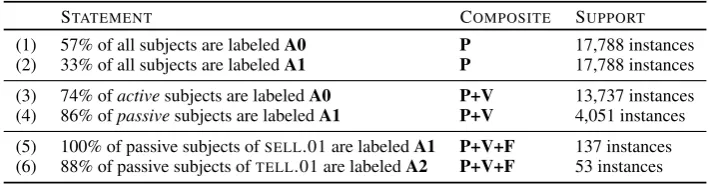
Feature contexts. We propose to explicitly capture local bias with feature contexts by constructing composites of standard SRL features. Refer to Table 1 for a list of observations over the CoNLL09 shared task gold data (Hajiˇc et al., 2009) for different numbers of features combined into composites: Statements 1 and 2 involve only the syntactic path feature P that models the syntactic function of an argument. Statements 3 and 4 use a composite feature of P and V, the predicate voice feature (either
activeorpassive). Finally, statements 5 and 6 use a composite feature of P, V and F, the specific frame context.
We make three observations in Table 1: First, the more atomic features we include in a composite feature, the more discriminative it becomes and the more explicitly it captures local bias. For instance, statement 6 is a composite of three atomic features and explicitly captures the exception for passive sub-jects ofTELL.01 discussed earlier. Second, higher order composite features tend to have lower support
(i.e. number of training examples that share this combination of atomic features). The use of composite features can therefore aggravate sparsity issues in training data. Finally, since composite features make the interplay of features explicit, they can be rendered as human readable statements. Classification decisions using such features can be easily interpretable for error analysis and extension.
Instance-based Learning for SRL Based on these observations, we propose to useinstance-based learning(Aha et al., 1991; Daelemans and Van den Bosch, 2005) for SRL. Such learning does not ab-stract away from specific feature contexts, but rather considers the overall similarity of a test instance to instances in the training data. It has been shown to be applicable to a range of NLP tasks such as PoS tagging (Daelemans et al., 1999), dependency parsing (Nivre et al., 2004) and word sense disambigua-tion (Veenstra et al., 2000). The arguably most well-known approach of this kind isk-nearest neighbors
classification (kNN) in which the class label is determined as the majority label of the k most similar training examples (Cover and Hart, 1967).
We propose to identify nearest neighbors using composite features, i.e. instances that share the most similar combination of atomic features. We use a function to assign to each composite of atomic features a discrete distance value, effectively rendering the search for nearest neighbors as a search within a
Parzenwindow (Parzen, 1962). The variablekrepresents the minimum support within this window that we require.
Figure 2 illustrates our proposed approach: To classify the underlined argument in the sample sentence, we search for nearest neighbors using composite features. A distance 1 composite feature consists of P+V+F and AL, the lemma of the argument head. Nearest neighbors at this distance are therefore all training instances in which “creditor” is a passive subject ofTELL.01. As the diagram on the right hand
side in Figure 2 shows, this finds only one match, labeledA2, which is below the minimum supportk
[image:2.595.121.476.154.246.2]A2 A2 A2A2
A1
A0
A1 A1
A2
A1 A1 A1
A1 A1
A0
A0 A1
?
A0 A2
1 2 3 n
distance
b) Find smallest window with at least k instances – extrapolate majority label of all instances in window
Creditors were told to hold off.
SBJ
ORPD VC
IM PRT
“creditor” passive subject of TELL.01
noun passive subject of TELL.01
any passive subject of any agentive verb
COMPOSITE FEATURE DISTANCE
1
2
n .
. .
. . .
a) Extract composite features for distance function
[image:3.595.90.481.94.221.2]?
Figure 2: Example of argument labeling with nearest neighbor classification and a composite feature distance function.
restriction on composites features. Nearest neighbors at this distance are all passive subjects ofTELL.01
in the training data. As the diagram shows, there are six nearest neighbors within a distance 2 window. From this neighborhood, we extrapolate the labelA2as prediction.
Contributions We propose a simple and highly effective instance-based learning model for semantic role labeling2. We develop anearest k-windowvariant of kNN in which we use a composite feature dis-tance function to explicitly capture local contexts in sparse data. We give a full description of our SRL system, dubbed K-SRL, motivate and illustrate the atomic and composite features we use, and describe an easy-first algorithm for modeling global argument labeling constraints (Section 2). We present a de-tailed experimental evaluation that shows that our proposed approach significantly outperforms existing state-of-the-art systems (Section 3).
2 Instance-based Learning for SRL
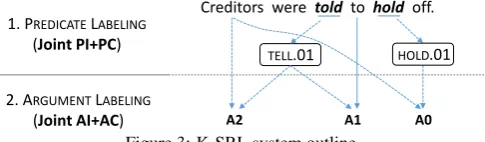
We use instance-based learning for SRL as a sequence of two classification tasks: First, joint predicate identification and classification (referred to as predicate labeling), followed by joint argument identi-fication and classiidenti-fication (referred to asargument labeling). See Figure 3 for an illustration. In this section, we describe the proposed nearestk-window classifier (Section 2.1) and discuss the specific fea-tures used (Sections 2.3 and 2.2), before presenting how we include global constraints into argument labeling (Section 2.4).
1. PREDICATELABELING
(Joint PI+PC)
2. ARGUMENTLABELING
(Joint AI+AC)
Creditors were told to hold off.
TELL.01
A2 A1 A0
HOLD.01
Figure 3: K-SRL system outline.
2.1 Nearestk-Window Classification
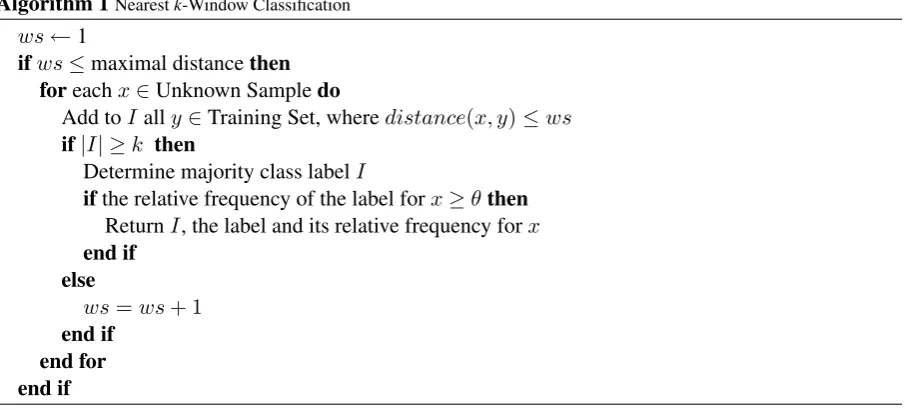
Algorithm 1 outlines our nearestk-window classification algorithm. It takes as input unlabeled instances and performs feature extraction. A distance function assigns each feature an integer distance value, with 1 as the closest distance. The search for nearest neighbors begins with a window of distance 1. The algorithm retrieves for each unlabeled sample all training examples whose distance from the current sample lie within this window. If the window contains fewer thanktraining instances, we increase the window size until it passes a threshold. Among the instances in the window, the algorithm determines
[image:3.595.177.420.528.599.2]the relative frequencies of each label. For instance, if the window contains 10 similar instances of which 9 are labeled A0 and one is labeled A1, the relative frequencies of A0 and A1 are 90% and 10% respectively. We interpret this relative frequency as a measure of confidence. The label with the highest relative frequency is returned as the most confident prediction. A label is returned only if its associated confidence is higher than a threshold (denoted byθ). If either insufficient examples in the nearest neighborhood are found, or the associated confidence is below the threshold, we return a fallback label. For the subtask of predicate labeling, the fallback label is the most common sense of a verb. For argument labeling, the fallback is to not label the word as an argument.
Algorithm 1Nearestk-Window Classification
ws←1
ifws≤maximal distancethen foreachx∈Unknown Sampledo
Add toI ally∈Training Set, wheredistance(x, y)≤ws if|I| ≥k then
Determine majority class labelI
ifthe relative frequency of the label forx≥θthen
ReturnI, the label and its relative frequency forx end if
else
ws=ws+ 1
end if end for end if
2.2 Features for Instance-based Predicate Labeling
Atomic Features The Proposition Bank distinguishes different frame options for a verb based on syn-tactic subcategorization and coarse-grained polysemy (Palmer et al., 2005). For instance, the verbreturn
may evoke the framesRETURN.01 (return to a place, as inJohn returned to Boulder) andRETURN.02
(return an item to someone, as in John returned the stapler to Mary). The key difference of the two in subcategorization is that RETURN.02 may take a syntactic object while RETURN.01 may not.
Be-sides objects, other differentiators in subcategorization involve particles, complements and prepositional objects mediated by different prepositions.
We use each component of a subcategorization frame as one feature: The subject lemma S, the verb lemma VB, the verb particle VP, the object lemma O and the prepositional object PP . Each of these features may also be empty if unobserved. In addition to such lexical features, we define a set of binary features that indicate whether a subcategorization frame component is observed or not: S? for subjects, O? for objects and PP? for prepositional objects. Finally, we use the verb voice V since some frames are more commonly observed in passive voice.
Composite Feature The set of atomic features described above constructs one single composite fea-ture, denoted asFxfor a given instancex. The distance betweenxtest(test instance) andxtrain(training instance) corresponds to the total number of non-empty features that the two instances do not share, de-fined asd(x, y) = |Fxtest∪Fxtrain| − |Fxtest ∩Fxtrain|. This distance function in essence corresponds to Jaccard distance, without normalizing to a value between 0 and 1.
2.3 Features for Instance-based Argument Labeling
Atomic Features Table 2 includes a list of atomic features. Besides four well-established features from previous work (i.e. the predicate frame F, the predicate voice V, the argument head lemma AL and the argument head PoS tag AP), we define the following two novel atomic features:
[image:4.595.74.527.188.393.2]FEATURE SHORTHAND
Predicate frame F
Predicate frame class FC
Predicate voice V
Syntactic-semantic path P
Argument head lemma AL
[image:5.595.274.527.64.160.2]Argument head pos AP
Table 2: Argument labeling features, with novel features in bold.
The man drank some coffee and opened a book.
AL: man AP: noun
P: A0 of verb in conjunction V: active F: OPEN.01
A0 A1
CONJ
OBJ
FC: agentive verb
ARGUMENT FEATURES PATH FEATURES VERB FEATURES
Figure 4: Features extracted for the underlined word (man) with re-gards to the predicateOPEN.01.
COMPOSITE DISTANCE EXAMPLE
AL+V+P+F 1 “man”∧A0 of verb in conjunction∧active∧OPEN.01
AP+V+P+F 2 any noun∧A0 of verb in conjunction∧active∧OPEN.01
V+P+F 3 any word∧A0 of verb in conjunction∧active∧OPEN.01
AL+V+P+FC 4 “man”∧A0 of verb in conjunction∧active∧agentive verb AL+V+P+FC 5 any noun∧A0 of verb in conjunction∧active∧agentive verb
[image:5.595.72.238.64.160.2]V+P+FC 6 any word∧A0 of verb in conjunction∧active∧agentive verb
Table 3: Distance value assigned to each composite feature, with an example for features extracted in Figure 4.
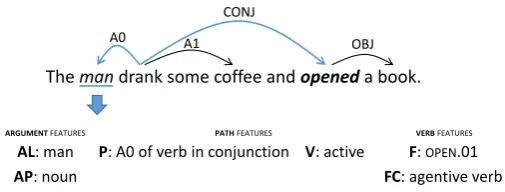
phenomenon ofraisedarguments, defined as syntactic constituents of a preceding verb. For instance, in Figure 4, manis a constituent of the verbdrankas well as a raised argument for the verbopen. In this example, we build the path frommantoopenby first traversing the semantic arc (A0) frommanto
drankand then the syntactic arc (CONJ) fromdranktoopen. The resulting syntactic-semantic path is verbalized as ”A0 of verb in conjunction”.
(2)Frame ClassFC: This feature categorizes frames based on whether they may take a thematicagent
as argument. Some frames, such as FESTER.01 and HOVER.01, cannot and are therefore considered
non-agentive. Non-agentive frames define noA0and therefore realize semantic roles differently3. Composite Features Table 3 lists all composite features along with their associated distances, in-cluding features extracted for the sample sentence in Figure 4. As described in Section 1, the relevant context for argument labeling includes: 1) The syntactic-semantic relationship between predicate and argument (P+V), 2) The frame-specific context of this syntactic-semantic relationship (F or FC), and 3) The argument-specific context (AL or AP). We require each of the three components to be represented in each composite feature in order to capture argument contexts. We define a distance function that as-signs the closest distance 1 to the most discriminative of these composite features (i.e. AL+P+V+F). The function assigns higher distances to composites with fewer or less specific features (AP is a less specific representation of the argument context than Al).
This approach draws inspiration frombackoff modeling, a well known method for addressing spar-sity in language modeling with n-grams (Katz, 1987): If insufficient training data exists, such models commonly backoff to lower histories (for instance, a 3-gram model may back off to a 2-gram language model). The six distance values assigned to composite features in Table 3 may be interpreted in a similar spirit since our approach broadens the search to nearest neighbors with less specific composite features if insufficient training data exists.
2.4 Easy-First Argument Labeling
While argument labeling decisions are made locally, each core semantic role (labels A0through A5) may only be assigned once per predicate (Che et al., 2009). To include this global constraint, we use a greedy approach in which already assigned core labels are removed from consideration for the remaining predictions. Our approach follows an easy-first philosophy (Goldberg and Elhadad, 2010) where
[image:5.595.121.477.205.290.2]Algorithm 2Easy-First Argument Labeling
foreach predicatep∈Unknown Sampledo
A←∅
C←Candidate arguments ofp, their labels and confidence value in sorted order by confidence
forc∈Cwith the highest confidence value inCdo
RemovecfromC
ifLabel ofc /∈Set of labels inAthen
AddctoA end if end for end for
sifications for all predicate arguments are ordered by confidence and highest confidence predictions are made first. Algorithm 2 outlines this approach.
3 Experiments
In this section we evaluate K-SRL, our proposed instance-based labeling approach for SRL. We conduct a comparison study to evaluate its performance against previously published state-of-the-art systems. We also examine how different parameters of K-SRL impact its performance, including the minimum support variablek, different components in composite features, and our interpretation of relative label frequencies in the nearest neighborhood as an indication of confidence for assigning labels.
3.1 Experimental Setup
We use the benchmark data sets from the CoNLL-2009 shared task (Hajiˇc et al., 2009) and compare our results against the top two scoring systems of the CoNLL-2009 shared task as well as two recent state-of-the-art systems: 1) CHEN(Zhao et al., 2009), which uses maximum entropy classifiers. 2) CHE(Che
et al., 2009), which uses SVM classifiers. 3) MATEPLUS(Roth and Woodsend, 2014a), a state-of-the-art
extension of a previous system (Bj¨orkelund et al., 2009) that uses logistic regression classifiers and word embeddings. 4) PATHLSTM (Roth and Lapata, 2016), the current state-of-the-art which uses logistic
regression classifiers for predicates and neural network models with word embeddings for arguments. Our default settings for K-SRL arek = 3and confidence threshold θ = 0, both determined through experimentation. For both settings, we present parameter sweep experiments.
We compute the precision, recall and F1to measure the quality of the systems. In our study, we focus on verbal predicates and their roles, which we evaluate using the scoring metric of the CoNLL-2009 shared task. We recomputed the measures for the previous state-of-art systems using their published results to focus on verbal predicates and their roles4.
3.2 Evaluation Results
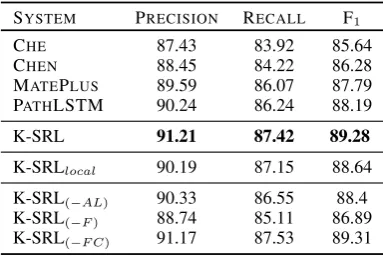
Tables 4 and 5 summarize the results for our comparison study on in-domain and out-of-domain data respectively. As can be seen, K-SRL outperforms all previous approaches by a significant margin on both data sets. In the in-domain setting, K-SRL achieves 89.28% F1-score, outperforming PATHLSTM, the currently published state-of-the-art approach, by 1.1 percentage points. In the out-domain setting, K-SRL achieves 79.91% F1-score, outperforming MATEPLUS, the best previous system on out-of-domain data in our evaluation, by over 3 percentage points, and PATHLSTM by an even larger margin.
3.3 Additional Experiments
We conduct a detailed empirical examination to evaluate different aspects of our approach and make the following observations:
SYSTEM PRECISION RECALL F1
CHE 87.43 83.92 85.64
CHEN 88.45 84.22 86.28
MATEPLUS 89.59 86.07 87.79 PATHLSTM 90.24 86.24 88.19
K-SRL 91.21 87.42 89.28
K-SRLlocal 90.19 87.15 88.64
[image:7.595.77.269.62.191.2]K-SRL(−AL) 90.33 86.55 88.4 K-SRL(−F) 88.74 85.11 86.89 K-SRL(−F C) 91.17 87.53 89.31
Table 4: Evaluation results on in-domain data.
SYSTEM PRECISION RECALL F1
CHE 76.25 71.24 73.66
CHEN 78.1 71.64 74.73
MATEPLUS 79.46 74.21 76.74 PATHLSTM 79.92 73.31 76.47
K-SRL 82.09 77.84 79.91
K-SRLlocal 80.38 77.78 79.06
[image:7.595.331.525.65.190.2]K-SRL(−AL) 81.69 77.28 79.42 K-SRL(−F) 80.96 76.88 78.86 K-SRL(−F C) 81.69 77.71 79.65
Table 5: Evaluation results on out-of-domain data.
87 87.5 88 88.5 89 89.5
1 2 3 4 5 6 7 8 9 10 11 12 13 14 15 16 17 18 19 20
F1
k
In-domain, different k
Figure 5: Parameter sweep overkon in-domain data.
78 78.5 79 79.5 80 80.5
1 2 3 4 5 6 7 8 9 10 11 12 13 14 15 16 17 18 19 20
F1
k
Out-of-domain, different k
Figure 6: Parameter sweep overkon out-of-domain data.
Highest quality predictions from small neighborhoods.To determine the best setting fork, we conduct a parameter sweep experiment. Figures 5 and 6 summarize results of SRL fork from 1 to 20 on both in-domain and out-domain data. The results show that the best F1 scores are achieved at relatively low settings fork, with best results obtained withk= 3for in-domain andk= 4for out-of-domain data. At higherk, F1-score drops gradually, indicating that this approach loses its ability to capture local bias. At lowerk, the approach overfits, decreasing F1-score especially in the out-of-domain scenario (↓1.8 pp). These observations confirm our initial conjecture that SRL is affected by a strong local bias and that a small nearest neighborhood suffices to make high quality predictions.
Global constraints improve argument labeling. We run an ablation test in which we make only local predictions without modeling global constraints as described in Section 2.4, which reduces the F1-score by .6 and .8 percentage points respectively on in-domain and out-of-domain data (see K-SRLlocal in Tables 4 and 5). These results are in line with previous evaluations on the impact of modeling global argument constraints (Toutanova et al., 2008; Roth and Lapata, 2016).
Frame and argument contexts are important. To assess the importance of individual features in their contexts, we run ablation tests in which we remove individual atomic features from composites, as summarized in Tables 4 and 5. Specifically, removing the frame feature F from argument labeling (K-SRL(−F))), which causes all argument labeling predictions to be made without frame-specific contests, leads to the most significant decrease on F1 scores (↓2.5 pp and↓1 pp) in our ablation tests. Omitting argument head lemma feature AL (K-SRL(−AL)), the only feature capturing argument-level selectional preference (Resnik, 1997) in our approach, results in evident reduction on F1 scores (↓0.8 pp and↓0.5 pp). Meanwhile, the removal of frame class feature (K-SRL−F C) impacts only the out-of-domain scenario slightly (↓0.3 pp). This observation indicates that small neighborhoods with the frame feature often suffice to capture exceptions for non-agentive verbs.
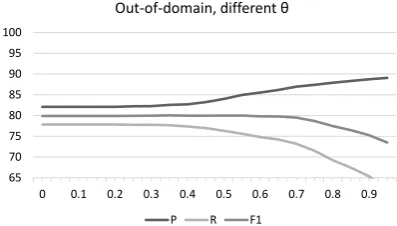
[image:7.595.322.519.219.331.2] [image:7.595.72.272.220.332.2]observa-75 80 85 90 95 100
0 0.1 0.2 0.3 0.4 0.5 0.6 0.7 0.8 0.9
In-domain, different θ
[image:8.595.73.274.61.175.2]P R F1
Figure 7: Parameter sweep overθon in-domain data.
65 70 75 80 85 90 95 100
0 0.1 0.2 0.3 0.4 0.5 0.6 0.7 0.8 0.9
Out-of-domain, different θ
[image:8.595.320.519.62.175.2]P R F1
Figure 8: Parameter sweep overθon out-of-domain data.
tions indicate that relative frequencies can serve as a good measure of confidence and be used to influence the precision-recall trade-off.
3.4 Discussion
Our instance-based learning approach is designed to capture the strong local bias of SRL. We note that even in out-of-domain evaluation scenarios, a very small nearest neighborhood suffices to make high quality predictions. Our experimental results demonstrate the effectiveness of this approach compared to previous state-of-the-arts for both in-domain and out-of-domain scenarios.
The state-of-the-art results are also remarkable in light of the relatively simple feature set we used. While previous work has investigated the use of word clusters (Choi and Palmer, 2011), word embed-dings (Roth and Woodsend, 2014b; Roth and Lapata, 2016) and explicit learning of selectional prefer-ence (Zapirain et al., 2013) for better generalization across the training data, such features are absent in our current approach. Instead, for predicate labeling we use only the subcategorization frame and for argument labeling a simple set of 6 basic atomic features. This is in stark contrast to previous works that often employ dozens of different features classes (Johansson and Nugues, 2008; Bj¨orkelund et al., 2009; Choi and Palmer, 2011).
Interpretability of classification decisions. Our approach has the advantage of interpretability since each classification is determined through a specific composite feature that can be translated into a human readable statement (as illustrated in Table 3). This enables us to easily understand classification results and debug misclassifications, and thus facilitates the process of defining atomic features and compos-ites for SRL. At the same time, we note that explicitly modeling composcompos-ites does add another layer of complexity in feature engineering to this task. We plan to further investigate this in future work.
4 Conclusion and Outlook
We introduced an instance-based learning approach for semantic role labeling that is designed to address the large number of low-frequency exceptions in training data. We proposed to construct composites based on a few existing well-known features to identify similar instances. Our experimental results indicates that our model built on top of this approach significantly outperform existing systems, leading to new state-of-the-art results in SRL for verbal predicates and their roles.
We intend to focus more specifically on feature engineering for instance-based SRL. In particular, we plan to explore automatic feature selection methods especially in the context of composite features. We also plan to evaluate generalization features such as word clusters or word embeddings in the context of instance-based SRL.
Finally, we plan to extend our system to different types of predicates including nouns and complex predicates (Bonial et al., 2014), as well as evaluate its applicability to SRL in different languages (Xue and Palmer, 2005).
References
Anders Bj¨orkelund, Love Hafdell, and Pierre Nugues. 2009. Multilingual semantic role labeling. In Proceed-ings of the Thirteenth Conference on Computational Natural Language Learning: Shared Task, pages 43–48. Association for Computational Linguistics.
Claire Bonial, Julia Bonn, Kathryn Conger, Jena D Hwang, and Martha Palmer. 2014. Propbank: Semantics of new predicate types. InLREC, pages 3013–3019.
Wanxiang Che, Zhenghua Li, Yongqiang Li, Yuhang Guo, Bing Qin, and Ting Liu. 2009. Multilingual dependency-based syntactic and semantic parsing. In Proceedings of the thirteenth conference on computa-tional natural language learning: shared task, pages 49–54. Association for Computational Linguistics.
Jinho D Choi and Martha Palmer. 2011. Transition-based semantic role labeling using predicate argument cluster-ing. InProceedings of the ACL 2011 Workshop on Relational Models of Semantics, pages 37–45. Association for Computational Linguistics.
Thomas Cover and Peter Hart. 1967. Nearest neighbor pattern classification. IEEE transactions on information theory, 13(1):21–27.
Walter Daelemans and Antal Van den Bosch. 2005. Memory-based language processing. Cambridge University Press.
Walter Daelemans, Sabine Buchholz, and Jorn Veenstra. 1999. Memory-based shallow parsing. InProceedings of the Third Conference on Computational Natural Language Learning.
Anthony Fader, Stephen Soderland, and Oren Etzioni. 2011. Identifying relations for open information extraction. In Proceedings of the Conference on Empirical Methods in Natural Language Processing, pages 1535–1545. Association for Computational Linguistics.
Yoav Goldberg and Michael Elhadad. 2010. An efficient algorithm for easy-first non-directional dependency parsing. InHuman Language Technologies: The 2010 Annual Conference of the North American Chapter of the Association for Computational Linguistics, pages 742–750. Association for Computational Linguistics. Jan Hajiˇc, Massimiliano Ciaramita, Richard Johansson, Daisuke Kawahara, Maria Ant`onia Mart´ı, Llu´ıs M`arquez,
Adam Meyers, Joakim Nivre, Sebastian Pad´o, Jan ˇStˇep´anek, et al. 2009. The conll-2009 shared task: Syntactic and semantic dependencies in multiple languages. InProceedings of the Thirteenth Conference on Computa-tional Natural Language Learning: Shared Task, pages 1–18. Association for Computational Linguistics. Richard Johansson and Pierre Nugues. 2008. Dependency-based semantic role labeling of propbank. In
Proceed-ings of the Conference on Empirical Methods in Natural Language Processing, pages 69–78. Association for Computational Linguistics.
Slava Katz. 1987. Estimation of probabilities from sparse data for the language model component of a speech recognizer. IEEE transactions on acoustics, speech, and signal processing, 35(3):400–401.
Karin Kipper, Anna Korhonen, Neville Ryant, and Martha Palmer. 2008. A large-scale classification of english verbs. Language Resources and Evaluation, 42(1):21–40.
Chi-kiu Lo, Meriem Beloucif, and Dekai Wu. 2013. Improving machine translation into chinese by tuning against chinese meant. InProceedings of the Tenth International Workshop on Spoken Language Translation (IWSLT 2013).
Umar Maqsud, Sebastian Arnold, Michael H¨ulfenhaus, and Alan Akbik. 2014. Nerdle: Topic-specific question answering using wikia seeds. InCOLING (Demos), pages 81–85.
Joakim Nivre, Johan Hall, and Jens Nilsson. 2004. Memory-based dependency parsing. InProceedings of the Eighth Conference on Computational Natural Language Learning.
Martha Palmer, Daniel Gildea, and Paul Kingsbury. 2005. The proposition bank: An annotated corpus of semantic roles. Computational linguistics, 31(1):71–106.
Emanuel Parzen. 1962. On estimation of a probability density function and mode. The annals of mathematical statistics, 33(3):1065–1076.
Michael Roth and Mirella Lapata. 2016. Neural semantic role labeling with dependency path embeddings. In Pro-ceedings of the 54th Annual Meeting of the Association for Computational Linguistics (ACL), Berlin, Germany. To appear.
Michael Roth and Kristian Woodsend. 2014a. Composition of word representations improves semantic role labelling. In Proceedings of the 2014 Conference on Empirical Methods in Natural Language Processing (EMNLP), pages 407–413, Doha, Qatar, 25–29 October.
Michael Roth and Kristian Woodsend. 2014b. Composition of word representations improves semantic role labelling. InEMNLP, pages 407–413. ACL.
Dan Shen and Mirella Lapata. 2007. Using semantic roles to improve question answering. InEMNLP-CoNLL, pages 12–21.
Kristina Toutanova, Aria Haghighi, and Christopher D Manning. 2008. A global joint model for semantic role labeling. Computational Linguistics, 34(2):161–191.
Lonneke van der Plas, Marianna Apidianaki, Rue John von Neumann, and Chenhua Chen. 2014. Global methods for cross-lingual semantic role and predicate labelling.
Jorn Veenstra, Antal Van den Bosch, Sabine Buchholz, Walter Daelemans, et al. 2000. Memory-based word sense disambiguation. Computers and the Humanities, 34(1-2):171–177.
Nianwen Xue and Martha Palmer. 2005. Automatic semantic role labeling for chinese verbs. InIJCAI, volume 5, pages 1160–1165. Citeseer.
Benat Zapirain, Eneko Agirre, Lluis Marquez, and Mihai Surdeanu. 2013. Selectional preferences for semantic role classification.Computational Linguistics, 39(3):631–663.