55
Dragonfly Optimization for Unit Commitment
With Wind Based Generating Systems
J. Sasikala
Assistant Professor in Information Technology,
Annamalai University, Annamalainagar-608002, Tamil Nadu, India [email protected]
Abstract- The optimal commitment of generating units and their economic generations for traditional generating plants require to be modified considering the present day wind based generation systems. This paper proposes a strategy for unit commitment (UC) for power systems with wind based generating systems using dragonfly optimization (DO). The suggested strategy splits the UC problem into many sub-problems, each indicating UC problem at each hour, and solves these sub-problems employing DO. The results on a standard ten generating unit UC problem with a wind based generation system portrays that the suggested strategy superior than the other methods.
Keywords: dragonfly optimization; unit commitment.
1. INTRODUCTION
The impact of wind based generation systems, which are quickly installed, abundant, and do not pollute the atmosphere, has increased significantly in recent decades and is projected to grow further in the following years. The economic selection of generating units and their generations for traditional generation units require to be modified considering the present day wind based generation systems. The available wind cannot be estimated exactly because its irregular nature, extra reserves should be assigned for wind based generating systems and traditional generating units should be run in a more adjustable and flexible way, which lowers the efficiency by partial loading and requires more number of start-ups of traditional power generating units. The unit commitment (UC) problem is modeled as a complex mixed-integer optimization problem, whose dimension increases largely with the number of generating units and scheduling period [1].
Many of the existing traditional solution techniques [2-7] suffer from inherent complexity of UC problem and divergence issues. Recently, population based methods such as SA, GA, EP and PSO were employed for obtaining robust solution of UC problems [8-11]. Besides, the impact of wind generation systems on UC problems were also discussed in [12-14]. An optimization
technique based on swarm-intelligence of
dragonflies based technique has been proposed for
solving optimization problems [15]. This
technique, named as Dragonfly Optimization (DO), modifies a population of solutions based on their evaluated objective function values [15]. It is
a swarm intelligence based meta-heuristic
optimization technique imitated from the swarming nature of dragonflies. This paper presents a DO based strategy for UC problems with a wind based generation system for obtaining robust solution.
2. PROBLEM FORMULATION
The UC problem comprising an objective function and constraints is outlined as
Minimize
itnt
t ng
i
t i t i Git i
G U F P ST U U
P ,
1 1
1 , 1 ) ( )
,
(
(1)
Subject to
0 1
,
ng
i
t i Git Wt
Dt P P U
56
objective function to be minimized over the scheduling period
t
P minimum and maximum generation limits of th
i generator respectively
t
57 Vci Vr Vco
Wind Speed (m/s)
rate W
P
Wi
nd
P
o
w
er (M
W)
0
Fig.1 Characteristic Wind Generation System
The real power generation of wind driven generation system can be obtained from its characteristic curve of Fig. 1 for a give wind speed. The characteristic curve. The wind plant begins generation at cut-in wind speed (Vci) and stops
generation at cut-out wind speed (Vco). However, the rated power, PWrate, is generated at rated wind speed (
V
r). The real power generation at a wind speed is computed by the following expression:
co co r
rate W
r ci
rate W
ci W
V V
V V V P
V V V V
V P
V V
P
0
0 0
2
(8)
Where
W
P output of the wind turbine
rate W
P rating of the wind turbine
V wind speed (m/s)
ci
V cut-in speed (m/s)
co
V cut-out speed (m/s)
ci
V rated speed (m/s)
, , wind generator coefficients
3. PROPOSED METHOD
The original UC problem is split into a number of sub-problems, each indicating a problem of each interval and DO is applied for solving each sub-problem. The solution of each sub-problems involves a orderly procedure with DO for obtaining the UC schedule at each interval, whose maximum dimension equals number of generating units. Besides, the solving of each sub-problem eliminates a few generating units, which are found to be economical for rest of the intervals, thereby reducing the size of each sub-problem in the subsequent intervals.
Each dragonfly in the population is modelled to comprise binary variables, representing the status
of generating units, of each UC sub-problem at interval-
t
:
t t ngt
i U U U
dragonfly 1,, 2, ,, ,
(9)
The above dragonfly contains ng decision
variables for the first two intervals and its size decreases in the subsequent intervals. The dragonfly is modified as
U j
dragonflyi j,t;
(10)
Where
is a vector of non-committed generating58 The fitness function of each sub-problem is tailored
to contain the objective and constraint functions at
th
The economic load dispatch of each sub-interval is obtained by equal incremental cost based lambda UC sub-problem through DO operations. An initial swarm of dragonflies is produced. The fitness of each dragonfly is evaluated by committing generating units with a status of 1 and decommitting the generating units with 0 status.
The procedure involving exploration and
exploitation by dragonflies behavior in navigating
and searching for foods and avoiding enemies are carried out for all the members in the swarm and is continued till optimum is recahed.
The above procedure may give a solution that causes violation of the minimum-up/down time and spinning reserve constraints. Such constraint violation can be eliminated by the procedure outlined below:
If there is spinning reserve constraint
violation, the augmented objective function of Eq. (12) should be modified to contain the penalized spinning reserve constraint.
2 binary variables that produces violation and involves minimum bit changes.
Repeat the above two till there is no
constraint violation.
4. SIMULATION RESULTS
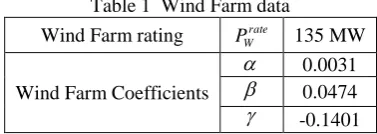
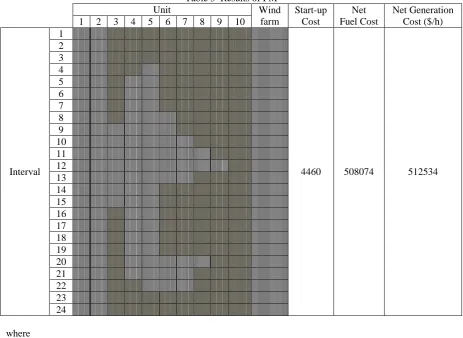
The DO based solution strategy is applied on a power system comprising 10 generating plants, whose data are available in [9] and presented in Table 1 and 2. The results are obtained for 20 runs (100 iterations for each run) and the global best schedule is given in this section. The UC schedule,
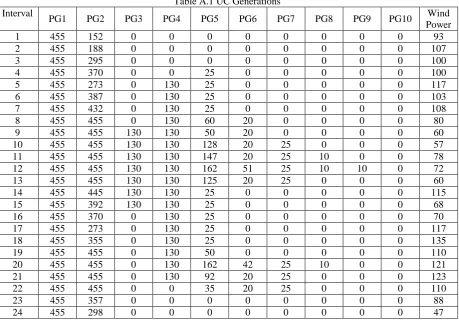
the net start-up cost, the net fuel cost and the net generation cost are detailed in Table 3. The corresponding generations for all the intervals are presented in Table A.1 of the Appendix.
Table 1 Wind Farm data
Wind Farm rating rate
W
P 135 MW
Wind Farm Coefficients
0.0031
0.0474
-0.1401Table 2 Wind Speed data for 24 hours Interval Wind Speed
m/s
Interval Wind Speed m/s
59 Table 3 Results of PM
Unit Wind
farm
Start-up Cost
Net Fuel Cost
Net Generation Cost ($/h)
1 2 3 4 5 6 7 8 9 10
Interval
1
4460 508074 512534
2
3
4
5
6
7
8
9
10
11
12
13
14
15
16
17
18
19
20
21
22
23
24
where
Represents Uncommitted generating units Represents Committed generating units
5. CONCLUSION
A solution strategy involving DO has been narrated for UC with wind based generation systems, which represent a large dimensioned mixed-integer nonlinear optimization problem. The UC problem has been divided into several sub-problems, each one has been successively solved by DO. A repair mechanism has been applied to handle the constraint violations. The results on 10 generating unit problem with a wind based generating plant clearly illustrated that the suggested strategy is simple, robust and efficient.
Acknowledgments
The author gratefully acknowledges the authorities of Annamalai University for the facilities offered to carry out this work.
REFERENCES
[1]. Wood. AJ & Woolenberg. BF. (1996). Power generation, operation and control, John Willey & Sons, New York.
[2]. HH. Happ, RC. Johnson and WJ.
Wright. (1971). Large Scale
Hydrothermal unit Commitment method and results. IEEE Trans. On PAS, PAS – 90: 1373-1383.
[3]. TS. Dillon and KW. Edwin. (1978).
Integer Programming approach to the problem of optimal unit commitment with probabilistic reserve Determination. IEEE Trans. on PAS, PAS – 97(6): 2154-2166.
[4]. JA. Muckstadt and RC. Wilson. (1968).
An application of mixed-integer
programming duality to scheduling thermal generating systems”, IEEE Trans. Power App. Syst., 1968-1978.
[5]. WL. Snyder, HD. Powell Jr and JC.
60 Trans. Power Syst., PWRS S-2(2):
339-350.
[6]. AI. Cohen and M.Yoshimura. (1983). A
branch and bound algorithm for unit commitment. IEEE Trans. on PAS, PAS-10: 444 – 451.
[7]. CP. Cheng, CW. Liu and CC. Liu.
(2000). Unit commitment by Lagrangian relaxation and genetic algorithem, IEEE Trans. Power Syst., 15: 707-714.
[8]. DN. Simopoulos, SD. Kavatza and CD.
Vournas. (2006). Unit commitment by
an enhanced simulated annealing
algorithm , IEEE Trans. Power Syst., 21(1), 68-76.
[9]. Kazarlis SA, Bakirtzis AG, Petridis V.
(1996). A genetic algorithm solution to the unit commitment problem, IEEE Trans Power Syst., 11(1): 83-92.
[10]. Juste K.A, Kita H, Tanaka E and
Hasegawa J. (1999). An evolutionary programming solution to the unit commitment problem, IEEE Trans Power Syst., 14(4):1452-59.
[11]. Chakraborty S, Ito T, Senjyu T and
Saber AY. (2012). Unit commitment strategy of thermal generators by using
advanced fuzzy controlled binary
particle swarm optimization algorithm. Int J Electr Power Energy Syst., 43(1):1072-80.
[12]. G.J.Osório, J.M.Lujano-Rojas,
J.C.O.Matias and J.P.S. Catalão. (2015).
A new scenario generation-based
method to solve the unit commitment problem with high penetration of renewable energies, Electrical Power and Energy Systems 64: 1063–1072.
[13]. Amir Kalantari ⇑, Francisco D. Galiana.
(2015). Generalized Sigma approach to unit commitment with uncertain wind power generation, Electrical Power and Energy Systems 65: 367–374.
[14]. Ji.B, Yuan.X, Chen.Z and Tian.H.
(2014). Improved gravitational search
algorithm for unit commitment
considering uncertainty of wind power, Energy, 67: 52–62.
[15]. Seyedali Mirjalili. Dragonfly algorithm.
(2015). A new meta-heuristic
optimization technique for solving
61
Appendix
Table A.1 UC Generations Interval
PG1 PG2 PG3 PG4 PG5 PG6 PG7 PG8 PG9 PG10 Wind
Power
1 455 152 0 0 0 0 0 0 0 0 93
2 455 188 0 0 0 0 0 0 0 0 107
3 455 295 0 0 0 0 0 0 0 0 100
4 455 370 0 0 25 0 0 0 0 0 100
5 455 273 0 130 25 0 0 0 0 0 117
6 455 387 0 130 25 0 0 0 0 0 103
7 455 432 0 130 25 0 0 0 0 0 108
8 455 455 0 130 60 20 0 0 0 0 80
9 455 455 130 130 50 20 0 0 0 0 60
10 455 455 130 130 128 20 25 0 0 0 57
11 455 455 130 130 147 20 25 10 0 0 78
12 455 455 130 130 162 51 25 10 10 0 72
13 455 455 130 130 125 20 25 0 0 0 60
14 455 445 130 130 25 0 0 0 0 0 115
15 455 392 130 130 25 0 0 0 0 0 68
16 455 370 0 130 25 0 0 0 0 0 70
17 455 273 0 130 25 0 0 0 0 0 117
18 455 355 0 130 25 0 0 0 0 0 135
19 455 455 0 130 50 0 0 0 0 0 110
20 455 455 0 130 162 42 25 10 0 0 121
21 455 455 0 130 92 20 25 0 0 0 123
22 455 455 0 0 35 20 25 0 0 0 110
23 455 357 0 0 0 0 0 0 0 0 88