Simple and Efficient Algorithm
for Approximate Dictionary Matching
Naoaki Okazaki University of Tokyo
Jun’ichi Tsujii University of Tokyo University of Manchester National Centre for Text Mining
Abstract
This paper presents a simple and effi-cient algorithm for approximate dictio-nary matching designed for similarity measures such as cosine, Dice, Jaccard, and overlap coefficients. We propose this algorithm, called CPMerge, for the τ
-overlap join of inverted lists. First we show that this task is solvable exactly by a τ-overlap join. Given inverted lists
re-trieved for a query, the algorithm collects fewer candidate strings and prunes un-likely candidates to efficiently find strings that satisfy the constraint of theτ-overlap
join. We conducted experiments of ap-proximate dictionary matching on three large-scale datasets that include person names, biomedical names, and general English words. The algorithm exhib-ited scalable performance on the datasets. For example, it retrieved strings in 1.1 ms from the string collection of Google Web1T unigrams (with cosine similarity and threshold 0.7).
1 Introduction
Languages are sufficiently flexible to be able to express the same meaning through different dic-tion. At the same time, inconsistency of surface expressions has persisted as a serious problem in natural language processing. For example, in the biomedical domain, cardiovascular disorder can be described using various expressions: cardio-vascular diseases, cardiovascular system disor-der, anddisorder of the cardiovascular system. It
is a nontrivial task to find the entry from these sur-face expressions appearing in text.
This paper addresses approximate dictionary matching, which consists of finding all strings in a string collectionV such that they have
similar-ity that is no smaller than a threshold α with a
query stringx. This task has a broad range of
ap-plications, including spelling correction, flexible dictionary look-up, record linkage, and duplicate detection (Henzinger, 2006; Manku et al., 2007).
Formally, the task obtains a subsetYx,α⊆V,
Yx,α={y∈V
sim(x, y)≥α}, (1)
wheresim(x, y)presents the similarity betweenx
and y. A na¨ıve solution to this task is to
com-pute similarity values |V|times, i.e., between x
and every stringy ∈ V. However, this solution
is impractical when the number of strings|V|is
huge (e.g., more than one million).
In this paper, we present a simple and effi-cient algorithm for approximate dictionary match-ing designed for similarity measures such as co-sine, Dice, Jaccard, and overlap coefficients. Our main contributions are twofold.
1. We show that the problem of approximate dictionary matching is solved exactly by a
τ-overlap join (Sarawagi and Kirpal, 2004)
of inverted lists. Then we presentCPMerge, which is a simple and efficient algorithm for theτ-overlap join. In addition, the algorithm is easily implemented.
and general English words. We com-pare the algorithm with state-of-the-art al-gorithms, including Locality Sensitive Hash-ing (Ravichandran et al., 2005; Andoni and Indyk, 2008) and DivideSkip (Li et al., 2008). The proposed algorithm retrieves strings the most rapidly, e.g., in 1.1 ms from Google Web1T unigrams (with cosine simi-larity and threshold 0.7).
2 Proposed Method
2.1 Necessary and sufficient conditions In this paper, we assume that the features of a string are represented arbitrarily by a set. Al-though it is important to design a string represen-tation for an accurate similarity measure, we do not address this problem: our emphasis isnot on designing a better representation for string simi-laritybuton establishing an efficient algorithm.
The most popular representation is given by n-grams: all substrings of size n in a string. We use trigrams throughout this paper as an example of string representation. For example, the string “methyl sulphone” is expressed by 17 elements of letter trigrams1, {‘$$m’, ‘$me’, ‘met’,
‘eth’,‘thy’,‘hyl’,‘yl ’,‘l s’,‘ su’,
‘sul’, ‘ulp’, ‘lph’, ‘pho’, ‘hon’,
‘one’, ‘ne$’,‘e$$’}. We insert two$s be-fore and after the string to denote the start or end of the string. In general, a string xconsisting of
|X| letters yields (|x|+n−1) elements of n
-grams. We call |x|and |X| the lengthand size,
respectively, of the stringx.
Let X and Y denote the feature sets of the
stringsxandy, respectively. The cosine similarity
between the two stringsxandyis,
cosine(X, Y) = p|X∩Y|
|X||Y|. (2)
By integrating this definition with Equation 1, we obtain the necessary and sufficient condition for 1In practice, we attach ordinal numbers ton-grams to
rep-resent multiple occurrences ofn-grams in a string (Chaud-huri et al., 2006). For example, the string “prepress”, which contains two occurrences of the trigram ‘pre’, yields the set {‘$$p’#1, ‘$pr’#1, ‘pre’#1, ‘rep’#1,
‘epr’#1, ‘pre’#2, ‘res’#1, ‘ess’#1, ‘ss$’#1,
‘s$$’#1}.
Table 1: Conditions for each similarity measure Measure min|Y| max|Y| τ(= min|X∩Y|)
Dice α
2−α|X|
2−α
α |X|
1
2α(|X|+|Y|)
Jaccard α|X| |X|/α α(|X1+|+|αY|) Cosine α2|X| |X|/α2 αp|X||Y| Overlap — — αmin{|X|,|Y|}
approximate dictionary matching,
l
αp|X||Y|m≤ |X∩Y| ≤min{|X|,|Y|}.
(3) This inequality states that two stringsxandymust
have at leastτ = lαp|X||Y|mfeatures in com-mon. When ignoring|X∩Y|in the inequality, we
have an inequality about|X|and|Y|,
α2|X|≤ |Y| ≤
|X| α2
(4)
This inequality presents the search range for re-trieving similar strings; that is, we can ignore strings whose feature size is out of this range. Other derivations are also applicable to similar-ity measures, including Dice, Jaccard, and overlap coefficients. Table 1 summarizes the conditions for these similarity measures.
We explain one usage of these conditions. Let query stringx = “methyl sulphone” and thresh-old for approximate dictionary matchingα= 0.7 with cosine similarity. Representing the strings with letter trigrams, we have the size ofx,|X|= 17. The inequality 4 gives the search range of|Y|
of the retrieved strings, 9 ≤ |Y| ≤ 34. Presum-ing that we are searchPresum-ing for strPresum-ings of|Y|= 16, we obtain the necessary and sufficient condition for the approximate dictionary matching from the inequality 3,τ = 12 ≤ |X∩Y|. Thus, we need to search for strings that have at least 12 letter tri-grams that overlap withX. When considering a stringy = “methyl sulfone”, which is a spelling variant ofy(ph → f), we confirm that the string
is a solution for approximate dictionary matching because|X∩Y|= 13(≥τ). Here, the actual
sim-ilarity iscosine(X, Y) = 13/√17×16 = 0.788 (≥α).
2.2 Data structure and algorithm
Input:V: collection of strings
Input:x: query string
Input:α: threshold for the similarity
Output:Y: list of strings similar to the query X←string to feature(x);
1
Y ←[];
2
forl←min y(|X|,α)tomax y(|X|,α)do
3
τ←min overlap(|X|,l,α);
4
R←overlapjoin(X,τ,V,l);
5
foreachr∈Rdo appendrtoY;
6
end
7
returnY;
8
Algorithm 1: Approximate dictionary matching.
Given a query stringx, a collection of stringsV,
and a similarity threshold α, the algorithm
com-putes the size range (line 3) given by Table 1. For each size l in the range, the algorithm
com-putes the minimum number of overlapsτ (line 4).
The function overlapjoin(line 5) finds sim-ilar strings by solving the following problem (τ -overlap join): given a list of features of the query stringXand the minimum number of overlapsτ,
enumerate strings of sizelin the collectionV such that they have at leastτ feature overlaps withX.
To solve this problem efficiently, we build an inverted index that stores a mapping from the fea-tures to their originating strings. Then, we can perform theτ-overlap join by finding strings that
appear at least τ times in the inverted lists
re-trieved for the query featuresX.
Algorithm 2 portrays a na¨ıve solution for the
τ-overlap join (AllScan algorithm). In this
algo-rithm, functionget(V, l, q) returns the inverted
list of strings (of size l) for the feature q. In short, this algorithm scans strings in the inverted lists retrieved for the query featuresX, counts the
frequency of occurrences of every string in the inverted lists, and returns the strings whose fre-quency of occurrences is no smaller thanτ.
This algorithm is inefficient in that it scans all strings in the inverted lists. The number of scanned strings is large, especially when some query features appear frequently in the strings, e.g.,‘s$$’(words ending with ‘s’) and‘pre’
(words with substring ‘pre’). To make matters worse, such features are too common for charac-terizing string similarity. The AllScan algorithm
Input:X: array of features of the query string
Input:τ: minimum number of overlaps
Input:V: collection of strings
Input:l: size of target strings
Output:R: list of strings similar to the query M ← {};
1
R←[];
2
foreachq∈Xdo
3
foreachi∈get(V,l,q)do
4
M[i]←M[i] + 1;
5
ifτ ≤M[i]then
6
appenditoR;
7
end
8
end
9
end
10
returnR;
11
Algorithm 2: AllScan algorithm.
is able to maintain numerous candidate strings in
M, but most candidates are not likely to qualified
because they have few overlaps withX.
To reduce the number of the candidate strings, we refer tosignature-based algorithms(Arasu et al., 2006; Chaudhuri et al., 2006):
Property 1 Let there be a set (of sizeh)Xand a
set (of any size)Y. Consider any subsetZ ⊆Xof
size(h−τ+ 1). If|X∩Y| ≥τ, thenZ∩Y 6=φ. We explain one usage of this property. Let query stringx = “methyl sulphone” and its trigram set
X be features (therefore, |X| = h = 17).
Pre-suming that we seek strings whose trigrams are size 16 and have 12 overlaps withX, then stringy
must have at least one overlap with any subset of size6(= 17−12 + 1) ofX. We call the subset
signatures. The property leads to an algorithmic design by which we obtain a small set of candi-date strings from the inverted lists for signatures, (|X| −τ + 1) features in X, and verify whether
each candidate string satisfies theτ overlap with
the remaining (τ−1)n-grams.
Algorithm 3 presents the pseudocode employ-ing this idea. In line 1, we arrange the features in
Xin ascending order of the number of strings in
their inverted lists. We denote thek-th element in
the ordered features asXk(k∈ {0, ...,|X| −1}),
where the index number begins with0. Based on this notation,X0andX|X|−1are the most
uncom-mon and the most comuncom-mon features inX,
respec-tively.
Input:X: array of features of the query string
Input:τ: minimum number of overlaps
Input:V: collection of strings
Input:l: size of target strings
Output:R: list of strings similar to the query sort elements inXby order of|get(V,l,Xk)|;
Algorithm 3: CPMerge algorithm.
X0, ..., X|X|−τ to generate a compact set of
can-didate strings. The algorithm stores the occur-rence count of each stringsinM[s]. In lines 9–
21, we increment the occurrence counts if each ofX|X|−τ+1, ..., X|X|−1inverted lists contain the
candidate strings. For each stringsin the
candi-dates (line 10), we perform a binary search on the inverted list (line 11), and increment the overlap count if the stringsexists (line 12). If the overlap
counter of the string reachesτ (line 14), then we
append the stringsto the result listRand remove sfrom the candidate list (lines 15–16). We prune
a candidate string (lines 17–18) if the candidate is found to be unreachable forτ overlaps even if it
appears in all of the unexamined inverted lists.
3 Experiments
We report the experimental results of approximate dictionary matching on large-scale datasets with person names, biomedical names, and general En-glish words. We implemented various systems of approximate dictionary matching.
• Proposed: CPMerge algorithm.
• Naive: Na¨ıve algorithm that computes the
cosine similarity|V|times for every query.
• AllScan: AllScan algorithm.
• Signature: CPMerge algorithm without pruning; this is equivalent to Algorithm 3 without lines 17–18.
• DivideSkip: our implementation of the
algo-rithm (Li et al., 2008)2.
• Locality Sensitive Hashing (LSH)(Andoni and Indyk, 2008): This baseline system fol-lows the design of previous work (Ravichan-dran et al., 2005). This system approxi-mately solves Equation 1 by finding dictio-nary entries whose LSH values are within the (bit-wise) hamming distance of θ from the LSH value of a query string. To adapt the method to approximate dictionary match-ing, we used a 64-bit LSH function com-puted with letter trigrams. By design, this method does not find an exact solution to Equation 1; in other words, the method can miss dictionary entries that are actually sim-ilar to the query strings. This system has three parameters,θ,q(number of bit
permu-tations), andB(search width), to control the
tradeoff between retrieval speed and recall3. Generally speaking, increasing these param-eters improves the recall, but slows down the speed. We determined θ = 24andq = 24 experimentally4, and measured the perfor-mance whenB∈ {16,32,64}.
The systems, excluding LSH, share the same implementation of Algorithm 1 so that we can specifically examine the differences of the algo-rithms forτ-overlap join. The C++ source code of the system used for this experiment is available5. We ran all experiments on an application server running Debian GNU/Linux 4.0 with Intel Xeon 5140 CPU (2.33 GHz) and 8 GB main memory.
2We tuned parameter valuesµ
∈ {0.01, 0.02, 0.04, 0.1, 0.2, 0.4, 1, 2, 4, 10, 20, 40, 100}for each dataset. We se-lected the parameter with the fastest response.
3We followed the notation of the original
pa-per (Ravichandran et al., 2005) here. Refer to the original paper for definitions of the parametersθ,q, andB.
4qwas set to24so that the arrays of shuffled hash values
are stored in memory. We choseθ= 24from{8,16,24} be-cause it showed a good balance between accuracy and speed.
3.1 Datasets
We used three large datasets with person names (IMDB actors), general English words (Google Web1T), and biomedical names (UMLS).
• IMDB actors: This dataset comprises actor
names extracted from the IMDB database6. We used all actor names (1,098,022 strings; 18 MB) from the file actors.list.gz. The average number of letter trigrams in the strings is 17.2. The total number of trigrams is 42,180. The system generated index files of 83 MB in 56.6 s.
• Google Web1T unigrams: This dataset
con-sists of English word unigrams included in the Google Web1T corpus (LDC2006T13). We used all word unigrams (13,588,391 strings; 121 MB) in the corpus after remov-ing the frequency information. The aver-age number of letter trigrams in the strings is 10.3. The total number of trigrams is 301,459. The system generated index files of 601 MB in 551.7 s.
• UMLS: This dataset consists of English
names and descriptions of biomedical con-cepts included in the Unified Medical Lan-guage System (UMLS). We extracted all English concept names (5,216,323 strings; 212 MB) fromMRCONSO.RRF.aa.gzand
MRCONSO.RRF.ab.gzin UMLS Release
2009AA. The average number of letter tri-grams in the strings is 43.6. The total number of trigrams is 171,596. The system generated index files of 1.1 GB in 1216.8 s.
For each dataset, we prepared 1,000 query strings by sampling strings randomly from the dataset. To simulate the situation where query strings are not only identical but also similar to dictionary entries, we introduced random noise to the strings. In this experiment, one-third of the query strings are unchanged from the original (sampled) strings, one-third of the query strings have one letter changed, and one-third of the query strings have two letters changed. When changing a letter, we randomly chose a letter po-sition from a uniform distribution, and replaced
6ftp://ftp.fu-berlin.de/misc/movies/database/
the letter at the position with an ASCII letter ran-domly chosen from a uniform distribution.
3.2 Results
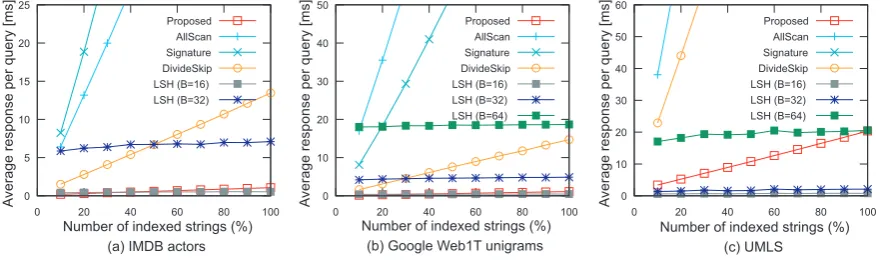
To examine the scalability of each system, we controlled the number of strings to be indexed from 10%–100%, and issued 1,000 queries. Fig-ure 1 portrays the average response time for re-trieving strings whose cosine similarity values are no smaller than 0.7. Although LSH (B=16) seems
to be the fastest in the graph, this system missed many true positives7; the recall scores of approx-imate dictionary matching were 15.4% (IMDB), 13.7% (Web1T), and 1.5% (UMLS). Increasing the parameterBimproves the recall at the expense
of the response time. LSH (B=64)8. It not only
ran slower than the proposed method, but also suffered from low recall scores, 25.8% (IMDB), 18.7% (Web1T), and 7.1% (UMLS). LSH was useful only when we required a quick response much more than recall.
The other systems were guaranteed to find the exact solution (100% recall). The proposed algorithm was the fastest of all exact systems on all datasets: the response times per query (100% index size) were 1.07 ms (IMDB), 1.10 ms (Web1T), and 20.37 ms (UMLS). The response times of the Na¨ıve algorithm were too slow, 32.8 s (IMDB), 236.5 s (Web1T), and 416.3 s (UMLS).
The proposed algorithm achieved substantial improvements over the AllScan algorithm: the proposed method was 65.3 times (IMDB), 227.5 times (Web1T), and 13.7 times (UMLS) faster than the Na¨ıve algorithm. We observed that the Signature algorithm, which is Algorithm 3 with-out lines 17–18, did not perform well: The Sig-nature algorithm was 1.8 times slower (IMDB), 2.1 times faster (Web1T), and 135.0 times slower (UMLS) than the AllScan algorithm. These re-sults indicate that it is imperative to minimize the number of candidates to reduce the number of binary-search operations. The proposed algorithm was 11.1–13.4 times faster than DivideSkip.
Figure 2 presents the average response time
7Solving Equation 1, all systems are expected to retrieve
the exact set of strings retrieved by the Na¨ıve algorithm.
8The response time of LSH (B=64) on the IMDB dataset
0
Number of indexed strings (%)
Proposed
Number of indexed strings (%)
Proposed
Number of indexed strings (%)
(a) IMDB actors (b) Google Web1T unigrams (c) UMLS
Proposed
Figure 1: Average response time for processing a query (cosine similarity;α= 0.7).
0
(a) IMDB actors (b) Google Web1T unigram (c) UMLS
Figure 2: Average response time for processing a query.
of the proposed algorithm for different similarity measures and threshold values. When the similar-ity threshold is lowered, the algorithm runs slower because the number of retrieved strings |Y| in-creases exponentially. The Dice coefficient and cosine similarity produced similar curves.
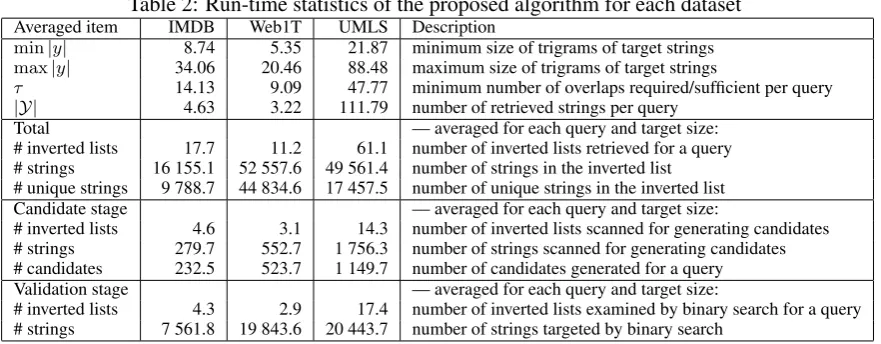
Table 2 summarizes the run-time statistics of the proposed method for each dataset (with co-sine similarity and threshold 0.7). Using the IMDB dataset, the proposed method searched for strings whose size was between 8.74 and 34.06; it retrieved 4.63 strings per query string. The proposed algorithm scanned 279.7 strings in 4.6 inverted lists to obtain 232.5 candidate strings. The algorithm performed a binary search on 4.3 inverted lists containing 7,561.8 strings in all. In contrast, the AllScan algorithm had to scan 16,155.1 strings in 17.7 inverted lists and con-sidered 9,788.7 candidate strings, and found only 4.63 similar strings.
This table clearly demonstrates three key con-tributions of the proposed algorithm for efficient
approximate dictionary matching. First, the pro-posed algorithm scanned far fewer strings than did the AllScan algorithm. For example, to obtain candidate strings in the IMDB dataset, the pro-posed algorithm scanned 279.7 strings, whereas the AllScan algorithm scanned 16,155.1 strings. Therefore, the algorithm examined only 1.1%– 3.5% of the strings in the entire inverted lists in the three datasets. Second, the proposed algo-rithm considered far fewer candidates than did the AllScan algorithm: the number of candidate strings considered by the algorithm was 1.2%– 6.6% of those considered by the AllScan algo-rithm. Finally, the proposed algorithm read fewer inverted lists than did the AllScan algorithm. The proposed algorithm actually read 8.9 (IMDB), 6.0 (Web1T), and 31.7 (UMLS) inverted lists during the experiments9. These values indicate that the proposed algorithm can solveτ-overlap join prob-lems by checking only 50.3% (IMDB), 53.6% (Web1T), and 51.9% of the total inverted lists
Table 2: Run-time statistics of the proposed algorithm for each dataset Averaged item IMDB Web1T UMLS Description
min|y| 8.74 5.35 21.87 minimum size of trigrams of target strings
max|y| 34.06 20.46 88.48 maximum size of trigrams of target strings
τ 14.13 9.09 47.77 minimum number of overlaps required/sufficient per query |Y| 4.63 3.22 111.79 number of retrieved strings per query
Total — averaged for each query and target size:
# inverted lists 17.7 11.2 61.1 number of inverted lists retrieved for a query # strings 16 155.1 52 557.6 49 561.4 number of strings in the inverted list # unique strings 9 788.7 44 834.6 17 457.5 number of unique strings in the inverted list Candidate stage — averaged for each query and target size:
# inverted lists 4.6 3.1 14.3 number of inverted lists scanned for generating candidates # strings 279.7 552.7 1 756.3 number of strings scanned for generating candidates # candidates 232.5 523.7 1 149.7 number of candidates generated for a query Validation stage — averaged for each query and target size:
# inverted lists 4.3 2.9 17.4 number of inverted lists examined by binary search for a query # strings 7 561.8 19 843.6 20 443.7 number of strings targeted by binary search
trieved for queries.
4 Related Work
Numerous studies have addressed approximate dictionary matching. The most popular configu-ration usesn-grams as a string representation and the edit distance as a similarity measure. Gra-vano et al. (1998; 2001) presented various filter-ing strategies, e.g., count filterfilter-ing, position fil-tering, and length filfil-tering, to reduce the num-ber of candidates. Kim et al. (2005) proposed two-leveln-gram inverted indices (n-Gram/2L) to eliminate the redundancy of position information in n-gram indices. Li et al. (2007) explored the
use of variable-length grams (VGRAMs) for im-proving the query performance. Lee et al. (2007) extended n-grams to include wild cards and
de-veloped algorithms based on a replacement semi-lattice. Xiao et al. (2008) proposed the Ed-Join algorithm, which utilizes mismatchingn-grams.
Several studies addressed different paradigms for approximate dictionary matching. Bocek et al. (2007) presented the Fast Similarity Search (FastSS), an enhancement of the neighborhood generation algorithms, in which multiple variants of each string record are stored in a database. Wang et al. (2009) further improved the technique of neighborhood generation by introducing parti-tioning and prefix pruning. Huynh et al. (2006) developed a solution to thek-mismatch problem in compressed suffix arrays. Liu et al. (2008) stored string records in a trie, and proposed a framework called TITAN. These studies are
spe-cialized for the edit distance measure.
A few studies addressed approximate dictio-nary matching for similarity measures such as cosine and Jaccard similarities. Chaudhuri et al. (2006) proposed the SSJoin operator for sim-ilarity joins with several measures including the edit distance and Jaccard similarity. This algo-rithm first generatessignatures for strings, finds all pairs of strings whose signatures overlap, and finally outputs the subset of these candi-date pairs that satisfy the similarity predicate. Arasu et al. (2006) addressedsignature schemes, i.e., methodologies for obtaining signatures from strings. They also presented an implementation of the SSJoin operator in SQL. Although we did not implement this algorithm in SQL, it is equivalent to the Signature algorithm in Section 3.
Sarawagi and Kirpal (2004) proposed the Mer-geOpt algorithm for theτ-overlap join to
approx-imate string matching with overlap, Jaccard, and cosine measures. This algorithm splits inverted lists for a given queryA into two groups, S and L, maintains a heap to collect candidate strings on S, and performs a binary search onLto verify the
condition of theτ-overlap join for each candidate
string. Their subsequent work includes an effi-cient algorithm for the top-ksearch of the overlap
join (Chandel et al., 2006).
Li et al. (2008) extended this algorithm to the SkipMerge and DivideSkip algorithms. The Skip-Merge algorithm uses a heap to compute theτ
-overlap join on entire inverted lists A, but has
fron-tier pointers of inverted lists efficiently based on the strings popped most recently from the heap. Consequently, SkipMerge can reduce the number of strings that are pushed to the heap. Similarly to the MergeOpt algorithm, DivideSkip splits in-verted listsAinto two groupsSandL, but it ap-plies SkipMerge toS. In Section 3, we reported
the performance of DivideSkip.
Charikar (2002) presented the Locality Sen-sitive Hash (LSH) function (Andoni and Indyk, 2008), which preserves the property of cosine similarity. The essence of this function is to map strings into N-bit hash values where the bitwise
hamming distance between the hash values of two strings approximately corresponds to the angle of the two strings. Ravichandran et al. (2005) ap-plied LSH to the task of noun clustering. Adapting this algorithm to approximate dictionary match-ing, we discussed its performance in Section 3.
Several researchers have presented refined sim-ilarity measures for strings (Winkler, 1999; Cohen et al., 2003; Bergsma and Kondrak, 2007; Davis et al., 2007). Although these studies are sometimes regarded as a research topic of approximate dic-tionary matching, they assume that two strings for the target of similarity computation are given; in other words, it is out of their scope to find strings in a large collection that are similar to a given string. Thus, it is a reasonable approach for an ap-proximate dictionary matching to quickly collect candidate strings with a loose similarity threshold, and for a refined similarity measure to scrutinize each candidate string for the target application.
5 Conclusions
We present a simple and efficient algorithm for approximate dictionary matching with the co-sine, Dice, Jaccard, and overlap measures. We conducted experiments of approximate dictio-nary matching on large-scale datasets with person names, biomedical names, and general English words. Even though the algorithm is very sim-ple, our experimental results showed that the pro-posed algorithm executed very quickly. We also confirmed that the proposed method drastically re-duced the number of candidate strings considered during approximate dictionary matching. We be-lieve that this study will advance practical NLP
applications for which the execution time of ap-proximate dictionary matching is critical.
An advantage of the proposed algorithm over existing algorithms (e.g., MergeSkip) is that it does not need to read all the inverted lists retrieved by queryn-grams. We observed that the proposed
algorithm solvedτ-overlap joins by checking ap-proximately half of the inverted lists (with cosine similarity and thresholdα = 0.7). This
charac-teristic is well suited to processing compressed inverted lists because the algorithm needs to de-compress only half of the inverted lists. It is nat-ural to extend this study to compressing and de-compressing inverted lists for reducing disk space and for improving query performance (Behm et al., 2009).
Acknowledgments
This work was partially supported by Grants-in-Aid for Scientific Research on Priority Areas (MEXT, Japan) and for Solution-Oriented Re-search for Science and Technology (JST, Japan).
References
Andoni, Alexandr and Piotr Indyk. 2008. Near-optimal hashing algorithms for approximate nearest neighbor in high dimensions. Communications of the ACM, 51(1):117–122.
Arasu, Arvind, Venkatesh Ganti, and Raghav Kaushik. 2006. Efficient exact set-similarity joins. InVLDB ’06: Proceedings of the 32nd International Confer-ence on Very Large Data Bases, pages 918–929.
Behm, Alexander, Shengyue Ji, Chen Li, and Jiaheng Lu. 2009. Space-constrained gram-based indexing for efficient approximate string search. In ICDE ’09: Proceedings of the 2009 IEEE International Conference on Data Engineering, pages 604–615.
Bergsma, Shane and Grzegorz Kondrak. 2007.
Alignment-based discriminative string similarity. In
ACL ’07: Proceedings of the 45th Annual Meet-ing of the Association of Computational LMeet-inguistics, pages 656–663.
Chandel, Amit, P. C. Nagesh, and Sunita Sarawagi. 2006. Efficient batch top-k search for dictionary-based entity recognition. In ICDE ’06: Proceed-ings of the 22nd International Conference on Data Engineering.
Charikar, Moses S. 2002. Similarity estimation tech-niques from rounding algorithms. In STOC ’02: Proceedings of the thiry-fourth annual ACM sym-posium on Theory of computing, pages 380–388.
Chaudhuri, Surajit, Venkatesh Ganti, and Raghav Kaushik. 2006. A primitive operator for similar-ity joins in data cleaning. InICDE ’06: Proceed-ings of the 22nd International Conference on Data Engineering.
Cohen, William W., Pradeep Ravikumar, and Stephen E. Fienberg. 2003. A comparison of string distance metrics for name-matching tasks. In Proceedings of the IJCAI-2003 Workshop on Information Integration on the Web (IIWeb-03), pages 73–78.
Davis, Jason V., Brian Kulis, Prateek Jain, Suvrit Sra, and Inderjit S. Dhillon. 2007. Information-theoretic metric learning. InICML ’07: Proceedings of the 24th International Conference on Machine Learn-ing, pages 209–216.
Gravano, Luis, Panagiotis G. Ipeirotis, H. V. Jagadish, Nick Koudas, S. Muthukrishnan, and Divesh Srivas-tava. 2001. Approximate string joins in a database (almost) for free. InVLDB ’01: Proceedings of the 27th International Conference on Very Large Data Bases, pages 491–500.
Henzinger, Monika. 2006. Finding near-duplicate web pages: a large-scale evaluation of algorithms. InSIGIR ’06: Proceedings of the 29th Annual Inter-national ACM SIGIR Conference on Research and Development in Information Retrieval, pages 284– 291.
Huynh, Trinh N. D., Wing-Kai Hon, Tak-Wah Lam, and Wing-Kin Sung. 2006. Approximate string matching using compressed suffix arrays. Theoreti-cal Computer Science, 352(1-3):240–249.
Kim, Min-Soo, Kyu-Young Whang, Jae-Gil Lee, and Min-Jae Lee. 2005. n-Gram/2L: a space and time efficient two-level n-gram inverted index structure. InVLDB ’05: Proceedings of the 31st International Conference on Very Large Data Bases, pages 325– 336.
Lee, Hongrae, Raymond T. Ng, and Kyuseok Shim. 2007. Extending q-grams to estimate selectivity of string matching with low edit distance. In VLDB ’07: Proceedings of the 33rd International Confer-ence on Very Large Data Bases, pages 195–206.
Li, Chen, Bin Wang, and Xiaochun Yang. 2007. Vgram: improving performance of approximate queries on string collections using variable-length grams. InVLDB ’07: Proceedings of the 33rd In-ternational Conference on Very Large Data Bases, pages 303–314.
Li, Chen, Jiaheng Lu, and Yiming Lu. 2008. Effi-cient merging and filtering algorithms for approx-imate string searches. In ICDE ’08: Proceedings of the 2008 IEEE 24th International Conference on Data Engineering, pages 257–266.
Liu, Xuhui, Guoliang Li, Jianhua Feng, and Lizhu Zhou. 2008. Effective indices for efficient approxi-mate string search and similarity join. InWAIM ’08: Proceedings of the 2008 The Ninth International Conference on Web-Age Information Management, pages 127–134.
Manku, Gurmeet Singh, Arvind Jain, and Anish Das Sarma. 2007. Detecting near-duplicates for web crawling. In WWW ’07: Proceedings of the 16th International Conference on World Wide Web, pages 141–150.
Navarro, Gonzalo and Ricardo Baeza-Yates. 1998. A practical q-gram index for text retrieval allowing er-rors.CLEI Electronic Journal, 1(2).
Ravichandran, Deepak, Patrick Pantel, and Eduard Hovy. 2005. Randomized algorithms and nlp: us-ing locality sensitive hash function for high speed noun clustering. In ACL ’05: Proceedings of the 43rd Annual Meeting on Association for Computa-tional Linguistics, pages 622–629.
Sarawagi, Sunita and Alok Kirpal. 2004. Efficient set joins on similarity predicates. InSIGMOD ’04: Proceedings of the 2004 ACM SIGMOD interna-tional conference on Management of data, pages 743–754.
Wang, Wei, Chuan Xiao, Xuemin Lin, and Chengqi Zhang. 2009. Efficient approximate entity extrac-tion with edit distance constraints. In SIGMOD ’09: Proceedings of the 35th SIGMOD Interna-tional Conference on Management of Data, pages 759–770.
Winkler, William E. 1999. The state of record link-age and current research problems. Technical Re-port R99/04, Statistics of Income Division, Internal Revenue Service Publication.