Handling Big Data and Sensitive Data Using EUDAT’s Generic Execution
Framework and the WebLicht Workflow Engine.
Claus Zinn, Wei Qui, Marie Hinrichs, Emanuel Dima, and Alexandr Chernov
University of T¨ubingenWilhelmstrasse 19, 72074 T¨ubingen, Germany
{claus.zinn, wei.qui, marie.hinrichs, emanuel.dima, alexandr.chernov}@sfs.uni-tuebingen.de
Abstract
Web-based tools and workflow engines can often not be applied to data with restrictive property rights and to big data. In both cases, it is better to move the tools to the data rather than having the data travel to the tools. In this paper, we report on the progress to bring together the CLARIN-based WebLicht workflow engine with the EUDAT-based Generic Execution Framework to address this issue.
Keywords:Generic Execution Framework, WebLicht, Big Data, Sensitive Data
1.
Introduction
Our work addresses two challenges that affect the appli-cability of workflows for some data sets. First, restrictive property rights may forbid research data to leave their home institution, and therefore, data transferal to other institu-tions for processing is not allowed. The second issue con-cerns the size of the data, with big data often causing pro-hibitive overhead once it is necessary to send such data back and forth to the various tools of a scientific tool pipeline. In both cases, it is desirable to bring the workflow engine to the data, rather than having the data travel to the tools. The EUDAT project is currently developing the Generic Execution Framework (GEF). The GEF aims at providing a framework that allows the execution of scientific workflows in a computing environment close to the data. In this paper, we describe how WebLicht needs to be adapted to render its services compatible with the GEF.
The remainder of the paper is structured as follows. In Sect. 2, we give some technical background on the Generic Execution Framework and WebLicht. Sect. 3 specifies the GEF-WebLicht integration from WebLicht’s side. This in-cludes user-centric front-end considerations as well as nec-essary adaptations to WebLicht’s back-end and the process-ing services connected to WebLicht, which need to be con-verted to GEF compatible web services. An integral part is a translation mechanism that liaises the WebLicht workflow engine with the GEF environment, and which ensures that all data transfers occur at the GEF’s host institution, which also hosts all data. Sect. 4 reviews the service compatibility of WebLicht from the point of view of a GEF administra-tor, and in Sect. 5, we reconsider WebLicht’s perspective. In Sect. 6, we conclude.
2.
Background
2.1.
The Generic Execution Framework
One underlying motivation for the GEF is that datasets have become much larger than the tools that process them. It is thus more efficient to move the tools to the data rather than the data to the tools, given that the tools do not require a large amount of processing power. This argument is often supported by restrictive property or privacy rights attached to the data; here data transfer to tools not under control by
the property holder is often not possible. Also, the transfer of big data sets across the tools of a tool chain often leads to bottlenecks, and transfer time is sometimes higher than the actual processing time.
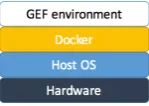
The GEF aims at a framework that allows developers to pack tools (and their computation) into movable contain-ers that can be moved towards the data. GEF makes use of Docker [U1], a virtualization mechanism that wraps an application into a container that capsules and sandboxes all computation, that is, everything needed to run the applica-tion, including all system tools, system libraries, and set-tings. Docker-based technology shows a very good perfor-mance, with container images that can have a small image size, and are fast to start. Container images are immutable by design and relatively easy to specify, using Docker scripts and pre-built container images to build-upon. Fig. 1 shows the design rationale of GEF (Dima et al., 2015). Docker software runs on the operating system of the host, on the host’s hardware, and is able to execute Docker containers (holding the tools’ virtualization). The
Figure 1: The GEF architecture.
GEF software is built-upon Docker allowing community admin users to upload their tools together with a Dock-erfile from which Docker container images are generated. These images become GEF services and can be invoked on any data set in the EUDAT Collaborative Data Infrastruc-ture (EUDAT, 2017), see [U2].
Figure 2: Main Page of the GEF front-end, see [U8].
Fig. 2 shows the front-end of the GEF. In the top pane, there are three items: “Build”, “Services” and “Jobs”. When choosing the first item, the GEF admin (“power user”) can build a new GEF service. For this, the user needs to up-load a Dockerfile, together with other files which should be part of the container. With the file upload complete, GEF’s underlying Docker software will build a Docker-based con-tainer image, which the GEF will use to provide the corre-sponding GEF service of the application.
Fig. 2 shows four services from the GEF test site. A GEF service can be run by supplying a PID or URL that points to the input to be processed. Hitting the “Submit” button, will start the service asynchronously. All running jobs can be inspected through “Jobs”. Once a job terminates, its output volume holds the result of the computation.
2.2.
The WebLicht Workflow Engine
WebLicht is a workflow engine giving users a web-based access to over fifty tools for analysing digital texts (Hin-richs et al., 2010). Its pipelining engine offers prede-fined workflows (“Easy Mode”) and supports users in configuring their own (“Advanced Mode”). With Web-Licht, users can analyse texts at different levels such as morphology analysis, tokenization, part-of-speech tagging, lemmatization, dependency parsing, constituent parsing, co-occurrence analysis and word frequency analysis, sup-porting mainly German, English, and Dutch. Note that WebLicht does not implement any of the tools itself but me-diates their use via pre-defined as well as user-configurable process pipelines. These workflows schedule the
succes-sion of tools so that one tool is called after another to achieve a given task, say, named entity recognition. WebLicht is a good step forward in increasing (web-based) tool access and usability as its TCF format mediates be-tween the various input and output formats the tools re-quire; and it calls the tools (hosted on many different servers located nation and world-wide) without any user en-gagement. WebLicht has now been used for many years in the linguistics community, and it is the workflow engine of choice for many national and European researchers in the CLARIN context. WebLicht is actively maintained, profits from regular tool updates and new tool integrations, and has recently been integrated with T¨uNDRA, a treebank search and visualization tool that allows WebLicht users to inspect linguistically annotated data (Chernov et al., 2017). With T¨uNDRA, users can search for specific linguistic phenom-ena at the word and sentence level, and visualize such phe-nomena. The WebLicht workflow engine is closed source, but all members of the CLARIN Service Provider Feder-ation can access its services [U6]. WebLicht-related tech-nology is maintained in a public Github repository [U7].
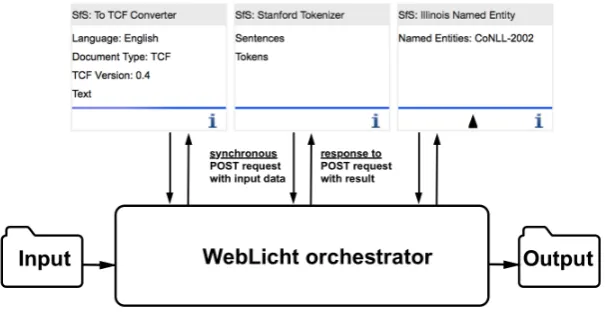
Figure 3: Data Flow in WebLicht.
the workflow have been executed in the given order. Fig. 3 shows the data flow between the WebLicht orches-trator and the tools. Note that each tool is invoked via the Hypertext Transfer Protocol (HTTP) using a POST method, with the tools’ output data being captured in the response body of the request. This design decision makes it hard to use WebLicht on huge data sets, or on data that cannot leave the host institution for property rights or privacy concerns. In the GEF mind set, WebLicht’s tools need to be “mi-grated” to a GEF environment that encapsulates all com-putation. To keep all data transfer local to the GEF en-vironment that also hosts the data, the way the WebLicht orchestrator invokes the services needs to be changed.
3.
Integration of WebLicht into GEF
GEF is not capable of executing workflows by itself. To execute a GEF-based workflow, it must be orchestrated by an external engine, which makes reference to a GEF-based repository of (immutable) application containers, each of which can be referenced by a PID. In the sequel, we will describe how the WebLicht orchestrator can be used to ex-ecute a GEF-based WebLicht workflow; we also describe how any data transfer between the GEF-external WebLicht orchestrator and the GEF-internal services is handled.
3.1.
WebLicht Adaptations
WebLicht Front-End. Fig. 4 depicts a proposed UI change to WebLicht’s entry page. In addition to the “In-put Selection” pane, there is a “Tool Location” pane, where users can select the tool environment that the WebLicht or-chestrator should use. The environment “GLOBAL – all tools” is the default tool environment where WebLicht as-sumes traditional operation (all tools are eligible for in-clusion in the workflow). When the user selects the envi-ronment “GEF@sfs tuebingen”, the WebLicht orchestrator will only make use of workflows whose tools are running in the GEF environment at the SfS in T¨ubingen. In GEF mode, no data is uploaded to WebLicht, rather users spec-ify a data URL that points to the data, usually located close to the chosen GEF computing environment.
WebLicht Back-End. The backend adaptations to Web-Licht are more substantial. Two changes to WebWeb-Licht’s back-end are discussed: how should the orchestrator organ-ise its tool space; and how should the orchestrator call the individual tools to minimize data transfers?
The WebLicht orchestrator uses the tools’ metadata to help users define workflows. For this, WebLicht is harvesting tool metadata from tool providers (as ingested to the meta-data repositories of the CLARIN centre registries). We as-sume that providers of GEF-ified tools advertise them in the same way so that WebLicht is aware of them. The de-scription of a WebLicht tool is based on the CMDI Profile
WebLichtServiceProfile, which is addressed via a persistent identifier in the tool’s metadata. Among other information, the metadata provides information about the tool’s invocation URL and its input and output parameters. By default, the WebLicht Orchestrator works on the en-tire tool space that results from the tools’ metadata har-vest. When a WebLicht user specifies a GEF environment of her choice, the orchestrator must cut through this space. In Easy Mode, it needs to identify which predefined work-flows are available in the GEF organisation specified by the user (a workflow is available in a GEF environment if each tool of the workflow is available in the GEF environment). In Advanced Mode, the Weblicht orchestrator ignores all tools not originating in the given GEF environment; only tools that are part of a given GEF environment are consid-ered for workflow construction.
Figure 4: Screenshot of WebLicht GEF extension.
the output data locally (no transfer), and (v) returns this lo-cation with a corresponding URL. With the workflow con-sisting only of tools with such wrappers no data is sent back and forth to WebLicht, but rather URL-based pointers to the data. Note that the wrappers will be required to monitor the execution of the tools they wrap. That is, when an HTTP POST request yields an error message, then this message is sent back to the WebLicht orchestrator, which then pre-maturely terminates the execution of the workflow with an appropriate error message. Once, a tool is wrapped, it needs to get Dockerized and ingested into the GEF.
3.2.
Liaising between WebLicht and the GEF
A translation mechanism is needed to liaise between Web-Licht and the GEF-enabled services in a GEF environment. Consider a user wanting to annotate sensitive data, say an English text with named entities; for this, the user se-lects a GEF-based WebLicht workflow, whose correspond-ing XML representation is given in Fig. 5.
Figure 5: The NER EasyChain in XML (fragment).
Each of the three tools in the tool chain is referenced with a persistent URL, pointing to metadata that describes the
tool, see for instance, Fig. 6.
Figure 6: Metadata for the Stanford Tokenizer..
The metadata has a URL slot that is used to invoke the tool from WebLicht. Note that the URL does not point to the GEF environment, but rather to the translation mecha-nism, see below. Also note that the type of the input is not “text/tcf+xml” but “text/tcf+url”, indicating that WebLicht will need to invoke the tool by passing a reference to the data to the tool, rather than the actual data.
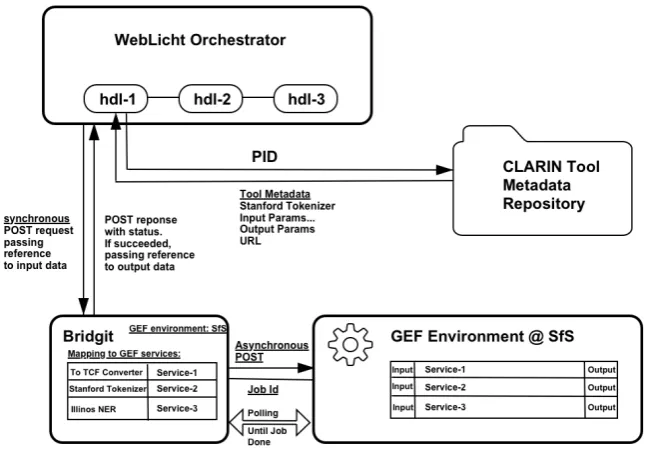
Figure 7: Architecture of WebLicht - GEF interaction.
• a pointer to the GEF environment, say, http:// gef.sfs.uni-tuebingen.de:8443.
• a JSON-based table that maps URL-encoded informa-tion such as “/StanfordTokenizer” to a service code that identifies the corresponding GEF service.
With this information the URL http://gef.sfs. uni-tuebingen.de:4041/jobs?serviceId= <id>&pid=<pointerToData> is constructed and BridgIt sends this URL as POST request to start the GEF service. The given GEF environment answers with a JSON structure that gives the job identifier of the corresponding GEF service. Bridgit then polls the GEF environment at regular intervals (200 ms) to check whether the job has terminated. This is a GET request of the form http://gef.sfs.uni-tuebingen.de: 4041/jobs/<jobId>. This GET request returns all information about the GEF job with the given jobID: the job’s id, state, and output volume (for the result of the processing). When the job terminated successfully, then BridgIt returns a reference to the output volume associated with the job id; otherwise BridgIt passes on the error code encoded in the response of the GET request. Any result is returned to WebLicht as response to the synchronous POST request to BridgIt.
4.
GEF Perspective
Setting-up a GEF environment comes at a substantial cost. Technical and logistical support is needed to keep costs manageable. From the perspective of a GEF community manager, it is highly desirable that all tools he or she wants to integrate into a GEF environment are pre-packaged. The dockerization of a tool requires intricate knowledge about the tool and its best runtime environment. In general, such
information is rarely available. As a consequence, we as-sume a GEF community manager to contact the WebLicht developers and asks them for support. The step from a Dockerized web service and the GEF-wrapper is small. Setting-up a GEF environment must also include the pro-vision of metadata records that describe all GEF-ified tools using the CMDI profile WebLichtWebService. The metadata must be included in the GEF host’s CLARIN cen-tre repository so that WebLicht can harvest this data, and hence knows about the existence of the GEF environment. For this, the existing metadata of the original web service should be adapted accordingly.
The GEF community manager must also complement the GEF environment with the translation mechanism. Here, we assume that a reference implementation of BridgIt will be provided by the WebLicht team so that a GEF admin can use and configure the translation mechanism easily. Given the required expertise and high cost of setting-up a GEF environment, the WebLicht team may provide GEF environments for popular natural language processing chains. Once a GEF environment has been set-up, the cost of moving it to a new location (close to the data) should come at relatively cheap cost.
5.
The WebLicht Perspective
execution in WaaS produces the same data flow than the browser-based version, see Fig. 3. That is, data is sent back and forth to all web services in the chain via HTTP post requests, which is expensive. The work described in this paper improves the situation for larger files as the Web-Licht orchestator now invokes GEFified tools by sending them references to the data rather then the actual data. But there is ample potential for optimization. The wrapping of services described earlier introduces an unnecessary over-head. Here, it is advisable to Dockerize the initial tools (that is, not their REST-based variants), and have them ac-cessing their input via mounted Docker volumes (instead of responding to HTTP requests).
Another path for optimization is WebLicht’s TCF format, which is rather verbose when compared with other compet-ing formats (Lapponi et al., 2014). As a matter of fact, each tool in a WebLicht workflow enriches the TCF input with its processing result. Reconsider the easy-chain displayed in Fig. 3. Here, the Stanford Tokenizer tokenizes all input as preprocessed by the TCF converter, and then adds all to-kens to the TCF file; this stage hence more than doubles the data, which is then sent to the Illinois Named Entity Recog-nizer. Assuming that the Illionois NER relies on the tokens only, the original input could have been consumed by the Stanford Tokenizer, nearly halving the data then sent to the next stage. Here, WebLicht’s original design rationale is to blame. It regards all web services connected to WebLicht as black boxes and abstracts from their inner workings. For big data, this abstraction may prove too wasteful. Future tool metadata descriptions might need to specify whether a tool, say, requires only tokenized input or whether they also need access to the original input. WebLicht’s workflow en-gine would then invoke the services with a ’consume’ flag set to true or false, respectively.
In addition, the TCF format itself could be compacted in many different ways without inflicting any information loss. A JSON-based representation of TCF, for instance, promises to cut space requirements by half.
In the paper, WebLicht breaks out of its current bound-aries. It empowers users to not only select the tools for their workflow, it lets them now also choose where the tools should run (see the selection of the GEF environment in Fig. 4). Here, more flexibility can be added by allowing mixed workflows: here, the first stages of the workflow, for instance, must be processed by in-house (i.e., GEFified) tools, while the latter processing stages could be processed by non-GEF services (assuming that the original input is ’consumed’ by the prior stages, see above).
To use WebLicht and its associated tools, users need to be authenticated with an account of the CLARIN Service Provider Federation. For users to process sensitive data with WebLicht, a future version will need to ask users for additional credentials. For this, reconsider, Fig. 4. When users specify a data url for the input data (bottom right), WebLicht could mediate users’ credentials with the data site to check whether a given user is authorized to access the data. Only after successful AAI, users will be delegated to the next GUI page to identify or construct workflows.
6.
Discussion and Conclusion
We are in the process of setting-up a proof of concept GEF environment for a popular language processing workflow (Named Entity Recognition for English). So far, we have dockerized all three tools of this workflow (including their service wrapping). This is the essential step towards “mov-able computation”. The BridgIT liaison device is currently being developed and tested, and CMDI-based metadata de-scriptions for GEF-enabled services are being authored and made available for harvest by WebLicht. For testing pur-poses, we will create a WebLicht branch that offers GEF-enabled services to users.
Our work has already had a positive impact on the devel-opment of both WebLicht and GEF. To limit the amount of data transfer between the original WebLicht orchestra-tor and the individual services that define a workflow, it is now being discussed whether services shall also be invok-able by passing references to the data rather than by posting the data to them. Our work also informed the EUDAT-GEF development team to ensure that user requirements stem-ming from the WebLicht use case lead to GEF feature re-quests that will find their way into the official GEF speci-fication and implementation. One feature request concerns the invocation of a GEF service. At the time of writing, starting a GEF-ified tool means starting a new Docker con-tainer. Some tools, however, consume significant resources at start-up. The Illinois Named Entity Recognizer, for in-stance, loads large models to inform its processing. Here, it is more advisable to not terminate the GEF service (that is, to not stop the Docker container) once NER processing finished. In this case, the GEF service should continue lis-tening to and serving future incoming processing requests.
We have started our article with GEF’s underlying motiva-tion that datasets have become much larger than the tools that process them, or that there are datasets that are not allowed to leave their hosting institition for legal reasons. Moving the tools to the data rather than the data to the tools seems reasonable. In linguistics, there is sensitive data, but big data issues become more prominent, too. Take, for instance, the Newsreader project with the aim to parse 100.000+ news articles live on a daily basis (Vossen et al., 2016). For these projects, a future version of WebLicht based on our approach can play a key role in orchestrat-ing and executorchestrat-ing a variety of workflows to gather, collect and post-process such data. The integration of the CLARIN WebLicht workflow engine and its services with EUDAT’s Generic Execution Framework makes it possible to bring the language processing tools to an execution environment that also hosts the data, hence allowing language processing of sensitive and big data.
7.
Acknowledgements
8.
URL References
[U1]https://www.docker.com/what-docker [U2]https://www.eudat.eu/eudat-cdi/about [U3]https://github.com/EUDAT-GEF/GEF [U4]https://golang.org[U5]https://facebook.github.io/react [U6]https://weblicht.sfs.uni-tuebingen.de [U7]https://github.com/weblicht
[U8]https://eudat-gef.mpimet.mpg.de
[U9] https://weblicht.sfs.uni-tuebingen.de/ WaaS
9.
Bibliographical References
Chernov, A., Hinrichs, E., and Hinrichs, M. (2017). Search your own treebank. InProceedings of the 15th Interna-tional Workshop on Treebanks and Linguistic Theories (TLT15), pages 25–34. Bloomington, IN, USA.
Dima, E., Pag´e, C., and Budich, R. (2015). D7.5.2: Tech-nology Adaptation and Development Framework (final). Technical report, EUDAT deliverable.
EUDAT. (2017). The EUDAT Collaborative Data Infras-tructure (CDI). See the website at https://eudat.eu/eudat-collaborative-data-infrastructure-cdi.
Hinrichs, E., Hinrichs, M., and Zastrow:, T. (2010). We-blicht: Web-Based LRT Services for German. In Pro-ceedings of the 48th Annual Meeting of the Association for Computational Linguistics (System Demonstrations). Lapponi, E., Velldal, E., Oepen, S., and Knudsen, R. L. (2014). Off-road laf: Encoding and processing anno-tations in nlp workflows. In N. Calzolari (Conference Chair), et al., editors,Proceedings of the Ninth Interna-tional Conference on Language Resources and Evalua-tion (LREC’14), Reykjavik, Iceland, may. European Lan-guage Resources Association (ELRA).
![Figure 2: Main Page of the GEF front-end, see [U8].](https://thumb-us.123doks.com/thumbv2/123dok_us/813485.1096321/2.595.105.488.65.361/figure-main-page-gef-end-u.webp)