Overview of the 2019 ALTA Shared Task: Sarcasm Target Identification
We present an overview of the 2019 ALTA shared task. This is the 10th of the series of shared tasks organised by ALTA since 2010. The task was to detect the target of sarcastic comments posted on social media. We intro-duce the task, describe the data and present the results of baselines and participants. This year’s shared task was particularly challenging and no participating systems improved the re-sults of our baseline.
1 Introduction
Sarcasm is a form of verbal irony that is intended to express contempt or ridicule. Sarcastic text has been understood to be a challenge to sentiment analysis because a sarcastic text may appear to be positive on the surface but is intended to be neg-ative. Empirical results also show that sarcastic text is detrimental to sentiment analysis (Maynard and Greenwood,2014). Applications where senti-ment understanding is important are also impacted by sarcastic text. These applications include di-alogue systems where the correct prediction of sentiment is important to generate appropriate re-sponses. Towards this, computational sarcasm has gained interest in the research community.
Sentiment in a text can be understood to be composed of valence (positive/negative) and the target (Liu, 2012). The connection between sar-casm detection and sentiment analysis is the tar-get. Sarcastic text bears a target of ridicule. It is this target that receives negative sentiment in the sarcastic sentence.
The goal of the 2019 ALTA Shared Task is the automatic detection of sarcasm targets. Section2
describes the general aims of the ALTA shared tasks, and the specific aim of the 2019 shared task. Section3briefly presents related work. Section4
describes the data. Section5shows the evaluation
results. Section 6 presents the results, and Sec-tion7concludes this paper.
2 The 2019 ALTA Shared Task
The 2019 ALTA Shared Task is the 10th of the shared tasks organised by the Australasian Lan-guage Technology Association (ALTA). Like the previous shared tasks, it targets university students with programming experience, but it is also open to graduates and professionals. The general objec-tive of these shared tasks is to introduce interested people to the sort of problems that are the subject of active research in a field of natural language processing. Depending on the availability of data, the tasks have ranged from classic but challenging tasks to tasks linked to very hot topics of research. There are no limitations on the size of the teams or the means that they may use to solve the prob-lem. We provide training data but participants are free to use additional data and resources. The only constraint in the approach is that the processing must be fully automatic — there should be no hu-man intervention.
As in past ALTA shared tasks, there are two cat-egories: a student category and an open category.
• All the members of teams from thestudent category must be university students. The teams cannot have members that are full-time employed or that have completed a PhD.
• Any other teams fall into theopen category.
Given a sarcastic text, the task of the 2019 ALTA shared task is to identify the set of words which are the target of sarcasm. The words are to be returned as a list with all words in lowercase, where all duplicates have been removed. If such set of words is not found, the system should return a fall-back label ”OUTSIDE”. Table1shows ex-amples of sarcastic comments and the annotated targets. The assumption in each of the samples used in the shared task is that they are sarcastic.
3 Related Work
Sarcasm has been understood as a challenge for sentiment analysis (Pang et al., 2008). Over the past years, automatic detection of sarcasm gained interest. Several approaches have been reported for automatic detection of sarcasm in text, span-ning rule-based approaches to deep neural archi-tectures (Joshi et al.,2017).
Since sarcasm is a peculiar form of sentiment expression, the target of a sarcastic text bears im-plications on attribution of the negative sentiment to the appropriate target. For example, for an aspect-based sentiment analysis system, the sar-casm target will be the aspect towards which a negative sentiment will be assigned. Two prior pa-pers report approaches for sarcasm target identifi-cation.
The problem of sarcasm target identification was introduced in Joshi et al. (2018). They present three kinds of methods: (a) rule-based which use heuristics to determine sarcasm targets, (b) learning-based which use a sequence labelling algorithm trained on a dataset labelled with sar-casm targets, and (c) a hybrid of the two where output of the two systems is combined to make the final predictions.
More recently, Patro et al. (2019) present a deep learning-based architecture for sarcasm tar-get identification. The semantic representation of each word is captured in terms of its context win-dow using a bidirectional LSTM. This semantic representation is then concatenated with features based on LIWC, NER, empathy and POS tags, to learn a classifier. They show an improvement over the prior work.
4 Data
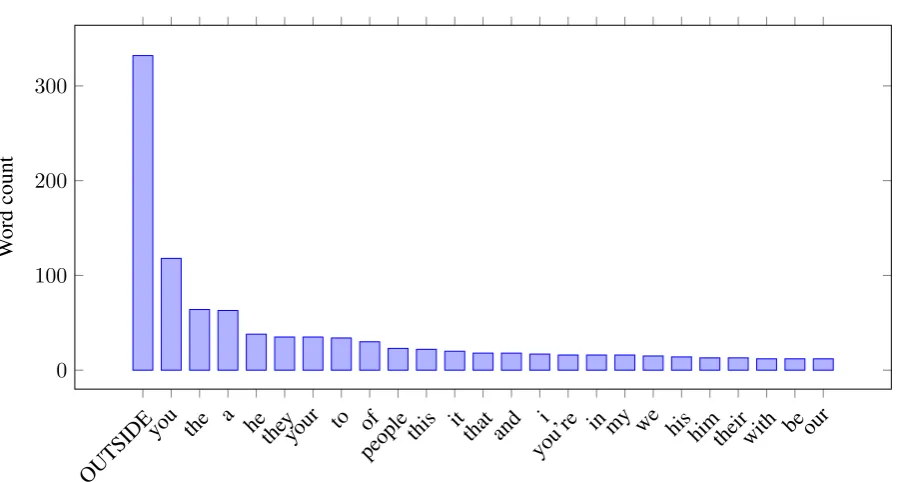
The data used in the 2019 ALTA Shared Task con-sists of 950 training samples and 544 test sam-ples. A count of the words appearing in the
tar-gets of the training data (Figure 1) reveals that a large percentage of the data is labelled as OUT-SIDE, and many of the remaining words are sonal and possessive pronouns, including first per-son “I”, “we”, “my”. This observation led us de-fine a baseline that focus on the presence of pro-nouns — see Section6for details of the baseline.
5 Evaluation
As in previous ALTA shared tasks, the 2019 shared task was managed and evaluated using Kaggle in Class, with the name “ALTA 2019 Chal-lenge”.1 This allowed the participants to submit runs prior to the submission baseline for immedi-ate feedback and compare submissions in a public leaderboard.
The test data was split into a public and a private partition. Submissions by participants were eval-uated on the entire test data but only the results of the public partition were shown in the public leaderboard. Only the shared task organisers had access to the results of the private leaderboard, and these results were used for the final ranking after the submission deadline.
Each participating team was allowed to submit up to two (2) runs per day. By limiting the number of runs per day, and by not disclosing the results of the private partition, the risks of overfitting to the private test results were controlled.
The evaluation metric was the mean of the F1 score over the test samples (Formula1),
F1 = 2p×rp+r p = tp+f ptp r = tp+f ntp
(1)
where the true positives (tp) in a sample were the set of target words correctly identified by the sys-tem, the false positives (f p) were the set of words incorrectly identified as target, and the false neg-atives (f n) were the set of words from the target that were not identified by the system.
The mean F-Score is equivalent to the mean of the Sørensen-Dice coefficient (Formula2),
D(A, B) = 2 |A∩B|
|A|+|B| (2)
whereArepresents the set of words of the target, andBrepresents the set of words of the prediction.
1https://inclass.kaggle.com/c/
Comment Target
Your shirt reminds me of my 10-year-old your shirt This is the best film ever! film Oh, and I suppose the apple ate the cheese OUTSIDE
Table 1: Examples of sarcastic comments and their targets.
OUTSIDE
you the a hetheyyour to of peoplethis
it
that and i
you’re in my we his himtheirwith be our 0
100 200 300
W
ord
count
Leaderboard Name Category Public Private
OUTSIDE Baseline 0.36764 0.34926
Powers Student 0.38624 0.33311 Orangutan Student 0.37150 0.29218 Pronouns Baseline 0.20933 0.22539
Table 2: Public and private leaderboards based on runs selected for the final ranking (by default these were the runs with highest score in the public leaderboard). The figures indicate the mean F1 score.
6 Results
Two baselines were made available to the partic-ipants as a Kaggle notebook.2 The first baseline simply returned the word OUTSIDE, meaning that in all cases the target was predicted as not explic-itly mentioned in the text. This baseline proved particularly hard to beat, as discussed below.
The second baseline is based on the observation that many of the target words are pronouns (Fig-ure1). Thus, the baseline returns all personal and possessive pronouns, and if no such pronouns are found, it returns OUTSIDE.
In total 16 teams registered for the competition — 14 in the student category and 2 in the open category. Of these, only 5 teams submitted runs, and only 2 submitted valid runs with results dif-ferent from the baselines. Table 2 shows the re-sults of the public and private leaderboard for the baselines and the 2 teams.
As Table 2 shows, no teams outperformed the OUTSIDE baseline in the private partition. A team was allowed to submit up to two runs per day, and the team received immediate feedback of the score of the public leaderboard. By default, the fi-nal submission was the one with the highest score in the public leaderboard, and the team had the op-tion to override the default and select a different run. We observed that, even though none of the selected runs outperformed the baseline in the pri-vate leaderboard, some runs with lower scores in the public leaderboard did outperform the baseline in the private leaderboard. Table 3shows the re-sults of the best runs in the private leaderboard and their scores in the public leaderboard. The runs of Table2, however, were not considered for the final ranking.
2https://inclass.
kaggle.com/dmollaaliod/
baselines-for-sarcasm-target-identification
Leaderboard Name Category Public Private
OUTSIDE Baseline 0.36764 0.34926 Powers Student 0.34731 0.34490 Orangutan Student 0.33242 0.37802 Pronouns Baseline 0.20933 0.22539
Table 3: Public and private leaderboards based on runs with best scores in private leaderboard. The figures in-dicate the mean F1 score.
It is possible that the existence of the OUTSIDE label made the task particularly challenging. We therefore also conducted an alternative evaluation (not used for the final ranking) where we removed all samples labelled as OUTSIDE by either the an-notators or the system (Table4). The data set for this evaluation was the entire test data set combin-ing the public and private partitions.3 The table also includes the results of the pronoun baseline evaluated on the same data. None of the systems beat the pronoun baseline on the same test data.
The results of Table4use different data for each system and therefore they cannot be used for com-paring the systems. Also we should note that the systems were designed assuming that some of the data would be labelled as OUTSIDE, so the re-sults are probably not indicative of the quality of the systems.
7 Conclusions
The aim of the 2019 ALTA shared task was to de-tect the target of sarcastic comments. As in previ-ous years, the task was managed as a Kaggle-in-Class competition. This year the task proved par-ticularly challenging and none of the selected runs obtained better results than the baselines in the private leaderboard and therefore no prizes were given. The challenge will remain open in Kaggle in Class and new submissions are welcome.
Acknowledgments
The authors would like to thank Pranav Goel, Uni-versity of Maryland, for his assistance with obtain-ing the dataset.
3The reason behind using the combine public and private
Name Category Mean F1 Mean F1 of Pronoun Baseline Test Size
Powers Student 0.37931 0.38152 170
Orangutan Student 0.35469 0.31534 105
Table 4: Evaluation on the test data after removing entries labelled as OUTSIDE by annotators and systems. The figures indicate the highest mean F1 score of each of the participant’s submissions, which could be a different submission from the systems of Tables2and3.
References
Aditya Joshi, Pushpak Bhattacharyya, and Mark J. Car-man. 2017.Automatic sarcasm detection: A survey.
ACM Computing Surveys, 50(5):73:1–73:22.
Aditya Joshi, Pranav Goel, Pushpak Bhattacharyya, and Mark J. Carman. 2018. Sarcasm target identi-fication: Dataset and an introductory approach. In
Proceedings of the Eleventh International Confer-ence on Language Resources and Evaluation (LREC 2018), Miyazaki, Japan. European Language Re-sources Association (ELRA).
Bing Liu. 2012. Sentiment analysis and opinion min-ing. Synthesis lectures on human language tech-nologies, 5(1):1–167.
DG Maynard and Mark A Greenwood. 2014. Who cares about sarcastic tweets? investigating the im-pact of sarcasm on sentiment analysis. In LREC 2014 Proceedings. ELRA.
Bo Pang, Lillian Lee, et al. 2008. Opinion mining and sentiment analysis. Foundations and TrendsR in In-formation Retrieval, 2(1–2):1–135.