Topic Modeling for Native Language Identification
Sze-Meng Jojo Wong
Mark Dras
Mark Johnson
Centre for Language Technology
Macquarie University
Sydney, NSW, Australia
{sze.wong,mark.dras,mark.johnson}@mq.edu.au
Abstract
Native language identification (NLI) is the task of determining the native language of an author writing in a second language. Several pieces of earlier work have found that fea-tures such as function words, part-of-speech n-grams and syntactic structure are helpful in NLI, perhaps representing characteristic er-rors of different native language speakers. This paper looks at the idea of using Latent Dirichlet Allocation as a feature clustering technique over lexical features to see whether there is any evidence that these smaller-scale features do cluster into more coherent latent factors, and investigates their effect in a clas-sification task. We find that although (not un-expectedly) classification accuracy decreases, there is some evidence of coherent clustering, which could help with much larger syntactic feature spaces.
1
Introduction
Native language identification(NLI), the task of de-termining the native language of an author writing in a second language, typically English, has gained in-creased attention in recent years. The problem was first phrased as a text classification task by Koppel et al. (2005), using a machine learner with fundametally lexical features — function words, character n-grams, and part-of-speech (PoS) n-grams. A number of subsequent pieces of work, such as that of Tsur and Rappoport (2007), Estival et al. (2007), Wong and Dras (2009) and Wong and Dras (2011), have taken that as a starting point, typically along with a wider range of features, such as document structure or syntactic structure.
Wong and Dras (2011) looked particularly at syn-tactic structure, in the form of production rules and parse reranking templates. They noted that they did not find the expected instances of clearly un-grammatical elements of syntactic structure indicat-ing non-native speaker errors; instead there were just different distributions over regular elements of grammatical structure for different native languages. Our intuition is that it is several elements together that indicate particular kinds of indicative errors, such as incorrect noun-number agreement; and from this, that there might be coherent clusters of corre-lated features that are indicative of a particular native language. In this preliminary work, we investigate this using the basic lexical features of the original Koppel et al. (2005) model.
Latent Dirichlet Allocation (LDA) — a genera-tive probabilistic model for unsupervised learning — was first introduced by Blei et al. (2003) to dis-cover a set of latent mixture components known as topics which are representative of a collection of discrete data. The underlying idea of LDA is that each document from a text corpus is constructed ac-cording to a specific distribution of topics, in which words comprising the document are generated based on the word distribution for each selected topic; a topic is typically represented by a set of words such asspecies,phylogenetic,evolutionand so on. Such a model allows multiple topics in one document as well as sharing of topics across documents within the corpus.
useful clusters of features) in each document affects classification performance. Here we are mapping clusters of features as ‘topics’ in typical LDA mod-els and the posterior topic distributions inferred are to be used for classifying the native language of the authors against baseline models using the actual fea-tures themselves. We are particularly interested in whether the topics appear at all to form coherent clusters, and consequently whether they might po-tentially be applicable to the much larger class of syntactic features.
The remainder of this paper is structured as fol-lows. In Section 2, we discuss some related work on the two key concepts of this paper: first relevant work in NLI, and then a brief description of LDA with its application to classification. We then de-scribe both the topic models and the classification models used for the corpus to be examined, in Sec-tion 3. SecSec-tion 4 presents classificaSec-tion results, and is followed by discussion in Section 5.
2
Related Work
2.1 Native Language Identification
Most of the existing work on native language identi-fication adopts the supervised machine learning ap-proach to classification. Koppel et al. (2005) is the earliest work in this classification paradigm using as features function words, character n-grams, and PoS bi-grams, together with some spelling mistakes. They used as their corpus the first version of Inter-national Corpus of Learner English(ICLE), select-ing authors writselect-ing in English who have as their na-tive language one of Bulgarian, Czech, French, Rus-sian, or Spanish. Koppel et al. (2005) suggested that syntactic features (specifically errors) might be potentially useful, but only explored this idea at a rather shallow level by characterising ungrammati-cal structures with rare PoS bi-grams. This work of Koppel et al. (2005) was then investigated by Tsur and Rappoport (2007) to test their hypothesis that the choice of words in second language writ-ing is highly influenced by the frequency of native language syllables, through measuring classification accuracy with only character bi-grams as features.
Another work with a similar goal, of developing profiles of authors, is that of Estival et al. (2007). They used a variety of lexical and document struc-ture feastruc-tures over a set of three languages —
En-glish, Spanish and Arabic — also looking at pre-dicting other demographic and psychometric author traits in addition to native language.
Wong and Dras (2009) first replicated the work of Koppel et al. (2005) with the three types of lexical feature as mentioned above and then ex-tended the classification model with three syntac-tic errors commonly observed in non-native English users — subject-verb disagreement, noun-number disagreement and misuse of determiners — which had been identified as being influenced by the na-tive language based on ‘constrana-tive analysis’ (Lado, 1957). Although the overall classification did not improve over the lexical features alone, an ANOVA analysis showed that there were significant differ-ences amongst different groups of non-native En-glish users in terms of the errors made. In this work the classification task was carried out using the sec-ond version of ICLE (Granger et al., 2009), across seven languages (those of Koppel et al. (2005) with the two Asian languages Chinese and Japanese).
The later work of Wong and Dras (2011), on the same data, further explored the usefulness of syn-tactic features in a broader sense by characterising syntactic errors with cross sections of parse trees obtained from statistical parsing. More specifically, they utilised two types of parse tree substructure to use as classification features — horizontal slices of the trees as sets of CFG production rules and the fea-ture schemas used in discriminative parse reranking (Charniak and Johnson, 2005). It was demonstrated that using these kinds of syntactic features performs significantly better than lexical features alone.
(2011).
2.2 Latent Dirichlet Allocation
Latent Dirichlet Allocation is a Bayesian probabilis-tic model used to represent collections of discrete data such as text corpora, introduced by Blei et al. (2003). It addressed limitations of earlier tech-niques such as probabilistic latent semantic index-ing, which is prone to overfitting and unable to gen-eralise to unseen documents. LDA is a relaxation of classical document mixture models in which each document is associated with only a single topic, as it allows documents to be generated based on a mix-ture of topics with different distributions. We dis-cuss the basic details of LDA, and our particular rep-resentation, in Section 3.1.
LDA has been applied to a wide range of tasks, such as building cluster-based models for ad hoc information retrieval (Wei and Croft, 2006) or grounded learning of semantic parsers (B¨orschinger et al., 2011). Relevant to this paper, it has been ap-plied to a range of text classification tasks.
The original paper of Blei et al. (2003) used LDA as a dimensionality reduction technique over word unigrams for an SVM, for genre-based classification of Reuters news data and classification of collabora-tive filtering of movie review data, and found that LDA topics actually improved classification accu-racy in spite of the dimensionality reduction. This same basic approach has been taken with other data, such as spam filtering of web text (B´ır´o et al., 2008), where LDA topics improved classification f-measure, or finding scientific topics from article ab-stracts (Griffiths and Steyvers, 2004), where LDA topics appear to be useful diagnostics for scientific subfields.
It has also been augmented in various ways: su-pervised LDA, where topic models are integrated with a response variable, was introduced by Blei and McAuliffe (2008) and applied to predicting senti-ment scores from movie review data, treating it as a regression problem rather than a classification prob-lem. Work by Wang et al. (2009) followed from that, extending it to classification problems, and applying it to the simultaneous classification and annotation of images. An alternative approach to joint models of text and response variables for sentiment classifi-cation of review texts (Titov and McDonald, 2008), with a particular focus on constructing topics related
to aspects of reviews (e.g. food, decor, or service for restaurant reviews), found that LDA topics were pre-dictively useful and seemed qualitatively intuitive.
In all of this preceding work, a document to be classified is represented by an exchangeable set of (content) words: function words are generally re-moved, and are not typically found in topics useful for classification. It is exactly these that are used in NLI, so the above work does guarantee that an LDA-based approach will be helpful here.
Two particularly relevant pieces of work on using LDA in classification are for the related task of au-thorship attribution, determining which author wrote a particular document. Rajkumar et al. (2009) claim that models with stopwords (function words) alone are sufficient to achieve high accuracy in classifi-cation, which seems to peak at 25 topics, and out-perform content word-based models; the results pre-sented in Table 2 and the discussion are, however, somewhat contradictory. Seroussi et al. (2011) also include both function words and content words in their models; they find that filtering words by fre-quency is almost always harmful, suggesting that function words are helping in this task.1
In this paper we will explore both function words and PoS n-grams, the latter of which is quite novel to our knowledge in terms of classification using LDA, to investigate whether clustering shows any potential for our task.
3
Experimental Setup
3.1 Mechanics of LDA
3.1.1 General Definition
Formally, each document is formed from a fixed set of vocabularyV and fixed set of topicsT (|T|= t). Following the characterisation given by Griffiths and Steyvers (2004), the process of generating a cor-pus ofmdocuments is as follows: first generate a set of multinomial distributions over topicsθj for each documentDj according to aT-dimensional Dirich-let distribution with concentration parameterα(i.e.
θj∼Dir(α)); then generate a set of multinomial dis-tributionsφi over the vocabularyV for each topici according to aV-dimensional Dirichlet distribution with concentration parameterβ(i.e. φi∼Dir(β));
1They note that for function words the term ‘latent factor’ is
and finally generate each of thenj words for docu-ment Dj by selecting a random topic z according θj and then drawing a word wj,k from φz of the selected topic. The overall generative probabilistic model can be summarised as follows:
θj ∼Dir(α) j∈1, ..., m
φi∼Dir(β) i∈1, ..., t
zj,k∼θj j∈1, ..., m,k∈1, ..., nj
wj,k∼φzj,k j∈1, ..., m,k∈1, ..., nj
From the inference perspective, given a corpus of mdocuments withnj words each, the task is to es-timate the posterior topic distributions θj for each documentDjas well as the posterior word distribu-tionsφifor each topicithat maximise the log like-lihood of the corpus. As exact inference of these posterior distributions is generally intractable, there is a wide variety of means of approximate inference for LDA models which include approximation algo-rithms such asVariational Bayes (Blei et al., 2003) and expectation propagation (Minka and Lafferty, 2002) as well asMarkov Chain Monte Carlo infer-ence algorithm with Gibbs sampling (Griffiths and Steyvers, 2004).
3.1.2 LDA as PCFG
Johnson (2010) showed that LDA topic models can be regarded as a specific type of probabilistic context-free grammar (PCFG), and that Bayesian in-ference for PCFGs can be used to learn LDA mod-els where the inferred distributions of PCFGs cor-respond to those distributions of LDA. A general schema used for generating PCFG rule instances for representing m documents with t topics is as fol-lows:2
Sentence→Doc0j j∈1, ..., m Doc0j → j j∈1, ..., m Doc0j →Doc0j Docj j∈1, ..., m
Docj →T opici i∈1, ..., t;j∈1, ..., m
T opici →w i∈1, ..., t;w ∈V
Each of the rules in the PCFG is associated with a Bayesian inferred probability. The probabilities as-sociated with the rules expandingT opicicorrespond to the word distributionsφi of the LDA model, and the probabilities associated with the rules expand-ing Docj correspond to the topic distributions θj
2It should be noted that each document is given with a
docu-ment identifier in which sentences in the docudocu-ment are prefixed with j.
of LDA. Similarly, inference on the posterior rule distributions can be approximated with Variational Bayes and Gibbs sampling. We use this PCFG for-mulation of LDA in this work.
3.2 Experimental Models
This section describes both the LDA models and the corresponding classification models used for our na-tive language identification task on the ICLE cor-pus (Version 2) (Granger et al., 2009). Following Wong and Dras (2011), our experimental dataset consists of 490 essays written by non-native English users from seven different groups of language back-ground — namely, Bulgarian, Czech, French, Rus-sian, Spanish, Chinese, and Japanese. There are 70 documents per native language.
Unlike the documents often inferred by LDA topic models which mostly consist of only content words, we represent our documents with function words instead, as this is typical for authorship re-lated tasks, and does not allow unfair clues based on different distribution of domain discourses. In addition, we also experiment with documents repre-sented by another type of lexical features for NLI, PoS bi-grams.
3.2.1 LDA Models for NLI
For each of the models we describe below, we experiment with different numbers of topics, t =
{5,10,15,20,25}. In terms of the total number of PCFG rules representing each model, there are 490 of the first three rules as shown in the schema (Sec-tion 3.1.2),490×tof the rule expandingDocj →
T opici, andt×vof the rule expandingT opici →w (see Table 1). All the inferences are performed with the PCFG-based Gibbs sampler implemented by Mark Johnson.3
FW-LDA Models The first LDA model is func-tion word based. The vocabulary used for generating documents with this model is therefore a set of func-tion words. We adopt the same set as used in Wong and Dras (2011) which consists of 398 words. An instance of the PCFG rule expandingT opici → w isT opic1 → the; there are 398 such rules for each topic.
3
LDA Models t= 5 t= 10 t= 15 t= 20 t= 25
FW-LDA 5,910 10,350 14,790 19,230 23,670
POS-LDA 4,920 8,370 11,820 15,270 18,720
FW+POS-LDA 6,910 12,350 17,790 23,230 28,670
Table 1: Number of PCFG rules for each LDA model with different number of topicst
POS-LDA Models The second model is PoS bi-gram based. We choose bi-bi-grams as it has been shown useful in Tsur and Rappoport (2007), and was used in Wong and Dras (2009). By tagging the 490 documents with Brill tagger (with Brown cor-pus tags), we extract the 200 most frequent occur-ring PoS bi-grams to form the vocabulary for this model. An instance of the PCFG rule expanding
T opici → w isT opic1 → NN NN; there are 200 such rules for each topic.
FW-POS-LDA Models The third model com-bines the first two. We note that this is not typical of topic models: most form topics only over single types, such as content words.4 The vocabulary then consists of both function words and PoS bi-grams with 598 terms in total. Thus, there are 598 instances of the rule expandingT opici→wfor each topic.
3.2.2 Classification Models for NLI
Here we exploit LDA as a form of feature space dimension reduction to discover clusters of features as represented by ‘topics’ for classification. Based on each of the LDA models inferred, we take the posterior topic distributions to use as features for classifying into one of the seven native language classes. All the classifications are performed with a maximum entropy learner — MegaM (fifth release) by Hal Daum´e III.5
Baselines Each LDA classification model (as de-scribed in the following) is compared against a cor-responding baseline model. These sets of model use the actual features themselves for classification without feature reduction. There are three base-lines: function word based with 398 features (FW -BASELINE), PoS bi-gram based with 200 features (POS-BASELINE), and the combination of the first two set of features (FW+POS-BASELINE). For each
4
Those that include multiple types typically treat them in different ways, such as in the separate treatment of content words and movie review ratings of Blei and McAuliffe (2008).
5
MegaM is available athttp://www.cs.utah.edu/ ˜hal/megam/.
of these models, we examine two types of feature value — relative frequency and binary.
Function Words Features used in this model (FW
-LDA) are the topic distributions inferred from the first LDA model. There are five variants of this based on number of topics (Section 3.2.1). The fea-ture values are the posterior probabilities associated with the PCFG rules expanding Docj → T opici which correspond to the topic distributionsθjof the
LDA representation.
PoS Bi-grams Similarly, this set of classification models (POS-LDA) uses the topic probabilities in-ferred from the second LDA model as features. Five variants of this with respect to the different topic numbers are examined as well.
Combined Features The last set of models com-bine both the function words and PoS bi-grams as classification features. The feature values are then the topic probabilities extracted from the last LDA model (the combinedFW+POS-LDAmodel).
3.3 Evaluation
Often, LDA models are evaluated in terms of good-ness of fit of the model to new data, by estimating the
perplexityor similar of unseen held-out documents given some training documents (Blei et al., 2003; Griffiths and Steyvers, 2004). However, there are issues with all such proposed measures so far, such as importance sampling, harmonic mean, Chib-style estimation, and others; see Wallach et al. (2009) for a discussion. Alternatively, LDA models can be evaluated by measuring performance of some specific applications such as information retrieval and document classification (Titov and McDonald, 2008; Wang et al., 2009; Seroussi et al., 2011). We take this approach here, and adopt the standard mea-sure for classification models —classification accu-racy— as an indirect evaluation on our LDA mod-els. The evaluation uses 5-fold cross-validation.
4
Classification Results
4.1 Baseline Models
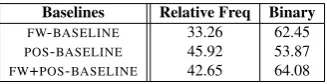
Baselines Relative Freq Binary FW-BASELINE 33.26 62.45
POS-BASELINE 45.92 53.87
FW+POS-BASELINE 42.65 64.08
Table 2: Classification performance (%) of each baseline model – feature types of relative frequency and binary
values perform much better in general, although the results are lower because the calculation was made under cross-validation rather than on a sep-arate held-out test set (hence with an effectively smaller amount of training data). Combining both the function words and PoS bi-grams yield a higher accuracy as compared to individual features alone. It seems that both features are capturing different useful cues that are predictive of individual native languages.
4.2 LDA Models
The classification performance for each of the LDA models is presented in Tables 3 to 5. Three sets of concentration parameters (Dirichlet priors) were tested on each of the three models to find the best fitted topic model: Table 3 contains results for uni-form priorsα= 1andβ= 1(the default); Table 4 is for α = 50/t and β = 0.01 (as per Steyvers and Griffiths (2007)); and Table 5 is for α = 5/t and β = 0.01 (since for us, with a small number of topics, the α = 50/t of Steyvers and Griffiths (2007) gives much larger values ofαthan was the case in Steyvers and Griffiths (2007)). On the whole, weaker priors (α= 5/tandβ= 0.01) lead to a bet-ter model as evidenced by the accuracy scores.
As observed in Table 3, the model with 10 topics is the best model under uniform priors for both the individual feature-based models (FW-LDAandPOS -LDA) with accuracies of 50.61% and 51.02% respec-tively, while the combined model (FW+POS-LDA) performs best at 55.51% with 15 topics. It should be noted that these are the outcomes of using the topic probabilities as feature value. (We also investigated the extent to which binary feature values could be useful by setting a probability threshold at 0.1; how-ever, the results are consistently lower.)
By setting a stronger α = 50/t and a much weaker β = 0.01, the resulting models perform no better than those with uniform priors (see Ta-ble 4). The best performing models under this set-ting are with 25 topics for the individual feature-based models but with 20 topics for the combined
LDA Models t= 5 t= 10 t= 15 t= 20 t= 25
FW-LDA 44.89 50.61 44.29 47.14 49.59
POS-LDA 47.35 51.02 50.00 50.61 49.79
FW+POS-LDA 49.79 54.08 55.51 52.86 53.26
Table 3: Classification performance (%) of each LDA-induced model (α = 1andβ = 1); feature values of topic probabilities
LDA Models t= 5 t= 10 t= 15 t= 20 t= 25
FW-LDA 32.45 42.45 44.29 45.71 47.35
POS-LDA 44.29 46.53 50.82 48.76 50.82
FW+POS-LDA 47.75 49.39 51.02 54.49 50.81
Table 4: Classification performance (%) of each LDA-induced model (α= 50/tandβ= 0.01); feature values of topic probabilities
model. This setting of priors was found to work well for most of the text collections as suggested in Steyvers and Griffiths (2007). However, given that our topic sizes are just within the range of 5 to 25, we also tried α = 5/t. The classification results based onα = 5/tandβ= 0.01are showed in Ta-ble 5. This setting leads to the best accuracy (thus far) for each of the models with 25 topics — FW -LDA (52.45%), POS-LDA (53.47%), FW+POS-LDA (56.94%). The overall trajectory suggests that more than 25 topics might be useful.
Overall, the classification performance for each of the LDA-induced models (regardless of the pa-rameter settings) performs worse than the baseline models (Section 4.1) where the actual features were used, contra the experience of Rajkumar et al. (2009) in authorship attribution. The drop is, however, only small in the case of PoS tags; the overall result is dragged down by the drop in function word model accuracies. And comparatively, they are still well above the majority baseline of 14.29% (70/490), so the LDA models are detecting something. On the one hand it is not surprising that reducing a rela-tively small feature space reduces performance; on the other hand, other work (as discussed in Sec-tion 2.2) had found that this had actually helped. While these results are not conclusive — a more sys-tematic search might find better values ofαandβ
LDA Models t= 5 t= 10 t= 15 t= 20 t= 25
FW-LDA 41.63 47.14 48.76 45.51 52.45 POS-LDA 43.47 49.79 51.22 52.86 53.47 FW+POS-LDA 51.84 50.61 53.88 52.62 56.94
Table 5: Classification performance (%) of each LDA-induced model (α= 5/tandβ= 0.01); feature values of topic probabilities
5
Discussion
Despite the fact that all the LDA-induced models had lower accuracy scores than the baseline mod-els, the inferred topics (clusters of related features) did demonstrate some useful cues that appear to be indicative of a particular native language. Here we present a discussion of three of these.
Analysis ofFW-LDA It is often noted in the
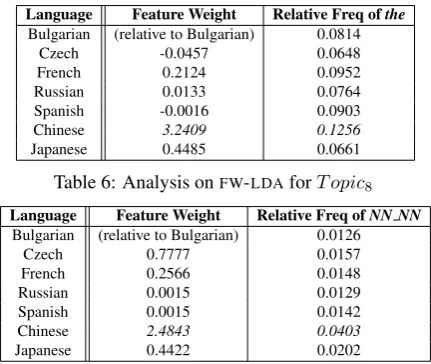
litera-ture on second language errors that a typical error of Chinese speakers of English is with articles such as a,an, andthe, as Chinese does not have these. Look-ing at the best performLook-ingFW-LDAmodel (weak pri-ors ofα = 5/tandβ = 0.01; 25 topics), we ob-served that for the three topics —T opic8 (the 8th feature),T opic19(the 19th feature) andT opic20(the 20th feature) — each of these is associated with a much higher feature weight for Chinese as compared to other native language groups (Table 6 shows the analysis onT opic8). As for the function words clus-tered under these topics,theappears to be the most probable one with the highest probabilities of around 0.188, 0.181, and 0.146 for each respectively (i.e. the PCFG rules ofT opic8 →the,T opic19 → the, and T opic20 → the); this is a higher weighting than for any other word in any topic. To verify that the topic model accurately reflects the data, we found that the relative frequency of thein the doc-uments produced by Chinese learners is the highest in comparison with other languages in our corpus. It seems that Chinese learners have a tendency to misuse this kind of word in their English construc-tions, overusingthe: this parallels the example given in Wong and Dras (2011), noted in Section 2.1, of the overuse of rules likeNP → NN NN(rather than specifically ungrammatical constructions) character-ising Chinese texts. However, there is no obvious pattern to the clustering (at least, that is evident to the authors)—if the clusters were to be grouping fea-tures in a way representative of errors, one of these topics might reflect misuse of determiners. But, none of these appear to: inT opic8, for example,a
Language Feature Weight Relative Freq ofthe Bulgarian (relative to Bulgarian) 0.0814
Czech -0.0457 0.0648 French 0.2124 0.0952 Russian 0.0133 0.0764 Spanish -0.0016 0.0903 Chinese 3.2409 0.1256 Japanese 0.4485 0.0661
Table 6: Analysis onFW-LDAforT opic8
Language Feature Weight Relative Freq ofNN NN Bulgarian (relative to Bulgarian) 0.0126
Czech 0.7777 0.0157
French 0.2566 0.0148 Russian 0.0015 0.0129 Spanish 0.0015 0.0142 Chinese 2.4843 0.0403 Japanese 0.4422 0.0202
Table 7: Analysis onPOS-LDAforT opic1
appears only in 5th place, and no other determiners appear at all in the upper end of the distribution.
Analysis of POS-LDA However, there is a
differ-ent story for POS-LDA, in terms of Chinese error phenomena. As shown in Table 7, Chinese has the highest feature weight for the first feature, T opic1 (and also forT opic4). To characterise this, we note that the PoS bi-gramNN NNappears as the top bi-gram under T opic1 (∼0.18) (and also occurs most frequently among Chinese learners as compared to other native language groups). Further, the next four bi-grams are NN IN,AT IN, IN NN and NN NNS, the last of which appears to be in complementary distribution in Chinese errors withNN NN(i.e. Chi-nese speakers tend to use the singular more often in compound nouns, when a plural might be more ap-propriate). This observation also seems to be con-sistent with the finding of Wong and Dras (2011) in which the production rule NP → NN NN, re-flecting determiner-noun disagreement, appears to be very common amongst Chinese learners.T opic1 thus seems to be somehow connected with noun-related errors.
Our second instance to look at in some detail is
Language Feature Weight Relative Freq ofPPSS VB Bulgarian (relative to Bulgarian) 0.0111
Czech 0.7515 0.0137
French -0.7080 0.0074 Russian -0.2097 0.0116 Spanish -0.3394 0.0117 Chinese -0.1987 0.0059 Japanese 2.0707 0.0224
Native Absolute Frequency
Languages I They Thou We You it she they we you Total
Bulgarian 229 66 0 52 38 1 0 297 338 219 1240
Czech 483 188 0 166 34 1 0 459 348 202 1881
French 161 55 0 71 4 2 0 282 261 90 926
Russian 355 100 1 76 28 1 0 332 286 110 1289
Spanish 157 52 0 49 6 2 1 361 360 107 1095
Chinese 143 52 0 9 2 2 0 259 66 30 563
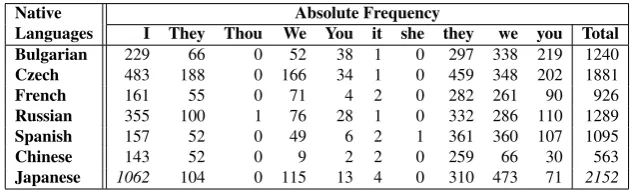
Japanese 1062 104 0 115 13 4 0 310 473 71 2152
Table 9: Pronoun usage across seven native language groups (absolute frequency of words tagged withPPSS)
for Japanese. Our expectation is that there are likely to be errors related to pronouns, as Japanese often omits them. In his comprehensive survey of sec-ond language acquisition, Ellis (2008) describes four measures of crosslinguistic influence: error (neg-ative transfer), where differences between the lan-guages lead to errors; facilitation (positive transfer), where similarities between the languages lead to a reduction in errors (relative to learners of other lan-guages); avoidance, where constructions that are ab-sent in the native language are avoided in the second language; and overuse, where constructions are used more frequently in an incorrect way in the second language, because of overgeneralisation.
A priori, it is difficult to predict which of these
types of influence might be the case. The
clas-sic study of avoidance by Schachter (1974) exam-ines Persian, Arab, Chexam-inese, and Japanese learners of English, and their performance on using relative clauses. It found that even though Persian and Ara-bic have similar (right-branching) relative clauses to English, and Japanese and Chinese have differ-ent (left-branching) ones, the Japanese and Chinese learners made fewer errors; but that that was be-cause they avoided using the construction. On the other hand, for a grammatically less complex phe-nomenon such as article use, several studies such as those of Liu and Gleason (2002) show that there can be a developmental aspect to crosslinguistic in-fluence, with initial errors or avoidance turning to overuse because of overgeneralisation, which is later corrected; intermediate learners thus show the great-est level of overuse.
Looking at T opic8 and T opic20 under the POS -LDA model, relative to other topics inferred, top-ranking PoS bi-grams are mostly related to pronouns
(such as PPSS VB, PPSS MD, and PPSS VBD).
Much higher feature weights are associated to these two topics for Japanese (as seen in Table 8 the
analysis on T opic8). Bi-grams of PPSS VB and
PPSS MDoccur much more often in Japanese learn-ers’ writings, and they are the first and the fifth terms underT opic8, which seems to capture some of these
phenomena.
To understand what these were saying about Japanese pronoun usage, we looked at a breakdown of pronoun use (see Table 9). Most apparently, the texts by Japanese speakers use more pronouns than any others. As the texts in the ICLE corpus are writ-ten by intermediate speakers, this could indicate a very strong instance of overuse. Looking at the dis-tribution of pronouns, the Japanese speakers make much more use of the pronounIthan others: this has been noted elsewhere by Ishikawa (2011) on differ-ent corpora, particularly in the use of phrases such
as I think. (The phraseI think is over-represented
among Japanese speakers in our data also.)
Overall, then, POS-LDA seems to provide useful
clustering of terms, while FW-LDA does not. This accords with the classification accuracies seen.
Analysis of FW+POS-LDA One question about the combined models was whether topics split along feature type — if that were the case, for a rough 2:1 ratio of function words to PoS bi-grams under 15 topics, there might be 10 topics whose upper rankings are dominated by function words, and 5 by PoS bi-grams. However, they are relatively evenly spread: for the top 20 words in each topic (uniform priors; 15 topics), the proportion of function words varied from 0.22 to 0.44, mean 0.339 and standard deviation 0.063. The topics thus appear to be quite mixed.
Looking into the combined model, T opic3 and
T opic11inferred by this model are amongst the
fea-tures that associated with high feature weights for Chinese. Coinciding with our expectation, the two
potential terms indicative of Chinese —NN NN and
re-spectively (where the also appears as the second most probable inT opic3).
6
Conclusion
Although the LDA-induced classification models with feature space reduction somewhat underper-formed in relation to the full feature-based models (the baselines), the ‘topics’ (latent factors) found appear in fact to be capturing useful information for individual native languages. Given the
perfor-mance of POS-LDA, and the fact that the
cluster-ing seems more intuitive here, it seems promiscluster-ing to explore LDAs further with larger class of unre-stricted PoS bi-grams, or of syntactic features such as the parse tree substructures used in Wong and Dras (2011). This could be complemented by using the adaptor grammars of Johnson (2010) to capture collocational pairings. Another potential approach that could be combined with this is to deploy the supervised LDA proposed by Blei and McAuliffe (2008), which might produce feature clusters that are more closely aligned to native language identi-fication cues.
Acknowledgments
We acknowledge the support of ARC grant LP0776267. We also thank the anonymous review-ers, particularly for insightful critiques of the analy-sis of the topic models.
References
Istv´an B´ır´o, J´acint Szab´o, and Andr´as A. Bencz´ur. 2008. Latent dirichlet allocation in web spam filtering. In
Proceedings of the 4th International Workshop on Ad-versarial Information Retrieval on the Web, pages 29– 32, Beijing, China, April.
David Blei and Jon McAuliffe. 2008. Supervised topic models. In J.C. Platt, D. Koller, Y. Singer, and S. Roweis, editors, Advances in Neural Information Processing Systems 20, pages 121–128. MIT Press, Cambridge, MA.
David M. Blei, Andrew Ng, and Michael Jordan. 2003. Latent Dirichlet allocation. Journal of Machine Learning Research, 3:993–1022.
Benjamin B¨orschinger, Bevan K. Jones, and Mark John-son. 2011. Reducing grounded learning tasks to gram-matical inference. InProceedings of the 2011 Confer-ence on Empirical Methods in Natural Language Pro-cessing, pages 1416–1425, Edinburgh, Scotland, July.
Eugene Charniak and Mark Johnson. 2005. Coarse-to-fine n-best parsing and MaxEnt discriminative rerank-ing. InProceedings of the 43rd Annual Meeting on As-sociation for Computational Linguistics, pages 173– 180, Ann Arbor, Michigan, June.
Rod Ellis. 2008. The Study of Second Language Acqui-sition, 2nd edition. Oxford University Press, Oxford, UK.
Dominique Estival, Tanja Gaustad, Son-Bao Pham, Will Radford, and Ben Hutchinson. 2007. Author profiling for English emails. InProceedings of the 10th Con-ference of the Pacific Association for Computational Linguistics (PACLING), pages 263–272.
Sylviane Granger, Estelle Dagneaux, Fanny Meunier, and Magali Paquot. 2009. International Corpus of Learner English (Version 2). Presses Universitaires de Louvain, Louvian-la-Neuve.
Thomas L. Griffiths and Mark Steyvers. 2004. Find-ing scientific topics. Proceedings of the National Academy of Sciences, 101(suppl. 1):5228–5235. Shun’ichiro Ishikawa. 2011. A New Horizon in Learner
Corpus Studies: The Aim of the ICNALE Project. In G. Weir, S. Ishikawa, and K. Poonpon, editors, Cor-pora and Language Technologies in Teaching, Learn-ing and Research, pages 3–11. University of Strath-clyde Press, Glasgow, UK.
Mark Johnson. 2010. PCFGs, Topic Models, Adaptor Grammars and Learning Topical Collocations and the Structure of Proper Names. InProceedings of the 48th Annual Meeting of the Association for Computational Linguistics, pages 1148–1157, Uppsala, Sweden, July. Moshe Koppel, Jonathan Schler, and Kfir Zigdon. 2005. Automatically determining an anonymous author’s na-tive language. InIntelligence and Security Informat-ics, volume 3495 ofLecture Notes in Computer Sci-ence, pages 209–217. Springer-Verlag.
Robert Lado. 1957. Linguistics Across Cultures: Ap-plied Linguistics for Language Teachers. University of Michigan Press, Ann Arbor, MI, US.
Dilin Liu and Johanna L. Gleason. 2002. Acquisition of the Articletheby Nonnative Speakers of English: An Analysis of Four Nongeneric Uses. Studies in Second Language Acquisition, 24:1–26.
Thomas Minka and John Lafferty. 2002. Expectation-propagation for the generative aspect model. In Pro-ceedings of the Eighteenth Conference on Uncertainty in Artificial Intelligence, pages 352–359.
J. Schachter. 1974. An error in error analysis.Language Learning, 27:205–214.
Yanir Seroussi, Ingrid Zukerman, and Fabian Bohnert. 2011. Authorship attribution with latent Dirichlet al-location. InProceedings of the Fifteenth Conference on Computational Natural Language Learning, pages 181–189, Portland, Oregon, June.
Mark Steyvers and Tom Griffiths. 2007. Probabilis-tic Topic Models. In T. Landauer, D. Mcnamara, S. Dennis, and W. Kintsch, editors,Handbook of La-tent Semantic Analysis, chapter 21, pages 427–448. Lawrence Erlbaum Associates.
Ivan Titov and Ryan McDonald. 2008. A joint model of text and aspect ratings for sentiment summariza-tion. InProceedings of ACL-08: HLT, pages 308–316, Columbus, Ohio, June.
Oren Tsur and Ari Rappoport. 2007. Using classifier fea-tures for studying the effect of native language on the choice of written second language words. In Proceed-ings of the Workshop on Cognitive Aspects of Compu-tational Language Acquisition, pages 9–16.
Hanna Wallach, Iain Murray, Ruslan Salakhutdinov, and David Mimno. 2009. Evaluation Methods for Topic Models. In Proceedings of the 26 th International Conference on Machine Learning, Montreal, Canada. Chong Wang, David Blei, and Fei-Fei Li. 2009.
Simul-taneous image classification and annotation. In Pro-ceedings of the IEEE Conference on Computer Vision and Pattern Recognition, pages 1903–1910, June. Xing Wei and W. Bruce Croft. 2006. LDA-Based
Docu-ment Models for Ad-hoc Retrieval. InProceedings of the 29th Annual International ACM SIGIR Conference (SIGIR’06), pages 178–185.
Sze-Meng Jojo Wong and Mark Dras. 2009. Contrastive analysis and native language identification. In Pro-ceedings of the Australasian Language Technology As-sociation Workshop 2009, pages 53–61, Sydney, Aus-tralia, December.