SUBLETHAL AND OVIPOSITION- DETERRENT ACTIVITY OF
COMBINATION AGAINST MALARIA VECTORS
Prejwltta Maurya, A.K. Kulshrestha
Applied Entomology Laboratory, Department of Zoology,
Narain College, Shikohabad -205135 Uttar Pradesh (INDIA)
Running Title: combination as ecofriendly larvicide
ABSTRACT
The plant extracts reduces the activities of the different developmental stages of the target organisms, therefore, they can be used as a growth inhibitors. The effect of phytochemicals on the inhibition of mosquito growth is also governed with their toxicity by mosquito species, plant species, plant parts, solvents used in extraction and fractions of the same solvent. Such plant extracts have, therefore, attracted the attention of the scientists involved in the vector control programmes. A range of pre emergent effects can occur; such as prolongation of instar and pupae durations, inhibition of larval and pupal molting, morphological abnormalities and mortality especially during molting and melanization processes. Thus, the growth inhibiting activity of a phytochemical play an important role in the management of the mosquito borne diseases
KEYWORDS- Anopheles, combination, imidacloprid, growth-inhibitor, Ocimum
INTRODUCTION
Insects constitute about 65% of living species and about 75% of animal species that’s why they
are the predominant group of living organisms on the earth. Numerically, there are about 1
million species as recorded until date. Yet the diversity could be far more, with estimate of as
high as 30 million. They were evolved more than 350 million years ago and have adapted well to
all kinds of vagaries of nature. This evolution has been both beneficial, harmful and indifferent
humans. Millions of people suffer from diseases like malaria, dengue, filarial, chikungunya and plague wherein insects play a major role of transmission of causal organism. The use of chemical insecticides for controlling pests and vector of diseases is undesirable, save and yet effective
methods of control are being sought. The use of natural products of plants origin is a new trend
that preserves the environment and can be applied effectively. Botanical extracts, termed Insect
Growth Regulators (IGRs), can have a pronounced effect on the developmental period, growth,
adult emergence, fecundity, fertility and egg hatching resulting in effective control. Thus the
growth inhibiting activity of a phytochemical may be essential to its uptake by mosquito control
industries. Indeed, the rational application of exceptional phytochemicals may not only lead to
new strategies, but may inhibit the development of insect resistance.
Identification of phytochemicals with growth inhibition properties combined with a
considerable capacity to reduce adult emergence is the need of a phytogrowth inhibitor in vector
management. Another desirable quality would be that a control agent induces IGR effects at dose
lesser than the lethal dose so that recruitment is reduced over time.
No proper attention has been paid to study the effect of combination of synthetic
insecticide and phytochemical on developmental profile of mosquito. Therefore, the detailed
study on the impact of so evolved potent combination on the morphometric and developmental
profile of anopheline mosquito was observed.
MATERIALS AND METHODS
TESTED COMPOUND
The tested plant material i.e. leaves of Ocimum basilicum were washed to avoid dusts and dirt then lift to dry under shade in the laboratory. Dried part of plant was crushed into small pieces
and powdered. Hundred grams of the resulting powdered material of plant was exhaustively
extracted with three solvents namely petroleum ether, carbon-tetrachloride and methanol,
following the method described by [1].
Next to plant, neonicotinoid insecticide, imidacloprid (97.6% SL) provided by District
Malaria Office, Circuit House, Agra (India), was also used for bioassay test against target.
Anopheles stephensi (Culicidae: Diptera).
Mosquito larvae at the 3rd-4th instars of a laboratory colony of the mosquito Anopheles
stephensi were used
TOXICOLOGICAL STUDIES
According to WHO [2] bioassay test was performed with different concentration to assess the
larvicidal activity.
JOINT ACTION OF SELECTED WASTE EXTRACTS
The selected most potent plant extract were mixed with selected synthetic insecticide to carry out
synergistic activity against anopheline larvae. The combined action of the different mixtures was
expressed as the co-toxicity factor and synergistic factor [3].
EFFECT OF SUBLETHAL TREATMENTS OF SELECTED PLANT EXTRACT AND
IMIDACLOPRID ON DIFFERENT DEVELOPMENTAL STAGES OF ANOPHELES
STEPHENSI:
For observing the effect of most potent combination identified on the different developmental
stages of the target organism, twenty unhatched eggs of each mosquito species after observing
under microscope were selected. These selected unhatched eggs were exposed to different
concentrations ranging from 0.0025 to 0.15 ppm of the most potent combination. The percent
egg hatched, larval emergence, larval mortality, larval period, pupal emergence, pupal mortality,
pupal period and adult emergence were examined and observed the deformalities observed
noticed in the developmental stages after every 24 hr. The larvae/pupae were transferred to same
fresh concentrations of the combination after each 48 hours, until adult emergence. Experiments
were set in triplicates along with control.
Saxena and Sumithra [4] used a simple formula to calculate a Growth Index (GI) based
on emergence and the duration of the developmental period as follows:
GI = Ae ÷ Px
where Ae is the percentage of adult emergence and Px is the average developmental period.
OBSERVATIONS
The larvicidal potential of imidacloprid, LC50 values were 0.018 ppm and 0.009 ppm after 24
and 48 hours of treatment. LC90 values were 0.063 ppm and 0.030 ppm after 24 and 48 hours of
treatment, respectively [3].
LARVICIDAL ACTIVITY OF OCIMUM BASILICUM
The data mentioned in Table 1 reveal that the crude petroleum ether extracts (PEE) of O.
basilicum were the most effective as compared to their carbon tetrachloride (CEE) and methanol extracts (MEE). LC50 values of the PEE was 8.29 ppm and 4.57 ppm; LC90 values were 87.68
ppm and 47.25 ppm after 24 and 48 h of exposure, accordingly [1].
LARVICIDAL ACTIVITY OF COMBINATIONS
Among different combinations of PEE of Ocimum basilicum and Imidacloprid, combinatorial
ratio 1:1 show highest toxicity with LC50 values 0.011 ppm and 0.007 ppm; LC90 values were
0.033 ppm and 0.019 ppm after 24 and 48 h of exposure, accordingly in table 2 & 3 [3].
IMPACT ON MORPHOMETRIC AND DEVELOPMENTAL PROFILE
The observations were made on the effect of most potent combination, imidacloprid and PEE of
Ocimum basilicum on the morphometric and developmental profile of anopheline interpretated in table 4.
The average size of anopheline eggs was 0.495 mm in control along with airfloats at the
same time as in treatment they were slightly increased in size 0.527 mm with partly damaged egg
shell, dissolved cuticle and shaded airfloats. The hatching was initiated in treated eggs at low
concentrations, 0.0025-0.0175 ppm but arrested beyond the concentration 0.025 ppm while in
control there is no change (Plate 1 a, b).
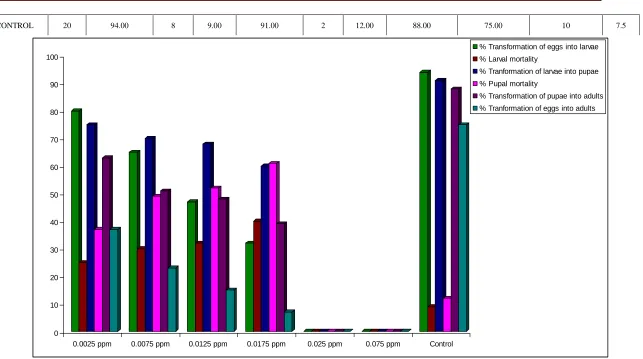
The data depicted in table – 4 indicate that the percent hatching was 80.0% at 0.0025
ppm, 65.0% at 0.0075 ppm, 47.0% at 0.0125 ppm, 32% at .0175 and 94% in control. The
hatching was completely arrested beyond 0.025 ppm. The larvae were emerged from control
eggs be dark brown and cylindrical with average size 3.954 mm in addition to larvae emerged
from combination were decreased in size to 3.252 mm show sluggish movement with peculiar
coiling. Microscopic examination of dead larvae revealed that larval cuticle had was partly
bodies were found significantly damaged, discarded bristles and disruption of alimentary canal
(Plate 2 a, b). The larval mortality was 25.0% at 0.0025 ppm, 30.0% at 0.0075 ppm, 32.0% at
0.0125 ppm, 40% at 0.0175 ppm and 9.0% in control. The larval period was noted as 9 days at
0.0025 and 0.0075 ppm, 10 days at 0.0125 and 0.0175 ppm and 8 days in control.
The percent transformation of larvae into pupae was 75.0% at 0.0025 ppm, 70.0% at
0.0075 ppm, 68.0% at 0.0125 ppm, 60% at 0.0175 ppm and 91.0% in control. The pupae were
comma shaped (,), dark brown with average length 3.527 mm during control and 4.129 mm
during treatment conditions, slightly increased. Treated pupae had less sclerotization of cuticle,
discarded bristles and disturbed trachea. Active histolysis of heamolymphatic tissues were
observed but histogenesis was arrested (Plate 3 a, b). The average pupal period was 2 days at
0.0025 and 0.0075 ppm, 3 days at 0.0125 and 0.0175 ppm and 2 days in control conditions. The
pupal mortality was 37.0% at 0.0025 ppm, 49.0% at 0.0075 ppm, 52.0% at 0.0125 ppm, 61% at
0.0175 ppm and 12.0% in control. The percent transformation of pupae into adults was recorded
as 63.0% at 0.0025 ppm, 51.0% at 0.0075 ppm, 48.0% at 0.0125 ppm, 39% at 0.0175 ppm and
88.0% in control. The percent transformation of eggs into adults was 37.0% at 0.0025 ppm,
23.0% at 0.0075 ppm, 15.0% at 0.0125 ppm, 7% at 0.0175 ppm and 75.0% in control and the
average developmental period was noted as 11 days at 0.0025 and 0.0075 ppm, 13 days at 0.0125
and 0.0175 ppm and 10 days in control. The growth index was observed as 3.7, 2.3, 1.15, 0.53
and 7.5 at the concentration 0.0025, 0.0075, 0.0125, 0.0175 and in control, respectively (Fig. 1).
DISCUSSION
The present investigation reveals that potent combination of imidacloprid and PEE of Ocimum
basilicum induced abnormalities and prolongations during life cycle of exposed mosquito. These observations were supported by number of workers effort in vector control field.
The anopheline and culicine eggs hatching were arrested at higher concentrations of the
combination without any change in control. These results supported by findings of [5] who
evaluated the ovicidal activities of azadirachtin against Cx. pipiens and reported that at 5 and 10
ppm no hatching was recorded. In another study, [6] showed the ovicidal effects of various
formulations of azadirachtin against the Cx. tarsalis and Cx. quinquefasciatus and revealed that 1
activity of the extract was influenced by concentration. The percent transformation of eggs into
larvae was decreased with the increase in concentration in both anopheline and culicine
mosquito.
Induction of morphogenic abnormalities in both mosquito larvae were marked by
disorganization of body wall, bristles, alimentary canal, heamolymphatic tissues, fat bodies and
tracheal network. These changes were generally attributed to neural or muscular disturbances,
disturbed endocrine systems, arrest metabolic activities and disturbance in normal behavior
physiology [7, 8, 9, 10, 11 and 12]. [13] recorded morphogenic abnormalities of mosquito larvae
treated with plant extract were generally attribute to interference of the active ingredients with
the endocrine system. [14] found larval mortality might be due to the chemical constituents
present in extract that arrest the metabolic activities of the larvae and increase in turbidity at
higher concentration might block the oxygen depletion to the larvae. The average larval period
increases with increasing concentration of combination in both the larvae. This may be due to the
interference in normal hormonal activity as interpreted by [9].
The percentage of pupal transformation decreases with increase in concentration in both
the cases. The negative trend in pupal emergence was corresponding to the positive trend in
larval mortality. This observation was in consonance with the investigation with the findings of
[10]. In another study [11] reported that disruption of growth of the larvae to pupae observed in
this study may be the result of disturbances in the digestive process, which led to inadequate
supply of nutrition to the larvae.
The pupal mortality generally take place through the structural damage was marked by
loss of bristles, trachea, loose arthropodal joints and arrested histogenesis in both the mosquitoes.
[11] studied impact of Clerodendron inerme on life cycle of Ae. aegypti and interpretated that the
dead pupae showed less sclerotization of the cuticle compared to untreated ones, and in majority
of the pupae, the head capsule remained attached to the pupal head.
The percent emergence of the adults from pupae was influenced on increasing the
concentration of combination. The failure of adult emergence has been interpreted by [15] this
availability of chitin during metamorphosis which perhaps caused death since the insect was
entangled in the weak integument.
The present morphometric and developmental studies predicts that the effect of
combination on the morphogenesis and development of mosquitoes is similar in the mosquitoes
exposed to different phytoextracts as reported by [16, 13, 17, 18, 19, 20, 10, 11, 12]. Thus, this
combination contributes larvicidal, pupicidal and ovicidal activity against the mosquitoes, as a
result in an extension of the duration of development by decreased egg hatchability, increased
larval and pupal mortality and decreased adult emergence. The present finding has important
implications in the practical control of mosquito population to facilitate suppress vector borne
diseases and beneficially applied for future vector control program.
ACKNOWLEDGMENTS
Authors are thankful to Department of Science and Technology, New Delhi for providing
financial assistance under Start-Up Research Grant (Young Scientist) SERB /LS-443/2013.
REFERENCES
[1] P. Maurya, P. Sharma, L. Mohan, L. Batabyal and C.N. Srivastava, Evaluation of toxicity of
different phytoextracts of Ocimum basilicum against Anopheles stephensi and Culex
quinquefasciatus. J. Asia-Pacific Entomol., 12, 2009, 113–115.
[2] WHO, Instructions for determinig the susceptibility of resistance mosquito larvae to
insecticides. Geneva: WHO; 1975.
[3] P. Maurya, P. Sharma, L. Mohan, M.M. Verma and C.N. Srivastava, Larvicidal efficacy of
Ocimum basilicum extracts and its synergistic effect with neonicotinoid in the management of Anopheles stephensi.. Asia Pacific Journal of Tropical Disease, 2012, 110-116.
[4] S.C. Saxena and L. Sumithra, Laboratory evaluation of leaf extract of a new plant to suppress
the population of malaria vector Anopheles stephensi Liston (Diptera: Culicidae) Curr.
[5] B.A.Soliman and M.A. Tewfieck, Activity and efficacy of azadirachtin (Neem product) on
the eggs of the filarial vector, Culex pipiens (Diptera: Culicidae). Journal of the Union
of Arab Biologist. Cairo 12 (A), 1999, 33-41.
[6] T. Su and M. S. Mulla, Oviposition bioassay response of Culex tarsalis and Culex
quenquifasciatus to neem products containing azadirachtin. Entomologia Experimentalis et Applica., 82 , 1999, 337-340
[7] A. Sherif, R.G. Hall and M.M.E.L. Amamy, Effects of an Elodea extract on immature stages
of Culex quinquefasciatus. Say. J. Florida Anti Mosq. Assoc., 56 (2), 1985, 82 - 85.
[8] A. Saxena and R.C. Saxena, Effect of Ageratum conyzoides extract on the developmental
stages of malaria vector, Anopheles stephensi (Diptera: Culicidae). J. Environ. Biol., 13, 1992, 207 – 209.
[9] P. Sharma, Studies on bioefficacy of certain phytoextracts with reference to mosquito
(Anopheles & Culex sp.) larvae. Ph.D. Thesis, Dayalbagh Educational Institute (Deemed University), Dayalbagh, Agra, 2005.
[10] E.B.S Shaalan., D.V. Canyon, M.W.F. Younes, H.A. Wahab, and A.H. Mansour,
Synergistic efficacy of botanical blends with and without synthetic insecticides against
Aedes aegypti and Culex annulirostris mosquitoes. Journal of Vector Ecology , 30( 2), 2005, 284-288.
[11] P.B. Patil, S.N. Holihosur and V.L. Kallapur, Efficacy of natural product, Clerodendron
inerme against dengue mosquito vector Aedes aegypti. Current science. 90 (8), 2006, 1064-1066.
[12] C. Kuppusamy and K. Murugan, Mosquitocidal effects of Euphorbia heterophylla Linn.
Against the Bancroftian filariasis vector, Culex quinquefasciatus say
(Diptera:Culicidae). International Journal of Integrative Biology. 4 (1), 2008, 34-39.
[13] C.P.W. Zebitz, E. Schmutt, and K.P.S. Ascher, Potential of neem seed kernel extracts in
mosquitoes control. In: Natural pesticides from the neem tree and other tropical plants.
[14] J. Muthukrishnan, E. Pushpalathe and A. Kasthuribhai, Biological effects of four plant
extracts on Culex quinquefasciatus larval stages. Insect Sci. Appl., 17, 1997, 389-394.
[15] S.C. Saxena and R.S. Yadav, A new plant extract to suppress the population of yellow fever
and dengue vector Aedes aegypti (Diptera: Culicidae). Curr. Sci., 52 (15), 1983, 713 -
715
[16] B.S. Attri and R. Prasad, Neem oil extractive – An effective mosquito larvicide. Ind. J. Ent.,
42, 1980, 371 – 374.
[17] C.N. Bhagwan, P. Grover, A. Hameed and K. Sukumar, Developmental defects and protein
reduction caused by Ailanthus extract in red cotton bug, Dysdercus koenigii. Ind. J. Exptl. Biol., 33 (4), 1995, 287 – 290.
[18] O. Koul, and J.S. Shankar, Systemic uptake of Azadirachtin into Ricinus communis and its
effects on Spodoptera litura larvae. Ind. J. Exptl. Biol., 33, 1995,: 865 – 867.
[19] R. Dhar, H.J. Dawar, S. Garg, S.F. Basir and S. Prasad, Effect of volatiles from neem and
other natural products on gonadotrophic cycle and oviposition of Anopheles stephensi
and An. culicifacies (Diptera: Culicidae).J. Med. Entomol., 33 (2), 1996, 195 – 201.
[20] G.K. Jayaprakasha, R.P. Singh, J. Pereira and K.K. Sakariah, Limonoids from Citrus
reticulata and their moth inhibiting activity in mosquito Culex quinquefasciatus larvae.
Phytochemistry,44 (5), 1997, 843 – 846
TABLE.1. TOXICITY OF DIFFERENT LEAVE EXTRACTS OF OCIMUM BASILICUM AGAINST
ANOPHELINE LARVAE Solvent extract Exposur e Period (hrs.) Chi-squar e Regressio n equation
LC50±SE (Fiducial limits) (ppm) Relative toxicity irrespectiv e of time period
LC90±SE (Fiducial limits) (ppm) Relative toxicity irrespectiv eof time period Carbon tetra-chloride
24 3.77
1.89X-1.47 268.61±40.28 58.78 1282.45±501.34 27.14 (347.56-189.66) (2265.07-299.83)
TABLE.2. TOXICITY OF DIFFERENT COMBINATIONS OF IMIDACLOPRID WITH
PETROLEUM ETHER CRUDE EXTRACT OF OCIMUM BASILICUM AGAINST
ANOPHELINE LARVAE
Combinations Exposure Period (hrs.) Chi-square Regression equation
LC50±SE (Fiducial limits) (ppm) Relative toxicity irrespective of time period
LC90±SE (Fiducial limits) ppm Relative toxicity irrespective of time period
1:1 24
1.162 1.504X+6.401 0.011±0.002 1.57 0.033±0.027 1.73
(0.016-0.006) (0.137-0.028)
48
0.424 1.667X+6.838 0.007±0.0019 1.00 0.019±0.012 1.00
(0.011-0.004) (0.071-0.021)
1:2 24
2.497 1.451X+6.324 0.012±0.0028 1.714 0.040±0.0343 2.105
(0.017-0.006) (0.160-0.025)
48
0.764 1.520X+6.605 0.008±0.002 1.142 0.021±0.0194 1.105
(0.013-0.004) (0.099-0.013)
1:4 24
2.251 2.047X+6.422 0.0201±0.003 2.857 0.0653±0.022 3.436
(0.026-0.014) (0.129-0.041)
48
3.574 2.113X+6.618 0.017±0.002 2.428 0.059±0.016 3.105
(0.022-0.012) (0.102-0.036) 48 2.39 (195.87-91.84) (694.33-321.27)
Methanol
24 26.34
4.06X-9.82 446.61±31.76 97.73 923.60±140.33 19.55 (508.86-384.36) (1198.64-648.56)
48 19.69
3.53X-7.67 384.84±30.70 84.21 887.00±139.01 18.77 (445.01-324.66) (1159.46-614.54) Petroleu m ether
24 3.70
1.25X+2.
60
8.29±1.92
1.81 87.68±34.35 1.86 (12.05-4.52) (154.99-20.36)
48 6.02
1.26X+2.
90
4.57±1.24
TABLE.3. CATEGORIZATION OF DIFFERENT COMBINATIONS OF IMIDACLOPRID WITH
PETROLEUM ETHER CRUDE EXTRACT OF OCIMUM BASILICUM AGAINST
ANOPHELINE LARVAE
Ratio
Analysis with LC50 values Analysis with LC90 values
Exposure
(Hours)
Co-toxicity
coefficient
Combined
factor
Nature of
action
Co-toxicity
coefficient
Combined
factor
Nature of
action
1:1
24 163.63 1.636 S 190.90 1.90 S
48 128.57 1.285 S 157.89 1.578 S
1:2
24 150.00 1.50 S 157.50 1.575 S
48 112.5 1.125 S 150.0 1.50 S
1:4
24 90.00 0.90 A 96.92 0.96 A
S.No. Concentration Eggs % Average % % Average % % % Average Growth
(ppm) Treated transformation larval Larval transformation pupal pupal transformation transformation developmental Index*
of eggs period mortality of larvae period mortality of pupae of eggs into period into larvae (days) into pupae (days) Into adults adults (days)
1. 0.0025 20 80.00 9 25.00 75.00 2 37.00 63.00 37.00 11 3.7
2. 0.0075 20 65.00 9 30.00 70.00 2 49.00 51.00 23.00 11 2.3
3. 0.0125 20 47.00 10 32.00 68.00 3 52.00 48.00 15.00 13 1.15
4. 0.0175 20 32.00 10 40.00 60.00 3 61.00 39.00 7.00 13 0.53
5. 0.025 20 - - - -
6. 0.075 20 - - - -
*Statistical evaluation carried out by using student 't' test (p<0.001) compared to the control
7. CONTROL 20 94.00 8 9.00 91.00 2 12.00 88.00 75.00 10 7.5
L
et
h
al
C
o
n
ce
n
tr
at
io
n
(
p
p
[image:13.792.120.763.75.434.2]m)
FIGURE. 1. IMPACT OF THE COMBINATIONON THE LIFECYCLE OF ANOPHELINE MOSQUITO. 0
10 20 30 40 50 60 70 80 90 100
0.0025 ppm 0.0075 ppm 0.0125 ppm 0.0175 ppm 0.025 ppm 0.075 ppm Control
% Transformation of eggs into larvae % Larval mortality
% Tranformation of larvae into pupae % Pupal mortality
PLATE-1a PLATE-1b AF-Air floats, SH-Shell SH-Shell
Anopheles
egg (Control)
Anopheles
egg (Treated)
PLATE-2a PLATE-2b
CE-Compound eye, TH-Thorex, CE-Compound eye, TH-Thorex, ALC-Alimentary canal, AB-Abdomen ALC-Alimentary canal, AB-Abdomen
PLATE-3a PLATE-3b
PLATE-3a PLATE-3b
CE-Compound eye, AB-Abdomen , CE-Compound eye, AB-Abdomen ALC-Alimentary canal