Fast-Champollion: A Fast and Robust
Sentence Alignment Algorithm
Peng Li and Maosong Sun
Department of Computer Science and Technology State Key Lab on Intelligent Technology and Systems National Lab for Information Science and Technology [email protected],[email protected]
Ping Xue The Boeing Company [email protected]
Abstract
Sentence-level aligned parallel texts are important resources for a number of nat-ural language processing (NLP) tasks and applications such as statistical machine translation and cross-language informa-tion retrieval. With the rapid growth of online parallel texts, efficient and ro-bust sentence alignment algorithms be-come increasingly important. In this paper, we propose a fast and robust sentence alignment algorithm, i.e., Fast-Champollion, which employs a combi-nation of both length-based and lexicon-based algorithm. By optimizing the pro-cess of splitting the input bilingual texts into small fragments for alignment, Fast-Champollion, as our extensive experi-ments show, is 4.0 to 5.1 times as fast as the current baseline methods such as Champollion (Ma, 2006) on short texts and achieves about 39.4 times as fast on long texts, and Fast-Champollion is as ro-bust as Champollion.
1 Introduction
Sentence level aligned parallel corpora are very important resources for NLP tasks including ma-chine translation, cross-language information re-trieval and so on. These tasks typically require support by large aligned corpora. In general, the more aligned text we have, the better result we achieve. Although there is a huge amount of bilin-gual text on the Internet, most of them are either only aligned at article level or even not aligned at all. Sentence alignment is a process mapping
sentences in the source text to their correspond-ing units in the translated text. Manual sentence alignment operation is both expensive and time-consuming, and thus automated sentence ment techniques are necessary. A sentence align-ment algorithm for practical use should be (1) fast enough to process large corpora, (2) robust enough to tackle noise commonly present in the real data, and (3) effective enough to make as few mistakes as possible.
lex-ical information together to determine whether two sentences should be directly aligned or not (Simard et al., 1993; Wu, 1994). The other way is to produce a rough alignment based on sentence length (and possibly some lexical information at the same time), and then build more precise align-ment by using more effective lexicon-based algo-rithms (Moore, 2002; Varga et al., 2005). But both of the two ways suffer from high computational cost and are not fast enough for processing large corpora.
Lexical information is necessary for improving robustness of a sentence alignment algorithm, but use of lexical information will introduce higher computational cost and cause a lower speed. A common fact is that the shorter the text is, the less combination possibilities it would introduce and the less computational cost it would need. So if we can first split the input bilingual texts into small aligned fragments reliably with a reasonable amount of computational cost, and then further align these fragments one by one, we can speed up these algorithms remarkably. This is the main idea of our algorithm Fast-Champollion.
The rest of this paper is organized as fol-lows: Section 2 presents formal definitions of sen-tence alignment problem, and briefly reviews the length-based sentence alignment algorithm and Champollion algorithm; Section 3 proposes the Fast-Champollion algorithm. Section 4 shows the experiment results; and Section 5 is the conclu-sion.
2 Definitions and Related Work 2.1 Definitions and Key Points
A segment is one or more consecutive sen-tence(s). Afragmentconsists of one segment of the source text (denoted byS) and one segment of
the target text (denoted byT), and a fragment can be further divided into one or more beads. Abead
represents a group of one or more sentences in the source text and the corresponding sentence(s) in the target text, denoted byAi = (SAi;TAi) =
(Sai−1+1, Sai−1+2,· · · , Sai;Tbi−1+1, Tbi−1+2,· · ·,
Tbi), whereSi andTj are the ith and jth sentence
ofSandT respectively.
In practice, we rarely encounter crossing
align-ment, e.g., sentencesSiandSj of the source
lan-guage are aligned to the sentences Tj and Ti of
the target language respectively. But much more effort has to be taken for an algorithm to process crossing alignment well. So we do not consider crossing alignment here.
In addition, only a few type of beads are fre-quently observed in the real world. As it can save significantly in terms of computational cost and it would not do significant harm to algorithm with-out considering rare bead types, a common prac-tice for designing sentence alignment algorithms is to only consider the frequently observed types of beads. Following this practice, we only con-sider beads of 1-to-0, 0-to-1, 1-to-1, 1-to-2, 2-to-1, 1-to-3, 3-to-2-to-1, 1-to-4, 4-to-1 and 2-to-2 types in our algorithm, where n-to-m means the bead con-sists of n sentence(s) of the source language and m sentence(s) of the target language.
2.2 Length-based Sentence Alignment Algorithm
Length-based sentence alignment algorithm was first proposed in (Brown et al., 1991). This algo-rithm captures the idea that long or short sentences tend to be translated into long or short sentences. A probability is produced for each bead based on the sentence length, and a dynamic programming algorithm is used to search for the alignment with the highest probability, which is treated as the best alignment.
This algorithm is fast and can produce good alignment when the input bilingual texts do not contain too much noise, but it is not robust, be-cause it only uses the sentence length information. When there is too much noise in the input bilin-gual texts, sentence length information will be no longer reliable.
2.3 Champollion Aligner
Champollion aligner was proposed in (Ma, 2006). It borrows the idea oftf-idf value, which is widely used in information retrieval, to weight term1pair
similarity. Greater weight is assigned to the less frequent translation term pairs, because these term
pairs have much stronger evidence for two seg-ments to be aligned. For any two segseg-ments, a sim-ilarity is assigned based on the term pair weight, sentence number and sentence length. And the dy-namic programming algorithm is used to search for the alignment with the greatest total similarity. This alignment is treated as the best alignment.
Champollion aligner can produce good align-ment even on noisy input as reported in (Ma, 2006). Its simplicity and robustness make it a good candidate for practical use. But this aligner is slow. Because its time complexity isO(n2)and
it has to look up the dictionary multiple times in each step of the dynamic programming algorithm, which needs higher computational cost.
3 Fast-Champollion Algorithm
In this section we propose a new sentence align-ment algorithm: Fast-Champollion. Its basis is splitting the input bilingual texts into small aligned fragments and then further aligning them one by one to reduce running time while maintain-ing Champollion-equivalent (or better) alignment quality; it takes the advantages of both length-based and lexicon-length-based algorithms to the maxi-mum extent. The outline of the algorithm is that first the length-based splitting moduleis used to split the input bilingual texts into aligned frag-ments, and then the components of each of these fragments will be identified and aligned by a Champollion-based algorithm. The details are de-scribed in the following sections.
3.1 Length-based Splitting Module
Although length-based sentence alignment algo-rithm is not robust enough, it can produce rough alignment very fast with a certain number of re-liably translated beads. Length-based splitting module is designed to select these reliably trans-lated beads to be used for delimiting and splitting the input bilingual texts into fragments. These beads will be referred to as anchor beads in the remaining sections.
There are four steps in this module as described below in detail.
Step 1: decide whether to skip step 2-4 or not
When there is too much noise in the input bilin-gual texts, the percentage of reliably translated beads in the alignment produced by the length-based algorithm will be very low. In this case, we will skip step 2 through 4.
An evidence for such a situation is that the difference between the sentence numbers of the source and target language is too big. Suppose
NS and NT are the number of sentences of the
source and target language respectively. We spec-ifyr =|NS−NT|/min{NS, NT}as a measure
of the difference, whereminmeans minimum. If
ris bigger than a threshold, we say the difference
is too big. In our experiments, the threshold is set as 0.4 empirically.
Step 2: align the input texts using length-based algorithm
In this step, length-based sentence alignment algorithm is used to align the input bilingual texts. Brown, et al. (1991) models the process of sen-tence alignment as two steps. First, a bead is gen-erated according to a fixed probability distribution over bead types, and then sentence length in the bead is generated according to this model: for the 0-to-1 and 1-to-0 type of beads, it is assumed that the sentence lengths are distributed according to a probability distribution estimated from the data. For other type of beads, the lengths of sentences of the source language are generated independently from the probability distribution for the 0-to-1 and 1-to-0 type of beads, and the total length of sen-tences of the target language is generated accord-ing to a probability distribution conditioned on the total length of sentences of the source language. For a bead Ai = (SAi;TAi), lSAi and lTAi are
the total lengths of sentences inSAi andTAi
re-spectively, which are measured by word2. Brown,
et al. (1991) assumed this conditioned probability distribution is
P rob(lTAi|lSAi) =αexp
−(λi−µ)
2
2σ2
,
where λi = log(lTAi/lSAi) and α is a
tioned probability distribution is
P rob(lTAi|lSAi) =
exp (−lSAir) (lSAir)
lTAi
lTAi! ,
where r is the ratio of the mean length of
sen-tences of the target language to the mean length of sentences of the source language. We tested the two models on our development corpus and the re-sult shows that the first model performs better, so we choose the first one.
Step 3: determine the anchor beads
In this step, the reliably translated beads in the alignment produced by the length-based algo-rithm in Step 2 will be selected as anchor beads.
The length-based algorithm can generate a probability for each bead it produces. So a triv-ial way is to choose the beads with a probability above certain threshold as anchor beads. But as pointed out before, when there is too much noise, the alignment produced by the length-based algo-rithm is no longer reliable, and so is it with the probability. A fact is that if we select a non-translated bead as an anchor bead, we will split the input bilingual texts into wrong fragments and may cause many errors. So we have to make de-cision conservatively in this step and we decide to use lexical information instead of the probability to determine the anchor beads.
For a beadAi = (SAi;TAi), the proportion of
translation term-pairs is a good measure for de-termine whether this bead is reliably translated or not. In addition, use of local informationwill also be greatly helpful. To explain the use of “lo-cal information”, let’s define the fingerprint of a sentence first. Suppose we have a sequence of sentencesS1, S2,· · ·, Sm, andW(Si)is the set of
distinct words inSi, then the fingerprint ofSiis
f(Si) =W(Si)−W(Si−1)−W(Si+1),
and specially
f(S1) =W(S1)−W(S2),
f(Sm) =W(Sm)−W(Sm−1).
The fingerprints of SAi and TAi, denoted by f(SAi)andf(TAi), are the unions of all the
fin-gerprints of sentences inSAiandTAirespectively.
As you can see, the fingerprint of a sentence is the set of words in the sentence that do not appear in the adjacent sentence(s), and thus can distinguish this sentence from its neighbors. So fingerprint is also a good measure. By combining these two measures together, we can select out more reliably translated beads.
For a wordw, we usedD(w) to denote the set
of all its translations in a bilingual dictionaryD, and use tD(w) to denote the union of {w} and dD(w), i.e.,tD(w) = {w} ∪dD(w). Given two
sets of wordsAandB. We say a wordwofAis translated byB if either one of its translations in
the dictionaryDor the word itself appears inB,
i.e.,tD(w)∩B 6=∅. The set of all the words ofA
that are translated byBis:
hD(A, B) ={w∈A and tD(w)∩B6=∅}.
Then the proportion of terms inAthat are
trans-lated byBis
rD(A, B) = |
hD(A, B)|
|A| .
We specify the proportion of translation term pairs in a bead, denoted as arD(Ai), to be
min{rD(W(SAi), W(TAi)), rD(W(TAi), W(SAi))},
where W(SAi) and W(TAi) are the sets of
dis-tinct words inSAi andTAirespectively. Also we
specify the proportion of translation term-pairs in the fingerprint, denoted as f rD(Ai), to be
min{rD(f(SAi), f(TAi)), rD(f(TAi), f(SAi))}.
Given thresholds T Har and T Hf r, a bead is
selected as an anchor bead when arD(Ai) and f rD(Ai) are not smaller than T Har and T Hf r
respectively. We will show that Fast-Champollion algorithm is not sensitive toT Har andT Hf r to
some extent in Section 4.2.
Step 4: split the input bilingual texts
The anchor beads determined in Step 3 are used to split the input texts into fragments. The ending location of each anchor bead is regarded as a split-ting point, resulsplit-ting in two fragments.
3.2 Aligning Fragments with Champollion Aligner
and target language) groups of sentences in a fragment, denoted by GS=S1, S2,· · ·,Sm and GT=T1, T2,· · ·,Tn, suppose there are k pairs
of translated terms in GS and GT denoted
by (ws1, wt1),(ws2, wt2),· · ·,(wsk, wtk), where wsi is inGS andwti is inGT. For each pair of
the translated terms(wsi, wti), define idtf(wsi)
to be
T otal#of terms in the whole document
#occurrences of wsiin GS
,
and define
stf(wsi, wti) = min{stf(wsi), stf(wti)},
where stf(wsi) and stf(wti) are the frequency
ofwsi andwti inGS andGT respectively. The
similarity betweenGS andGT is defined as
k
P
i=1
log (idtf(wsi)×stf(wsi, wti))
×alignment penalty
×length penalty,
where alignment penalty is 1 for 1-to-1
align-ment type of beads and a number between 0 and 1 for other type of beads,length penaltyis a
func-tion of the total sentence lengths ofGSandGT.
The reason for choosing Champollion aligner instead of other algorithms will be given in Sec-tion 4.2. And another quesSec-tion is howidtf values
should be calculated.idtfis used to estimate how
widely a term is used. An intuition is that idtf
will work better if the texts are longer, because if the texts are short, most words will have a low frequency and will seem to only appear locally. In Fast-Champollion, we calculateidtfaccording to
the whole document instead of each fragment. In this way, a better performance is achieved.
3.3 Parameter Estimation
A development corpus is used to estimate the pa-rameters needed by Fast-Champollion.
For the length-based algorithm, there are five parameters that need to be estimated. The first one is the probability distribution over bead types. The ratio of different types of beads in the develop-ment corpus is used as the basis for the estimation. The second and third parameters are the proba-bility distributions over the sentence length of the
source language and the target language. These distributions are estimated as the distributions ob-served from the input bilingual texts. That is to say, these two distributions will not be the same for different bilingual input texts. The forth and fifth areµandσ. They are estimated as the mean and variance ofλiover the development corpus.
For Champollion aligner, alignment penalty
andlength penaltyneed to be determined.
Be-cause the Perl version of Champollion aligner3
is well developed, we borrow the two definitions from it directly.
4 Experiments
4.1 Datasets and Evaluation Metrics
We have two English-Chinese parallel corpora, one for the development purpose and one for the testing purpose. Both of the two corpora are col-lected from the Internet and are manually aligned. The development corpus has 2,004 beads. Given the space constraint, detailed information about the development corpus is omitted here.
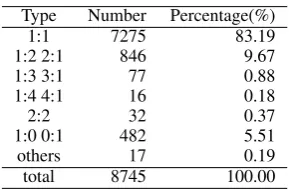
The testing corpus contains 26 English-Chinese bilingual articles collected from the Internet, in-cluding news reports, novels, science articles, television documentary subtitles and the record of government meetings. There are 9,130 English sentences and 9,052 Chinese sentences in these ar-ticles4. The number of different type of beads in
the golden standard answer is shown in Table 1.
Type Number Percentage(%)
1:1 7275 83.19
1:2 2:1 846 9.67
1:3 3:1 77 0.88
1:4 4:1 16 0.18
2:2 32 0.37
1:0 0:1 482 5.51
others 17 0.19
total 8745 100.00
Table 1: Types of beads in the golden standard
Both the Fast-Champollion algorithm and the Champollion aligner need a bilingual dictionary and we supply the same bidirectional dictionary to
3http://champollion.sourceforge.net
them in the following evaluations. This dictionary contains 45,439 pair of English-Chinese transla-tion terms.
We use four commonly used measures for eval-uating the performance of a sentence alignment algorithm, which are therunning time,
Precision= |GB∩P B|
|P B| ,
Recall= |GB∩P B|
|GB| ,
and
F1-measure= 2×P recision×Recall
P recision+Recall ,
whereGB is the set of beads in the golden stan-dard, andP B is the set of beads produced by the
algorithm.
All the following experiments are taken on a PC with an Intel QX6800 CPU and 8GB memory.
4.2 Algorithm Design Issues Why Choose Champollion?
We compared Champollion aligner with two other sentence alignment algorithms which also make use of lexical information. And the result is shown in Table 2. 1-to-1” and “Moore-all” are corresponding to the algorithm proposed in (Moore, 2002). The difference between them is how Recall is calculated. Moore’s algorithm can only output 1-to-1 type of beads. For “Moore-1-to-1”, we only consider beads of 1-to-1 type in the golden standard when calculating Recall, but all types of beads are considered for “Moore-all”. The result suggests that ignoring the beads that are not of 1-to-1 type does have much negative effect on the overall performance of Moore’s algorithm. Our goal is to design a general purpose sentence alignment algorithm that can process frequently observed types of beads. So Moore’s algorithm is not a good choice. Hunalign refers to the hunalign algorithm proposed in (Varga et al., 2005). The re-sources provided to Champollion aligner and nalign algorithm are the same in the test, but hu-nalign algorithm’s performance is much lower. So hunalign algorithm is not a good choice either. Champollion algorithm is simple and has a high overall performance. So it is a better choice for us.
Aligner Precision Recall F1-measure Champollion 0.9456 0.9546 0.9501 Moore-1-to-1 0.9529 0.9436 0.9482 Moore-all 0.9529 0.7680 0.8505 Hunalign 0.8813 0.9037 0.8923
Table 2: The performance of different aligners on the development corpus
The Effect ofT Har andT Hf r
T Har andT Hf r are two thresholds for
select-ing anchor beads in Step 3 of length-based split-ting module. In order to investigate the effect of these two thresholds on the performance of Fast-Champollion, we run Fast-Champollion on the de-velopment corpus with differentT HarandT Hf r.
BothT Har andT Hf r vary from 0 to 1 with step
0.05. And the running time and F1-measure are shown in Figure 1 and Figure 2 respectively.
0
0.5
1
0 0.5
1 0 50 100 150 200
THar
TH fr
Running time(s)
Figure 1: The running time corresponding to dif-ferentT Har andT Hf r
0
0.5
1
0 0.5
1 0.8 0.85 0.9 0.95 1
THar
TH fr
F1−measure
From Figure 1 and Figure 2, we see that for a large range of the possible values of T Har and T Hf r, the running time of Fast-Champollion
in-creases slowly while F1-measure are nearly the same. In other words, Fast-Champollion are not sensitive toT Har andT Hf r to some extent. So
making choice for the exact values ofT Har and T Hf r becomes simple. And we use 0.5 for both
of them in the following experiments.
4.3 Performance of Fast-Champollion
We use three baselines in the following evalua-tions. One is an implementation of the length-based algorithm in Java, one is a re-implemented Champollion aligner in Java according to the Perl version, and the last one is Fast-Champollion-Recal. Fast-Champollion-Recal is the same as Fast-Champollion except that it calculates idtf
values according to the fragments themselves in-dependently instead of the whole document, and the Java versions of the length-based algorithm and Champollion aligner are used for evaluation.
Performance on Texts from the Internet
Table 3 shows the performance of Fast-Champollion and the baselines on the testing cor-pus. The result shows that Fast-Champollion achieves slightly better performance than Fast-Champollion-Recal. The running time of Cham-pollion is about 2.6 times longer than Fast-Champollion with lower Precision, Recall and F1-measure. It should be pointed out that Fast-Champollion achieves better Precision, Recall and F1-measure than Champollion does because the splitting process may split the regions hard to align into different fragments and reduces the chance for making mistakes. Because of the noise in the corpus, the F1-measure of the length-based algorithm is low. This result suggests that Fast-Champollion is fast, robust and effective enough for aligning texts from the Internet.
Robustness of Fast-Champollion
In order to make a more precise investigation on the robustness of Fast-Champollion against noise, we made the following evaluation. First we manually removed all the 1-to-0 and 0-to-1 type of beads from the testing corpus to pro-duce a clean corpus. This corpus contains 8,263
beads. Then we added 8263×n% 1-to-0 or 0-to-1 type of beads to this corpus at arbitrary posi-tions to produce a series of noisy corpora, with n having the values of 5,10,...,100. Finally we ran Fast-Champollion algorithm and the baselines on these corpora respectively and the results are shown in Figure 3 and Figure 4, which indi-cate that for Fast-Champollion, when n increases 1, Precision drops 0.0021, Recall drops 0.0038 and F1-measure drops 0.0030 on average, which are very similar to those of Champollion, but Fast-Champollion is 4.0 to 5.1 times as fast as Champollion. This evaluation proves that Fast-Champollion is robust against noise and is a more reasonable choice for practical use.
0 20 40 60 80 100 Time of length−based aligner
Figure 3: Running Time of Fast-Champollion, Fast-Champollion-Recal, Champollion and the length-based algorithm
Figure 4: Precision (P), Recall (R) and F1-measure (F1) of Champollion (FC), Fast-Champollion-Recall (FCR), Champollion (C) and the length-base algorithm (L)
Performance on Long Texts
cor-Aligner Precision Recall F1-measure Running time(s)
Fast-Champollion 0.9458 0.9408 0.9433 48.0
Fast-Champollion-Recal 0.9470 0.9373 0.9421 45.4
Champollion 0.9450 0.9385 0.9417 173.5
Length-based 0.8154 0.7878 0.8013 11.3
Table 3: Performance on texts from the Internet
Aligner Precision Recall F1-measure Running time(s)
Fast-Champollion 0.9457 0.9418 0.9437 51.5
Fast-Champollion-Recall 0.9456 0.9362 0.9409 50.7
Champollion 0.9464 0.9412 0.9438 2029.0
Length-based 0.8031 0.7729 0.7877 23.8
Table 4: Performance on long text
pus into a single long “article”. Its length is com-parable to that of the novel of Wuthering Heights. Table 4 shows the evaluation results on this long article. Fast-Champollion is about 39.4 times as fast as Champollion with slightly lower Precision, Recall and F1-measure, and is just about 1.2 times slower than the length-based algorithm, which has much lower Precision, Recall and F1-measure. So Fast-Champollion is also applicable for long text, and has a significantly higher speed.
4.4 Evaluation of the Length-based Splitting Module
The reason for Fast-Champollion can achieve rel-atively high speed is that the length-based split-ting module can split the bilingual input texts into many small fragments reliably. We investigate the fragments produced by the length-based splitting module when aligning the long article used in Sec-tion 4.3. The length-based splitting module splits the long article at 1,993 places, and 1,972 seg-ments are correct. The numbers of Chinese and English segments with no more than 30 Chinese and English sentences are shown in Figure 5. As there are only 27 and 29 segments with more than 30 sentences for Chinese and English respectively, we omit them in the figure. We can conclude that although the length-based splitting module is sim-ple, it is efficient and reliable.
5 Conclusion and Future Work
In this paper we propose a new sentence align-ment algorithm Fast-Champollion. It reduces the running time by first splitting the bilingual input texts into small aligned fragments and then further aligning them one by one. The evaluations show
0 5 10 15 20 25 30
0 200 400 600 800
Number of Sentences Contained in a Segment
Number
English Segment Chinese Segment
Figure 5: Numbers of Chinese/English segments with no more than 30 Chinese/English sentences
that Fast-Champollion is fast, robust and effective enough for practical use, especially for aligning large amount of bilingual texts or long bilingual texts.
Fast-Champollion needs a dictionary for align-ing sentences, and shares the same problem of Champollion aligner as indicated in (Ma, 2006), that is the precision and recall will drop as the size of the dictionary decreases. So how to build bilingual dictionaries automatically is an impor-tant task for improving the performance of Fast-Champollion in practice, and is a critical problem for applying Fast-Champollion on language pairs without a ready to use dictionary.
Acknowledgement
References
Brown, Peter F., Jennifer C. Lai, and Robert L. Mercer. 1991. Aligning sentences in parallel corpora. In
Proceedings of the 29th Annual Meeting of the Asso-ciation for Computational Linguistics, pages 169– 176, Berkeley, California, USA, June. Association for Computational Linguistics.
Chen, Stanley F. 1993. Aligning sentences in bilin-gual corpora using lexical information. In Proceed-ings of the 31st Annual Meeting of the Association for Computational Linguistics, pages 9–16, Colum-bus, Ohio, USA, June. Association for Computa-tional Linguistics.
Ma, Xiaoyi. 2006. Champollion: A robust paral-lel text sentence aligner. InProceedings of LREC-2006: Fifth International Conference on Language Resources and Evaluation, pages 489–492.
Melamed, I. Dan. 1996. A geometric approach to mapping bitext correspondence. InProceedings of the First Conference on Empirical Methods in Nat-ural Language Processing, pages 1–12.
Moore, Robert C. 2002. Fast and accurate sentence alignment of bilingual corpora. In Proceedings of the 5th Conference of the Association for Machine Translation in the Americas on Machine Transla-tion: From Research to Real Users, pages 135–144, London, UK. Springer-Verlag.
Simard, Michel, George F. Foster, and Pierre Isabelle. 1993. Using cognates to align sentences in bilingual corpora. InProceedings of the 1993 Conference of the Centre for Advanced Studies on Collaborative Research, pages 1071–1082. IBM Press.
Utsuro, Takehito, Hiroshi Ikeda, Masaya Yamane, Yuji Matsumoto, and Makoto Nagao. 1994. Bilingual text matching using bilingual dictionary and statis-tics. In Proceedings of the 15th Conference on Computational Linguistics, pages 1076–1082, Mor-ristown, NJ, USA. Association for Computational Linguistics.
Varga, D., L. Nmeth, P. Halcsy, A. Kornai, V. Trn, and Nagy V. 2005. Parallel corpora for medium den-sity languages. InProceedings of the RANLP 2005, pages 590–596.