A Monthly Double-Blind Peer Reviewed Refereed Open Access International e-Journal - Included in the International Serial Directories
International Journal in Physical & Applied Sciences
http://www.ijmr.net.in email id- [email protected] Page 19 Study the removal of Co (II) ion from aqueous solution by using poly acrylamide
Ghassan Jabbar Shadahan
Department of chemistry, College of Science,Wasit university,Kut,Wasit,Iraq
ABSTRACT
Removal of Co (II) ions from its aqueous solution were performed by using poly acrylamide. The operating variables effecting: time of contact, operating temperature, and pH of the medium have been studied; the results showed the maximum adsorption rate was 199.79mg/gm. Thermodynamic properties enthalpy, entropy, and free energy investigated indicated that the removal of Co(II) on active sites of the polymer are spontaneous, exothermic, and positive values of entropy indicated there were a large surface area available of adsorption at temperature range of 273-313 K, using 400 ppm aqueous solution of Co(II) ion and 0.05gm of polymer dose in all experiments.
Keywords: - Co (II) ion, Poly acrylamide, Adsorption
1 . INTRODUCTION
Water pollution become the biggest challenge must counter it since it effect on human health, environment, agriculture, and biodiversity of aquatic , which required a treatment in order to eliminate all heavy metals and chemical materials within waste water with toxic nature in order to recycled it for different purposes which agree international standards . Large numbers of adsorbent material have been employed to remove ions of heavy metals ( Pb, Cd, Ni, Co, Fe, Zn, Cr, As, Ag ) to permitted limit since its efficient and effective .These polluents oftenly present within waste water of chemical industries such as electroplating, battery pesticide, insecticide, metallurgical industries which influence negatively on human and causes disorder of nervous system , brain and kidney damage and cancer (1-5), some heavy metal ions are strongly toxic even at low concentration of 0.001-0.1 ppm of Hg and Cd ( 6-7).
There are different kind of industrial process employed for metal ions removal are ion exchange, adsorption, and other processes. However industrially adsorption is more favorable for its effectiveness in metal ions removal (8). Recently low price adsorption material have been used for elimination of heavy metal ions, coal (9), fly ash(10-12), activated clay(13), palm fruit bunch(14), rice husk(15), coconut shell(16), peat(17,18), activated carbon(19), sawdust(20), lignin(21).
2 . EXPERIMENTAL
A Monthly Double-Blind Peer Reviewed Refereed Open Access International e-Journal - Included in the International Serial Directories
International Journal in Physical & Applied Sciences
http://www.ijmr.net.in email id- [email protected] Page 20 Adsorption process took place in a batch process, were 0.05 gm of poly acrylamide was stirred with 25 ml of Co(II) ion aqueous solution continuously at room temperature for different time of contacts (4,8,24,48) hours and at different process temperature (273,288,298,313) K and different pH (5,7,9,12).
The remain aqueous solution was separated from polymer by filtration by using vacuum pump, then the concentration of Co(II) was measured in order to find out the percentage of removal.
The amount of adsorbed then estimated by the following relationship (22):
Qe = ( Co – Ce ) Vsol / M ---(1)
Where Qe is the adsorption capacity of the adsorbent at equilibrium (mg/g), Co and Ce are initial concentration and the equilibrium concentration of Co (II) ion in aqueous solution (ppm)
respectively, Vsol is the volume of Co (II) ion in aqueous solution (L), and M represents weight of the
adsorbent (gm).
3 . RESULTS AND DISCUSION 3.1 . EFFECT OF CONTACT TIME
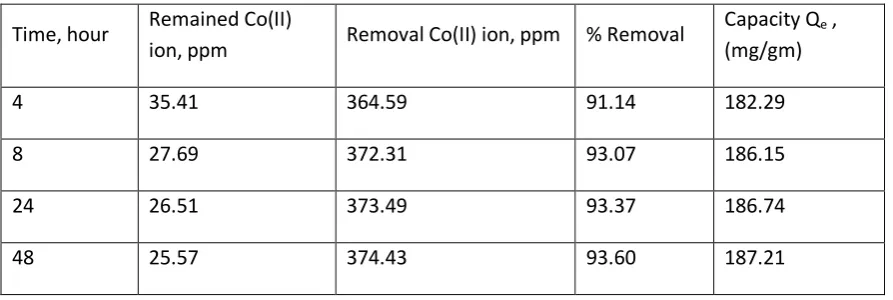
Effect of contact time of Co(II) ions removal has been studied by variation of time (4 to 48) hours at constant initial concentration (400 ppm). The results are shown in Table (1), and Figure (1)
Table (1) Results obtained at various time of contact
Time, hour Remained Co(II)
ion, ppm Removal Co(II) ion, ppm % Removal
Capacity Qe , (mg/gm)
4 35.41 364.59 91.14 182.29
8 27.69 372.31 93.07 186.15
24 26.51 373.49 93.37 186.74
A Monthly Double-Blind Peer Reviewed Refereed Open Access International e-Journal - Included in the International Serial Directories
International Journal in Physical & Applied Sciences
http://www.ijmr.net.in email id- [email protected] Page 21 Fig (1) Effect of contact time variation on Co(II) ion removal from aqueous solution
It can be seen from Fig (1) the percentage of removal reached the equilibrium at time 4 hr. However it can be seen percentage of removal become stable after increasing time more than 4 hr. , therefore it can be concluded that 4 hr. is ideal time for removal Co(II) ions from its aqueous solution effectively since active sites are largely available for adsorption at beginning, therefore it can considered 4 hr suitable from economical aspect when using this type of polymer in the industry. .
3.2 . EFFECT OF TEMPERATURE
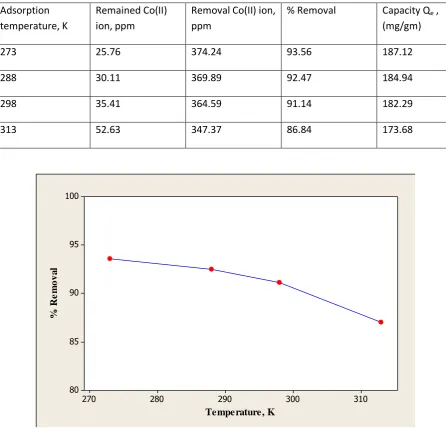
In order to study the thermodynamic properties of adsorption, the process performed at different temperatures of (273,288,298,313 K). Results indicated adsorption process is a function of temperature. Table (2) shows results obtained at various temperature which reveals adsorption rates decreases with increasing of temperature, however which indicates that adsorption is exothermic process (23) as shown in Figure (2), however temperature of 298 K can be considered an optimum temperature with 91.14% of removal from economic view.
50 40
30 20
10 0
94
93
92
91
90
Contact time , hr.
%
R
e
m
o
v
a
A Monthly Double-Blind Peer Reviewed Refereed Open Access International e-Journal - Included in the International Serial Directories
International Journal in Physical & Applied Sciences
http://www.ijmr.net.in email id- [email protected] Page 22 Table (2) Results obtained at various adsorption temperatures
Adsorption temperature, K
Remained Co(II) ion, ppm
Removal Co(II) ion, ppm
% Removal Capacity Qe ,
(mg/gm)
273 25.76 374.24 93.56 187.12
288 30.11 369.89 92.47 184.94
298 35.41 364.59 91.14 182.29
313 52.63 347.37 86.84 173.68
Fig (2) Effect of adsorption temperature on Co(II) ion removal from aqueous solution
3.3 . EFFECT OF pH OF EQUEOUS SOLUTION
Effect of pH of aqueous solution have been investigated at different values of 5, 7, 9, 12 to obtain further information of the removal process, 25 ml of aqueous solution of Cobalt Chloride and 0.05 gm of polymer used again at temperature of 298 K the solution left 4 hr then the remaining Co(II) solution concentration was determined . Table (3) shows the experimental results obtained, however these results showed that optimum pH for adsorption is 5 – 7
Figure (3) shows that percent removal of metal ion was lower at low pH, while percent removal increases with increasing of pH. This phenomena attributed to more protons at lower pH are available which attacks the amino group of the polymer consequently the attraction forces between Co(II) ions and these functional groups will decreases. While with increasing pH of the solution this functional group become more active therefore the attraction force increases between metal ions and amino groups (23).
310 300
290 280
270 100
95
90
85
80
Temperature, K
%
R
e
m
o
v
a
A Monthly Double-Blind Peer Reviewed Refereed Open Access International e-Journal - Included in the International Serial Directories
International Journal in Physical & Applied Sciences
http://www.ijmr.net.in email id- [email protected] Page 23 Table (3) Results obtained at different pH of aqueous solution
pH value Remained Co(II) ion,
ppm
Removal Co(II) ion, ppm
% Removal Capacity Qe ,
(mg/gm)
5 37.12 362.88 90.72 181.44
7 33.46 366.54 91.63 183.27
9 17.34 382.66 95.66 191.33
12 0.41 399.59 99.89 199.79
Fig (3) Effect pH of aqueous solution on percent removal of Co(II) ion
3.4 . TERMODYNAMIC PROPERTIES
These properties for Co (II) ion removal by adsorption on poly acryl amide can be estimated by using the following relationships (22):
Kc = Qe / Ce --- (2)
Ln Kc = So / R - Ho / RT --- (3)
Go = Ho – T So --- (4)
12 11
10 9
8 7
6 5
100
98
96
94
92
90
pH
%
R
e
m
o
v
a
A Monthly Double-Blind Peer Reviewed Refereed Open Access International e-Journal - Included in the International Serial Directories
International Journal in Physical & Applied Sciences
http://www.ijmr.net.in email id- [email protected] Page 24
Where R is gas constant, T is absolute temperature, and Kc is thermodynamic equilibrium constant.
Thermodynamic properties can be estimated by plotting Ln Kc vs. 1/T with the accuracy R2 = 0.922.
The value of enthalpy of adsorption can be calculated from the slope and entropy from the intercept.
Enthalpy of adsorption, ΔHads is estimated to be -13.744 Kj/mol; this indicates the adsorption is exothermic process, while the positive value of entropy of adsorption ΔS which refers to the increased the randomness at the boundary rejoins of solid and liquid during the removal (23). Table
(4) shows the thermodynamic properties and Figure (4) shows the plot of Ln Kc vs. 1/T.
Table (4) the estimated thermodynamic properties of adsorption
Temperature, K Free energy, ΔG, Kj/mol Entropy, ΔS, Kj/mol.K
273 -4.499 0.486
288 -4.346 0.462
298 -4.059 0.447
313 -3.106 0.429
Fig (4) A plot of Ln Ke vs. 1/T
From table (4) shows the negative values of free energy which indicates that the process is spontaneous
0.0037 0.0036
0.0035 0.0034
0.0033 0.0032
2.2
2.0
1.8
1.6
1.4
1.2
1.0
1/T , K
L
n
K
A Monthly Double-Blind Peer Reviewed Refereed Open Access International e-Journal - Included in the International Serial Directories
International Journal in Physical & Applied Sciences
http://www.ijmr.net.in email id- [email protected] Page 25 4 . CONCULSIONS
The present study showed that poly acrylamide very effective in removal of Co (II) ions from aqueous solution. The results showed that the removal percent of ions decreases with increasing temperature and thermodynamic properties i.e., enthalpy, entropy, free energy found that the process of adsorption is feasible, and the adsorption is exothermic, spontaneous, and the positive sign of entropy indicates a large randomness of the system. pH of aqueous solution found to be affection the removal of ions of Co(II), and the contact time effect considerably the adsorption rate.
REFRENCES
*1+ Nazih K. Shammas, Lawrence K. Wang, (2016).”Water Engineering, Hydraulics, Distribution, and Treatment”, John Wiley & Sons, Inc, pp. (302-307).
*2+ Duffus, J. H., (2002). “Heavy metals a meaningless term”, Pure Applied Chemistry, Vol. 74, pp. (793-807).
*3+ Sudha P. N., (2010). “Chitin, Chitosan, Oligosaccharides and Their Derivatives”, Ed. Sekwon Kim, CRC Press, pp. (561-585).
*4+ Bishop P. L., (2002). “Pollution Prevention Fundamentals and Practice”, Tsinghua Unniversity Press, Beijing.
*5+ Vassilev S. V., Baxter D., Andersen L. K., (2012). “An overview of the Organic and Inorganic Phase Composition of Biomass”, Fuels, Vol. 94, pp. (1-33).
[6] Ramya R., Sankar P. , Anbalagan S., Sudha P. N.,(2011), “Adsorption of Cu(II) ions and Ni(II) ions from metal solution using crossliked chitosan-g-acrylonitrile copolymer”, International Journal of Environmental Science, Vol. 1, No. 6
*7+ Wang X, S., and Qin Y., (2005), “Equilibrium sorption isotherms for of Cu+2 on rice bran”, Process
Biochemistry, Vol. 40, pp. (677-680).
*8+ Jumping Z., Yelling W., (2011),”Rapid removal of Pb(II) from aqueous solution by chitosan-poly acrylic acid hydrogel”, Environmental Technology, Vol. 32, No. 5, pp.(523-531).
*9+ Mohan S. V., Rao N. C., Karthikeyan J.,(2002), “Adsorptive removal of direct azo dye from aqueous phase onto coal based sorbent: A kinetic and mechanistic study”, Journal of Hazardous Materials, Vol. 90, No. 2, pp.(189-204).
[10] Gupta V. K. , Jain C. K., Sharma M.,(2003),”Removal of Cadmium and Nickel from waste water using bagasse fly ash industry waste”, Water Research , Vol. 37, No. 16, pp. (4038-4044).
*11+ Nollet H., Roels M., Lutgen P., Meeren P. V., and Verstraete W., (2003),”Removal of PCBs from waste water using fly ash”, Chemosphere, Vol. 53, No. 6, pp.(655-665).
A Monthly Double-Blind Peer Reviewed Refereed Open Access International e-Journal - Included in the International Serial Directories
International Journal in Physical & Applied Sciences
http://www.ijmr.net.in email id- [email protected] Page 26 *13+ Ricou P., Lecuyer I., and Cloirec P. L., (2003),”Experimental design methology applied to adsorption of metallic ions onto fly ash”, Water research , Vol. 35, No. 4, pp.(965-976).
*14+ Wu F. C. , Tseng R. L.,Juang R. S.,(2001),”Kinetic of colour removal by adsorption from water using activated clay”, Environmental Technology, Vol. 22, No. 6, pp.(721-729).
*15+ Nassar M. M., (1997), “The kinetics of basic dye removal using palm fruit bunch”, Adsorption Science and Technology, Vol. 15, No. 8, pp.(609-617).
*16+ Kobya M., (2004),“Removal of Cr(VI) from aqueous solutions by adsorption onto hazelnut shell activated by carbon:Kinetic and equilibrium studies”, Bioresource Technology, Vol. 91, No. 3, pp.(317-321).
[17] Brown P. A., Gill S. A., Allen S. T.,(2000),”Metal removal from waste water using peat”, Water Research, Vol. 34, No.16, pp(3907-3916).
*18+ Ho Y. S., McKay G., (2000),”The kinetic of sorption of divalent metal ions onto sphagnum moss flat”, Water Research, Vol. 34, No. 3, pp.(735-742).
*19+ Rajappa A., Ramesh K., Nandhakumar V., (2014),”Adsorption of Nickel(II) ion from aqueous
solution onto ZnCl2 activated carbon prepared from delonix regia pods (flame tree)”, International
Journal of chemical and physical science, Vol. 3, No. 6, pp.(42-52).
*20+ Wang X., Wang A.,(2010),” Removal of Cd(II) from aqueous solution by chitsan poly acrylic acid hydrogel”, Environmental Technology, Vol. 33, pp.(745-753).
*21+ Parajuli D., Inoue K., Ohto K.,(2005)”Adsorption of heavy metal on crosslinked lignocatechol”, React. Funct. Plym., Vol. 62, pp. (129-139).
*22+ Ahmed M., Mohammed J.,(2013),”New approach for removal of total hardness ( Ca+2 , Mg+2 )
from water using commercial poly acrylic acid hydrogel beads study and application,”, International Journal of Advanced Biological and Biomedical Research, Vol. 1, No. 9, pp. (1142-1156)