1
The
relevance
of
foreshocks
in
earthquake
triggering:
A
statistical
study
E.Lippiello1,C.Godano1,L.deArcangelis2
DepartmentofMathematicsandPhysics,UniversityofCampania“L.Vanvitelli”,VialeLincoln5,81100Caserta,Italy
2
Abstract
Anincreaseofseismicactivity isoftenobservedbeforelargeearthquakes. Events
responsi-bleforthisincreaseareusuallynamedforeshockandtheiroccurrenceprobablyrepresentsthe
mostreliableprecursorypattern. Manyforeshocksstatisticalfeatures canbe interpretedinterms
ofthestandardmainshock-to-aftershocktriggeringprocessandarerecovered intheEpidemic
TypeAftershock SequenceETASmodel. Herewepresentastatisticalstudy ofinstrumental
seismiccatalogsfromfourdifferent geographicregions. Wefocusonsomecommonfeatures
offoreshocksinthefourcatalogswhichcannotbereproducedbytheETASmodel. In
par-ticularwefind ininstrumentalcatalogsasignificantlylargernumberofforeshocksthanthe
onepredictedbytheETASmodel. Weshowthatthisforeshockexcesscannotbeattributed
tocatalog incompleteness.Wethereforeproposeageneralizedformulationof theETASmodel,
theETAFSmodel,whichexplicitlyincludesforeshockoccurrence. Statisticalfeaturesof
af-tershocksandforeshocksintheETAFS modelareinverygoodagreementwith
instrumen-talresults.
1 Introduction
Theepidemic-type-aftershocksequenceETASmodel Ogata[1985,1988a,b,1989]is
nowadaysconsidered“adefactostandardmodel,or nullhypotheses,for othermodelsand
ideastobecomparedto”Huangetal. [2016]The modelassumesthattwoclassesof
earth-quakesexist: Independentbackgroundandtriggeredearthquakes. Anepidemicorganization
ofeventsarisesundertheassumptionthat eachearthquakecantriggeritsowndescendents
lead-ingtoabranchingorganization. Fromaphysicalpointof view,backgroundseismicitycanbe
thoughtas theeffectoftheslowtectonic drivewhereastriggeredearthquakesareinducedby
stressredistributionafter previousshocks. Inthe ETASmodeltheoccurrencerateoftriggered
eventsisobtained onthebasisofwellestablishedempirical lawscontrollingthe spatio-temporal
clusteringofaftershocks. Asaconsequence,byconstruction,themodelisveryefficientin
re-producingstatistical featuresof aftershockorganizationobservedinexperimentalcatalogs. At
thesametime,intheETASmodelaneventcantriggeralsoalargershock.In thissituation
thetriggeringeventisoftennamed“foreshock”andthetriggeredearthquake,ifit isthelargest
eventinthesequence,isnamed“mainshock”.
Inthisstudyweadopt thestandarddefinition ofmainshocksaseventssufficiently
iso-latedintimeandspacefromotherlargerevents. Foreshocks(aftershocks)arethenallevents
theETASframework,thisclassificationof eventsdoes notreflectdifferentphysical
proper-tiessince,asanticipated, onlytwokinds (independentortriggered)earthquakesare assumed
and,for instance,amainshockcanbeeitheranindependent oratriggeredearthquake. On the
otherhand,accordingtoanucleation theoryOhnaka[1992,1993];Dodgeetal.[1996],the
nucleationphasecanbecharacterizedbythe occurrenceof smallerearthquakesinsidethe
re-gioninvolved inthefracture processofthesubsequent incominglargershock.Thispre-shock
seismicityisnotimplementedintheETASmodel andthemainquestionaddressedinthisstudy
isifitsinclusion,within theETASmodeling,givesamoreaccuratedescriptionof offoreshock
organizationininstrumentalcatalogs. Inthe lastfiveyearsseveralstudieshaveshownalack
offoreshocksinETASwithrespecttoinstrumentalcatalogsBrodsky[2011];Lippielloetal.
[2012c];Shearer[2012a, b];Hainzl[2013];Shearer[2013];Bouchonetal. [2013];Mignan
[2014];ChenandShearer[2013];BrodskyandLay [2014];OgataandKatsura[2014];Felzer
etal. [2015];BouchonandMarsan [2015];deArcangelisetal.[2016];Lippielloetal. [2017].
Nevertheless,thedeficit offoreshocksinETAScatalogshasbeenattributed,atleastpartially,
tothe deficitofaftershocksininstrumentalcatalogscausedbyspuriousincompleteness. This
pointwillbediscussedinthefollowingsectionswherewe provideevidencethatit cannot
jus-tifytheexcessofforeshocksininstrumentaldatasets.
2 Datasetsanddefinitions
Weperformasystematicanalysisof fourdifferentinstrumentalcatalogs: Therelocated
SouthernCaliforniaearthquake catalog(RSCEC)Haukssonetal. [2012](from01/01/1981to
12/31/2013),therelocatedNorthernCaliforniaearthquakecatalog (RNCEC)Waldhauserand
Schaff [2008](from01/01/1981to06/30/2011),theItalian earthquakecatalog(ItEC)[ISI](from
01/01/2002to12/31/2012) andtheJapaneseearthquake catalog(JaEC)[NIE](from01/01/1966
to01/30/2011). Weusethesamedefinition ofmainshock, aftershocksandforeshocksadopted
inLippielloetal.[2017].More precisely,we defineaneventas “mainshock”ifalarger
earth-quakedoes notoccurinthepreviousy daysandwithinadistanceL.In additionalarger
earth-quakemustnotoccur intheselected areainthefollowingy2 days. Wethenassociatetoeach
mainshockitsown“aftershocks”and“foreshocks”definedasallearthquakesrecorded inthe
subsequentor intheprecedingtimeintervalT = 12h, respectively,andwithinacircle of
radiusR≤RM centeredinthe mainshockepicenter. Weusedifferent RM for different
cat-alogs:RM = 2 kmforRSCEC andRNEC,RM = 5kmfor ItECandRM = 10km for
Oncemainshocksareidentified,they aregroupedinclassesaccordingtotheir
magni-tudem∈[mM,mM+1)and, foreachcatalog,we evaluatethetotalnumberof mainshocks
belongingtothegivenclassnmain(mM),thetotalnumberofassociatedaftershocksnaf t(mM)
andforeshocksnf ore(mM). Wealsoevaluatethe epicentraldistance∆rbetweeneach
main-aftershockandmain-foreshockcoupleandconstructtheaftershockandforeshockepicentral
distancedistributions,ρa(∆r,mM)andρf(∆r,mM).Their precisedefinitionisgiveninSec.4.1.
Thechoiceofparametershasbeendeeplyinvestigatedinpreviousstudies[Felzerand
Brodsky,2006;Lippielloetal.,2009a,2012c, 2017]andhereweimplementtypicalvalues,
L = 100km,y = 3 andy2 = 0.5. Thevalueof RM isfixedimposingthat, foreach
in-strumentalcatalog,differentchoicesofT ≤12hproducessimilarresultsρa(∆r,mM)when
∆r <RM.ThisleadstoRM =2,2,5,10km,forRSCEC,NSCEC; ItECandJMAC,
re-spectively.
2.1 The ETAS model
The ETAS model is specified by the conditional intensity function, which represents the
expected seismicity rate in a given space position conditioned to a given observational history.
The conditional intensity functionΛ(m, ~x, t), which represents the occurrence probability of
events with magnitudem≥mc in the position~xat timet, can be written in the following
form:
Λ(m, ~r, t) = [µw(~r) +Q(|~ri−~r|, t−ti, mi)]
1 blog(10)10
−b(m−mc) (1)
and
Q(∆ri, t−ti, mi) =
A(p−1) c
X
i:ti<t
10α(mi−mc)
1 +t−ti c
−p
G(∆ri, mi) (2)
where∆ri = |~ri −~r|and the sum extends over all events with magnitudemi, epicentral
coordinates~xi and occurrence timeti< t. The functionG(∆ri, mi)is a spatial kernel which
explicitly depends on the triggering magnitudemi andµw(~x)is a time independent
contri-bution due to background seismicity. The form of the spatio-temporal kernel (Eq.(2)
imple-ments three well established laws for aftershock triggering:
• A1: The number of aftershocksna depends on the mainshock magnitude class,
accord-ing to the productivity lawna=Ka10αamM;
• A2: The aftershock number decays as function of the time from the mainshock,
con-sistently with the Omori lawna(∆t)∼∆t−p withp≃0.8;
• A3: The linear density distribution of epicentral distances between mainshock and
af-tershocks (∆r) clearly depends on the mainshock magnitude classmM with the
aver-age distanceL(mM)∝10γmM withγ≃0.4.
In the following we present results from numerical simulations of the ETAS model
per-formed according to the algorithm discussed in ref.Lippiello et al.[2012c, 2017]; de
Ar-cangelis et al.[2016, 2018]. In particular, the spatial functionw(~x)is obtained from
the smoothed seismicity whereas the functional form ofG(∆ri, mi)is tuned in order
to collpase the aftershock epicentral distribution on the instrumental one, for all
val-ues ofmM.
3 Results
3.1 Previous Results
The statistical features of foreshocks in instrumental catalogs has been recently
inves-tigated in ref.Lippiello et al.[2017]. This study has shown that foreshocks follow
em-pirical laws like (A1-A3) of aftershocks but with important differences. More precisely:
• F1: The number of foreshocksnf depends on the mainshock magnitude class
accord-ing to a productivity lawnf =Kf10αfmM;
• F1b: The number of foreshocks is systematically smaller than the aftershock number
andαf ≃0.7αa;
• F2: The foreshock number increases approaching the mainshock occurrence time,
con-sistently with an inverse Omori lawnf(∆t)∼ |∆t|−p withp≃0.8;
• F3: The linear density distribution of epicentral distances fore-mainshockρf(∆r, mM)
depends on the mainshock magnitude class with a roughly symmetrical behavior
be-tween spatial distribution before and after the mainshocksρf(∆r, mM)≃ρa(∆r, mM);
• F3b: The foreshock linear density distributionρf(∆r, mM)does not depend on the value
of the lower magnitude cut-offmth.
The comparison between instrumental and ETAS catalogs has shown (Lippiello et al.[2017])
that it is possible to generate ETAS catalogs which reproduce at quantitative level the
statis-tical features (A1-A3) of instrumental aftershocks. At the same time ETAS catalogs can
re-produce foreshock features F1 and F2. Conversely it is not possible to generate ETAS
cata-logs with foreshocks obeying features F3 and F3b. Furthermore, ETAS catacata-logs always present
a deficit of foreshocks with respect to instrumental catalogs. In the following section we will
3.2 The aftershock and foreshock number
In Fig.1 we plot the ratio between aftershock and mainshock numbernaf t(mM)/nmain(mM)
for different mainshock classesmM and for the different instrumental catalogs. We also plot
the ratio between foreshock and mainshock numbernf ore(mM)/nmain(mM). We only
con-sider events with magnitudem > mth = 2. The lower thresholdmth must not be confused
withmc in Eq.(2). Indeed,mc is a fixed parameter of the ETAS model and synthetic catalogs
contain only events withm≥mc. The lower magnitudemth, conversely, is a parameter
im-plemented in the data analysis and it can be arbitrarily varied withmth≥mc.
Results in Fig.1 show that the aftershock number is systematically larger than the
fore-shock number and this difference increases for increasingmM. The aftershock number is
con-sistent with the Utsu-productivity law (A1)
naf t(mM)/nmain(mM) =Ka10αmM (3)
and a similar law is also observed for foreshocksnf ore(mM)/nmain(mM) = Kf10αfmM
(F1).
In Fig.1 we compare results fornaf t(mM)/nmain(mM)andnf ore(mM)/nmain(mM)
for the RSCEC with the results obtained applying the same definition of aftershocks,
main-shocks and foremain-shocks to simulated ETAS catalogs. The values of bothnaf t(mM)/nmain(mM)
andnf ore(mM)/nmain(mM)depend on the parametersA, p, c, α(Eq.(2) of the numerical model.
In particular, in first approximation the value ofnaf t(mM)/nmain(mM)is given by
naf t(mM)≃µ(RM)T+nmain(mM)BR10α(mM−mc) 1−(T /c+ 1)1−pH(Rm). (4)
In this equationµ(RM)is the average background rate inside a circle of radiusRM,nmain(m)dm
represents the number of mainshocks in the range[m, m+dm),BR = log(10)(Ab−α) is the branching ratio, i.e. the average number of events triggered by any earthquake, andH(Rm) =
RRm
0 d∆rG(∆r, mM). Neglecting the background contribution, Eq.(4) indicates that the ETAS model can reproduce the experimental result Eq.(3) withαf =α. In numerical simulations
we have explored a wide range of ETAS parametersA, p, c, αand verified that there exists a
set of parameters leading to ETAS catalogs with the same behavior ofnaf t(mM)/nmain(mM)
of the instrumental ones. In all cases the agreement between ETAS and instrumental catalogs
is always recovered for values ofα&αf. We wish to stress the difference between αand
αf: αis the model parameter which controls the productivity law in numerical simulations
whereasαf is the value obtained applying our definition of mainshock and aftershock to ETAS
catalogsandthenperformingafitaccordingtoEq.(3).Thesmall discrepanciesbetweenαand
αf canbeattributedtothe backgroundcontributionwhichweaklyaffectsdataatsmallmM
whereasitcanbeneglectedforincreasing mM.
Acentralobservationisthat allchoicesof parametersproducingagreementinnaf t(mM)/nmain(mM)
betweenETASandinstrumentalcatalogsgiveavalueof nf ore(mM)/nmain(mM)inETAS
catalogssystematicallysmallerthantheinstrumentalvalue. Itisdifficulttoobtainasimple
approximatedexpressionfortheforeshocknumberasfunctionofmM asinEq.(4).However,
itisreasonabletoexpectthat therationaf t(mM)/nf ore(mM)weaklydependsonmodel
pa-rameters. Thisissupportedbynumericalsimulationswherewe fixαinordertohavethesame
valueofαf inETAScatalogs. ResultsplottedinFig.(2)showthatdifferentchoicesof B,p,c
leadtosimilarresultsfornaf t(mM)/nf ore(mM),significantlylargerthanthe experimental
valueforany mM.
4 CatalogincompletenessandtheETASI2model
Asanticipatedinthe introduction,the incompletenessofinstrumentaldatasetscanbe
responsibleforthe observeddifferenceswithETAScatalogs.Indeed, becauseofthe overlap
ofseismiccodawaves, manyaftershocksarenotrecordedinparticularinthefirsttemporal
periodsafterlargeshocksKagan[2004];Helmstetteretal.[2006];Enescuetal.[2007];Peng
etal. [2007];PengandZhao[2009];OmiandAihara [2013];Lippielloetal.[2016];Hainzl
[2016a,b];deArcangelisetal.[2018]. Thedirectinspectionof seismicsignals[Lippielloetal.,
2016;deArcangelisetal.,2018]hasshownthat, atatemporaldistanceτ after aneventof
mag-nitudem0,thereexistsalowermagnitudelevelmx(τ,m0)such thatitisimpossibleto
de-tecteventswithm≤mx(τ,m0).Resultsindicate alogarithmicdecayofmx(τ,m0)intime
mx(τ, m0) =m0−φlog(τ)−∆m (5)
withφ≃1 and∆m≃1, ifτ is measured in seconds. Accordingly earthquakes can be
hid-den by larger events occurring before them at small temporal distances. As a consequence
in-completeness affects more strongly the aftershock than the foreshock number and could
pro-vide an explanation for the larger value ofnf ore(mM)/naf t(mM)in instrumental catalogs.
In the following we take explicitly into account the aftershock incompleteness adopting
the same procedure developed in ref.de Arcangelis et al.[2018] to reproduce both the non-trivial
dependence of thec-value in the OU law on the manishock magnitudeShcherbakov et al.[2005];
David-senandBaiesi[2016],aswellasthenon trivialmagnitudecorrelationsbetweensubsequent
earthquakesLippielloetal. [2007b,2008,2009b,a];Sarlisetal. [2010a,b];Sarlis[2011];
Lip-pielloetal.[2012b, 2013].Themodel,definedas ETASI2model,implementsaftershock
in-completenessbymultiplyingtheoccurrencerateQ(∆r,t−ti,mi)inEq.(2)byadetection
ratefunctionofthe magnitudeΦ(m|q,σ)representedbythecumulativedistributionfunction
ofthenormal distribution. ThefunctionΦ(m|q,σ)dependsontwoparametersqandσ
rep-resenting,respectively, themagnitudewitha50% detectionrate andapartiallydetected
mag-nituderange. Inotherwords,Φ(q|q,σ) = 0.5 whereasΦ(m|q,σ) ≃ 0 whenm < q−σ
andΦ(m|q,σ) ≃ 1when m > q−σ.In theETASI2 modeltheqparameterdependson
timeaccordingtoEq.(5),q=mx(τ,mi).
Wehaveperformedextendednumericalsimulationsof theETASI2 modelexploringa
widerangeofmodel parametersandevaluatednaf t(mM)andnf ore(mM).Restrictingto
pa-rameterswithnaf t(mM)/nmain(mM)inagreementwiththeinstrumentalRSCECcatalog,
wefind(Fig.(2))that, asexpected,theincompletenessincreasesthevalueofnf ore(mM)/naf t(mM)
which,however,stillremainssystematicallysmallerthanthevaluefoundininstrumental
cat-alogs. Forfixedφand∆minEq.(5),theratio nf ore(mM)/naf t(mM)does notstrongly
de-pendondifferentchoicesofσ,aswellasondifferentvaluesof A,p,candisalways
signif-icantsmallerthanthenumericalone. Wealsofind thatnf ore(mM)/naf t(mM)slightly
in-creasesfordecreasing∆mandbecomes approximately∆mindependent for∆m.0.
How-ever,alsointhiscasethevaluenf ore(mM)/naf t(mM)issignificantlysmallerthantheone
measuredintheinstrumentalcatalogs.Theoriginof thisdiscrepancyisthat incompleteness
alsoaffectsthe foreshocknumber. Indeed,consideringamainshockof magnitudem2 triggered
byanevent(aforeshock)withmagnitudem1 < m2,incompletenessdoes notonlyaffect
theidentificationofbothm1 andm2 butitcanhideforeshockswithmagnitudem < m1
occurringbetweenthem.Therefore,iftheparametersaretunedinordertoproduceahigher
aftershockincompletenessthisalsoreducesthe foreshocknumberandtheexperimentalresult
isneverrecovered. In Fig.1weplot foreachinstrumentalcatalogtheresultsof theETASI2
modelsettingthemodel parametersinordertoachievethebestagreementfor naf t(mM)/nmain(mM)
and minimizing the discrepancy fornf ore(mM)/nmain(mM). Results are obtained
assum-ingφ = 0.75and∆m = 0.8for all catalogs, and keepingσ = 0.3. Furthermore we use
p= 1.2 andc = 0.01sec. The values ofAandαproducing the best agreement are listed
in the caption of Fig.1.
4.1 Aftershock and Foreshock spatial distribution
In the previous section we have shown that incompleteness can only partially explain
the deficit of foreshocks in ETAS catalogs. As discussed in Sec.3.1 an important difference,
which has been observed in previous studies concerns the feature F2. This implies that even
if the aftershock and foreshock number are different, their linear density distribution are
sim-ilarρa(∆r, mM)≃ρf(∆r, mM)for different values ofmM.
Inthisstudywefocusontheaftershockandforeshockaverageepicentraldistanceζa(∆r,mM)
andζb(∆r, mM)defined as ζa(∆r, mM)≡ ∆1r
R∆r
0 dxrρa(r,mM)andζf(∆r,mM)≡1∆r
R∆r
0 drrρa(r,mM).
Hereρa(∆r, mM)is the aftershock linear density distribution defined as the number of
after-shocks with epicentral distance from the mainshock in the interval[∆r,1.2∆r), divided by
0.2∆rand by the total number of aftershocks in the interval[0, R]. A similar definition
ap-plies to the foreshock linear densityρf(∆r, mM).
In Fig.(3) we plotζa(∆r, mM)andζf(∆r, mM)for different catalogs. It is evident that,
for all catalogs, data corresponding to differentmM are well separated and in all casesζa(∆r, mM)≃
ζf(∆r, mM). The latter result is a direct consequence of the similarityρa(∆r, mM)≃ρf(∆r, mM)
(F2) which cannot be reproduced by the ETAS model. Indeed, neglecting the contribution of
background seismicity, we indicate bypa(m|m0)the probability that an event with magnitude
m0 triggers a smaller earthquake (m < m0) inside a temporal windowT. The aftershock
epicentral distribution is approximatively given byρa(∆r, m0)≃pa(m|m0)G(∆r, m0).
Con-sidering triggering events in the range[mM, mM+dM)we therefore obtain
ρa(∆r, mM)≃
RmM+dM
mM dm0
Rm0
mthdmG(∆r, m0)pa(m|m0)
RmM+dM
mM dm0
Rm0
mthdmpa(m|m0)
. (6)
At the same time we indicate withpf(m|m0)the probability that an event with magnitudem
triggers a larger earthquake (m < m0) inside a temporal windowT. In this case, the
fore-shock epicentral distance is approximatively given byρf(∆r, m0) ≃ pf(m|m0)G(∆r, m)
and considering triggered events in the range[mM, mM+dM)we find
ρf(∆r, mM)≃
RmM+dM
mM dm0
Rm0
mthdmG(∆r, m)pf(m|m0)
RmM+dM
mM dm0
Rm0
mthdmpf(m|m0)
. (7)
We wish to stress the fundamental difference between Eq. (6) and Eq. (7). In Eq. (6) the
spa-tial distance is controlled by the kernelG(∆r, m0)which depends on m0 ∈ [mM, mM +
dM)and ifdM → 0ρa(∆r, mM) ≃ G(∆r, mM). Conversely, in Eq. (7) the spatial
ker-nel isG(∆r, m)withm ranging inm∈[mth, mM). In this case ifdM →0, sincepf(m|m0)
C
contributionfromm≃mth whichleadstoρf(∆r,mM)≃G(∆r,mth).Asaconsequence,
inthe ETASmodel,weexpectthatρf(∆r,mM)onlyweaklydependsonmM differentlyfrom
ρa and strongly depends on mth. The comparison between Eq.s(6,7) therefore shows that,
in-dependently of the value of the model parameters, the condition ρa(∆r,mM)≃ρf(∆r,mM)
can never be observed. This is confirmed by the results of numerical simulations (Fig.(4)) which show that, even if one can generate ETAS catalogs with ζa(∆r,mM)in good agreement with
instrumental catalogs ( Fig.(4)a), significant differences are observed between the numeric and the experimental ζf(∆r,mM)( Fig.(4)b). This difference becomes more pronounced for
in-creasing mM and can simply attributed to the nature of foreshocks in the ETAS model which
are tipical events that have triggered a larger shock.
Wefinallystress thattheobserveddifferenceinζf(∆r,mM)betweeninstrumentaland
ETAS catalogs cannot be related to catalog incompleteness. Indeed, incompleteness typically affects the number of aftershocks and foreshocks but not their spatial distribution. We have explicitly verified this point by means of numerical simulations evidencing that the dependence on ∆rand mM of ζa(∆r,mM)and ζf(∆r,mM)is substantially indistinguishable for the ETAS
andthe ETASI2model(notshown).
5 TheETAFSmodel
Accordingtothe nucleationtheory[Ohnaka,1992,1993;Dodgeetal.,1996]one
ex-pectsaconcentrationof seismicityinsidethenucleation zoneduringthepreparatoryphase.
Thiskindofseismicactivity isnotconsideredintheETASmodelandcanjustifytheexcess
offoreshocksobservedininstrumentalcatalogs(Fig.(2)). Furthermore,sincethesizeof the
nucleation zone scales with the magnitude of the incoming mainshock[Ohnaka, 1992; Dodge
etal., 1996], the pre-seismic activity can also explain the result ζa(∆r,mM)≃ζf(∆r,mM)
(Fig.(3)). We then propose a novel model, the Epidemic Type Aftershocks and Foreshock Se-quence (ETAFS) model, which implements together with the standard aftershock triggering
alsoadditionalearthquakescorrespondingtotheforeshocksexpectedaccordingtoanucleation
scenario.In theETAFSmodeleach earthquakecantriggeritsownaftershockswitha
prob-abilityQ(Eq.(2))as intheETASmodel. Thenewingredientisthateach earthquakecanbe
alsoanticipatedbyanumberofforeshocksaccordingtoaprobability
Qf(∆r, t−ti, mi) =
B(p−1) c′
X
i:ti<t
10α′(m
i−mc)1 +t−ti
c′
−p
Gf(∆ri, mi). (8)
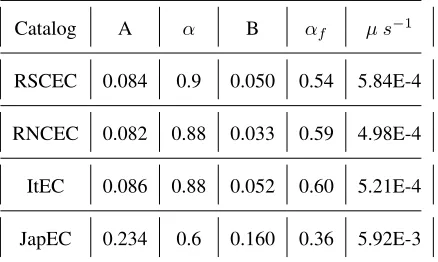
Table 1. Best parameters of the ETAFS model
Catalog A α B αf µ s−1
RSCEC 0.084 0.9 0.050 0.54 5.84E-4
RNCEC 0.082 0.88 0.033 0.59 4.98E-4
ItEC 0.086 0.88 0.052 0.60 5.21E-4
JapEC 0.234 0.6 0.160 0.36 5.92E-3
Because of the experimental resultρa(∆r, mM)≃ρf(∆r, mM)we setGf(∆ri, mi) =G(∆ri, mi)
in Eq.(2). We have also implemented an inverse-Omori law with the samepas for aftershock
occurrence, to reduce the number of model parameters. There is no physical justification for
it and we expect that similar results can be recovered with other functional forms of
tempo-ral clustering. We fixc= 100s and chose the parametersB, c′, α′, for each instrumental cat-alog, in order to reproduce the valuenf ore(mM)/nmain(mM), for differentmM (see Tab. 1).
We also take explicitly into account aftershock incompleteness, implemented as in the ETASI2
model, and finally generate synthetic catalogs with the same number ofnaf t(mM)/nmain(mM)
andnf ore(mM)/nmain(mM)of instrumental ones. Fig.2 shows that for all values of mM ETASI2
catalogs contains the same number of both aftershocks and foreshocks of instrumental data
sets. In (Fig.4) we compare the average fore-mainshock distanceζf(∆r, mM)between the ETAFS
and the RSCEC catalog. Results show good agreement for all values ofmM.
6 Conclusions
In conclusions, we have discussed the differences between statistical features of
fore-shocks in ETAS and instrumental catalogs. We have then introduced the novel ETAFS model
which explicitly implements foreshocks in the ETAS model and is able to reproduce the
en-tire ensemble of experimental observations. All properties investigated in this study are
ob-tained by means of a stacking procedure. An interesting point is the behavior expected
accord-ing to the ETAFS model for the seismic activity before a saccord-ingle large shock. The best-fit
pa-rameters of the ETAFS model (Tab.1) indicate a small coefficientαf ≃1.1in the foreshock
productivity law and accordingly the number of foreshock remains relatively small also
daybefore amagnitudem=7 mainshock,withinaradiusof 10km. Thissmallnumber
im-pliesthat,for asinglemainshock,foreshockactivity canatmostappearintheformof
iso-latedburstsnotleadingtoanevidentsystematicincreaseoftheseismicrate. Thisis
consis-tentwithexperimentalobservations,wheretheinverseOmori-law isobtainedonlyaftera
stack-ingprocedureandrarelyobservedinsideisolated sequences[Papadopoulosetal.,2010;Daskalaki
etal.,2016].
Theagreementwithexperimentaldatasuggeststhatthe ETAFSmodelcancontribute
toasignificantimprovement ofpre-seismicforecasting. Arigorousvalidation ofthispoint,
however,needstobetestedinprospectivetests. Unfortunately,amainlimitationof themodel
isthatitisnotimmediatelysuitable tobeimplementedinthiskindof analysis.Indeed, in
or-dertoforecast theoccurrenceofanearthquake,accordingtotheETAFSmodel itis
neces-sarytodistinguishforeshockfromnormalearthquake triggering.Anattemptinthisdirection
([Lippielloetal.,2012c]) multipliesthe ETASoccurrenceprobabilitybyanad-hocfunction,
givingdifferentweightstoaftershockandforeshockclustering. Thisproducessignificant gain
inthe retrospectiveforecasting ofm>6 earthquakes.The natureofforeshocksimplemented
inthe ETAFSmodelisconsistentwiththisapproachpromotingfurtherstudiesonthe
rele-vanceof foreshocksinseismicforecasting.
0,1 1
0,1 1
n
aft(m
M
)/n
main
(m
M
) & n
fore
(m
M
)/n
main
(m
M
)
0,1 1
2 2,5 3 3,5 4
m
M
0,1 1
RSCEC
RNCEC
ItEC
JapEC
Figure 1. (Color online) The rationaf t(mM)/nmain(mM)andnf ore(mM)/nmain(mM)in
instru-mental and synthetic catalogs. Different panels correspond to different instruinstru-mental catalogs. We use open
symbols fornaf t(mM)/nmain(mM)and filled symbols fornf ore(mM)/nmain(mM). Results from the
in-strumental data sets are indicated with black circles. Green triangles are results for the ETASI2 model and red
squares for the ETAFS model. The error bars (of the same size of symbols) in numerical catalogs represent
the standard deviation from100realization of synthetic catalogs. The best parameter of the ETAFS model are
listed in Tab.1 whereas for the ETASI2 model the best agreement is obtained withA = 0.084,α = 0.9and
µ = 5.8510−4s−1for RSCEC,A = 0.082,α = 0.88andµ = 4.9810−4s−1for RNCEC,A = 0.082,
2 2,5 3 3,5 4
m
M0,1 1
n
fore(m
M
)/n
aft
(m
M
)
Figure 2. (Color online) The rationf ore(mM)/naf t(mM)in the RSCEC catalog (blue stars) is
com-pared with the value obtained in synthetic ETAS and ETASI2 and ETAFS catalog. The black open symbols
are results for the ETAS model for different choices of the parametersA ∈ [0.05,0.12],p ∈ [1.1,1.25]
andc ∈ [0.001,0.1]. The red filled symbols are results for the ETASI2 model implementing Eq.(5) with
φ = 0.75and∆m = 0.8and for different choices of the parametersA ∈ [0.05,0.12],p ∈ [1.1,1.25]and
c ∈ [0.001,0.1]. Green symbols correspond toA = 0.084,c = 0.01andp = 1.2used in Fig.1 for the
RSCEC catalog and considering different values ofφ,∆mandσ. The filled magenta up triangles are results
of the ETAFS model with the best set of parameters listed in Tab.1.
10-3 10-2 10-1 100
0,01 0,1 1
∆r (km)
10-3 10-2 10-1 100ζ
a(
∆
r,m
M) &
ζ
f(
∆
r,m
M)
10-2 10-10,01 0,1 1 10
∆r (km)
10-3 10-2 10-1
mM=2 mM=3 mM=4
RSCEC
RNCEC
ItEC
JapEC
Figure 3. (Color online) The average distanceζa(∆r, mM)of aftershocks (open symbols) and of
fore-shocksζf(∆r, mM)(filled symbols) is plotted as function of∆rfor the different catalogs. Different
main-shock magnitude classes are plotted with different colors and symbols.
Acknowledgments
We thank the National Research Institute for Earth Science and Disaster Prevention for the
main-land Japan catalog.
References
From I.S.I.D.E. italian seismological instrumental and parametric data-base.
From Japan Meteorological Agency Earthquake Catalog, provided by N.I.E.D.
Bottiglieri, M., L. de Arcangelis, C. Godano, and E. Lippiello, The generalized omori law:
magnitude incompleteness or magnitude clustering,International Journal of Modern
Physics B,23(28n29), 5597–5608, doi:10.1142/S0217979209063882, 2009a.
Bottiglieri, M., E. Lippiello, C. Godano, and L. de Arcangelis, Identification and
spa-tiotemporal organization of aftershocks,Journal of Geophysical Research: Solid Earth,
114(B3), B03,303, doi:10.1029/2008JB005941, 2009b.
Bottiglieri, M., L. de Arcangelis, C. Godano, and E. Lippiello, Multiple-time scaling and
0,01 0,1 1
∆
r (km)
0,001 0,01 0,1 1
ζ
a(
∆
r,m
M
)
mM=2 mM=3 mM=4
0,01 0,1 1
∆
r (km)
0,01 0,1
ζ
f(
∆
r,m
M
)
(a)
(b)
Figure 4. (Color online) (Left panel) The average distance of aftershocksζa(∆r, mM)in the RSCEC
(open symbols) and in the synthetic ETASI2 catalogs (continuous lines) is plotted as function of∆rfor
dif-ferent mainshock magnitude classes. (Right Panel) The average distance of foreshocksζf(∆r, mM)in the
RSCEC (filled symbols) and in the synthetic ETASI2 catalog (continuous lines) is plotted as function of∆r
for different mainshock magnitude classes. Results for the EATFS model, for the best set of model parameters
listed in Tab.1, are plotted with crosses.
158,501, doi:10.1103/PhysRevLett.104.158501, 2010.
Bottiglieri, M., E. Lippiello, C. Godano, and L. de Arcangelis, Comparison of branching
models for seismicity and likelihood maximization through simulated annealing,Journal
of Geophysical Research: Solid Earth,116(B2), n/a–n/a, doi:10.1029/2009JB007060,
b02303, 2011.
Bouchon, M., and D. Marsan, Reply to artificial seismic acceleration,Nature Geosci.,8,
83, 2015.
Bouchon, M., V. Durand, D. Marsan, H. Karabulut, and J. Schmittbuhl, The long
precur-sory phase of most large interplate earthquakes,Nature Geosci.,6, 299302, 2013.
Brodsky, E. E., The spatial density of foreshocks,Geophysical Research Letters,38(10),
L10,305, doi:10.1029/2011GL047253, l10305, 2011.
Brodsky, E. E., and T. Lay, Recognizing foreshocks from the 1 april 2014 chile
earth-quake,Science,344(6185), 700–702, 2014.
Chen, X. W., and P. M. Shearer, California foreshock sequences suggest aseismic
trigger-ing process,Geophysical Research Letters,40(11), 2602–2607, doi:10.1002/grl.50444,
n/a, 2013.
Daskalaki, E., K. Spiliotis, C. Siettos, G. Minadakis, and G. A. Papadopoulos, Foreshocks
and short-term hazard assessment to large earthquakes using complex networks: the
case of the 2009 l’aquila earthquake,Nonlinear Processes in Geophysics Discussions,
2016, 1–20, doi:10.5194/npg-2015-80, 2016.
Davidsen, J., and M. Baiesi, Self-similar aftershock rates,Phys. Rev. E,94, 022,314, doi:
10.1103/PhysRevE.94.022314, 2016.
de Arcangelis, L., C. Godano, J. R. Grasso, and E. Lippiello, Statistical physics
ap-proach to earthquake occurrence and forecasting,Physics Reports,628, 1 – 91, doi:
http://dx.doi.org/10.1016/j.physrep.2016.03.002, statistical physics approach to
earth-quake occurrence and forecasting, 2016.
de Arcangelis, L., C. Godano, and E. Lippiello, The overlap of aftershock coda waves
and short-term postseismic forecasting,Journal of Geophysical Research: Solid Earth,
123(7), 5661–5674, doi:10.1029/2018JB015518, 2018.
Dodge, D. A., G. C. Beroza, and W. L. Ellsworth, Detailed observations of california
foreshock sequences: Implications for the earthquake initiation process,Journal of
Geophysical Research: Solid Earth,101(B10), 22,371–22,392, doi:10.1029/96JB02269,
Enescu, B., J. Mori, and M. Miyazawa, Quantifying early aftershock activity of the 2004
mid-niigata prefecture earthquake (mw6.6),Journal of Geophysical Research: Solid
Earth,112(B4), B04,310, doi:10.1029/2006JB004629, 2007.
Felzer, K. R., and E. E. Brodsky, Decay of aftershock density with distance indicates
triggering by dynamic stress,Nature,441, 735–738, 2006.
Felzer, K. R., M. T. Page, and A. J. Michael, Artificial seismic acceleration,Nature
Geosci.,8, 82–83, 2015.
Hainzl, S., Comment on self-similar earthquake triggering, bth’s law, and
fore-shock/aftershock magnitudes: Simulations, theory, and results forsouthern california
by p. m. shearer,Journal of Geophysical Research: Solid Earth,118(3), 1188–1191,
doi:10.1002/jgrb.50132, 2013.
Hainzl, S., Apparent triggering function of aftershocks resulting from rate-dependent
in-completeness of earthquake catalogs,Journal of Geophysical Research: Solid Earth,
121(9), 6499–6509, doi:10.1002/2016JB013319, 2016JB013319, 2016a.
Hainzl, S., Ratedependent incompleteness of earthquake catalogs,Seismological Research
Letters,87(2A), 337–344, 2016b.
Hauksson, E., P. Shearer, , and W. Yang, Waveform relocated earthquake catalog for
southern california (1981 to june 2011),Bulletin of the Seismological Society of America,
102(5), 2239–2244, doi:10.1785/0120120010, 2012.
Helmstetter, A., Y. Y. Kagan, and D. D. Jackson, Comparison of short-term and
time-independent earthquake forecast models for southern california,Bulletin of the
Seismo-logical Society of America,96(1), 90–106, doi:10.1785/0120050067, 2006.
Huang, Q., M. Gerstenberger, and J. Zhuang, Current challenges in statistical seismology,
Pure and Applied Geophysics,173(1), 1–3, doi:10.1007/s00024-015-1222-7, 2016.
Kagan, Y. Y., Short-term properties of earthquake catalogs and models of earthquake
source,Bulletin of the Seismological Society of America,94(4), 1207–1228, 2004.
Lippiello, E., M. Bottiglieri, C. Godano, and L. de Arcangelis, Dynamical scaling
and generalized omori law,Geophysical Research Letters,34(23), L23,301, doi:
10.1029/2007GL030963, 2007a.
Lippiello, E., C. Godano, and L. de Arcangelis, Dynamical scaling in branching models
for seismicity,Phys. Rev. Lett.,98, 098,501, doi:10.1103/PhysRevLett.98.098501, 2007b.
Lippiello, E., L. de Arcangelis, and C. Godano, Influence of time and space
correlations on earthquake magnitude,Phys. Rev. Lett.,100, 038,501, doi:
10.1103/PhysRevLett.100.038501, 2008.
Lippiello, E., L. de Arcangelis, and C. Godano, Role of static stress diffusion in the
spatiotemporal organization of aftershocks,Phys. Rev. Lett.,103, 038,501, doi:
10.1103/PhysRevLett.103.038501, 2009a.
Lippiello, E., L. de Arcangelis, and C. Godano, Time, space and magnitude correlations
in earthquake occurrence,International Journal of Modern Physics B,23(28n29), 5583–
5596, doi:10.1142/S0217979209063870, 2009b.
Lippiello, E., A. Corral, M. Bottiglieri, C. Godano, and L. de Arcangelis, Scaling behavior
of the earthquake intertime distribution: Influence of large shocks and time scales in the
omori law,Phys. Rev. E,86, 066,119, doi:10.1103/PhysRevE.86.066119, 2012a.
Lippiello, E., C. Godano, and L. de Arcangelis, The earthquake magnitude is
influ-enced by previous seismicity,Geophysical Research Letters,39(5), L05,309, doi:
10.1029/2012GL051083, 2012b.
Lippiello, E., W. Marzocchi, L. de Arcangelis, and C. Godano, Spatial organization of
foreshocks as a tool to forecast large earthquakes,Sci. Rep.,2, 1–6, 2012c.
Lippiello, E., C. Godano, and L. de Arcangelis, Magnitude correlations in the
Olami-Feder-Christensen model,Europhysics Letters,102(5), 59,002, 2013.
Lippiello, E., A. Cirillo, G. Godano, E. Papadimitriou, and V. Karakostas, Real-time
fore-cast of aftershocks from a single seismic station signal,Geophysical Research Letters,
43(12), 6252–6258, doi:10.1002/2016GL069748, 2016GL069748, 2016.
Lippiello, E., F. Giacco, W. Marzocchi, C. Godano, and L. d. Arcangelis, Statistical
fea-tures of foreshocks in instrumental and etas catalogs,Pure and Applied Geophysics, pp.
1–19, doi:10.1007/s00024-017-1502-5, 2017.
Mignan, A., The debate on the prognostic value of earthquake foreshocks: A
meta-analysis,Sci. Rep.,4, 4099–4103, 2014.
Ogata, Y., Statistical models for earthquake occurrences and residual analysis for point
processes,Research Memo. Technical report Inst. Statist. Math., Tokyo.,288, 1985.
Ogata, Y., Statistical models for earthquake occurrences and residual analysis for point
processes,J. Amer. Statist. Assoc.,83, 9 27, 1988a.
Ogata, Y., Space-time point-process models for earthquake occurrences,Ann. Inst.
Math.Statist.,50, 379402, 1988b.
Ogata, Y., A monte carlo method for high dimensional integration,Numerische
Ogata, Y., and K. Katsura, Comparing foreshock characteristics and foreshock forecasting
in observed and simulated earthquake catalogs,Journal of Geophysical Research: Solid
Earth,119(11), 8457–8477, doi:10.1002/2014JB011250, 2014JB011250, 2014.
Ohnaka, M., Earthquake source nucleation: A physical model for short-term precursors,
Tectonophysics,211(14), 149 – 178, 1992.
Ohnaka, M., Critical size of the nucleation zone of earthquake rupture inferred from
immediate foreshock activity,Journal of Physics of the Earth,41(1), 45–56, doi:
10.4294/jpe1952.41.45, 1993.
Omi, Y. O. Y. H., T., and K. Aihara, Forecasting large aftershocks within one day after
the main shock,Scientific Report,3(2218), 2013.
Papadopoulos, G. A., M. Charalampakis, A. Fokaefs, and G. Minadakis, Strong
fore-shock signal preceding the l’aquila (italy) earthquake (mw 6.3) of 6 april 2009,Natural
Hazards and Earth System Science,10(1), 19–24, doi:10.5194/nhess-10-19-2010, 2010.
Peng, Z., and P. Zhao, Migration of early aftershocks following the 2004 parkfield
earth-quake,Nature Geosci,2(12), 877–881, 2009.
Peng, Z., J. E. Vidale, M. Ishii, and A. Helmstetter, Seismicity rate immediately before
and after main shock rupture from high-frequency waveforms in japan,Journal of
Geo-physical Research: Solid Earth,112(B3), n/a–n/a, doi:10.1029/2006JB004386, b03306,
2007.
Sarlis, N. V., Magnitude correlations in global seismicity,Phys. Rev. E,84, 022,101, doi:
10.1103/PhysRevE.84.022101, 2011.
Sarlis, N. V., E. S. Skordas, and P. A. Varotsos, Nonextensivity and natural time: The case
of seismicity,Phys. Rev. E,82, 021,110, doi:10.1103/PhysRevE.82.021110, 2010a.
Sarlis, N. V., E. S. Skordas, and P. A. Varotsos, Nonextensivity and natural time: The case
of seismicity,Phys. Rev. E,82, 021,110, doi:10.1103/PhysRevE.82.021110, 2010b.
Shcherbakov, R., G. Yakovlev, D. L. Turcotte, and J. B. Rundle, Model for the
dis-tribution of aftershock interoccurrence times,Phys. Rev. Lett.,95, 218,501, doi:
10.1103/PhysRevLett.95.218501, 2005.
Shearer, P. M., Self-similar earthquake triggering, bath’s law, and foreshock/aftershock
magnitudes: Simulations, theory, and results for southern california,Journal of
Geophys-ical Research-Solid Earth,117, doi:10.1029/2011jb008957, n/a, 2012a.
Shearer, P. M., Space-time clustering of seismicity in california and the distance
2012b.
Shearer, P. M., Reply to comment by s. hainzl on self-similar earthquake triggering,
bth’s law, and foreshock/aftershock magnitudes: Simulations, theory and results for
southern california,Journal of Geophysical Research: Solid Earth,118(3), 1192–1192,
doi:10.1002/jgrb.50133, 2013.
Waldhauser, F., and D. P. Schaff, Large-scale relocation of two decades of northern
cal-ifornia seismicity using cross-correlation and double-difference methods,Journal of
Geophysical Research: Solid Earth,113(B8), B08,311, doi:10.1029/2007JB005479,