
Article
Misconceptions about Calorimetry
MicheleLivan 1andRichardWigmans2
1 Dipartimento di Fisica, Università di Pavia and INFN Sezione di Pavia, Via Bassi 6, Pavia 27100 Italy;
2 Department of Physics, Texas Tech University, Lubbock, TX 79409-1051, U.S.A.; [email protected]
Abstract: In the past 50 years, calorimeters have become the most important detectors in many particle physics 1
experiments, especially experiments in colliding-beam accelerators at the energy frontier. In this paper, we describe 2
and discuss a number of common misconceptions about these detectors, as well as the consequences of these 3
misconceptions. We hope that it may serve as a useful source of information for young colleagues who want to 4
familiarize themselves with these tricky instruments. 5
1. Introduction 6
In the past fifty years, calorimeters have become a very important component of the toolbox of particle 7
physicists. Especially in experiments at large storage rings, where beams of high-energy particles are brought 8
into collision with each other, calorimeter systems are the heart and soul of the detector system. Some of the reasons 9
that make calorimeters extremely suitable for such experiments are 10
1. The fact that they are sensitive to both the charged and neutral particles produced in the interactions. 11
2. The fact that their performance typically improves with increasing energies. 12
These two characteristics distinguish them from other detector components, which are typically only sensitive 13
to charged particles and become less performant at increasing energy. 14
3. The fact that they can provide the information needed for deciding whether a certain event is worth retaining 15
for further (offline) inspectionextremely fast,i.e.,almost instantaneously. 16
This is the most decisive reason for the important role of calorimeters in modern experiments, where the 17
interesting events sometimes (i.e.,at CERN’s Large Hadron Collider) represent a very tiny fraction of the 18
total. The capability of calorimeter systems to provide information on theenergy flowin the events (missing 19
energy, transverse energy, jet production,etc.) is an extremely valuable feature in this context. 20
Despite the crucial role of calorimeters in many experiments, there are unfortunately still many misconceptions 21
about these instruments. These misconceptions derive from the, in many ways, counter-intuitive performance 22
characteristics. They have led and continue to lead to fundamental mistakes in designing detector systems, and 23
interpreting results of experiments. 24
In this paper, we review a few common misconceptions, and describe some of the practical consequences. 25
We mainly concentrate on sampling calorimeters, since that is where most of the problems occur. With few 26
exceptions, most calorimeter systems at large4π experiments at colliders use indeed different materials for the 27
absorption of the particles and for generating the signals resulting from this absorption process. Section 2 contains 28
a brief introduction to calorimetry as a particle detection technique. In Section 3, the misconceptions and their 29
consequences are described. In Section 4, we show how beam tests of prototype calorimeter modules are often at 30
2. Calorimetry as a particle detection technique 32
In nuclear and particle physics, the term calorimetry refers to the detection of particles, and measurement 33
of their properties, through total absorption in an instrument called acalorimeter. Calorimeters exist in a wide 34
variety, but they all have the common feature that the measurement process through which the particle properties 35
are determined isdestructive. Unlike, for example, wire chambers that measure a particle’s properties by tracking 36
it in a magnetic field, the particles are no longer available for inspection by other devices once the calorimeter 37
is done with them. The only exception to this rule concerns muons. The fact that these particles may penetrate 38
the substantial amount of matter represented by a calorimeter without losing much of their energy is actually an 39
important ingredient for their identification as muons. Other particles (neutrinos and particles hypothesized in 40
the context of Supersymmetry) do not leave any trace in a calorimeter, or in any other detector component. Yet, 41
calorimeters are also crucial tools for recognizing the presence of these particles, and measuring their properties. 42
In the absorption process, which is usually calledshower development, almost all the particle’s energy is 43
eventually converted into heat, hence the term calorimetry. However, the units of the energy involved in this process 44
are typically very different from the thermodynamic ones. The most energetic particles in modern accelerator 45
experiments are measured in units of TeV (1 TeV =1012 eV = 1000 GeV), whereas 1 calorie (4.18 Joule) is 46
equivalent to about107 TeV. The rise in temperature of the particle detector is thus, for all practical purposes, 47
negligible, and therefore other ways to measure the deposited energy are employed. These methods are typically 48
based on the measurable effects of atomic or molecular excitation (ionization charge, scintillation light), or on 49
collective effects such as the production of ˇCerenkov light or sound in the absorbing medium. 50
2.1. Functions and properties of calorimeters 51
Calorimeters measure the energy released in the absorption of (sub)nuclear particles that enter them. They 52
generate signals that make it possible to quantify that energy. Typically, these signals provide also other information 53
about the particles, and about the event in which they were produced. The signals from a properly instrumented 54
absorber may be used to measure the entire four-vector of the particles. 55
By analyzing the energy deposit pattern, the direction of the particle can be measured. The mass of the 56
showering particle can be determined in a variety of ways,e.g.,from the time structure of the signals, the energy 57
deposit profile, or a comparison of the measured energy and momentum of the particle. Calorimeters are also 58
used to identify muons and neutrinos. High-energy muons usually deposit only a small fraction of their energy 59
in the calorimeter and produce signals in downstream detectors. Neutrinos typically do not interact at all in the 60
calorimeter. If an energetic neutrino is produced in a colliding-beam experiment, this phenomenon will lead to an 61
imbalance between the energies deposited in any two hemispheres into which a4πdetector can be split. Such an 62
imbalance is usually referred to asmissing transverse energy. 63
The latter is an example of theenergy flow informationa calorimeter system can provide. Other examples of 64
such information concern thetotal transverse energyand the production ofhadronic jetsin the measured events. 65
Since this information is often directly related to the physics goals of the experiment, and since it can be obtained 66
extremely fast, calorimeters usually play a crucial role in the trigger scheme, through which interesting events are 67
selected and retained for further inspection off-line. 68
The calorimeter’s properties should be commensurate with the role it has to play in the experiment. Relevant 69
properties in this context are the energy resolution, the size (which determines the effects of shower leakage), the 70
signal speed and the hermeticity. 71
2.2. Calorimeter types 72
One frequently distinguishes between homogeneous and sampling calorimeters. In a homogeneous 73
calorimeter, the entire detector volume is sensitive to the particles and may contribute to the generated signals. In a 74
called thepassiveandactive medium, respectively. The passive medium is usually a high-density material, such as 76
iron, copper, lead or uranium. The active medium generates the light or charge that forms the basis for the signals 77
from such a calorimeter. 78
In some non-accelerator experiments, the calorimeter is also the source that generates the particles to be 79
detected. As examples, we mention large water ˇCerenkov counters built to detect astrophysical neutrinos and the 80
high-purity76Ge crystals or the136Xe liquid used to studyββdecay. 81
2.2.1.Electromagnetic calorimeters 82
Electromagnetic calorimeters are specifically intended for the detection of energetic electrons andγs, but 83
produce usually also signals when traversed by other types of particles. They are used over a very wide energy 84
range, from the semiconductor crystals that measureX-rays down to a few keV to shower counters such as AGILE, 85
PAMELA and FERMI, which orbit the Earth on satellites in search for electrons, positrons andγs with energies 86
> 10TeV. These calorimeters don’t need to be very deep, especially when high-Zabsorber material is used. For 87
example, when 100 GeV electrons enter a block of lead,∼90%of their energy is deposited in only 4 kg of material. 88
By far the best energy resolutions have been obtained with large semiconductor crystals, and in particular high-purity 89
germanium. These are the detectors of choice in nuclearγray spectroscopy, and routinely obtain resolutions (σ/E) 90
of 0.1% in the 1 MeV energy range. The next best class of detectors are scintillating crystals, which are often the 91
detectors of choice in experiments involvingγrays in the energy range from 1 - 20 GeV, which they measure with 92
energy resolutions of the order of 1%. Excellent performance in this energy range has also been reported for liquid 93
krypton and xenon detectors, which are bright (UV) scintillators. Other homogeneous detectors of em showers are 94
based on ˇCerenkov light, in particular lead glass. Very large water ˇCerenkov calorimeters (e.g.,SuperKamiokande) 95
should also be mentioned in this category. 96
Sampling calorimeters, which are typically much cheaper, become competitive at higher energies. In properly 97
designed instruments of this type, the energy resolution is determined bysampling fluctuations. These represent 98
fluctuations in the number of different shower particles that contribute to the calorimeter signals, convoluted with 99
fluctuations in the amount of energy deposited by individual shower particles in the active calorimeter layers. They 100
depend both on thesampling fraction, which is determined by the ratio of active and passive material, and on the 101
sampling frequency, determined by the number of different sampling elements in the region where the showers 102
develop. Sampling fluctuations are stochastic and their contribution to the energy resolution is described by [1] 103
σ E =
a
√
E with a = 0.027
q
d/fsamp (1)
in whichdrepresents the thickness of individual active sampling layers (in mm), and fsamp the sampling fraction 104
for minimum ionizing particles (mips). This expression describes data obtained with a large variety of different 105
(non-gaseous) sampling calorimeters reasonably well. 106
2.2.2.Hadron calorimeters 107
The energy range covered by hadron calorimeters is in principle even larger than that for em ones. Calorimetric 108
techniques are used to detect thermal neutrons, which have kinetic energies of a small fraction of 1 eV, to the 109
highest-energy particles observed in nature, which reach the Earth from outer space as cosmic rays carrying up to 110
1020eV or more. In accelerator-based particle physics experiments, hadron calorimeters are typically used to detect 111
protons, pions, kaons and fragmenting quarks and gluons (commonly referred to asjets) with energies in the GeV -112
TeV range. In this paper, we mainly discuss the latter instruments. 113
The development of hadronic cascades in dense matter differs in essential ways from that of electromagnetic 114
1. Anelectromagneticcomponent;π0s andηs generated in the absorption process decay intoγs which develop 116
em showers. 117
2. A non-electromagnetic component, which combines essentially everything else that takes place in the 118
absorption process. 119
For the purpose of calorimetry, the main difference between these components is that some fraction of the energy 120
contained in the non-em component doesnotcontribute to the signals. Thisinvisible energy, which mainly consists 121
of the binding energy of nucleons released in the numerous nuclear reactions, may represent up to 40% of the total 122
non-em energy, with large event-to-event fluctuations. 123
The appropriate length scale of hadronic showers is the nuclear interaction length (λint), which is typically 124
much larger (up to 30 times for high-Zmaterials) than the radiation length (X0), which governs the development of 125
em showers. Many experiments make use of this fact to distinguish between electrons and hadrons on the basis of the 126
energy deposit profile in their calorimeter system. Since the ratioλint/X0is proportional toZ, particle identification 127
on this basis works best for high-Zabsorber materials. Lead and depleted uranium are therefore popular choices for 128
the absorber material in preshower detectors and the first section of a longitudinally segmented calorimeter, which 129
is therefore commonly referred to as theelectromagnetic section. 130
Just as for the detection of em showers, high-resolution hadron calorimetry requires an average longitudinal 131
containment better than 99%. In iron and materials with similarZ, which are most frequently used for hadron 132
calorimeters, 99% longitudinal containment requires a thickness ranging from5λintat 20 GeV to8λintat 150 GeV. 133
Hadronic energy resolutions of 1% require not only longitudinal shower containment at the 99% level, but also 134
lateral containment of 98% or better. 135
Energeticπ0s may be produced throughout the absorber volume, and not exclusively in the em calorimeter 136
section. They lead to local regions of highly concentrated energy deposit. Therefore, there is no such thing as a 137
“typical hadronic shower profile". This feature affects not only the shower containment requirements, but also the 138
calibration of longitudinally segmented calorimeters in which one tries to improve the quality of calorimetric energy 139
measurements of jets with an upstream tracker, which can measure the momenta of the charged jet constituents with 140
great precision. This method has become known asParticle Flow Analysis(PFA). 141
2.2.3.Compensation 142
The properties of the em shower component have also important consequences for theenergy resolution, the signallinearityand theresponse function. The average fraction of the total shower energy contained in the em component has been measured to increase with energy following a power law:
hfemi = 1−E/E0 k−1
(2)
whereE0is a material dependent constant related to the average multiplicity in hadronic interactions (varying from 143
0.7 GeV to 1.3 GeV for π-induced reactions on Cu and Pb, respectively), and k ∼ 0.82. For proton-induced 144
reactions, hfemi is typically considerably smaller, as a result of baryon number conservation in the shower 145
development. 146
Let us define the calorimeterresponseas the conversion efficiency from deposited energy to generated signal, 147
and normalize it to electrons. The responses of a given calorimeter to the em and non-em hadronic shower 148
components,eandh, are usually not the same, as a result of invisible energy and a variety of other effects. Such 149
calorimeters are callednon-compensating(e/h6=1). Since their response to hadrons,hfemi+1− hfemih/e, is 150
energy dependent (2), they are intrinsically non-linear. 151
Event-to-event fluctuations in fem are large and non-Poissonian. If e/h 6= 1, these fluctuations tend to 152
dominate the hadronic energy resolution and their asymmetric distribution characteristics are reflected in the 153
calibration problems [2] are absent in compensating calorimeters (e/h = 1.0). Compensation can be achieved in 155
sampling calorimeters with high-Zabsorber material and hydrogenous active material. It requires a very specific 156
sampling fraction, so that the response to shower neutrons is boosted by the precise factor needed to equalizeeand 157
h. For example, in Pb/scintillating-plastic structures, this sampling fraction is∼2%for showers [3–5]. This small 158
sampling fraction sets a lower limit on the contribution of sampling fluctuations, while the need to efficiently detect 159
MeV-type neutrons requires signal integration over a relatively large volume during at least 30 ns. Yet, calorimeters 160
of this type currently hold the world record for hadronic energy resolution (σ/E∼30%/
√
E[4]). 161
Excellent hadronic performance has also been achieved with calorimeters that use thedual-readout method 162
(DREAM) [6]. Such calorimeters produce two signals that provide complementary information about the shower 163
development. Since ˇCerenkov light is almost exclusively produced in the em shower component, a comparison of 164
the ˇCerenkov signal with a signal to whichallcharged shower particles contribute, the value offemcan be measured 165
for each individual event. This makes it possible to eliminate the detrimental effects of fluctuations in this variable 166
and achieve similar performance as intrinsically compensating calorimeters, without the mentioned disadvantages. 167
3. Common misconceptions and their consequences 168
3.1. Shower particles contributing to the calorimeter signals 169
The most common, important and consequential misconception about calorimetry is that a shower is a 170
collection of minimum ionizing particles (mips). Already in the early days, it was realized that the signal from 171
a high-energy electron absorbed in a sampling calorimeter was substantially different from that of a muon that 172
traversed this calorimeter and deposited the same energy in it as the showering electron. This is due to the fact that 173
the composition of the em shower changes as a function of depth, or age. 174
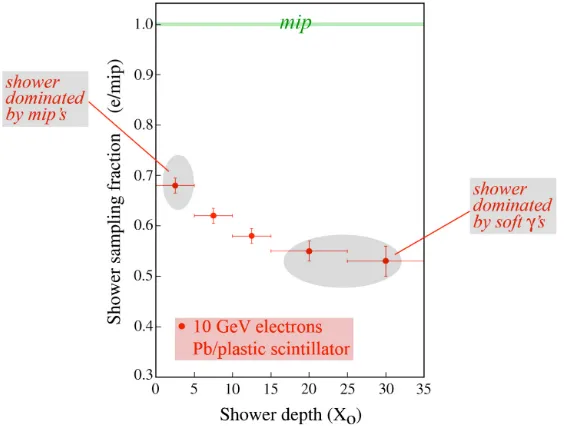
In the late stages, most of the energy is deposited by softγs which undergo Compton scattering or photoelectric 175
absorption, and the sampling fraction for this shower component (i.e.,the fraction of the energy that contributes to 176
the calorimeter signals) may be very different from that of the mips that dominate the early stages of the shower 177
development. This causes major complications for the intercalibration of the different sections of a longitudinally 178
Figure 1.The sampling fraction changes in a developing shower. Thee/mipratio is shown as a function of depth, for 10 GeV
segmented calorimeter, as is well known from the experiences of several experiments that have had to deal with this 179
problem [7,8]. 180
3.1.1.Intercalibration problems 181
Figure1 illustrates how the sampling fraction of a given calorimeter structure depends on the stage of the 182
developing showers. In calorimeters consisting of high-Zabsorber material (e.g.,lead) and low-Zactive material 183
(plastic, liquid argon), the sampling fraction may vary by as much as 25 - 30% over the volume in which the 184
absorption takes place [9]. An example of the pitfalls that this causes for calibrating a longitudinally segmented 185
device concerns the calorimeter for the AMS-02 experiment at the International Space Station [8]. This calorimeter 186
has eighteen independent longitudinal depth segments. Each layer consists of a lead absorber structure in which 187
large numbers of plastic scintillating fibers are embedded, and is about1X0thick. A minimum ionizing particle 188
deposits 11.7 MeV upon traversing such a layer. The AMS-02 collaboration initially calibrated this calorimeter by 189
sending muons through it and equalizing the signals from all eighteen longitudinal segments. This seems like a very 190
good method to calibrate this detector, since all layers have exactly the same structure.
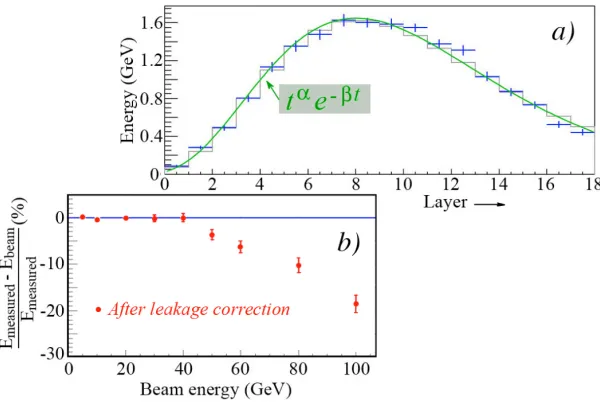
Figure 2. Average signals measured for 20 GeV electrons in the 18 depth segments of the AMS-02 lead/scintillating-fiber
calorimeter (a). Average relative difference between the measured energy and the beam energy, after leakage corrections based on extrapolation of the fitted shower profile (b). Data from [8].
191
However, when this calorimeter module was exposed to beams of high energy electrons, it turned out to be 192
highly non-trivial how to reconstruct the energy of these electrons. Figure2a shows the average signals from 20 193
GeV electron showers developing in this calorimeter. These signals were translated into energy deposits based 194
on the described calibration. The measured data were then fitted to aΓ-function and since the showers were not 195
fully contained, the average leakage was estimated by extrapolating this fit to infinity. As shown in Figure 2b, 196
this procedure systematically underestimated this leakage fraction, more so as the energy (and thus the leakage) 197
increased. The reason for this is that a procedure in which the relationship between measured signals and the 198
corresponding deposited energy is assumed to be the same for each depth segment will cause the energy leakage to 199
be systematically underestimated, more so if that leakage increases. 200
This very complicated problem will most definitely also affect calorimeters based on Particle Flow Analysis 201
(PFA) [10], which are all based on structures that are highly segmented, both longitudinally and laterally. The 202
a developing shower. As the composition of the shower changes, so does the sampling fraction. Figure2provides a 204
clear example of the problems that this may cause. 205
3.1.2.Catastrophic effects 206
Another aspect of the misconception that a shower is a collection of mips is the fact thata singleshower particle 207
may cause catastrophic effects for the calorimeter performance. This is particularly true for hadron showers, and 208
may be illustrated by a recent example taken from the CMS experiment. The CMS calorimeter system consists of 209
a crystal based em calorimeter, followed by a brass/plastic-scintillator hadronic compartment. Each PbWO4crystal 210
is read out by two Avalanche Photo Diodes (APDs, Figure3a). 211
Figure 3. Arrangement of the APDs used to read the signals from the CMS ECAL (a). A “spike” event recorded by the CMS
calorimeter system (b) [11]. A typical nuclear interaction in a developing hadron shower, induced by a 0.57 GeV/cproton (c).
When hadrons are sent into this calorimeter system, it produces sometimes events in which an anomalously 212
large signal is recorded in one individual crystal [11]. Such events are referred to as “spikes” (Figure3b). Figure3c 213
shows an example of a nuclear interaction that is a typical feature in hadron shower development. A proton with a 214
momentum of 0.57 GeV/cinteracts with a nucleus of the absorber structure, and produces seven even lower-energy 215
charged particles, presumably protons and/or nuclear aggregates such as αparticles in this process. There are 216
probably also at least as many neutrons produced in this reaction, but these do not ionize the material and are thus 217
invisible in this figure. The charged fragments are all heavily ionizing, with typicaldE/dxvalues of 100 - 1000 218
times that of a mip. If such an event happens close to an APD, these charged fragments may create a very large 219
signal. The APDs are intended to detect scintillation photons produced in the PbWO4crystals, and the energy scale 220
of the calorimeter signals is set by the production rate of such photons. However, the APDs produce signals that are 221
orders of magnitude larger when traversed by a charged particle. The densely ionizing fragments of an event such 222
as the one shown in Figure3c may produce signals that are interpreted as an energy deposit of several hundred GeV 223
inside the scintillating crystals, and this is precisely what causes these spikes. As an aside, we mention that this 224
phenomenon should be very easily recognizable if the two APDs connected to each crystal were read out separately, 225
since the described phenomenon would only occur in one of them. However, in order to save money, CMS had 226
ganged them together and treated the two APDs as one readout cell. 227
Another well known example of a catastrophic effect caused by a single shower particle occurs in sampling 228
calorimeters with gaseous active media, such as proportional wire chambers that use a gas mixture containing free 229
hydrogen atoms,e.g.,isobutane. Neutrons, which are abundantly produced in hadronic shower development, may 230
elastically scatter off a hydrogen nucleus and the recoil proton may be stopped in the wire chamber. The result is a 231
signal contribution that may be orders of magnitude larger than the signal from a mip traversing the wire chamber. 232
Because of the extremely small sampling fraction of such calorimeters (typically∼ O(10−5), a 1 MeV energy 233
became known as the “Texas Tower effect” in CDF [12] and necessitated a complete replacement of the forward 235
calorimeter system in that experiment. 236
3.2. Signal (non)linearity 237
Calorimeters may be non-linear for a variety of reasons. Intercalibration of longitudinal sections, signal 238
saturation and the energy dependence of the em shower fraction (in hadron showers) are the most common causes. 239
Many calorimeters are non-linear, even though their owners sometimes pretend otherwise. 240
A common misconception is that a calorimeter is linear if the average signals plotted versus the deposited 241
energy can be described with a straight line. This is incorrect. The straight line has to extrapolate through the 242
origin of the plot. Signal linearity means that the average calorimeter signal isproportionalto the deposited energy, 243
i.e.,theresponse is constant. 244
Figure 4.Average signal as a function of electron energy for the W/Si ECAL built by CALICE (a) [13]. Residual signals from
this detector, before and after taking out a 360 MeV offset (b).
Figure 4 illustrates this issue. The experimental data were obtained with a W/Si em calorimeter built by 245
CALICE [13]. The authors fit the measured signals with the following expression: 246
Emean=βEbeam−360 MeV (3)
Then, they define 247
Emeas=Emean+360 MeV (4)
and plot 248
(Emeas−Ebeam)/Emeas
as a function of the beam energy. The result is represented by the (black) squares in Figure4b. They conclude that 249
“the calorimeter is linear to within approximately 1%.” This is highly misleading. When the calorimeter signals 250
they actuallymeasuredare used to check the linearity,i.e.,when 251
is plotted as a function of the beam energy, the results, represented by the (red) full circles in Figure4b, look quite 252
different. We conclude from these results that the authors measured a signal non-linearity of 5% over one decade in 253
energy. 254
3.2.1.Non-linearity resulting from signal saturation 255
Whereas the non-linearity discussed in the previous subsection is probably the result of the intercalibration of 256
the numerous longitudinal segments of this PFA calorimeter, Figure5shows non-linearity with a different origin. It 257
concerns data obtained with a digital hadron calorimeter built by CALICE [10]. This calorimeter contains 500,000 258
readout cells (1×1cm2RPCs), which produce “digital” signals ("yes" or “no”) in response to charged particles. 259
However, this type of cell produces the same signal, regardless whether it is caused by 1, 3 or 29 shower particles. 260
This leads to signal non-linearity, especially in em showers. Since the lateral shower profile is independent of the 261
energy of the showering particle, and the longitudinal shower profile only varies logarithmically with that energy, 262
the density of shower particles in the region where the energy is deposited increases almost proportionally with the 263
shower energy, signal non-linearity isinevitable. The same is true for hadron showers, albeit that the shower particle 264
density is smaller in that case, and the non-linearity effects correspondingly less pronounced. 265
Figure 5. Non-linearity as a result of signal saturation. The average signal is shown as a function of energy for electrons and
hadrons in a large calorimeter based on digital readout [10].
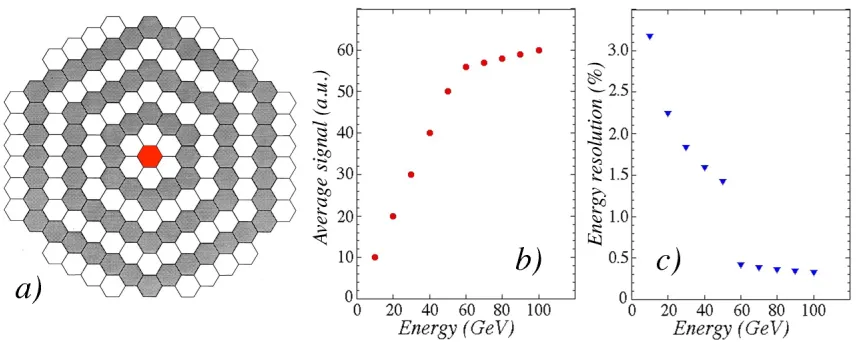
We use data from one of our own experiments to illustrate the effects of signal saturation. The SPACAL 266
calorimeter (Figure6a) consisted of 155 hexagonal towers. Each of these towers was calibrated by sending a beam 267
of 40 GeV electrons into its geometric center. Typically, 95% of the shower energy was deposited in that tower, the 268
remaining 5% was shared among the six neighbors. The high-voltage settings were chosen such that the maximum 269
energy deposited in each tower during the envisaged beam tests would be well within the dynamic range of that 270
tower. For most of the towers (except the central septet), the dynamic range was chosen to be 60 GeV. 271
When we did an energy scan with electrons in one of these non-central towers, the results shown in Figures6b 272
and6c were obtained. Up to 60 GeV, the average calorimeter signal increased proportionally with the beam energy, 273
but above 60 GeV, a non-linearity became immediately apparent (Figure6b). The signal in the targeted tower 274
had reached its maximum value, and would from that point onward produce the same value for every event. Any 275
increase in the total signal was due to the tails of the shower, which developed in the neighboring towers. A similar 276
trend occurred for the energy resolution (Figure6c). Beyond 60 GeV, the energy resolution suddenly improved 277
Figure 6.Saturation effects in one of the towers of the SPACAL calorimeter (a). Shown are the average signal (b) and the energy resolution (c) as a function of energy, measured when a beam of electrons is sent into this tower.
these higher energies. The energy resolution was thus completely determined by event-to-event fluctuations in the 279
energy deposited in the neighboring towers by the shower tails. 280
A similar situation occurred in the CALICE calorimeter of which the results are shown in Figure5. And since 281
also in this calorimeter an important source of fluctuations is suppressed, the energy resolution measured with it is 282
meaningless. 283
3.2.2.Non-linearity for hadron detection 284
Calorimeters intended for the detection of hadron showers are typically intrinsically non-linear, as a result of 285
the fact that the average em shower fraction depends on the energy of the showering particle. Non-compensating 286
calorimeters respond differently to the em and non-em shower components (e/h 6=1), and the overall calorimeter 287
response reflects the fact that the energy sharing between these shower components is energy dependent. These 288
signal non-linearities for hadron detection are thus the result of the physics of the shower development process, they 289
do not depend on peculiarities of the calorimeter signals, as in the examples described in the previous subsection. 290
For that reason, hadronic signal non-linearity does in general not preclude an (on average) correct measurement of 291
the energy of the showering particle on the basis of the observed signals. This is not necessarily true for all the 292
non-linearities that may affect electromagnetic shower detection, such as the ones discussed in the next subsection. 293
A (on average) correct measurement of hadronic energy deposits is possible, provided that the em energy scale 294
has been determined in the same way for all longitudinal calorimeter segments. In that case the hadronic response 295
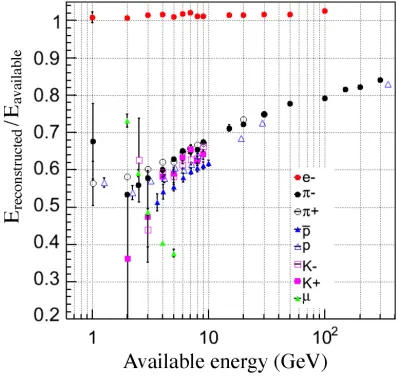
can be determined with hadron beams of different energy, using the em energy scale. An example is shown in Figure 296
7. The correct hadron energy is then found by multiplying the measured energy with the inverse of the calorimeter 297
response for that energy. The figure shows slightly different responses for different types of hadrons, but in CMS 298
this is a secondary effect compared to the large dependence of the response on the starting point of the showers [14]. 299
3.2.3.Signal non-linearity as a result of miscalibration 300
One of the most common reasons for signal non-linearity is the method chosen to intercalibrate the various 301
longitudinal sections of a longitudinally segmented calorimeter. This is illustrated with the example of the HELIOS 302
calorimeter [15], discussed below. This calorimeter consisted of two longitudinal segments, with depths of6.4X0 303
and 4λint, respectively (Figure8a). Electrons developing in this structure deposited comparable amounts of energy 304
Figure 7. The response to electrons and pions as a function of energy, for the CMS barrel calorimeter. The ratio of the total reconstructed energy in the CMS barrel calorimeter and the available beam energy for a variety of beam particles is shown as a function of energy. The different calorimeter sections were calibrated with electrons [14].
of the signals from the two sections was performed by minimizing the width of thetotal signal distribution. Figure 306
8b shows how this width depended on the choice of the ratio of the calibration constants for the signals from both 307
sections,B/A. The optimum value turned out to be different from the value for muons. The latter could simply be 308
calculated from the composition of the two sections. 309
If we takeB/A= 1for muons, then the optimal value for electrons was around 0.6 - 0.9, depending on the 310
energy. This can be understood from the fact that the sampling fraction decreased as the shower developed (Figure 311
1). Since the sampling fraction in the first section was larger, a smaller total width was obtained when signals from 312
that section were attributed a relatively larger weight, hence the optimal valueB/A<1. Now, if the electron energy 313
increases, a larger fraction of that energy is deposited in the second calorimeter section. And since the signals from 314
that section are given a relatively small weight, the result is a total signal that is smaller than if the signals from both 315
sections had been given the same weights as mips (B/A= 1). In other words, the calorimeterresponse(i.e.,the 316
average signal per GeV) decreases. 317
A calibration procedure in which the width of the total signal distribution of showers that develop in several 318
different calorimeter segments is minimized thus leadsinevitablyto a non-linear response. Now one might argue 319
that there is in principle no reason why a calorimeter that is non-linear for em shower detection, although somewhat 320
inconvenient, should be unacceptable. After all, all non-compensating calorimeters are intrinsically non-linear for 321
hadron and jet detection and one uses those too, in many experiments. 322
Any type of non-linearity could in principle be dealt with by means of a polynomial relationship between the 323
signalsSand the corresponding energyE: 324
E = c0 + c1S + c2S2 + c3S3 + ... (5)
and the fact that other constants thanc1have a non-zero value might be a small price to pay for improving energy 325
resolution. 326
This line of reasoning is, however, crucially flawed [16]. The non-linearity introduced by this weighting 327
scheme impliesby definitionthat a high-energyπ0, decaying into two unresolvedγs produces, on average, a larger 328
signal in this calorimeter than an electron, or one photon, of the same energy. Anω0resonance decaying into 329
Figure 8. Calibration procedures and resulting effects in the HELIOS calorimeter [15]. The calibration constants of the two longitudinal sections (a) of this calorimeter (AandB) were varied in order to minimize the total width of the electron signal distributions (b). The chosen value of the intercalibration constantB/Aleads to a signal non-linearity (c) for electrons. Even for the same energy (20 GeV), the average value of the signal depended on the number ofγs of which the showering electromagnetic object consists (d). See text for details.
them all (Figure8d). By introducing a signal non-linearity, the calorimeter response is made dependent on such 331
differences. And since, in practice, the calorimeter information does not always allow one to tell whether the signal 332
was caused by one, two, three or even moreγs, the systematic differences in the average calorimeter response for 333
those cases are anintegral part of the energy resolution. Interpreting the width of the signal distribution measured 334
for single electrons from a test beam as the em energy resolution is thus incorrect. 335
The approach chosen in this case (minimization of the width of the total signal distribution) is only one of 336
several different methods described in the literature for intercalibrating the different sections of a longitudinally 337
segmented calorimeter. Other methods aim to achieve 338
1. Correct energy reconstruction of pions penetrating the em compartment without starting a shower, or 339
2. Hadronic signal linearity, or 340
3. Independence of hadron response on starting point shower, or 341
4. Equal response to electrons and pions. 342
Each of these approaches introduces specific additional problems [17]. Intercalibrating the different sections of a 343
longitudinally segmented calorimeter system is in practice one of the most daunting tasks when commissioning a 344
detector, and it isfundamentally impossibleto achieve a result in which the signals measured in the different sections 345
can be correctly translated into deposited energy. This is even true for compensating calorimeters. The combination 346
of the energy dependence of the shower profiles, combined with the depth dependence of the sampling fraction are 347
responsible for this problem. 348
The best way to intercalibrate the different sections of a longitudinally segmented calorimeter system is by 349
using the same particles for all individual sections. If these particles develop showers, then they can only be 350
used to calibrate sections in which these showers are completely contained. Only in this way is the relationship 351
between the deposited shower energy (in GeV) and the charge (in picoCoulombs) generated as a result established 352
unambiguously. We have referred to this as theB/A=1method. The use of a beam of muons to intercalibrate the 353
eighteen segments of the AMS-02 electromagnetic calorimeter (Figure2) definitely qualifies as a viable method in 354
this respect. The mistake made in that case did not concern the calibration method itself, but the interpretation of 355
3.3. Energy resolution 357
A common mistake with regards to energy resolution has to do with its very definition. The energy resolution 358
is the precision with which the energy of an unknown object can be determined from the signals it produces in the 359
calorimeter. Typically, this resolution is determined as the relative width of the signal distribution measured for a 360
beam of mono-energetic particles from an accelerator. However, this is only correct if the average value of that 361
measured signal distribution corresponds indeed to the correct energy of these particles. Response non-linearities 362
tend to invalidate that assumption, as illustrated by the example shown in Figure8d. 363
Often, the measured signal distributions exhibit non-Gaussian tails. In that case, one should quote theσrms 364
value as the energy resolution. However, some authors use another variable, in order to make the results less 365
dependent on the tails of the signal distributions they measure, and thus look better. This variable, calledrms90, 366
is defined as the root-mean-square of the energies located in the smallest range of reconstructed energies which 367
contains 90% of the total event sample. For the record, it should be pointed out that for a perfectly Gaussian 368
distribution, this variable gives a 21% smaller value than the trueσrms (i.e.,σfit). Of course, one is free to define 369
variables as one likes. However, one should then not use the term “energy resolution” for the results obtained in 370
this way, and compare results obtained in terms ofrms90 with genuine energy resolutions from calorimeters with 371
Gaussian response functions [18]. This misleading practice is generally followed by the proponents of PFA. 372
Another widespread misconception concerns the way in which the energy resolution of a calorimeter is quoted. 373
Frequently, the relative energy resolution (σ/E) of a particular calorimeter is expressed asx%/
√
E. However, this 374
is rarely a correct description of reality, since in practice other factors, which are not governed by Poisson statistics, 375
contribute to the energy resolution, and such factors often dominate the performance, especially at the low and high 376
ends of the energy spectrum for which the detector is intended. 377
Figure 9.Hadronic energy resolutions of the ZEUS [19] and ATLAS [20] calorimeters.
As an example, Figure9shows the hadronic energy resolutions of the ZEUS and the ATLAS calorimeters. 378
The experimental data points are plotted on a scale that is linear inE−1/2and runs from right to left. Scaling with 379
1/√Eimplies that the data points should be located on a straight line through the bottom right corner in this plot. 380
This is indeed the case for the compensating ZEUS calorimeter, for which the resolution is quoted as35%/√E. 381
However, the resolution of ATLAS does not at all scale with1/√E. As a matter of fact, the data points are at all 382
more than a factor of four worse than for ZEUS. Yet, in talks about ATLAS, the hadronic energy resolution is often 384
quoted as0.6−0.7/√E. 385
Another mistake that is not uncommon concerns the extrapolation of measurement results far beyond their 386
region of validity, We mention two examples. 387
The HELIOS Collaboration measured a resolutionσ/E = 1.9%for 3.2 TeV16O ions [15], and the WA80 388
Collaboration, which also operated a uranium/scintillator calorimeter, found a resolution of 1.7% for 6.4 TeV32S 389
ions [21]. One should realize, however, that in these cases a convolution of either 16 or 32 independent 200 GeV 390
nucleon showers was measured. Hence, strictly speaking, these results only say something about the precision of 391
the energy measurement for a 200 GeV nucleon shower. If sixteen signals from such showers are convolved, then 392
the resulting signal has a resolutionσ/Ethat is four (=
√
16) times smaller than the resolution for the individual 393
signals from 200 GeV nucleons. In other words, if the resolution for 200 GeV protons (or neutrons) was 7.6%, then 394
a resolution of 1.9% should be expected for16O ions with an energy of 3.2 TeV. The measured resolution for heavy 395
ions at multi-TeV energies is thus by no means indicative for the resolution that may be expected for the detection 396
of single hadrons or jets carrying such energies. 397
A similar statement should be made concerning the “determination” of the energy resolution for high-energy 398
em shower detection in liquid xenon, based on convolving the signals from large numbers of low-energy electrons 399
(100 keV) recorded in a small cell [22]. Also in this case, the measurements only revealed something about the 400
energy resolution for the detection of these low-energy electrons. In a high-energy em shower, a variety of new 401
effects, absent or negligible in the case of these electrons, affect the signals and their fluctuations. As an example 402
of such effects, we mention the fact that the (174 nm) shower light is produced in a large detector volume. Light 403
attenuation,e.g., through self-absorption and shower leakage, are the likely consequences of this. 404
These examples illustrate that, in general, measurements made for low-energy particles cannot be used to 405
determine the high-energy calorimeter performance. 406
Finally, we want to point out that often times a good energy resolution is only part of the requirements for 407
obtaining the desired physics sensitivity. As an example, we mention the Higgs boson, discovered in 2012 by two 408
experiments at the Large Hadron Collider through its decay mode H0 → γγ[23,24]. The invariant mass of a 409
particle decaying into twoγs is given by 410
M =
q
2E1E2(1−cosθ12) (6)
The precision with which the mass can be measured is thus not only determined by the energy resolution,i.e.,the 411
measurement uncertainty on theγenergiesE1andE2, but also by the relative uncertainty on the angle (θ12) between 412
the directions of theseγs. A good localization of theγs is thus very important to identify the parent particle. While 413
CMS emphasized excellent energy resolution for em showers in its design of the experiment, at the expense of 414
degraded hadronic performance, ATLAS concentrated its efforts also on the localization issue. As a result, the mass 415
resolution for the Higgs bosons turned out to be very similar in both experiments. 416
3.4. Effects of non-compensation 417
Almost all calorimeters that are operating in large storage ring experiments are non-compensating. This means 418
that the responses (i.e.,the average signal per unit deposited energy) to the em and non-em components of hadron 419
showers are not the same in these calorimeters (e/h6=1.0). The consequences of this feature are a source of several 420
misconceptions. Often, an additionalconstant termin the hadronic energy resolution is considered the main, if not 421
the only, consequence of non-compensation. This is a misconception at several levels. Not only is non-compensation 422
the cause of a number of other serious problems, but the effect on the hadronic energy resolution is by no means 423
Figure 10.Experimental data points for the hadronic energy resolution of the SPACAL lead/plastic-fiber calorimeter [4], together with two different fits of these data points. The differences between these two fits only become noticeable at very high energies, beyond the range where this instrument was tested.
The incorrectness of this notion is illustrated by the fact that the hadronic energy resolution of non-425
compensating calorimeters is not only considerably worse compared to compensating ones at high energies, but 426
also at low energies. The resolution of the best hadron calorimeters, such as the one used for the ZEUS experiment 427
[19], is∼ 30%/√E,i.e.,σ/E ∼ 10%at 10 GeV (Figure9). Adding a constant term of 5% would increase this 428
resolution to∼ 11%. However, the energy resolution of non-compensating calorimeters is typically two to three 429
times larger at this energy. The effects of non-compensation are thus by no means limited to high energy, where a 430
constant term tends to dominate the contributions that are determined by Poisson fluctuations. 431
The correct way of incorporating the effects of non-compensation on the hadronic energy resolution is given 432
by Equation7, and illustrated in Figure10. 433
σ E =
a1
√
E⊕a2
E E0
l−1
(7)
The effects are described by an energy dependent term, added in quadrature to the scaling term that accounts for the 434
Poisson fluctuations (a1=27%in this example). The coefficient of this non-compensation term,a2=0.13in this 435
example, is determined by the degree of non-compensation:a2=|1−h/e|, andl∼0.72[25]. 436
Figure10also shows that the correct description of the hadronic energy resolution yields in practice almost 437
identical results as an expression in which a constant term (1%) is added linearly to a scaling term (30%/√E). 438
There are several examples in the literature in which such an expression is used to describe the hadronic energy 439
resolution. However, the linear addition of two terms suggests complete correlation between the effects described 440
by these terms, which is nonsense in this situation. Figure10 shows that one has to go to very high energies, 441
beyond the reach of the current generation of available test beams, to see a significant difference between the two 442
mentioned expressions. However, only one of these expressions (the red one) is correct, and indicates that the effects 443
of non-compensation on the hadronic energy resolution are indeed energy dependent. 444
However, a hadronic energy resolution that deviates from E−1/2 scaling is not the only consequence of 445
non-compensation. Among the other effects, we mention 446
• Hadronic signal non-linearity (see Section 2.2.2). This is a result of the fact that the average em fraction of 447
• Non-Gaussian response functions. This is a consequence of the fact that the distribution of fem is not 449
Gaussian, but asymmetric, favoring large values (Figure11). 450
Figure 11.The distribution of the fraction of the energy of 150 GeVπ−showers contained in the em shower core
(a) [26] and the signal distribution for 300 GeVπ−showers in a non-compensating calorimeter (b) [27].
This may cause problems, such as trigger biases. For example, if one uses the calorimeter signals to select 451
events with a minimum (missing) transverse energy from a steeply falling distribution, then the event sample 452
is likely to be strongly dominated by events in which the actual value of this energy was smaller than the 453
trigger level, but in which upward fluctuations pushed it beyond that level. An asymmetric response function 454
makes it very difficult to deal with this problem in a correct way. 455
• Different response functions for different hadrons (protons, pions, kaons) of the same energy. This is the topic 456
of the next subsection. 457
3.5. Particle dependence of the calorimeter response 458
The absorption of different types of hadrons in a calorimeter may differ in very fundamental ways, as a result of 459
applicable conservation rules. For example, in interactions induced by a proton or neutron, conservation of baryon 460
number has important consequences. The same is true for strangeness conservation in the absorption of kaons. This 461
has implications for the way in which the shower develops. For example, in the first interaction of a proton, the 462
leading particle has to be a baryon. This precludes the production of an energeticπ0 which carries away most 463
of the proton’s energy. Similar considerations apply in the absorption of strange particles. On the other hand, in 464
pion-induced showers it is not at all uncommon that most of the energy carried by the incoming particle is transferred 465
to aπ0. The resulting shower is in that case almost completely electromagnetic. This phenomenon is the reason for 466
the asymmetric distributions from Figure11. 467
Experimental studies have confirmed these effects. Figure12 shows the signal distributions measured for 468
300 GeV pions (a) and protons (b), respectively. The signal distribution for protons is much more symmetric, as 469
indicated by the Gaussian fit. This is because the em component of proton-induced showers is typically populated 470
byπ0s that share the energy contained in this component more evenly than in pion-induced showers.The figure also 471
shows that the rms width of the proton signal distribution is significantly smaller (by∼ 20%) than for the pions. 472
Figure12c shows that the average signal per GeV deposited energy is smaller for the protons than for the pions, 473
by about 10%. This is also a consequence of the limitations onπ0production that affect the proton signals in this 474
non-compensating calorimeter (e/h>1). So while the response to protons is smaller in this calorimeter, the energy 475
resolution is better. Similar effects are expected to play a role for the detection of kaons, whereπ0production is 476
Figure 12. Signal distributions for 300 GeV pions (a) and protons (b) in the CMS forward calorimeter. Average signals per GeV for protons and pions as well as the ratio of these response values in this detector, as a function of energy (c) [27].
Whereas the phenomena discussed above are the result of differences in the em shower component, which 478
lead to differences in the response functions of the calorimeter to baryons, pions and kaons, other effects may also 479
cause significant differences that at first sight might be unexpected. As an example, we mention the differences 480
between electron and photon detection in a calorimeter. These are important, since the em performance is typically 481
experimentally studied with electron beams, whereas photon detection may be the most important goal1. Showers 482
initiated by high-energy photons and electrons are quite different in the early stage of the absorption process, before 483
the shower maximum [16]. 484
1. Photon-induced showers deposit their energy, on average, deeper inside the absorbing structure than do em 485
showers induced by charged particles of the same energy. The response differences in Figure8d are the result 486
of this. 487
2. The fluctuations in the amount of energy deposited in a given slab of material are larger for showers induced 488
by photons than for showers induced bye+ore−. 489
The first effect results from the fact that the photons travel a certain distance (9/7X0, on average) in the absorbing 490
structure before they start losing energy, while electrons and positrons start losing energy immediately upon their 491
entry. Moreover, the starting point of the photon-induced showers fluctuates from event to event, which leads to the 492
second effect. 493
These effects are illustrated in Figure13, which shows the distribution of the energy deposited by 10 GeV 494
electrons and 10 GeV photons in a5X0(2.8 cm) thick slab of lead. On average, the electrons deposit more energy 495
in this material than the photons (2.10 GeV vs. 1.48 GeV). However, the fluctuationsin the energy deposited 496
by the photons are clearly larger than those in the energy deposited by the electrons (0.86 GeVvs. 0.64 GeV). 497
The distribution for the photon showers exhibits an excess near zero, which is the result of photons penetrating 498
(almost) the entire slab without interacting. The “punch-thru” probability for a high-energyγis in this example 499
exp(−35/9)≈2%. 500
Figure 13.Distribution of the energy fraction deposited in the first five radiation lengths by 10 GeV electrons and
γs showering in lead. Results of EGS4 simulations [16].
The different effects of dead material installed in front of the calorimeter on electrons/positrons and γs is 501
relevant for experiments such as ATLAS, where the electromagnetic calorimeter is “hidden” in a cryostat, although 502
the fact that this cryostat is made of aluminium makes the effects less dramatic than suggested in Figure13. Another 503
consequence of the differences between electron and γ induced showers is the fact that the very complicated 504
calibration scheme that was developed for electrons showering in the three longitudinal segments of the ATLAS 505
ECAL [7] isnotnecessarily the optimal solution forγdetection in this calorimeter. 506
3.6. The perceived benefits of longitudinal segmentation 507
There is a deeply rooted belief that calorimeter systems for high-energy collider experiments should be 508
longitudinally subdivided into several sections. As a minimum, one will usually want to have an electromagnetic and 509
a hadronic section. A major reason for this belief is that such a subdivision is needed for recognizing em showers, 510
and thus identify electrons andγs entering the calorimeter. 511
This is a myth. It has been demonstrated repeatedly that there are several ways to identify em showers in 512
longitudinallyunsegmentedcalorimeters. For example, the DREAM Collaboration has demonstrated four different 513
methods that can be used to achieve this [28]. These methods are based on 514
1. The measured lateral shower profile, 515
2. A comparison between the scintillation and ˇCerenkov signals produced by the developing shower, 516
3. The time structure of the signals, and in particular the starting time of the signals with respect to the signal 517
produced in an upstream detector, or the pulse width 518
Figure14 illustrates one of these methods, which is based on the starting time of the calorimeter signals, 519
measured with respect to the signal produced by an upstream detector. This method is based on the fact that the 520
light in the optical fibers travels at a lower speed than the particles that generate this light. The deeper inside the 521
calorimeter the light is produced, the earlier the calorimeter signal starts. For the polystyrene fibers, the effect 522
amounted to 2.55 ns/m. For the tested calorimeter, this led to a longitudinal position resolution of∼20cm. 523
Figure14shows the measured distribution of the starting time of the signals from 60 GeV e− (Figure14a) 524
andπ− (Figure14b). This pion distribution peaked∼ 1.5ns earlier than that of the electrons, which means that 525
the light was, on average, produced 60 cm deeper inside the calorimeter. The distribution is also asymmetric, it 526
has an exponential tail towards early starting times,i.e.,light production deep inside the calorimeter. This signal 527
Figure 14.The measured distribution of the starting time of the calorimeter’s scintillation signals produced by 60 GeV electrons (a) and 60 GeV pions (b). This time is measured with respect to the moment the beam particle traversed a trigger counter installed upstream of the calorimeter. These data were also used to determine the distribution of the average depth at which the light was produced in the hadron showers (c).
showers. The result, depicted in Figure14c, essentially shows the longitudinal profile of the 60 GeV pion showers 529
in this calorimeter. 530
It was shown in this paper that by combining all the available methods, which in several different ways 531
exploited complementary information about the events, the longitudinally unsegmented RD52 fiber calorimeter 532
could be used to identify electrons with a very high degree of accuracy. Using the time structure of the signals, the 533
lateral shower profile and a comparison of the ˇCerenkov and scintillation signals, more than 99% of the electrons 534
entering the detector were correctly identified with criteria that ruled out almost all hadronic particles as electron 535
candidates. 536
However, good electron/pion separation can already be achieved with much less sophisticated methods. 537
Especially in beam tests, a very simple preshower detector (PSD), placed in front of the calorimeter, may do an 538
adequate job. Such a device may consist of a plate of lead, 1 cm (1.9X0, 0.06λint) thick, followed by a sheet of 539
plastic scintillator. When a beam consisting of a mixture of high-energy electrons and pions is sent through this 540
device, almost all pions (96%) traverse it without strongly interacting. These pions produce a minimum ionizing 541
peak in the scintillator. On the other hand, the electrons lose a considerable fraction of their energy by radiating large 542
numbers of bremsstrahlung photons. Some of these photons convert intoe+e−pairs in the PSD and thus contribute 543
to the scintillation signals produced by this device. 544
The result is a very clear separation between electrons and pions. Figure15shows the signal distributions for 545
75 GeV electrons and pions in the described device, used in beam tests of the CDF Plug Upgrade calorimeter [29]. 546
Even with such simple devices, pion rejection factors of the order of one hundred are readily achieved. Longitudinal 547
segmentation of the calorimeter is thus most definitelynotnot an essential requirement for this purpose. 548
Other reasons often used for longitudinal segmentation include the possibility to optimize the energy resolution 549
Figure 15.Signal distributions for 75 GeV pions and electrons in a preshower detector used in beam tests of CDF calorimeters.
at the next generation high-energy lepton-lepton colliders, excellent energy resolution is needed forallparticles, not 551
just electrons. Since sampling fluctuations are a major limiting factor both for electrons and hadrons in well designed 552
dual-readout calorimeters, it stands to reason to use the same high sampling fraction and frequency throughout the 553
calorimeter. This uniform structure is also a crucial factor for eliminating the intercalibration problems, illustrated 554
in Sections 2.1.1 and 2.2.3, that plaguealllongitudinally segmented non-compensating calorimeter systems [2,9]. 555
Elimination of longitudinal segmentation also offers the possibility to make a finer lateral segmentation with 556
the same number of electronic readout channels. This has many potential benefits. A fine lateral segmentation is 557
crucial for recognizing closely spaced particles as separate entities. Because of the extremely collimated nature of 558
em showers2, it is also a crucial tool for recognizing electrons in the vicinity of other showering particles. Moreover, 559
a fine lateral segmentation is important for the identification of electrons in general. Unlike the vast majority of other 560
calorimeter structures used in practice, the RD52 fiber calorimeter offers almost limitless possibilities for lateral 561
segmentation. If so desired, one could read out every individual fiber separately. Modern silicon PM technology 562
certainly makes that a realistic possibility. 563
3.7. Other misconceptions 564
Perhaps the most widespread misconception about calorimetry is the assumption that all calorimeter problems 565
can be solved offline. We are unaware of any convincing evidence in support of this assumption. 566
4. Misconceptions deriving from beam tests of prototypes 567
Before embarking on the construction of a calorimeter system, the (expected) performance is typically studied 568
by exposing prototype modules to beams of different particles with different energies produced by an accelerator. 569
Many of the misconceptions discussed in the previous section are the result of mistakes made in that process. 570
4.1. The meaning of energy resolution 571
One of the most important tasks of a calorimeter system is to measure the energy of particles or particle jets 572
that are absorbed in it. The energy resolution is a measure of the calorimeter quality in this respect. The energy 573
resolution is typically determined from the measured signal distribution for a beam of mono-energetic particles that 574
enter the calorimeter in (approximately) the same impact point, usually the center of a module. However, one has to 575
be careful interpreting the results of such measurements. We use experimental data obtained with the dual-readout 576
lead/fiber calorimeter to illustrate this [31]. 577
Figure 16. Signal distributions of the RD52 Dual-Readout lead/fiber calorimeter for 60 GeV pions [31]. Scatter plot of the two
types of signals as recorded for these particles (a) and rotated around the point where the two lines from diagramaintersect (b). Projection of the latter scatter plot on thex-axis (c).
Figure16a shows a scatter plot of the ˇCerenkov signalsvs.the scintillation signals measured with this detector 578
for 60 GeV pions. The calorimeter was laterally too small to fully contain the showers, which affected mainly 579
the scintillation signals. In order to deal with this side leakage, the calorimeter was surrounded with 10 cm thick 580
slabs of plastic scintillator material, and the signals from these counters were added to those from the scintillating 581
fibers, using the fact that the measured shower profile indicated that the side leakage at this energy was, on average, 582
6.4%. The energy scale for both the ˇCerenkov and the scintillation signals is given in units of GeV, derived from the 583
calibration of these signals with electron showers. 584
This scatter plot shows the data points located on a locus, clustered around a straight line that intersects the 585
C/S = 1line at the beam energy of 60 GeV. This is to be expected [32]. In first approximation, the ˇCerenkov 586
fibers only produced signals generated by the electromagnetic components of the hadron showers, predominantly 587
π0s. The larger the em shower fraction, the larger theC/Ssignal ratio. Events in which (almost) the entire hadronic 588
energy was deposited in the form of em shower components thus produced signals that were very similar to those 589
from 60 GeV electrons and are, therefore, represented by data points located near (60,60) in this scatter plot. 590
We can now rotate the scatter plot over the angleθaround this intersection point, the result is shown in Figure 591
16b. The projection of this rotated scatter plot on thex-axis is shown in Figure16c. This signal distribution is 592
well described by a Gaussian function with a central value of 61.0 GeV and a relative width,σ/E, of3.9%. This 593
corresponds to30%/√E. The narrowness of this distribution reflects the clustering of the data points around the 594
axis of the locus in Figure16a. 595
The same procedure was applied for hadrons of other energies, covering a range from 20 - 125 GeV, and yielded 596
similarly excellent results in terms of the response function. Interestingly, significant differences between pions and 597
protons disappeared in this process. For example, at 80 GeV, the raw data showed that the average ˇCerenkov signal 598
was about 10% larger for the pions than for the protons, confirming the effect shown in Figure12. However, using 599
the intersection of the axis of the locus and theC/S=1point as the center of rotation, and the same rotation angle 600
and 80.4 GeV for the protons. The widths of both distributions were also about the same: 2.60 GeV for pions, 2.69 602
GeV for protons (∼30%/√E). Regardless of the differences between the production ofπ0s (and thus of ˇCerenkov 603
light) in these two types of showers, the signal distributions obtained after the dual-readout procedure applied here, 604
were thus practically indistinguishable. 605
Yet, while we have managed to obtain very narrow signal distributions for the beam particles using only the 606
calorimeter information, we don’t think it is correct to interpret the relative width of these distributions as a measure 607
for the precision with which the energy of an arbitrary particle absorbed in this calorimeter may be determined. 608
The determination of the coordinates of the rotation point, and thus the energy scale of the signals, relied on the 609
availability ofan ensemble of eventsobtained for particles of the same energy. In practice, however, one is only 610
dealing withoneevent and the described procedure can thus not be used in that case. 611
Figure 17.Scatter plots of the ˇCerenkovvs.the scintillation signals from showers induced by mono-energetic hadrons (a). The
arrow indicates the precision with which the em shower fraction, and thus the energy, of an individual particle can be determined on the basis of the measured ratio of the ˇCerenkov and scintillation signals, 0.7 in this example. The rotation procedure for an ensemble of mono-energetic pions leads to the scatter plot shown in diagramb. The precision of the measurement of the width of that distribution is indicated by a white arrow as well [31].
The DREAM Collaboration has developed a procedure to determine the energy of an unknown particle 612
showering in the dual-readout calorimeter that isnotaffected by this problem [6]. In this procedure, the em shower 613
fraction (fem) of the hadronic shower is derived from the ratio of the ˇCerenkov and scintillation signals. Using 614
the known e/h values of the two calorimeter structures, the measured signals can then be converted to the em 615
energy scale (fem = 1). The energy resolutions obtained with this method are worse than the ones given above, 616
although it should be mentioned that they are dominated by incomplete shower containment and the associated 617
leakage fluctuations, and are likely to improve considerably for detectors that are sufficiently large. However, the 618
same is probably true for the measurements of which the results are shown in Figure16. 619
The message we want to convey in this subsection is that one should not confuse the precision of the energy 620
determination of a given event based on calorimeter signals alone with the width of a signal distribution obtained 621
in a testbeam, since the latter is typically based on additional information that is not available in practice. In the 622
example described above, this additional information derived from the fact that a large number of events generated by 623
particles of the same energy were available. In other cases, additional information may be derived from knowledge of 624
the particle energy. This is especially true for calorimeters whose energy scale depends on “offline compensation,” or 625
other techniques intended to minimize the total width of the signal distribution from a detector system consisting of 626
several longitudinal segments. Such techniques depend on calibration constants whose values depend on the energy, 627
on the type of showering particle, and sometimes also on the ratios of the signals from the different calorimeter 628
![Figure 3. Arrangement of the APDs used to read the signals from the CMS ECAL (a). A “spike” event recorded by the CMScalorimeter system (b) [11]](https://thumb-us.123doks.com/thumbv2/123dok_us/8050964.1341369/7.612.75.532.205.327/figure-arrangement-apds-signals-ecal-spike-recorded-cmscalorimeter.webp)
![Figure 4. Average signal as a function of electron energy for the W/Si ECAL built by CALICE (a) [13]](https://thumb-us.123doks.com/thumbv2/123dok_us/8050964.1341369/8.612.131.478.230.398/figure-average-signal-function-electron-energy-ecal-calice.webp)
![Figure 5. Non-linearity as a result of signal saturation. The average signal is shown as a function of energy for electrons andhadrons in a large calorimeter based on digital readout [10].](https://thumb-us.123doks.com/thumbv2/123dok_us/8050964.1341369/9.612.220.395.284.455/linearity-saturation-function-electrons-andhadrons-calorimeter-digital-readout.webp)
![Figure 8. Calibration procedures and resulting effects in the HELIOS calorimeter [the same energy (20 GeV), the average value of the signal depended on the number ofobject consists (distributions (15]](https://thumb-us.123doks.com/thumbv2/123dok_us/8050964.1341369/12.612.82.536.70.247/calibration-procedures-resulting-calorimeter-depended-ofobject-consists-distributions.webp)
![Figure 9. Hadronic energy resolutions of the ZEUS [19] and ATLAS [20] calorimeters.](https://thumb-us.123doks.com/thumbv2/123dok_us/8050964.1341369/13.612.175.428.375.585/figure-hadronic-energy-resolutions-zeus-atlas-calorimeters.webp)
![Figure 10. Experimental data points for the hadronic energy resolution of the SPACAL lead/plastic-fiber calorimeter [4], togetherwith two different fits of these data points](https://thumb-us.123doks.com/thumbv2/123dok_us/8050964.1341369/15.612.173.441.72.237/figure-experimental-hadronic-resolution-plastic-calorimeter-togetherwith-different.webp)
