Development and Evaluation of an Internet-Based Airway Evaluation Tutorial
Tammy Y. Euliano, MD
*, Amy I. Lee
†, Jeremy Melker, MD
‡, Ilona M. Schmalfuss, MD
§*
Associate Professor of Anesthesiology
†
Medical Student
‡
Resident in Otolaryngology
§
Assistant Professor of Radiology
University of Florida College of Medicine, Gainesville, Florida
Abstract: Airway evaluation and basic management are essential skills for all physicians. Identify-ing patients for whom mask ventilation or endotracheal intubation will be difficult to impossible is vital for patient safety. Despite this, training in airway evaluation is minimal in the curricula of most medical schools. To ensure a thorough understanding of airway anatomy and evaluation, as well as exposure to various abnormal findings, we developed an Internet-based module including interactive components, graphics, animation, video, and a self-assessment tool. The site received more than 1800 visits in its first nine months of operation, with uniformly laudatory comments. Eighty subjects over a six-month period completed a pre- and post-test quiz structured to evaluate the utility of the site. Of those completing the on-line survey, more than 76% rated the site very useful. Most felt their knowledge of airway examination improved after completion of the site (p<0.00004). The median amount of time spent on the site was 29.5 minutes. Judging from the overwhelming response to this site from around the world and across disciplines, such interactive training tools that exploit the technological capabilities of the Internet provide useful adjuncts to traditional teaching methods.
Keywords: Education; Airway Evaluation; Internet-based Education
Airway evaluation and basic management are essential skills of all physicians.1,2 The ability to identify patients for whom mask ventilation or en-dotracheal intubation will be difficult to impossible is vital for patient safety. In fact the American Medical Association's policy on Advanced Cardiac Life Sup-port Training encourages medical schools to include, "airway anatomy and function" and "airway man-agement and intubation in the unconscious patient."3 Despite this, training in airway evaluation is minimal in the curricula of most medical schools. Although Departments of Anesthesiology are the logical educa-tors on this topic, in 2002 (the last year for which complete data is available) less than 25% (30 out of 126) of US medical schools required exposure to anesthesiology.4 Thus most graduating medical stu-dents likely receive inadequate training regarding airway evaluation and management. At the Univer-sity of Florida we introduce the airway examination during a two-week exposure to anesthesiology in the fourth year of medical school. To ensure a thorough understanding of airway anatomy and evaluation techniques, and exposure to various abnormal find-ings, we developed an Internet-based module
includ-ing interactive graphics, animation, video, and a self-assessment tool. Here we describe the development of this educational site (http://www.anest.ufl.edu/at) and report the results of an investigation into its util-ity.
Methods
Project Definition - Two of the investigators (TYE, AIL) determined learning objectives for the module:
• name all significant airway-related structures in the pharynx and neck
• list the innervation of the pharynx
• perform a thorough airway examination
• identify and recognize the presence of risk fac-tors for difficult endotracheal intubation
• describe the airway management of a high-risk patient
interactivity, and employed images and animations wherever possible.
Site Development - We divided the content into sev-eral case presentations, each with specific teaching points:
1) A healthy patient with normal airway for emer-gency appendectomy
a. Aspiration of gastric contents, and preven-tion
b. Airway examination: mouth opening, Mal-lampati classification, predictors of difficult intubation
c. Positioning for intubation d. Direct laryngoscopy e. Laryngoscopy grades
2) An otherwise healthy patient with a small chin a. Innervation of the upper airway
b. Basics of airway blocks
c. Detailed airway anatomy (CT and fiberoptic cross-sectional images)
3) A trauma patient with a potentially unstable cer-vical spine for repair of an open femur fracture a. Cervical spine anatomy
b. Neck movement with direct laryngoscopy c. Evaluation of the cervical spine, including
the “Nexus” criteria5
Tasks included: writing the text components, including hypertext to define terms and interactive quizzes; identification and drawing of necessary im-ages; collection of appropriate patient photographs; development of aspiration animation; fiberoptic en-doscopy of a volunteer; collection of radiographic images; and video of laryngoscopy on a simulator (HPS, METI Inc., Sarasota, FL). An engineering student implemented the site using Dreamweaver 4 (Macromedia, San Francisco, CA), with Java for the interactive components as needed. A medical student with graphic skills created the aspiration animation using Adobe Illustrator and Photoshop (Adobe Sys-tems Inc, San Jose, CA). A comments page, re-quested input from users upon completion of the site. Funding through the College of Medicine Education Committee supported the programmer and graphic artist. The Website (http://www.anest.ufl.edu/at) is freely accessible.
Faculty and residents in the Department of Anes-thesiology reviewed the site, and their suggestions were incorporated. Finally a link to the Airway Evaluation Website was added to the Department of Anesthesiology Home Page, and completion of the site was required of all fourth year medical students during their required two-week anesthesiology
clerk-ship in 2002-3. To ensure completion, an examina-tion link at the end of the site directed students to the medical education server, which requires a student-specific login.
Site Evaluation Study - Following Institutional Review Board approval, we implemented a pre- and post-test study. The pre-test consisted of a survey question regarding the subject’s pre-existing knowl-edge of the airway examination (“Thorough, Ade-quate, Marginal, None”) and three questions related to the airway evaluation of a pictured patient (Mal-lampati classification, mouth opening and mental-hyoid distance). The post-test contained identical items, with the addition of a question regarding utility of the site (“Very helpful, Somewhat helpful, Not helpful”). The pre- and post-tests are linked by user input of their email address (a unique identifier) on both tests.
Statistical evaluation of responses to the knowl-edge level question was performed with the Wil-coxon matched pairs test. Airway evaluation scoring was compared using the Wilcoxon sign test.
Results
Between June 2002 and May 2003, the site re-ceived more than 1800 “hits.” The comments feature was used 3-4% of the time, with uniformly compli-mentary statements. In addition to anesthesiologists, anesthesia residents, nurse anesthetists and nurse anesthesia students, comments have been received from pharmacists, medical students, and surgeons, and from as far away as Europe, Indonesia, and South America.
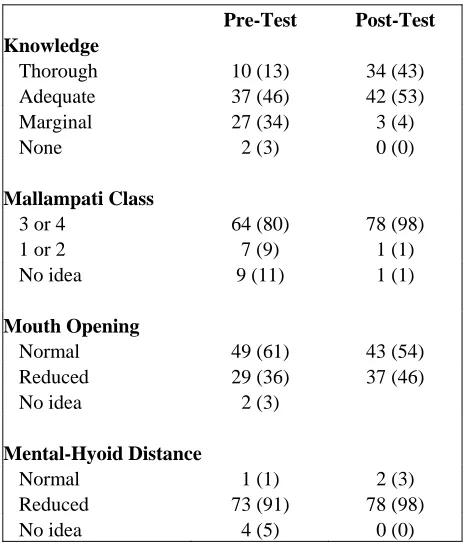
The study examination was not added until sev-eral months into the project. By May, 2003, 168 pre-tests and 103 post-pre-tests were submitted. Many indi-viduals failed to include their email address, or other unique identifier, on both exams, and their data were excluded. The remaining 80 unique subjects were included for data analysis (table). Other than obtain-ing their a priori self-assessment of airway evalua-tion skills, their occupaevalua-tion and level of training were not requested as part of the study.
pre-test), mouth opening (54% post-vs 61% pre-test), and mental-hyoid distance (98% post- vs 91% pre-test).
Using the time-stamps from the pre- and post-tests, the median amount of time spent on the website was 29.5 minutes (range 0-168). Three subjects sub-mitted the pre- and post-tests at the same time, with three others spending <10 minutes. Still others took the pre- and post-tests on different dates (excluded from the maximum calculation). Thus the median is a more realistic measure than average for these data.
Subjects graded the utility of the site by answer-ing the question, “Was this web site helpful?” with three choices of “Very,” “Somewhat” and “No.” All but one of the respondents found the site very helpful (76%) or somewhat helpful (23%).
Discussion
Any physician may be expected to care for an unconscious patient requiring airway management. The increasing use of conscious sedation for office-based procedures accentuates this issue. The ability to anticipate the potential for particular difficulty
with certain patients is essential for all physicians. If recognized in advance, sedative selection may be altered, specialty assistance requested earlier in an emergency, and selection of agents to facilitate intu-bation would certainly be changed (e.g., avoidance of the routine long-acting muscle relaxants).
Despite the fact that all physicians should be able to manage the airway of an unconscious patient, only anesthesiologists and emergency medicine physicians are routinely, formally trained in airway evaluation. At the University of Florida there is a two-week re-quired anesthesiology clerkship in the fourth year of medical school. During this course, the students re-ceive formal training in airway management consist-ing of didactic sessions, practice with manikins, and hands-on experience paired with an anesthesiology resident in the operating room. Unfortunately that experience varies widely with the teaching skills of the resident, the interest of the medical student, and the caseload during their brief tenure. The airway examination is often lost amidst the desire to perform procedures. Thus the investigators endeavored to produce a thorough, readily accessible teaching tool for the airway examination.
Use of the Internet for teaching has expanded rapidly in the last decade. In addition to numerous brief descriptions of various sites6, Internet-based teaching tools have been developed and investigated for use in radiology7,8, geriatrics9, dermatology10, genetic testing11 and pathology.12 All have been well-received as a supplement to traditional teaching. While not proven superior to traditional teaching methodologies from an educational standpoint, ample evidence exists that Web-based learning can be at least as effective.13
Table 1 - Results of pre- and post- tests.
Pre-Test Post-Test
Knowledge
Thorough 10 (13) 34 (43) Adequate 37 (46) 42 (53)
Marginal 27 (34) 3 (4)
None 2 (3) 0 (0)
Mallampati Class
3 or 4 64 (80) 78 (98)
1 or 2 7 (9) 1 (1)
No idea 9 (11) 1 (1)
Mouth Opening
Normal 49 (61) 43 (54)
Reduced 29 (36) 37 (46)
No idea 2 (3)
Mental-Hyoid Distance
Normal 1 (1) 2 (3)
Reduced 73 (91) 78 (98)
No idea 4 (5) 0 (0)
Note: n=80; numbers in parentheses are percentages.
Use of high tech tools for education has become commonplace in anesthesiology, where sophisticated human patient simulators are integrated into many curricula.14,15 While these models provide an excel-lent environment for practicing airway management techniques, the manikin's external anatomy does not change, thus the abnormal airway examination cannot be adequately simulated. For this we exploit the flexibility, availability and low end-user cost of the Internet.
incor-poration of hypertext, interactive images, animations, or scripting technology. Furthermore none incorpo-rated a review of basic anatomy. The developed site, while containing much of the same information, ex-ploits these capabilities. In particular the interactive features were highly regarded in many of the com-ments received, “the topics presented here have all been presented during this rotation (at another institu-tion), however, the interactive aspect of your tutorial made the material easier to visualize and under-stand,” “Excellent interactive website in both format and content. [It] helped to reinforce important con-cepts from prior reading and [the] quizzes were also beneficial. Great interactive tool overall; wish more courses had this type of additional interactive activity to supplement clinical education.”
Utility Study - The pre- and post-tests focus on the same case: a thin female patient with <2 finger-breadths mentum-hyoid distance, and limited mouth opening with a Mallampati Class IV airway. Unfor-tunately the photographs are not perfect. There is no scale (e.g. hand) next to the open mouth to demon-strate its limited size, and the shadows in the poste-rior pharynx give the impression the base of the uvula may be visible. Furthermore, in the presence of such a patient, most would adjust their viewing angle re-peatedly in an effort to obtain the optimal view. Thus it may be disputable whether, from this single photo, the airway is a Class III or IV; but it is clearly not a I or II. Similarly it is not entirely obvious whether the mouth opening is “normal” or “reduced.” There is no question, however, that the mentum-hyoid distance is short (as demonstrated by a hand under the chin).
The design of the site does not force users to participate in the study. Their responses are recorded only if they choose to submit them. In order to link the pre- and post-test scores, a unique identifier was required; the subject’s email address was selected. Unfortunately many are reluctant to provide this in-formation, probably in fear they will receive un-wanted email in response. In retrospect, another identifying option should have been offered, or a more sophisticated software system that linked the two tests anonymously.
We successfully developed a Website to teach the fundamentals of the airway examination. Unlike other sites on this topic, this airway evaluation tuto-rial functions as much more than an electronic hand-out; it exploits the interactive, animation, and graphi-cal potential of the Internet to present an engaging educational experience. Users of this site have found it entertaining and educational. A common theme in the literature regarding such sites, many of the users,
as well as the authors, recommend a similar approach to other medical topics, as an adjunct to traditional teaching techniques.
Acknowledgements
The authors wish to thank Christopher Hurt, MD for his graphical artistry, Karthik Paladugu for pro-gramming the site and Rick Lockwood for its main-tenance. F. Kayser Enneking, MD was instrumental in acquiring images for the site. In addition Dr. Euliano would like to thank Kelly Spaulding for secretarial support, Anita Yeager for editorial assis-tance, and J.S. Gravenstein, MD for his expert advice in preparation of this manuscript.
This study was made possible by a grant from the University of Florida College of Medicine Educa-tion Committee(COMEC).
References
1. Bajaj A: Resident Physicians Section Adopts Resolutions. JAMA 1998; 279: 267
2. Scott CS, Barrows HS, Brock DM, Hunt DD: Clinical behaviors and skills that faculty from 12 institutions judged were essential for medi-cal students to acquire. Acad Med 1991; 66: 106-11
3. AMA Policy # H-295.919 Advanced Cardiac Life Support Training. (Sub. Res. 309, A-95; Reaffirmed and Appended: CME Rep. 3, I-99)
4. Association of American Medical Colleges.
AAMC Curriculum Management & Informa-tion Tool http://www.aamc.org/currmit (Ac-cessed November 10, 2003)
5. Hoffman JR, Mower WR, Wolfson AB, Todd KH, Zucker MI: Validity of a set of clinical criteria to rule out injury to the cervical spine in patients with blunt trauma. N Engl J Med 2000; 343:94-99
6. Applications of the Internet. Acad Med 2001; 76(5): 542-553 (various authors)
8. Grunewald M, Heckemann RA, Gebhard H, Lell M, Bautz WA: COMPARE radiology: creating an interactive Web-based training program for radiology with multimedia author-ing software. Acad Radiol 2003; 10: 543-553
13. Chumley-Jones HS, Dobbie A, Alford CL: Web-based Learning: Sound Educational method or Hype? A Review of the Evaluation Literature. Academic Medicine 2002; 77:S86-S93
9. Swagerty D, Studenski S, Laird R, Rigler S: A Case-Oriented Web-Based Curriculum in Geriatrics for Third-Year Medical Students. J Am Geriatr Soc 2000; 48:1507-1512
14. Schwid HA, Rooke GA, Carline J, Steadman RH, Murray WB, Olympio M, Tarver S, Steckner K, Wetstone S: Evaluation of anes-thesia residents using mannequin-based simu-lation: a multi-institutional study. Anesthesiol-ogy 2002; 97:1434-1444
10. Pagnanelli G, Soyer HP, Argenziano G, Tala-mini R, Barbati R, Bianchi L, et al: Diagnosis of pigmented skin lesions by dermoscopy: web-based training improves diagnostic per-formance of non-experts. Br J Dermatology 2003; 148:698-702
15. Morgan PJ, Cleave-Hogg D: A worldwide survey of the use of simulation in anesthesia. Can J Anaesth. 2002; 49:659-62
Correspondence 11. Barnes K, Itzkowitz S, Brown K: Teaching
clinical management skills for genetic testing of hereditary nonpolyposis colorectal cancer using a Web-baed tutorial. Genet Med 2003; 5:43-48
Tammy Y. Euliano, MD, Department of Anesthesiology PO Box 100254
Gainesville, FL 32610-0254
12. Marchevsky AM, Relan A, Baillie S: Self-Instructional "Virtual Pathology" Laboratories Using Web-Based Technology Enhance Medi-cal School Teaching of Pathology. Hum Pathol 2003; 34:425-429