CHEMISTRY TEACHERS’ ROLE IN CHANGING PRACTICAL WORK FROM “HANDS ON” ACTIVITIES TO “MINDS ON” ACTIVITIES
Monica Ituma Nicholas Twoli
Kenyatta University Kenyatta University
[email protected] [email protected]
Practical work is important in the effective learning of Chemistry. In most Kenyan secondary schools practical work mainly involves ‘hands on’ activities where learners follow laid down procedures to arrive at a predetermined outcome. This may lead to working without much thought of the actions and thus low conceptualization resulting in poor performance in chemistry at the end of the course. This study aims at providing alternative approach on how to engage the learners’ mind more in practical activities. Data was collected through
observations of practical lessons, followed by analysis of instructional materials used by chemistry teachers and questionnaires for the chemistry teachers. The findings showed that the strategies used to teach practical work did not adequately focus on the learners’ ‘minds on’ the activity. The teachers, therefore, require design and resource support for the
implementation of learner-centred investigative practical work in secondary school chemistry.
Keywords: Instructional Materials, “Minds On” Practical Activities, Practical Investigations Introduction
In order for chemistry practical work to be effective in producing meaningful learning, the teachers should develop activities that engage the learners in scientific investigations in which their minds are focused on the activity and its outcome. Science educators argue that practical work should involve learner-cantered learning environment that engage students in knowledge construction, as opposed to teacher-centered environment which involves
information absorption (Gravoso et al 2008). Conventional methods of teaching practical work used in most Kenyan secondary schools mainly focuses on developing students’ knowledge in chemistry, rather than on developing understanding of scientific investigative procedures. The practice in practical work has been a cookbook trend where the instructions are carried out like a recipe that reduces meaningful learning. The learners therefore, do not use scientific ideas to guide their actions during the practical activity and to reflect upon the data they collect. Kim & Chin (2011) argue that this nature of recipe-based practical work is not sufficient to develop students ‘habits of mind’ because they involve simply doing but do not require thinking through doing. Effective practical activities should enable students to build a bridge between what they can see and handle (hands-on) and scientific ideas that account for their observations (brains-on).
Need to Support Investigative Practical Work
There has been continued poor performance in chemistry at the end of course
examination in Kenya indicating that the learning of chemistry may not be as effective as required. Studies indicate that use of investigative approaches of science learning through practical work is a means of improving learning in chemistry (SCORE, 2007). Investigative inquiry approaches to learning the content and process of science has been central in the recent years yet the challenges to investigative teaching are still evident and the shift from traditional expository methods has been slow (Krajcik et al 2003). Hubber & Moore (2001) argue that ‘hands on’ activities in science practical work do not guarantee scientific
investigation. This points to a need to support teachers in use of learner centered
the teacher or from textbooks where the learners are supposed to strictly carry out the
activities as per the instructions; sometimes without much interest or thought on what they are doing. Learners tend to follow the teacher’s guidance to the letter. It is therefore of paramount importance to change the teachers’ practice in order to achieve ‘minds on’ learning of
practical chemistry.
Changing practical activities to ‘minds on’ type requires proper management of all stages of the activity. Practical work is usually carried out in four main stages (Twoli, 2006;
Omosewo, 2006); planning, implementation/activity, discussions and conclusions. When these stages are well managed they can lead to conceptualization (Figure 1).
Figure 1: Development of Understanding of Scientific Principles Through Practical Work
Krajcik et al (2003) noted that research-based curriculum materials could address these challenges and provide improved tools for learning for teachers and students through
development of appropriate instructional designs. Instructional materials can serve as learning materials for both students and teachers. Materials can also serve as a primary influence on how teachers should teach science (Krajcik et al 2003). Yandila et al (2003) quoted teachers as facing difficulties in implementation of learner-centered approach due to, among other factors, lack of exemplary teaching materials and inappropriate textbooks.
Aim of the Study
The main aim of this study was to develop insights into the characteristics of instructional strategies that would support teachers to engage learners in use of learner centered
investigative practical work in the secondary school chemistry. Study Location and Population
The study was carried out in Kajiado County in Kenya. The 42 public schools managed by the government were taken as the study population. From a sample of 19 schools, 42 teachers responded to a questionnaire and lesson observations were carried out in six schools. 47 teachers carried out the first appraisal of the materials and 3 experienced teachers carried out the second appraisal of the materials. The first try out of materials was done by three teachers who taught a total of twelve lessons. The second classroom use that involved
evaluation of the strategies was carried out by five teachers in which a total of 30 lessons were observed.
Conceptualization of the Study
Considering that this study aimed at defining the characteristics of learner centred instructional strategies and how they can be developed and used, the study focused on instructional design strategy that involves designing, developing and evaluating instructional material prototypes. Such developmental research characterizes the situation with all its complexity instead of identifying a few variables to hold constant (Aksela, 2005; DBRC, 2003). The study considered the content of instructional materials for practical work and teaching strategies (including student engagement in designing practical work) as the
conditions that affect understanding of concepts and acquisition of skills (learning outcome). Instructional strategies were designed in the instructional materials and developed through various stages to produce refined model of instructional materials that contain strategies for investigative practical work.
Methodology
This study employed a Design-Based Research (DBR) design. Design-Based Research is one terminology used to describe a research methodology that is used to design/develop an intervention (such as programs, teaching-learning strategies and materials, products and systems) with the aim to solve a complex educational problem and to advance knowledge about the characteristics of these interventions and the processes to design and develop them (Plomp & Nieveen 2007). Some scholars also refer to this research design as developmental research design (Wang & Hannafin, 2005; Motswiri, 2004). DBR design was appropriate because it helped create and extend knowledge about developing, enacting, and sustaining innovative learning environments (DBRC, 2003). DBR has an advantage of offering solutions to real life problems because the research is carried out in real life setting where learning is done, it has multiple dependent variables, it characterizes the situation with all its complexity and it involves different participants in the design who bring in differing expertise instead of being subjects of study. It is a flexible design for revision in which tentative initial set is revised depending on success (Krajcik et al, 2007; DBRC, 2003). DBR emphasizes the participatory role of practitioners. Teachers and students can become re-designers by
collaborating with researchers (Aksela, 2005). Based on constructivism theory of teaching and learning, practical work instructional materials that support investigative learner-centred teaching strategies were developed.
A construct referring to step-by-step prescriptive procedure for creating instructional materials in a consistent and reliable fashion in order to facilitate learning is referred to as an instructional design model. The five basic phases of Instructional Design Model were used in the study (Gustafson and Branch 2002). The first stage involved assessment of the practices and needs of Chemistry practical work in schools. This was done through use of
questionnaires for teachers, lesson observations and analysis of content in the books commonly used by teachers in chemistry teaching. Stage two involved design and development of Chemistry practical work instructional materials prototype. Design specifications were developed based on the outcome of stage one analysis, constructivism theories and state-of-the-art knowledge about teaching of science. From the specifications, the first prototype of the materials was developed. These were appraised by teachers. After the appraisals, the materials were refined and developed into a second prototype. The third stage was the try-out of the second prototypes with chemistry teachers in the form one classes. The feedback from these try-outs were used to refine the materials further thus development of the third prototype. The fourth stage involved evaluation of the instructional strategies. This was carried out in the classrooms as chemistry teachers used the materials to support their
implementation of learner centred investigations. The evaluation was done using lesson observation, teacher logbook, teacher’s interview and student questionnaire. The feedback was used for the refinement of the materials leading to a model of instructional materials that support learner centred investigative work.
Findings Use of Practical Work in Chemistry
64.3% 21.4%
2.4% 11.9%
Demonstration
Class experiments/ group work
Project
Individual student activities
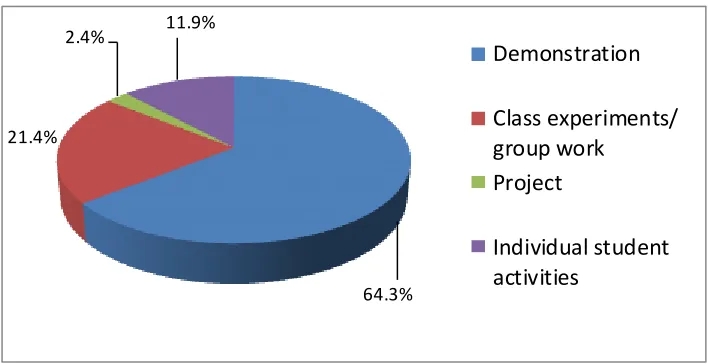
Figure 2: Methods Used to Manage Instruction in School Chemistry Practical Work
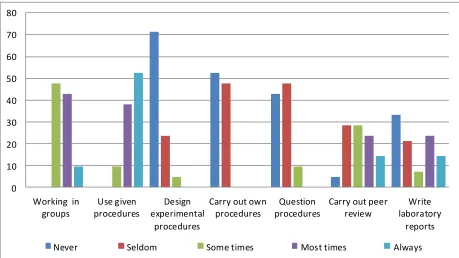
Practical work involved placing learners into groups and providing them with detailed procedures to follow. Responses to questionnaire items showed that most teachers (80.9%) believed that providing learners with detailed procedures to follow leads to their engagement in learning. It is however important to note that merely placing learners in groups does not lead to practice of inquiry (Wachanga & Mwangi; 2004). Educationists argue that following strictly set procedures to arrive at a predetermined outcome is limiting and does not lead to meaningful learning in science (Hubber & Moore, 2001; Trowbridge et al, 2004; Motswiri 2004; Chiapetta & Koballa, 2010). There are some common practices observed during chemistry practical lessons in secondary school chemistry. The frequencies with which these practices are carried out depend on how the teacher organizes the learning activities. For the practical lessons observed frequencies of these practices was as shown in Figure 3.
0 10 20 30 40 50 60 70 80
Working in groups
Use given procedures
Design experimental
procedures
Carry out own procedures
Question procedures
Carry out peer review
Write laboratory
reports
Never Seldom Some times Most times Always
Figure 3: Common Practices Carried Out in Secondary School Chemistry Practical Work
The study further showed that teachers did not have laboratory manuals that they could use for practical work. They used chemistry textbooks that are approved by Kenya Institute of Curriculum Development (KICD). Most of the practical activities in these materials appeared to be geared towards confirmation of facts and ideas and therefore provide detailed step-by-step experimental procedures. Most of the teachers (81.0%) indicated that the expected results of the practical activity were clearly outlined and most learners work towards getting the results indicated in the book. The books were found to emphasize mainly on manipulative skills and observation lacking emphasis of important skills of predicting/hypothesizing, creativity and imagination, as well as application of scientific facts. Such materials do not provide learners with an opportunity to develop their own procedures for practical activity or look for alternatives to procedures given and do not encourage thoughtful reflection on experience. This indicates the need for special instructional material support for practical work in chemistry teaching and learning. The lessons observed indicated that teachers used the textbook as guide for structuring their lessons. Learners were not accorded opportunities to engage in scientific arguments and support the outcome of their experiments. Similar weaknesses concerning instructional materials have been noted by other researchers (Motswiri, 2004; Krajcik et al, 2003).
Design and Development of Instructional Materials that Support Investigative practical Work
content, scientific practices, scientific literacy practices, participation structures and assessment opportunities:
The features of appropriate instructional materials were adapted. These are pedagogical appropriateness, appropriate science content and presentation and format (National Science Resources Center, 1997; National Academy of Sciences, 1998). A number of evaluation processes were carried out (Nieveen, 1997; Motswiri, 2004; Ottevanger, 2013). The first was expert appraisal in which experienced teachers appraised the materials and identified areas that required review and improvement. The appraisal was guided by a structured
questionnaire that mainly comprised open-ended questions and an informal interview. The results indicated that the materials reflected the KCSE syllabus and could be used in the classroom. Suggestions were made for adjustments of materials that were to be used for practical experiments. There was a general agreement that the materials would be instrumental in guiding the teacher through discussions during the lesson and in helping learners build information on their prior knowledge.
Science education lecturers from the university also appraised the materials with the purpose of enhancing consistency of the materials and research instruments. Their views were used to review and redesign the materials producing a second prototype. Three teachers tried out this prototype with their students in their classrooms. This focused on the practical usability of the materials in the chemistry classes. The results were used to review the materials producing the third prototype. This prototype was taken for a field test where
evaluation of practicality and effectiveness were carried out. Five teachers in their classrooms used the instructional materials for a series of six lessons. The results of the evaluation were used to refine the materials further producing the final version. These evaluation activities in the study were embedded in a cyclic approach of design and formative evaluation for the development and refinement of the instructional strategies for learner centered investigative practical work.
Evaluation of the Materials
The instructional materials consisted of the teacher guide and student materials that composed six practical lessons covering the topic of acids, bases and indicators. The
teacher‘s guide provided detailed procedures on how to guide the learners through each step of the investigative process including predicting/ hypothesizing and formulation of procedures to use for the activity. The evaluation involved use of the materials with five teachers in their chemistry classes. This involved a total of 144 learners. A total of 30 lessons were carried out. The evaluation of the materials was carried out to determine the instructional support the materials provided in achieving learner centered investigative practical work. The key criteria for this evaluation were guided by determination of practicality and effectiveness of the materials in actual classrooms (Krajcik et al, 2003; Nieveen, 1999; Otteavenger, 2013). Practicality was evaluated as measure of the materials' quality, which was indicated by support, clarity, congruence, complexity, and cost as perceived by the teacher using it in the context of his or her practice.
Lesson observation schedule was used to guide the recording of observations made during the practical activity. The teacher was provided with a logbook to record the happenings in each lesson carried out. This contained structured guide with open-ended questions to guide the teacher. The teachers were interviewed at the end of the lesson series and the learners responded to the student’s questionnaire. The Lesson observation guide was outlined as teacher expected actions in an investigative lesson set-up were the researcher recorded whether the expected action was observed or not. Teacher interview and logbook provided information regarding their perception on how the materials supported them in implementing learner centered investigative practical activities. They also provided the
provided data on practicality and effectiveness as observed by the researcher while
questionnaire for students provided feedback from the learners. The average percentage of expected teacher actions observed during investigative practical work in each of the six chemistry practical lessons was calculated (Table 1).
Table 1: Observed Teacher Actions During Investigative Practical Work Lesson number
Lesson Phase 1 2 3 4 5 6 Average
% Introduction 60.16 79.98 91.42 79.98 88.56 91.42 81.92
Development 71.22 86.30 86.32 85.04 78.80 78.80 81.08
Conclusion 63.36 74.28 93.32 84.26 89.98 76.66 79.75
From Table 1, it can be observed that an average of 81.92% of expected teacher actions were observed in the introduction phase of the lessons, 81.08% expected teacher actions were observed in the lesson development phase and 79.75% actions were observed in the
conclusion stage. These high percentages were taken to be an indication that the materials were used as intended by the developer and were able to facilitate teaching of practical work.
From the logbook and the interviews, the teachers indicated that the objectives for all the lessons were achieved. This implies that the materials were effective in their classes and were able to offer support for the implementation of investigative practical work. Concerning congruence, the teachers indicated that the practice was very different from what they
commonly used in class but also indicated that the investigations would be easier to carry out when supported by such materials. All the teachers indicated that they experienced a problem with learners adjusting to the practice of developing their own procedures while they were used to being provided with step-by-step procedures for all their practical activities. The teachers indicated that the method had high demand on resources but also agreed that the materials were available and all it required was change in teaching approach as well as innovativeness.
The responses from students also showed that most students (83.3%) perceived the structure of the practical activities as motivating and helpful to them in carrying out the investigations. The responses that agreed to the statement ‘doing practical work by setting our own procedures makes practical work easier and more satisfying’ were quite high (88.2%). A high percentage (90.7%) of the learners indicated that they enjoyed the activities. Students perceived the exemplary materials helpful to their learning and understanding (88.2%). They perceived that they were able to learn the concepts easily because the developing their own procedures made them think about what they were doing. These were indications that if chemistry teachers could be supported by appropriate instructional materials they can make practical work a ‘minds on’ investigative activity.
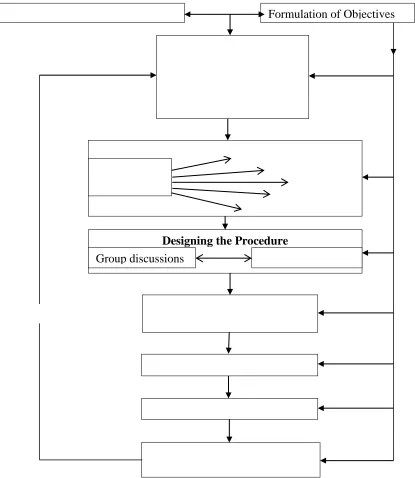
resembles the common outline of a practical lesson involving planning, introduction of the lesson, lesson development and conclusion. The model guides through sequencing of instructional activities, which starts with identification of content to be taught to a particular group of learners based on their learning level. The general process of learner centered investigative practical lessons used in the study can be summarized as shown in Figure 4. It serves as conceptual framework for organizing and sequencing a set of instructional activities to build meaningful student learning.
Figure 4: Model for Organizing and Sequencing Instructional Activities in Practical Work
Planning involves designing the activity, identification of required materials and safety precautions. The teacher guide provides detailed ideas on how to introduce the activity, which could be through a simple exercise, prediction, observation, examples or discussion. The discussion is tailored to assess relevant prior knowledge, identify preconceptions or
Formulation of Objectives
misconceptions in science learning related to the particular activity. The teacher is guided to use open-ended driving question that would arouse learners’ interest in the activity (Krajick et al., 2007). The lesson development section is broken further into sections of planning for the activity, plenary discussion of the procedures set and the carrying out of the actual activity. Learners are grouped in small groups of 2-4 learners and allowed to brainstorm on ways of carrying out an activity to achieve the objective set. They are provided with the apparatus or list of apparatus they will be using and allowed to plan for the investigation. Learners then develop their own experimental procedures. After the discussion of the procedures in groups, the learners are called to attention for plenary discussion with the teacher. The outcome of their discussions is presented and the teacher guides through the refinement of the procedures. The learners are allowed to carry out the practical activities using the procedures they have developed. They record their findings in their notebooks as they progress with the activity. Consolidation and discussion of results is done after the learners have carried out the activity. This involves pooling together their findings by receiving feedback from groups of learners. The teacher should then guide learners to make meaning in their discussion, and make conclusions related to the focus question or prediction, evidence and connection to the real world.
Conclusion
Teachers have a facilitative role in the learning using practical work in chemistry. They can change the commonly used procedures of teaching practical work into investigative activities involving: planning and designing practical activities, implementing their plans, carrying out analysis and interpretation of the results and applying the knowledge they acquired as a result of taking part in investigative practical work. It was deemed important to provide the teachers with instructional materials with sufficient details that support these activities. Instructional materials used in this study were a useful guide to the teachers in organizing learning resources, preparing students for the concept of the study, guiding students during their practical work activities and assisting learners in constructing meanings of the results of the activity. Most of the teachers were able to guide learners through
development of the procedures using the teacher guide provided. This provided the lesson with the much-desired characteristic of being ‘minds on’ as well as ‘hands on’ activities. During the initial lessons, teachers felt that the approach was very demanding but with time they found the activities fulfilling.
References
Aksela, M. (2005). Supporting meaningful chemistry learning and higher-order thinking through computer-assisted inquiry: A Design Research Approach. Thesis, University of Helsinki; Finland. Retrieved from http://ethesis.helsinki.fi,/julkaisut/mat/kemia
Chiapetta, E.L. & Koballa, R.T. (2010). Science institution in the middle and secondary schools. Developing fundamental knowledge and skills. USA : Allyn and Bacon, Peason.
Davis, E. A., Arias, A. M., Bismack, A. S., Marulis, L. M., & Iwashyna, S. K. (2014). Designing Educative Curriculum Materials: A Theoretically and Empirically Driven Process. Harvard Educational Review, 84 (1), Spring.
DBRC. (2003). Design-Based Research Collective, Design-Based Research: An Emerging Paradigm for Educational Inquiry. Educational Researcher. 32. (1) 5–8.
Hubber, R.A. & Moore, C.J. (2001). A model for extending hands –on science to be inquiry based. School Science and Mathematics. 101 (1); 32-41.
Krajcik, J.S., McNeill, K. L., & Reiser, B.J. (2007). Learning-goals-driven design model: Developing curriculum materials that align with national standards and incorporate project-based pedagogy. Science Education, 92(1), 1-32. Retrieved from www.interscience.wiley.com
Kim, M., & Chin, C., (2011). Pre-service teachers’ views on practical work with inquiry orientation in textbook-oriented science classrooms . International Journal of Environmental & Science Education, 6 (1), 23-37. Motswiri, M. J. (2004). Supporting chemistry teachers in implementing formative assessment of investigative
http://doc.utwente.nl/4824/1thesis-motswiri.pdf
National Academy of Sciences, (1997). Science for all children: a guide to improving elementary science education in your school district. Washington, DC: The National Academies Press. Retrieved from: http://www.nap.edu/openbook.php?record_id=4964&page=1
National Science Resources Center. (1997).“Criteria for Selecting Inquiry-Centered Science Curriculum Materials” (chapter 5). In Science for All Children: A Guide to Improving Elementary Science Education in Your School District (63-75). National Science Education Standards (NSES), Washington, DC: National Academy Press.
Nieveen, N. (1999). Prototyping to reach product quality. In J. van den Akker, R.M. Branch, K. Gustafson, N. Nieveen, & Plomp, T. (eds), Design approaches and tools in education and training (pp. 125-135). Dordrecht: Kluwer Academic Publishers.
Orado, G. (2009): Factors influencing performance in chemistry practical work among secondary schools in Nairobi Province. Unpublished M.Ed. Thesis, Kenyatta University, Kenya.
Ottevanger, W. (2013). Using design research to develop teacher support materials in order to facilitate the successful implementation of a new science curriculum in post-apartheid Namibia. In T. Plomp, & N. Nieveen (Eds.), Educational design research – Part B: Illustrative cases (pp. 381-405). Enschede, the Netherlands
Reiser, B. J., Krajcik, J., Moje E., & Marx, R. (2003). Design strategies for developing science instructional materials. Paper presented at the 2003 Annual Meeting of the National Association of Research in Science Teaching, Philadelphia, PA available at:
http://www.umich.edu/~hiceweb/iqwst/Papers/reiser_krajcik_NARST03.pdf
SCORE. (2007). Practical work in science: a report and proposal for a strategic framework. London: The Science Community Representing Education, (SCORE). Retrieved from
http://www.score-education.org/media/3668/report.currentissues.
Trowbridge, L.W., Bybee, R.W. & Janel, C.P. (2004). Teaching secondary school science, “Strategies for developing scientific literacy” New Jersey: Pearson, Ohio.
Twoli, N.W. (2006). Teaching secondary school chemistry. Nairobi: Neema Publishers, Kenya.
Wachanga, S.W., & Mwangi, J. G. (2004). Effects of Cooperative Class Experiment Teaching Method on Secondary School Students’ Chemistry Achievement in Kenya’s Nakuru District. International Educational Journal, 5(1), 26-36.
Yandila, C.D., Komane, S.S., & Moganane, S.V. (2003). Towards learner-centred approach in senior secondary school science lessons. Department of Mathematics and Science Education; University of Botswana. Krajcik, J.S., Reiser, B. Moje, J E., & Marx, R. (2003). Design Strategies for Developing Science Instructional
Materials. Paper presented at the 2003 Annual Meeting of the National Association of Research in Science Teaching. Philadelphia, PA. retrieved from: