Role of Sports Education in Preventing Competitive Sports Dropout:
A Structural Equation Modeling Approach
Manish Shukla
Ph.D. Scholar, LNIPE, Gwalior (INDIA) Email- [email protected]
Contact no.: 9685343896
Abstract: This paper aimed to analyze
predictive ability of sport education for competitive sports dropout. Variables in the model: perceived adequacy of sports education, financial factor, injury management, career opportunities in sports, intention to practice sports and dropout. The study was performed over a period of 10 months. 200 Indian athletes were included in study, aged 16-23 years (μ =20.41, σ=1.65), 120 male and 80 female. Self-constructed questionnaire was administered to measure variables considered as predictors of sports dropout, and after 10 months persistence or dropout was assessed. Structural equation modeling supported causal model with direct relationship between perceived adequacy of sports education and intention to practice sport (r=0.50, p<0.05). Analysis of invariance found the model consistent for age and gender. However, MANOVA revealed that intention to practice, although assessed at the start of study, was significantly different for those athletes who persisted at 10 months than those who dropped out. Age-related differences were also identified: as the age increased, need for a job increased and intention to practice sport decreased, while there were no differences in other variables. The results support the hypotheses that efficient sports education program may help decrease dropout by empowering athletes about nutrition, injury management, and career prospects.
Keywords: sports education, dropout, causal model, structural equation modeling.
Physical Education and sport are two separate yet overlapping terms often misunderstood as one. Physical Education may be defined as "an education of and through human movements where many of the educational objectives are achieved by means of big muscular activities involving sports, games, gymnastics, dance, and exercise (Barrow, 1983)." Sport also involves organized form of play but it incorporates competitive activities. Sports may be thought of as unique part of broad physical education discipline where activities are organized based upon certain rules and aimed at achieving peak performance (Siedentop, 1994).
In order to develop an efficient sports culture, Sports education must be a part of physical
education curriculum. Taggart (1988)
commented about sport being one of the historic cornerstones of physical education. Students also perceive sport and games as an important part of the physical education program. In a study of the middle and high school students' attitudes toward physical education by Tannehill and Zakrajsek (1993) it was found that gameplay was the most important component of physical education. However, state of sport education has been poor (Stroot, 1994; Tinning & Fitzclarence, 1992; Locke, 1992) resulting in an annual dropout rate from sport of over 30% (Rotella, Hanson, & Coop, 1991), and has resulted in renewed interest in the "sport education" curriculum model.
participation. Supported by many quantitative and qualitative studies it is obvious that people with higher socio-economic status are more likely than those with lower socio-economic status to participate in physical activity, and more specifically in sport (Kara & Demirci, 2010; Scott & Munson, 1994). Cost of equipment, nutrition, and medical treatment in sports injuries determines the interest towards practicing sports (Egger, 1990; Korkmaz et al, 2014).
Injuries are common among athletes and are sometimes so severe that they affect an athlete's career in sport. Even elite athletes terminate their sporting career due to injury as reported in a study by Kettunen et al. (2001). According to Vuolle (2008), almost 50% of Finnish ice hockey players reported that one of the reasons for ending their career in sport was an injury. Athletes also fear re-injury as a cause for not returning to the sport, especially for those who have sustained a severe injury (Chimielewski et al., 2008).
There is a great misconception that the only way to earn in sports is through playing. Many athletes do not find career opportunities after injury or retirement and thus turn their attention towards exploring other fields for livelihood. This lowers motivation of athlete towards sports training for peak performance and opting out before achieving highest objectives (Leffler, 2012). Some athletes disengage from one's competitive sport due to the financial crisis or employment to earn money (Boothby, Tungatt, & Townsend, 1981).
Intention to practice sport
According to Theory of planned behavior (Fishbein & Ajzen, 1975) intention to practice a
particular sport determines his/her
dropout/persistence behavior in future. The present study explores the role of sports
education in determining intention to practice sport and ultimately, dropout behavior.
Sport Dropout
According to Bussmann (1999), Dropout is defined as withdrawal of athlete from sports activity prematurely i.e. before achieving top performance. Dropout phenomenon in sports has attracted researchers who illustrated significant dropout rates in adolescence (Gould, 1987); aged between 13 and 18 years (Sallis, 2000; Schulz & Curnow, 1988). Researchers are having diverse views regarding participation and dropping out from sports (Kondric et al., 2013). In line with several predictive models developed to explain sport dropout from different aspects (Pelletier et al., 2001), this study aims to develop a causal model to (1) explain sport dropout from developmental and preventive approach taking into account perceived adequacy of sport education, finance factor, injury management, career opportunities in sports and intention to practice sport, and (2) to study whether the model varies with age or gender; and (3) to analyze group differences in the dependent variables.
Methods and Procedures
In this research study, the term "dropouts" refers to those high potential, high performing sportspersons who have reached at least the National level championships in their respective sport and have terminated their sports career prematurely, i.e., before they have reached their full potential.
Participants
The sample consisted of 200 Indian athletes, 120 boys and 80 girls, aged
16-yrs
handball, volleyball, cricket, basketball, football, water polo and field hockey). After 10 months, 64 athletes had dropped out (32%) and 136 athletes persisted (68%).
Design and procedure
A prospective study was conducted over a 10-month period. With their prior consent, the self-constructed questionnaire was administered to the participants at the start of the training season. Ten months later, at the start of the following season, the researcher contacted the athletes and asked them if they had continued to participate in their competitive sport.
Measures
To estimate the overall goodness of the fit, multiple indices are required (Bollen, 1989). The indices used in the study were: ratio chi-square
statistic-fit index (CFI); Tucker-Lewis coefficient (TLI), incremental fit index (IFI), normed fit index (NFI), and root mean square error of approximation (RMSEA). The variables included in the study were perceived adequacy of sports education, financial factor, injury management, career opportunities in sports; intention to practice sport in the future; and finally, sports dropout. All with the exception of injury management and dropout were measured through
5-point Likert scales, anchored with 1
corresponding to ‘‘strongly disagree’’ and 5 to ‘‘strongly agree’’. Later on, using the proportion of maximum scaling (POMS), the scores were converted to 0-1 scale (Little, 2013; Moeller, 2015).
All the variables except dropout were assessed through self-constructed 3-item scales: perceived adequacy of sport education (Cronbach's alpha= 0.921); Financial factor (Cronbach's alpha = 0.936); Injury management (Cronbach's alpha=
0.924); Career opportunities in sports
(Cronbach's alpha= 0.906); Intention to practice (competitive) sport (adopted from Guzman, 2012) (Cronbach's alpha= 0.942). Finally, sport dropout was determined through the athletes’ response to the question of whether or not they continued with their competitive sport practice (assessed 10 months later). The financial factor and persistence/dropout were measured in a way that higher score on items indicated a positive association with other variables.
Data analysis
A Multivariate Analysis of Variance
(MANOVA) was conducted to examine whether the dropout, gender, and age, or interactions between them, were significant on the dependent variables considered in the study (see Guzman, 2012). Also, structural equation modeling (SEM) using AMOS 21.0 was used to test the hypothesized model, applying the two-step approach advocated by Anderson & Gerbing (1988).
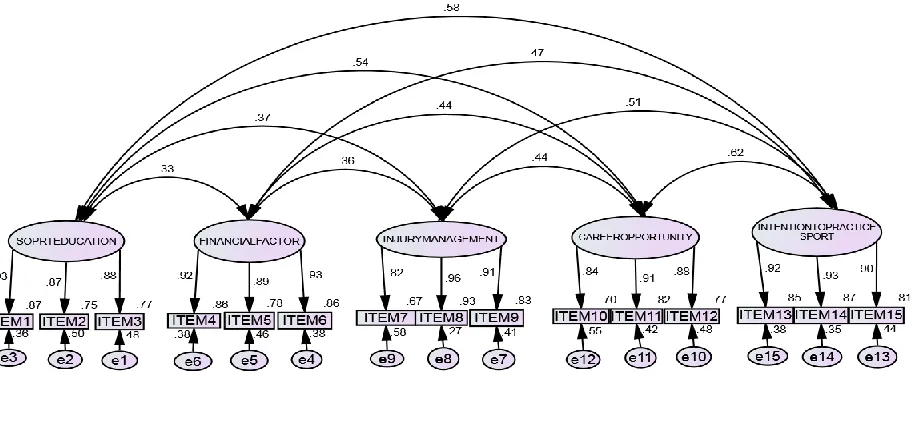
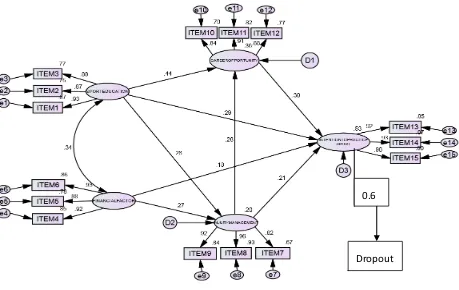
The first step (measurement model) consisted of a confirmatory factor analysis (CFA), done to analyze the factor structure underlying each construct and to ascertain the discriminating validity of the factors in a measurement model. Maximum likelihood estimation procedure was used because the sample size was sufficiently large and the variables were considered as quantitative (Figure 1). The second step involved testing the structural model of sports dropout (Figure 2) to explore connections between the latent factors and dropout behavior in sport (see Guzman, 2012).
was categorical in nature, maximum likelihood estimation procedure was utilized.
Results
MANOVA
A 2(dropout or persistence)*2(gender)*3(age) MANOVA was done. Two age categories were considered, 16-19 (n=66), and 20-23 (n=134).
Dependent variables in MANOVA were
Perceived adequacy of sports education, financial factor, injury management, career opportunity in sports and intention to practice sport. Multivariate contrasts revealed significant effects for dropout (F=34.735; p<0.05; η2= 0.479; power= 1.00) but no significant effects were found for age and gender. Also, interactions between the factors were insignificant. Between-subject effects test results suggested that persistent athletes perceived sports education as adequate for professional success and had lesser financial constraints, good injury management skills, higher job opportunities and higher intention to practice a competitive sport. Moreover, with age there was a significant decline in intention to practice sport (mean value for agecat1= 2.33; for agecat2= 2.09) (Table 1,2,3).
Analysis of the proposed model
Measurement model
The CFA model was based on 5 latent constructs and 15 observed measurements (scale items).
Latent factors were correlated freely during CFA (Anderson & Gerbin, 1988) and yielded excellent model fit indices: 2/df =0.992; CFI= 1.00;
TLI=0.998; IFI= 0.997; NFI=0.971;
RMSEA=0.002; PCLOSE= 0.994. All the latent constructs were positively correlated among themselves (see Figure 1).
Structural model
Having done CFA, hypothesized structural relationships were examined among the latent dimensions and the actual dropout behavior (see figure 2). Fit indexes for model were acceptable:
2/df = 1.118; CFI= 0.996; TLI= 0.995; IFI=
0.996; NFI= 0.967; RMSEA= 0.024; PCLOSE= 0.966. Nevertheless, modification indices of the model illustrated the potential value of incorporating a direct effect of Financial factor on career opportunities but since it was not hypothesized as per the review, it was left unrelated. Specifically, within the model, perceived adequacy positively predicted injury management, career opportunity in sports and intention to practice sport (p< 0.05). Financial factor positively predicted injury management and intention to practice sport (p<0.05). Injury
management positively predicted career
opportunity and intention to practice sport. Career opportunity in sports positively predicted intention to practice sport (p<0.05) and finally intention to practice sport positively predicted persistence/ negatively predicted dropout (r= 0.60, p< 0.05) (Estimates shown in figure 2).
Table 1: Means, standard deviations, F, significant differences and effect size in terms of persistence. Variables in the study Persistent
Mean S.D.
Dropout Mean S.D.
F-statistics Partial η2 Power(1-β)
Perception of sport education 2.52 0.69 2.50 0.73 1255.13* 0.93 1.00
Financial factor 1.99 0.79 2.06 0.75 658.48* 0.87 1.00
Injury management 2.08 1.26 1.90 1.40 240.95* 0.72 1.00
Intention to practice sport 2.21 0.82 2.10 0.87 674.12* 0.88 1.00
*p< 0.05.
Table 2: Means, standard deviations, F, significant differences and effect size in terms of gender. Variables in the study Female
Mean S.D.
Male Mean S.D.
F-statistics Partial η2 Power(1-β)
Perception of sport education 2.50 0.93 2.54 0.65 0.18 0.00 0.07
Financial factor 2.03 0.71 2.00 0.76 0.04 0.00 0.06
Injury management 1.92 1.34 2.18 1.25 1.81 0.00 0.27
Career opportunity 2.14 0.70 2.15 0.62 0.00 0.00 0.05
Intention to practice sport 2.18 0.84 2.17 0.83 0.01 0.00 0.05
Table 3: Means, standard deviations, F, significant differences and effect size in terms of age categories. Variables in the study Age (16-19)
Mean S.D.
Age (20-23) Mean S.D.
F-statistics Partial η2 Power(1-β)
Perception of sport education 2.54 0.64 2.50 0.73 0.07 0.00 0.06
Financial factor 1.99 0.74 2.03 0.80 0.07 0.00 0.06
Injury management 2.18 1.25 1.94 1.33 0.95 0.00 0.16
Career opportunity 2.25 0.68 2.09 0.66 2.63 0.01 0.37
Intention to practice sport 2.33 0.78 2.09 0.85 3.38** 0.01 0.45
**p< 0.05.
Figure 2: coefficients of the structural model (standardized regression coefficients).
Analysis of invariance
Two multi-group analyses of invariance were performed, one examining age and the other gender. These investigated whether model worked equally for age groups and gender categories, testing the null hypothesis that there were no differences between them. An
insignificant chi-square value (using stats tool package.xls) between the unconstrained model and the constrained models suggested no differences across both age categories and gender. This indicates that the relationships were universal for this particular sample (see Table 4).
Table 4: Model invariance for age and gender.
Overall Model Age Gender
Chi-square df p value Invariant Chi-square df p value Invariant
Unconstrained 168.898 160 0.300 152.384 160 0.654
Fully constrained 183.54 175 0.314 168.455 175 0.625
Number of groups 2 2
Difference 14.642 15 0.477 Yes 16.071 16 0.448 Yes
Analysis of invariance Two multi-group analyses of invariance were
performed, one examining age and the other gender. These investigated whether model
worked equally for age groups and gender categories, testing the null hypothesis that there were no differences between them. An insignificant chi-square value (using stats tool package.xls) between the unconstrained model and the constrained models suggested no differences across both age categories and gender. This indicates that the relationships were universal for this particular sample (see Table 4).
Discussion
The primary aim of this research was to develop a model, based on the role of sports education to predict sports dropout. This model represents a development to the previous models for sports dropout by inclusion of certain other variables. The latent constructs included in the hypothesized model were significantly related among themselves and fit indices showed sufficiency of variables in the prediction of sports persistence/ dropout. Based on the results, it is concluded that athletes should undergo sports education curriculum to increase persistence in sports. Also, future studies could explore if other variables such as well-being, perceived conflict between study and sports, loss of interest from sports, or familial pressure on
athlete might strongly influence the
relationship.
The result of the analysis of invariance showed that relationships proposed within the model are universal to all cultures, across gender, and
throughout all developmental periods
(Guzman, 2012) because the regression path
coefficients were similar though the
measurement weights and intercepts, together with structural weights and residuals, varied across age and gender.
The secondary purpose of the study was to examine age and gender differences in composite variables of the model, namely:
perceived adequacy of sports education, financial factor, injury management, career opportunity in sports and intention to practice
sport. MANOVA results showed no
differences related to age and gender. In a very specific sample and sport, it may be easier to find differences due to gender characteristics (Guzman, 2012). On the other hand results showed a decrease in intention to practice sport associated with age, giving support to previous studies (Athanasios, 2007; Van Wersch, Trew, & Turner, 1992), and contributing to understanding the massive dropout rates in adolescence reported by several studies (Gould, 1987).
Conclusion
As Allan Guttmann (1978) and John H. Jenny (1961) note, sports education has largely been overlooked in academic curricula which makes it very difficult to develop "sports culture" and intrinsically motivate the athletes, often resulting in "Dropout" from sports prematurely. This study stresses the need for better and wider provision of structured physical activity and sports education in schools and colleges to better equip the athletes with basic knowledge and skills to prolong their career since some students experience physical activity in school only and decide to take sport professionally. Sports education also helps to recognize students' perceptions of their skill performance and improvement during such a unit (Green et al., 2005; Kirk, 2005). Due to insufficient sport education many athletes lack necessary knowledge about nutrition, injury management and job skills.
in their studies, people in high- income level participated in natural sports more frequently than those in low-income level.
It was also found that sports injuries play a significant role in terminating career in sport. Injury prevention and adequate treatment and rehabilitation of injuries are thus essential to avoid the long-term consequences of severe sports injuries (Ristolainen et al., 2012).
It may also be that gender, age and other factors such as embarking on further education may influence the decision to terminate a career in sport. It may be hard to combine a strict training regime with academic studies, and if an athlete’s performance has been impaired as a result of injury, choosing to be educated for an alternative occupation in later life is understandable (Ristolainen et al., 2012; Guzman, 2012).
References
[1]. Anderson, J.C., & Gerbin, D.W. (1988). Structural equation modeling in practice: a review and recommended two-step approach. Psychological Bulletin, 103, 411-423.
[2]. Athanasios, K. (2007). Grade and
gender differences in students’
self-determination for participating in physical education. Georgian Electronic Scientific Jurnal: Education Science and Psychology, 2(11), 23-30.
[3]. Barrow, Harold M. (1983). Man and movement: Principles of Physical Education. 3rd ed. Philadelphia: Lea and Febiger, 23-24.
[4]. Bollen, K.A. (1989). A new
incremental fit index for general structural equation models. Sociological Methods & Research, 173, 303-316.
[5]. Boothby, J., Tungatt, M., & Townsend, A. (1981). Ceasing participation in sports
activity: Reported reasons and their
implications. Journal of Leisure Research, 13(1), 1-14.
[6]. Bussmann. G. (1999). How to prevent "dropout" in competitive sport. New studies in athletics, ©bylAAF, 14:1;23-29.
[7]. Chmielewski, T. L., Jones, D., Day, T., Tillman, S. M., Lentz, T. A., & George, S. Z. (2008). The association of pain and fear of
movement/reinjury with function during
anterior cruciate ligament reconstruction rehabilitation. Journal of Orthopaedic Sports of Physical Therapy, 38, 746-753.
[8]. Enoksen, E., & Shalfawi, S. (2009). Dropout Rate and Dropout Reasons in talented Track and Field athletes: A 25 Year Study. 14th Annual Congress of European College of Sport Science, Oslo/Norway, June 24-27, 2009.
[9]. Fishbein, M., & Ajzen, I. (1975). Belief, attitude, intention, and behavior. An introduction to theory and research. Reading: Addison Wesley.
[10]. Gould, D. (1987). Understanding
attrition in children’s sport. In D. Gould, & M.R. Weiss (Eds.), Advances in Pediatric Sciences (pp. 6185). Champain, IL: Human Kinetics.
[11]. Green, K., Smith, A. & Roberts, K. (2005) ‘Social Class, Young People, Sport and Physical Education’, in K. Green and K. Hardman (eds.) Physical Education: Essential Issues, pp. 180–96. London: SAGE.
[12]. Guttmann, A. (1978). From ritual to record: the nature of modern sports. New York: Columbia Univ. Press, 9.
[13]. Guzma´n, Jose F. & Kingston, K. (2012). A Prospective study of sports dropout: A motivational analysis as a function of age and gender. European journal of sport science. September 2012; 12(5): 431442.
[14]. Jenny, John H. (1961). Physical
[15]. Johnson, C., Bowker, J. & Cordell, H. (2001) Outdoor Recreation Constraints: An Examination of Race, Gender, and Rural Dwelling. Southern Rural Sociology, 17, 111-133.
[16]. Kara, F. & Demirci, A. (2010). An Assessment of outdoor recreational behaviors and preferences of the residents in Istanbul. Scientific Research and Essay, 5(1), 93-104. [17]. Kettunen, J. A., Kujala, U. M., Kaprio, J., Koskenvuo, M., & Sarna, S. (2001). Lower-limb function among former elite male athletes. American Journal of Sports Medicine, 29, 2-8.
[18]. Kini, A., & Gupta, N. (2009). Dropouts in Indian sports: A research report by Gosport Foundation, September 2009.
[19]. Kirk, D. (2005) ‘Physical Education, Youth Sport and Lifelong Participation: The Importance of Early Learning Experiences’, European Physical Education Review 11(3): 239–55.
[20]. Kondric, M., Sindik, J., Furjan-Mandic, G., & Schiefler, B. (2013). Participation motivation and student's physical activity among sports students in three countries. J Sports Sci Med. 2013 Mar; 12(1): 10–18. [21]. Korkmaz, M., Kılıç, B., Çatıkkaş, F. & Yücel, Ali S. (2014). Financial dimension of
sports injuries. European Journal of
Experimental Biology, 4(4):38-46.
[22]. Leffler, Brandy S. (2012). Perceptions of sports retirement by current student-athletes. The University of Tennessee, Chattanooga, Tennessee. Dissertation, August. [23]. Little T. D. (2013). Longitudinal Structural Equation Modeling (Methodology in the Social Sciences). New York, NY: The Guilford Press.
[24]. Locke, L. (1992). Changing secondary school physical education. Quest, 44,361-372.
[25]. Moeller, J. (2015). A word on
standardization in longitudinal studies: don't. Front Psychol. 2015; 6: 1389.
[26]. Pelletier, L.G., Fortier, M.S.,
Vallerand, R.J., & Brie`re, N.M. (2001). Associations among perceived autonomy support, forms of self-regulation, and persistence: A prospective study. Motivation and Emotion, 25, 279-306.
[27]. Povertydata.worldbank.org. "Poverty & Equity Data". Retrieved 11 February 2016. [28]. Ristolainen, L., Kettunen, Jyrki A., Kujala, Urho M., & Heinonen, A. (2012). Sports injuries as the main cause of sports career termination among Finnish top-level athletes. European Journal of Sport Science; 12(3): 274-282.
[29]. Rotella, R.J., Hanson, T., & Coop, R.H. (1991). Burnout in youth sports. Elementary School Journal, 91,421-428. [30]. Sallis, J.F. (2000). Age-related decline in physical activity: A synthesis of human and animal studies. Medicine and Science in Sport and Exercise, 32, 1598-1600.
[31]. Schulz, R. & Curnow, C. (1988). Peak Performance and Age among Superathletes: Track and Field, Swimming, Baseball, Tennis,
and Golf. Journal of Gerontology:
Psychological Sciences, 1988, Vol. 43, No. 5, P113-120.
[32]. Scott, D., & Munson, W. (1994) Perceived Constraints to Park Usage among Individuals With Low Incomes. Journal of Park and Recreation Administration, 12(4), 79-96. 6.
[33]. Siedentop, D. (1994). Introduction to physical education, fitness, and sport. 2nd ed. Mountain View, CA: Mayfield, 216-218. [34]. Stroot, S. (1994). Contemporary crisis or emerging reform? A review of secondary school physical education. Journal of Teaching in Physical Education, 13,333-341.
[36]. Taggart, A. (1988). The endangered species revisited. ACHPER Journal, 121,34-35.
[37]. Tannehill, D., & Zakrajsek, D. (1993). Student attitudes towards physical education: A multicultural study. Journal of Teaching in Physical Education, 13, 78-84.
[38]. Tinning, R., & Fitzclarence, L. (1992). Post-modem youth culture and the crisis in
Australian secondary school physical
education. Quest, 44,287-303.
[39]. Van Wersch, A., Trew, K., & Turner, I. (1992). Post-primary school education: Age and gender differences. British Journal of Educational Psychology, 62, 56-72.