Available online: https://edupediapublications.org/journals/index.php/IJR/ P a g e | 1881
A Computational Complexity Reduced Reconfigurable
Architecture of DCT
M.RA VI M.TECH , A SSISTA NT PROFFESSOR , DEPA RTM ENT OF ECE
ACHANTA.PRIYANKA ,K.S.ANUSHA ,B.Y.S.S.LAKSHMI SAI ,A.S.K.PRIYANKA
B.Tech Students , Department of Electronics & Communication Engineering, Ramachandra College of Engineering, Eluru, Andhra Pradesh, India.
ABSTRACT:
Available online: https://edupediapublications.org/journals/index.php/IJR/ P a g e | 1882
Keywords: Algorithm-architecture code sign, DCT approximation, discrete cosine transform (DCT), high efficiency video coding (HEVC).
I. INTRODUCTION
Lately, significant work continues to be completed to derive approximate of 8-point
DCT for lowering the computational
complexity. The necessity of approximation is much more essential for greater-size DCT because the computational complexity from the DCT develops nonlinearly. However, modern video coding standards for example high quality video coding (HEVC) uses DCT of bigger block dimensions to have
greater compression ratio. The
multiplications which consume the majority of the power and computation-time, and also to obtain significant estimation of DCT too. The discrete cosine transform (DCT) is commonly utilized in image and video compression [1]. Because the DCT is
computationally intensive, several
calculations happen to be suggested within the literature to compute it efficiently. Haw eel has suggested the signed DCT (SDCT) for 8 8 blocks in which the basis vector elements are changed by their sign. They've provided a great estimation from the DCT
by changing the foundation vector elements by, 1/2, 1. Different color leaves, Bayer and Contra have suggested two transforms produced from and 1 as aspects of transform kernel, and also have proven their techniques perform much better than the
technique, designed for low-
and-compression ratio situations. But, the extension from the design strategy utilized in H264 AVC for bigger transform dimensions, for example 16-point and 32-point isn't feasible. Besides, several images
processing programs for example
monitoring and synchronized compression and file encryption require greater DCT dimensions. Within this context, Cintra features a brand new type of integer
transforms relevant to many
block-measures. Lately, two new transforms happen to be suggested for 8-point DCT approximation. The very first technique is for length, 16 and 32 and is dependent on the right extension of integer DCT [2]. Also, an organized way of creating a binary form of high-size DCT (BDCT) using the
sequence-purchased Walsh-Hadamard
Available online: https://edupediapublications.org/journals/index.php/IJR/ P a g e | 1883
transform is really a permutated form of the
WHT which approximates the DCT
perfectly and keeps all the benefits of the WHT. A plan of approximation of DCT must have the next features: i) it ought to have low computational complexity. ii) It ought to have low error energy to be able to provide compression performance near to the exact DCT, and ideally ought to be orthogonal. iii) It ought to work with greater measures of DCT to aid modern video coding standards, along with other programs
like monitoring, surveillance, and
synchronized compression and file
encryption. However the existing DCT calculations don't provide the very best of all of the above three needs. A few of the existing techniques are deficient when it comes to scalability, generalization for greater dimensions, and orthogonally. We intend to maintain orthogonally within the approximate DCT for 2 reasons. First of all, when the transform is orthogonal, we are able to always find its inverse, and also the kernel matrix from the inverse transform is acquired just by transposing the kernel matrix from the forward transform. This selection of inverse transform could be employed to compute the forward and
inverse DCT by similar computing
structures. Furthermore, just in case of
orthogonal transforms, similar fast
calculations are relevant to both forward and inverse transforms [3]. Within this paper, we advise a formula to derive approximate type of DCTs which satisfy all of the three
features. We have the suggested
approximate type of DCT by recursive decomposition of sparse DCT matrix. It's observed that suggested algorithm involves less arithmetic complexity compared to existing DCT approximation calculations. The suggested approximate type of DCT of various measures is orthogonal, and lead to lower error-energy in comparison towards
the existing calculations for DCT
approximation. The decomposition process enables generalization from the suggested transform for greater-size DCTs. Curiously, suggested formula is definitely scalable for
hardware in addition to software
implementation of DCT of greater measures, and it could make utilization of the greatest of the existing approximations of 8-point DCT. In line with the suggested formula, we've suggested a completely scalable, reconfigurable, and parallel architecture for
approximate DCT computation. One
Available online: https://edupediapublications.org/journals/index.php/IJR/ P a g e | 1884
computation of 32-point DCT might be configured for parallel computation of two 16-point DCTs or four 8-point DCTs.
Fig.1. Proposed DCT structure
II. PROPOSED MODEL
For approximation of we are able to pick the 8-point DCT, since that is definitely the best trade-off between the amount of needed arithmetic operators and excellence of the reconstructed image. Therefore, when we replace by, we shall have two primary advantages. First of all, we shall have good compression performance because of the efficiency of and next the implementation is going to be much easier, scalable and
recon-figural. For approximation of we've
investigated two other low-complexity
options, as well as in the next we discuss here three possible options of approximation of: We haven't done thorough search of
possible solutions. To locate these
approximated sub matrices we go ahead and take tiniest size DCTmatrix to terminate the approximation procedure to eight, since 4-point DCT and a pair of-4-pointDCT could be implemented by adders only. Consequently, a great approximation of, where's an important power two, for, results in a proper approximations. So there might be other
possible low-complexity implementation.
We discuss the suggested scalable
architecture for that computation of
approximate DCT of and 32.We has derived the theoretical estimate of their hardware
complexity and discusses the
reconfiguration plan. Observe that structures of 16-point DCT might be extended to get the DCT of greater dimensions. To evaluate the computational complexity of suggested -point approximate DCT, we have to
determine the computational price of
matrices The amount of arithmetic
Available online: https://edupediapublications.org/journals/index.php/IJR/ P a g e | 1885
combinational components, and needs only rewiring during hardware implementation. However it has indirect contribution towards the hardware complexity since shift-add procedures result in rise in bit-width which results in greater hardware complexity of arithmetic models which stick to the shift-add operation. Also, we observe that all
considered approximation techniques
involve considerably less computational
complexity over those of the precise DCT calculations. Pipelined and non-pipelined types of different techniques are developed,
synthesized and validated utilizing an
integrated logic analyzer. Observe that both pipelined and non-pipelined designs involve exactly the same quantity of LUTs since pipeline registers don't require additional LUTs. For 8-point DCT, we've used the approximation suggested, which forms the fundamental computing block from the suggested method [5]. Also, we underline that designs have a similar critical path and accordingly have a similar MOFs. Most significantly, the suggested designs are multiple-use for various transform measures.
Therefore, confirmed DCT architecture
ought to be potentially reused for that DCT of various measures rather than using separate structures for various measures. We
advise here such reconfigurable DCT structures that could be reused for that computation of DCT of various measures. The reconfigurable architecture for that implementation of approximated 16-point DCT It includes three computing models, namely two 8-point approximated DCT models along with a 16-point input adder unit that creates. It performs the calculation of the 32-point DCT or two 16-point DCTs in parallel or four 8-point DCTs in parallel. The architecture consists of 32-point input adder unit, two 16-point input adder models,
and 4 8-point DCT models. The
configurability is accomplished by three control blocks made up of 64 2:1 MUXes together with 30 3:1 MUXes. The very first control block decides if the DCT dimensions are of 32 or lower. To judge the performance from the suggested formula for video coding we've integrated the suggested approximated DCT into HEVC reference software HM12.1.
Available online: https://edupediapublications.org/journals/index.php/IJR/ P a g e | 1886
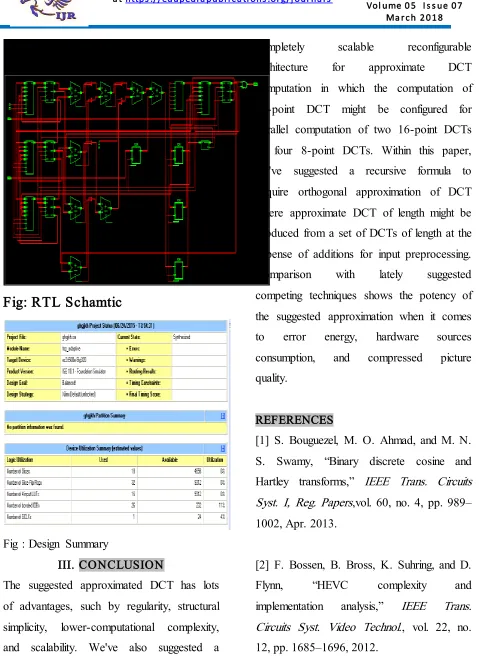
Fig: RTL Schamtic
Fig : Design Summary
III. CONCLUSION
The suggested approximated DCT has lots of advantages, such by regularity, structural simplicity, lower-computational complexity, and scalability. We've also suggested a
completely scalable reconfigurable
architecture for approximate DCT
computation in which the computation of 32-point DCT might be configured for parallel computation of two 16-point DCTs or four 8-point DCTs. Within this paper, we've suggested a recursive formula to acquire orthogonal approximation of DCT where approximate DCT of length might be produced from a set of DCTs of length at the expense of additions for input preprocessing.
Comparison with lately suggested
competing techniques shows the potency of the suggested approximation when it comes
to error energy, hardware sources
consumption, and compressed picture
quality.
REFERENCES
[1] S. Bouguezel, M. O. Ahmad, and M. N. S. Swamy, “Binary discrete cosine and
Hartley transforms,” IEEE Trans. Circuits
Syst. I, Reg. Papers,vol. 60, no. 4, pp. 989– 1002, Apr. 2013.
[2] F. Bossen, B. Bross, K. Suhring, and D.
Flynn, “HEVC complexity and
implementation analysis,” IEEE Trans.
Available online: https://edupediapublications.org/journals/index.php/IJR/ P a g e | 1887
[3] Z. Wang, A. C. Bovik, H. R. Sheikh, and E. P. Simoncelli, “Image quality assessment: From error visibility to structural similarity,” IEEE Trans. Image Process., vol. 13, no. 4, pp. 600–612, 2004.
[4] U. S. Potluri, A.Madanayake, R. J. Cintra, F.M. Bayer, S. Kulasekera, andA. Edirisuriya, “Improved 8-point approximate DCT for image and video compression
requiring only 14 additions,” IEEE Trans.
Circuits Syst. I, Reg. Papers, vol. 61, no. 6, pp. 1727–1740, Jun. 2014.
[5] S. Bouguezel, M. Ahmad, and M. N. S. Swamy, “Low-complexity 88 transform for
image compression,” Electron. Lett., vol. 44,