Available Online at www.ijcsmc.com
International Journal of Computer Science and Mobile Computing
A Monthly Journal of Computer Science and Information Technology
ISSN 2320–088X
IJCSMC, Vol. 3, Issue. 12, December 2014, pg.302 – 309
RESEARCH ARTICLE
PSR: Methodology and Comparative Study along
with Different Routing Protocol in Manet
Shriganesh S Mane
College of Engineering Sawitri Bai Phule Pune University, Pune
{Computer Engineering Department}
I.
INTRODUCTION
Mobile ad-hoc network (MANET) is a wireless communication network that contains various mobile devices. These mobile devices form a network with each other without any existing infrastructure or any other kind of fixed stations. It is a self-configuring and self organized network of mobile devices. These devices can move in any direction. The links between these devices will be change frequently, due to their movement. In a dynamic environment of the wireless network, nodes are independent and their mobility causes frequent change of network connectivity. Nodes in such network can act as end points of data transmission as well as routers when the two end points are not in direct range of each other. In a decentralized network, a node is responsible to find the topology information and deliverance of data to the destination. The implementation of appropriate routing protocol is based on the nature of application. MANET continuously maintains the information required to properly route the traffic. MANET is a type of wireless adhoc network that usually has a routable networking
In this paper, we propose a lightweight proactive source routing (PSR) protocol to facilitate opportunistic data forwarding in MANETs. In PSR, each node maintains a breadth-first search spanning tree of the network rooted at itself. This information is periodically exchanged among neighboring nodes for updated network topology information. Thus, PSR allows a node to have full-path information to all other nodes in the network, although the communication cost is only linear to the number of the nodes. This allows it to support both source routing and conventional IP forwarding. When doing this, we try to reduce the routing overhead of PSR as much as we can. Our simulation results indicate that PSR has only a fraction of overhead of OLSR, DSDV, and DSR but still offers a similar or better data transportation capability compared with these protocols.
Index Terms—Mobile ad hoc network, proactive, source routing ,Differential update, mobile ad hoc networks (MANETs), opportunistic data forwarding, proactive routing, routing overhead control, source routing, tree-based routing.
II.
RELATED WORK
provide a solution for one of the existing challenges. Routing protocols in MANETs can be categorized using an array of criteria. The most fundamental among these is the timing of routing information exchange. On one hand, a protocol may require that nodes in the network should maintain valid routes to all destinations at all times. In this case, the protocol is considered proactive, which is also known as table driven. Examples of proactive routing protocols include destination sequenced distance vector (DSDV) [8] and OLSR [9]. On the other hand, if nodes in the network do not always maintain routing information, when a node receives data from the upper layer for a given destination, it must first find out about how to reach the destination. This approach is called reactive, which is also known as on demand. DSR [10] and ad-hoc on-demand DV (AODV) [11] fall in this category. These well-known routing schemes can be also categorized by their fundamental algorithms. The most important algorithms in routing protocols are DV and LS algorithms. In an LS, every node floods the information of the links between itself and its neighbours in the entire network, such that every other node can reconstruct the complete topology of the network locally. In a DV, a node only provides its neighbours with the cost to reach each destination. With the estimates coming from neighbours, each node is able to determine which neighbour offers the best route to a given destination. Both LS and DV support the vanilla IP packets. DSR, however, takes a different approach to on demand source routing. In DSR, a node employs a path search procedure when there is a need to send data to a particular destination. Once a path is identified by the returning search control packets, this entire path is embedded in each data packet to that destination. Thus, intermediate nodes do not even need a forwarding table to transfer these packets. Because of its reactive nature, it is more appropriate for occasional or lightweight data transportation in MANETs. AODV, DSDV, and other DV-based routing algorithms were not designed for source routing; hence, they are not suitable for opportunistic data forwarding. The reason is that every node in these protocols only knows the next hop to reach a given destination node but not the complete path. OLSR and other LS-based routing protocols could support source routing, but their overhead is still fairly high for the load-sensitive MANETs. DSR and its derivations have a long bootstrap delay and are therefore not efficacious for frequent data exchange, particularly when there are a large number of data sources. In fact, many lightweight routing protocols had been proposed for the Internet to address its scalability issue, i.e., all naturally ―table driven.‖ The path-finding algorithm (PFA) is based on DVs and improves them by incorporating the predecessor of a destination in a routing update. Hence, the entire path to each node can be reconstructed by connecting the predecessors and destinations; therefore, the source node will have a tree topology rooted at itself. In the meantime, the link vector (LV) algorithm [35] reduces the overhead of LS algorithms to a great deal by only including links to be used in data forwarding in routing updates. The extreme case of LV, where only one link is included per destination, coincides with the PFA. PFA and LV were both originally proposed for the Internet, but their ideas were later used to devise routing protocols in the MANET. The Wireless Routing Protocol (WRP) [37] was an early attempt to port the routing capabilities of LS routing protocols to MANETs. It is built on the same framework of the PFA for each node to use a tree to achieve loop-free routing. Although it is an innovative exploration in the research on MANETs, it has a rather high communication overhead due to the amount of information stored at and exchanged by the nodes. This is exacerbated by the same route update strategy as in the PFA, where routing updates are triggered by topology changes. Although this routing update strategy is reasonable for the PFA in the Internet, where the topology is relatively stable, this turns out to be fairly resource demanding in MANETs. (Our original intention was to include the WRP in the experimental comparison later in this paper, and we have implemented WRP in ns2. Unfortunately, our preliminary tests indicate that the changing topology in the MANET incurs an overwhelming amount of overhead, i.e., at least an order of magnitude higher than the other mainstream protocols. Thus, we do not include the simulation result of WRP as a baseline in our comparison.)
III.
METHODOLOGY
about the same communication overhead as DV-based protocols. Differential update mechanism is also useful to reduce more routing overhead.
No
Yes
No
Yes
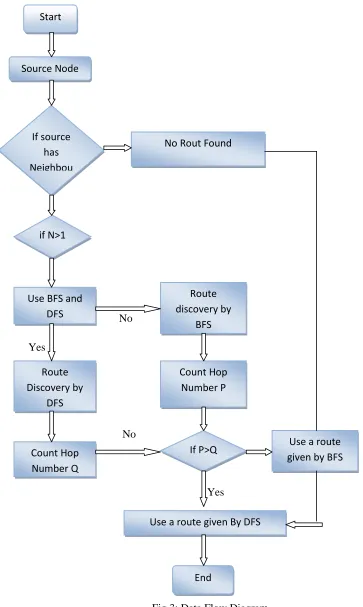
Fig 3: Data Flow Diagram
Start
Source Node
If source
has
Neighbou
rs
if N>1
Use BFS and
DFS
Route
discovery by
BFS
Route
Discovery by
DFS
Count Hop
Number P
Count Hop
Number Q
If P>Q
Use a route
given by BFS
Use a route given By DFS
1) Table Update:
Due to its proactive nature, the update operation of our work is iterative and distributed among all nodes in the network. At the beginning, node is only aware of the existence of itself. By exchanging the table information with the neighbours, it is able to maintain the network topology. In each subsequent iteration, nodes exchange their table data with their neighbours. From the perspective of source node, toward the end of each operation interval, it has received a set of routing messages from its neighbours. Note that, in fact, more nodes may be situated within the transmission range of source node, but their periodic updates were not received by it due to, for example, bad channel conditions. After all, the definition of a neighbour in MANETs is a fickle one. (We have more details on how we handle lost neighbours subsequently.) Source Node incorporates the most recent information from each neighbour to update its own table. It then broadcasts this information to its neighbours at the end of the period. In fact, in our implementation, the given update of the table happens multiple times within a single update interval so that a node can incorporate new route information to its knowledge base more quickly. This does not increase the communication overhead at all because one routing message is always sent per update interval.
2) Lost Neighbour Information Removal
If a neighbour is disconnected from the network then each node removes all the data about the lost node. Such process is triggered by the following cases: No routing update or data packet has been received from this neighbour for a given time. A data transmission to such node has failed. This process can be initiated more number of times.
3) Differential Update Mechanism
In addition to dubbing route updates as hello messages in this mechanism, we interleave the ―full dump‖ routing messages, with ―differential updates‖. The basic idea is to send the full update messages less frequently than shorter messages containing the difference between the current and previous knowledge of a node’s routing module. Our goal is to broadcast the information stored at a node to its neighbours in a short packet.
4) Route Discovery using BFS and DFS
The route discovery procedure is performed by Breadth First Search (BFS) and Depth First Search (DFS) in the wireless network. These search techniques work separately in the nodes of MANET. BFS and DFS algorithms are performed by two separate neighbour nodes of the source node. The optimized result is selected by such scheme and transfers the packet on the network. We can easily understand this process with Fig 3 that shows the data flow diagram
IV.
PERFORMANCE METRICES
MANET has number of qualitative and quantitative metrics that can be used to compare ad hoc routing protocols. This paper has been considered the following metrics to evaluate the performance of ad hoc network routing protocols.
1. End-to-end Delay:
This metric represents average end-to-end delay and indicates how long it took for a packet to travel from the source to the application layer of the destination. It includes all possible delay caused by buffering during route discovery latency, transmission delays at the MAC, queuing at interface queue, and propagation and transfer time. It is measured in seconds.
2. Packet Delivery Ratio:
Packet delivery ratio is calculated by dividing the number of packets received by the destination through the number of packets originated by the application layer of the source (i.e. CBR source). It specifies the packet loss rate, which limits the maximum throughput of the network.
3. Throughput:
It is the measure of the number of packets successfully transmitted to their final destination per unit time. It is the ratio between the number of received packets vs sent packets.
4. Packet Jitter:
5. Normalized Routing load:
It is defined as number of routing packets ―transmitted, per data packet ―delivered, at destination. Each hop-wise transmission of a routing is counted as one transmission. It is the sum of all control packet sent by all node in network to discover and maintain route.
V.
Simulation And Comparison Of Routing Protocols
A. Comparative Study of Ad Hoc Routing Protocols
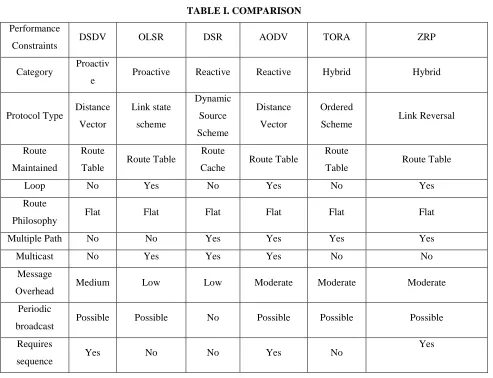
TABLE I. COMPARISON
Performance
Constraints DSDV OLSR DSR AODV TORA ZRP
Category Proactiv
e Proactive Reactive Reactive Hybrid Hybrid
Protocol Type Distance Vector
Link state
scheme
Dynamic
Source
Scheme
Distance
Vector
Ordered
Scheme Link Reversal
Route
Maintained
Route
Table Route Table
Route
Cache Route Table
Route
Table Route Table
Loop No Yes No Yes No Yes
Route
Philosophy Flat Flat Flat Flat Flat Flat
Multiple Path No No Yes Yes Yes Yes
Multicast No Yes Yes Yes No No
Message
Overhead Medium Low Low Moderate Moderate Moderate
Periodic
broadcast Possible Possible No Possible Possible Possible
Requires
sequence Yes No No Yes No
Yes
VI.
PERFORMANCE ANALYSIS OF DIFFERENT ROUTING PROTOCOL
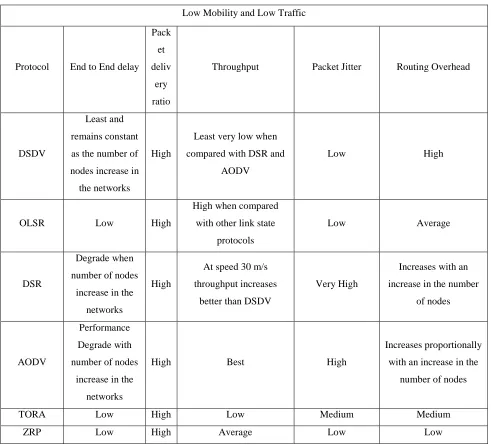
TABLE II. ROUTING PERFORMANCE IN LOW MOBILITY
Low Mobility and Low Traffic
Protocol End to End delay Pack
et
deliv
ery
ratio
Throughput Packet Jitter Routing Overhead
DSDV
Least and
remains constant
as the number of
nodes increase in
the networks
High
Least very low when
compared with DSR and
AODV
Low High
OLSR Low High
High when compared
with other link state
protocols
Low Average
DSR
Degrade when
number of nodes
increase in the
networks
High
At speed 30 m/s
throughput increases
better than DSDV
Very High
Increases with an
increase in the number
of nodes
AODV
Performance
Degrade with
number of nodes
increase in the
networks
High Best High
Increases proportionally
with an increase in the
number of nodes
TORA Low High Low Medium Medium
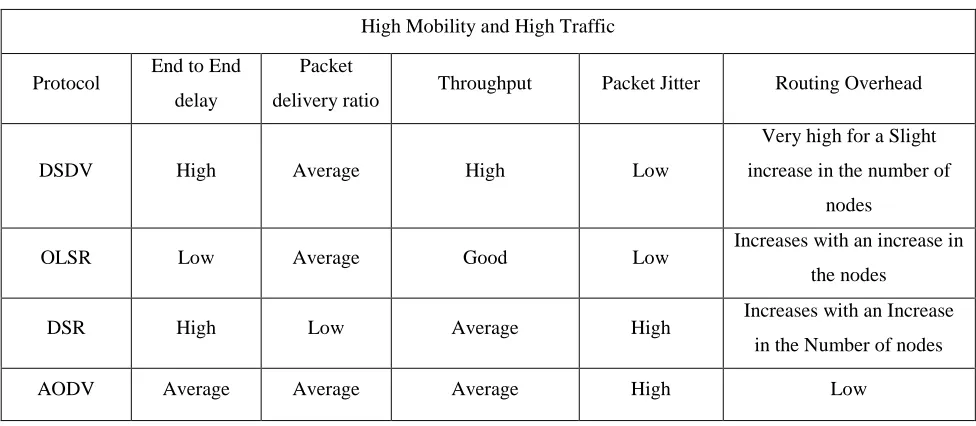
TABLE III. ROUTING PERFORMANCE IN HIGH MOBILITY
High Mobility and High Traffic
Protocol End to End delay
Packet
delivery ratio Throughput Packet Jitter Routing Overhead
DSDV High Average High Low
Very high for a Slight
increase in the number of
nodes
OLSR Low Average Good Low Increases with an increase in
the nodes
DSR High Low Average High Increases with an Increase
in the Number of nodes
AODV Average Average Average High Low
VII.
CONLCUSION
This paper presents the comparative study and performance analysis of various ad hoc routing protocols (DSDV, OLSR, DSR, AODV, TORA and ZRP) on the basis of end-to-end delay, packet delivery ratio, throughput, routing overhead, jitter performance metrics. By observing the table II and III, it is found that AODV has maximum throughput under low traffic and DSDV has maximum throughput under high traffic. As network becomes dense OLSR, DSR and DSDV perform well in terms of Throughput than AODV and TORA. TORA performs well in dense networks in terms of packet delivery fraction but at the same time Normalized Routing load of TORA is maximum among all the protocols in both the networks. Most evaluations and comparisons of protocols for ad-hoc networks skip ZRP. The reason is usually that ZRP is aimed for larger networks than the test comprises, or that ZRP is not an independent protocol but rather a routing framework. Further, any evaluation of the ZRP version with support for unidirectional links could not be found. It is especially well adapted to large networks and diverse mobility patterns. DSDV has least Normalized Routing load in both low and high traffic. OLSR and DSDV give the least Jitter and Average Delay in both networks Low delay and low jitter are mainly required in voice applications and real time applications, so OLSR and DSDV can be used there. The applications like voice and video conferencing need more BW, so in this case DSDV can be used. The applications like video telephony, web games, etc. require high throughput, so in this case AODV can be used under low mobility and low traffic and DSDV can be used under high mobility and high traffic. There is high mobility of users and network nodes at the time of emergency and military operations. We have observed that as the mobility increases there is an improvement in the throughput of OLSR, DSR and DSDV. So these three protocols can be used in emergency and military applications.
REFERENCES
[1] Zehua Wang, Yuanzhu Chen and Cheng Li, ― PSR: A Lightweight Proactive Source Routing Protocol For Mobile Ad Hoc Networks‖,IEEE Transactions on Vehicular Technology, Vol. 63, no. 2, February 2014.
[2] Seema Vilas Bhujade, Prof. S. D. Sawant, ―Evaluation AODV, DSR and DSDV Protocol of MANET by USING NS-2‖, IJET, Volume 4 Issue 8- August 2013.
[4] Basu Dev Shivahare, Charu Wahi, Shalini Shivhare, ― Comparison Of Proactive And Reactive Routing Protocols In Mobile Adhoc Network Using Routing Protocol Property‖, International Journal of Emerging Technology and Advanced Engineering , Volume 2, Issue 3, March 2012.
[5] Zehua Wang, Yuanzhu Chen, Cheng Li, ―CORMAN: A Novel Cooperative Opportunistic Routing Scheme in Mobile Ad Hoc Networks‖, IEEE JOURNAL ON SELECTED AREAS IN COMMUNICATIONS, VOL. 30, NO. 2, FEBRUARY 2012.
[6] D. Johnson, Y. Hu, D. Maltz, ―The Dynamic Source Routing Protocol (DSR) for Mobile Ad Hoc Networks for IPv4‖, Microsoft Research,February 2007.
[7] Zehua Wang, Cheng Li, and Yuanzhu Chen, ―PSR: Proactive Source Routing in Mobile Ad Hoc Networks‖, IEEE GLOBECOM 2011.
[8] Prakash B. Khelage, Dr. Uttam Kolekar, ―Survey and Simulation base Performance Analysis of TCP-Variants in terms of Throughput, Delay and drop Packets over MANETs‖, International Journal of Scientific & Engineering Research, Volume 5, Issue 1, January 2014.
[9] T. Clausen, P. Jacquet, ―Optimized Link State Routing Protocol (OLSR) ‖, INRIA, October 2003. [10] Charles E. Perkins, Elizabeth M. Royer, ―Ad-hoc On-Demand Distance Vector Routing‖.