
Available Online atwww.ijcsmc.com
International Journal of Computer Science and Mobile Computing
A Monthly Journal of Computer Science and Information Technology
ISSN 2320–088X
IJCSMC, Vol. 3, Issue. 11, November 2014, pg.691 – 698
RESEARCH ARTICLE
A Taxonomy of Data Management
Issues in Mobile Cloud Computing
Amandeep Singh Bhatia
1, Vineet Mehan
2, Kaushik Adhikary
3Assistant Professor, Maharja Agrasen University, CSE Department, India
Associate Professor, Maharja Agrasen University, CSE Department, India
Assistant Professor, Maharja Agrasen University, CSE Department, India
1 [email protected]; 2 [email protected]; 3 [email protected]
Abstract— Cloud computing can greatly boost the computing ability of mobile devices. Mobile users can rely on the cloud to perform computationally rigorous operations such as data mining searching and multimedia processing. Even with increasing usage of mobile computing, it is difficult to exploit its ability due to its inherent tribulations such as frequent disconnections, resource insufficiency and mobility. It can deal with these problems by executing mobile applications on resource providers exterior to the mobile device. In this paper, we analyzed the specific concerns in mobile cloud computing and present taxonomy based on the major issues in this area. We conclude the paper with a vital analysis of challenges that have not yet been fully met, and emphasize guidelines for future work.
Keywords— Mobile Cloud Computing, Cloud computing, mobile computing, data management issues, Research directions
I. INTRODUCTION
NIST (National Institute of Standards and Technology, USA) definition from September, 2011 released in its “Special Publication 800-145” of Cloud Computing is:
“Cloud Computing is a model for enabling convenient, on-demand network access to a shared pool of configurable resources (e.g. networks, servers, storage, applications and services) that can rapidly be provisioned and released with minimal management effort or service provider interaction.”
According to the top ten strategic technology trends for 2012 [1] provided by Gartner (a famous global analytical and consulting company), cloud computing has been on the top of the list, which means cloud computing will have an increased impact on the enterprise and most organizations in 2012.
II. MOBILECLOUDCOMPUTING
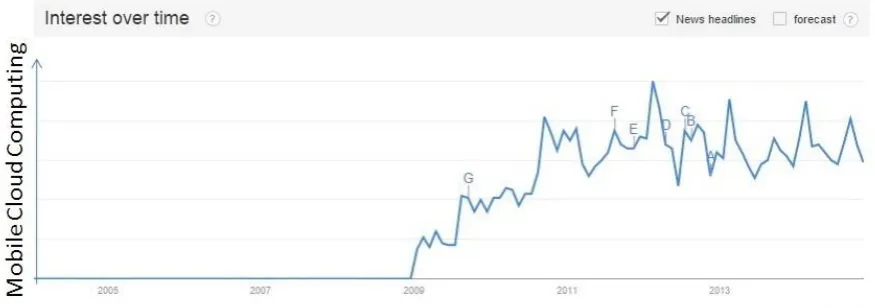
Meanwhile, smartphones are considered as the representative for the various mobile devices as they have been connected to the Internet with the rapidly growing of wireless network technology. The word “mobility‟ has become very popular in the world of computing. There has also been a rise in development and sales of mobile devices like smartphones, tablets etc. supporting different kinds of mobile computing and networking technologies. The status and availability of mobile devices such as smartphones, which are offering everywhere communication and information services, are creating such a dependency that one does not leave home without them.
Fig 1: Mobile cloud Computing Trends (www.google.co.in/trends)
III. DEFINATIONS
IV. VISIONANDVIEWOFMCC
MCC is the state-of-the-art mobile computing technology that aims to enlarge a multitude of mobile devices, especially smartphones and alleviate their resource poverty. Mobile users can have access to their applications, data, and cloud services through the Internet by leveraging mobile web [5]. This futuristic accomplishment will be employed in several areas like healthcare (e.g. telemonitoring and telesurgery), education, IT Business, rural and urban development, and social networking.
The arrival of MCC has been superior into a technological revolution given those profitable opportunities for several domains such as healthcare, e-learning, telecommunication, and the tourism industry. The idea is to reduce development cost and stimulate execution of resource-intensive mobile applications by leveraging distant rich resources to increase the quality of user experience. Fig2 shows an abstract view of MCC and depicts its applications in several domains such as healthcare, social networking, urban development, and vehicular technology.
Fig 2: View of Mobile Cloud Computing [5]
V. CHALLENGES IN MOBILE CLOUD COMPUTING
Several research works contribute to the development of MCC by tackling issues. However, there are some challenges which need to be addressed. This section presents several open challenges in the mobile cloud computing.
disconnection, and the signal attenuation caused by mobile users‟ mobility. They cause delays when users want to communicate with the cloud, so QoS is reduced significantly. B. Limitation of Mobile as Handheld devices: While talking about mobile devices using
cloud computing, the first thing that has to be looked upon is the resource constraints. Although mobile devices have enhanced in all aspects- storage, size of the screen, capability of CPU, wireless communication, operating systems, there are serious limitations in computing ability and energy resource to set up multifaceted applications. As compared to PCs and laptops, the modern mobile devices like the iPhone 6 or the Android or Window mobile phones, decrease the processing capability by 3 times, memory by 5-6 times and bandwidth by around 10 times. Although these intelligent phones are improving constantly, the vast disparities still pose a limitation to mobile cloud computing.
C. Lose of battery & network flow: If an application desires a lot of battery and network flow, it will become difficult to set up that application on the mobile device. To overcome this problem [7], there will need to be a reduction in the data exchange rate and the amount of data exchanged between the mobile device and the cloud end, by optimizing the cloud end.
D. Migration Optimization: As the mobility feature in mobile devices, provide a flawless migration environment for data transmission or service guarantee has becoming another hot issue in mobile cloud computing research. An optimal migration mechanism can reduce interaction delay, enhance processing capability, and improve user‟s experience efficiently [6].
E. Quality of communication: In contrast with wired network uses physical connection to ensure bandwidth reliability, the data transfer rate in mobile cloud computing environment is constantly changing and the connection is discontinuous due to the existing clearance in network overlay [8]. Furthermore, data centre in large enterprise and resource in Internet service provider normally is far away to end users, especially to mobile device users. Some other issues such as dynamic varying of application throughput, mobility of users, and even weather will lead to changes in bandwidth and network overlay. Therefore, the handover delay in mobile network is higher than in wired network.
VI. DATA MANAGEMENT ISSUES TAXONOMY
that mobile databases contain policies to safeguard against data loss while ensuring it conforms to mobility constraints.
By “analytical data management”, we refer to applications that query a data store for use in business planning, problem solving, and decision support. Historical data along with data from multiple operational databases are all typically involved in the analysis. Consequently, the scale of analytical data management systems is generally larger than transactional systems (whereas 1TB is large for transactional systems, analytical systems are increasingly crossing the petabyte barrier [19]). Furthermore, analytical systems tend to be mostly (or read-only), with occasional batch inserts. Analytical data management consists of $3.98 billion [21] of the $14.6 billion database market [20] (27%) and is growing at a rate of 10.3% annually [21].
Fig3: Data management issues taxonomy in MCC
A. Personal data storage on mobile cloud: One of the key concerns for people by means of a mobile cloud is that their personal data on mobile device could be stored on, or accessed by the cloud. A mobile device contains contact lists, text messages, personal photos and videos, calendars, location information, and these data can reveal many things about someone‟s personal life. However, a personal computer also stores many such personal data such as photos and other multimedia, chat logs, emails, passwords, financial records or access to such records, calendar and contact lists [13]. Today, thousands of financial transactions are being done in online shopping sites such as eBay, and Amazon.
Therefore, the risks involved in mobile cloud are not essentially greater than those involved in traditional clouds. However, the issue here is whether the means of handling those risks have been properly implemented in the mobile cloud. Despite reservations, people do tend to use their mobile devices with the cloud. Some recent examples of mobile cloud storage are Apple‟s iCloud, Google Drive and Dropbox. Apple iCloud enables users of iOS devices to synchronize their application data such as photos, iTunes music, calendars, email, and messages [17].
consideration. An approach more suited for mobile cloud is the concept of „Pocket Cloudlets‟ [14], where a local storage cache based on nonvolatilememory is used to store parts or full cloud services in the mobile devices. However, this method needs the mobile device to decide a priori which portions of cloud services it will need to cache locally. Hence, the dynamic nature is compromised.
C. Data portability and interoperability: The mobile cloud will cater to many different mobile devices including Android, BlackBerry, and iPhone. In addition, these participating devices have various sensing capabilities, and as a result, contain sensor specific data as well. Since a mobile cloud will also have to communicate with typical cloud structures containinglarge scale servers, and PCs in addition to mobile devices, it is important that a platform independent representation is provided [15].
Open cloud computing standards could be the answer to such data lock-in problems. An open standard would add in multiple cloud computing service providers to present a uniform interface. One possible solution for the mobile cloud is the Mobile Agent Based Open Cloud Computing Federation (MABOCCF) [16], where data and code are transferred from one device to another via mobile agents. When a user encapsulates code/task inside a mobile agent, there should be certain information in the data structure at the head of the agent such as, whether or not if it is a mobile agent, resources needed for that particular task, mobile agent code, and application code. Each mobile agent is executed in a virtual machine called Mobile Agent Place (MAP), and the mobile agents are able to move between MAPs, and also to communicate and consult with each other, realizing portability among heterogeneous cloud computing service providers.
D. Embedded mobile databases: Because of obvious limitations, mobile databases (or embeddedmobile databases, as they are called) cannot possess all the functionalities of a traditional database. In the context of the mobile cloud, mobile databases need to be lightweight, and require the ability to download data from a remote repository and execute on this data even in a disconnected state, and also should be able to coordinate the modified data during the downtime with the enterprise whenever the network becomes accessible again.Furthermore, databases for mobile clouds need to have a quick start up time since faults in mobile devices can be more regular than for a fixed host. Security constraints on the subject of access and real time processing are also important [15].
These are usually incorporated with the operating system and specific application, and in spirit are similar to traditional databases which could be relational or object oriented. However, mobile embedded databases are directly driven by procedure calls, as conflicted to traditional databases which are not bound to the operational system or a particular application, and are considered for data storage in persistent media [14]. Database technologies used in p2p systems such as PeerDB [15], and CouchDB20 and recently CouchOne Mobile21 derived from the peer-based CouchDB, can also be facilitated for the mobile cloud, especially in cases where mobile devices act as resource providers and form decentralized p2p connections.
VII. CONCLUSIONS
(cloud-mobile users) and end-users (cloud providers) regardless of heterogeneous, wireless environments and primary platforms in global roaming. MCC landscape is providing higher magnitude values than mobile computing since it can release the power of mobile devices by stimulating virtual heavy functionality and bulk data storage in mobile devices. Similarly, it will face greater challenges because of converge heterogeneous domains of mobile and cloud computing.
This paper presented an overview of cloud computing, evolution of mobile cloud computing, vision of MCC and challenges in MCC. We have analyzed and classified taxonomy of data management issues in mobile cloud computing. The survey advocated that although there are several academic and industrial solutions, there is no suitable ground yet that can cover the highlighted challenges for endusers, application developers, mobile cloud service providers, and third parties. The absence of early standards and lack of advanced technologies decelerate MCC growth. However, challenges are present in order to „„elastically‟‟ on-demand form clouds of services and resources efficiently, seamlessly and in a robust manner.
ACKNOWLEDGEMENT
This research paper is made possible through the help and support from my colleagues. Especially, please allow me to dedicate my acknowledgment of gratitude toward the following significant advisors and contributors: First and foremost, I would like to thank Mr. Vineet Mehan and Mr. kaushik Adhikary for their most support and encouragement. The product of this research paper would not be possible without all of them.
References
1) C. Albanesius. (2011, Feb.) “smartphone shipments surpass PC shipments for first time. what‟s next?”. PC Magazine. [Online]. Available: http://www.pcmag.com/article2/0,2817,2379665,00.asp
2) M. Satyanarayanan, “Pervasive computing: vision and challenges,” IEEE Pers. Commun., vol. 8, no. 4, pp. 10–17, 2001.
3) J. Flinn, S. Park, and M. Satyanarayanan, “Balancing performance, energy, and quality in pervasive computing,” in Proc. IEEE 22nd International Conference on Distributed Computing Systems (ICDCS’02), Vienna, Austria, Jul. 2002, pp. 217–226.
4) M. D. Kristensen, “Scavenger: Transparent development of efficient cyber foraging applications,” in Proc. IEEE Eighth Anual International Conference on Pervasive Computing and Communications (PerCom), Mannheim, Germany, Apr. 2010, pp. 217–226.
5) Zohreh Sanaei, Saeid Abolfazli, Abdullah Gani, Rajkumar Buyya, “Heterogeneity in Mobile Cloud Computing: Taxonomy and Open Challenges” in IEEE communications surveys & tutorials, vol. 16, NO. 1 (2014).
6) M. Sharifi, S. Kafaie, and O. Kashefi, “A survey and taxonomy of cyber foraging of mobile devices,” IEEE Commun. Surveys & Tutorials, vol. PP, no. 99, pp. 1–12, 2011.
7) R. Buyya, C. Yeo, S. Venugopal, J. Broberg, and I. Brandic, “Cloud computing and emerging it platforms: Vision, hype, and reality for delivering computing as the 5th utility,” Future Generation Computer Systems, vol. 25, no. 6, pp. 599–616, 2009.
8) Han Qi, Abdullah Gani, “Research on Mobile Cloud Computing: Review,Trend and Perspectives” in Proceedings of the Second International Conference on Digital Information and Communication Technology and its Applications (DICTAP), IEEE, Pages 195-202, 2012
9) Xiaopeng Fan, Jiannong Cao, and Haixia Mao, “A Survey on Mobile Cloud Computing”, ZTE Corporation 10) http://cloudcomputingtopics.com/2011/05/the-mobile-cloud-why-its-so-important/
11) Hoang T. Dinh, Chonho Lee, Dusit Niyato, and Ping Wang, “A survey of Mobile Cloud Computing: Architecture, Applications and Approaches”, Wireless Communications and Mobile Computing, 2011 12) H.T. Dinh, C. Lee, D. Niyato, P. Wang, A survey of mobile cloud computing: architecture, applications,
and approaches, Wireless Communications and Mobile Computing (2011)
14) E. Koukoumidis, D. Lymberopoulos, K. Strauss, J. Liu, D. Burger, Pocket cloudlets, SIGARCH Computer Architecture News 39 (2011) 171–184.
15) F. Capobianco, Five reasons to care about mobile cloud computing, http://www.ifosslr.org/ifosslr/article/viewArticle/24/47, 2009.
16) P. Ganapati, Apple blocks palm pre itunes syncing again, http://www.wired.com/gadgetlab/2009/10/palm-pre-itunes/, 2009.
17) Z. Zhang, X. Zhang, Realization of open cloud computing federation based on mobile agent, in: IEEE International Conference on Intelligent Computing and Intelligent Systems, ICIS 2009, vol. 3, pp. 642–646. 18) W. Li, H. Yang, P. He, The research and application of embedded mobile database, in: International
Conference on Information Technology and Computer Science, ITCS 2009, vol. 2, 2009, pp. 597–602. 19) C. Monash. The 1-petabyte barrier is crumbling. http://www.networkworld.com/community/node/ 31439. 20) C. Olofson. Worldwide RDBMS 2005 vendor shares. Technical Report 201692, IDC, May 2006.
![Fig 2: View of Mobile Cloud Computing [5]](https://thumb-us.123doks.com/thumbv2/123dok_us/1968535.1259704/3.595.77.519.273.591/fig-view-mobile-cloud-computing.webp)
