Volume 2, No. 6, Nov-Dec 2011
International Journal of Advanced Research in Computer Science
RESEARCH PAPER
Available Online at www.ijarcs.info
A Proposed Method for Contour Detection of an Image Based On Dynamic
Parameterisation by Fractal Coding
Shimal Das*
Tripura Institute of Technology, Narsingarh,India [email protected]
Dr. Dibyendu Ghoshal,
National Institute of Technology, Agartala, India
Abstract:Reduction the storage cost of images in memory plays the pivotal role in the process of data transfer. Fractal image compression that uses the characteristics of existing self similarity within images for coding is a suitable method in coding an image. The encoding method was the same as in conventional fractal coding, and the compressed code, i.e. call fractal code, is used for image segmentation and contour detection instead of image reconstruction. The fractal code of the image is actually the collection of these transformations, which are called fractal transformations. Usually, fractal transformations can be represented by fewer bits than the original image, so a fractal code is a compression of the original image, sometimes with very high compression ratios. Contours of the objects in the image are detected by the inverse mapping from the range block to the domain block. The proposed methods are expected to enable compressed codes to be used directly for image processing.
Keywords: Fractals, Image coding, Contour detection, IFS, FBC.
I. INTRODUCTION
With the ever increasing demand for images, sound, video sequences, computer animations and volume visualization, data compression remains a critical issue regarding the cost of data storage and transmission times. While JPEG currently provides the industry standard for still image compression, there is ongoing research in alternative methods. Fractal image compression [1, 2] is one of them.
The concept of fractal was introduced by Mandelbrot [3] as an alternative to the traditional Euclidean geometry mainly for dealing with shapes generated by nature. In recent years, the interest of applying this theory has been steadily growing. A recent trend in computer graphics and image processing has been to use iterated function system (IFS) to generate and describe both man-made fractal- like structures and natural images. Barnsley et al. were the first to present the concept of fractal image compression using IFS [4]. A fully automatic image compression algorithm for real life gray scale images called fractal block coding (FBC) was proposed by Jacquin [5], [6]. Due to the increased use of digital image processing, image compression has become an important technology for the transmittal and storage of images. For lossy compression of gray-scale images, the discrete cosine transform is used widely, and it has been adopted in some international standards for image compression. There are many coding methods that have been researched actively, including vector quantization, subband coding, and wavelet transformation. Fractal image coding is a novel method that was originally proposed by Barnsley [4] as a compression method for binary images, and applied to gray-scale images by Barnsley [4], [7] and Jacquin [5], [8]. Fractal coding has received considerable attention since it was proposed [5], [9] because of its use of the self-similarity in images, an innovation that had not been used previously in the field of image compression. Many improvements in compression efficiency and decoded image quality have been reported [6], [11].
This paper presents new functions of fractal coding which go beyond just compression. If images would be compressed by fractal coding, contour-detected images can
be produced directly from the compressed code without decoding the images [12].The encoding algorithm is the same as in the conventional method, but the call fractal code is used not only for image reconstruction, but also for contour detection. Since the image representations referred to above are used in many image processing systems, the new functions are expected to expand the applications of fractal coding. The rest of the paper arranged thus: section II presents Overview of Fractal Image Coding Techniques, section III presents Image Representation Using Dynamical Fractal Coding, section IV presents Experimental Result for Contour Detection, section V presents Conclusions, section VI presents Acknowledgments and section VII presents References.
II. OVERVIEW OF FRACTAL IMAGE CODING
TECHNIQUES
In the encoding phase of fractal image compression, the image of size N x N is first partitioned into non-overlapping range blocks Ri , { R1,
R2 , ……. RP R} of a predefined size BxB. Then, a
search codebook (domain pool Ω) is created from the image taking all the square blocks (domain blocks) Dj ,
{ D1 , D2 , …….. DP } of size 2B x 2B, with integer step
L in horizontal or vertical directions shows in fig.1.(a) To enlarge the variation, each domain is expanded with the eight basic square block orientations by rotating 90 degrees clockwise the original and the mirror domain block. The range-domain matching process initially consists of a shrinking operation in each domain block that averages its pixel intensities forming a block of size B x B. For a given range Ri the
between the image Ri and the image wi ( Di ), (i.e. wi
( Di ) ≈ Ri ).The distance is taken in the luminance
dimension not the spatial dimensions. Such a distance can be defined in various ways, but to simplify the computations it is convenient to use the Root Mean Square (RMS) metric. For a range block with n pixels, each with intensity ri and a decimated domain block
with n pixels, each with intensity di the objective is to
minimize the quality
. …. (1)
This occurs when the partial derivatives with respect to s and o are zero. Solving the resulting equations will give the best coefficients s and o [13].
With s and o given the square error is
If the denominator in Eq. (2) is zero, then s =0
and
The parameters that need to be placed in the encoded bit stream are Si , Oi index of the best matching domain, and
rotation index. The range index i can be predicted from the decoder if the range blocks are coded sequentially. The coefficient Si represents a contrast factor, with | Si |≤ 1.0, to
make sure that the transformation is contractive in the luminance dimension, while the coefficient Oi represents
brightness offset. At decoding phase, Fisher [14] has shown that if the transforms are performed iteratively, beginning from an arbitrary image of equal size, the result will be an attractor resembling the original image at the chosen resolution.
III. IMAGE REPRESENTATION USING
DYNAMICAL FRACTAL CODING
A. Segmentation Using an Enlarging Map: We propose a discrete dynamical system in which the map is iterated.
Here, is a point in A, X is a set of x. Although fienlarges the distance between any two arbitrary points in
Di, the mapped points always lie within A because all Ri
are in A. Stretching by fi and overlapping of Ri generates
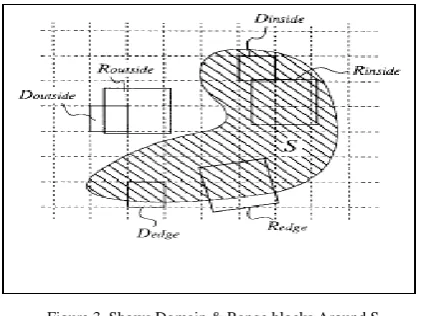
chaotic loci with the mapped point moving in a complicated manner fig.2. Shows the mapping of intensity value. An ideal example of domain blocks and their range blocks around an object S is illustrated in Fig.1 (b) & fig. 3. There are some texture patterns of intensity, but no distinct edges in S . The background is flat, and its intensity is different from the mean intensity in S.
Figure.3. Shows Domain & Range blocks Around S
Most of the blocks satisfy the conditions described below because the block which gives the minimum distance from the domain block is selected as its range blocks considerable as.
Step-1: If a domain block is in S , its range block is also in S
( Fig. 3 shows).
Step-2: If a domain block is outside S , its range block is
also Outside S ( Fig. 3 shows).
Step-3: If a domain block includes a contour of S, its range
block also includes the same contour, and the pixel pattern in the range block is similar to that in the domain block (Fig. 3 shows).
A range block which satisfies the step-3 can be found easily for a domain block containing a simple edge. Although some range blocks are omitted in Fig. 3 for simplification, it is assumed that there is a range block satisfying conditions Step-1 to Step-3 for each domain block.
B. Contour Detection Using a Contractive Map M:
And E is the set of indexes i such that Di includes the
contour of an object such as Dedge in Fig. 3 & Fig. 4. Since gi
is contractive (ri >1), Mn converges to a limit set when
[image:3.595.327.539.228.392.2]n→∞. We propose an algorithm with a reasonable computational load, in which the number of mapping points is fewer than or equal to the number of pixels in A. The iteration phases are described below as with considering figure as fig. 5.
Iteration-1. Place points at the pixel positions and call the initial set X0.
Iteration-2. Iterate the map M, k times and get Xk. Here,
round off the position of each of the mapped points to the position of the nearest pixel in each iteration. Iteration-3. Show the pixels of Xk obtained as a result of
contour detection. In general, the number of mapped points increases as a result of the mapping M because there are points which belong to more than one range block. Divergence of the number of mapped points is, however, avoided because some points are unified in Iteration-2.
The proposed method requires an accurate determination of E because, it does not include a part of the contour, and the limit set might be a broken line. The method for determining E is described in Section of Experimental Result for Contour Detection.
IV. EXPERIMENTAL RESULT FOR CONTOUR
DETECTION
In this experiment, a block-type switching method [5], [10] was used to encode the image for the convenient detection of E . Blocks Di having a smaller variance than the
given Th (Th was taken as 17 in the experiment) were
regarded as blocks without an edge and labeled type2, and the other blocks were labeled type1 [10]. Note that
Where N is the number of pixels in Di, bk is intensity of
the k-th pixel, and is the intensity mean of. Jacquin has used more block types and a different block-type detection method in [5]. If a block was labeled type2, the intensity mean of the block was only involved in the compressed code. The fractal transformation, therefore, changes to
Here, τi is the block type. Although the block-type
switching method requires bits for τi, the total amount of
conventional method if there are a sufficient
number of
blocks of type2, because
type2 blocks do not need transformation parameters. X0 , X1, X2, X3 are shown in fig5. Here E = {block index of type1}……… (10)
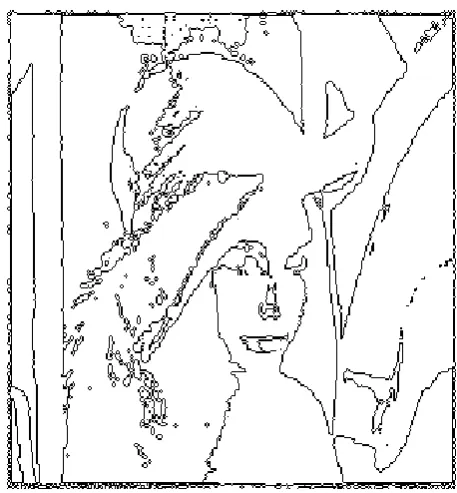
[image:4.595.323.550.52.448.2]Contours of the hat, the face, the shoulder, and the frame of the mirror were detected. However, the eyes and the decoration of the hat could not be seen. This was because the block size was too large to satisfy the conditions step-1 to step-3 around such small objects. In addition, black regions those are not contours and are a result of inaccuracy in the determination of E. Fig. 6 shows the proposed contour detected using fractal coding of “Lena image”. And Fig.7. Shows the original Car image and Fig.8. Shows the contour detected Car image using our method.
[image:4.595.44.270.220.460.2]Figure. 6. Contour detected “Lena” image
Figure.7. Original Car image
Figure.8. Contour Detected Car image
V. CONCLUSIONS
A contour detection method based on dynamical systems parameterized by fractal coding was proposed. It was shown that an enlarging mapping system produces a segmented image, and the limit set in the inverse system forms the contours. Although the quality of contour-detected images can be improved by adding rotations to or using a smaller block size to satisfy condition sstep-1 to step-3, these parameters require more bits in the compressed code. The parameters should be set depending on the use. The proposed methods are new applications of fractal coding, and can also be considered novel one for image representation. The advantage of the proposed method is that they are done on the level of compressed code. If images compressed by fractal coding are kept on a database, an image can be contour detected in a short time without decompressing it to the gray-scale image. Therefore, the methods are useful for fast browsing to find images, for example. In addition, they will contribute to image processing on compressed codes, which will be critical for the handling of large numbers of images on a machine. This is because contour detection of image is basic technologies for image editing, recognition, and other types of image processing.
[image:4.595.42.271.491.738.2]We would like to thank Dr. P.K. Bose, Director, NIT, Agartala, India for supporting this research work and thanks to the reviewer for their valuable comments.
VII. REFERENCES
[1]. M. F. Bamsley and A. Jacquin, “Application of recurrent iterated function systems to images,” Proc. SPIE, , vol. 1001, pp. 122-131, 1988.
[2]. A. E. Jacquin. Image Coding Based on a Fractal Theory of Iterated Contractive Image Transform. IEEE trans. on Image Processing, Vol. 1, pp. 18-30, Jan. 1992.
[3]. B.B. Mandelbrot, The Fractal Geometry of Nature, Freeman, San Francisco, 1983.
[4]. M. Barnsley, Fractals Everywhere. San Diego, CA: Academic, 1988.
[5]. A. Jacquin, “A novel fractal block-coding technique for digital images,” in Proc. ICASSP-90, 1990, pp. 2225– 2228.
[6]. A. Jacquin “Fractal image coding: A review,” Proc. IEEE, vol. 81, pp. 1451–1465, Oct. 1993.
[7]. M. Barnsley and A. D. Sloan, “Method and apparatus for processing digital data,” U.S. Patent 5065447, 1991. [8]. A. Jacquin , “Image coding based on a fractal theory of
iterated contractive image transformations,” IEEE Trans. Image Processing, vol. 1, pp. 18–30, Jan. 1992.
[9]. M. Barnsley and L. P. Hurd, Fractal Image Compression. Wellesley, MA: AK Peters, 1993.
[10]. Y. Fisher, Ed., Fractal Image Compression: Theory and Application. New York: Springer-Verlag, 1994.
[11]. T. Ida and K. Dachiku, “Image compression using iterated transformation theory-based coding” (in Japanese), in Proc. 5th Karuizawa Workshop Circuits Syst., 1992, pp. 137– 142.
[12]. T. Ida and Y. Sambonsugi, “Image segmentation using fractal coding,” IEEE Trans. Circuits Syst. Video Technol., vol. 5, pp. 567–570, Dec. 1995.
[13]. T. Ida, “Improvement of fractal image coding using new code-decision criterion,” in Proc. Int. Picture Coding Symp., 1994, pp. 444–447.