International Journal of Emerging Technology and Advanced Engineering
Website: www.ijetae.com (ISSN 2250-2459, Volume 2, Issue 3, March 2012)65
The BlueBooster – Mobile Bluetooth Range Expansion
Kulkarni Amit Anil
1, Shirole Bajirao Subhash
2, Waghmare Arun I.
3, Kolhe Sunil Bhausaheb
4,
Jadhav Yogita Prakash
5,Jagdale Rohit Jaywant
61-6
S.N.D College Of Engineering & Research Center,Yeola,Nashik,Maharashtra
3
[email protected] 4 [email protected]
Abstract—Bluetooth is widely used technology in today’s mobile phones. It enables a device to communicate wirelessly without being in line of site of other device, but Bluetooth has its own shortcomings such as it is applicable between only two Bluetooth enabled mobile phones at a time and it is limited by range So to overcome these disadvantages we propose a new system BlueBooster system. This BlueBooster system will extend physical range of Bluetooth without using any external hardware. Also by using this BlueBooster system , more than two devices can communicate with each other which forms a network of devices. It is based on AODV (Ad-hoc on demand distance vector routing) algorithm used to create Ad-hoc networks, and providing some enhancements to it.
Keywords—BlueBooster, Bluetooth range expander, Bluetooth Network Expansion, Bluetooth Optimizer,Bluetooth Community.
I. INTRODUCTION
Mobile devices have evolved immensely from their humble beginnings of being a gadget that provided only voice transmission to that which is capable of handling multiple technologies and even controlling other equipment around it. Some of the other technologies that today's mobile phone can handle are Infrared (IR), Bluetooth and Wireless Local Area Network (WLAN).
Bluetooth is an industrial specification for wireless personal area networks (PANs). It is available in a wider range of mobile phones than WLAN. Some of the main benefits it provides its users are, Enable users to create Ad-hoc networks. Enable users to interact within a peer to peer network configuration. Enable users to transfer files and data among each other.
Bluetooth has its own shortcoming such as 1. Physical range limitation of 10 m.
2. Applicable between only two Bluetooth enabled mobile phones at a time.
There are two existing systems to overcome these problems which are Piconet and Scatternet.
1) Piconet:-
A Piconet is a network of devices connected in an Ad-hoc fashion using Bluetooth technology.One device is acting as master and other as slave. Maximum devices that can be in Piconet are 8 devices 1 as master and other 7 as slave.
2) Scatternet:-
A Scatternet is No of interconnected piconets. It is formed when member of one piconet acts as slave in another separate piconet. Using this approach a large scatternet can be formed which expands physical range of Bluetooth.
Problems of existing systems:-
1) Master slave restrictions. 2) Interoperability breakdown. 3) Multicasting is not allowed.
International Journal of Emerging Technology and Advanced Engineering
Website: www.ijetae.com (ISSN 2250-2459, Volume 2, Issue 3, March 2012)66
The main concept behind the BlueBooster solution will be to allow the creation of a virtual community, and use the nodes of the community as relay points between two nodes, which are not in the direct range of each other which will help to expand physical range of 10 m of Bluetooth. Multicasting is a feature in BlueBooster system where the user can select multiple destinations from within the virtual community, and send the same file to all of them in just one operation because of no master slave restrictions. If any in-between node fails then another path will be chosen by AODV Algorithm dynamically hence no interoperability breakdown.
BlueBooster system features:-
1) To extend existing Bluetooth range of 10 m. 2) To provide Bluetooth network of wide range. 3) For expanding range middle Bluetooth device as
router.
4) Multicasting (sending one file to many destinations).
5) No master slave restrictions.
6) No interoperability breakdown
II. REQUIREMENTS REVIEW
A. Bluetooth Architecture
Bluetooth provides communications based on Radio Frequency. There are different kinds of Bluetooth devices from different manufactures built already. The aim of the Bluetooth specification is to ensure the communications between these devices in an efficient and effective manner. To achieve the above, the Bluetooth specification specifies a protocol stack to ensure that Bluetooth devices can discover each other, explore each other's services, and make use of these services [1].
B. Object Exchange (OBEX) Protocol
OBEX layer is used to transfer data such as files, as objects. The OBEX protocol uses Client-server model to send/receive files between Bluetooth devices. The server should open up an OBEX connection with the client to perform put and get operations. To pass additional information can use OBEX headers
C. File Transfer Profile
Bluetooth profiles define vendor-neutral device capabilities, to ensure interoperability and consistency between devices. They provide a well defined set of higher layer procedures and uniform ways of using the lower layers of Bluetooth. Bluetooth applications which provide file transferring should understand the requirements of the protocols (OBEX) and procedures which will be used.
D. Radio Frequency Communication (RFCOMM) Protocol
RFCOMM is a Transport protocol. RFCOMM is better used to send stream data and it provides emulation of serial ports, which are normally necessary to transfer stream data[2]. It is better to use RFCOMM instead of OBEX to send/receive simple text string between Bluetooth devices.
III. EXISTING SOLUTIONS
1. Piconet
Piconet is a network of devices connected in an Ad-hoc fashion using Bluetooth technology. One device is acting as master and other as slave. maximum devices that can be in piconet are 8 devices out of which 1 acts as master and other 7 as Slave. Piconet is one technique which can be used to overcome the distance limitation to some extent. Piconet operates in range of about 10m and transfer rate is from 400 to 700kbit/s, depending on synchronous or asynchronous connection used.
All devices in a Piconet are peer units and have identical implementations. However, when a Piconet is formed between two or more devices, one device is dynamically elected to take the role of 'master', and all other devices assume a 'slave' role for synchronization reasons .
2. Scatternet
Scatternet - A Scatternet is a number of interconnected Piconets that supports communication between more than 8 devices. Scatternets can be formed when a member of one Piconet elects to participate as a slave in a second, separate Piconet. The device participating in both Piconets can relay data between members of both Ad-hoc networks. Using this approach, it is possible to join together numerous Piconets into a large Scatternet, and to expand the physical size of the network beyond Bluetooth's limited range. Some of the main disadvantages of Scatternet are the Master-Slave restrictions, interoperability breakdown [3].
3. Ad-Hoc Networking
International Journal of Emerging Technology and Advanced Engineering
Website: www.ijetae.com (ISSN 2250-2459, Volume 2, Issue 3, March 2012)67
When considering the networks that exist today, they can be classified to two main categories as infrastructured and infrastructureless.
Infrastructured networks consist of fixed and wired gateways. Local area networks (LANs) and wireless LANs are good examples of infrastructured networks. In both there is at least one fixed and wired base station to which other nodes connect to, with either a wired or wireless connection. Infrastructureless networks on the other hand do not have any fixed or wired gateways. All nodes are mobile and can have dynamic and arbitrary connections. Infrastructureless networks can be called as 'Ad-hoc' networks. Ad-hoc mobile wireless networks have a constantly changing network topology. Each node in an Ad-hoc network acts as a router. The main advantage of Ad-Ad-hoc networks is that they can be established very quickly and they do not require a fixed infrastructure and it’s a temporary connection made between two or more devices when connection released, network disappears again [5].
IV. ROUTING ALGORITHM
A. Ad-hoc on demand distance vector routing (AODV)
Ad-hoc on demand distance vector routing was implemented based on the protocol DSDV and is a much improved version. When a source node needs to send a message to a destination which is not directly reachable it initiates a path discovery process to find and establish a route [6]. Route Requests (RREQs), Route Replies (RREPs), and Route Errors (RERRs) are the message types defined by AODV. These message types are received via Universal Datagram Protocol (UDP), and normal IP header processing applies. In the process of forwarding the RREQ, intermediate nodes record the address of the source to them, the sender of the first copy of a particular RREQ. Once the destination is found a RREP is sent back using the reverse path. While the RREP is forwarded, the nodes keep the RREP source node addresses to them, creating the forward path. The source will use this path to send the message to the destination. In AODV, if the source node is moved, it will reinitiate the RREQ.
V. DESIGN OF BLUEBOOSTER
The BlueBooster application will extend the communication facilities via Bluetooth between mobile phones. There are several core areas in the BlueBooster system, BlueBooster service, creation of community list, the blue community concept, Blue line concept, message transfer, file transfer, multicasting & security module.
The two new terms 'blue community' and 'blue line' were introduced for the BlueBooster application.
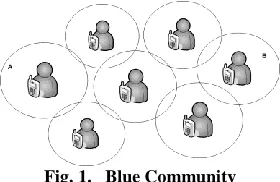
[image:3.612.372.512.214.305.2]The "blue community" as shown in Fig. 1, is created when a Bluetooth enabled device running BlueBooster application, is connected with all Bluetooth enabled nodes around it, that are running BlueBooster application.
Fig. 1. Blue Community
A. Bluetooth Range Expansion
The BlueBooster application first allows the user to start the BlueBooster Service. This service is used to identify Bluetooth enabled mobile devices which are willing to participate in a virtual community as shown in Fig 2., and ensures consent of the users eliminating any privacy violations.
[image:3.612.361.525.603.691.2]When a user is sending a file or a message through the blue line, intermediate users (between source and destination) do not need to worry about 'send file/message' or 'receive ACK' operations this will be handled automatically through the BlueBooster application. Intermediate users only need to have the BlueBooster application running with the BlueBooster service started. If the intermediate users are not using the application they can run it in the background. A log will be maintained by the system, keeping track of all the connection details, data transferring and other activities done. This log can be used by the user to track all the activities done through the device. In a scenario where a Blue Community member sends a file to another member who has the application in the sleep state, then the destination user’s application will be brought to the active state to notify the file/message receipt.
International Journal of Emerging Technology and Advanced Engineering
Website: www.ijetae.com (ISSN 2250-2459, Volume 2, Issue 3, March 2012)68
B. Blue Community and Connection Initiation
The First step to start communicating using the Blue Community is to join the community. Once the user joins, the BlueBooster service will be started in his/her device (if not already started) and a list of the other reachable members will be shown. Initially the directly reachable nodes are listed in the community list. To see all nodes in the virtual community the user can choose the option ―show more devices‖ then the application will search for nodes that the successive devices can reach, this will result in the successive nodes sending the list of nodes that they can reach and all lists will be collected and appended to list all nodes that are in the community. When creating the list the duplicates will be avoided. The community list will be sorted according to the distance based on the number of hops to a specific node (all destination nodes will be assigned the least number of hopes to it from the source).[7]
C. Routing Methodology and the Blue Line Concept
The following set of diagrams would describe the routing model clearly. Please consider that all nodes are Blue Community members.
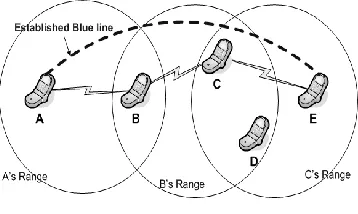
In Fig 3, node A needs to communicate with node E. E
can be reached via two paths but a single route will be established for communication. The length of both paths is the same. Length is determined by the number of hops to reach the destination.
[image:4.612.77.256.565.672.2]First a route request message (RREQ) will be broadcasted by A then by all other subsequent nodes that receive the RREQ. Once the RREQ reaches E, since it is the destination then a route reply (RREP) will be sent back through its source to A and the Blue Line will be established, if A receives.
Fig. 3. Blue Line
D. Multicasting
This functionality of the BlueBooster system allows the user to send a single file or a message to multiple users by just one action from the user. This feature is more effective and efficient when selected multiple nodes are in a single Blue Line. The community list will be sorted and listed according to the distance to each node from the current node.[8] In this case the distance is measured according to number of hops to remote device from the current node. As mentioned earlier when creating the list, the system will retrieve community lists from other nodes. Each list will consist of friendly name, Bluetooth address and number of hops to every node.
E. Security in Ad-hoc Networks
International Journal of Emerging Technology and Advanced Engineering
Website: www.ijetae.com (ISSN 2250-2459, Volume 2, Issue 3, March 2012)69
VI. SIMULATION MODEL
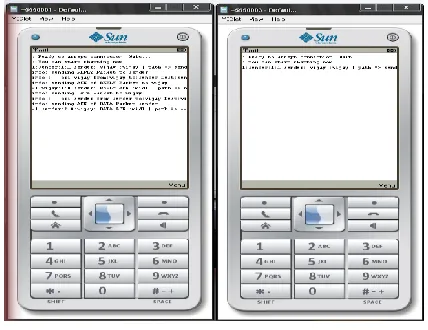
The emulator provided by the Java Wireless Tool Kit was used to simulate and test the BlueBooster application. In order to simulate real mobile phones that are in the Blue Community the java location API was used to specify the location of each emulator so that the distance between the source and destination exceeded the standard range of Bluetooth in mobile phones which is usually of 10m.
[image:5.612.46.260.386.551.2]Emulators become clients and servers depending on the role they play in the data transferring process[10]. An emulator that requests connection is a client and the emulator that responds to it is a server. If the emulator is a server then the longitude value will be stored in the server’s services as an attribute. The Movement Tracker class will update this service attribute if location was changed. When a client connects to a server the system will check the longitude of client and server. If the difference in the longitudes is less than simulated distance limitation (10), then system allows client to connect and communicate with server via Bluetooth.
Fig. 4. Wireless Toolkit 2.5.2
VII. ADVANTAGES AND USES
The usages of the BlueBooster application are endless. It can be used by any application which requires an Ad-hoc networking platform. Since BlueBooster system has improved the success rate of message being delivered to the destination it can be considered to be very reliable.
Looking at a real life application, in a campus environment or in an office environment once the Blue Community is created it provides a very cost effective way of communication.
In an exhibition or a conference like environment, the Blue Community can provide the administrators a way of broadcasting advertisements and important messages among the visitors, this will result in a huge reduction in cost.
The BlueBooster system can also be used as a device finding mechanism. A user in a Blue Community can create a Blue Line to the desired destination then looking at the message received from the application the user can determine the relative location of the destination in relation to the other nodes in the community.
VIII. FUTURE ENHANCEMENTS
In this research the BlueBooster system is limited to the Bluetooth technology, if it is further expanded to integrate other technologies it will increase the capabilities and allow the mobile users to interact with other wireless networks around them.
By introducing techniques like file streaming the system can be further enhanced so that if a mobile phone in the Blue Line cannot handle the file sent due to its size, then the file can be broken down into small pieces and sent to the destination through the same Blue Line.
If a method was found to securely distribute the encryption key in Ad-hoc networks and make them much secure it will allow this system to be implemented in military and other high risk applications.
IX. CONCLUSION
In this way we are extending the current Bluetooth range from 10 m range to more by using other idle Bluetooth devices running this BlueBooster application. The BlueBooster system has also enhanced the data transferring capabilities. With a single operation the system allows data to be sent to multiple destinations. This allows system to be used in a wide variety of community applications such as multi destination chat programs and multi player games can run on top of it.
International Journal of Emerging Technology and Advanced Engineering
Website: www.ijetae.com (ISSN 2250-2459, Volume 2, Issue 3, March 2012)70
R
EFERENCES[1] Andr N. Klingsheim, "J2me Bluetooth Programming,", [pdf].Department of Informatics, University of Bergen, pp. 6-8, 30-06-2004.
[2] Bluetooth SIG, "Part F:2, IrDA INTEROPERABILITY," [pdf]. Available: Bluetooth SIG, 2001.
[3] Bluetooth SIG, Part K:12 , "File Transfer Profile", [pdf]. Available: Bluetooth SIG, 2001.
[4] Bluetooth SIG, "Part F: 1, RFCOMM with TS 07.10", [pdf]. Available: Bluetooth SIG, 2003.
[5] Matthew Stannard, "Piconet", 31-03-2004,
Available:http://en.wikipedia.org/wiki/Piconet, [Accessed: 28-02-2008]
[6] Will Tsang, Paul Carey, Gerald O'Connor, Paul Connaughton, "Bluetooth",29-11-2000,[Online].Available: http://ntrg.cs.tcd.ie/undergrad/4ba2.01/group3/terminology.html [Accessed: 2008-08-11]
[7] S. Corson and J. Macker, "Mobile Ad-hoc networking (manet): Routing protocol performance and evaluation considerations.", [pdf].University of Maryland, 1999.
[8] Markku Manner, Science, ‖Table-Driven Routing Protocols in Ad-hoc Mobile Wireless Networks‖,, [pdf].University of Helsinki, Department of Computer Science, 2006.
[9] Koojana Kuladinithi, AndreasTimm-Giel, Carmelita Grg, "Mobile Ad-hoc Communications in AEC Industry", [pdf]. University of Bremen, Germany, 2004.