Volume 3, No. 2, March-April 2012
International Journal of Advanced Research in Computer Science
RESEARCH PAPER
Available Online at www.ijarcs.info
ISSN No. 0976-5697
Intelligent Agent-Based Knowledge Management and Knowledge Discovery
Prof. T. Joshva Devadas*
Professor Department of IT, Sethu Institute of Technology,
Pulloor, Kariapatti [email protected]
Dr. R. Ganesan
Professor Department of EEE Sethu Institute of Technology,
Pulloor, Kariapatti [email protected]
Abstract: Knowledge Management is the process of collecting information which supports to create disseminate and utilize the knowledge between the individuals, groups within an organization or independent organization. The process of knowledge management involves various steps such as identifying, collecting, storing, sharing, applying, creating and selling knowledge. Agents are autonomous intelligent computer programs that perform tasks on behalf of the user or user-initiated process by using its knowledge base. Agents are designed and developed in such a way that they are goal-oriented, adaptive, reactive and mobile. Agents incorporated in the process of knowledge management should be capable of communicating with other agents by using its common characteristics namely cooperate, coordinate and collaborate. These common characteristics will improve the performance of knowledge management process by helping the agents to discover the knowledge from it. Agent uses its learning characteristics to update its knowledge base whenever it encounters new information from the organization. Agent’s uses its dynamic characteristics for knowledge sharing among users in an organization. Knowledge sharing is done both at work group and at company level. During this process agent roles associated with the knowledge management and knowledge discovery are identified. This paper aims at describing such agents and their roles.
I. INRODUCTION
The concept of agent has become popular in computing in the recent years because of its flexibility, modularity and applicability to wide range of applications. The new level of abstraction they offer can reduce the complexity of the development of the software. Agents perform a set of tasks for the user and so they should in turn have some amount of intelligence in order to perform the actions, communicate, adapt to changes in the environment and learn from experience. Knowledge Management deals with usage of information, acquiring, searching and distribution. Knowledge can be collected from various sources in different formats and are stored and processed to obtain the required format. Therefore knowledge management approach encompasses the following process: Knowledge capturing, Knowledge Representation, Knowledge Processing, Knowledge sharing and using knowledge [8][17]. Since the agents are knowledgeable and react to the environment, the agent concepts incorporated in this paper would perform the knowledge management process implicitly by collecting, processing, sharing (with other agents) and using the existing knowledge to analyze the data. Hence agents can be seen as building blocks for any knowledge management service, we call them as knowledge agents [18].
In software research communities mainly the discussion has been in the classical organization of information and its related metadata, leading into technical issues on hierarchies of concepts and terminologies and development and sharing of ontologies. The recent development of semantic web has put more pressure on more rigid information design, especially the metadata definition and usage. Also changes in networking and availability of information via web, and various information classifications is transforming the knowledge landscape. In our approach, we try to put forward these methodologies from the IT and technical experts towards the communities and organizational usage cases.
In section 2 we describe about the software intelligent agents, need of agents, agents and knowledge management, design of an agent, and the agent learning process. Section 3 explains the knowledge management basic concepts and the flow of knowledge management process. In Section 4 discusses the agent role in knowledge discover, knowledge management and knowledge management process. Finally the paper ends with the conclusion.
II. SOFTWARE INTELLIGENT AGENTS
A. What is an Agent
An Agent is a software program that performs the task on behalf of others with its characteristics behavior like autonomy, reactivity, mobility and learning [1]. Autonomy enables the agent to follow the goals independently without interaction or command from the environment. Reactivity
characteristics activate the agent to make appropriate action relevant to the influences from its environment. Mobility
characteristics make the agent to move from one computer network to another one to obtain data. Learning
characteristics ensure that the agent must have certain degree of intelligence to learn things from the environment.
B. Need of an Agent:
Agents can move towards the goal without frequent intervention of the user and can be deployed to obtain valid information.
C. Agents and Knowledge Management:
Data mining is the process of automatically extracting useful information and relationships from immense quantities of data [RubenKing, 2001] and Agents incorporated in the knowledge management system can perform retrieval of knowledge from the knowledge base[3][6]. Knowledge acquired to the system through various sources is heterogeneous. Agents incorporated in the knowledge management process are to identify the relevance of the data and react to the situation. Knowledge obtained by the agent updates its knowledge base for future references [18]. Knowledge management process includes the creating, modifying and updating of the knowledge base. Agent access the knowledge base for data retrieval and decision making. Agents use their intelligence to process the user requests and produce the output in the required format by collecting, processing, verifying and validating the user preferred data. Agents with these functionalities are referred as Knowledge Agents[9] which posses the characteristics of the knowledge management.
D. Designing an Agent:
Several methods are available in the design process of an agent, and most of them use the following procedure [2]
a. Role Identification b. Skill Identification c. Knowledge Modeling d. Organizational structure
e. Dynamics of Multi-agent systems
Role identification is done with respect to the given application domain in terms of its goal or tasks. The roles are identified by the responsibilities required by the system.
Skill Identification associated with the basic services rendered by the agents
Knowledge Modeling involves identifying the association rules or skills.
Organizational structure describes the coordination and communication schemes of the agents defined in the system
Dynamics of Multi-agent systems should be analyzed in terms of flow of information resulting in the process.
E. Agent Learning Process:
A learning agent can adapt to its user’s likes and dislikes. It can learn which agents to trust and cooperate with, and which one to avoid. A learning agent can recognize situations it has been in before and improve its performance based on prior experience, which is more difficult to implement. A learning agent would obviously be much more valuable than a fixed function agent. Learning provides the mechanism for an initially generic filtering agent to adapt and become a truly personal filtering agent [2].
Learning procedure can be classified according to the functionality of the agents. The functionality of the agents is categorized by the components present in it. Hence each agent resides in the system describes how and what information to collect and process.
Neural Network (NN) plays an important role in the learning process. Neural Network uses a set of processing elements loosely analogous to neurons in the brain. These
nodes are interconnected in a network that can then identify patterns in the data as it is exposed to the data. In a sense, the network learns from experience just as people do. This distinguishes NN from traditional computing programs that simply follow instructions in a fixed sequential order. A learning task implicitly incorporates the structure of NN.
Learning can be classified as Supervised, and Unsupervised [5][7]. Learning with a supervisor or a teacher or an instructor is referred as supervised learning. It learns according to the instruction given by the instructor. Learning without a supervisor or learn by themselves is referred as unsupervised learning. It learns using its possessed knowledge. Every time it refers its knowledge base before updating new information to it. Knowledge Management plays an important role to add a newly learned knowledge with its decision making capability.
III. KNOWLEDGE MANAGEMENT
Knowledge Management (KM) comprises a range of practices used by organizations to identify, create, represent, and distribute knowledge. Knowledge management is a million dollar world wide market. KM programs are typically tied to organizational objectives such as improved performance, competitive advantage innovation; lessons learnt transfer and the general development of collaborative practices [11]. KM is frequently linked to the idea of learning organizations although neither practice encompasses the other.
The key concept of KM is Dimensions of knowledge, Knowledge Access Stages, and Adhoc Knowledge Access. The dimension of the knowledge may be either tacit or explicit. Tacit knowledge describes as subconscious, internalized and the individual may or may not have knowledge about how they obtain the result, whereas explicit knowledge that the individual holds explicitly. In other words, tacit knowledge is what is in our hands and explicit knowledge is what we have codified. Knowledge Access stages may be accessed at three stages: before, during or after knowledge-related activity. Adhoc Knowledge Access deals with the retrieval of knowledge from the knowledge repository.
Knowledge flow comprises of a set of processes, events, and activities through which data, information, knowledge and meta-knowledge are transformed from one state to another. The knowledge flow has the following primary activity area namely knowledge creation, retention, transfer and utilization [16]. Knowledge creation associates with the entry of new knowledge to the system, and includes knowledge development, discovery and capture. Knowledge Retention describes the process of reserve knowledge which requires the system to perform maintenance. Knowledge transfer is an activity associated with the flow of knowledge, which requires communication, translation, conversion, filtering and rendering. Finally knowledge utilization includes activities associated with the application of knowledge to business process.
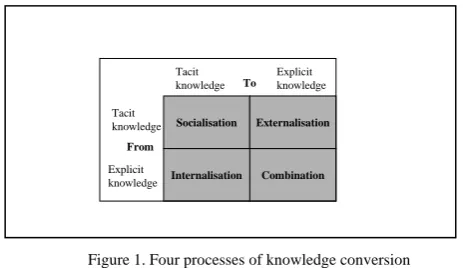
Figure 1. Four processes of knowledge conversion
A. Transformation from tacit to explicit knowledge:
It is a process of externalisation transformation, which corresponds to the knowledge claim formulation in the KLC. In the KLC model, knowledge claims do not mean “objective knowledge’ until they are used successfully to pass the knowledge validation process. Organisational knowledge makes use of only the validated knowledge, after having been formalised and edited in the knowledge integration process of the KLC.
B. Transformation from tacit to tacit knowledge:
This process corresponds to the socialisation transformation as well as to sharing of “personal” knowledge by intelligent agent interactions. Though this process does not create “new” organisational knowledge, it may be crucial to maintaining and enhancing the competitive advantage of many creative organisations. This transformation fits into the knowledge production process of the KLC.
C. Transformation from explicit to tacit knowledge:
This type of transformation corresponds to the internalisation. This transformation matches closely the knowledge operationalization step of the knowledge integration process of the KLC. Although no new knowledge is produced at this stage, the transformation may be very important for highly innovative organizations.
D. Transformation from explicit to explicit
knowledge:
We do not consider the explicit knowledge combination to be relevant to knowledge management, since either a mechanical process of external knowledge takes place through some mechanism of information categorisation, or an intelligent agent must be involved in inferring new knowledge from a combination of external knowledge artefacts. In the latter case, other transformations, namely the internalisation-externalisation path, would have to be followed.
IV. ROLE OF INTELLIGENT AGENTS
The magic of information transforming itself into knowledge, which in turn becomes information at the next level, thus continuing the eternal cycle of knowledge quest has always fascinated people throughout the ages. The technocrats are now moving towards knowledge-driven society. Agents provide a prominent and fascinating role by providing intelligence to the knowledge management systems. Hence the significance of the agent roles needs to be identified. In this work, agents associated with
knowledge management task are explored as Agents in knowledge management, Agents in knowledge management process and Agents in knowledge discovery.
A. Agents in knowledge management:
The recent popularity of the World Wide Web has provided a tremendous opportunity to expedite the dispersement of various knowledge creation/diffusion infrastructures. This enforces organizations to create a knowledge repository and to extend the scope of collaboration in an easy and cost-effective manner. It creates the possibility of developing global collaborative Knowledge Management platforms overload problem [13]. While the web allows various kinds of knowledge to be created and disseminated across time and space barriers, it does not support the processes of using and updating the knowledge in a timely manner. For assisting and facilitating these processes the concept of intelligent agent was introduced in the knowledge management process.
In order to keep compatibility with our discussion we shall distinguish two classes of actors interacting within the KM environment; human beings called employees or knowledge workers, and knowledge-based computer programs called intelligent agents. The Knowledge Base (KB) of the system describes about the set of remembered data, validated propositions, meta-models, and the software used for manipulating this. The size of the knowledge base determines the intelligent behavior of the agent. A knowledge base, not necessarily meant as the IT-related concept, constitutes the principal element of any knowledge management system and therefore requires a more detailed consideration.
Agents associated with the knowledge management should have specific functionality. The specific functionality is referred as the role played by the agent. Agents roles are identified according to the functionality of the agents present in the system. Agents are classified and analyzed as interaction agent, which is responsible for communicating with other agents or components. Some agents are designated to receive data or collecting information is referred as data collection agent. Agents which are capable of performing the task independently are referred as processing agents. The Knowledge management agents are responsible of learning knowledge from the environment and update its knowledge base or providing knowledge to the current environment. Some agents are referred as administrative agent, which can monitor the environment and assist accordingly.
B. Agents in Knowledge Management process:
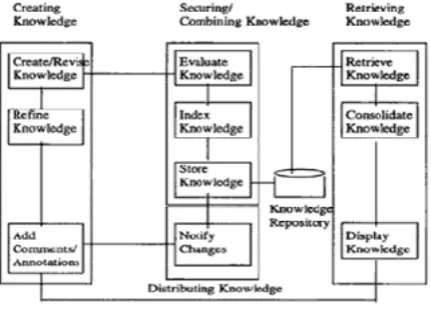
The Knowledge management process encompasses the knowledge creation, securing / combining knowledge and retrieving knowledge [15].
Knowledge is created through interactions between tacit knowledge and explicit knowledge at two different levels: the individual and the group levels. Knowledge is created through communication of individual learning among co-workers. Knowledge is created based on prior knowledge; in other words, the process of creating knowledge can be characterized as the process of assimilating new knowledge into preexisting knowledge.
Socialisation Externalisation
Combination Internalisation
To
From
Tacit knowledge
Explicit knowledge
Tacit knowledge
Figure 2. Overview of KM Process
Securing knowledge associates with the team, once the task of a team is completed, team members incorporate Tacit knowledge acquired and created in the project with explicit knowledge in the forms of documents and reports. Besides formal knowledge, informal knowledge in the form of tacit know-how, letters, memos, informal conversations should be captured, shared, and reused. When new knowledge is added, the existing linkages and associations among different knowledge sources need to be modified.
Distributing Knowledge is disseminated by building a cross-functional, self-organizing team. A variety of mechanism can be used for spreading knowledge quickly and efficiently throughout the organization; this includes written, oral, & visual reports; site visits and tours; Personal rotation programs; education programs & seminars. Individuals who stand between subunits within the organization, capture, translate, & disseminate external information in order to allow other co-workers to share it.
Retrieving knowledge is describing about how the knowledge is created and tested by various departments within the organization. This is called a “crystallization process.” Through double-loop learning, individuals continuously update the existing norms, procedures, & policies in the organization based on their experiences. All available knowledge can be combined by establishing new linkages with preexisting knowledge. Diverse knowledge sources are closely linked in a shared memory.
The knowledge management process needs to incorporate agents with multiple functionalities. The Agents designed for this process need to perform jobs like creating knowledge, securing knowledge and retrieving knowledge from the existing one. When a new task is delegated by the user, an intelligent agent should determine precisely what its goal is, evaluate how the goal can be reached in an effective manner, and perform the necessary actions. An intelligent agent should also be capable of learning from past experience and responding to unforeseen situation with its reasoning strategies. It should be reactive/autonomous so that it can sense the current state of its environment and act independently to make progress toward its goal (Reactive and autonomous). Finally, it often needs to interact with other agents to perform its tasks (cooperative and mobile).
C. Agents in Knowledge Discovery:
Knowledge discovery is connected with extracting knowledge from the database or knowledge base. Learning concepts are used to find out the required pattern. Initially
knowledge is stored in a database and accessed either locally or via network. As the days emerge the concept of distribution comes in to existence. Now the issue is, how to gather distributed information and how the new knowledge can be discovered in the distributed environment. Recent knowledge discovery systems have focused on extracting numeric or propositional knowledge from the database [14]. A data mining system aims to discover knowledge that is novel, useful, and understandable, which typically requires a human to focus the search and provide feedback on the knowledge discovered. Agents may query knowledge from the existing knowledge. Agents communicate with each other during the discovery process, which permits the agents to integrate the new knowledge they produce into a global one. Agents use user-interface to communicate with the user. These interface allows the user to assign agents data sources, and to allocate high level discover goals. It allows the user to critique new knowledge discovered by the agents and direct the agents to new discovery goals. Multi agents may also be used to discover the knowledge in the case of distributed computing environment.
V. CONCLUSION
This paper aims at describing the basic aspects of knowledge management. The concept of Agents, the need for the agent and the design of the agents was discussed in detail. During the discussion of the design of the agent the roles of the agents are identified in association with knowledge management process. A detailed discussion on the association of the Agents with the Knowledge Management system was carried out. Also the Agents roles in terms of the knowledge management process and knowledge discovery are described in detail. Future of this work can be extended to design multi agents for the knowledge management and the agent learning process may also be extended.
VI. REFERENCE
[1]. Ayse Yasemin SEYDIM “Intelligent Agents: A Data
Mining Perspective “, CiteSeer.IST, Scientific Literature Digital Library. 1999.
[2]. Zili Zhang, Chengqi Zhang and Shichao Zhang “An
Agent-based hybrid framework for database mining” submitted for publication in Taylor & Francis Group. Applied Artificial Intelligence, 2003,pp 17:383-398.
[3]. Shahram Rahimi and Norman F. Carver , “ A Multi-Agent
Architecture for Distributed Domain-Specific Information Integration” Proceedings of the 38th Hawaii International Conference on System Sciences-2005, ©IEEE, 0-7695-2268-8/05
[4]. Alex Bordetsky “Agent-Based Support for Colloborate
Data Mining in System Management” proceedings of the 34th Hawaii international conference on System Science-2001,© IEEE, 0-7695-0981-9/01
[5]. S.Russell, P. Norvig, Artificial Intelligence, “A Modern
Approach, Printice-Hall, 1995.
[6]. Jiawei Han , Micheline Kamber “ Data mining: Concepts
[7]. Gerhard Weiss, “ Multiagent Systems – A Modern Approach to Distributed Artificial Intelligence”, The MIT Press, , 1999
[8]. S.Staab,H-P.Schurr, R.Sure, Y.Sure - Knowledge
Processes and Ontologies,IEEE Intelligent Systems (16/1) 2001
www.aifb.uni-karlsruhe.de/WBS/ysu/publications/ 2001_knowledge_processes_and_ontologies.pdf
[9]. Michael Koch – Knowledge Management and Knowledge
Agents in Campiellom
www11.informatik.tu-muenchen.de/ publications/pdf/Koch1998
[10]. A.Aldea, R. Banares- Alcantara, J.Bocio,J.Gramajo,
D.Isern, A.Kokossis, L.Jimenez ,A.Moreno, D.Riano “An ontology based knowledge management platform”
www.isi.edu/info-agents/workshops/ ijcai03/papers/DIsern-article-ijcai.pdf
[11]. Nenad Stojanovic, Slegfried Handschuh “A Framework for
Knowledge Management on the Semantic Web”
www2002.org/CDROM/poster/130.pdf
[12]. Witold Staniszkis, “Feature Requirements of a Knowledge Management System” , ICONS Project IST 2001-3249
[13]. Michael Koch, “Knowledge Management and Knowledge
Agents in Campiello”
[14]. Winton H E Davies & pete Edwards, “Agent Based
Knowledge Discovery” EPSRC.
[15]. seung baek, Jay Liebowitz, Srinivas Y prasad, Mary
Granger “Intelligent Agent for knowledge Management toward intelligent web based collaboration within virtual teams”
[16]. Brian (BO) Newman, Kurt W Conrad, “A Framework for
characterizing Knowledge Management methods, practices, and Technologies”, Knowledge Management Forum, West Richland, WA.
[17]. David kinny, Micheal P.Georgeff: Modelling and design of Multi-Agent Systems, Lecture Notes in Computer Science, Vol : 1365 Archive Proceedings of the 4th International
workshop on Intelligent Agents IV, Agent Theories, Architectures and Languages, 1-20,1996 ISBN:3-540-64162-9.
[18]. M. Wooldridge, N.R, Jennings, D.Kinny: The Gaia
methodology for agent-oriented analysis and design, Journal of Autonomous Agents and Multi-Agent systems
3(3):285-312,2000,http://www.agent.ai/doc/upload/200302/wool00. pdf
[19]. Lorna Uden, Kimmo Salmenjoki, Marjan Hericko, Luka