Proceedings of the Linguistic Annotation Workshop, pages 132–139,
Annotating a Japanese Text Corpus with
Predicate-Argument and Coreference Relations
Ryu Iida, Mamoru Komachi, Kentaro Inui and Yuji Matsumoto Graduate School of Information Science,
Nara Institute of Science and Technology 8916-5 Takayama, Ikoma, Nara, 630-0192, Japan
{ryu-i,mamoru-k,inui,matsu}@is.naist.jp
Abstract
In this paper, we discuss how to anno-tate coreference and predicate-argument re-lations in Japanese written text. There have been research activities for building Japanese text corpora annotated with coref-erence and predicate-argument relations as are done in the Kyoto Text Corpus version 4.0 (Kawahara et al., 2002) and the GDA-Tagged Corpus (Hasida, 2005). However, there is still much room for refining their specifications. For this reason, we discuss issues in annotating these two types of re-lations, and propose a new specification for each. In accordance with the specification, we built a large-scaled annotated corpus, and examined its reliability. As a result of our current work, we have released an anno-tated corpus named theNAIST Text Corpus1,
which is used as the evaluation data set in the coreference and zero-anaphora resolu-tion tasks in Iida et al. (2005) and Iida et al. (2006).
1 Introduction
Coreference resolution and predicate-argument structure analysis has recently been a growing field of research due to the demands from NLP appli-cation such as information extraction and machine translation. With the research focus placed on these tasks, the specification of annotating corpora and the
1
The NAIST Text Corpus is downloadable from
http://cl.naist.jp/nldata/corpus/, and it has already been downloaded by 102 unique users.
data sets used in supervised techniques (Soon et al., 2001; Ng and Cardie, 2002, etc.) have also grown in sophistication.
For English, several annotation schemes have al-ready been proposed for both coreference relation and argument structure, and annotated corpora have been developed accordingly (Hirschman, 1997; Poe-sio et al., 2004; Doddington et al., 2004). For in-stance, in the Coreference task on Message Under-standing Conference (MUC) and the Entity Detec-tion and Tracking (EDT) task in the Automatic Con-tent Extraction (ACE) program, which is the suc-cessor of MUC, the details of specification of anno-tating coreference relation have been discussed for several years. On the other hand, the specification of predicate-argument structure analysis has mainly been discussed in the context of the CoNLL shared task2 on the basis of the PropBank (Palmer et al., 2005).
In parallel with these efforts, there have also been research activities for building Japanese text corpora annotated with coreference and predicate-argument relations such as the Kyoto Text Corpus version 4.0 (Kawahara et al., 2002) and the GDA3-Tagged Cor-pus (Hasida, 2005). However, as we discuss in this paper, there is still much room for arguing and re-fining the specification of such sorts of semantic an-notation. In fact, for neither of the above two cor-pora, the adequacy and reliability of the annotation scheme has been deeply examined.
In this paper, we discuss how to annotate coref-erence and predicate-argument relations in Japanese
2http://www.lsi.upc.edu/˜srlconll/ 3
The Global Document Annotation
text. In Section 2 to Section 4, we examine the an-notation issues of coreference, predicate-argument relations, and event-nouns and their argument rela-tions respectively, and define adequate specification of each annotation task. Then, we report the results of actual annotation taking the Kyoto Corpus 3.0 as a starting point. Section 6 discusses the open issues of each annotation task and we conclude in Section 7.
2 Annotating coreference relations
2.1 Approaches to coreference annotation
Coreference annotation in English has been evolving mainly in the context of information extraction. For instance, in the 6th and 7th Message Understand-ing Conferences (MUC), coreference resolution is treated as a subtask of information extraction4. The annotated corpora built in the MUC contain coref-erence relations between NPs, which are used as a gold standard data set for machine learning-based approaches to coreference resolution by researchers such as Soon et al. (2001) and Ng and Cardie (2002). However, van Deemter and Kibble (1999) claim that the specification of the MUC coreference task guides us to annotate expressions that are not nor-mally considered coreferential, such as appositive relations (e.g. Julius Caesari, a well-known em-perori, ...).
In the task of Entity Detection and Tracking (EDT) in the Automatic Content Extraction (ACE) program (Doddington et al., 2004), the successor of MUC, the coreference relations are redefined in terms of two concepts,mentionsandentities, in or-der to avoid inappropriate co-indexing. In the speci-fication of EDT, mentions are defined as the expres-sions appearing in the texts, and entities mean the collective set of specific entities referred to by the mentions in the texts. Entities are limited to named entities such as PERSON and ORGANIZATION for adequacy and reliability of annotation. Therefore, the ACE data set has the drawback that not all coref-erence relations in the text are exhaustively anno-tated. It is insufficient to resolve only the annotated coreference relations in order to properly analyze a text.
4http://www-nlpir.nist.gov/related projects/muc/
proceedings/co task.html
2.2 Coreference annotated corpora of Japanese
In parallel with these efforts, Japanese corpora have been developed that are annotated with coreference relations, such as the Kyoto Text Corpus version 4.0 (Kawahara et al., 2002) and GDA-Tagged Cor-pus (Hasida, 2005). Before reviewing these works, we explain the relationship between anaphora and coreference in Japanese, referring to the following examples. In example (1), the pronoun sorei (it)
points back toiPodi, and these two mentions refer
to the same entity in the world and thus are consid-ered both anaphoric and coreferential.
(1) Tom-wa iPodi-o ka-tta .
Tom-TOP iPodi-ACC buy-PAST PUNC Tom bought an iPod.
kare-wa sorei-de ongaku-o ki-ita .
he-TOP iti-INS music-ACC listen to-PAST PUNC
He listened to music on it.
On the other hand, in example (2), we still see an anaphoric relation betweeniPodi (iPodi) andsorej (itj)andsorej points back to iPodi. However, these
two mentions are not coreferential since they refer to different entities in the world.
(2) Tom-wa iPodi-o ka-tta .
Tom-TOP iPodi-ACC buy-PAST PUNC Tom bought an iPod.
Mary-mo sorej-o ka-tta .
Mary-TOP onej-ACC buy-PAST PUNC
Mary also bought one.
As in the above examples, an anaphoric relation can be either coreferential or not. The former case is called an identity-of-reference anaphora (IRA) and the latter an identity-of-sense anaphora (ISA) (see Mitkov (2002)). In English the difference between IRA and ISA is clearly expressed by the anaphoric relations formed with ‘it’ and ‘one’ respectively. This makes it possible to treat these classes sepa-rately. However, in Japanese, no such clear lexical distinction can be drawn. In both the Kyoto Cor-pus and GDA-Tagged CorCor-pus, there is no discussion in regards to distinction between ISA and IRA, thus it is unclear what types of coreference relations the annotators annotated. To make matters worse, their approaches do not consider whether or not a mention refers to a specific entity like in the EDT task.
2.3 Annotating IRA relations in Japanese
pre-cise definition of coreference relations, resulting in inappropriate annotation. On the other hand, in our specification, we consider two or more mentions as coreferential in case they satisfy the following two conditions:
• The mentions refer to not a generic entity but to a specific entity.
• The relation between the mentions is consid-ered as an IRA relation.
3 Annotating predicate-argument relations
3.1 Labels of predicate-argument relations
One debatable issue in the annotation of predicate-argument relations is what level of abstraction we should label those relations at.
The GDA-Tagged Corpus, for example, adopts a fixed set of somewhat “traditional” semantic roles such as Agent, Theme, and Goal that are defined across verbs. The PropBank (Palmer et al., 2005), on the other hand, defines a set of semantic roles (la-beled ARG0, ARG1, and AM-ADV, etc.) for each verb and annotates each sentence in the corpus with those labels as in (3).
(3) [ARGM−TMP A year earlier], [ARG0 the refiner] [rel
earned] [ARG1$66 million, or$1.19 a share].
In the FrameNet (Fillmore and Baker, 2000), a spe-cific set of semantic roles is defined for each set of semantically-related verbs called a FrameNet frame. However, there is still only limited consensus on how many kinds of semantic roles should be iden-tified and which linguistic theory we should adopt to define them at least for the Japanese language.
An alternative way of labeling predicate-argument relations is to use syntactic cases as labels. In Japanese, arguments of a verb are marked by a postposition, which functions as a case marker. In sentence (4), for example, the verb tabe has two arguments, each of which is marked by a postposition,gaoro.
(4) Tom-ga ringo-o tabe-ru Tom-NOM apple-ACC eat-PRES (Tom eats an apple.)
Labeling predicate-argument relations in terms of syntactic cases has a few more advantages over se-mantic roles as far as Japanese is concerned:
• Manual annotation of syntactic cases is likely to be more cost-efficient than semantic roles
because they are often explicitly marked by case markers. This fact also allows us to avoid the difficulties in defining a label set.
• In Japanese, the mapping from syntactic cases to semantic roles tends to be reasonably straightforward if a semantically rich lexicon of verbs like the VerbNet (Kipper et al., 2000) is available.
• Furthermore, we have not yet found many NLP applications for which the utility of seman-tic roles is actually demonstrated. One may think of using semantic roles in textual infer-ence as exemplified by, for example, Tatu and Moldovan (2006). However, similar sort of inference may well be realized with syntactic cases as demonstrated in the information ex-traction and question answering literature. Taking these respects into account, we choose to label predicate-argument relations in terms of syn-tactic cases, which follows the annotation scheme adopted in the Kyoto Corpus.
3.2 Syntactic case alternation
Once the level of syntactic cases is chosen for our annotation, another issue immediately arises, alter-ation of syntactic cases by syntactic transformalter-ations such as passivization and causativization. For exam-ple, sentence (5) is an example of causativization, whereMarycausesTom’s eating action.
(5) Mary-ga Tom-ni ringo-o tabe-saseru Mary-NOM Tom-DAT apple-ACC eat-CAUSATIVIZED (Mary helps Tom eat an apple.)
One way of annotating these arguments is some-thing like (6), where the relations between the causativized predicate tabe-saseru (to make some-one eat)and its arguments are indicated in terms of surface syntactic cases.
(6) [REL=tabe-saseru (eat-CAUSATIVE),
GA=Mary,NI=Tom,O=ringo(apple)]
In fact, the Kyoto Corpus adopts this way of label-ing.
labeled as theExtra-Nominative(EX-GA) which we newly invent to indicate the Causer of a syntactically causativized clause.
(7) [REL=tabe-(ru) (eat), GA=Tom, O=ringo (ap-ple),EX-GA=Mary]
In the NAIST Text Corpus, we choose to this lat-ter way of annotation motivated by such considera-tions as follows:
• Knowing that, for example,Tomis the filler of the ga-case (Nominative) of the verb tabe (to eat)in (5) is more useful than knowing thatTom
is theni-case (Dative) of the causativized verb
tabe-saseru (to make someone eat)for such ap-plications as information extraction.
• The mapping from syntactic cases to semantic roles should be described in terms of logical case relations associated with bare verbs.
3.3 Zero-anaphora
In the PropBank the search space for a given pred-icate’s arguments is limited to the sentence that predicate appears in, because, syntactically, English obligatory arguments are overtly expressed except pro-form (e.g.John hopes[PROto leave.]).
In contrast, Japanese is characterized by extensive use of nominal ellipses, called zero-pronouns, which behave like pronouns in English texts. Thus, if an argument is omitted, and an expression correspond-ing to that argument does not appear in the same sentence, annotators should search for its antecedent outside of the sentence. Furthermore, if an argument is not explicitly mentioned in the text, they need to annotate that relation as “exophoric.” In the second sentence of example (8), for instance, thega (Nomi-native) argument of the predicatekaeru (go back)is omitted and refers toTomin the first sentence. The
kara (Ablative) argument of that predicate is also omitted, however the corresponding argument does not explicitly appear in the text. In such cases, omit-ted arguments should be considered as “exophoric.”
(8) Tomi-wa kyo gakko-ni it-ta .
Tomi-TOP today school-LOC go-PAST PUNC Tom went to school today.
(φi-ga) (φexophoric-kara) kae-tte suguni
φi-NOM φexophoric-ABL go back immediately
(φi-ga) kouen-ni dekake-ta .
φi-NOM park-LOC go out-PAST PUNC He went to the park as soon as he came back from school.
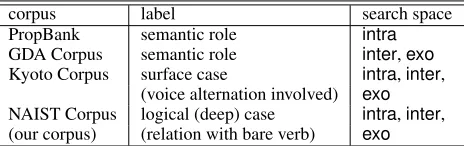
Table 1: Comparison of annotating predicate-argument relations
corpus label search space
PropBank semantic role intra
GDA Corpus semantic role inter,exo
Kyoto Corpus surface case intra,inter, (voice alternation involved) exo
NAIST Corpus logical (deep) case intra,inter, (our corpus) (relation with bare verb) exo intra: intra-sentential relations,inter: inter-sentential relations,
exo: exophoric relations
To the best of our knowledge, the GDA-Tagged Cor-pus does not contain intra-sentential zero-anaphoric relations as predicate-argument relations, so it has a serious drawback when used as training data in ma-chine learning approaches.
Unlike coreference between two explicit nouns where only an IRA is possible, the relation between a zero-pronoun and its antecedent can be either IRA or ISA. For example, in example (8),φiis annotated
as having an IRA relation with its antecedentTomi.
In contrast, example (9) exhibits an ISA relation be-tweeniPodiandφi.
(9) Tom-wa iPodi-o kaa-tta .
Tom-TOP iPodi-ACC buya-PAST PUNC Tom bought an iPod.
Mary-mo (φi-o) kab-tta .
Mary-TOP φi-ACC buyb-PAST PUNC Mary also bought one.
[REL=ka-(u)(buy),GA=Mary,O=iPodi]
The above examples indicate that predicate-argument annotation in Japanese can potentially be annotated as either an IRA or ISA relation. Note that in Japanese these two relations cannot be explicitly separated by syntactic clues. Thus, in our corpus we annotate them without explicit distinction. It is arguable that separate treatment of IRA and ISA in predicate-argument annotation could be preferable. We consider this issue as a task of future work.
A comparison of the specification is summarized in Table 1.
4 Annotating event-noun-argument relations
paper. They release the NomBank corpus, in which PropBank-style semantic relations are anno-tated for event-nouns. In (10), for example, the noun “growth” refers to an event and “dividends” and “next year” are annotated as ARG1 (roughly corresponding to the theme role) and ARGM-TMP (temporal adjunct).
(10) 12% growth in dividends next year[REL=growth, ARG1=in dividends, ARGM-TMP=next year]
Following the PropBank-style annotation, the Nom-Bank also restricts the search space for the argu-ments of a given event-noun to the sentence in which the event-noun appears. In Japanese, on the other hand, since predicate-argument relations are often zero-anaphoric, this restriction should be relaxed.
4.1 Labels of event-noun-relations
Regarding the choice between semantic roles and syntactic cases, we take the same approach as that for predicate-argument relations, which is also adopted in the Kyoto Corpus. For example, in (11),
akajii(deficit)is identified as thegaargument of the
event-nouneikyo (influence).
(11) kono boueki akajii-wa waga kuni-no
this trade deficit-TOP our country-OF kyosoryokuj-ni eikyo-o oyobosu
competitiveness-DAT influence-ACC affect
[REL=eikyo (influence),GA=akajii(deficit),
O=kyosoryokuj(competitiveness)]
The trade deficit affects our competitiveness.
Note that unlike verbal predicates, event-nouns can never be a subject of voice alternation. An event-noun-argument relation is, therefore, necessarily an-notated in terms of the relation between the bare verb corresponding to the event-noun and its argu-ment. This is another reason why we consider it reasonable to annotate the logical case relations be-tween bare verbs and their arguments for predicate-argument relations.
4.2 Event-hood
Another issue to be addressed is on the determina-tion of the “event-hood” of noun phrases, i.e. the task of determining whether a given noun refers to an event or not. In Japanese, since neither singular-plural nor definite-indefinite distinction is explic-itly marked, event-hood determination tends to be highly context-dependent. In sentence (12), for ex-ample, the first occurrence of denwa (phone-call),
subscripted with i, should be interpreted as Tom’s calling event, whereas the second occurrence of the same noundenwashould be interpreted as a physical telephone (cellphone).
(12) karea-karano denwai-niyoruto watashib-wa
hea-ABL phone-calliaccording to Ib-NOM kare-no ie-ni denwaj-o wasure-tarasii
his-OF home-LOC phonej-ACC leave-PAST
According to his phone call, I might have left my cell phone at his home.
To control the quality of event-hood determina-tion, we constrain the range of potential event-nouns from two different points of view, neither of which is explicitly discussed in designing the specifications of the Kyoto Corpus.
First, we impose a POS-based constraint. In our corpus annotation, we consider only verbal nouns (sahen-verbs; e.g. denwa (phone) ) and deverbal nouns (the nominalized forms of verbs; e.g.furumai (behavior)) as potential event-nouns. This means that event-nouns that are not associated with a verb, such asjiko (accident), are out of scope of our anno-tation.
Second, the determination of the event-hood of a noun tends to be obscure when the noun consti-tutes a compound. In (13), for example, the ver-bal nounkensetsu (construction)constituting a com-pounddouro-kensetsu (road construction)can be in-terpreted as a constructing event. We annotate it as an event anddouro (road)as theoargument. (13) (φ-ga) douro-kensetsu-o tsuzukeru
φ-NOM road construction-ACC continue
Someone continues road construction.
In (14), on the other hand, since the compound
furansu kakumei (French Revolution) is a named-entity and is not semantically decomposable, it is not reasonable to consider any sort of predicate-argument-like relations between its constituents fu-ransu (France)andkakumei (revolution).
(14) furansu-kakumei-ga okoru French Revolution-NOM take place
The French Revolution took place.
We therefore do not consider constituents of such se-mantically non-decomposable compounds as a tar-get of annotation.
5 Statistics of the new corpus
using all the documents in Kyoto Text Corpus ver-sion 3.0 (containing 38,384 sentences in 2,929 texts) as a target corpus. We have so far annotated predicate-argument relations with only three major cases: ga(Nominative),o(Accusative) and ni (Da-tive). We decided not to annotate other case relations like kara-case (Ablative) because the annotation of those cases was considered even further unreliable at the point where we did not have enough experiences in this annotation task. Annotating other cases is one of our future directions.
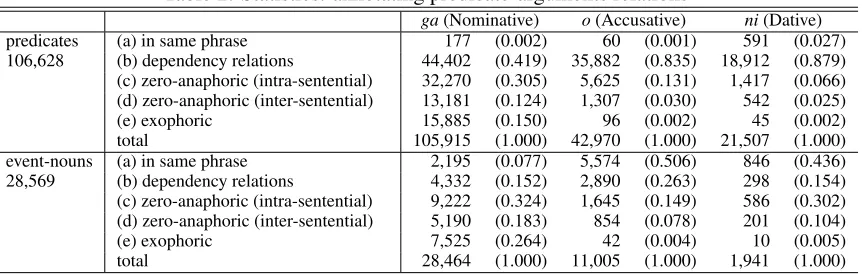
The numbers of the annotated predicate-argument relations are shown in Table 2. These relations are categorized into five cases: (a) a predicate and its argument appear in the same phrase, (b) the argu-ment syntactically depends on its predicate or vice versa, (c) the predicate and its argument have an intra-sentential zero-anaphora relation, (d) the pred-icate and its argument have an inter-sentential zero-anaphora relation and (e) the argument does not ex-plicitly appear in the text (i.e. exophoric). Table 2 shows that in annotation for predicates over 80% of botho- andni-arguments were found in depen-dency relations, while around 60% ofga-arguments were in zero-anaphoric relations. In comparison, in the case of event-nouns, o- and ni-arguments are likely to appear in the same phrase of given event-nouns, and about 80% ofga-arguments have zero-anaphoric relations with event-nouns. With respect to the corpus size, we created a large-scaled anno-tated corpus with predicate-argument and corefer-ence relations. The data size of our corpus along with other corpora is shown in Table 3.
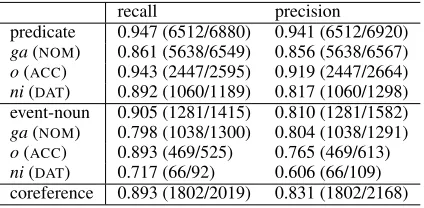
Next, to evaluate the agreement between the two human annotators, 287 randomly selected articles were annotated by both of them. The results are evaluated by calculating recall and precision in which one annotation result is regarded as correct and the other’s as the output of system. Note that only the predicates annotated by both annotators are used in calculating recall and precision. For eval-uation of coreference relations, we calculated re-call and precision based on the MUC score (Vilain et al., 1995). The results are shown in Table 4, where we can see that most annotating work was done with high quality except for theni-argument of event-nouns. The most common source of error was caused by verb alternation, and we will discuss this
Table 3: Data size of each corpus
corpus size
PropBank I 7,891 sentences NomBank 0.8 24,311 sentences ACE (2005 English) 269 articles GDA Corpus 2,177 articles
Kyoto Corpus 555 articles (5,127 sentences) NAIST Corpus (ours) 2,929 articles (38,384 sentences)
Table 4: Agreement of annotating each relation
recall precision
predicate 0.947 (6512/6880) 0.941 (6512/6920) ga(NOM) 0.861 (5638/6549) 0.856 (5638/6567) o(ACC) 0.943 (2447/2595) 0.919 (2447/2664) ni(DAT) 0.892 (1060/1189) 0.817 (1060/1298) event-noun 0.905 (1281/1415) 0.810 (1281/1582) ga(NOM) 0.798 (1038/1300) 0.804 (1038/1291) o(ACC) 0.893 (469/525) 0.765 (469/613) ni(DAT) 0.717 (66/92) 0.606 (66/109) coreference 0.893 (1802/2019) 0.831 (1802/2168)
issue in detail in Section 6. Such investigation of the reliability of annotation has not been reported for ei-ther the Kyoto Corpus or the GDA-Tagged Corpus. However, our results also show that each annotating task still leaves room for improvement. We summa-rize open issues and discuss the future directions in the next section.
6 Discussion
6.1 Identification of predicates and event-nouns
Identification of predicates is sometimes unreliable due to the ambiguity between a literal usage and a compound functional usage. For instance, the ex-pression “to-shi-te”, which includes the verbshi(to do), is ambiguous: either the verbshifunctions as a content word, i.e. an event-denoting word, or it con-stitutes a multi-word expression together withtoand
te. In the latter case, it does not make sense to inter-pret the verbshito denote an event. However, this judgment is highly context-dependent and we have not been able to devise a reliable criterion for it.
Tsuchiya et al. (2006) have built a functional expression-tagged corpus for automatically classify-ing these usages. They reported that the agreement ratio of functional expressions is higher than ours. We believe their findings to also become helpful in-formation for annotating predicates in our corpus.
Table 2: Statistics: annotating predicate-arguments relations
ga(Nominative) o(Accusative) ni(Dative)
predicates (a) in same phrase 177 (0.002) 60 (0.001) 591 (0.027)
106,628 (b) dependency relations 44,402 (0.419) 35,882 (0.835) 18,912 (0.879) (c) zero-anaphoric (intra-sentential) 32,270 (0.305) 5,625 (0.131) 1,417 (0.066) (d) zero-anaphoric (inter-sentential) 13,181 (0.124) 1,307 (0.030) 542 (0.025)
(e) exophoric 15,885 (0.150) 96 (0.002) 45 (0.002)
total 105,915 (1.000) 42,970 (1.000) 21,507 (1.000)
event-nouns (a) in same phrase 2,195 (0.077) 5,574 (0.506) 846 (0.436)
28,569 (b) dependency relations 4,332 (0.152) 2,890 (0.263) 298 (0.154) (c) zero-anaphoric (intra-sentential) 9,222 (0.324) 1,645 (0.149) 586 (0.302) (d) zero-anaphoric (inter-sentential) 5,190 (0.183) 854 (0.078) 201 (0.104)
(e) exophoric 7,525 (0.264) 42 (0.004) 10 (0.005)
total 28,464 (1.000) 11,005 (1.000) 1,941 (1.000)
also arises. If, for example, a compound noun con-tains a verbal noun, we have to judge whether the verbal noun can be interpreted as an event-noun or not. Currently, we ask annotators to check if the meaning of a given compound noun can be compo-sitionally decomposed into those of its constituents. However, the judgement of compositionality tends to be highly subjective, causing the degradation of the agreement ratio of event-nouns as shown in Table 4. We are planning to investigate this problem more closely and refine the current compositionality criterion. One option is to build lexical resources of multi-word expressions and compounds.
6.2 Identification of arguments
As we mentioned in 3.1, we use (deep) cases instead of semantic roles as labels of predicate-argument re-lations. While it has several advantages as discussed in 3.1, this choice has also a drawback that should be removed. The problem arises from lexical verb alternation. It can sometimes be hard for annota-tors to determine a case frame of a given predicate when verb alternation takes place. For example, sen-tence (15) can be analyzed simply as in (16a). How-ever, since the verbshibaru(bind) has also another alternative case frame as in (16b), the labeling of the case of the argument kisoku (rule), i.e. either GA
(NOM) orDE(INST) may be undecidable if the argu-ment is omitted.
(15) kisoku-ga hitobito-o shibaru rule-NOM people-ACC bind The rule binds people.
(16) a. [REL=shibaru(bind),GA=kisoku(rule),O=hitobito (people)]
b. [REL=shibaru(bind),GA=φ(exophoric),O= hito-bito(people),DE(Instrumental) =kisoku(rule)]
Similar problems occur for event-nouns as well. For example, the event-nounhassei (realization)has both transitive and intransitive readings, which may produce awkward ambiguities.
To avoid this problem, we have two options; one is to predefine the preference in case frames as a convention for annotation and the other is to deal with such alternations based on generic resources of lexical semantics such as Lexical Conceptual Struc-ture (LCS) (Jackendoff, 1990). Creating a Japanese LCS dictionary is another on-going project, so we can collaborate with them in developing the valuable resources.
6.3 Event-hood determination
Event-nouns of some semantic types such askeiyaku (contract),kisei (regulation)andtoushi (investment)
are interpreted as either an event or an entity result-ing from an event dependresult-ing on are context. How-ever, it is sometimes difficult to judge whether such an event-noun should be interpreted as an event or a resultant entity even by considering the whole con-text, which degrades the stability of annotation. This phenomena is also discussed in the NomBank, and we will share their insights and refine our annotation manual in the next step.
6.4 Identification of coreference relation
Annotators judge coreference relations as whether or not abstract nouns refer to the same entity in the world. However, the equivalence of the referents of abstract nouns cannot be reconciled based on real-world existence since by definition abstract nouns have no physical entities in the real world.
As far as predicate-argument relation is con-cerned, there might be a need for treating generic entities in addition to specific entities as coreferen-tial in some application. For example, one may want to relatekidstochildrenin sentence (17).
(17) We all want children to be fit and healthy. However, the current invasion of fast food is creating overweight and unhealthykids. The coreference relation between generic nouns are missed in the current specification since we annotate only IRA relations between specific nouns. Even though there are various discussions in the area of semantics, the issue of how to deal with generic nouns as either coreferential or not in real texts is still left open.
7 Conclusion
In this paper, we reported on the current specifica-tion of our annotated corpus for coreference reso-lution and predicate-argument analysis. Taking the previous work of corpus annotation into account, we decided to annotate predicate-argument relations by ISA and IRA relations, and coreference relations ac-cording to IRA relations. With the Kyoto Text Cor-pus version 3.0 as a starting point, we built a large annotated corpus. We also discussed the revelations made from annotating our corpus, and discussed fu-ture directions for refining our specifications of the NAIST Text Corpus.
Acknowledgement
This work is partially supported by the Grant-in-Aid for Scientific Research in Priority Areas JAPANESE CORPUS (http://tokuteicorpus.jp).
References
G. Doddington, A. Mitchell, M. Przybocki, L. Ramshaw, S. Strassel, and R. Weischedel. 2004. Automatic content extraction (ace) program - task definitions and performance measures. InProceedings of the 4rd International Confer-ence on Language Resources and Evaluation(LREC-2004), pages 837–840.
Charles J. Fillmore and Collin F. Baker. 2000. Framenet: Frame semantics meets the corpus. In Proceedings of the 74th Annual Meeting of the Linguistic Society of America. K. Hasida. 2005. Global document annotation (gda) annotation
manual.http://i-content.org/tagman.html.
L. Hirschman. 1997. MUC-7 coreference task definition. ver-sion 3.0.
R. Iida, K. Inui, and Y. Matsumoto. 2005. Anaphora reso-lution by antecedent identification followed by anaphoricity determination.ACM Transactions on Asian Language Infor-mation Processing(TALIP), 4:417–434.
R. Iida, K. Inui, and Y. Matsumoto. 2006. Exploiting syntac-tic patterns as clues in zero-anaphora resolution. In Proced-dings of the 21st International Conference on Computational Linguistics and 44th Annual Meeting of the Association for Computational Linguistics(COLING-ACL), pages 625–632. R. Jackendoff. 1990. Semantic Structures. Current Studies in
Linguistics 18. The MIT Press.
D. Kawahara, T. Kurohashi, and K. Hasida. 2002. Construc-tion of a japanese relevance-tagged corpus (in japanese). In Proceedings of the 8th Annual Meeting of the Association for Natural Language Processing, pages 495–498.
K. Kipper, H. T. Dang, and M. Palmer. 2000. Class-based con-struction of a verb lexicon. InProceedings of the 17th Na-tional Conference on Artificial Intelligence and 12th Confer-ence on on Innovative Applications of Artificial IntelligConfer-ence, pages 691–696.
A. Meyers, R. Reeves, C. Macleod, R. Szekely, V. Zielinska, B. Young, and R. Grishman. 2004. The nombank project: An interimreport. InProceedings of the HLT-NAACL Work-shop on Frontiers in Corpus Annotation.
Ruslan Mitkov. 2002. Anaphora Resolution. Studies in Lan-guage and Linguistics. Pearson Education.
V. Ng and C. Cardie. 2002. Improving machine learning ap-proaches to coreference resolution. InProceedings of the 40th ACL, pages 104–111.
M. Palmer, D. Gildea, and P. Kingsbury. 2005. The proposi-tion bank: An annotated corpus of semantic roles. Compu-tational Linguistics, 31(1):71–106.
M. Poesio, R. Mehta, A. Maroudas, and J. Hitzeman. 2004. Learning to resolve bridging references. InProceddings of the 42nd Annual Meeting of the Association for Computa-tional Linguistics(ACL), pages 144–151.
W. M. Soon, H. T. Ng, and D. C. Y. Lim. 2001. A machine learning approach to coreference resolution of noun phrases. Computational Linguistics, 27(4):521–544.
M. Tatu and D. Moldovan. 2006. A logic-based semantic ap-proach to recognizing textual entailment. In Proceddings of the 21st International Conference on Computational Lin-guistics and 44th Annual Meeting of the Association for Computational Linguistics(COLING-ACL), pages 819–826. M. Tsuchiya, T. Utsuro, S. Matsuyoshi, S. Sato, and S. Nak-agawa. 2006. Development and analysis of an exam-ple database of japanese compound functional expressions. IPSJ Journal, 47(6):1728–1741.
K. van Deemter and R. Kibble. 1999. What is coreference, and what should coreference annotation be? InProceedings of the ACL ’99 Workshop on Coreference and its applications, pages 90–96.